Rise up against the proxy war on students by the Modi regime.

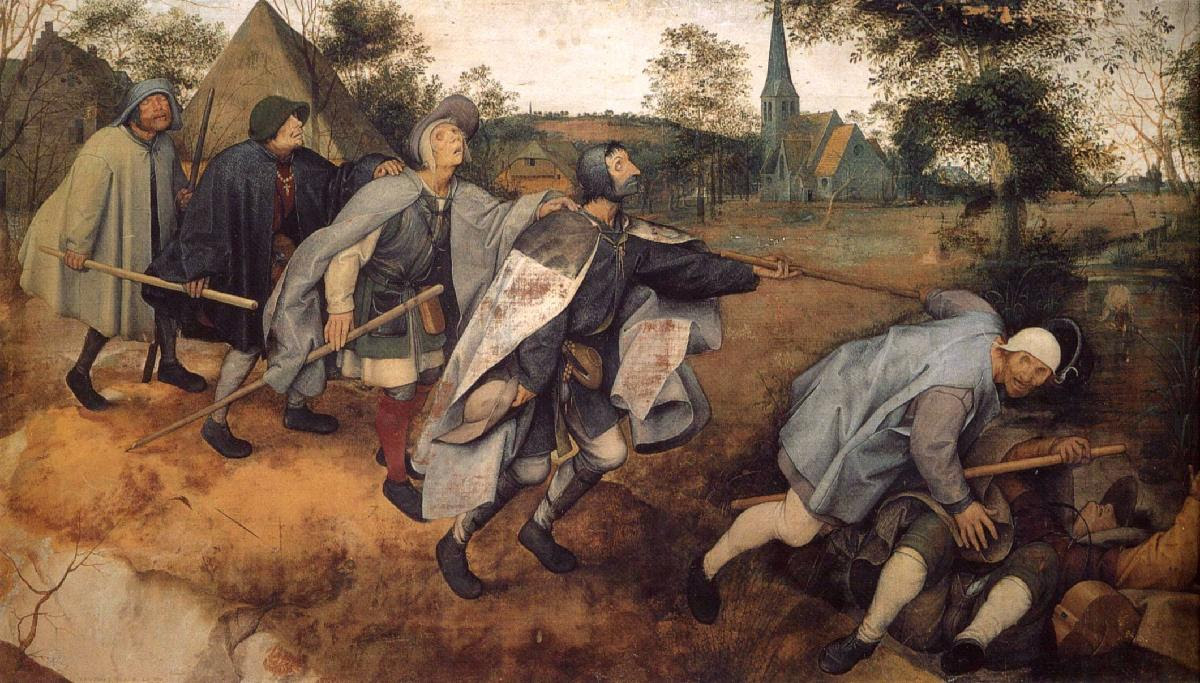
Cartoon by V. Arun Kumar
JNUSU rejects the report of the enquiry committee constituted by the Vice-Chancellor to look into the 9th of February incident. JNUSU also rejects its reports and any punishment handed out by it. The JNUSU and JNUTA had repeatedly asked the administration to democratise the enquiry committee, but this was not done. Now, when the holidays are here, the VC has made public the punishments, after one and a half months of submission of the HLEC (High Level Enquiry Committee) report.
[Shehla Rashid, VP, JNUSU, speaking at the Press Conference in JNU on April 26 against the HLEC. Courtesy, ‘We are JNU’ Youtube Channel ]
The punishments are nothing but a proxy war waged against the students by the Modi govt through its puppets installed in the JNU administration. Modi govt cannot answer our difficult questions, and is, therefore, resorting to these tactics. They want to create a chilling effect and discourage students from speaking up against Modi government’s failures. Here are 12 reasons why we must fight against these undemocratic “punishments”:
1. On the advice of the then Registrar, Bhupinder Zutshi, who has been exposed as an RSS puppet and whose removal the JNUSU & JNUTA demanded, the newly appointed VC had picked three members, Prof. Suman Dhar, Prof. H.B. Bohidar and Prof. Rakesh Bhatnagar, who is also the Head of the Committee, to conduct the enquiry. Zutshi is also the person who allowed the police to raid the hostels, and banned the entry of media into the campus.
2. The then Chief Proctor, Prof. Krishna Kumar, had resigned over the way in which a Proctorial Committee was first formed, and then dismissed within four hours of its formation. As a matter of routine, all matters involving students are looked at by the Proctor’s office. However, in this case, the Proctorial committee was dissolved arbitrarily and replaced by a “high level” committee, headed by Prof. Bhatnagar who is a known anti-reservationist. He continues to be the authority responsible for raising funds for the rabid student group, “Youth for Equality”.
3. No woman, no SC/ST/OBC/minority teacher, no one from the Social Sciences was included in the committee, whereas the defendants all hail from poor and marginalised backgrounds, include women and are mostly from the Social Sciences!
4. The CVO, Chief Vigilance Officer, is the final appellate authority of the University, but he himself is part of the HLEC. Prof Suman Dhar, who happens to be the CVO, is a member of the Committee. Hence, we cannot even appeal against this decision!
5. When all these questions were raised, the VC added two more members to it. These are simply token additions, as they were added after the entire enquiry process was over. We demanded that, since the composition of the enquiry committee had changed, a fresh probe must be started, as the newly inducted members did not get a chance to cross-examine the witnesses and evidence. This is a legitimate demand, but it was not accepted. Even in the enquiry committee that handed out punishments to Rohith Vemula and his friends, a token Dalit member was added in the end. This is a shamefully cosmetic move and does not make any difference to the enquiry process.
6. Due to all this, the students refused to participate in the enquiry process. Based on one-sided depositions of ABVP members, the enquiry committee has come up with massive fines, rustication, draconian out-of-bounds orders and what not? This shows how scared the government is of dissenting voices.
7. The HLEC has randomly punished people. One of the students, Anirban, has been punished with rustication and out-of-bounds orders for five years! Around 14 students have been fined for Rs. 20,000 each and threatened to pay the fine by 13th of May or face hostel eviction. Former JNUSU President, Ashutosh Kumar has been evicted from hostel for one year and fined with Rs. 20,000. Such punishments are unheard of, and reek of extreme vendetta against student activists. This is clearly a war bugle sounded by the Central government.
8. Nowhere do the punishment orders mention the exact crime committed by the students. All the orders cite a statute that reads, “Any other action deemed inappropriate by the Vice-Chancellor.” This cannot be the yardstick to measure the legality of any event. The administration, in these orders, repeatedly says that “taking part in a march”, “raising slogans” is unbecoming of a JNU student. This is ridiculous and unacceptable. In order to punish anyone, a three-step link has to be established by any enquiry committee:
a) Establish the exact action for which punishment is being handed out.
b) Justify how that particular action violates a certain University statute.
c) Justify how a certain violation attracts a certain amount of punishment.
The committee hasn’t bothered to do any of this, and has arbitrarily punished students for holding political opinions that they may not like.

9. The scope of the enquiry committee was never clarified. If it was constituted to look into slogans, why have the provocative slogans being raised by the right-wing student groups not been accounted for? If the enquiry report itself says that outsiders raised the slogans, why are JNU students being punished? Why is there no enquiry into the reason why Zee News was called by JNUSU Joint Secretary, Saurabh Sharma, of the ABVP, an hour before the programme? Why is there no enquiry into the reason Zee News and Times Now circulated doctored videos, even though the Delhi govt has also filed cases against these channels on these very issues? If mere speech and slogans are to be criminalised, why is there no action against Prof. Amita Singh, who has called Dalit and Muslim teachers as anti-nationals? Why is there no enquiry committee looking at the violence unleashed by ABVP members on 13th of Feb against Rajya Sabha MP, Anand Sharma on JNU campus? Why has the complaint of misbehavior filed by the teachers residing at Paschimabad against ABVP members, not been taken up? Why is JNU administration, despite repeated communications from the JNUSU Vice-President and the JNUTA President, not acted against Amit Jani, who threatened to kill Kanhaiya and Umar, and whose brother has been arrested for planting arms in a JNU-bound bus?
10. why has GSCASH representative, Aishwarya Adhikari, been fined with Rs. 20,000 even though her name is not even there in the enquiry committee report?

JNUSU Office Bearers Burn Copies of the HLEC Document. Photo by Mohit Pandey
11. The HLEC had submitted its report one and a half months back to the VC. However, the VC has waited till the onset of holidays to make the punishments public, showing how scared the VC is of students’ protests. But we want to remind the new VC here that, many struggles have been fought by the student community during the time of exams and vacations. The struggle to implement Mandal-II (OBC reservation in higher educaiton) saw a 34-day hunger strike in JNU during holidays. In the summer of 2014, under the Dera Dalo movement, students and workers together occupied the Ad Block for 14 days in blazing heat, to demand hostels and workers’ rights. The 16th December movement and the Occupy UGC movement went on despite holiday, biting cold and water cannons.
12. Why has the VC not held an Academic Council meeting which is supposed to happen every semester? Every year, there are two AC meetings- one in October and one in April. This is a huge failure on part of the VC, who is so afraid to face the students and the teachers that he cancelled the AC meeting scheduled on the 19th of April and hasn’t reconvened it. The reality is, that without consulting the students and teachers, sweeping changes in admission policy have been brought about by the new administration. It is shocking that, without discussing the issues of reduction of deprivation points for women and BA applicants, and introduction cluster system in BA entrance exam, these changes were brought into the prospectus. Also, bypassing the High Court order to provide relaxation to OBC applicants at two stages, the administration has decided to grant the relaxation at only one level. Not only will we oppose the punishments, we will also raise these issues through our hunger strike.
The Modi government cannot deal with the issues we raise, cannot answer our questions regarding organised scams, communal hate mongering and economic failure. They cannot answer our questions on non-NET fellowship and Rohith Vemula, on minority institutions, on police action on students, on Bastar, on Kashmir, on Gajendra Chauhan. Rather than countering us politically, rather than working on developmental and economic issues, the Modi govt has directed all of its energy into crushing opposition. However, not only will JNUSU continue to fight against these fines and punishments, we will continue to expose the government. Not only will we oppose the rustications, we will also raise difficult questions. Students, teachers, farmers’ organisations, women’s groups, bank employees’ Unions and IT employees’ Unions across the country have assured support to us. People from all walks of life are supporting JNU students against this targeting. We will launch a countrywide campaign to expose this government’s anti-student, anti-Dalit character.

Poster Announcing Commencement of Hunger Strike at JNU, Courtesy, Rama Naga, Gen. Sec. JNUSU
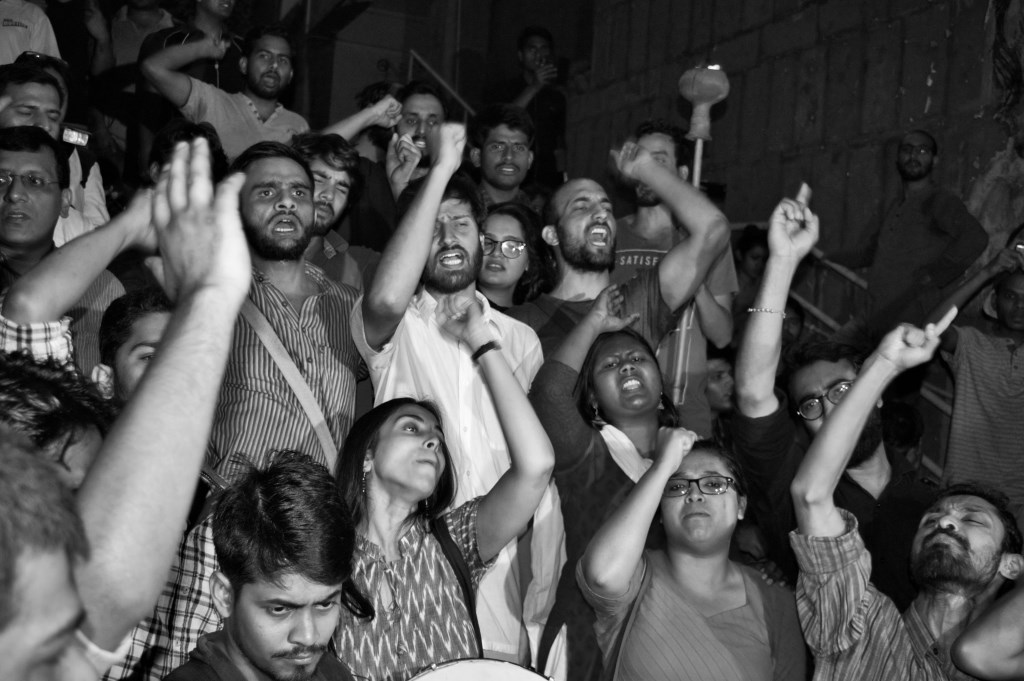
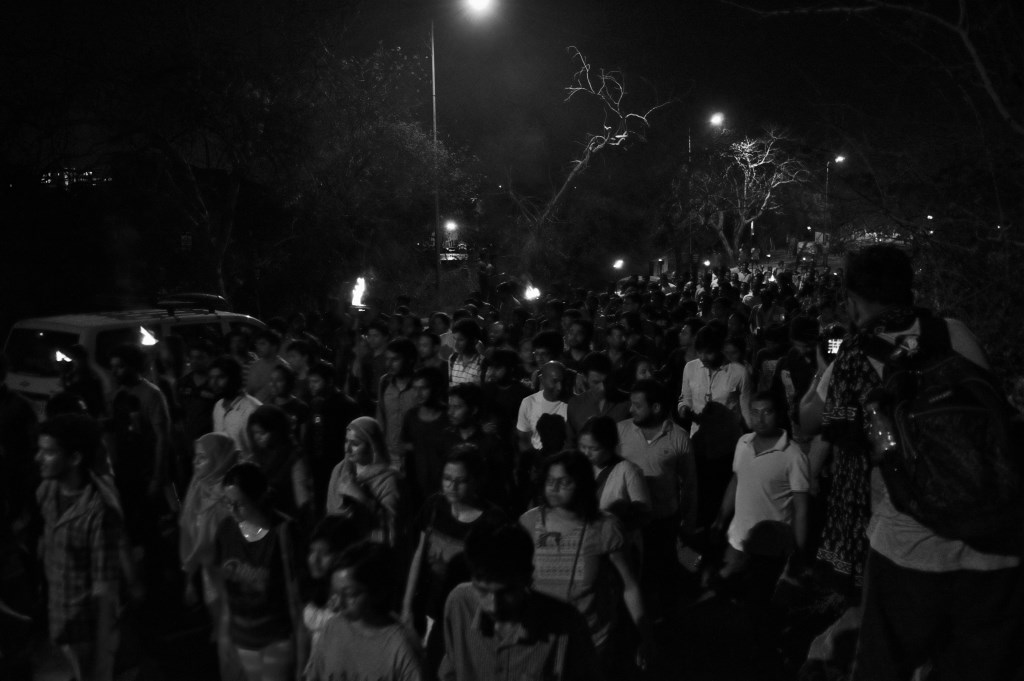
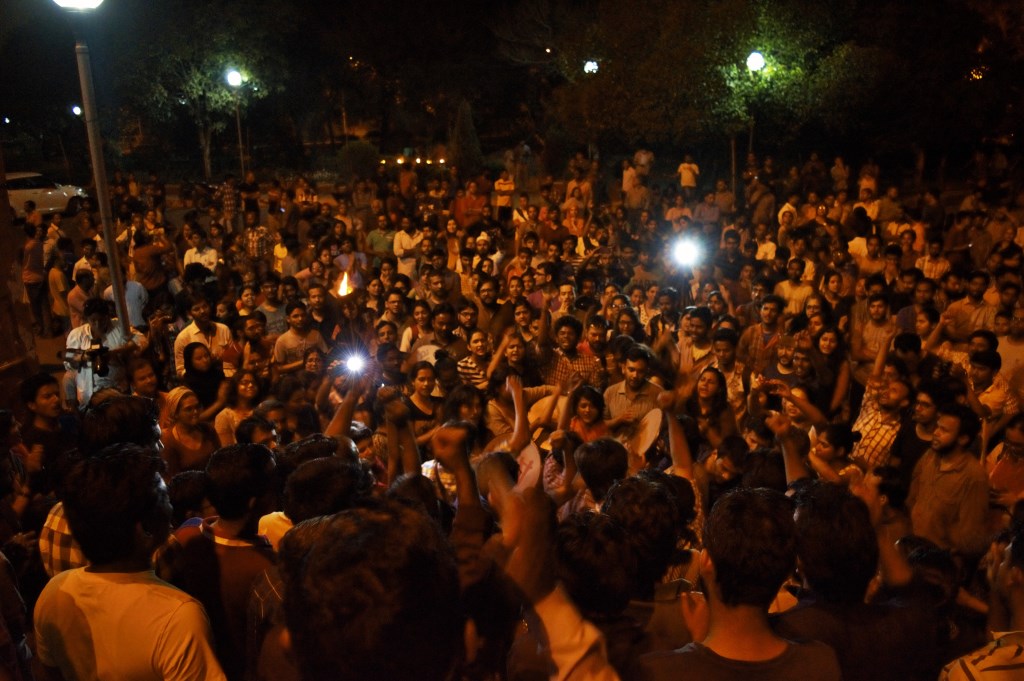
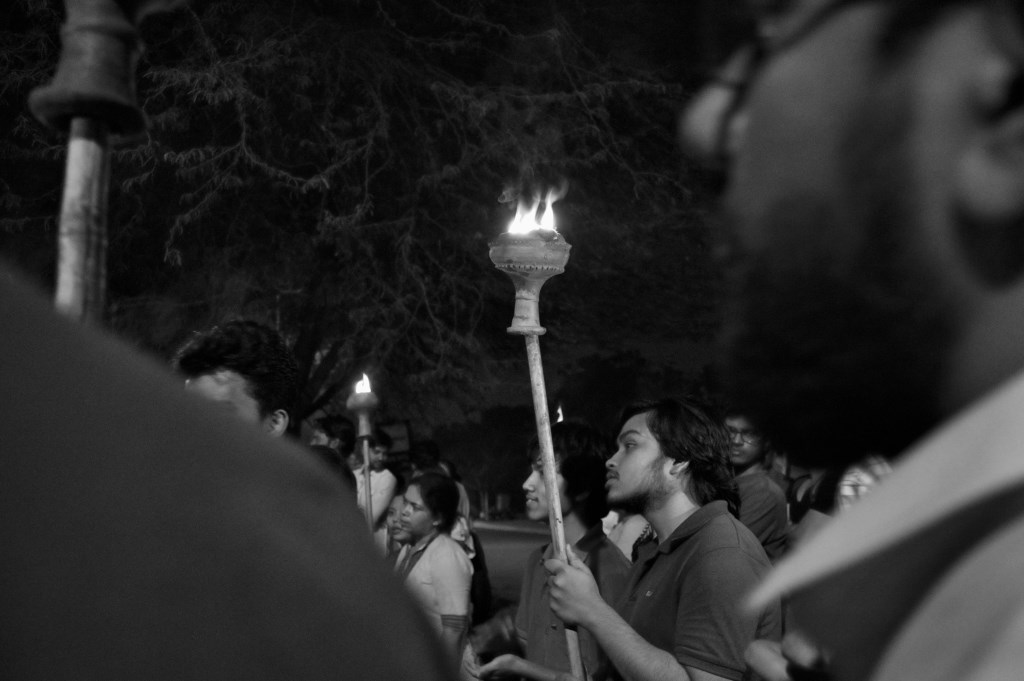
We appeal to everyone to join Mashaal Juloos from Ganga Dhaba to Ad Block tomorrow at 9 p.m., culminating in fast unto death at the Ad Block (renamed Freedom Square). The March/Mashaal Juloos has its dedicated events page on Facebook, please share and circulate the link widely.
Students will prepare for their entrance examinations by sitting at AD BLOCK, we will write our papers at the freedom square, students will write their synopsis and term papers from the site of the hunger strike. We from JNUSU appeal all the students to join in ever larger numbers tomorrow’s March from Ganga to Ad Block at 9 PM, culminating in a fast unto death.
Shehla Rashid, is Vice-President, JNUSU
Courtesy: Kafila.org