Local BJP MLA Forcibly Occupies Land around Mosque
UPDATE:
After this story broke, journalists poke to, and questioned, Kavita Jain, who apart from being an MLA is also the Haryana State Minister for Women and Child Development. At first she denied outright that land around the Mosque in Dewarhu village had been illegally occupied. When pressed further she said, "It may have been a Mosque before Indepedence. That does not make it a Mosque today," she is quoted in The Inquilab daily of April 7, 2016 as saying.
Meanwhile, Sabrangindia spoke to the former Sarpanch of the village, Haji Juma Sabiq who said that while the immediate tension(s) had somewhat eased the worry over the possible attempts to capture the Mosque and the land, remain.
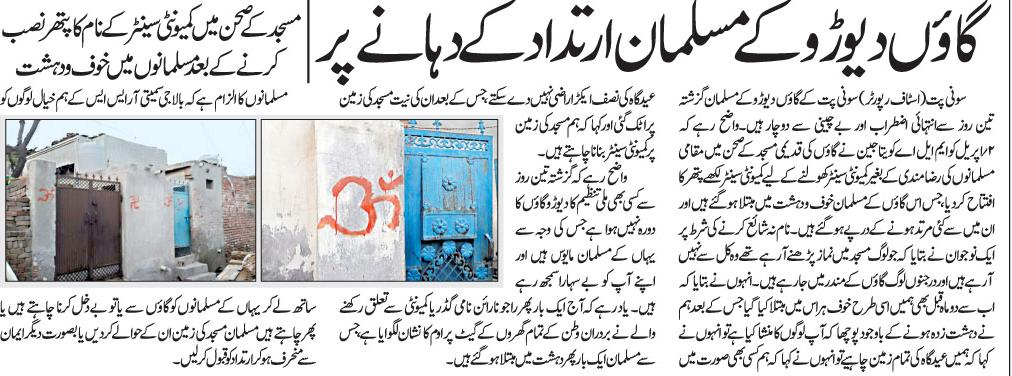
Muslims living in the Dewarhu village of Sonipat tehsil in Haryana live nail-biting fear after questionable efforts to mark out Hindu homes with the ‘Om’ symbol ostensibly by activists belonging to the Rashtriya Swayamsevak Sangh (RSS) in the village.
The Inquilab daily, Mewat edition reported on April 5 that Kavita Jain, an MLA (member of the legislative assembly) belonging to the ruling Bharatiya Janata Party (BJP) recently forcibly took possession of the land around the Purani Masjid, still used by local Muslims for their worship. The report states that Raju Narayan from the local Gadhiar caste was among the local activists belonging to the RSS that have marked out all Hindu homes with the sign ‘Om”. Reportedly, Jain had sought use of the Idgah in the village for a community centre that had been declined. Sabrangindia’s inquiries revealed that of a total of eligible 1500 votes in the village, 500 belong to voters from the Muslim community.
Such a marking out of homes with religio-political symbols has invariably signaled a possible physical attack thereafter. This was visible and marked in post Babri Masjid demolition Bombay in 1992-1993 but specifically in the Gujarat of 2002 where electoral rolls and even company registration lists were used to earmark homes and businesses by exclusion prior to vicious mob attacks.
Photos have been shared with Sabrangindia by the Inquilab editorial team
Brutal Assault on Students, Parents of a Government School and Activists of the Naujawan Bharat Sabha by Delhi Police
The arrests of four activists of the Naujawan Bharat Sabha (NBS) by the Karawal Nagar police station in Delhi late evening of Monday, April 4 provoked widespread protests before they were finally released. On being contacted by Sabrangindia, Inspector GS Mehta of the Karawal police station that the activists were “not arrested but brought to the police station for ‘verification’ in the matter related to a local school.”
The police however did not comment on allegations of brutal behaviour of the police with students and parents of a local government school, especially girl students, on April 1, however. These allegations of repression by the local police on the political outfit and their activists have been made since April 1 after they had organised a public meeting on 1 April in Karawal Nagar, Delhi against the alleged incidents of manhandling and beating of female students and their parents by the Delhi Police.
The genesis of the problems that led to the detention of NBS activists on Monday, April 4, relate to examination results in a local school. Reportedly, on April 1, 2016, results of class 9 and 11 were published for the girls shift in the government school in Karawal Nagar.
More than 90% of the students had failed in the exams according to the results that had been displayed on the board at school, the distressed students rushed to the teachers and Principal. The students asked the Principal to look into the matter and asked for re-evaluation of the exam papers. Instead of listening to the grievances of the students, the Principal reportedly called the Police which upon reaching the school premises brutally charged on the girl/women students that had gathered there. As the news of this police beating and manhandling the female students reached the parents and guardians of the students, they also rushed to the school.
When the parents reportedly attempted to intervene, reportedly the police instead of listening to them beat them as well. The police even arrested a few female students along with their parents and took them to the police station, a daily wage worker who had been passing by happened to ask one the policemen as to what was happening inside the school and the policemen in rage beat him and also threw him inside the van.
There are serious allegations that the students were beaten inside the van, abuses were hurled at them while on the way to the police station. The police reportedly even threatened the students and their parents with false charges and severely beat them. While the police finally released the female students late at night of April 1, parents were not let off. They were made to spend the night in custody without any fault of theirs. It was on the next day that activists of Naujawan Bharat Sabha, already active in the area, went to the police station and asked for their release. An initially reluctant Police had to grant bail to the arrested parents as they lacked any evidence against them after the protests grew.
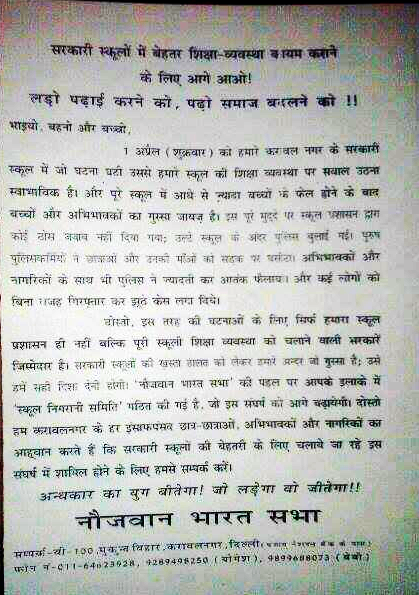
After the release, efforts were made by NBS to mobilise citizens against the police action and brutality. Pamphlets were also distributed in Karawal Nagar urging the students and their parents to organise a public meeting on April 3 to discuss the further course of action. On April 4, the activists distributed a pamphlet outside the school and in the neighbourhood urging the citizens to intervene in the matter so that the future education of the girls is not hindered. A copy of the pamphlet being distributed by the NBS may be read here.
Soon after the pamphlets began to be distributed Yogesh Swamy, an activist of NBS got a call from the Karawal Nagar Police station around noon advising him against distributing the pamphlets or to bear the consequences. Yogesh told the officer on the phone that they are not doing anything illegal, that they are simply trying to help the students get justice. At 7 pm on the evening on April 4, local police barged into the Karawal Nagar located office of Naujawan Bharat Sabha, and started abusing and beating the activists present there. The activists (Rakesh and Rahul) were also beaten inside the office before being thrown into Police vans, one of the activists Sachin, 16 years of age who is ill with malaria and had been asleep was also slapped at the police station.
The NBS has been active in several parts of north and north east Delhi. The grassroot activities of the NBS include mobilising local communities through popularising history and spreading the message of brotherhood and communal harmony as advocated by Bhagat Singh, Ashfaqullah Khan and Ram Prasad Bismil.
Finally protests and interventions from citizens, intellectuals and journalists led to the release of the activists yesterday. Activists of the NBS, even while they were being released were reportedly threatened by the police against the distribution of pamphlets or organising public meetings and protests. They were reportedly told that ‘the consequences will be very severe’. A press release of the Delhi Unit and its organizer, Sunny Singh has been issued related to the incident.
There is a chilling similarity behind police behaviour across the country and in different states when it comes to groups active in exposing, through the popularising of history, the role of the Sangh Parivar in the national movement. Related to this is the exposing of the Sangh Parivar’s shallow brand of nationalism.
On March 27, 2016, Sabrangindia had reported how, in Mankhurd, a Mumbai suburb, the RSS similarly tried to get the local police to prevent pamphlets exposing the fraudulent bid of the sangh parivar to claim Shaheed Bhagat Singh as their own. The Naujawan Bharat Sabha (NBS) in the area have been distributing leaflets in the area and in local trains.
When threats did not scare the NBS, the sanghis got the local police, and even the anti-terrorism squad to intervene. The police raided the NBS office, confiscated the anti-RSS leaflets and tried to intimidate the activists. Not to be so easily cowed down, the activists challenged the police to explain under which law of the land it was acting to prevent the NBS from exercising their constitutional right to free speech and democratic dissent. Shockingly, they (police) answered that although there is nothing wrong in those pamphlet but people belonging to RSS do not want these pamphlets to be distributed. Finally, when the police could not come up with any substantial argument they had to release activists including Virat Choudhary.
Incidentally, the NBS that has been active on the issue of popularising history of revolutionaries like Bhagat Singh, Asfarquallah Khan and Ramprasad Bismil. Within seven months of the Modi government coming to power in Delhi, on December 19, 2014, Naujawan Bharat Sabha, Delhi, had planned to organise a cultural programme at Ramleela ground (officially called Rajeev Park), Sriram Colony, Khajoori in North East Delhi to commemorate the martyrs Ashfaqullah khan and Ramprasad Bismil, who were hanged to death by the British on this day in 1926.
Although no permission is required to hold any programme at this ground, especially those in which no tent needs to be fixed, the NBS did give a written intimation of this programme to the SHO as well as DCP, North East, Delhi on November 22, 2014. However, on December 1,2014, the SHO of the local police station informed the organisers that the programme cannot be held at the said venue as it is ‘disputed’ land. Moreover, he added that this cultural programme, which in fact is being envisaged as upholding the unity of Hindus and Muslims as was exemplified by the unflinching friendship of Bismil and Ashfaqullah, can cause a ‘law and order situation’ in the area.
Finally, despite efforts of the RSS and local police administration to prevent NBS from organizing 'Awami Ekta Diwas' program on the martyrdom day of Bismil, Ashfakullah, Roshan and Lahiri, the NBS unit of Khajoori, Delhi successfully organized the program and hundreds of youth, citizens and children participated in it. Revolutionary songs and a play called 'Desh ko aage badhao' were staged.
The Modi ruled Central Government and its Representatives were Conspicuous in their Absence at the NIA Officer's Funeral
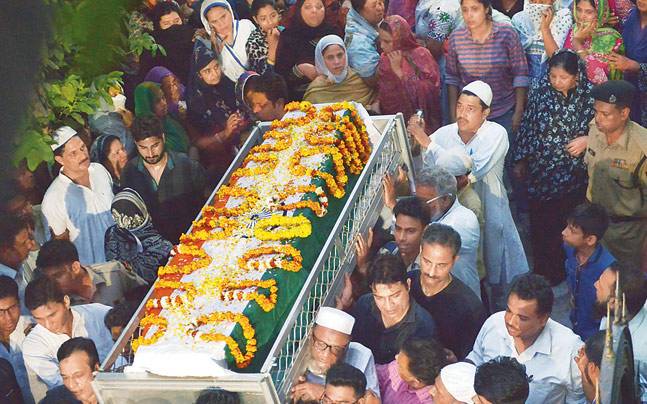
Image: India Today
Surrounded by grief-struck, friends and family, inconsolable in their loss and angry too, at the absence of any government presence or acknowldgement of the tragedy, deputy superintendent Mohammad Tanzil Ahmed, was laid to rest yesterday.
This 45 year-old officer from India's premier security organisation, the National Investigation Agency (NIA) that was formed expressly to investigate terror cases was shot dead on the midnight of April 3 and 4, while returning from a wedding at midnight with his wife and two children in Uttar Pradesh's Bijnor – his home town. Tenzil's wife, Farzana, suffered four bullet injuries and remains in a critical condition at a hospital on the outskirts of Delhi. The wedding that the family was attending was of Tanzil Ahmed's niece.
It was around sunset yesterday, April 4 when the coffin was lowered, with the rays of the setting sun reflecting off it. On the outside was draped the Indian tricolour, reminding us that he has been officially recognised as a martyr.
Mohammad Tanzil Ahmed was part of a team which was probing the Pathankot Air Force Station attack and had handled several high profile cases in the past. Reports indicate that it was he who was instrumental in clamping down on the home-grown terror outfit Indian Mujahideen (IM) and had a big role in the arrest of its chief Yasin Bhatkal in 2013. Yet for those in power in Delhi actions such as these mean little especially if you are a Mohammad Tanzil Ahmed. He was on leave after a five-member joint investigation team (JIT) from Pakistan – which was sent to investigate the Pathankot attack had left the country, enjoying a few quiet days with his family when tragedy struck.
NIA officer Tanzil Ahmed.
Reports say that he also played a role in busting an Islamic State (ISIS) module which led to several arrests, including those in Delhi. Though speculation remains rife about the mens rea behind the murder of Tanzil, investigation agencies haven't ruled out a possible terror angle.
As the plank of the coffin in which Tanzil’s body arrived was lifted, a fresh wave of grief swept through the mourners. And a palpable anger was felt. Dressed in white kurta-salwar, men of all ages had gathered around the Jamia Millia University, the spot for the final adieu.
While top officers of the the NIA, police and Border Security Force (BSF) – which he was initially recruited to – were present, paying a dignified homage, significantly , there were no signs of any minister from the central government. The vehicle in which the body arrived belonged to the BSF and was decorated with flowers.
The family members were anguished, and a restlessness surrounded the place where his body was placed. "Not a single official from the Central ministry has come here, they don't want to recognise him as a martyr," said his relative as he addressed a group of youth present.
The end was near, and as the coffin was lowered to the ground, lights were turned on as the sun had, by now, set. Friends, colleagues and of course family had come to bid their final farewell.
"He joined NCC (National Cadet Corps) here and was my close friend. I used to live in the hostel here and he was my mate there too," says a man, who has come wearing formal garments.
Today, a soldier, whose foundation was laid at the university, lies dead buried on its premises while he was serving to eliminate the same terror which his university was accused of being the advocate of.
Why Jamia Millia ? Tanzil was an alumnus of this university. It is the same university that the then chief minister of Gujarat – and now Prime Minister – Narendra Modi described as one which was run on government money and yet was ready "to spend money on lawyers to get terrorists out of jail", after the Batla House encounter in September 2008. He uttered these words again in February 2014 on his campaign journey to become prime minister.
One person from the political class did grace the funeral, however. Chief minister of Delhi, Arvind Kejriwal arrived, prayed for the departed soul and even announced Rs 1 crore reparation for the family, which family members at the scene refused to accept. The chief minister then left. Those gathered at the site raised slogans against the ‘package’ offered to the family.
The atmosphere reverberated with Islamic verses. People were made to stand in rows to read the verses from the final prayer, the jinaza (last rites). All Tanzil’s non-Muslim friends and colleagues stood with their heads down, as namaz was offered. All of them had identification cards around their necks with NIA printed on them. There was silence as the imam (priest) recited the prayer.
The lull broke as a tall man started to talk to the media angrily. "He was handling investigations of the Samjhauta Express blast, Pathankot attack, Bijnor bomb blast, why wasn't security given to such an officer?" he questions, demanding compensation for the family. There are also demands that the Central government to declare him as a martyr as people shout "Kendriya Sarkar Murdabad" (Down with Central government).
While the anger bursts forth, the last rites have been completed, the coffin closed and was, by now now ready for the final journey. The tricolour is now back on the coffin, as the march past band of the BSF leads the way. The graveyard isn't far; it's behind the hostel of the Jamia Millia University. It was where Tanzil lived as a student.
The wreath has been laid on the coffin, the grave has been dug and as the body reaches the spot, it is lowered in homage and dignity. It is now time for the official salute, the guns are raised and fired, three times as is due to an officer in command. All mourners have bowed their heads in respect for the final moment.
An officer from the NIA hands over the tricolour that had been draped in homage over Tanzil’s coffin, to Tanzil's brother and says a few words. Tanzil's teenage son is present, standing in front as the body is laid to rest. Mourners put handfuls of soil to fill the grave. Prayers are offered again. Slowly people begin to leave. Dust surrounds the air as everyone leaves the graveyard. Tanzil is laid to rest, mourned by his family, friends and colleagues, but seemingly callously forgotten by the state.
A few stay back. Tanzil's brothers look desolate and disturbed.
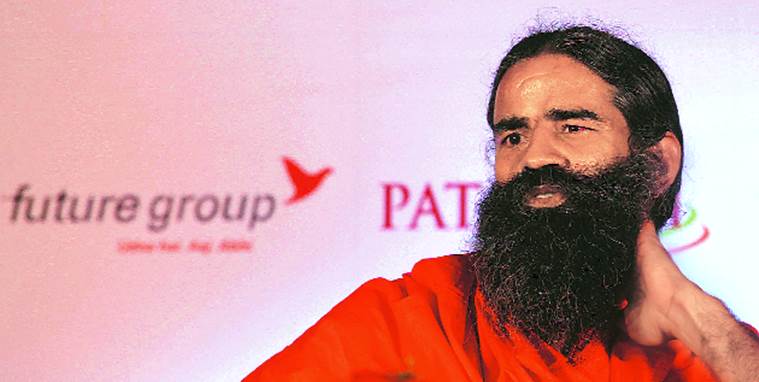
Serious questions arise for Indian Law Enforcement Agencies: Akbar Owaisi was jailed for hate speech in 2013; why does Baba Ramdev enjoy impunity?
Provoking Mass murder as the New Normal
On Sunday, April 3, yoga guru Baba Ramdev, was addressing a sadhbavana, peace and understanding rally (sic) organised by none less than the Rashtriya Swayamsevak Sangh (RSS) in Haryana. The perpetrated aim of the function was to bring back peace after the brutal Jat reservation riots in February. But for Ramdev (and the RSS?) the agenda clearly appeared to be something else.
Instead of focussing on peace, he seemed to hint at mass murder and the decapitation of lakhs of people who refuse to say “Bharat Mata ki jai”.
“Some person wears a cap and stands up,” began Ramdev referring to Muslims. “He says I will not say 'Bharat Mata ki jai' even if you decapitate me. This country has a law, otherwise let alone one, we can behead lakhs. But we respect this country’s law. If somebody stands up and speaks like this, that gives strength to hooligans. We respect this country’s law and Constitution. Otherwise if anybody disrespects Bharat Mata, we have the capability of beheading not one but thousands and lakhs.”
Many Indians, also including Muslims and other minority groups that believe in monotheism have pointed out that they can be nationalistic without invoking India as a goddess.
Be it Ramdev or Phadnavis, the supremacist religious nationalism of the demand that all Indian chant “Bharat Mata ki jai” as a proof of their patriotism is a convenient smokescreen to push the hardline politics of the RSS not to mention divert ‘national’ attention from the BJP’s massive failures in governance.
Ramdev’s show took place in Haryana. Haryana (not far from the capital) in February 2016 was the seat of brute violence unleashed by the Jats pressing for reservations, protests that drew a relatively benign response from the police that in nearby Delhi was being used against students of the Jawaharlal Nehru University (JNU). Ramdev’s call to divert Haryana’s attention to those who refuse to chant a slogan is a poor cover for the BJP’s complete faiure to control the terrible violence during the recent agitation for reservations by Jats. So scandalous was the official response that the Bharatiya Janata Party government in Haryana meekly agreed to be arm-twisted into actually awarding the quota. In Maharashtra, Fadnavis's rhetoric is a cynical attempt to distract attention from the crushing drought in the state.
In 2013, Majlis-e-Ittehadul Muslimeen legislator Akbaruddin Owaisi was arrested for hate speech. Were the same standards applied to Baba Ramdev, the police would be pursuing him with equal vigour. But given the signals to law enforcement agencies across the country, dictated by forces that rule who believe not only in Constitutional rights but a supremacist majoritarianism, that seems an unlikely prospect.
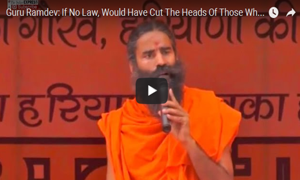
Watch the video of Ramdev admitting that India’s laws prevent him from beheading the "lakhs" of people who refuse to say Bharat Mata ki Jai. How Bharat Mata” became the code word for a theocratic Hindu state.
Naturally, the godman got plenty of cheers from the crowd.
Yoga guru Ramdev claims to have an odd relationship with the Indian Constitution and the law. At a Rashtriya Swayamsevak Sangh rally in Rohtak on Sunday, the godman explained what he would have happily done if the constitution and the law didn't exist: Cut the heads off of those who refuse to say Bharat Mata ki Jai.
"Some person wears a cap and stands up. He says I will not say Bharat Mata ki Jai, even if you decapitate me. This country has a law, otherwise let alone one, we can behead lakhs. But we respect this country’s law," Ramdev said at the rally, according to the Indian Express.
Look at that statement again carefully. Ramdev, well known for his flexibility, has managed some truly exceptional verbal calisthenics.
First he brought up someone wearing a topi, making a rather unsubtle reference to political leader Asaduddin Owaisi (who did Muslims no favours in furthering this debate over Bharat Mata ki Jai).
"If somebody stands up and speaks like this, that gives strength to hooligans. We respect this country’s law and Constitution, otherwise if anybody disrespects Bharat Mata, we have the capability of beheading not one but thousands and lakhs." — Baba Ramdev
Then he claims to respect this country's laws. How does he show that respect? By insisting that, without laws, he would have overseen the massacre of "thousands and lakhs." Finally, he claims that it is the people who stand up and speak like this – i.e. refuse to say Bharat Mata ki Jai – are the ones giving strength to hooligans.
That's right. Playing with the same sort of fire that the Owaisis dabble with – and which the Hindu Right constantly laments – Ramdev has managed to be communal, subtly threaten mass violence and insist on true respect for the Indian legal system, all while speaking at a Sadbhavna ("goodwill") rally. Oh, and he insists that the ones not saying something are encouraging violence, not the ones threatening to behead lakhs. Pointing out all the rather scary ironies of these statements almost seems redundant.
The most troubling part, though, may be what followed.
Still, some on Twitter had a better idea of what exactly is going on.
The Sadbhavna rally was organised by the RSS to restore peace, harmony and brotherhood in Haryana which was witness to violence in February in the wake of the Jat reservation agitation.
Written by VARINDER BHATIA | Chandigarh | Updated: April 4, 2016 2:37 pm
Yoga guru Baba Ramdev.Referring to Muslims who refuse to chant ‘Bharat Mata ki Jai’, yoga guru Ramdev on Sunday said if the country didn’t have laws, “hum toh lakhon ki gardan kaat sakte hain (we would have decapitated lakhs)”. He also said “if any religion says that do not honour the motherland, such a religion is also not in the interest of this country”.
Speaking at a Sadbhavna rally organised by the RSS in Rohtak — attended among others by Himachal Pradesh Governor Acharya Devvrat — Ramdev said: “Koi aadmi topi pehan kar ke khada ho jaata hai, bolta Bharat Mata ki Jai nahi bolunga, chahe meri gardan kaat do. Arey is desh mein kanoon hai, nahi toh teri ek ki kya, hum toh lakhon ki gardan kaat sakte hain. Lekin hum is desh ke kanoon ka samman karte hain. Koi aise khada ho ke bol de, isliye in hurdangiyon ke honsle buland ho jaate hain. Hum is desh ke kanoon aur samvidhan ka samman karte hain, nahi toh koi Bharat Mata ka apmaan kare, ek nahi, hum hazaron lakhon ke sheesh kalam karne ka samarth rakhte hain”.
(Some person wears a cap and stands up. He says I will not say Bharat Mata ki Jai even if you decapitate me. This country has a law, otherwise let alone one, we can behead lakhs. But we respect this country’s law. If somebody stands up and speaks like this, that gives strength to hooligans. We respect this country’s law and Constitution, otherwise if anybody disrespects Bharat Mata, we have the capability of beheading not one but thousands and lakhs).
Ramdev continued: “Mujhe ashcharya hota hai, kuch sansthayein bani hui hain, kehti hain Bharat Mata ki Jai bolna hamare dharm ke khilaaf hai. Yeh kaise ho sakta hai. Apni matrabhoomi ko gaurav dena kisi majhab ke khilaf nahi, aur agar koi majhab yeh kehta ho ki apni matrabhoomi ko gaurav mat do, woh majhab bhi desh ke hit mein nahi”.
(I am astonished. There are a few organisations which say chanting Bharat Mata ki Jai is against their religion. How can it be? Giving honour to your motherland is not against any religion, and if any religion says that do not honour the motherland, such a religion is also not in the interest of this country).
“Bharat Mata ki Jai bolna koi kisi dharm ki pooja nahi hai. Bharat Mata ki Jai bolna kisi ki aarti utarna nahi hai. Bharat Mata ki Jai bolna koi dharm pooja nahi hai, yeh toh apne rashtra ke gaurav ka, apne rashtra ke swabhiman ka, apne rashtra ki garima ka prashan hai, aur hum Hindu hon, hum Sikh hon, hum Muslim hon, hum Isai hon, hum sabse pehle Hindustani hain,” Ramdev said.
(Chanting Bharat Mata ki Jai is not worship of any religion. It is a matter of national honour, pride, prestige. We may be Hindu, Sikh, Muslim, Christians, we are Indians first).
The Sadbhavna rally was organised by the RSS to restore peace, harmony and brotherhood in Haryana which was witness to violence in February in the wake of the Jat reservation agitation.
BJP suspends UP women's wing leader for saying 'those who are ruling us used to clean our shoes'
Madhu Mishra had also asked for a war against the upliftment of backward classes such as the Dalits.
Image credit: Twitter/ABP News
The Bharatiya Janata Party on Monday expelled its Uttar Pradesh women’s wing leader Madhu Mishra for six years after she made casteist remarks at a rally. The state Mahila Morcha president had said on Sunday, "Aaj tumhare sar par baith kar samvidhan ke sahare jo log raaj kar rahe hain, yaad karo woh kabhi tumhare joote saaf kiya karte they (Remember that those who are ruling us with the help of the Constitution today used to clean our shoes in the past)."
The Times of India reported that she also asked for a war against the upliftment of backward classes such as the Dalits. "There was a time when we didn't like to even sit close to them. Soon, our children might be calling these people huzoor," she added. Uttar Pradesh BJP president Laxmi Kant Bajpai dismissed Mishra from the party on Monday,
PTI reported. The Uttar Pradesh polls are scheduled to be held in 2017. The state has 403 Assembly seats.
This PIL will be heard by the Bombay High Court today, April 6, 2016. The entire petition may be read below.
A brief synopsis on the matter of the PIL which is being filed in the High Court today, April 4
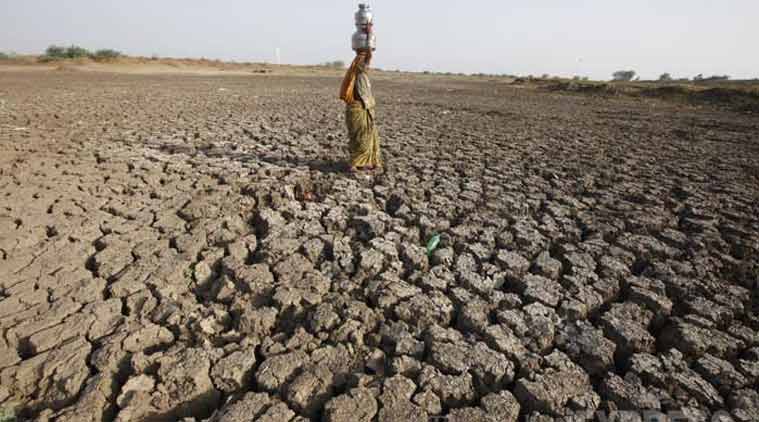
Huge quantities (nearly 60 lakh litres) of water is proposed and ready to be willingly wasted by The Board of Control for Cricket in India, The Mumbai Cricket Association, The Maharashtra Cricket Association Stadium, the Vidarbha Cricket Association, all being the Respondent(s) Nos. 6 to 9 in the petition. These authoritiies are being asked to answer, through this PIL, how they can justify maintaining the Cricket Pitches in the three venues nominated for Indian Premier League, 2016, in the State of Maharashtra, especially when the State is reeling through the worst kind of drought in a century and is facing acute shortage of water as the level of water in dams and lakes in the State has gone down.
The petition also states that: There is already a scarcity of drinking water and water for sanitation purposes and The State of Maharashtra, Through its Water Resources Department, The Maharashtra Water Resources Regulatory Authority,The Mumbai Corporation of Greater Mumbai (MCGM), The Nagpur Municipal Corporation, The Pune Municipal Corporation, being the Respondent Nos. 1 to 5 have not raised any objection to the proposed wastage thereby violating the Article 21 and 47 of the Constitution of India as also violating the National Water Policy and the State Water Policy.
Loksatta Movement PIL against IPL matches in Maharashtra



.jpg)
.png)
.png)
.png)
.png)