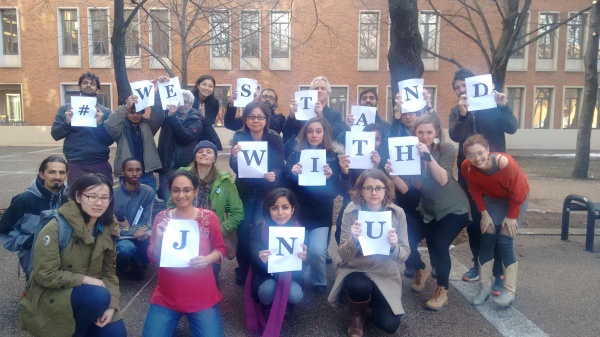
Under Prime Minister Narendra Modi’s watch, the BJP-backed ABVP’s drive to subjugate the universities in India is geared to the RSS goal of moulding a submissive, pliable, authoritarian character-structure among the youth of India and crushing all possible sources of resistance to it, including Dalit, left-wing and other secular-democratic student groups on campuses.
In an important essay written over a year ago, German psychoanalyst Dr. Andreas Peglau, reflecting on the Europe’s rightward drift as indicated by the results of the May 2014 elections, raised the broader question of the origins, and more importantly the mass appeal, of authoritarian movements and ideologies. His analysis and his perspective on how to resist such movements and ideologies are as relevant to us in today’s India as they are to the West.
The results of the European elections of May 2014 have urgently called into question the origins of ‘rightwing’[1] movements and ideologies. The developments underscore once again that fascistic groups have become socially acceptable on our continent. Many studies of extremist viewpoints held by people in the political center have yielded ominous results for years.[2] The work of psychoanalysts and social scientists Erich Fromm (1900-1980) and Wilhelm Reich (1897-1957) provide us with explanations that go beyond the usually cited factors,[3] and should therefore be included in current discussions.
Fromm and Reich on National Socialism
Beginning in 1929, Erich Fromm conducted an empirical study of the psychic structures of German workers and employees. The study showed that “the workers educated in parties and unions, despite their revolutionary allegiance and convictions, did not exhibit the resistance to an authoritarian and dictatorial regime that one would have expected of them.”[4] What characterized them instead was a widespread need for authoritarian leadership – fertile soil for the change of power that was soon to occur.[5]
Around the same time Wilhelm Reich, too, worked to uncover the roots of ‘rightwing’ movements.[6] In the late summer of 1933, he published The Mass Psychology of Fascism from his Danish exile – a book that has remained unrivalled in the psychoanalytic literature until this day.[7] Reich begins his analysis by noting the “doubts about the accuracy of Marxist concepts of the social process.”[8] The fact that millions of workers behaved contrary to their allegedly ‘objective’ class interests by voting for ‘rightwing’ parties was no longer explicable by Marxist theory. It was not only the fact that material ‘being’ translated into consciousness that had to be accounted for, but also how this occurred, how this consciousness, in turn, acted on external processes, and which unconscious processes were occurring. For this, psychoanalysis was necessary.[9]
“National Socialism is our mortal enemy,” Reich wrote in the beginning of his book, “but we can only defeat it if we properly assess its strengths.”[10] One of those strengths was that Hitler pointedly embodied conscious, and especially unconscious neurotic conceptions of millions of Germans: “Only if a [psychic – A.P.] structure of a Führer personality is in accord with the structures of the average mass individual can a ‘Führer’ make history.”[11] The basis for such a concordance was that the socialization of the Führer and of the followers fundamentally conformed to each other: as children, they first had “to go through the authoritarian miniature state, the family […] in order to be able to insert themselves into the general social framework.”[12] “The more helpless the individual was made by his upbringing, the more strongly does he identify himself with the Führer,” and the stronger became his wish for an authoritarian surrogate father [13] with whom he could identify. Instead of recognizing his petty role as a cog in the societal machine, he felt like a “little Hitler.”[14]
Erich Fromm was the first psychoanalyst after Reich to take a strong public stance against fascism, and his claims were similar to Reich’s. In his 1941 book Escape from Freedom, Fromm wrote that Nazism, especially “the hold it has over a whole people,” is “a psychological problem,” but the psychological factors themselves have to be understood as being molded by socio-economic factors.” “Hitler’s personality, his teachings, and the Nazi system express an extreme form of the character structure which we have called ‘authoritarian’ and that by this very fact he made a powerful appeal to those parts of the population which were – more or less – of the same character structure.”[15]
First, both of these arguments run counter to all opinions that ascribe decisive importance to Hitler’s alleged charisma in explaining his success. If it hadn’t been Hitler, then – presupposing the same basic conditions – another, similarly structured psychopath would have likely been found as a celebrated ‘Führer’. Fromm later wrote: “there are probably hundreds of Hitlers among us who would come forth if their historical hour arrived.”[16]
Second, these insights refute the recurrent and conveniently used phrase, “it was all Hitler’s fault,” recognising that without the fanatics who backed him and the millions who blindly followed him, Hitler would have remained the politically aimless and insignificant nobody that he evidently was until 1919.[17] Furthermore, those who were pulling the strings politically and economically would have never supported someone without mass appeal.
If it hadn’t been Hitler, then – presupposing the same basic conditions – another, similarly structured psychopath would have likely been found as a celebrated ‘Führer’. Fromm later wrote: ‘there are probably hundreds of Hitlers among us who would come forth if their historical hour arrived’.
What Does This Mean for Our Times?
Applying the thesis of mutual dependence between leader and follower to the present age, today too we hear the claim, “it is all the politicians’ fault”; as with blaming Hitler, this does not hold up. Granted, the higher up one sits in the pyramid of power, the more influence and thus responsibility one has. Yet, the ‘masses’, and hence we – at least unconsciously – in large part support and create the society in which we live. Our political leaders will likely embody those character structures that resonate with our own and will fulfill our neurotic and unconscious expectations.
Do we thus have to conceive of Angela Merkel as mirroring the Germans’ state of their soul? I think it is likely. Reaching the top from humble beginnings, craftily doing one’s own thing, ‘sitting out’ problems, keeping a low profile – these are the that many Germans identify with. An assessment of a survey from April of 2014 explained Merkel’s popularity: “The chancellor […], with her unostentatious political style continued to conform […] with the people’s attitude of life and their need for security.” Issues that the Social Democratic Party (SPD) was raising – green revolution, minimum wage, and retirement age of 63 – were less important to German citizens.[18]
The vast majority of the population is not interested in larger problems, and even less, one can surmise, in contributing to their solution. Indeed, statistics show that the bulk of the German population is not interested in engaging in the democratic process, and gladly defer to a strong leadership model.[19] Merkel’s success shows that this figure need no longer be a stern surrogate father; it can equally be a shapeless surrogate mother who communicates that she has everything under control – even when that is arguably not true, when danger of war [20] and poverty [21] are growing under her regency, i.e. when security is, in reality, dismantled.
Reich and Fromm’s insights also show that it would be naïve to view parties such as the Ukrainian ‘Svoboda’, the Greek ‘Golden Dawn’, or the National Party of Germany (NPD) solely as representatives of minority groups. Such groups represent well-established psychosocial structures that are far more widespread than just among their members and voters. The above-mentioned studies on fascistic attitudes in the Federal Republic of Germany, conducted by a research group led by Oliver Decker and Elmar Brähler in Leipzig, regularly expose extremist rightwing positions among adherents of all parties.[22]
‘Rightwing’ partisans are thus only the tip of the iceberg, the ‘symptom bearers’ of a psychosocial aberration that has long ago ‘infected’ others who are seen to be liberal or even ‘leftwing’. Such symptoms can – in case of an economic crisis for example [23] – turn viral. The Germans, formerly seen as highly cultured, demonstrated this in the 1930s.
Psychosocial Roots of Fascism
The factors that Reich already pointed out in 1933 in his Mass Psychology will help us understand the origins of the fascistic developments that exist on our continent today.[24] Fascism owes its success in large part, he maintained, to psychic constellations that have been fostered for centuries, especially by the church, the nuclear family, and sexual repression. Those – and with them, ‘patriarchy’ in its entirety – have to be abolished in order to expunge the roots of ‘rightwing’ movements.[25] As to the current urgency of these issues, I can only offer a few brief statements here.
First: Does the church still exert an emotionally and sexually repressive influence that makes humans destructive?
This applies to the Catholic Church, simply because of its attitude toward contraception, pre- or extra-marital sex, homosexuality, and celibacy. This is also confirmed by the rampant sexual abuses in their institutions. While an aggressive, Catholic-dominated anti-contraception campaign is on the rise in Poland, [26] a recent poll showed that most German Catholics hold more desire-affirming views than their officials do. [27] But in these parts, too, the ecumenical dissemination of patriarchal myths such as the simultaneously good and omnipotent male creator-God strengthens authoritarian, and thus emotionally repressive, norms.
Recently, the pronouncements of military bishop Sigurd Rink confirmed [28] that even the formerly pacifist Protestant Church [29] – prominently represented by the militant former priest Joachim Gauck [30] – increasingly endorsed the triad of arms exports, war missions, and a foreign policy inclined toward aggression. The fact that 200,000 people in Germany leave their churches every year can in part be read as a rejection of those views. However, since the German state annually grants 460 million Euros in church taxes to the churches [31] – regardless of how many believers they still have – and has instituted nearly comprehensive religious instruction churches nonetheless continue to propound certain views of themselves and the world.[32]
Second: Does the nuclear family still engender authoritarian structures?
I think so. In a society that offers scant healthy social support the nuclear family often creates a constricting substitute sense of security. Oftentimes, parents uncritically pass on prevailing harmful norms to their children, shaping them in a way that they easily yield to the authority of adults.
For Germany, at least, it is necessary to note that the institution of marriage and as such the core of the nuclear family has lost significance, that, from 1968 onward, non-authoritarian tendencies have entered into education in West Germany, that children are oftentimes treated more lovingly in families, that extra-familial childcare has developed – albeit to an insufficient extent. In the year 2000, the German parliament finally adopted this passage into the German Civil Code: “Children have a right to non-violent upbringing. Physical punishments, psychological injuries and other degrading measures are inadmissible.”[33]
The extent to which oppression is still happening behind the nuclear family’s walls could recently be garnered from the book Deutschland misshandelt seine Kinder (Germany Abuses Its Children).[34] According to the German Child Protection League, three children in Germany die every week due to abuse and neglect.[35] In current parent surveys, 40 per cent indicated they beat their children,[36] 88 per cent wanted to mainly “teach them courtesy and good manners,”[37] and 70 percent ‘discipline’.
Third, on sexual repression: Sexual life in Europe is certainly freer today than it was in 1933, and women’s emancipation has crucially contributed to that.
Applying the thesis of mutual dependence between leader and follower to the present age, today too we hear the claim, ‘it is all the politicians’ fault’; as with blaming Hitler, this does not hold up. Granted, the higher up one sits in the pyramid of power, the more influence and thus responsibility one has. Yet, the ‘masses’, and hence we – at least unconsciously – in large part support and create the society in which we live.
However, only a sexuality that has been made sick through repression can, in my opinion, explain that at least 1,400 girls and boys were systematically raped, abused, and forced into prostitution in Rotherham, England, between 1997 and 2013.[38] Or that, in a recently published EU study, 12 percent of all women claimed to have been subjected to sexual harassment or abuse by adults before reaching the age of 15, that 33 percent claimed to have experienced physical and/or sexual violence since the age of 15, and that 5 percent claimed to have been raped. Germany performed slightly worse than the average of European countries.[39]
If ten per cent of the German women polled in a May 2014 survey claimed that they wanted to “enter marriage chastely” because “of their conviction”, [40] this could indicate that sexually repressive norms are regaining ground even in Germany.
Thus, even today, we are far away from having overcome the destructive impacts of church, nuclear family, and sexual repression. And at any rate, there is little hope for the abolition of capitalism’s ultimately inhuman conditions at the current moment.
Following Reich, this means that our contemporary governmental arrangements, too, breed those psychic deformations under whose impacts they then suffer, and they engender the psychic conditions that turn many of us into psychosocial ‘time bombs’.
The Character of Society
Things become even more alarming when we introduce a further insight by Reich and Fromm. The way a people behave is no coincidence, Reich wrote in Mass Psychology, since “every social order creates for itself in the masses of its members that structure which it needs for its main purposes.”[41] Erich Fromm remarked: “The socio-economic structure of a society molds the social character of its members so that they wish to do what they have to do.”[42]
But to what ends does our current social order require this vast number of superficial, dull, resigned people with their oftentimes primitive affects of anger and envy, as they, for example, abound in various internet blogs? For what does Germany need this disposition to violence, indicated by the 3,000 violent crimes in Berlin’s public transportation system in 2013,[43] the excesses of supposed soccer fans, or the presence of neo-Nazis brimming with hate in front of the homes of asylum seekers? It is clear that such psychically deformed people cannot provide a proper foundation for democracy. To call our state a thoroughly democratic system is out of the question anyway.
In spite of the movement of ’68, a democratic education [44] has not gained traction, much less a democratically structured economic sphere; the work life of most German citizens is still strictly authoritarian — capitalism has no other way of functioning.[45] And especially in recent times, one could clearly see how the German governmental apparatus subordinated itself to corporations, banks, and the imperial aspirations of the United States.[46] “America always has to take the lead on the world stage,” Barrack Obama announced once again in May of 2014. “The backbone of this leadership” has to be the US military.[47]
To subordinate oneself to, or even join in with, such megalomaniac and highly dangerous aspirations to hegemony requires one to condone, and even to participate in, criminal acts of war such as those in Iraq and Afghanistan. Even acceptance presupposes, in my opinion, a high degree of repression, cynicism, or subservience, or rather – psychoanalytically formulated – “identification with the aggressor”. For a soldierly participation that is successful in the eyes of the client, emotional dullness and the willingness to kill are indispensable.
In the spirit of Wilhelm Reich and Erich Fromm, we thus have to conclude that our society has an interest in a saturated petty bourgeois, in blind followers, and in a potential for destruction that can be arbitrarily directed toward any goal at any time. This society thus constantly creates the psychic dysfunctions conducive to those interests – and thus jeopardizes those democratic achievements that were established.
The Responsibility of the ‘Masses’
Our society today does not just consist of politicians, media personalities and corporate executives, but also of the ‘masses’. Even though politics and media issue their demands powerfully, we carry out the processes of socialization, especially in our capacities as parents. To this day, we oftentimes press our children into molds that predetermine public and internalized norms. It begins with teaching them order, discipline, motivation, and adaptability in order for them to get on in the world (instead of changing it), and with curtailing their independence and spontaneous emotions, since they are difficult to align with our often externally determined daily routine – we have to make a living, after all.
It continues with forcibly compelling them to attend a school in which mostly overwhelmed teachers oftentimes indoctrinate[48] them with irrelevant material, or with us foisting Ritalin on them,[49] instead of understanding that their supposed hyperactivity simply indicates how rotten they feel. Especially by paying taxes, we support everything reactionary and destructive with which the state ultimately damages our children’s and our own mentality, leading us to accept ‘neo-liberalism’, unnecessary CO2 emissions, and war operations.
All of this simultaneously aids the emergence of depressed resignation, authoritarian dependence, and pent-up anger – and thus creates susceptibility to ideologies such as fascism.
As Long As There Is Hate…
The fascist ideology, however, is not the deepest layer of the problem, but rather the destructiveness lurking behind it. Being able to direct its aggression against scapegoats and (supposed) enemies often feels liberating and reduces pressure: “Finally, I know whose fault all of this is, and I can take my revenge!” Thus, the more aggressive we have become, the more usable we are for nationalist, neo-fascist, fundamentalist, imperialist, anti-environmentalist, anti-children, misogynistic, homophobic, or xenophobic ideologies.
Adolf Hitler and Benito Mussolini, key proponents of Fascism, in Munich, Germany, ca. 06/1940
Once explosive anger has been given a ‘legitimate’ outlet, motivations can be arbitrarily exchanged; terrorism and murder can be perpetrated with the justification of ‘rightwing’ and ‘leftwing’ worldviews alike, in the name of salvation by Allah, for an environmentalist dictatorship, or as part of a Western neoliberal redemption of the world. For the latter purpose, demagogic mass media and war-mongers can attempt – as it could be seen since the Ukrainian crisis – to position this potential for hatred as “wrath of the people” against the bogeyman of “the Russian menace”.[50]
Banning of ‘Golden Dawn’, ‘Svoboda’ and the NPD therefore can never root out the evil; the destructive force will seek out new battlegrounds. More jobs and prosperity alone apply a thin plaster to a festering wound; [51] the psychosocial ‘womb’ from which disaster grows, remains fertile.
In 1946, Reich wrote in the new English edition of his Mass Psychology:
“In this character-logical sense, ‘fascism’ is the basic emotional attitude of man in authoritarian society, with its machine civilization and its mechanistic-mystical view of life.
“It is the mechanistic-mystical character of man in our times which creates fascist parties, and not vice versa.
“Even today, as a result of fallacious political thinking, fascism is still being considered a specific national characteristic of the Germans or the Japanese […].
“My character-analytic experience, however, shows that there is today not a single individual who does not have the elements of fascist feeling and thinking in his structure […].
“Correspondingly, there is a German, Italian, Spanish, Anglo-Saxon, Jewish and Arabian fascism […].
“One cannot make the fascist harmless if, according to the politics of the day, one looks for him only in the German or Italian, or the American or the Chinese; if one does not look for him in oneself; if one does not know the social institutions which hatch him every day.”[52]
But are we truly ready to do this: to search out our own fascistic tendencies, understand them to be psychic dysfunctions, and to ‘work on’ these patterns – perhaps therapeutically? At any rate, many of us have good reasons to do so.
Rightwing Extremism in Germany Today
In 2014, merely 5.6% of respondents in the Leipzig research group’s surveys explicitly professed a “fully rightwing extremist worldview”. [53] However, these ‘mere’ 5.6% represent at least 3.56 million [54] of our fellow citizens who ‘largely’ or ‘fully agree to the following statements:
“We should have a leader who, for the wellbeing of all, governs Germany with a firm hand”.
“Germany currently needs a strong single party that stands for the people as a whole”.
“Our country needs to assert German interests forcefully and aggressively against other countries”.
“To all intents and purposes, Germans are naturally superior to other peoples”.
“In society, just as in nature, the stronger should prevail”.
“Due to the many non-resident aliens, the Federal Republic of Germany has become infiltrated by foreigners”.
“Foreigners solely come here to take advantage of social benefits”.
“More than any other people, the Jews use dirty tricks to achieve what they want”.
“There is worthy and worthless life”.
“The atrocities of national socialism have been greatly exaggerated in history.”[55]
Another 12 to 31% of respondents (where the latter number represents more than 22 million Germans) assessed these claims as ‘partially’ correct.[56] And an even larger number held additional xenophobic views. Three quarters of German citizens rejected “the demand that the government should evaluate applications for asylum generously.”[57] Less than 50% of respondents granted asylum seekers to have “truly suffered persecution or to be threatened by it.” Roughly 40% endorsed Islamophobic statements; roughly 53% defamed Sinti and Roma.[58]
The vast majority of the population is not interested in larger problems, and even less, one can surmise, in contributing to their solution. Indeed, statistics show that the bulk of the German population is not interested in engaging in the democratic process, and gladly defer to a strong leadership model.
This underscores that peace and disarmament treaties and necessary revolutions in processes of production and distribution of wealth, cannot, by themselves, foster sustainable peace. They are far from reaching people’s ‘hearts and minds’. It also shows that only few of the people professing ‘rightwing’ views are rightwing extremists.[59] Blanket statements such as, “whoever says something against foreigners is a fascist,” are indefensible. And since over 90% voiced support for ‘the idea of democracy’,[60] we apparently have to conclude that the majority of Germans are ‘xenophobic democrats’.
Are they predominantly ‘leftwing’ or ‘rightwing’?
A Dubious Bifurcation
Applied to politics, ‘rightwing’ (as well as ‘leftwing) has always been a hazy term that both ‘right-wingers’, as well as the experts who study them, have interpreted [61] in different ways. As such, there “cannot be said to be a single body of scholarship on rightwing extremism with a unified object of study.” [62] Those specialized scholars cannot even agree on a clear definition of ‘fascism’ and ‘national socialism’.[63]
In my opinion, the above-mentioned fact that supporters of all parties endorse ‘rightwing’ views nowadays confirms that the leftwing/rightwing schema obscures reality more than it helps to explain it. Fromm’s distinction between life–affirming and hostile-to-life attitudes appears to be much more meaningful here. [64] With this distinction it becomes possible to say that since ‘foreigners’ are humans, living beings, xenophobic views are hostile to life. But thinking through the idea of democracy to its logical end shows that all humans are entitled to an existence with equal opportunities – a decidedly life-affirming attitude. Most Germans thus combine in themselves positions that are hostile to life and life-affirming. The decisive boundary does not run between parties, but between portions of personality.
Fromm’s distinction can also be applied to groups of people and social systems. It doesn’t matter who initiates ethnic hate speech, wars of aggression, mass murder, and is indifferent to environmental destruction; it doesn’t matter if it is done openly or behind a smokescreen: these activities are hostile to life in any event. There is no good murder.
In a time in which the Ukraine crisis acutely threatens peace in Central Europe and raises the possibility, no matter how slim, of nuclear war, the following consideration seems important as well. Whoever earnestly – not in hypocritical or demagogic fashion! – advocates for peace acts as life-affirming should ally with everyone who also credibly stands for that goal – even across differences of ideology and class. For example, whoever insists on working only with people that bear no xenophobic thoughts whatsoever already excludes, as we have seen, more than three quarters of the German population – and thus nips in the bud any potentially successful mass movement.
Hopes
Already in his 1934 afterword to the second edition of Mass Psychology, Reich stated: “If one attempts to alter only the human structure, society resists. If one attempts to alter only society, the people resist.”[65] He identified some of the crucial areas in which ‘the structure of man’ can be constructively shaped: the living conditions of pregnant women, the means by which one is born (natural versus medically-aided birth), a non-authoritarian education, fulfilling sexuality and companionship, psychological and physical therapy.[66]
This leads us to conclude that lovingly nurturing children in life-affirming manner, actively striving for healthy relationships, a fulfilled sexuality, and psychological health are effective means of removing the psychosocial foundations for war and destructive violence – in the same way as resistance to authoritarian leaders and norms in the family, in school, at work, in the media, in the church, and in the state are as well. Whoever claims, “I can’t do anything about it!” is mistaken. Especially people who have been living in relative wealth and security – as most Central Europeans have until now – have considerable leeway in this regard.
Is this view (too) optimistic? Would a more pessimistic outlook be appropriate? Erich Fromm pointed out how similar the two are. Pessimists assume that everything will inevitably turn out badly – “so nothing needs to be done”.[67] Optimists trust that everything will somehow turn out well – “so nothing needs to be done”.[68] Two excuses for one and the same thing: passivity. Hence, it is instead necessary “to dare, to think the unthinkable, yet to act within the limits of the realistically possible.”[69]
In the spring of 1989, it still seemed inconceivable that the GDR could soon cease to exist. Soon after, even the entire ‘Socialist World System’ had disappeared. In 1988, the US government blacklisted Nelson Mandela, who had been incarcerated for 26 years, as a ‘terrorist’. It seemed inconceivable what should soon after become reality: Mandela was released in 1990, abolished the South African apartheid regime, received the Nobel Peace Prize for this achievement in 1993, and became the first black president of his country in 1994.
Courtesy: Avik Kumar Maitra
In light of such events, who would want to claim that fundamental social changes are impossible? In this highly complexly connected ‘globalised’ world, who can seriously claim to know what will be the case in five years? We can never know with full certainty that positive changes are impossible. Thus, there always remains a chance for which we should fight for ourselves and the next generations.
Supported by his “rational faith in man’s capacity to extricate himself from what seems the fatal web of circumstances that he has created”, Erich Fromm demanded “fundamental changes… not only in our economic and political structure but also in our values, in our concept of man’s aims, and in our personal conduct.”[70] The situation of mankind today is too serious to permit us to listen to the demagogues ― least of all demagogues who are attracted to destruction ― or even to the leaders who use only their brains and whose hearts have hardened. Critical and radical thought will only bear fruit when it is blended with the most precious quality man is endowed with ― the love of life.
Fromm repeatedly gave detailed outlines for paths to a ‘sane society’[71] “in which no one is threatened: not the child by the parent; not the parent by the superior; no social class by another; no nation by a superpower.”[72] Fromm’s hopes rested in a view of man that he summed up in 1973 in his book The Anatomy of Human Destructiveness. In order to render intelligible the political developments of the 20th century, including its fascist excesses, he connected psychoanalysis, (social) psychology, paleontology, anthropology, neurophysiology, animal psychology, and history. To this day, this piece of writing offers the most extensive and coherent argument that there are no inborn aggressions or even death drives,[73] that man is not born ‘evil’ – which current neurobiological research corroborates as well.[74]
In this context, Wilhelm Reich spoke of the ability to self-regulate: we have inborn values and impulses, which would – if they were nourished, and not suppressed and perverted – enable lively, loving relations and social systems.[75]
This also means that even US presidents and other statesmen who unscrupulously decree the murder of individuals or of masses [76] and even the mercenaries or religious fanatics who perpetrate these murders in, for example, Vietnam, Angola, Nicaragua, and Afghanistan,[77] even fascists that massacre dissenters, were born into this world with this healthy potential. They wanted to, and were able to, love. Assuming an uncomplicated pregnancy, every newborn has this ability. Every human being bears the chance of heralding a fundamentally new beginning into our world.
These insights, experiences, and suggestions have apparently not yet reached, or sufficiently influenced, most of those who want to improve this world. Let’s hope that this will change.
Were that to happen, a proper reaction to Europe’s shift to the right, which signals an increasing hostility to life, would be possible.
Or, more precisely: only in that case.
(My grateful thanks to all those who have read, commented on, and contributed to this manuscript. My special thanks Philip Bennett and Rainer Funk for their help and to Tobias Kühne for this English translation).
(Dr. Andreas Peglau is a Berlin-based psychoanalyst. He has written numerous articles on the history of psychoanalysis, especially about Wilhelm Reich. For a review of his book, ‘Unpolitische Wissenschaft? Wilhelm Reich und die Psychoanalyse im Nationalsozialismus’ [‘Apolitical science? Wilhelm Reich and psychoanalysis in Nazi Germany’] published in 2013, click here: https://sabrangindia.in/article/book-review-apolitical-science-wilhelm-reich-and-psychoanalysis-nazi-germany)
Source: http://andreas-peglau-psychoanalyse.de/suggestions-for-a-psychoanalysis-of-europes-shift-to-the-right/
Bibliography:
Bauer, Joachim. Schmerzgrenze. Vom Ursprung alltäglicher und globaler Gewalt. München: Blessing (2011).
Bauerkämpfer, Arnd. Der Faschismus in Europa 1918–1945. Stuttgart: Reclam (2006).
Breuer, Stefan. Grundpositionen der deutschen Rechten (1871–1945). Tübingen: edition discord (1999).
Breuer, Stefan. Ordnungen der Ungleichheit – die deutsche Rechte im Widerstreit ihrer Ideen 1871–1945. Darmstadt: Wissenschaftliche Buchgesellschaft (2001).
Breuer, Stefan. Nationalismus und Faschismus. Frankreich, Italien und Deutschland im Vergleich. Darmstadt: Wissenschaftliche Buchgesellschaft (2005).
Bröckers, Mathias/Schreyer, Paul. Wir sind die Guten. Ansichten eines Putinverstehers oder wie uns die Medien manipulieren. Frankfurt a.M.: Westend (2014).
Chomsky, Noam. Der Schutzschirm der amerikanischen Macht. Die Widersprüche der US-Politik zur Allgemeinen Erklärung der Menschenrechte. (o.O.) Lowell Factory Books (2013).
Crome, Erhard. Geopolitisches um die Ukraine. In: Ein Spiel mit dem Feuer: Die Ukraine, Russland und der Westen. ed. Peter Strutynski. Köln: PapyRossa (2014). 99-117.
Decker, Oliver/Weißmann, Marliese/Kiess, Johannes/Brähler, Elmar. Die Mitte in der Krise. Rechtsextreme Einstellungen in Deutschland. Springe: zu Klampen (2011).
Decker, Oliver/Kiess, Johannes/Brähler, Elmar. Rechtsextremismus der Mitte. Eine sozialpsychologische Gegenwartsdiagnose. Gießen: Psychosozial (2013).
—-. Rechtsextreme Einstellung in Deutschland 2014.“ Universität Leipzig: http://www.uni-leipzig.de/~kredo/Mitte_Leipzig_Internet.pdf (2014)
Erpenbeck, John/Sauter, Werner. So werden wir lernen! Kompetenzentwicklung in einer Welt fühlender Computer, kluger Wolken und sinnsuchender Netze. Berlin/Heidelberg: Springer/Gabler (2013).
Fromm, Erich. The Escape from Freedom. New York, NY: Farrar and Rinehart (1941).
—-. The Anatomy of Human Destructiveness. New York, Chicago, San Francisco: Holt, Rinehart, and Winston (1973).
—-. To Have or to Be? In“ World Perspectives vol.50, planned and edited by Ruth Nanda Anshen. New York, NY: Harper and Row (1976).
—-. Die Furcht vor der Freiheit. In: Gesamtausgabe, Bd. 1, München: dtv (1989a). 215-392.
—-. Wege aus einer kranken Gesellschaft. In: Gesamtausgabe, Bd. 4, München: dtv (1989b). 1-254.
—-. Die Revolution der Hoffnung. Für eine Humanisierung der Technik. In: Gesamtausgabe, Bd. 4, München: dtv (1989c). 255-377.
—-. Die Anatomie der menschlichen Destruktivität. In: Gesamtausgabe, Bd. 7, München: dtv (1989d).
—-. Haben oder Sein. ‘Die seelischen Grundlagen einer neuen Gesellschaft’. In: Gesamtausgabe, Bd. 2, München: dtv (1989e). 269-414.
—-. Arbeiter und Angestellte am Vorabend des Dritten Reiches. Eine sozialpsychologische Studie. In: Gesamtausgabe, Bd. 3, München: dtv (1989f). 1-224.
Funk, Rainer. Erich Fromm. Reinbek bei Hamburg: Rowohlt (1998).
—-. Ich und Wir. Psychoanalyse des postmodernen Menschen. München: dtv (2005).
—-. Entgrenzung des Menschen. Freiburg: Centaurus (2012).
Guddat, Saskia/Tsokos, Michael. Deutschland misshandelt seine Kinder. München: Droemer/Knaur (2014).
Henken, Lühr. ‘Die Folgen der Ukraine-Krise: Auf- oder Abrüstung?’ In: Ein Spiel mit dem Feuer. Die Ukraine, Russland und der Westen. ed. Peter Strutynski. Köln: PapyRossa (2014). 153-171.
Kornyeyeva, Lena. Die sedierte Gesellschaft: Wie Ritalin, Antidepressiva und Aufputschmittel uns zu Sklaven der Leistungsgesellschaft machen. München: Heyne (2014).
Kronauer, Jörg. ‘Die widersprüchlichen Imperative der deutschen Ostpolitik’. In: Ein Spiel mit dem Feuer. Die Ukraine, Russland und der Westen. ed. Peter Strutynski. Köln: PapyRossa (2014). 137-152.
Maaz, Hans-Joachim. Der Gefühlsstau. Ein Psychogramm der DDR. Berlin: Argon (1990).
—-. Das gestürzte Volk. Die unglückliche Einheit. Berlin: Argon (1991).
Mamdani, Mahmood. Guter Moslem, böser Moslem: Amerika und die Wurzeln des Terrors. Hamburg: Nautilus (2006).
Neill, Alexander S. Theorie und Praxis der antiautoritären Erziehung: Das Beispiel Summerhill. Reinbek bei Hamburg: Rowohlt (1969).
Nolte, Ernst. Das zwanzigste Jahrhundert. Die Ideologien der Gewalt. München: Herbig (2008).
Weltall, Erde, … ICH. Anregungen für ein (selbst)bewussteres Leben. ed. Peglau, Andreas. Berlin: Ulrich Leutner (2000).
Unpolitische Wissenschaft? Wilhelm Reich und die Psychoanalyse im Nationalsozialismus. Gießen: Psychosozial (2013).
Reich, Wilhelm. ‘Der masochistische Charakter. Eine sexualökonomische Widerlegung des Todestriebes und des Wiederholungszwanges’. In: Internationale Zeitschrift für Psychoanalyse Bd. 18 (1932). 303-351.
—-. Massenpsychologie des Faschismus. Zur Sexualökonomie der politischen Reaktion und zur proletarischen Sexualpolitik. Kopenhagen/Prag/Zürich: Verlag für Sexualpolitik (1933).
—-. Massenpsychologie des Faschismus. Zur Sexualökonomie der politischen Reaktion und zur proletarischen Sexualpolitik, 2nd ed. Kopenhagen/Prag/Zürich: Verlag für Sexualpolitik (1934).
—-. The Mass Psychology of Fascism. Third Revised and Enlarged Edition. trans. Theodore P. Wolfe. New York: Orgone Institute Press (1946).
—-. Children of the Future. On the Prevention of Sexual Pathology. New York: Farrar, Strauss and Giroux (1983).
—-. Die Massenpsychologie des Faschismus. Köln: Kiepenheuer und Witsch (1986).
Reuth, Ralf G. Hitlers Judenhass. Klischee und Wirklichkeit. München/Zürich: Piper (2009).
Roth, Jürgen. Der stille Putsch: Wie eine geheime Elite aus Wirtschaft und Politik sich Europa und unser Land unter den Nagel reißt. München: Heyne (2014).
Scahill, Jeremy. Schmutzige Kriege. Amerikas geheime Kommandoaktionen. München: Antje Kunstmann (2013).
Strutynski, Peter (Ed.). Ein Spiel mit dem Feuer. Die Ukraine, Russland und der Westen. Köln: PapyRossa.
Wippermann, Wolfgang. Faschismustheorien. Zum Stand der gegenwärtigen Diskussion. Darmstadt: Wissenschaftliche Buchgesellschaft (1980).
Reference:
[1] By ‘rightwing’ I essentially mean the proclivity to nationalism, xenophobia, and authoritarianism. When it is markedly pronounced, I will speak of ‘rightwing extremist’, which I equate with ‘fascistic’, as
“exhibiting fascist characteristics”. More on the usefulness of the leftwing/rightwing schema later.
[2] In 2012, 36.2% of Germans were identified as Islamophobic, 25.1% as xenophobic, 11.5% as ‘primarily anti-Semitic’. Between 2002 and 2012, an average of 6.8% of East Germans and 4.2% of West Germans endorsed a rightwing authoritarian dictatorship (Decker/Kiess/Brähler 2013, p.108, 133).
[3] On May 25, 2014, Huffingtonpost.de published the following superficial and trivializing remarks under the title, ‘Shift to the Right at the 2014 European Elections’ (‘Rechtsruck bei den Europawahlen 2014’): “poor track record for the government” (France), “fiscal crisis” (Greece), weakness of “popular parties” (Austria). In June of 2014, an anti-fascist convention in Frankfurt mainly offered the following explanations: “unemployment”, the fact that the working class hadn’t “resisted capitalism enough”, and that the social democratic parties had supported “international capital” (Junge Welt, July 4, 2014, p.15: “Authoritarian Capitalism” [“Autoritärer Kapitalismus”]). This stunningly resembles those helpless ‘leftist’ attempts at interpretation that Reich criticized as early as 1933 (pp. 36f., 58f.) Why, one can still ask with him today, does unemployment make you reactionary instead of revolutionary, why has the working class not resisted enough the mistakes that have been made, not only by social democratic, but also by ‘leftwing’ parties? What, in other words, are the real reasons?
[4] Cf. Funk 1998, p.68.
[5] The publication of the results was not possible until 1980 (Fromm 1989f). In 1931, Fromm, who had mainly been active in Berlin and Frankfurt on the Main, resettled into Switzerland, later into the US
[6] In 1930, Reich had come from Berlin to Vienna. Like Fromm, he was of Jewish descent. Unlike Fromm, he was a communist and member of the Communist Party. In April of 1933, Reich fled Germany.
[7] For background, content, and reception of Reich’s Mass Psychology, refer to Peglau 2013, pp.241-268. Reich’s book was one of several reasons why he was expelled from the Communist Party in November of 1933: contrary to the internal official line, he had assessed Hitler’s success as a grave defeat for the working class and derived fundamental criticism at the approach from it. Almost simultaneously, psychoanalytic organizations let go of Reich, as he had become a liability to them for his anti-fascist activism. The ‘Aryanising’ German Psychoanalytic Society rescinded Fromm’s membership in 1935, and temporarily reinstated it (ibid. 445-446). Even though Reich and Fromm are among the most important and most creative psychoanalysts, the psychoanalytic mainstream mostly suppresses and, in Reich’s case, defames them (ibid. 399-407).
[8] Reich 1933, p.1. Translation my own.
[9] Reich 1933, p.29.
[10] Ibid. p.7.
[11] Ibid., p.58.
[12] Ibid., p.25.
[13] As is well-known, Hitler too relied on the guiding principle of ‘destiny’ throughout his life.
[14] Reich 1933, pp.98, 123.
[15] Fromm 1941, pp.208, 219.
[16] Fromm 1973, p.418
[17] Reuth 2009, p.51-101.
[18] http://www.stern.de/politik/deutschland/stern-rtl-wahltrend-spd-regiert-am-waehler-vorbei-2100580.html
[19] Decker, Kiess, Brähler (2013, pp.22f., 42)
[20] Henken 2014.
[21] http://www.spiegel.de/wirtschaft/soziales/armutsbericht-verteilung-von-armut-und-reichtum-in-deutschland-a-939995.html; Roth 2014.
[22] For example, in 2014, 2.1% of CDU/CSU voters, 2.8% of SPD voters, and 2.9% of ‘Linke’ voters supported a rightwing authoritarian dictatorship (‘rightwing’ party voters: 26.1%). For xenophobia, the percentages were at 17.1 (CDU/CSU), 17.9 (SPD), 16.9 (‘Linke’), 69.6 (‘rightwing’ parties). Of individuals with a “holistically rightwing extremist worldview,” 21.4% voted for the CDU/CSU, 24.6% for the SPD, 7.3% for the ‘Linke’, but only 6.3% for clearly ‘rightwing’ parties, and 6.3% for the AfD (Decker/Kiess/Brähler 2014, p.41f.).
[23] Decker/Kiess/Brähler (2013, p.15f.) convincingly deduce from their data that this is still the case today.
[24] Going beyond Reich’s claims, Fromm meticulously analysed (1989d, especially pp.245-486) psychosocial factors that lead to destructive developments within individuals and societies. Since going into greater detail would go beyond the scope of this article, I can only refer the reader to the work itself.
[25] Reich 1933, pp.35, 126-138, 190f., 202, cf. Fromm 1989d, pp.137-143.
[26] http://www.welt.de/vermischtes/article125626992/Polinnen-reisen-zur-Abtreibung-nach-Brandenburg.html
[27] http://www.faz.net/aktuell/politik/umfrage-des-vatikans-katholiken-hadern-mit-sexualmoral-der-kirche-12783198.html
[28] Junge Welt, 9.9.2014, S. 2: „Zum Absegnen des Tötens bereit.“
[29] http://de.wikipedia.org/wiki/Schwerter_zu_Pflugscharen
[30] http://www.stern.de/politik/deutschland/juergen-todenhoefer-bestseller-autor-bezeichnet-gauck-als-dschihadisten-2117908.html
[31] http://www.welt.de/politik/deutschland/article13583390/Warum-der-Staat-der-Kirche-jaehrlich-Millionen-zahlt.html
[32] They nonetheless do not guard against ‘rightwing’ thinking: in 2014, 3.1% of members of the Protestant Church and 4.2% of the Catholic Church endorsed a ‘rightwing’ dictatorship (non-denominationals: 3.7%). For xenophobia, the numbers were 17.5% (prot.), 21.5% (cath.), and 15.7% (non-den.) (Decker/Kiess/Brähler 2014, p.42).
[33] http://www.gesetze-im-internet.de/englisch_bgb/englisch_bgb.html#p5687
[34] Guddat/Tsokos 2014.
[35] http://www.n-tv.de/politik/Kinderhilfe-versagt-zu-oft-article6373746.html
[36] http://www.eltern.de/kleinkind/erziehung/ohrfeigen-klaps.html
[37] http://de.statista.com/statistik/daten/studie/39028/umfrage/wichtige-erziehungsziele-fuer-eltern/
[38] http://www.tagesspiegel.de/weltspiegel/neuer-missbrauchsskandal-in-grossbritannien-mindestens-1400-kinder-in-nordenglischer-provinz-missbraucht/10617272.html
[39] http://fra.europa.eu/de/press-release/2014/gewalt-gegen-frauen-sie-passiert-taglich-und-allen-kontexten. Sexual violence against men was not surveyed. Some statisticians even question the quality of the data. “The experts do not, however, question the bottom line of the study, i.e. that appallingly many women across Europe experience violence.” WHO studies in other regions yielded similar results (http://www.spiegel.de/spiegel/print/d-125443825.html).
[40] http://www.presseportal.de/pm/52760/2749492/keusch-in-die-ehe-umfrage-fuer-jede-zehnte-frau-kommt-geschlechtsverkehr-vor-der-heirat-nicht-invv
[41] Reich 1933, p.39. (emphasis in the original)
[42] Fromm 1976, p.133.
[43] http://www.berliner-zeitung.de/polizei/identifizierung-durch-bvg-videos–3000-gewalttaten-in-bussen-und-bahnen-,10809296,26626850.html
[44] Neill 1969.
[45] Fromm 1989b, p.70.
[46] Kronauer (2014) shows by analyzing substantial conflicts between the U.S. and Germany that the latter is by no means a helpless victim of U.S. policy, but that it, too, pursues its own aspirations for power.
[47] http://www.focus.de/politik/ausland/diplomatie-obama-bekraeftigt-globalen-fuehrungsanspruch-der-usa_id_3881559.html. As early as 1997, U.S. presidential advisor and Obama mentor Brzezinski publicly declared that not only China and Russia, but also an autocratic. Europe – especially one cooperating with Russia – was to be viewed as a competitor that had to be kept in check. He also remarked that control over Ukraine would play a central role in this game of power (Crome 2014).
[48] Erpenbeck/Sauter 2013.
[49] Kornyeyeva 2014.
[50] Bröckers/Schreyer 2014, pp.125-161; Strutynski 2014, pp.173-210.
[51] Decker/Weißmann/Brähler (2011, p.115) see a flourishing economy as a ‘plombage’ that conceals ‘rightwing’ attitudes without dismantling them.
[52] Reich 1946, pp.ix-xi.
[53] Decker/Kiess/Brähler 2014, p.59.
[54] The researchers surveyed a representative sample of all Germans between 14 and 91 years. Those make up about 71.2 million (https://www.destatis.de/bevoelkerungspyramide/). Adducing 3.56 million as a figure applying to the entire population is a distortion, since the ones not surveyed under 14 (10.2 million) and over 91 (more than 300,000) certainly also do not exhibit exclusively democratic attitudes.
[55] Decker/Kiess/Brähler 2014, p.34-37.
[56] Ibid., p.60.
[57] 84.7% of East Germans and 73.5% of West Germans. With about 65 million West Germans and 16 million East Germans (including Berlin), this yields absolute numbers of about 48 million West Germans and 13.5 million East Germans that agree with this statement, i.e. a total of roughly 61.5 million, or roughly 76% of the total population.
[58] Ibid. pp.50, 62. The study gives no evidence for the supposition that the distribution is different among politicians. The aggressive characteristics of German policies vis-à-vis ‘foreigners’ at home and abroad thus seem to have a stable psychological basis, at the ‘top’ as well as at the ‘bottom’. The more negatively we view ‘foreigners’, the less troubling the export of arms becomes, since they ‘only’ kill foreigners.
[59] Indeed, isn’t the real ‘rightwing’ extreme the disposition, or even the wish, to kill and destroy excessively? In the question catalogue, the statement, “Without the extermination of the Jews, Hitler would be viewed as a great statesman today” (ibid. p.37), is put up for evaluation. Who also views him as a great statesman regardless of the extermination of the Jews can thus not be determined. The thought that people with such a view do not exist is, in my opinion, an illusion.
[60] Ibid., p.52.
[61] Breuer 1999; 2001; 2005
[62] Cf. Decker/Weißmann/Brähler 2012, p.11.
[63] Bauerkämpfer 2006, pp.13-46; Nolte 2008, p.97-111.
[64] Fromm 1989d.
[65] Cf. Reich 1934, p.283.
[66] Peglau 2013, p.386f. In the 1980s, psychotherapist Hans-Joachim Maaz (then still practicing in the GDR) developed these ideas into a ‘therapeutic culture’ (Maaz 1990; 1991). In the year 2000, I have worked with the organization ich-e.V. in an effort to visualize and discuss this concept (Peglau 2000).
[67] Fromm 1973, p.418.
[68] Ibid.
[69] Ibid.
[70] Ibid.
[71] E.g. Fromm 1989b; c; e, p.393-414. Rainer Funk, psychoanalyst and comrade-in-arms of Fromm’s analyzed and developed these concepts (Funk 2005; 2012; http://www.erich-fromm-online.de/)
[72] Fromm 1973, p.435.
[73] Reich also strongly objected to this thesis (1932), which Freud espoused.
[74] Bauer 2011.
[75] Reich 1983. Erwin Wagenhofer’s 2013 documentary Alphabet – Fear or Love [Alphabet – Angst oder Liebe] touchingly illustrates this.
[76] Scahill 2013; Chomsky 2013.
[77] Mamdani 2005, p.73-218.

.jpg)