An open letter to young protestors who were brutally assaulted on Rohith Venula’s birthday, January 30, 2016
Dear young friends who went to Jhandewala on Rohith Vemula’s birthday,
And all those who were there in spirit, in Delhi, Hyderabad and elsewhere. I am writing to you because I think you might have all taken things much further than anyone can quite imagine or understand at present.
I am writing to you, for today and for tomorrow, so that every time in the future that young people gather to celebrate their friend Rohith’s birthday, we might all begin to have a different kind of conversation. So that the boundaries between mourning and celebration, between anger and joy may always remain blurred enough for us to know what to do next, each time.
Since you had a close encounter with the police and their colleagues in the RSS on Rohith’s birthday, I want to spend a little time thinking about them with you. Bear with me. I sincerely hope we will not have to bear with them for much longer.
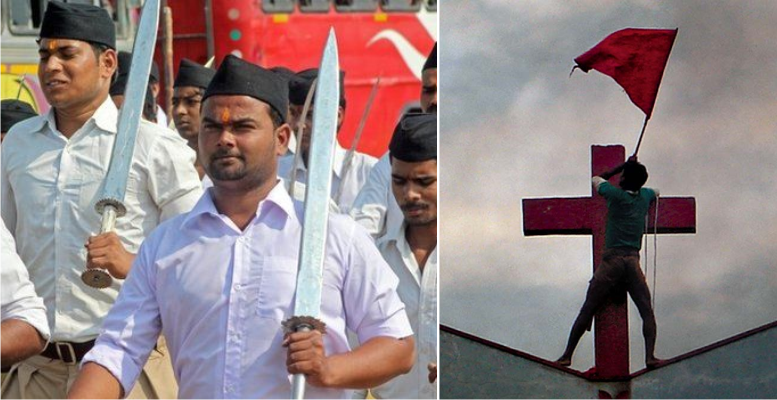
It is an undisputed fact that the ungainly khaki shorts of the far-right RSS (Rashtriya Swayamsevak Sangh / National Volunteer Force) militia’s uniform were inspired by the working attire of rank and file policemen in British India. Once upon a time it was the RSS which looked up to the police, playing out its fantasies about street-power in cop-drag. Nowadays, it is policemen, especially, but not only, those working here in our city with the Delhi Police (with us, for us, always) who seem to be guided by the RSS. Men with small minds and big sticks have always had a tendency to worship and obey men with smaller minds and bigger sticks.
Mark them well, dear students, dear young friends and comrades of Rohith, whosoever you may be, as you study, as you protest, as you agitate, educate and organize, as you walk the streets of our cities and take out marches in campuses, as you laugh and sing and grieve and fall in love with each other, discovering with your solidarities what it means to desire and demand a better life, for your bodies and for your minds, and, (as Rohith did) for your mothers too, and for all their sewing machines. For each and every body that labours and gives life to the world.
They, the men in Khaki, (shorts or trousers) are here to pull the shutters down on your world. They are the adversaries of all your desires. It is they, not you, who want to drag us all down from our destinations in the imagined world of stars, who want to close down universities, cut fellowships and pulp books and burn libraries. It is they, not you, who want to maintain the practices and protocols of exclusion and humiliation, to enforce the casual caste apartheid of canteens, common rooms and hostels. It is they, not you, who stop screenings, disrupt meetings and violate the daily intercourse and play of conversations. It is they, not you, who can’t deal with the fact that students do what students must – read, think, argue, learn, push their desires and curiosities. Never forget them, never forgive them. Look them calmly in the eye and do not yield an inch. They are terrified of your gaze, of the beauty of all your gatherings and assemblies.
The events unfolding before all our eyes, including the pathologically bellicose responses to all dissent (and even the mere suspicion of dissent) in and around university campuses in India makes it clear that in this regime led by Narendra Modi and administered by (Manu)Smriti Irani, in this winter of our discontent, the RSS and all that it represents and presides over, with its meagre moral compass and its frugal, miserable imagination, carries the biggest stick of all, especially when it comes to anything to do with education, culture and civic life. You are beginning to understand this more, aren’t you, with each semester that passes, with each passing day.
Rohith Vemula, a student of Hyderabad Central University (HCU) paid with his life for the clarity with which he came to this understanding. You, his young comrades, in their thousands, are now paying, all over the country with your peace of mind, with bruises, broken bones and lots of shattered dreams. We should treat this as an emergency that is already in operation in campuses across India, and wherever you, the young, gather.
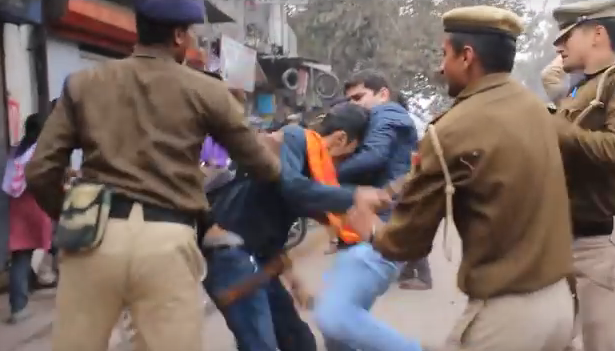
The Delhi Police shakha (branch) of the RSS protected its masters in Jhandewalan on the afternoon of Saturday, the 30th of January by mercilessly thrashing several of you – unarmed, peaceful students demonstrating against the complicity of the far right, especially the ABVP, (the RSS aligned student organization) and ministers of the BJP government at the Centre (who obey every ‘cultural and educational’ diktat of the RSS hydra) in the circumstances that drove the Dalit student-activist Rohith Vemula to suicide in Hyderabad Central University (HCU)
It is an undisputed fact that the ungainly khaki shorts of the far-right RSS (Rashtriya Swayamsevak Sangh / National Volunteer Force) militia’s uniform were inspired by the working attire of rank and file policemen in British India.
But for those of us who are new to this conversation, (because the whole world is listening), a brief recap, as they say on TV.
You, students (aligned to different organizations, as well as individuals) from all the major universities in Delhi (JNU, DU and JMI) had gathered at Ambedkar Bhavan in Central Delhi intending to march peacefully to the RSS headquarters at Jhandewalan on Saturday This was planned as an intrinsic part of an All-India programme of peaceful protests called by a ‘joint action committee of students for social justice’ demanding justice for Rohith Vermula on 30th January, which also happened to be Rohith’s birthday. The protest of the 30th of January was a logical continuation of what had started at the HCU campus, and that had spread, campus by campus, throughout the country, through day protests and night vigils, through speech, song and silence, in a splendor of dignified, angry, calm, considered actions and gatherings.
But not only were the students in Delhi not allowed to march to exercise constitutionally guaranteed rights to assembly and peaceful protest, rather, more disturbingly, a clearly disproportionate level of violence was unleashed to prevent them from doing so. What should have been a normal, routine, protest meeting turned into vortex of unprovoked violence unleashed by ‘the forces of law and order’. Women students were manhandled and abused by male police personnel. Journalists were assaulted. Cameras were broken. Men in plain clothes, clearly visible in a video that has gone viral on social networks, who the protesting students allege are RSS goons, joined the policemen in attacking the students. The police did nothing to stop, or restrain them. It allowed some men to take the law into their own hands in order to stop a peaceful protest. In doing so, the Delhi Police stands accused of violating the very structure of ’law and order’ that it is supposed to uphold. They have proved themselves to be nothing others than goons in uniform, acting in concert with goons in mufti.
The RSS has issued a customary and shameless denial that its members had any hand in thrashing the unarmed students. Since the RSS maintains no record of ‘members’, any RSS activist can do anything in any riot or situation of violence and then have higher office bearers resort to denials. This modus operandi of ‘plausible deniability’ is nothing but standard operating procedure as far as the sangh is concerned. Meanwhile, RSS-ABVP-BJP spokesmen, and key ministers of the Modi government (Smriti Irani and Sushma Swaraj) have continued to slander the spontaneous students movement that has emerged in rage from the grief over Rohith Vermula. They have continued their barrage of innuendo against Rohith and his grieving mother especially in connection with Rohith’s Dalit identity.
The Delhi Police (DP), on its part, initially suggested that the conflict near Jhandewalan occurred because of ‘tensions’ between two factions within the protesting students, one keen to contain the demonstration, and another eager to take it forward. This was exposed to be a lie when all the different student organizations present at the protest clearly stated that there were no ‘differences’ between them with regard to the conduct of the protest. It is well known that the Delhi Police apparatus has greater competence when it comes to wielding lathis in comparison to when it comes to bare faced lying. Someone should teach at least a few DP officers to occasionally aspire to a slightly higher standard of untruth on camera than they are accustomed to deploying on a routine basis in the lower courts of the capital. As of now, the police commissioner, who said he was unaware of what had been going on, has suggested that an internal enquiry will be conducted. The report of that enquiry can be predicted in advance – “anti-social and anti-national elements within the protesting students created a provocative situation…some students attacked some other students…the police personnel acted (with utmost restraint) to uphold law and order…”. A case of rioting, obstructing police personnel on duty and violating section 144 (prohibiting assembly of more than a certain specified number of persons) will in all probability be filed against a group of unknown persons. And so on.
While this recent incident of police-sangh brutality seems to have caught the attention of the mainstream media at last, it needs to be understood that this is only the latest instance of a long chain of events which we can begin to more accurately describe as a war being conducted by the Modi regime against the young. Perhaps in consonance with the great traditions that they lay exclusive claim to, they should call it ‘Operation Ekalavya’.
In recent months, Operation Ekalavya has meant that universities have suspended students, thrown them out of hostels and withdrawn fellowships as punitive measures (as happened in HCU with Rohith and his comrades). It has meant that administrators and student politicians affiliated to the ABVP have humiliated and attacked students on casteist, sexist and communal lines. That police have repeatedly entered university campuses, drenched students with water cannons on the streets of cities, conducted severe lathi-charges, undertaken pre-dawn swoops and detentions, taken students into custody and attacked peaceful gatherings with tear gas shells.
This has happened for any number of reasons – to protect politically connected administrators complicit in protecting those accused of sexual harassment (for instance in Jadavpur University, where the Trinamool Congress has mimicked the BJP in the way it handled dissent) – to break the spine of the ‘Occupy UGC Movement’ that refuses to lie low in campuses all over India – to measures undertaken to bolster the presence of incompetent favorites of the regime in power at the centre – as in the official responses to the protests at FTII.
In fact the momentum of attacks on students and young people has shown no sign of slowing down in recent days. One would have thought that given the rage that broke out in response to HCU’s shameless conduct with Rohith Vemula, university administrators and others with influence and power on campuses might have acted (in their own self interest, for the sake of maintaining a semblance of order) with a degree of restraint. That has not been the case. In fact, authorities have acted provocatively, and with a deliberate intent to scare students. For instance, students in Haryana Central University, (at the Mahendragarh Campus) were not only not allowed to take out a silent candle lit march to express their grief for Rohith Vemula, the organizers of the march were threatened by ABVP members who filed police complaints against them, university authorities also threatened them with suspensions and other punitive measures. A few students were even made to sign undertakings, under duress, to the effect that they would neither participate in nor organize such events while in the university. Similar threats were also made to students and faculty trying to organize a peaceful meeting in Udaipur. Police and RSS members assaulted students taking out a protest march in Kolkata, exactly as they did in Delhi on the 30th of January.
What the events of the last few days reveal is a pattern that has been visible for a while now to anyone following what is going on in academic life in India. Across India, in university and college campuses, on streets and in public spaces, the current regime has unleashed a systematic assault on the young, and this includes both young students as well as young workers. It has made attempts to deprive researchers of fellowships (which has led to the ‘Occupy UGC movement’ , it has placed tight controls on freedom of expression in university campuses and workplaces, it has tried to police every aspect of the social, personal and political lives of students and young working people. It has assaulted people gathered to celebrate love, freedom, equity and dignity on campuses. It has arrested young workers who have tried to protest against inhuman working conditions. It has heaped casteist abuse and humiliation on dalit students and and sought to drive terror into the hearts and minds of students and young people from ethnic, religious and sexual minorities. It has especially sought to curtail the mobility and personal autonomy of young women.
What should have been a normal, routine, protest meeting turned into vortex of unprovoked violence unleashed by ‘the forces of law and order’. Women students were manhandled and abused by male police personnel. Journalists were assaulted. Cameras were broken. Men in plain clothes, clearly visible in a video that has gone viral on social networks, who the protesting students allege are RSS goons, joined the policemen in attacking the students.
Contrary to what many of the idiots who appear as talking heads on television screens believe, I suspect that the Modi regime has come to recognize that it actually does not enjoy the support of a substantial section of the young. No amount of spin doctoring, ad copy and PR can actually alter that fact. The regime’s intense and pathological hatred of the normal life of young people in campuses all over India is indicative of the depth of its paranoia. And its stupid, clumsy responses to the life of the young, are its desperate attempts to dominate the one sphere of social life (in universities and higher education) where it feels it does not yet have total control.
Modi and his cronies are confident about the fact that their nonsense gets taken seriously in board-rooms, editorial offices, barracks, prisons, court-rooms and in the labyrinth of the bureaucracy, but they know that the places that they get laughed at routinely, on a daily basis is on campuses, workplaces and factory shop-floors – which is where the young gather. Unlike factories (where trade unions, who are unable to adjust to the realities of contractualization and in formalization, and are consequently no longer necessarily key loci of dissent, which has moved to other informal organizational forms) university campuses are still venues of a kind of formal political life around student organizations. The regime has understood that its promise of ‘better days’ has been seen through for the sham that it is, especially by the young, who actually have a real stake in the future. Coupled with this, as the sociologist Sanjay Srivastava has recently said, there is now, finally, thanks to reservation, a real presence of students from economically and socially deprived sections of society in higher education and research. These students, many of them from dalit backgrounds, know better than anyone else that the talk of ‘good days’ is only fakery. The radicalization of students like Rohith Vemula is a living example of this process at work.
Of late, the role played by Dalit and Ambedkarite student groups, increasingly in dialogue with a new kind of culture of independent left mobilization on campuses, has been the biggest thorn in the side of the effort to enforce what we might call the Modirani (Narendra Modi + Smriti Irani) consensus about the contours of higher education. This is important for the Modi regime for two reasons – firstly, if successfully implemented, it enables the regime to have a greater control over culture and the symbolic and intellectual engines of social life, and secondly, it also enables it to dominate the very spaces where the articulate elites (administrators, journalists, judges, civil society activists) of the near future will emerge from. The favorites of the regime know well that they have a real problem as far as the ‘quality’ of people who come up the standard ‘sangh’ structure. Most of them are inarticulate, ill-informed morons, and few have a pulse on life outside shakhas. They are not the best material to run a power structure with. Hence the desperate measures, implemented primarily through the ABVP, to get control, over the material, political and imagined life of university spaces.
It is not that ABVP activists are not young people, but that by aligning themselves with the active machinery of repression in universities, they are given an opportunity to quickly come into the political notice of BJP apparatchiki. This temptation to take a ‘short cut’ to a possible political career with the BJP acts as an incentive even insofar as the violent implementation of measures that are actually counter to the interests of all students qua students is concerned. The ABVP activist who willingly goes along with measures to destroy the functioning of universities, supports cuts, repressive administrative measures and constraints on student life is doing so only because he (and it is usually he) is promised a leg up in what is promised as a lucrative political career in the BJP, despite the fact that these measures actually hurt his interests as a student. (This is by no means particular to the ABVP and the BJP alone, the career of many SFI activists during the time that the CPI-M destroyed universities and academic life in West Bengal, or the career profile of a successful NSUI activist under a Congress dispensation would reveal features identical to this general pattern). At present, this leads to a kind of competitive thuggery, and a constancy of internal one-upmanship within the ABVP on campuses. With rival factions and leaders within the ABVP competing with each other to show who can be most disruptive, and consequently, who can obtain the greatest fraction of political patronage from a senior BJP politician. The chain of events that led to Rohith Vemula’s tragic suicide, with ABVP leaders ratcheting up the levels of obstruction to normal student political activity, including involving Bangaru Dattatreya, a union minister and a senior BJP leader, essentially to settle a petty campus score is clearly indicative of the consequences of this mode of operation.
There is now a chain of command that originates from the highest level of governance (cabinet ministers like Smriti Irani and Bangaru Dattatreya) and filters down to classrooms and canteens, mediated through the local ABVP ‘adda’ on a campus. It is this chain of command that disrupts and tries to dominate universities and colleges. This is the front-line of the war on the young, where some of the young also get used, as quislings and cannon fodder.
This war has only started, and its only going to get more ugly. Contrary to what a list of forty busy body courtiers suggest, the provocations in university campuses across India are not actually coming from the student opposition, it is coming from those close to power. The student groups who find themselves in opposition are doing all the little things that student groups always do – making posters, organizing events, inviting speakers, holding screenings, doing campaigns in classrooms and hostels, along with studying, going to the library, hanging out in canteens and undergoing all the personal and social ups and downs that striate the lives of young people all over the world. It is the student activists close to the ruling dispensation that act as obstructive forces, disrupting the normal rhythm of life in campuses.
What this means is that had the ABVP activists in Hyderabad Central University simply held a screening in opposition to Rohith Vemula and his friends’ attempt to screen a film on campus on the Muzaffarnagar Riots, or had they held a counter-meeting to a discussion that engaged with Yakub Memon’s hanging, we would not have had to come to this pass in Hyderabad. Instead of acting in a spirt of convivial but intense agonism, as normal student groups do – which is to say – to put up a poster in opposition to a poster, or to organize a meeting or screening to oppose a meeting or a screening, to share in the normal polemical life of a campus, they violently opposed the normal processes of student activism. They used their proximity to power, both administrative and political, to repress the intellectual and moral lives of their fellow students. It is this that led to the drama of suspension, expulsion from hostels, curtailment of dues and the administratively enforced, politically motivated social boycott that resulted in Rohith’s death. This is the kind of collateral damage that the war on the young is extracting routinely from our university spaces.
The Modi regime, as of now shows no sign of moderation or intelligence, and seems hell-bent, on provoking even more confrontations. The student opposition cannot afford to let its guard down. If it does, the universities will turn into mediocre teaching shops with shakhas attached to them.
This may require an escalating program of teach-ins, discussions and co-ordination between students, faculty and staff in universities to defend academic life from the corrosive influence of the Sangh Parivar and the Modi Regime. It will certainly require an insistence that there can be dialogue with the authorities only subsequent to the resignations of Smriti Irani and Bangaru Dattatreya – the two union ministers directly culpable for the situation that led to Rohith Vermula’s death. It can only express itself through an attitude of zero tolerance towards police-sangh violence against peaceful student protestors. This requires the immediate suspension of the police officers and authorities who commanded the ‘I-2-3 – Charge’ on unarmed students. It requires a serious investigation of the collusion between the police and the RSS.
This morning, at eleven, there is a call for students to assemble in protest at the Delhi Police Headquarters. Gather there, dear students, peacefully, but in rage, to register your disgust with the war the regime has declared on you. If you are listened to in the coming days, then you have the option to recognize the restoration of a certain kind of normalcy in the universities. If you are not listened to, you have the option to recognize that it is this regime that is transforming the spaces of higher education into zones of abnormal confrontation. If, in order to then defend the space of the university from further attacks you find yourself needing to transform the terms of engagement by taking your dissent outside the walls of the university and into every pore of society then only this regime, not you, will be called upon to answer for the situations that come to pass. What is at stake is all our futures, because you, more than anyone else can stake your claim to the republic of the future.
A few years ago, in the winter of 2012-2013 you, the young people of Delhi had gathered, many times, and in the face of gross violence, to express your solidarity with a young, then unnamed woman who had come to represent through her injured self the agonies that patriarchy unleashes on to the world. At that time, it was said, by some, that your assemblies were gatherings of the elite, that they did not represent wider solidarities. You proved those cynics wrong then, you are proving them wrong again. By making the substance of the assertion of a Dalit life the criterion for judging the way that the regime treats the young, the future, you have given everyone a chance to re-write the language of solidarity in this land.
Three years ago, you had lain siege to Raisina Hill, the very epicenter of power in this vast land, and had shaken that power to its foundations, for a few days. Is it time now for you to gather again, in even larger numbers, to insist that you will not let the evil of caste and its brokers, prejudice and the obscene fantasies of a fascist makeover of our social universe ever take root? Is it time once again for you to show us that the world, and the stars that Rohith Vermula was so drawn to can be re-imagined on the streets of Delhi, on the gradient of Raisina Hill?
The Modi regime may have started this war, Smriti Irani may have conducted a few maneuvers, but you – young people of oppressed castes and classes from Delhi, Hyderabad and everywhere – you who are students, workers, women, queer, friends and comrades, rivals even – all you lives that can share what it means to know yourself and others as dalit, without state or estate – who gather as beautifully as a rain-storm on the horizon of a parched land, to annihilate caste and the castes of mind that perpetuate violence and indignity of all kinds, you may yet be the ones who will bring it to an end,
Hyderabad, Jhandewala, Raisina Hil
Everywhere that you appear, you shall prevail, you shall win.
.jpg)