Home Blog Page 2619

India’s Sixth of December

0

The sixth of December is a day that is remembered by very large numbers of people all over our country for very different reasons and in very different ways.  There are those, mostly poor and oppressed, who mourn the sixth of December as the death anniversary of Dr. Babasaheb Ambedkar, his ‘Nirvan Diwas’.  The word ‘Nirvan’ was earlier associated with the passing away of the Buddha and is now used to honour the passing away of Dr. Ambedkar soon after his historic conversion to Buddhism, along with several of his followers. 

During a recent session of Parliament, held to commemorate the Constitution and pay homage to Dr. Ambedkar; and again, during the Parliamentary debate on ‘Growing Intolerance’, Babasaheb’s name was mentioned repeatedly.  It was recognized by all that he had made the greatest contribution to enshrine the principles of Democracy, Equality and Fraternity in the Constitution and fulsome praise and accolades were bestowed upon him, speciallyby members of the NDA II (read BJP) Government.  No one, however, except for Sitaram Yechury (CPIM, General Secretary) referred to his conversion to Buddhism or the reasons for this.

Despite the enormous and significant role he played in drafting the Constitution, Babasaheb had to, eventually abandon the religion of his forefathers.  Throughout his life he made untiring and valiant efforts to bring about a change in the attitude and thinking of high caste Hindus through argument, writings, historical research and continuous appeals to reason, humanity and compassion. The drafting of the Constitution and Hindu Code Bill were, of course, the most important of these efforts. 

Unfortunately, the bill did not bring about any real change of heart, mind and outlook.  Every one of his efforts had aroused the most vicious opposition and calumny.  Every promise that the Constitution made to bring about equality between all citizens was opposed tooth and nail during the Constituent Assembly debates by conservative elements determined to thwart all efforts to legislate equality into the existing unequal social hierarchies that they were determined to preserve.

The Hindu Code Bill was met by such howls of protest both inside the Constituent Assembly and outside on the streets that it had to be abandoned. Babasaheb resigned as Law Minister saying in protest that, “The Hindu Code was the greatest social reform measure ever undertaken by the legislature in this country. No law passed by the Indian Legislature in the past or likely to be passed in the future can be compared to it in point of its significance.

To leave inequality between class and class, between sex and sex, which is the soul of Hindu Society untouched and to go on passing legislation relating to economic problems is to make a farce of our Constitution and to build a palace on a dung heap.  This is the significance I attached to the Hindu Code.” (quoted from Dr. Ambedkar’s speech when he resigned from the first Indian cabinet of ministers).

The failure of his repeated and untiring efforts to bring about a change in the hearts and minds of his opponents was not unforeseen as far as Dr. Ambedkar was concerned.  As early as 1935, he had announced to his followers that although he had been born a Hindu he would not die as one because he was determined to abandon a belief system that refused to accept the principle of equality.  Finally, on the October 2, 1956, he embraced Buddhism along with many hundreds of thousands.  Tragically, within two months, on December 6, l956, he was no more.

On the same day, 36 years later, the Babri Masjid was destroyed by members of the Sangh Parivar.  This event is also commemorated, across the country, by some as “Shaurya (Valour) Diwas” and by others as a day of mourning.

There are also those, however, who feel that the choice of the date for the destruction of the mosque was no co-incidence.  They believe that it was Dr. Ambedkar’s Constitution that was the real target of the attack by the Sangh.  This is based not only on the choice of date but on the fact that the Sangh Parivar members who destroyed the mosque owed allegiance to the same RSS that had been in the forefront of the opposition to both the Constitution and the Hindu Code Bill.

The most uncompromising opposition both to the Constitution and the Hindu Code Bill came from Shri Golwalkar, head of the RSS.  Along with his supporters, he held fast to the view even after the Constitution was passed, that it was the Laws of Manu, the Manusmriti, alone that could be accepted as Law by Hindus.

As far as the Hindu Code Bill is concerned, Golwalkar castigated it by saying that it would reduce Hindu men to puny weaklings.  His views have never been repudiated by the Sangh Parivar. Today, Home Minister Rajnath Singh’s speech in Parliament is significant because while he heaped praise on the Constitution and Dr. Ambedkar, he also sharply criticized the later inclusion of the work ‘secular’ to describe the Republic that brought the Constitution into existence.

The reasons he gave for this criticism should be examined seriously by all Indian citizens.  He said “‘Secularism’ is the most misused word in the country… India’s religion itself is dharma nirpeksh. ..”Does the Constitution permit India to have a religion?  If India has a religion then can it continue to abide by its Constitution? Is it a co-incidence that the Home Minister who has now made known his commitment to a Religious State or a Hindu Rashtra was present at the site of the demolition of the mosque (Babri Masjid) on December 6, 1992?

Even at the time of its passage, Dr. Ambedkar feared for the future of the Constitution because he did not believe that the soil of India which had given birth to the worst forms of inequality would readily accept the seeds of democracy and fraternity.  Those who had opposed him then have given notice, time and again, that they continue to challenge the writ of this foundational doctrine.
 

The Evils of Caste

0


We reproduce below excerpts from the work of one of the oldest authorities on the Marathas, historian Jadunath Sarkar. In two books on the issue, the historian has dealt with the ticklish issue of caste which affected Shivaji’s acceptance as a formal ruler.

A deep study of Maratha society, indeed of society throughout India, reveals some facts which it is considered patriotism to ignore. We realise that the greatest obstacles to Shivaji’s success were not Mughals or Adil Shahis, Siddis or Feringis, but his own countrymen. First, we cannot be blind to the truth that the dominant factor in Indian life — even today, no less than in the seventeenth century — is caste, and neither religion nor country. By caste must not be understood the four broad divisions of the Hindus which exist only in the textbooks and the airy philosophical generalisations delivered from platforms. The caste that really counts, the division that is a living force, is the sub–division and sub–sub–division into innumerable small groups called shakhas or branches (more correctly twigs or I should say, leaves, they are so many!) into which each caste is split up and within which alone marrying and giving in marriage, eating and drinking together take place…
 
And each of these smallest sub–divisions of the Brahman caste is separated from the other sub–divisions as completely as it is from an altogether different caste like the Vaishya or Shudra, e.g., the Kanyakubja and Sarayupari Brahmans of northern India, the Konkanastha and Deshastha of Maharashtra.
Personal Jealousy Hindering Shivaji

Shivaji was not contented with all his conquests of territory and vaults full of looted treasure, so long as he was not recognised as a Kshatriya entitled to wear the sacred thread and to have the Vedic hymns chanted at his domestic rites. The Brahmans alone could give him such recognition, and though they swallowed the sacred thread they boggled at the Vedokta! The result was a rupture… Whichever side had the rights of the case, one thing is certain, namely, that this internally torn community had not the sine qua non of a nation. 
Nor did Maharashtra acquire that sine qua non ever after. The Peshwas were Brahmans from Konkan, and the Brahmans of the upland (Desh) despised them as less pure in blood. The result was that the state policy of Maharashtra under the Peshwas, instead of being directed to national ends, was now degraded into upholding the prestige of one family or social sub–division.

Shivaji had, besides, almost to the end of his days, to struggle against the jealousy, scorn, indifference and even opposition of certain Maratha families, his equals in caste sub-division and once in fortune and social position, whom he had now outdistanced. The Bhonsle Savants of Vadi, the Jadavs of Sindhkhed, the Mores of Javli, and (to a lesser extent) the Nimbalkars, despised and kept aloof from the upstart grandson of that Maloji whom some old men still living remembered to have seen tilling his fields like a Kunbi! Shivaji’s own brother Vyankoji fought against him during the Mughal invasion of Bijapur in 1666.

Shivaji’s religious toleration and equal treatment of all subjects
He stands on a lofty pedestal in the hall of the worthies of history, not because he was a Hindu champion, but because he was an ideal householder, an ideal king, and an unrivalled nation-builder. He was devoted to his mother, loving to his children, true to his wives, and scrupulously pure in his relations with other women. Even the most beautiful female captive of war was addressed by him as his mother. Free from all vices and indolence in his private life, he displayed the highest genius as a king and as an organizer. In that age of religious bigotry, he followed a policy of the most liberal toleration for all creeds.

The letter which he wrote to Aurangzeb, protesting against the imposition of the poll–tax on the Hindus, is a masterpiece of clear logic, calm persuasion, and political wisdom. Though he was himself a devout Hindu, he could recognise true sanctity in a Musalman, and therefore he endowed a Muhammadan holy man named Baba Yaqut with land and money and installed him at Keleshi. All creeds had equal opportunities in his service and he employed a Muslim secretary named Qazi Haidar, who, after Shivaji’s death, went over to Delhi and rose to be chief justice of the Mughal Empire.

There were many Muhammadan captains in Shivaji’s army and his chief admiral was an Abyssinian named Siddi Misri. His Maratha soldiers had strict orders not to molest any woman or rob any Muhammadan saint’s tomb or hermitage. Copies of the Quran which were seized in the course of their campaigns were ordered to be carefully preserved and then handed over respectfully to some Muhammadan.”
(From Jadunath Sarkar’s book, ‘House of Shivaji’).

The Coronation of Shivaji And After (1674-1676)

Why Shivaji wanted to be crowned

Shivaji and his ministers had long felt the practical disadvantages of his not being a crowned king. True, he had conquered many lands and gathered much wealth: he had a strong army and navy and exercised powers of life and death over men, like an independent sovereign. But theoretically his position was that of a subject; to the Mughal Emperor, he was a mere zamindar. He could not claim equality of political status with any king.

Then again, so long as he was a mere private subject, he could not, with all his real power, claim the loyalty and devotion of the people over whom he ruled. His promises could not have the sanctity and continuity of the public engagements of the head of a State. He could sign no treaty, grant no land with legal validity and an assurance of permanence. The territories conquered by his sword could not become his lawful property, however undisturbed his possession over them might be in practice. The people living under his sway or serving under his banners could not renounce their allegiance to the former sovereign of the land, nor be sure that they were exempt from the charge of treason for their obedience to him. The permanence of his political creation required that it should be validated as the act of a sovereign.

Shivaji recognized by Gaga Bhatta as a Kshatriya
But there was one curious hindrance to the realization of this ideal. According to the ancient Hindu scriptures, only a member of the Kshatriya caste can be legally crowned as king and claim the homage of Hindu subjects. The Bhonsles were popularly known to be neither Kshatriyas, nor of any other twice-born caste, but mere tillers of the soil, as Shivaji’s great–grandfather was still remembered to have been. How could an upstart sprung from such a Shudra (plebeian) stock aspire to the rights and honours due to a Kshatriya? The Brahmans of all parts of India would attend and bless the coronation of Shivaji, only if he could be authoritatively declared a Kshatriya.

It was, therefore, necessary first to secure the support of a pandit, whose reputation for scholarship would silence all opposition to the views he might propound. Such a man was found in Vishweshwar, nicknamed Gaga Bhatta, of Benares, the greatest Sanskrit theologian and controversialist then alive, a master of the four Vedas, the six philosophies, and all the scriptures of the Hindus, and popularly known as the Brahma–deva and Vyas of the age. 

After holding out for some time, he became compliant, accepted the Bhonsle pedigree as fabricated by the clever secretary Balaji Avji and other agents of Shiva, and declared that Rajah was a Kshatriya of the purest breed, descended in unbroken line from the Maharanas of Udaipur, the sole representatives of the solar line of the mythical hero-god Ramchandra. His audacious but courtierly ethnological theory was rewarded with a huge fee, and he was entreated to visit Maharashtra and officiate as high priest at the coronation of Shiva. He agreed, and on his arrival was welcomed like a crowned head, Shiva and all his officers advancing many miles from Satara to receive him on the way.

(From ‘Shivaji And His Times’ by Jadunath Sarkar).
 
(Archived from the October 2001 issue of Communalism Combat)
 

Thanks but no thanks: Leading activist declines state honour

0


Jagmati, general secretary, AIDWA writes to Maneka Gandhi protesting government’s anti-people politics

 
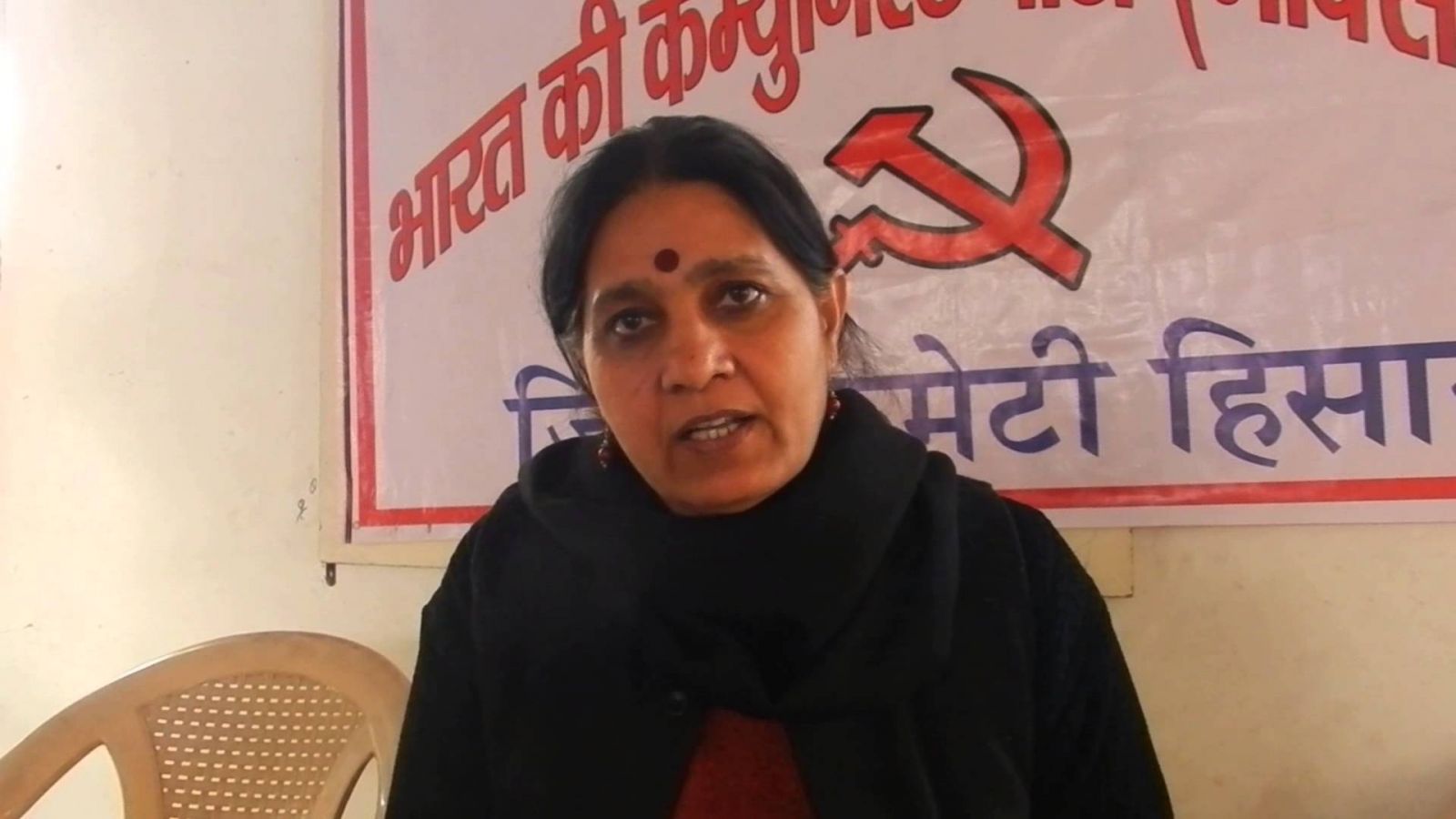
Jagmati Sangwan, a fiery activist and academic from Haryana who has initiated and led the campaign and struggles against honour crimes and the role of khap panchayats has declined to be honoured by the Modi government
 
In a polite but strong letter to the union minister for Women and Child Welfare, Maneka Gandhi, Jagmati Sangwan has turned down a potential honour from the Modi government. Around December 10, 2014, International Human Rights Day, the central government had, through a letter informed her that she had been shortlisted  as part of 100 Women Achievers to be honoured in the category of 'Women in Public Life'.

Four days later, on December 14, 2015 she has, in a letter to Maneka Gandhi politely but firmly declined the honour. Her letter available with Communalism Combatonline states,

“I would like to very humbly request you to take my nomination out of this award process. I am writing it to you with a heavy heart in the background of Haryana governments decision to put conditions on contesting panchayat elections which in effect have meant that 83% of Scheduled Caste women, 72% of the General category women, 71% of Scheduled Caste Men and 56% of general category men  and overall 67% of general citizens in the state cannot contest the local elections.

As you may be aware, it was after long fought struggle and assertion by women that their participation in the local bodies was ensured. However, such a decision taken by the state government would only be detrimental to what we have achieved so far.  
You are also aware about the massive fund cuts that the central government has undertaken in women friendly acts in the 2015 budget.

The day to day survival of women has only become more difficult in recent years as we feel that the central government has pulled itself (away) from its responsibility to safeguard the interests of women and other vulnerable sections including children.   
In this present scenario, I do feel that my work along with millions of other workers of my organisation is in complete contradiction to what your government is aiming to achieve.  Therefore, I would like to keep myself away from any award conferred by the government at the present juncture.”
This missive from a woman from the grassroots representing India’s largest woman’s organisation, is a blow to the Modi regime, keenly seeking respectability and considered, otherwise to be a master of symbolism.
 

Homeless and Cold

0

Demolitions violated the law, the Shakur Basti Demolition


Image Courtesy: indiatoday.in
 
Communalism Combatonline team
 
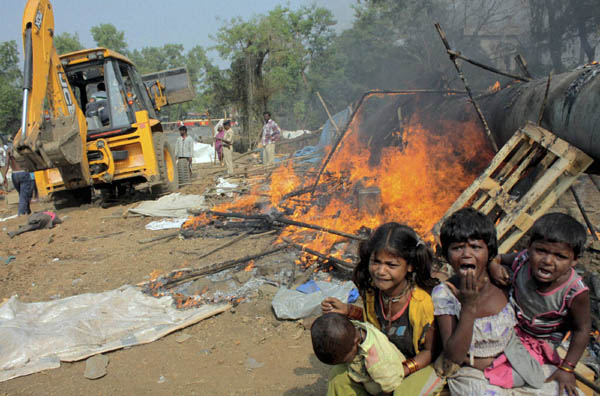
Six month old Rukaiyya died as her parents Mohammad Anwar and Safeena Khatoon rushed to save what they could as of their shanty as their home faced demolition by a bulldozer during a drive by the Indian railways on Sunday, December12 at the Shakur basti slum in north west Delhi raising serious questions of the fundamental rights of the homeless in the country. The temperature in the capital had dipped to a bitter 6.8 degrees Celsius on the day the authorities decided turn their lathis and bulldozers on the homeless.
 
Two demolitions, in the span of a fortnight smack of similar arbitrariness in action. One demolition took place at Belagaon on December 1 (conducted by the DDA), and the second by the Railways on Shakur Basti on December 12, 2015. A question that repeats itself every time such a demolition drive is undertaken is why such brute demolitions of home and hearth take place either during the pouring rain or the bitter cold.
 
The Railways and the Delhi Development Authority (DDA) are the two authorities that carried out this demolition. While the former is under the union government, the second is under the Lieutenant Governor of Delhi. Several judgements of the Delhi High Court including Sudama Singh and Ors.vs. Govt. of NCT Delhi (11 February 2010), have ordered for due process to be followed before any such action is undertaken.
 
According to these judicial pronouncements, due process includes an adequate survey, notice, and rehabilitation to be carried out before any demolition/eviction in Delhi. The Delhi Housing Rights Task Force (DHRTF)—a collective of individuals and organizations concerned with, and working to protect and promote, the human right to adequate housing in Delhi and across India has strongly condemned this action at the peak of winter. Besides the DHRTF has said that both these demolitions without due process and in violation of the Constitution of India, court judgements, and international human rights standards, including the United Nations Basic Principles and Guidelines on Development-based Evictions and Displacement.
 

Judiciary to the rescue, again

PIL against demolition

S Muralidhar and Vibhu Bakhru, Delhi High Court:
“What was the tearing hurry to demolish in December? …You really don’t care about the people, you just want to remove them,…There were a number of children suffering out there”

“Was there any survey?..“Railways had no business removing people”. Those who were forcibly evicted were protected from removal under the Delhi Urban Shelter Improvement Board (DUSIB) policy and the Delhi Laws (Special Provisions) Act which provides for protection of jhuggi clusters which existed before 2006.

“You are forgetting what your role as a public authority is. Your role is to ensure that people who satisfy the eligibility criteria don’t get removed. Just because you’re the Railways doesn’t mean the law doesn’t apply to you,” the bench said. The court directed that “responsible senior officials” from the Railways, Delhi Police and DUSIB be present in court Wednesday “with all relevant documents” to answer queries on the demolition drive.
 
Counsel for the Railways (evicting authorities) Jagjeet Singh: I have not received any briefing from officials except for the information that notices had been issued prior to the demolition.

Jagjeet Singh : Railways “not responsible for rehabilitation” since it did not have alternate land. Singh told the court that Railways had “paid 11 crore to the DUSIB” to remove the jhuggi cluster but the agency failed to do it.

DUSIB counsel: We were not even been informed that the demolition drive was to take place.
Railways Counsel Singh:  The removal of the jhuggi cluster was “necessary” since it was “right next to the railway tracks.” “We had to remove them because they were in the safety zone… they were sitting on the tracks and stopping trains. There were also deaths,” Singh argued.
 
Bench refused to accept the argument.
 
Court: “Are they safe now? You have forced them to suffer and shiver in the cold. Every minute that they sped out in the cold counts,” the bench said. The Railways claimed that notices for pending demolitions had been issued in March and again in September, but the drive could not be carried out as Delhi Police delayed providing police personnel to support the demolition drive. “ The bench also refused to accept the argument that the demolition drive was undertaken under orders from the National Green Tribunal which last week imposed a fine of Rs 5 lakh on the Railways, and 1 lakh each on DDA and DUSIB for failing to clear jhuggi clusters near the railways tracks. The bench commented that the government “did not take action” on several orders issued by various courts “till heavy costs were imposed.” “Given the scale of the human tragedy, the court expects all parties to act in coordination to ensure that relief and rehabilitation are given to persons who lost their homes. This should be done without regard to the legality of the Shakurbasti slum as it existed,” the bench said.

(The PIL has been filed by Congress leader Ajay Maken through advocate Aman Panwar who sought court orders to “ensure” rehabilitation of the displaced residents of the jhuggi cluster)
 

People in Belagaon and Shakur Basti, however, were not even given sufficient time to remove their belongings before their homes were demolished. Affected families have been left out in the cold with no provisions for alternative housing or compensation for the loss of their homes and belongings.
 
Through this brazen action carried out on a cold winter’s day when the temperature was at 6.8 degrees Celsius, the state authorities have been in contempt of these judgements of the High Court. Besides these actions have violated, the human rights to adequate housing, information, security of the person and home, food, water and sanitation, health, education, work/livelihood, the right to reside and settle in any part of the territory of India, and most importantly, the right to life.
 
While a six-month-old baby girl was killed while the demolition was in progress, another young girl suffered serious injuries, as a result of which she has had to miss her school examinations. After the outcry, the police has registered a case under section 304 A (causing death due to negligence) at Punjabi Bagh police station. Anwar, the father of the small child has, in a statement said a tied bundle of clothes fell down on the girl sleeping on the floor as the family was in a hurry to vacate their shanty.
 
Delhi has a population of over 150,000 homeless people, only about two per cent of who are accommodated in shelters. It is a cruel irony that the central government is demolishing homes and rendering more people homeless despite its claims to provide ‘Housing for All.’
 
In a press release issued yesterday, the DHRTF has said that while the Delhi government has condemned this act of the Railways, and DDA has agreed to stall evictions during the winter, DHRTF believes that concerned officials of both agencies must be held accountable for the grave violations of human rights, and tried according to the law. This is especially important given the refusal of the Railways to accept responsibility for the death of the baby. Members of DHRTF also object to the statement made by the Minister for Railways in Parliament on December 14, 2015 that, “Such encroachments are the main source of garbage and open defecation, etc.” This reflects a very strong prejudice against the marginalised and homeless population of the city.
 
The Delhi Housing Rights Task Force had, in fact, written a letter to DDA on 1 October 2015, requesting the authority not to carry out any demolitions in Delhi. In particular, the letter stated: “Impose an immediate moratorium on all demolitions of existing settlements on all DDA land. The winter season is approaching and any further demolitions at this stage will result in thousands of people being left homeless on the streets of Delhi in the intense cold weather, exposing them to the risk of death, which is in violation of directives issued by the Supreme Court of India.”
 
Given the recent demolitions in Delhi, the DHRTF has submitted a list of the following demands to the Government of India:
1. Impose a moratorium on evictions in Delhi on all central government land (in accordance with the directive of the Delhi government).
2. Provide immediate relief, including accommodation, food, water, medical supplies, and healthcare to all evicted families.
3. Compensate the affected families for loss of their homes and belongings, and provide immediate assistance to help families rebuild their homes at the same site.
4. Provide alternative uniforms, books, and other educational material to children and ensure that they are able to resume school and appear in their examinations.
5. Give special attention to pregnant and lactating women, infants, children, older persons, persons with disabilities, and persons with illness/health concerns, Dalits, and minorities.
6. Coordinate with the Delhi government and the Delhi Urban Shelter Improvement Board (DUSIB), and provide all the necessary information and support to the affected families.
7. Ensure that all officials responsible for the demolition and loss of homes and life are investigated and tried according to due process of the law.
8. Ensure that provisions of Pradhan Mantri Awas Yojana (Housing for All by 2022) and the National Urban Livelihoods Mission – Scheme of Shelters for Urban Homeless are implemented in Delhi.
9. Make adequate budgetary provisions for low-cost housing, especially for in situ upgrading and construction of housing for the homeless. This should include hostels, women’s homes and shelters, family shelters, short-stay homes, rehabilitation centres, special homes for destitute and    marginalised groups, which are linked to livelihoods of the urban poor.
10. Ensure reservation for Economically Weaker Sections (EWS) housing in all real estate/housing projects and develop a human rights-based law to provide affordable adequate housing for EWS and Low Income Groups.
11. Implement orders of the High Court of Delhi and Supreme Court of India.
12. Implement international law and guidelines, including the UN Basic Principles and Guidelines on Development-based Evictions and Displacement.
 
Members of the Task Force have also called upon the government to ensure that it meets its commitment to protecting the human rights of all residents and takes immediate steps to provide restitution for the human rights violations resulting from its act of commission and omission.


References 

  1. Shakur Basti demolition drive: Children suffering in cold, you don’t care, Delhi High Court tells Railways. http://indianexpress.com/article/cities/delhi/shakur-basti-demolition-drive-what-was-the-tearing-hurry-delhi-high-court-raps-railways/
  2. Shakur Basti dwellers freeze in open after slum demolition http://timesofindia.indiatimes.com/city/delhi/Shakur-Basti-dwellers-freeze-in-open-after-slum-demolition/articleshow/50167165.cms 
  3. Shakur Basti demolition: Case lodged in toddler's death; slugfest between political parties  http://zeenews.india.com/news/delhi/shakur-basti-demolition-case-lodged-in-toddlers-death-slugfest-between-political-parties-intensifies_1834522.html