

Young Friends,
As in the preliminary remarks it was said that the concept of India is a growing one, I propose to discuss how the concept of India arose, how it developed and how India became a nation; and what are the dangers today that face the nation. We are at a very sad moment in our history. Rationalists—people who believe in science—like Dabholkar, Pansare and Kalburgi […Kalburgi very recently] have been murdered in our country. In the name of GauRaksha(cow protection), Mohammad Akhlaq has been murdered! So, our country’s name is being dragged into dirt and it is, therefore, time for all of us to reflect and consider what our country is about and how best it can be served.
We must remember that far from its becoming a nation in the relatively recent past our BJP friends and their RSS mentors are fond of saying that India was a nation since Rig-Vedic times. But, in fact, neither in the Rigveda nor in the other three Vedas, nor even in the Brahmana which followed them, or, even for that matter, in the still later Upanishads, is India mentioned at all. In the Rig Veda, there is not even a mention of any geographical region; but only rivers and tribes. Even Sapta Saindhava (seven rivers) did not mean the region of Punjab, as it meant later on, but just the main seven rivers that form the Indus. The area in which the Vedic hymns were written was limited to the Punjab and parts of Afghanistan, and it was a inhabited by migratory tribes; so there was not even the concept of a region, least of all, the concept of “country”.
As culture developed, political entities arose. The first name of our country was in Prakrit Sola Maha-Janapada (Sixteen Great States), which occurs in texts going back to 500 BC Remember, Solah is a Prakrit word and many of our languages, including Hindi and Urdu, go back to Prakrit. These maha-janapadas ranged from Kamboja or Kabul to Anga in eastern Bihar but they were confined only to northern India; and there was not yet any concept of India as we now conceive it. In some Dharma Søtras, the term Aryavarta, ‘the land of the noble,’ begins to occur and Manusmriti defined Aryavarta as the country from Himalayas to the Vindhyas; but then again it is only a large part of India and not the whole country that the term encompasses.
The first perception of the whole of India as a country comes with the Mauryan Empire. Those of you, who have studied Indian history would know that the inscriptions of the Mauryan emperor Ashoka range from Kandahar and north of Kabul to Karnataka and Andhra and they are in Prakrit, Greek and Aramaic. So it was with such political unity that the concept of India came, and its first name was Jambudvipa a name which Ashoka uses in his Minor Rock Edict-1, meaning 'the land of the Jamun fruit.' The term Bharata was also used in Prakrit in an inscription in Orissa, at Hathigumpha, of the Kalinga ruler, Kharavela in 1st century BC; that is the first instance of the use of Bharat, and Kharavela uses it for the whole of India. So, gradually the concept of India as a country began to arise and a cultural unity was also seen within it as religions like Buddhism, Brahmanism and Jainism spread to all parts of the country. Prakrit was spoken, at least literary Prakrit, all over the country, becoming its lingua franca. So, there were things which, as people could see, united us.
There were also foreigners who could see that this was a culturally distinct country and it often happens [and this is an interesting part] that foreigners regard a country much more easily than its natives because they realize that there is difference between, say, Indians and Persians; whether you went to the Punjab or the South, Prakrit was the literary language and Sanskrit the priestly language. So, it is the Iranians who first time gave us the name ‘Hindu’, and Hindu is the Persian form of Sindhu river, that is, the Indus River. So, every region east of the Sindhu river, which was called Hindu in ancient Persian, was ‘Hindu’ and from this the name, ‘India’ comes. For Greeks, Hindu became Indu as Greeks did not pronounce the initial ‘H’, and the Chinese name for India, ‘Intu,’ also came from the same source. And then came the later Persian name ‘Hindustan.’ Remember, there is no such word in Sanskrit as Hindusthan. Sthan always means in Sanskrit a ‘particular spot’.But ‘stan’ in Persian is a territorial suffix, so, we have Seistan, Gurjistan, Hindustan and so on. This name is used in Sasanid inscriptions in the fourth century AD. So these words and the word Hindu itself are of non-Indian origin. Those talk about Hindutva and rejection of everything foreign, forget that their own name Hindu is Iranian in origin, and is not found in Sanskrit before the fourteenth century. Its first use in Sanskrit inscriptions comes from the Vijaynagar Empire where the Vijaynagar emperors call themselves Hindu raya suratrana, ‘Sultans over Hindu Rays.’ They regarded themselves as Sultans and their subordinates as ‘Hindu Rays’. So, our country as its name indicates is of a composite nature, illustrated by the very name Hindu, derived from ancient Iranian, then used by Iranian and Arab Muslims, and entering Sanskrit usage only in the 14th century.
I say all this because it means that the concept of India as a country was ancient, the assertion made by Perry Anderson in his book The Indian Ideology that the India is a name given by foreigners particularly Europeans in modern times, is a totally misleading statement. It is particularly misleading because there is another very interesting matter: True, there was a conception of India in ancient times, even before Christ, but when was there a conception of love for India i.e. patriotism? It is surprising that throughout ancient India you have no patriotic verse in Sanskrit expressing love for India.
The first patriotic poem in which India is praised, India is loved, Indians are acclaimed is Amir Khusrau’s long poem in his Nuh Sipihir written in 1318. I am very sorry that now we are losing this heritage. How many people here would be able to read Amir Khusrau, and so appreciate that here is the praise for India for the first time in its history. What does Amir Khusrau praise India for? For its climate first of all which I think is very unconvincing statement, its natural beauty, its animals and along with its animals its women, their beauty as well as faithfulness. Then he comes to Brahmans. He praises their learning. He praises their language Sanskrit. He identifies India not only with Brahmans, but also with Muslims. Those who speak Persian, as well as those who speak Turkish, he says, are to be found throughout India. He praises all the languages of India from Kashmiri to Mabari i.e. Tamil. All these languages that were spoken in India, not only north India but also in the south India, are listed there. He called them Hindavi. He adds that besides these languages there is the Sanskrit language, which is the language of science, and of learning. And had Arabic not been the language of the Quran, he would have preferred Sanskrit to Arabic. He then says India has given many things to the world: India has given Panchtantra tales, as well as chess, and most surprisingly, he says India has given the world the decimal numerals what are known as Arab numerals or International numerals. He is correct in all the three points. And, as for decimal notation Aryabhatta theoretically recommended its use in 4th century AD.
In the Mughal period patriotism turned into a more insistent assertion particularly with Akbar and Abul Fazl. They argued that India is a special country, India has a large number of religious communities, and so there must be tolerance, under the umbrella of Sulh-i Kul i.e. absolute peace.
Other historians, other writers, other poets also praised India but not in such detail, not with such fervor and not, of course, with such mastery of language as Amir Khusrau. In 1350 the poet, Isami said in a poem dedicated to the praise of India.
“Praise be to the splendour of the country of Hindustan for paradise is jealous of the beauty of this flower garden.”
So, you begin to find patriotic verses. I will not go in to details because they are all in Persian and Persian for Indians is almost a dead language now.
In the Mughal period patriotism turned into a more insistent assertion particularly with Akbar and Abul Fazl. They argued that India is a special country, India has a large number of religious communities, and so there must be tolerance, under the umbrella of Sulh-i Kul i.e. absolute peace.’ It was argued that the King, like God, must favour all without discrimination. It was not only Akbar and Abul Fazl who made this assertion but even Aurangzeb (when a prince), in 1658, using it to win Rajput support. Does God, it was asked, discriminate between Muslims and non-Muslims when He makes rain to fall or make sun shine on people? Does the sun not shine on Hindus, and only on Muslims? Does rain fall only on Muslims and not on non-Muslims? Where God is fair, where God is just, how can the emperor as a representative of God be different? There was thus a concept not of a secular state but of a “tolerant state” suited to the conditions of India. It was again and again said that in India every religion must be tolerated. Jahangir says that in Turan it is, only Sunnis and in Iran it only the Shias who are tolerated, but in India every religion has to be tolerated. And there was thus something new in the Mughal experience, and political development.
Dr. Tara Chand asserted in his well-known book The Influence of Islam on Indian Culture, published in 1928, which has been republished by National Book Trust (NBT), that these two successively large states, the Delhi Sultanate and the Mughal Empire, by bringing all parts of India together created the sense of a larger “national allegiance”, an assertion he continues to make, even in the official history of Indian National Movement which he partly wrote and partly edited. This concept of political India, is also very strongly present in the revolt of 1857. Those of you who know or who have studied Modern India probably know that the rebellion of 1857 occurred with the revolt of the Bengal Army. A hundred thousand men out of 130 thousand, one of the largest armies in the world at the time, revolted and they were in majority Brahmans sepoys. But what did they say? ‘Let us go to Delhi and crown Bahadur Shah Zafar, emperor of India’. Those of you who know Urdu, I invite them to read the Delhi Urdu Akhbar, the major organ of rebels in Delhi. For five months, it was the major organ through which the rebels spoke and it is of ‘Hindustan’ that they speak. They quote Sa‘di who said that all human beings must be one—Ayza-e-Yak-Digar and—“they are organs of each other”; if one is hurt the other is hurt. So Hindus and Muslims, the rebels proclaimed, must come together. The Delhi Urdu Akhbar actually issued a public declaration against the Wahabis who said Hindus and Muslims could not join in a rebellion against People of the Book (English). And in fact, the Wahabis did not support the 1857 revolt! They occupied the Jama Masjid at Eid-uz-Zuha, and demanded cow slaughter. Bakht Khan, the mutineers’ commander drove them out and threatened to suppress them if they persisted in this demand.
Syed Ahmad Khan in his Sarkashi-e-Zila Bijnor says in fact that the whole people of India were guilty in 1857 and rightly punished. So whether they are rightly punished or wrongly punished, we must remember that those who revolted considered themselves to be standing up for India. In my old age, I have now often taken to quoting Urdu poets. I quote now a simple couplet of Bahadur Shah Zafar which he wrote after he became a prisoner and he wrote in commendation/ memory of fallen martyrs of the mutiny:
Ay Zafar Qayam rahegi Jab Talak Iqleem-e-Hind,
Akhtar-e-Iqbal Is Gul Ka Chamakta Jayega
[O Zafar, so long as the country of India endures, The star of the glory of this [fallen] flower would go on shining]
So, a concept of India, politically independent, is already present in 1857. But was it sufficient? If the rebellion of 1857 failed, the reason was partly that it was not supported in large regions of the country. While the Bengal Army revolted, Madras and Bombay Armies didn’t. The rebels in their reply to Victoria’s Proclamation of 1858 themselves spoke up for the whole of India reminding people of how the English had treated rulers from Tipu Sultan of Mysore to Dilip Singh of the Punjab. Yet though the rebel leaders thought of the country as a whole, the rebellion did not actually extend outside the Hindustani-speaking region.
Indeed, something more was needed to turn India from a ‘country’ into a ‘nation’. Two stages seem to me to be very important for such conversion. First of all, there had to be a realization that an independent country, a free India would be different. It would be better than India governed by the British. The whole point of very sincere people like Raja Ram Mohan Roy and Syed Ahmad Khan in supporting British rule was the belief that the British rule was the best India could get. It was for people to understand that we could have an India which could be much better off than that governed by the British. And here the role of people like Dada Bhai Naoroji, Ramesh Chandra Dutt, Justice Ranade and a number of others was extremely important. They showed that Britain was exploiting India. From 1874 to 1901, Dada Bhai Naoroji, the Grand Old Man of the Indian National Movement, wrote essays and papers showing how India was being exploited, as the very title of his book of 1901, Poverty and the UnBritish Rule in India; shows so clearly. India was being impoverished by the tribute British were extorting and the de-industrialization of India, caused through free trade. Dada Bhai Naoroji was least interested in his own community, Parsi community and you see him pleading the case of all kinds of Indians, Hindus, Muslims, Bengalis, Punjabis, etc. And that’s a particular thing for us to remember when we think of these early writers like Ramesh Chandra Dutt or others. They have no element of communalism in their approach. They were talking about all Indians. Yet they were speaking to English speaking people, and so to a very small minority. They were taking about peasants, poor people, unemployed, the weavers and spinners, but they were writing in English and so addressing only small circles of people. How could this audience be enlarged? Well.. one way was by supporting movements for social reforms. The initial voice was that of Ram Mohan Roy, who by the way knew Persian, Arabic, Sanskrit, English, French, and Hebrew, being really a polymath. He wrote his first book (Tuhfatu’l Muwahhidin)’ in Persian. He said in 1828 that Indians can’t be patriotic because they are divided up among castes. If caste affinities continue, how can there be any patriotism for the country? And therefore the social reform movement, particularly as initiated by Keshav Chandra Sen (1838-84) was so important. He has practically been forgotten today; but look at the man who at the age of 18 or 20 was writing that untouchability must be abolished, intercaste marriages should be allowed, women should have equality with men in inheritance and every other right, modern education should be spread among women. And he created a new Brahmo Samaj some of whose members by the way ate beef which show that there were Indians who could defy religious orthodoxy. But that was a small thing; the real thing was that they made social reform movement possible. Everywhere these demands arose—abolition of untouchability, equal rights for women, and modern education. And Keshav Chandra Sen said in 1870 that as social reform progresses, India will become a nation, since India could only become a nation if its division into castes and religious communities was overcome.
I will not go into the early nationalist movement here, or to people who sacrificed their lives for the nation. I will only refer to the Ghadar movement that gave us the largest number of martyrs (before the INA), after acts of armed violence occurred in Maharashtrians, and under revolutionary nationalists of Bengal. The Ghadar movement arose in the Punjab and among Punjabi settlers in Canada and the United States in 1913-15. Hindus, Muslims and Sikhs, particularly Sikhs, were greatly involved. But the biggest uprising was the mutiny in Singapore by the Muslim sepoys of 5th Light Infantry, inspired by the Ghadar propaganda and Ghadar agents. 45 of them were shot in a public display in Singapore after the Mutiny had been suppressed. By their bold demeanor in facing death, they deprived the British of the propaganda value of public executions. This was the biggest mutiny in the Indian army after 1857 with the largest number of martyrs. In the Punjab, itself and other places over 50 people were executed in 1914-15 including Sikhs, Hindus, and Muslims. But some of the records left by the Ghadaritis in India are painful to read. Few among the public were supporting them. The people whom they sought refuge with went and reported the police. They died seemingly unsung. Because the national movement was still limited to a very small number, India was a nation in the eyes of very small number of people. Here, I think, one must with almost unconditional, unqualified assertion, say that Mahatma Gandhi was one person responsible for bringing the masses in to the National Movement, and so hastening the true creation of India as a nation. In the whole of Indian history before 1913 was there a case of 200 women—Hindus and Muslim—offering to go to prison because Indians were being ill-treated in South Africa? There had been no such protest against the British in India. Against acts of gross injustice, had anyone mobilized 200 in India before? Speaking of 1913, 2000 miners marched into the Transvaal—the Great March of Indian Miners in South Africa. Indian history had never seen such a thing! Who was that man behind it? M.K. Gandhi had done it and he came to India in 1915 because after this agitation, the South African Prime Minister Smuts surrendered: he abolished Native Poll Tax, he legalized Indian marriages, and he gave some other rights. So Gandhi Ji came to India. In 1917, there was the Peasant Satyagraha in Bihar the Champaran Satyagraha, which he led. For the first time in India peasants were brought into a political agitation. And Gandhi said: “when I met peasants I saw God”. He realized that the national movement could only succeed if the Indian peasants and masses of the poor joined the national movement. So we had the April Satyagraha of 1919 and then the Khilafat and Non-Cooperation Movement of 1920. Can I quote an Urdu verse here. Akbar Allahabadi had once said that people regarded the British with such awe that he was led to say in his famous misra: Main To Allah Ko Collector Samjha—I thought God was a Collector—since there could not be anything more powerful, more absolute, than the English Collector. But when Gandhiji began his Non-Cooperation everything changed. Then Akbar Allahbadi wrote ‘Buddhu Miyan Bhi Hazrate Gandhi Ke Sath Hain, Ek Musht-e-Khak Hain Magar Andhi Ke Sath Hain’. What was earlier the role of Buddhu Miyan or the Ordinary Man in Indian history? Nothing! He was nowhere. He is now brought into history. And as more and more ordinary peasants, ordinary women, joined the national movement, India became more and more of a ‘nation’. Because there is no nation unless the larger number or mass of the people feel that they should be independent and they should rule themselves. With the poor coming to the movement, what do you offer them? What is to be their future? And here I submit JawaharLal Nehru is very, very important, for from late 1920s he urged that the National Movement should have precise goals for peasants, workers, women, etc. fully worked out. There are also others who were important; I am not saying that Gandhi and Nehru together make the Indian national movement, but they were in fact the two crucial persons.
Dr. Tara Chand asserted in his well-known book The Influence of Islam on Indian Culture, published in 1928, which has been republished by National Book Trust (NBT), that these two successively large states, the Delhi Sultanate and the Mughal Empire, by bringing all parts of India together created the sense of a larger “national allegiance”, an assertion he continues to make, even in the official history of Indian National Movement which he partly wrote and partly edited.
What did Gandhi Ji have to offer the common man? When you ask this difficult question, you will go back to his book Hind Swaraj (1909). Muslims may find it very gratifying that unlike other Congress leaders Gandhi supported the Indian Councils Act 1909 and its concessions to Muslims. He says, in Hind Swaraj, that those Hindu leaders who opposed the concessions to Muslims were wrong. If our Muslim brothers get extra benefits, what is the harm? Should your brother get something, ought you to be pleased or displeased?—This is what he says in Hind Swaraj. To him, India’s past is not Hindu or Muslim but both. India was very good under the rule of Maharajas and Badshahs who were guided by Pandits and Maulvis. I myself consider it a horrible state but in Hind Swaraj he considers the government of Badshahs and Maulvis as very good government as compared to that of the British and equates that with those of Rajas and Pandits. But he even doesn’t condemn the caste system although he opposed untouchability in South Africa and in India too right from the time of his arrival in India in 1915. But this is not criticized in Hind Swaraj. All these things he believed would be left to private efforts—his own constructive programme, not government. Government should keep aloof. It is only through private efforts that people should be served. Peasants should be served by the Zamindars or landlords who should be their custodians. In factories, workers should be helped by the owners who should see themselves as their custodians. But in real life this was not sufficient, this was not going to draw the masses to national movement. Here then was the importance of Left and particularly of Jawaharlal Nehru. Right from 1928, he demanded not only independence, he also demanded that in independent India, peasant should get land, workers should get protection, women should get equal rights with men, and there should be total democracy with mass suffrage.
These demands were pushed in the Congress by Jawaharlal Nehru with the help of the Left and actually the Karachi resolution of 1931—which I strongly recommend all to read—it was emphasized that the state should pursue “neutrality” towards religions, women should have equal rights with men, peasants should get land and rent-relief, and the State should control the basic industries, indebtedness to moneylenders should be scaled down, etc., etc.
Now, without the Karachi resolution, without these promises, I don’t think there could have been that support for national movement which it obtained in 1930s and 1940s. In Civil-Disobedience Movement unprecedented number of peasants went to prison and lost their properties. Remember, going to prison in British rule was not the same as going to prison now; you lost your property, you lost everything, you couldn’t get employment, yet over hundred thousand people went to jail in the Civil-Disobedience movement of 1930. Many lost their lands, properties, everything. They were mostly poor. Unlike the Non-Cooperation Movement of 1921, Civil-Disobedience movement was the movement largely of the poor and that was the new thing. Once the movement took this form it became increasingly difficult for British rule to continue.
I want here to bring to your attention something which appeared in the Dawn, the Muslim League organ from pre-1947 days which comes out daily from Karachi. There was an article abstracted from it, which I read. In that article, the writer said that we have a problem in Pakistan our movement for Pakistan as a nation has no martyr, no hero. Because it never opposed the British rulers, it only opposed our fellow subjects (the Hindus). What shall we look to? Indeed those went to prison against British rule in what became Pakistan, they were Khudai Khidmatgars, Congressmen of the Punjab, nationalists of Sindh, and not the Pakistan leaders. Pakistan is, however, not alone in this problem. It shares it with those who are now in power in India.
The Hindu Mahasabha, and the Rashtriya Swayamsevak Sangh (RSS) have the same psychological problem. The RSS was founded in 1925 and if you ask them what did you do for twenty two years [till 1947]? Why didn’t you join the National Movement and go to the prison? Why don’t you do something against the British if you are such great patriots? You ask the Hindu Mahasabha the same question. Savarkar in the Andamans gave an apology thus washing away his whole patriotic past saying he will not oppose British government. He never did so, he only opposed Muslims, propounding a two-nation theory even before Mohammad Ali Jinnah.
What is RSS doing now; It is looking for other figures like Bhagat Singh to count among its heroes! What Bhagat Singh has to do with the RSS, the man who in the night before execution wrote Why I am An Atheist, the man who said that if there can be any leader from the Congress he supports, it is JawaharLal Nehru. The man who wrote that Hindu communalism is worse than any other opponent of the National Movement, how can he be your hero! As for Vallabh Bhai Patel, do not you know that he always said that he was a close follower of Mahatma Gandhi?
Another hero—they claim—is Subhash Chandra Bose. Did Subash Chandra Bose ever say that there should be Hindu Rashtra? He even made Iqbal’s poem “Sare Jahan Se Achchha Hindostan Hamara” the National Anthem of the Indian National Army. He made Urdu and Hindi official languages of Azad Hind Fauj. Look at the name –Azad Hind Fauj! He said—Jai Hind; he never said Hindu Rashtra! RSS men never say ‘Jai Hind’, nor ‘Inquilab Zindabad’ the slogan Bhagat Singh used to employ. Before 1947 I was present at many Congress meetings and I remember that the meetings always started with the audience shouting—Inquilab Zindabad in homage to Bhagat Singh. So, it is wrong when our newspapers say that Bhagat Singh had been forgotten by the Congress or that Subhash Bose once praised the RSS. Serious biographies of Subhash Chandra Bose show that he never had any dealings with the RSS.
RSS heroes like Shyama Prasad Mukherjee or Deen Dayal Upadhyay did nothing against British rule. Why are you exhibiting the latter’s photographs in the JawaharLal Nehru Museum? What did he do in the national Movement? Where was he? Nowhere! Shayama Prasad Mukherjee was a minister in Bengal along with the Muslim League at the time of the Quit India movement (1942). He remained a minister. He never lifted his finger against British rule but only against Muslims. So the Hindutva forces can claim no hero in the National Movement. Their entire theory and entire beliefs are totally opposed to those of the National Movement. Who in the National Movement ever said “Hindi, Hindu, Hindustan”? None, It was only Hindu Mahasabha! Who in the National Movement said “Hindu Raj Amar Rahe”? None It was only RSS! So, you had those slogans, then you say that you actually opposed the British government! Or is it that you really supported the British government because you tried to divide the National Movement; you tried to separate the Hindus and Muslims and so weaken the National Movement. You always raised the issue of communalism! The RSS men have not changed, they are the same! People say why does not the Prime Minister Modi issue a statement [on Akhlaq’s lynching]? I say what is the use that would be always hypocritical, so let him remain silent about Dadri!
I now turn to two things: Fight for Secular India and Fight for Prosperous India. These are the two objects for people of the nation. Since you are students of Aligarh Muslim University, I want you to remember August 1947. Aligarh had been described as the fortress of the Muslim League. We had insulted Abul Kalam Azad when he passed through the Aligarh railway station. What was to be our fate now? The first thing was that Nehru sent the Kumaon Regiment to protect the Aligarh Muslim University. But could it protect the whole district, when the whole of what is now Haryana was in flames? In Tappal, there was a massacre of Muslims. Muslim corpses were coming, to the morgue in our neighborhood from somewhere. All the time the Kumaon Regiment was trying to protect the city and the university with huge flares by which they could see a crowd at a distance at night. Any time the crowd could come. Only one man seemed to stood forth to prevent the destruction of this University and massacres of Muslims in western Uttar Pradesh, and that was Mahatma Gandhi. He was insulted when he went to Muslim refugee camps at Jama Masjid and he was insulted when he went to Hindu refugee camps! Day in and day out, he suffered insults. He went to Panipat trying to protect Muslims. On 13th January 1948, he went on fast. And what were the demands of the fast? One was that Muslims must be protected and those people who had been leading mobs against Muslims must sign that they would not do such thing again. And there were names of RSS and Hindu Mahasabha leaders in his list. And Muslims should be allowed as have not gone to Pakistan to return to their homes so that refugees from Pakistan were being asked to vacate for Muslims. This was the first demand and you can see what a huge demand it was in the circumstances. The second demand was that Rs. fifty five crores, an immense amount at that time, should be paid to Pakistan because Pakistan officials had not received salaries for a month and India had withheld that pledged amount. Can you imagine a man going against his own government in favour of a foreign government? And when he was asked, he said I am as much an Indian as I am Pakistani. I belong to both countries!
When the fast began on 13 January 2015 all through Delhi the slogan was ‘Gandhi Murdabad’. There was a procession marching with such slogans towards Gandhi Ji’s prayer meetings. But on the third day of the fast JawaharLal Nehru addressed a meeting of ten thousand people in front of the Red Fort. I always ask who called that meeting? Did Patel call that meeting? Did Rajendra Prasad call it? Who had the courage to call it and face the crowd? And yet by the time Nehru had spoken the crowd was with him. And then within two further days there was a procession of a hundred thousand people in Delhi. Peasants of Aligarh, peasants of Meerut, peasants also from Muzaffar Nagar—perhaps fathers and grandfathers of some of those who participated the riots recently—were in that procession along with. Sweeper unions, tongawalas and factory workders. Thereafter crowds surrounded the houses of Hindu Mahasabha and RSS leaders forcing them to agree to sign pledges and bringing them practically by force to Gandhi Ji’s site of fast until all of them had so submitted. And when Gandhi Ji ended his fast, and the government paid fifty five crores of rupees to Pakistan, violence was over, almost simultaneously in both countries. So, you are not speaking of an ordinary man when you speak of Gandhi. We are speaking of a man of immense courage who didn’t care for his personal status or dignity for the larger cause. He was always walking barefoot in total dirt among the homeless victims but he never minded it. He would go again and again to both Hindu and Muslim refugee camps for giving his message that Hindu and Muslims should be brothers and sisters.
So, it has been such people who have made us a nation. Things didn’t fall of themselves from the heavens. What happened after independence, I would not go into in great details but shortly one must remember –To a Muslim audience it may not sound very great, but for India, it was an immense thing that the Hindu Code was legislated in 1955-56. Hindu women had no right to inheritance, they have now. They had now equal rights except in very few matters. It represented a total overthrow of Dharma Shastra and not through a coup but through a general election. The Congress (and the Communist Party) went into that election saying that women should have equal rights with men. Jan Sangh and Ram Rajya Parishad stood up for the Dharmashastra, and surely need to be asked today, why did you oppose the Hindu Code in 1950s? Don’t you think men and women should have equal rights? But they were totally rejected by the electorate—Jan Sangh, the pre-cursor of the BJP as well as Hindu Mahasabha and Ram Rajya Parishad. So, India became a democracy, it changed civil laws where men and women, at least 80 percent of population, were made equal though unfortunately unfavorable social customs continue, like dowry. And simultaneously came the agrarian reforms. Millions of peasants throughout India got land. UP once had of the most radical Zamindari Abolition Acts besides Kashmir but every state had such Acts. Finally came the ceilings legislations of 1960s and the construction of the Indian public sector. The basis of new India, with all its weaknesses that still remain, was thus laid in the 1950s and 1960s.
Coming to this university, when I was a student (1947-53), only 900 students were left in this university in 1949. This was a private university run by donations under the British government the total amount, of whose grant was a few lakhs. In 1951 the Indian government took over the finances of the university. They didn’t touch the organization of the university. The government would fund everything. Otherwise AMU would have been in the dustbin! I was a student in 1947, what a small university it was at the maximum, about 2500 students. Now, I don’t know what the current number is? 28,000… or more, with huge buildings and so on! It’s all the nation’s gift!
Well, the real thing is how the poor have fared? They haven’t fared very well. If you read an essay by Utsa Patnaik, The Republic of Hunger, you will see that until 1989 the per capita calorie intake continuously increased. Even in years of drought this was maintained by Food Corporation’s, operations subsidies and so on. Do you know what has happened after 1991? Calorie intake per capita declined! By 2003, it reached the level that it was under British rule. When Mr. Modi and Co. speak of capital inflow, or go to various countries where, they can give away billion dollars, as in Mongolia, they are only supporting the corporations. The RSS and Hindu Mahasabha, very much like Muslim League, never had an economic programme. The poor mean nothing to them; only the rich fund-givers are important. I read today in the newspaper that the upper castes, ‘of course’, support the BJP in Bihar [VidhanSabha election 2015]. The word “of course” I liked. Not only upper castes but upper classes support the BJP. Therefore, in order to rule they must continue to raise the communal issues, which is the only way in which they can continue to get votes. They are not the first to do so, the Nazis did it by raising the racial question in Germany. Golwalkar, the RSS guru, actually praised Hitler for his policy towards the Jews saying that same policy should be resorted to in India against Muslims. So, to keep up the anti-Muslim fervor is now the RSS watchword. No opposition to religious fanaticism i.e. Hindutva can be tolerated. Even an ordinary history text book which says that the Rigveda was compiled in 1500 BC—and by implication not in 8000 BC—is unacceptable. Therefore, what is happening today—the murders of Dabholkar, Pansare, and Kalburgi—is part of a pre-determined pattern: by threats they want to silence people. The Congress didn’t much care who served in the ICHR, ICSSR, JawaharLal Nehru Museum but RSS cares! Everywhere they are filling places with fanatics. Everywhere they are giving a totally wrong picture of Indian history and of Indian Constitution. Therefore, on the shoulders of the educated people in India or those who can answer them in print, on paper, in speech, a great responsibility rests today. A massacre of Muslims is not just an attack on Muslim community, it is an attack on India and large number of people are realizing it. Read Indian Express, or The Times of India, and other dailies, the realization is amply there on their pages every day. And I am very glad to see that in Hindi press too, they are realizing it. This is the time for us to forget our small grouses and grievances and stand up against the conspiracy of the BJP and RSS against the very “Idea of India”.
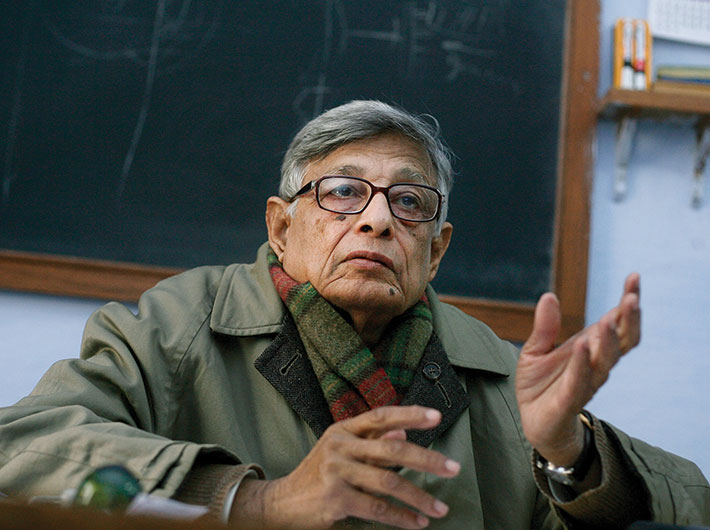
(This is a complete transcription of the lecture delivered by Professor Irfan Habib in the “Idea of India” Series at the Kennedy Hall, Aligarh Muslim University, Aligarh on October 7, 2015)


.jpg)