The Archaeological Survey of India’s report on excavations

Introduction
3.1. Before it submitted its final report to the Allahabad high court on its excavations at the Babri Masjid site, the ASI team had submitted a succession of interim reports. We have not taken these into consideration because by the orders of the Allahabad high court dated May 22, 2003 these were not to be considered for “substantive evidence”. Its ruling (para 223, sub-para (1)) ran as follows:
“It is only the final report that will be taken as an evidence on record which will be subject to the objection and evidence which may be led by the parties.”
Thus the ASI’s final report supersedes everything stated or claimed in its interim reports.
Manipulation of stratification and periodisation
3.2. The elementary rules of excavation, as may be seen in any good textbook on archaeology, lay down that from alterations primarily visible in soil, different layers should be established as one digs (see Peter L. Drewett, Field Archaeology: An Introduction, Routledge, London, 1999, pp. 107-08) and then the artefacts and other material found in each of these layers are to be carefully recorded and preserved. The lower layers are older than the upper and this sequence gives one a relative chronology of the layers. It is only through establishing dates of artefacts in different layers, by the C-14 method or thermoluminiscence or inscriptions, or comparisons with artefacts already securely dated, that the periods of different layers can then be keyed to absolute time (centuries BC or AD). (See Kevin Greene, Archaeology: An Introduction, New Jersey, 1989, Chapter 3: ‘Excavation’.) The first major defect of the ASI’s final report submitted to the high court is that it plays with periodisation of the layers in the most unprofessional fashion (and with undoubted motivation), quite contrary to Justice Agarwal’s commendation of their conduct (paras 3821 to 3879).
3.3. The ASI’s report’s authors’ clumsy manipulations are seen in their gross failure to provide essential data and the blatant contradictions in their period nomenclature, both of which we shall now examine.
3.4. The gross omission in the ASI’s report that we have just mentioned is the total absence of any list in which the numbered layers in each trench are assigned to the specific period as distinguished and numbered by the ASI itself during the digging. The only list available is for some trenches in the charts placed between pages 37-38. A list or concordance of trench layers in all trenches with periods was essential for testing whether the ASI has correctly or even consistently assigned artefacts from certain trench layers to particular periods in its main report. Where, as we shall see below, in connection with bones, glazed ware and other artefacts and materials, the finds can be traced to trench layers that are expressly identified with certain periods by the ASI in its above-mentioned charts, it can be shown that the ASI’s assignment of layers to particular periods is often demonstrably wrong and made only with the object of tracing structural remains or artefacts there to an earlier time in order to bolster the theory of a Hindu temple beneath the mosque. (See sub-para 4 of Dr RC Thakran’s evidence, reproduced in para 537 of the judgement, hereafter referred to as Judgement, para 537, RC Thakran.) We will be returning to the acts of manipulation repeatedly detected in the report when what it attributes to a trench in one place it omits in another.
3.5. As to periodisation, let us consider the following:
In Chapter III, ‘Stratigraphy and Chronology’, of the ASI report the nomenclature for Periods V, VI and VII is given as follows (in a description extending over pages 38-41):
Period V: “Post-Gupta-Rajput”, 7th to 10th Century
Period VI: “Medieval-Sultanate”, 11th-12th Century
Period VII: “Medieval”, End of 12th to beginning of 16th Century
The curious inclusion of the Sultanate in layers that the ASI officials wished to date to the 11th-12th centuries is on the very face of it a display of gross ignorance, since the Delhi sultanate was only established in AD 1206 and such designation for the period 11th-12th centuries has no precedent in the annals of the ASI. The purpose of this ignorant innovation clearly is to take cover under “Sultanate” in order to assign “Islamic”-period artefacts to the 11th-12th centuries when in actual fact the Gahadavala kings ruled over Ayodhya. Thereafter, the term “Sultanate” is forgotten and the period made purely “Hindu” by a simple change of nomenclature in the ‘Summary of Results’ (pp. 268-9). Here the nomenclature is given as follows:
Period V: Post-Gupta-Rajput, 7th to 10th Century
Period VI: Early medieval, 11th-12th Century
Period VII: Medieval-Sultanate, 12th-16th Century
This transference of the name “Medieval-Sultanate” from Period VI to Period VII has the advantage of ignoring Islamic-period materials like glazed ware or lime-mortar bonding by removing them arbitrarily from Period VI levels to those of Period VII so that their actual presence in those levels need not embarrass the ASI when it sets forth its thesis of the construction in Period VI of an alleged “massive” or “huge” temple. The device is nothing but manipulation and the so-called single “correction” of nomenclature of Period VI, much after the report had been submitted to the court, constitutes simple admission of the manipulation.
The ASI’s report’s authors’ clumsy manipulations are seen in their gross failure to provide essential data and the blatant contradictions in their period nomenclature… The ASI’s assignment of layers to particular periods is often demonstrably wrong and made only with the object of tracing structural remains or artefacts there to an earlier time in order to bolster the theory of a Hindu temple beneath the mosque
3.6. Justice Agarwal gives no concession to the critics of the ASI’s erroneous periodisation “which would ultimately may (sic) result in rejection of the entire report itself” (para 3846). So without coming anywhere to grips with the issue of the ASI’s simultaneous application of the designation ‘Medieval-Sultanate’ to two different sets of centuries (11th-12th centuries in one portion and 12th-16th centuries in another), Justice Agarwal declares that he found “no reason whatsoever in the above background to hold periodisation [which one?] determined by ASI as mistaken” (para 3878).
3.7. Justice Agarwal thought he had not said enough about critics of the ASI’s scheme of periodisation and so in para 3879 he takes them further to task: They should know that ASI officials “are experts of expert (sic!)”. Then Justice Agarwal offers this opinion of the ASI’s critics in the same para 3879:
“The result of a work if not chewable(!) to one or more, will not make the quality of work impure or suspicious. The self-contradictory statement [whose?], inconsistent with other experts made against ASI of same party, i.e. Muslim extra interest, and also the fact that they are virtually hired experts, reduces trustworthiness of these experts despite of (sic!) their otherwise competence.”
3.8. Let us not here worry however about Justice Sudhir Agarwal’s opinion of the ASI’s critics or about the difference between “hired” and “virtually hired” experts. Let us keep our eyes on the way in which the entire stratigraphy has been manipulated by the ASI, and certain layers obviously of Islamic provenance pressed into pre-Muslim periods (Period VI and earlier), as shown in Annexure No. 1, Table 2, attached to the objection of Mr Hashim dated October 8, 2003 (para 3821). This kind of false stratigraphy has led to situations that are impossible in correctly stratified layers, namely the presence of later materials in earlier strata. The presence of earlier materials in later or upper layers is possible but not the reverse except for pits but these have to be demarcated clearly from the regular layers as the digging takes place (and not later as an afterthought), which has not been done at all. Obviously, the entire stratigraphy has been frequently played with by the ASI to invent a temple in “Post-Gupta-Rajput” times.
The above facts were duly brought to the notice of the court vide para 537, RC Thakran, sub-paras 10, 11 and 12.
Structural remains beneath the mosque
3.9. While digging up the Babri Masjid, the excavators claim to have found four floors, numbered, upper to lower, as Nos. 1, 2, 3 and 4, Floor No. 4 being the lowest and so the oldest. In Chapter III of the ASI’s report, Floor 3 is put in the “Medieval Period” (i.e. 13th-16th century) by categorisation adopted in this Chapter. It is stated to consist of “a floor of lime mixed with fine clay and brick-crush” (p. 41) – in other words, a surkhi of standard ‘Muslim’ style (see below, the subsection on Lime Mortar and Surkhi). Floor 4, placed in the “Medieval-Sultanate Period”, has also a “red-brick crush floor” (p. 40), which too can come only from the use of surkhi. The word “Sultanate” is apparently employed to explain away the use of surkhi. Floors 3 and 4 are obviously the floors of an earlier qanati mosque/ idgah, since a mihrab and taqs (niches) were also found in the associated foundation wall (not, of course, identified as such in the ASI’s report). Such a floor, totally Muslim on grounds of technique and practice, is turned by the ASI into an alleged temple floor “over which”, in its words, “a column-based structure was built”. Not a single example is offered by the ASI of any temple of pre-Mughal times having such a lime-surkhi floor though one would think that this is an essential requirement when a purely Muslim structure is sought to be represented by the ASI as a Hindu one.
3.10. Once this arbitrary appropriation has occurred (p. 41), we are then asked by the ASI’s report to imagine a “Massive Structure Below the Disputed Structure”, the massive structure being an alleged temple. It is supposed to have stood upon as many as 50 pillars and, by fanciful drawings (Figures 23, 23A and 23B) in the ASI’s report, it has been “reconstructed”, Figure 23B showing the reconstructed temple with 50 imaginary pillars! Now, according to the ASI’s report, this massive structure, with “bases” of 46 of its alleged 50 pillars allegedly exposed, was built in Period VII, the period of the Delhi sultans, Sharqi rulers and Lodi sultans (1206-1526): This attribution of the grand temple to the “Muslim” period is not by choice but because of the presence of “Muslim”-style materials and techniques all through. This, given the ASI officials’ peculiar view of medieval Indian history (apparently shared by Justice S. Agarwal), when intolerance is supposed to have reigned supreme, may have further induced them to imagine yet another structure below, assignable to an earlier time.
About this structure however, it is admitted in the Summary of Results that “only four of the [imagined] fifty pillars exposed during the excavation belonged to this level with a brick-crush floor” (ASI Report, Chapter X, p. 269), and it is astonishing that this should be sufficient to ascribe them to the 10th-11th century (the “Sultanate” tag of Chapter III for it now forgotten) and to assume that all the four pillars belong to this structure. That structure is proclaimed as “huge”, extending to nearly 50 metres that separate the alleged “pillar-bases” at the extremes. If four “pillar bases” with their imaginary pillars were called upon to hold such a vast roof, it is not surprising that the resulting structure was, as the ASI admits, “short-lived”.
3.11. Furthermore, the four alleged pillar bases dated to the 11th-12th centuries are said “to belong to this level with a brick crush floor”. This amounts to a totally unsubstantiated assumption that surkhi was used in the region in Gahadavala times (11th-12th centuries). No examples of such use of surkhi in Gahadavala period sites are offered. One would have thought that Sravasti (district Bahraich), from which the ASI team has produced a linga-centred Shaivite “circular shrine” of the Gahadavala period for comparison with the so-called “circular shrine” at the Babri Masjid site or, again, the Dharmachakrajina Vihara of Kumaradevi at Sarnath, another Gahadavala site of early 12th century AD, which the report cites on other matters (e.g. on p. 56), would be able to supply at least one example of either surkhi or lime mortar. But such has not at all been the case.
Ayodhya: Building the evidence
One can see now why it had been necessary in the main text of the report to call this period (Period VI) “Medieval-Sultanate” (p. 40): By clubbing together the Gahadavala with the Sultanate, the surkhi is sought to be explained away; but if so, the alleged “huge” structure too must come to a time after 1206, for the Delhi sultanate was only established in that year. And so, to go by the ASI’s reasoning, the earlier allegedly “huge” temple too must have been built when the sultans ruled!
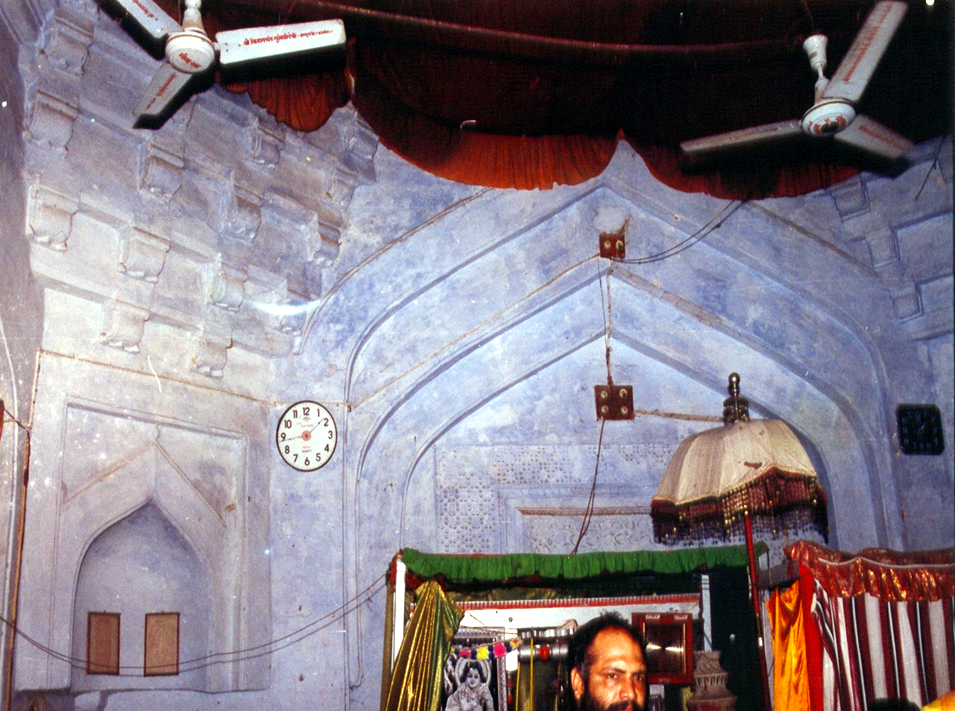
3.12. The way the ASI has distorted evidence to suit its “temple theory” is shown by its treatment of the mihrab (arched recess) and taqs (niches) found in the western wall (running north-south), which it turns into features of its imagined temple. On page 68 of the ASI’s report are described two niches in the inner side of Wall 16 at an interval of 4.60 metres in Trenches E6 and E7. These were 0.20 metres deep and one metre wide. A similar niche was found in Trench ZE2 in the northern area, and these have been attributed to the first phase of construction of the so-called ‘massive structure’ associated with Wall 16. Such niches, along the inner face of the western wall, are again characteristic of mosque/ idgah construction. Moreover, the inner walls of the niche are also plastered (as in Plate 49 of the ASI’s report), which indicated that the plaster was meant to be visible. A temple niche, if found, would in any case have to be on the outer wall and if it contained an image, the plaster would be on the image, not the niche’s interior.
In the first phase of construction, the supposed massive structure was confined to the thin wall found in Trenches ZE1-ZH1 in the north and E6-H5/H6 in the south (p. 41). How then does one explain the location of niches outside the floor area of the massive structure? This is typical of a mosque/ idgah, which would have a long, wide north-south wall, the qibla being in the western direction, with niches at intervals on its inner face and there may be a small covered area in the centre which would have narrow demarcating walls. The ASI is able to produce no example of a similar recess and niches from any temple.
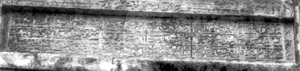
3.12A. The context and positions of the recess and niches show that these could only have belonged to a Muslim mosque or idgah. The argument advanced by the “Hindu parties” has been that the niche (taq) and mihrab (recessed false doorway) in mosques are invariably arched and here the niche at least is rectangular and so must belong to a temple (para 3991, VHP Counsel, sub-paras XXXIV to XXXVIII).
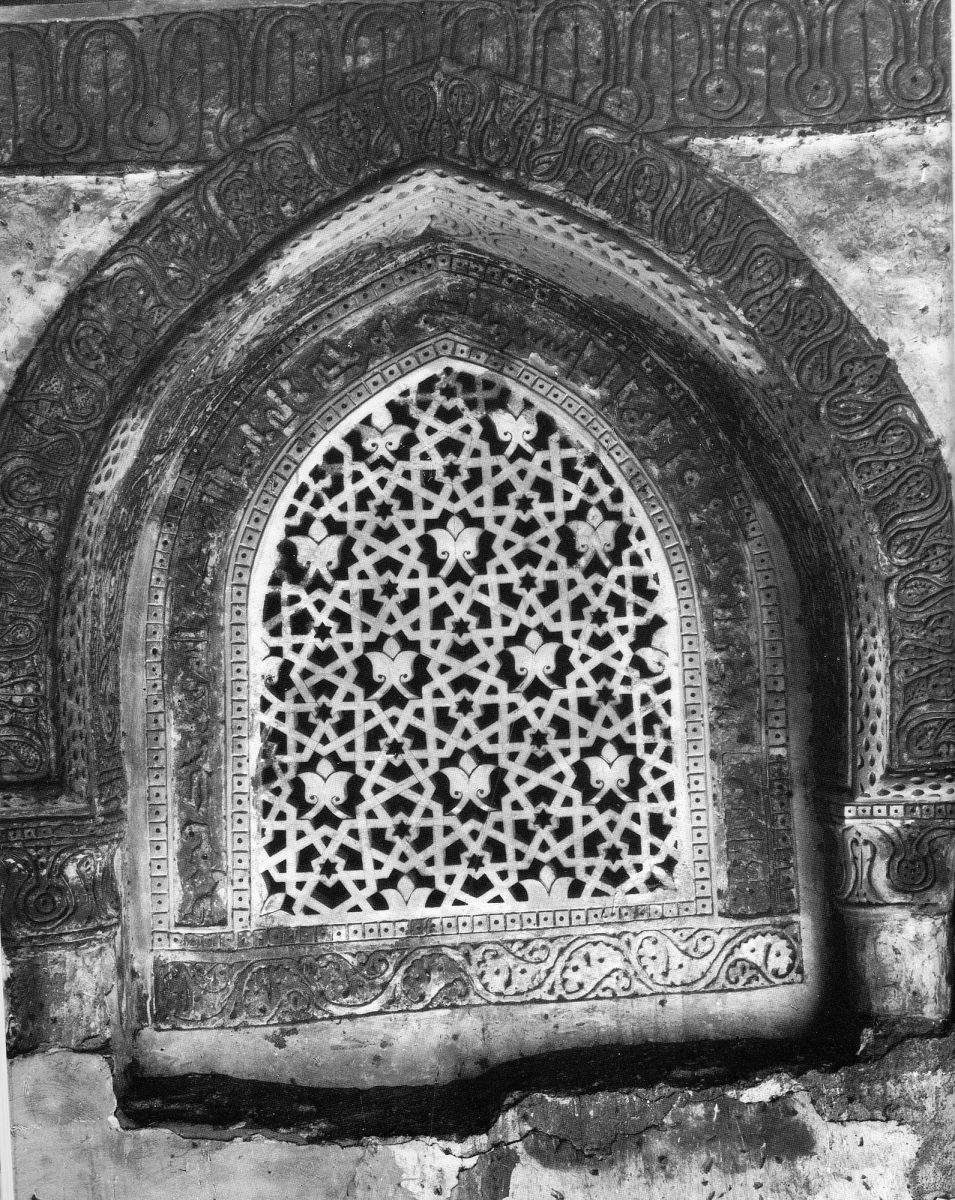
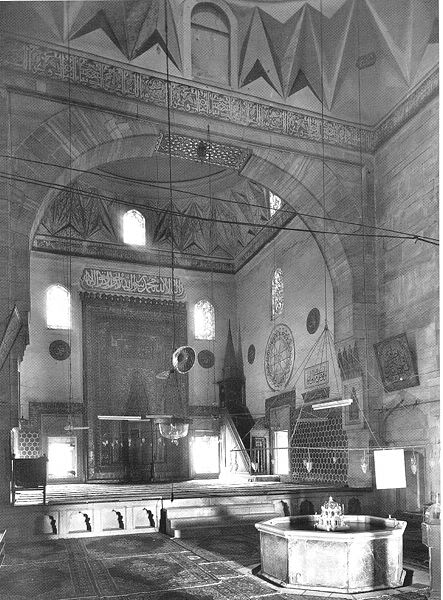
But if we look at Fuhrer’s The Sharqi Architecture of Jaunpur (a book submitted to the court), we find in its Plate XXVII (‘Jaunpur: Interior of the Lal Darwaza Masjid’) a refutation of this facile assumption. The niche (taq) close to the mimbar on the right is rectangular while the mihrab to the left, on the other side of the mimbar, is basically rectangular (flat-roofed) with the arches above being only ornamental. The VHP advocate’s claim that the floor of the mihrab is always at the same level as the main floor (para 3991, VHP Counsel, sub-para XXXVIII) is a ridiculous one, as may be seen from the illustration of mihrabs in the Jaunpur Jami Masjid (Fuhrer, op. cit., Plates LXIII and LXIV), where the floor of the mihrab stands, in one case, two courses and in the other, one course above the main floor. (See also Fuhrer’s text, p. 47, for how the mihrab is always placed ‘towards Makka’ i.e. to the west.) The evidence from the 15th century Lal Darwaza Masjid is crucially relevant, since the Babri Masjid in its design closely followed the style of Sharqi-period (15th century) mosques of Jaunpur.
3.13. Now let us see the way in which Justice Agarwal in para 3928 dismisses all the objections to the attribution of remains of the walls and floors, found under the extant floor of the Babri Masjid, to an imagined temple:
“The statements of Experts (Archaeologist) (sic!) of plaintiffs (Suit-4) in respect of walls and floors have already been referred to in brief saying that there is no substantial objection except that the opinion ought to [be?] this or that, but that is also with the caution that this can be dealt with in this way or that both and not in a certain way.”
This presumably means that no precise objections of the Muslim plaintiffs (Suit-4) need be considered!
3.14. Here a further point has to be made about the use of scientific dating methods. It is to be noted that the ASI made no use of thermoluminiscence (TL) dating although this should have been used where so much pottery was involved; and in the case of TL, unlike most carbon dates obtained from charcoal, the artefacts in the form of fired pottery can be directly dated. Yet only carbon dating was resorted to and no explanation is offered as to why the TL method was not also employed. Clearly, it was feared that the TL dates for glazed ware would upset the apple cart of the ASI’s stratification and periodisation.
The way the ASI has distorted evidence to suit its “temple theory” is shown by its treatment of the mihrab (arched recess) and taqs (niches) found in the western wall, which it turns into features of its imagined temple… Such niches are in fact characteristic of mosque/ idgah construction… The ASI is able to produce no example of a similar recess and niches from any temple
3.15. On page 69 of the ASI report we are told:
“The available C-14 dates (sic!) from the deposit between floors 2 and 3 in the trench ZH-1 is 1040±70BP (910±70 AD) having the calibrated age range of AD 900-1030. The early date may be because of the filling for levelling the ground after digging the earth from the previous deposit in the vicinity.”
So in the words of ASI officials themselves, this carbon date (from BS No. 2124) is valueless for determining the period of the Floor 2-3 interval. But what about the other carbon date or dates, for the word “dates” in the quoted passage implies that there was more than one carbon date obtained for the Floor 2-3 interval. In the statement of Carbon Dates (Appendix I) there are only two other dates bearing a calibrated date in AD. But since one of these two dates, that from sample BS 2123, dated to CAL AD 90-340, came from a depth of 265-270cm whereas the carbon date sample yielding AD 900-1030 (BS No. 2124) came from a depth of 50cm only, this is out of the question here. There then remains only sample BS No. 2127 whose depth is only 3cm less than that of BS No. 2124 (being 47cm). Its carbon date is AD 1500 (±110) and its calibrated date has a range of AD 1400-1620. Why should this not be used to date the Floor 2-3 interval?
Pillar bases
3.16. Since the entire basis of the supposed “huge” and “massive” temple structures preceding the demolished mosque lies in the ASI’s reliance upon its alleged numerous “pillar bases”, these have now to be examined. In this respect, one must first remember that what are said by the ASI to be pillar bases are in many cases only one or more calcrete stones resting on brickbats, just heaped up, and the ASI admits that only mud was used as mortar to bond the brickbats. (One should not be led astray by a highly selective few “pillar bases” whose photographs appear in the ASI’s volume of illustrative plates.) In many claimed “pillar bases” the calcrete stones are not found at all. As one can see from the descriptive table on pages 56-67 of the report, not a single one of these supposed “pillar bases” has been found in association with any pillar or even a fragment of it; and it has not been claimed that there are any marks or indentations or hollows on any of the calcrete stones to show that any pillar had rested on them.
The ASI report nowhere attempts to answer the questions (1) why brickbats and not bricks were used at the base; and (2) how mud-bonded brickbats could have possibly withstood the weight of roof-supporting pillars without themselves falling apart. It also offers not a single example of any medieval temple where pillars stood on such brickbat bases.
3.17. In paras 3901 to 3906 Justice Agarwal reproduces statements and arguments advanced by Shri MM Pandey, though these include statements that are not even made in the ASI report on a general basis at all, such as (a) “brickbats in the pillar bases are not heaped up but are carefully laid in well-defined courses” (para 3901); (b) “the foundation of pillar bases has been filled with brickbats covered with orthostat, which prima facie establishes its (sic) load-bearing nature” (para 3903); and (c) “all the fifty bases, more or less are of similar pattern except the orthostate (sic) position” (para 3903). These words of wild generalisation, quite overlooking the brickbat heaps passed off as pillar bases by the ASI, and the technological wisdom about highly dubious ‘orthostats’ are, to put it in the mildest of terms, highly controversial. Yet Justice Agarwal, in para 3907, says shortly: “We find substance in the submission (sic!) of Sri Pandey.”
3.18. Despite the claim of these pillar bases being in alignment and their being so shown in fancy drawings in the ASI’s report (Figures 23, 23A and 23B), the claim is not borne out by the actual measurements and distances and there is indeed much doubt about whether the plan provided by the ASI is drawn accurately at all. The fact that the alleged pillar bases do not stand in correct alignment or equal distances is admitted by Justice Agarwal in para 3917 but he speculates on his own that “there may be a reason for having variation in the measurement of pillar bases that the actual centre of the pillar bases could not be pointed out…” The ASI admitted to no such disability. Moreover, the justice goes on to state that “Figure 3A in any case has been confirmed by most of the Experts (Archaeologist) (sic!) of plaintiffs (suit-4)” when actually it has been held by them to contain inaccurate and fanciful details. Indeed there are enormous discrepancies between Figure 3A (the main plan) and the Table in Chapter 4 on the one hand, and the report’s Appendix IV on the other. Trench F7 has four alleged “pillar bases” in the former, for example, but only one in the latter!
3.19. In fact, the way the ASI has identified or created “pillar bases” is a matter of serious concern. Complaints were also made to the observers appointed by the high court that the ASI officials were ignoring calcrete-topped brickbat heaps where these were not found in appropriate positions, selecting only such brickbat heaps as were not too far off from its imaginary grids, and helping to create the alleged “bases” by clearing the rest of the floor of brickbats. Despite Justice Agarwal’s vehement rejection of these complaints (not so summarily rejected however by the bench to which they were made), the complaints do not lose their validity. (See Paper IV for relevant particulars.)
3.20. The most astonishing thing that the ASI so casually brushes aside relates to the varying levels at which the so-called “pillar bases” stand. Even if we go by the ASI’s own descriptive table (pp. 56-57), as many as seven of these alleged 50 “bases” are definitely above Floor 2 and one is at level with it. At least six rest on Floor 3 and one rests partly on Floor 3 and 4. Since Floor 1 belongs to the mosque, how did it come about that as many as seven pillars were erected, after the mosque had been built, in order apparently to sustain an alleged earlier temple structure?! More, as many as nine alleged “pillar bases” are shown as cutting through Floor No. 3. Should we then not understand that when the mosque floor was laid out, there were no “pillar bases” at all but either extant parts of earlier floors (now taken to be or made to look like pillar bases) or some kind of loosely bonded brickbat deposits connected with the floors?
3.21. It may be added that even the table on pages 56-67 of the ASI’s report may not correctly represent the layers of the pillar bases, since its information on floors does not match that of the report’s Appendix IV which in several trenches does not attest the existence of Floor No. 4 at all though this was the floor the “pillar bases” in many cases are supposed to have been sealed by or to have cut through or stand on! For example, “pillar base 22” on pages 60-61 is indicated as resting on Floor 4 but there is no Floor 4 shown as existing in Appendix IV of the report in Trench F2 where this base supposedly stands. Similar other discrepancies are listed in Table 1.
Thus in over 20 cases Floor 4 is presumed in the report whereas no proof of this is provided in Appendix IV. (See para 537, RC Thakran, sub-paras 16-20.)
A so-called pillar base: A dubious construct
3.22. There is also the crucial matter of what happened to the pillars that the alleged pillar bases carried. Justice Agarwal dismisses this as unworthy of consideration, since, in his view, they must have been demolished when the supposed temple was destroyed to build the mosque (para 3917). He says:
“One of the objection (sic!) with respect to the pillar bases is that nothing has been found intact with them saying (!) that the pillars were affixed thereon. The submission, in our view [is?] thoroughly hollow and an attempt in vain (sic!)… If we assume other cause (sic!) to be correct for a moment, in case of demolition of a construction it is a kind of childish expectation to hope that some overt structure as it is would remain intact.”
The real question is here bypassed: no one is asserting that pillars should have been found standing erect but they should have been found in recognisable fragments. The simple fact is that destruction does not mean evaporation. If the mosque was built immediately upon the alleged temple’s destruction, as Justice Agarwal holds, then the 50 stone pillars would have been used in the mosque and their remains should have been found in the debris of the demolished mosque which the ASI dug through. But no such pillar, or any recognisable part thereof, was found. Only one pillar fragment was found and that belonged to the set of 14 non-uniform decorative non-load-bearing black basalt pillars which were part of the Babri Masjid structure (On these see RS Sharma, M. Athar Ali, DN Jha and Suraj Bhan, Ramjanmabhumi-Baburi Masjid, A Historians’ Report to the Nation, People’s Publishing House, New Delhi, 1991, pp. 8-10.)
3.23. The ASI should surely therefore have looked about for other explanations for the heaps of brickbats before jumping to its “pillar bases” theory. There is at least one clear and elegant explanation for many of them, first proposed by Dr Ashok Datta (para 540, sub-para 10). When Floor No. 4 was being laid out over the mound sometime during the Sultanate period, its builders must have had to level the mound properly, using stones (the latter often joined with lime mortar) and brickbats to fill such holes. When Floor 4 went out of repair, it received similar deposits of brickbats to fill its holes in order to lay out Floor 3 (or indeed just to have a level surface) and this continued to happen with the successive floors. This explains why the so-called “pillar bases” appear to “cut through” both Floors 3 and 4 at some places while at others they “cut through” Floor 3 or Floor 4 only. They are mere deposits to fill up holes in the floors. Since such repairs were in time needed at various spots all over the floors, these brickbat deposits are widely dispersed.
Had not the ASI been so struck by the necessity of finding “pillar bases”, which had to be in some alignment, it could have found scattered over the ground not just 50 but perhaps over a hundred or more such deposits of brickbats. A real embarrassment of riches of false “pillar bases”, that is!
3.24. It may here be pointed out that when Dr BR Mani, the first leader of the ASI team at Ayodhya, excavated at Lal Kot, district of South New Delhi, he thus describes “pillar bases” of “Rajput style”, of about the 11th-12th century:
“These pillar bases rest on stone pedestals and are 2.90m apart from each other. They might have supported some wooden canopy” (Indian Archaeology 1992-93 – A Review, official publication of ASI, New Delhi, 1997, p. 9).
Dr Mani illustrates these four pillar bases in Plates VI and VII of the same publication. Each comprises a number of squarish stone slabs resting on each other with a larger stone slab at the bottom. Yet these were not thought by him to be strong enough to support anything more that “a wooden canopy”. And yet at Ayodhya, single calcrete slabs resting on nothing more than brickbats are often held by the same Mr Mani and his team to have supported stone pillars bearing “massive stone structures”! (See also paragraph 3.58 below.)
3.25. Having thus shown that there is no basis for the ASI’s illusory 50-pillared structure, and without at all conceding the reality of the claimed 50 pillar bases, it is still pertinent to ask why the ASI regards colonnades to have necessarily been part of a temple and of no other structure. In this respect, the ASI should have noticed such pillared structures of the Begumpuri Mosque, the Kali Masjid and the Khirki Masjid, all built at Delhi by Khan Jahan Firozshahi in the AD 1380s, the original photographs of which are printed in Tatsuro Yamamoto, Matsuo Ara and Tokifusa Tsokinowa, Delhi: Architectural Remains of the Delhi Sultanate Period, Tokyo, 1967, Vol. I, Plates 14b, 18c and 20c.
What of Delhi, the ASI could have looked closer at the 15th century mosques at Jaunpur, viz the Lal Darwaza Masjid and Jami Masjid, described by A. Fuhrer in his The Sharqi Architecture of Jaunpur, Calcutta, 1889, the account of Lal Darwaza Masjid being given on pp. 43-51 and the Jami Masjid on pp. 52-58. Both mosques have long colonnades with dozens of pillars carrying roofs on the trabeate (not arcuate) principle. The Lal Darwaza Masjid plan (Plate XXVIII in Fuhrer’s volume) shows about 150 such pillars in Lal Darwaza Masjid and Plates XXIX and XXX give good views of the Masjid’s colonnades. The Jami Masjid had equally numerous pillars of a similar kind but there has been much damage to the building. Still, even the extant remains give us an idea of its grand colonnades (Fuhrer’s Plates XLIV, L and LI). It is astonishing that the ASI should have closed its eyes to such structures but this is just another proof that its report is a simple product of bias and partisanship.
However, this point is raised merely incidentally just to illustrate the degree of bias and non-professionalism in the ASI’s approach. There in fact exist no real pillar bases to sustain any vision of pillared halls or grand colonnades, either of temple or mosque.
3.26. One of the assumptions in Justice Agarwal’s censures of the experts on the Muslim side has been that they have denied the existence of all pillars and pillar bases. The Babri Masjid also used quite large pillars to carry the roof and, as we have shown, pillars and colonnades were a feature of the Sharqi mosques. Thus Justice Agarwal’s contention that all pillar bases of whatever kind and those especially in the north are being rejected by critics of the ASI report, and then to discredit them on that basis (cf paras 3887 and 3890), is based on an incorrect inference. Nor is there any ground for the assertion that there was any suggestion on the part of the critics regarding a “north-south row of the wall 16 and 17” i.e. west of the mosque’s western wall (para 3895). It is therefore all the more unfortunate that, in para 3900, Justice Agarwal deals with the proper objections raised by Dr Jaya Menon and Dr Supriya Varma in the following manner:
“…it can easily be appreciated that the mind of two experts instead [of?] working for the assistance of the court in finding a (sic!) truth, tried to create a background alibi so that later on the same may be utilised to attack the very findings. However, this attempt has not gone well since some of these very pillar bases have been admitted by one or the other expert of plaintiffs (Suit-4) to be correct.”
All buildings, including the Babri Masjid and its predecessor, the qanati mosque or idgah, needed to stand on walls and pillars and it is naturally inconceivable that the concerned plaintiffs’ experts would deny the existence of such structures, as if mosques cannot contain pillars or their roofs only stand on walls!
A column in the Babri Masjid: Withstanding the lie
The circular shrine
3.27. Much is made in the ASI report of the “Circular Shrine” (Report, pp. 70-71), again with fanciful figured interpretations of the existing debris (Figures 24 and 24A in the Report). Comparisons with circular Shaivite and Vaishnavite shrines (Figure 18) are made. The ASI had no thought, of course, of comparing it with circular walls and buildings of Muslim construction – a very suggestive omission. Such shapes are indeed fairly popular in walls of medieval Muslim construction. And then there are Muslim-built domed circular structures such as the circular corner structures at the 13th century tomb of Sultan Ghari at Delhi. (See Ancient India, official publication of the ASI, No. 3 (1947), Pl. VIII-A.)
3.28. Even if we forget the curiously one-eyed nature of the ASI’s investigations, let us consider the shape and size of the alleged “shrine”. The extant wall makes only a little more than a quarter of a circle (ASI Report, Figure 17). Though there is no reason to complete the circle as the ASI does, the circular shrine, given the scale of the Plan (Figure 17 in the Report), would still have an internal diameter of just 160cm, or barely 5.5 feet! Such a small structure can hardly be a shrine. But it is in fact much smaller. Figures 3 (General Plan of Excavations) and 17 in the report show that not a circle but an ellipse would have had to be made by the enclosing wall, which it has to be in order to enclose the masonry floor. No “elliptic (Hindu) shrine” is however produced by the ASI for comparison: the few that are shown are all circular. As Plate 59 makes clear, the drawing in Figure 17 ignores a course of bricks which juts out to suggest a true circle much shorter than the elliptic one: this would reduce the internal diameter to less than 130cm, or 4.3 feet! Finally, as admitted by the ASI itself, nothing has been found in the structure in the way of image or sacred artefact that can justify it being called a “shrine”.
3.29. Indeed if the ASI insists on it being a shrine, it is strange that it did not consider the relevance of a Buddhist stupa here. Attention was drawn to Plate XLV-A showing “exposed votive stupas” at Sravasti, in the ASI’s own Indian Archaeology 1988-89 – A Review. It is indicative of the ASI’s bias that while it provided an example of an alleged circular Shaivite shrine from Sravasti, along with a photograph (Report’s Plate 61), it totally overlooks the circular structures representing stupas there. As shown above, the small size of the so-called “circular shrine” at the Babri Masjid site precludes it from being a shrine which anyone could enter, and the votive stupa (which is not entered) is the only possible candidate for it, if the structure has to be a pre-Muslim sacred structure. But the stupa is not a temple, let alone a Hindu temple. (See para 537, RC Thakran, sub-paras 24-26.) It is characteristic that despite no “circular shrine” of this small size being brought to the attention of the court, Justice Agarwal gives his own reasons, citing however no example or authority, to say that there could be a circular shrine which need not be entered (para 3947)!
3.30. We now come to Justice Sudhir Agarwal’s own reading of the evidence. We have seen above that the ASI on page 69 refers to a sample from “the deposit between Floors 2 and 3 in the Trench ZH-1”, giving the date AD 1040± calibrated to AD 900-1030 which it itself rejected as “too early”, the sample being held to be a possible intrusion from disturbed soils. Justice Agarwal, in para 3937 however, uses this reference to date the “Circular Shrine” which has no relationship to Trench ZH-1 (situated far on the northern side of the Masjid) or Floors 2 and 3. He says:
“The structure [the alleged Circular Shrine] may be dated to 9th-10th century. (the ASI carried out C-14 determination from this level (!) and the calibrated date ranges between 900 AD 1030 AD).”
The words in round brackets are, of course, those of Justice Agarwal and show that he here uses a carbon date which could be from disturbed strata according to the ASI itself and has nothing to do with the so-called circular shrine. He might also have considered the other sample (BS No. 2127) from a similar depth (47cm) but from Trench G7 adjacent to the “circular shrine”, which gives the calibrated range of AD 1400-1620. This date should make it a presumably “Islamic” structure!
3.31. Before we close this discussion on the “Circular Shrine”, let us come to the parnala which Justice Agarwal pronounces to be the decisive evidence (“an extremely important feature of this structure” – para 3936). The basic claim with regard to this supposed water outlet is in the ASI’s report, page 70:
“The structure was squarish from the inner side and a 0.04m wide and 0.53m long chute or outlet was noticed on plan made through the northern wall upto the end where in the lower course a 5.0cm thick cut in ‘V’ shape was fixed which was found broken and which projects 3.5cm outside the circular outer face as a parnala to drain out the water, obviously after the abhisheka of the deity, which is not present in the shrine now.”
In para 3929 Justice Agarwal reproduces the “serious” objection made to the circular shrine, in which, in sub-para 6.10, it is pointed out that the channel cannot be a draining chute at all not only because of its Lilliputian proportions but also because it is uneven in width and narrow at the end (see Plate No. 60 in the ASI’s volume of illustrations), measurements by a levelling instrument revealed it had no slope and, finally, there were no residues or traces of deposits that are formed within water drains after a period of use.
3.32. Not only does Justice Agarwal not take any notice of these objections but, in para 3937, considers the ‘v’ cut in a brick as a “gargoyle”. A “gargoyle” implies that there is a “grotesque spout, usually with human or animal mouth, head or body, projecting from gutter of (especially Gothic) building to carry water” (Concise Oxford Dictionary). No such sculptured figure is found so that this possible support for a “shrine” here is also absent.
The most sensational act of misconduct of the ASI officials has been that despite their being reminded by the bench (in April 2003) of the need to preserve and record animal bones properly, they failed to do so… From any point of view, the ASI’s avoidance of presenting animal-bone evidence after excavation must be regarded as a motivated, unprofessional act
Bones, artefacts and materials and their significance
3.33. Now we proceed to examine the archaeological finds that go entirely against the thesis of there having been a temple beneath the mosque.
Animal bones
3.34. The most sensational act of misconduct of the ASI officials has been that despite their being reminded by the bench of the need to preserve and record animal bones properly, they failed to do so.
3.35. The bones of large- and medium-sized animals (cattle, sheep and goats) would be a sure sign of animals being eaten or thrown away dead at the site and therefore rule out a temple existing at the site at that time. In this respect, directions were given by the high court to the ASI to record “the number and wherever possible size of bones and glazed wares”. (Order, April 10, 2003, reproduced in para 230). Yet the ASI officials have provided in their report no chapter or sub-chapter or even tabulation of animals by species, by kinds of bones, whether with cut-marks or not, as is required in any proper professional report of excavation. In fact today, much greater importance is being attached to study of animal bones, since they provide to archaeologists information about people’s diet and animal domestication (cf Kevin Greene, Archaeology: An Introduction, pp. 136-37).
From any point of view, the ASI’s avoidance of presenting animal-bone evidence after excavation must be regarded as a motivated, unprofessional act. The report in its ‘Summary of Results’ admits that “animal bones have been recovered from various levels of different periods” (Report, p. 270). Where did the unnamed author(s) of this chapter get this information when there is nothing about animal bones in the main report? There is much room for the suspicion then that there was a chapter or sub-chapter on animal bones in the report, on which the writer of the Summary of Results drew, but it has been suppressed or deleted because of its dangerous implications. It is characteristic of Justice Agarwal’s partisan attitude that he does not anywhere take the ASI to task for this but actually, as will presently be shown, makes use of the omission of details about animal bones in the ASI’s report to author imaginary explanations of where the bones were found and hold forth on what their presence implies.
3.36. Let us however first take the statement actually made in the ‘Summary of Results’, which we have just quoted. It concedes specifically that animal bones have been recovered from “various levels”. Here then it is not a matter of recovery from “pits” that Shri MM Pandey and, following him, Justice Agarwal enlarge on at length (paras 3966 and 3968). Furthermore, “various” in the context means “all”, particularly since the ASI report provides no reservation that there was any area or layers in which the bones were not found. Indeed the above inference is fully supported from even a random examination of the ASI’s Day-to-Day Register and Antiquities Register where the bones recovered are not usually attributed to pits or ‘secondary deposits’. This can be confirmed from D. Mandal’s tabulation of animal bones in D. Mandal and S. Ratnagar, Ayodhya: Archaeology after Excavation, Delhi, 2007, pp. 65-66. So where did Shri MM Pandey (an advocate, not a witness subject to cross-examination) and Justice Agarwal draw their information from?
Evidence of animal bones: Remains unheard
3.37. Indeed from the Day-to-Day and Antiquities Registers, we find that in Trench Nos. E-6 (Layer 4), E-7 (Layer 4), F-4/F-5 (Layer 4) animal bones have been found well below Period VII – layers i.e. in Period VI (Early Medieval or Pre-Sultanate) or still earlier and in Trench Nos. F-8, G-2, J-2/J-3 they are found in layers assigned by the ASI to Period VI itself. Thus bones have been found in what are allegedly central precincts of the alleged Ram temple allegedly built in ‘Period VI’. The ASI says that a massive temple was built again in Period VII but in Trench Nos. E6, F8, G-2 and J-E/J-4 bones have been found in layers assigned to this very period also in the same central precincts. The above data are given in the tables produced in the Sunni Central Board of Wakfs (UP)’s ‘Additional Objection’ dated February, 3, 2004.
3.38. Justice Agarwal, in para 3969, enters the following explanation of the presence of the bones:
“Moreover, it is a well-known fact that in certain Hindu temples animal sacrifices are made and flesh is eaten as Prasad while bones are deposited below the floor at the site.”
He cites no authority for this. Is there a single temple of this type at Ayodhya today?
3.39. Let us then look at least at one authority for such sacrifices. According to Abbe J. Dubois, Hindu Manners, Customs and Ceremonies, translated by Henry K. Beauchamp, with Preface by Professor Max Müller, Third Ed., Oxford, 1906, p. 647, the Kali Purana “contains rules of procedure in sacrificing animals and mentions the kinds and qualities of those which are suitable as victims. Lastly, it specifies those deities to whom these bloody offerings are acceptable. Among them are Bhairava, Yama, Nandi and above all the bloodthirsty goddess Kali.”
Two points here are worth noting: (a) the divinities to whom the sacrifices are offered are all connected with Lord Shiva except Yama, god of the dead; on the other hand, Lord Vishnu or any of his incarnations are in no way connected with the rites; and (b) there is nothing said of the worshippers eating the flesh of the sacrificial victims. So far as we know, there was no or little prevalence of the Kali cult in the Upper Gangetic basin where Ayodhya is situated. In any case, if one insists on the imaginary temple beneath the Babri Masjid having contained thrown away animal bones, it would make it not a Ram but a Kali or Bhairava temple. Yet even so, the sacrificed animals’ whole skeletons should have been found, not separate, scattered animal bones as were actually found in the excavations, according to the ASI’s own records.
3.40. One may here respectfully draw attention to the lack of consistency in Justice Agarwal’s implying, in para 3969, that the huge imaginary temple beneath the Babri Masjid was a Kali or Bhairava temple revelling in animal sacrifices and on the other hand deciding, (para 4070) under issue No. 14, that the Hindus have been “worshipping the place in dispute as Sri Ram Janam Bhumi Janam Asthan… since times immemorial”!
3.41. Justice Agarwal furthermore declares in para 3970 that “bones in such abundance” precluded the site from ever having been an idgah or qanati mosque before the Babri Masjid was built. Here it must be mentioned that it is his own finding, not that of the “Muslim” plaintiffs, that the Babri Masjid was built immediately upon the demolition of a preceding structure. Quite the contrary, the bones and the scattered medieval artefacts like glazed ware show that the land adjacent to the walls and main structure remained open, as would be the case with an idgah or qanati mosque, so that waste matter could be thrown there. During the period of three centuries preceding 1528, Ayodhya or Awadh was a city with a large Muslim population along with its Hindu inhabitants (see for such evidence, Irfan Habib, ‘Medieval Ayodhya (Awadh), Down to Mughal Occupation’, Proceedings of the Indian History Congress, 67th Session, Calicut University, 2006-07, Delhi, 2007, pp. 358-382). Given the dietary customs of the two communities, “abundance of animal bones” would weigh heavily in favour of there being a Muslim presence in the immediate vicinity of the disputed site.
Glazed ware
3.42. Glazed ware, often called “Muslim” or Medieval glazed ware, constitutes an equally definite piece of evidence which militates against the presence of a temple, since such glazed ware was not at all used in temples.
3.43. Before we go further, it is best to remove what was drawn apparently as a red herring but which, unfortunately, has been accepted by Justice Agarwal (para 3976) – the claim that, after all, there was “glazed ware” also in Kushana times so why not in Gahadavala times?
The matter is clarified in the authoritative Encyclopaedia of Indian Archaeology, ed. A. Ghosh (former director general, Archaeological Survey of India), New Delhi, 1989, page 260, where we read under ‘Glazed Ware’:
“Potsherds, light buff in colour, with a heavy turquoise blue glaze, have been found at Chaubara and Mahauli mounds near Mathura and at several other sites in the country and have been dated to the Kushan period. However, it bears no similarity to the reddish buff Kushan ware which abounds around Mathura and is completely different from the later-day medieval (Islamic) Glazed ware” (italics ours).
Examples of ancient Islamic pottery
Glazed ware, often called “Muslim” or Medieval glazed ware, constitutes an equally definite piece of evidence which militates against the presence of a temple, since such glazed ware was not at all used in temples… Such glazed ware is all-pervasive at the Babri Masjid site till much below the level of Floor No. 4, a floor ascribed in the ASI report to the imaginary “huge” structure of a temple allegedly built in the 11th-12th centuries
It may be mentioned that the word “Islamic” within brackets is in the original. In other words, archaeologists of standing regard the presence of medieval glazed ware as evidence of Muslim presence and this ware has nothing in common with the Kushana-period glazed ware. This passage disposes of the objection raised by Shri Pandey (quoted by Justice Agarwal in para 3976) that the medieval glazed ware was the same as Kushana ware and so was used in ancient India.
3.44. The “medieval (Islamic)” glazed ware is all-pervasive at the Babri Masjid site till much below the level of “Floor No. 4”, which floor is ascribed in the report to the imaginary “huge” structure of a temple allegedly built in the 11th-12th centuries. The ‘Summary of Results’ in the ASI’s report tells us that the glazed ware sherds only “make their appearance” “in the last phase of the period VII” (p. 270). Here we directly encounter the play with the names of periods. On page 270, Period VII is called “Medieval Sultanate”, dated to 12th-16th century AD. But on page 40, “Medieval-Sultanate” is the name used for Period VI, dated to the 10th and 11th centuries. As we have noted, the Summary of Results claims (on p. 270) that the glazed ware appears only in “the last phase of Period VII”. In Chapter V (Pottery) however, no mention is made of this “last phase” of Period VII; it is just stated that “the pottery of Medieval-Sultanate, Mughal and Late-and-Post Mughal period (Periods VII to IX)… indicated that there is not much difference in pottery wares and shapes” and that “the distinctive pottery of the periods [including Period VII] is glazed ware” (p. 108).
The placing of the appearance of glazed ware in the “last phase” only of Period VII appears to be a last-minute invention in the report (contrary to the findings in the main text) to keep its thesis of an alleged “massive” temple, allegedly built in Period VII, clear of the “Muslim” glazed ware because otherwise it would militate against a temple being built in that period. All this gross manipulation has been possible because not a single item of glazed pottery is attributed to its trenches and stratum in the select list of 21 items of glazed ware (out of hundreds of items actually obtained), on pages 109-111.
Seeing the importance of glazed ware as a factor for elementary dating (pre- or post-Muslim habitation at the site), and in view also of the high court’s orders about the need for proper recording of glazed ware, a tabulation of all recorded glazed-ware sherds according to trench and stratum was essential. That this has been entirely disregarded shows that, owing to the glazed-ware evidence being totally incompatible with any temple construction activity in Periods VI and VII, the ASI has resorted to the most unprofessional act of ignoring and manipulating evidence.
3.45. Going by the Pottery section of the report (p. 108), not by its ‘Summary’, the presence of glazed ware throughout Period VII (Medieval, 12th-16th centuries) rules out what is asserted on page 41, that a “column-based structure” – the alleged 50-pillar temple – was built in this period. How could Muslims have been using glazed ware inside a temple? Incidentally, the claim of a Delhi University archaeologist (Dr Nayanjot Lahiri) defending the ASI report, that glazed ware was found at Multan and Tulamba (near Multan) before the 13th century, is hardly germane to the issue, since these towns were under Arab rule with Muslim settlements since 714 AD onwards and so the use of glazed ware there is to be expected. The whole point is that glazed ware is an indicator of Muslim habitation and is not found in medieval Hindu temples.
3.46. Shri Pandey’s claim (para 3976), that pottery could be used by anyone and so medieval glazed pottery has no importance, is like saying that since all men are equal, there could not have been any untouchability in India at any time! We have surely to proceed with what the techniques and customs have been and not what we think should have happened.
Glazed tiles
3.47. The story of glazed tiles is very similar. These too are an index of Muslim habitation. The two glazed tiles are found in layers of Period VI, which means that the layers are wrongly assigned and must be dated to Period VII (Sultanate period). There could be no remains of any alleged “huge temple” in these layers, then.
3.48. When the ASI submitted its Day-to-Day and Antiquities Registers for inspection, it turned out that the ASI had concealed the fact in its report that the layer in certain trenches it had been attributing to pre-Sultanate Period V simply cannot belong to it because glazed tiles have been found in it and the layers assigned to Period VI could not have belonged to a temple, as alleged, because both glazed ware and glazed tiles have been found in them. In this respect, attention may be invited to the tables submitted as Annexure I to the Additional Objection of the Sunni Wakf Board, dated February, 3, 2004.
(Much of the above argument and information was presented before the bench vide para 537, RC Thakran, sub-paras 6-9).
Lime mortar and surkhi
3.49. Since lime mortar and surkhi are profoundly involved in (a) the dating of the levels they are found in; and (b) resolving the issue whether they could have been used in the construction of a temple structure at all, it is essential, first of all, to be clear about what these are and what exactly is meant by their use. It is acknowledged by the ASI’s report, as noted by Justice Agarwal himself (para 3895), that lime mortar was used to fix calcrete stones in the so-called “pillar bases”.
3.50. If one looks up the entry on Mortars and Plasters in A. Ghosh ed., An Encyclopaedia of Indian Archaeology, New Delhi, 1989, p. 295, we read: “Plaster is the material used for coating walls, etc while mortar is the binding material between brick or stone.” It is nobody’s case that lime plaster of some kind was not occasionally employed in ancient India. Indeed, according to PK Gode, Studies in Indian Cultural History, Vol. I, p. 158, lime (churna) in pan (tambula) was in use by about 500 AD, and the use of lime plaster (occasional) in certain places is described in the entry on Mortars and Plasters in the Encyclopaedia of Indian Archaeology above-cited. In his collecting sundry references to the use of lime plaster in para 3991, sub-paras VIII et seq, the VHP advocate, Shri MM Pandey, simply tilts at windmills, since the issue is not about the find of lime plaster but lime mortar in the remains of what is sought to be put off as a Hindu temple.
3.51. Now, here too the matter is narrowed to certain limits of time. Lime mortar is found in Mohenjodaro and Harappa, the great cities of the Indus Civilisation (see An Encyclopaedia of Indian Archaeology, op. cit.). It was found in Besnagar (now in Madhya Pradesh) in a structure dateable to the second century BC but the “cement” was here weakened by the low amount of lime (DR Bhandarkar in: Archaeological Survey of India, Annual Report, 1913-14, pp. 205-06). JD Beglar in A. Cunningham, Archaeological Survey of India Report, Vol. VIII, p. 120, claimed to find lime mortar in the “original building” of the Buddha Gaya temple, dated to the first century BC/ AD, but from his description of it on page 118, it appears to have been “lime-plaster”. Lime mortar was also found in Kausambi in structures dated to early historical (i.e. pre-Kushana) times. But thereafter, it simply disappears.
Thus Shri MM Pandey is grossly inaccurate when he says that “surkhi choona were in use in India continuously much before the advent of Muslims” (para 3991, sub-para XVIII). It is not present in the first true brahmanical temple of northern India, Bhitargaon in Kanpur district, dated to c. 500 AD, the bricks being “throughout… laid in mud mortar” (A. Cunningham in Archaeological Survey of India Report, Vol. XI, pp. 40-41). No lime mortar nor surkhi has been discovered at the two Gahadavala sites excavated by the ASI, namely Sravasti and Sarnath, to judge from the reports of their excavations published in Indian Archaeology – A Review; nor have they been noticed by Dr Mani himself in the ‘Rajput’ levels of his Lal Kot excavations at Delhi.
Window grill of the Babri Masjid
3.52. Surkhi is still more elusive in pre-Sultanate ancient India. It is not at all mentioned among mortars or even plasters by the Encyclopaedia of Indian Archaeology, Vol. I, p. 295, the volume dealing only with ancient India. This alone testifies to the rareness, if not absence, of the use of this material in ancient India. We should here take care to understand what the term signifies.
According to the famous glossary of Yule and Burnell, Hobson-Jobson, revised by W. Crooke, London, 1903, p. 854, it means “pounded brick used to mix with lime to form a hydraulic mortar”. It quotes a description of c. 1770 in which it is spoken of as “fine pulverised stones, which they call surkee; these are mixed up with lime-water, and an inferior kind of molasses, [and] in a short time grow as hard, or as smooth, as if the whole was one large stone”. No surkhi floor or bonding mortar has yet been found in any pre-1200 AD site in India, whether in a temple or any other building. One rare exception is the presence of surkhi as plaster in the lower levels of the Buddhist temple at Buddha Gaya, by Beglar’s account just mentioned; and between it and the alleged temple at Ayodhya there is a gap of over a thousand years. Nor has the ASI in its report, or the VHP advocate, been able to produce a single credible example from any Gahadavala or contemporary temple or structural remains.
3.53. The straight answer must then be that all the levels, especially Floors 1-4, which all bear traces of lime mortar and/ or surkhi must belong to the period after AD 1200 and cannot be parts of a temple. Yet Justice Agarwal rules otherwise in para 3986:
“whether lime molter (sic!) or lime plaster from a particular period or not, whether glazed ware were Islamic or available in Hindustan earlier are all subsidiary questions when this much at least came to be admitted by the experts of the objectionist (sic!) parties i.e. the plaintiffs (Suit-4) that there existed a structure, walls, etc used as foundation walls in construction of the building in dispute and underneath at least four floors at different levels are found with lots of other structures.”
Let us here overlook the statement that “lots of other structures” were found but concentrate on the main argument. The justice is in effect arguing that it just does not matter that the floors underneath the Babri Masjid contained all the standard accompaniments of Islamic (not temple) construction and articles of customary use; the assumption is that anything found beneath the Babri Masjid ipso facto, by faith must be ‘un-Islamic’ and belong to a temple irrespective of whether it bears Islamic features (mihrab and taqs) or is material exclusively of Islamic manufacture and use.
3.53A. There are two more matters to which attention should be drawn:
(a) Underneath a “brick pavement” dated to Period VII, two Mughal coins (Reg. No. 69 and 1061, one of which is of Akbar and the other of Shah Alam II, 1759-1806) have been found (ASI’s Report, pp. 210-17). Obviously, the ASI’s dating of the pavement to the Sultanate period (c. 1200-1526) is erroneous and the floor belongs to recent times (late 18th century or later). So much for the ASI’s expert stratification!
(b) The presence of terracotta human and animal figures is no index of Hindu or Muslim occupations. In Period II at Lal Kot, Delhi, along with Sultanate coins were found 268 terracotta human and animal figurines, the horse being “represented widely” (BR Mani’s report on 1991-92 excavations: Indian Archaeology 1992-93 – A Review, ASI, New Delhi, pp. 12-13). Muslim children were apparently as drawn to terracotta figurines (human as well as animal) as children everywhere in the world.
Evidence for a temple?
3.54. Apparently responding to the objections raised by critics of the ASI’s report, Justice Agarwal in para 3986 states as follows:
“Normally it does not happen but we are surprised to see in the zeal of helping their clients or the parties in whose favour they were appearing, these witnesses went ahead than (sic!) what was not even the case of the party concerned and wrote totally a new story. Evidence in support of a fact which has never been pleaded and was not the case of the party concerned is impermissible in law. Suffice it to mention at this stage that even this stand of these experts makes it clear that the disputed structure stood over a piece of land which had a structure earlier and that was of religious nature.”
One may well feel however that it would be poor experts who would be guided in their statements by what suitors, as lay persons, have said or expect them to say. If the justice were to look at A Historians’ Report to the Nation on the Ramjanmabhoomi-Babri Masjid dispute by Professors RS Sharma, M. Athar Ali, DN Jha and Suraj Bhan, all eminent historians, published in 1991 (12 years before the ASI excavated the site), there is no statement to the effect that the Babri Masjid was built on vacant or virgin land. How could this be known? The historians gave their views as follows (p. 23):
“There are no grounds for supposing that a Rama temple, or any temple, existed at the site where Baburi Masjid was built in 1528-29. This conclusion rests on an examination of the archaeological evidence as well as the contemporary inscriptions on the mosque.”
Thus no “new story” was being told now, after the ASI’s 2003 excavations, by any of the academic witnesses. Their conclusion still remained that no temple was demolished in order to build the Babri Masjid and this was the essence of the issue in the lawsuit. Moreover, if any conclusion which is derived strictly from historical or archaeological evidence is held “impermissible in law”, this does not mean that it is thereby wrong. It is the law which should yield!
3.55. What is of interest is that the corresponding question is not asked of especially the Suit No. 5 plaintiffs and the “Hindu” parties generally: ‘You said there was a Ramjanmabhoomi temple underneath the Babri Masjid. What is the evidence that there was a temple of Lord Ram here, and consecrated to his Ramjanmabhoomi? We will just stick to this point, for anything else not according with your precise claim will be “impermissible in law”. That the structural remains beneath the Babri Masjid are “religious”, as asserted in para 3986, is not sufficient in itself because such a religious structure could theoretically be also Islamic, Jain, Buddhist or Shaivite and so not be a Ramjanmabhoomi temple at all.’
Had this line of questioning been adopted, would not the claim for a Ramjanmabhoomi temple have been found to be quite “impermissible in law”?
3.56. Let us however return to the alleged “religious” structure below the Babri Masjid. It has already been shown that by the archaeological finds it must be an idgah or qanati mosque (with much open land), constructed during the three centuries of the Sultanate (1206-1526) – given its western wall, mihrab and taqs, glazed ware, lime mortar and surkhi. If we are looking for a Ram or Vaishnavite temple, what would we have been expecting?
3.57. We would first be expecting images or idols and sculptured scenes as are seen in the façades and interior of the temples of Khajuraho, Bhubaneswar and Konarak of the same period. If we begin by the presumption (as the VHP plaintiffs do) that the temple was demolished by Muslims to build the mosque, we would also expect as a necessary corollary such signs of vandalism as mutilated images or mutilated sculptured figures. They should have been found in levels or fills beneath the Masjid floor or in the debris of the Masjid because one would expect all kinds of stone images or stones with sculptured divinities to have been employed in the mosque with or without mutilation. But not a single image or sculptured divinity, mutilated or otherwise, has been found even after such a comprehensive excavation where doubtless these were the things everyone in the ASI team was looking for.
3.58. Surely this total lack of what would be expected out of the remains of a massive Hindu or Vaishnavite temple should summarily rule out the case for a temple having existed beneath the mosque.
.Interior of the Babri Masjid: A lost heritage
As for the alleged pillars, deduced from the fictitious pillar bases, one needs to record the opinion of an eminent archaeologist, Professor MS Mate, formerly of the Deccan College, Pune, that “even if it is granted purely for the sake of argument that the pillar bases are a reliable affair”, the plan of the structure that would result as per the ASI report’s Figure 23A-B cannot be that of “the plan of a twelfth-century temple”. “No shilpi,” he adds, “would venture to adopt such a plan for a temple, as it would be totally unsuitable for temple rituals” (Man and Environment, XXXIV(1), 2009, p. 119; see also plans figured on p. 118). Professor Mate then goes on to comment on the unreality of the alleged “pillar bases without the support of a solid plinth” thus endorsing the objections advanced above in our paragraphs 3.16 to 3.24.
3.59. Let us then consider what the ASI offers as the main indicators of a temple at the site besides those controversial pillar bases we have already discussed: It refers to “yield of stone and decorated bricks, as well as mutilated sculpture of divine couple and carved architectural members, including foliage patterns, amalaka, kapotapali doorjamb with semi-circular pilaster, broken octagonal shaft of black schist pillar, circular shrine having parnala (water chute) in the north”. Since Justice Agarwal’s list in para 3979 is derived from the ASI’s list, so let us primarily consider the list furnished by the ASI in support of the temple-beneath-the-mosque theory.
3.60. We begin with the curious phrase “stone and decorated bricks”. Perhaps “stone” is a misprint for “stones” for there can be no stone bricks. But mere stones as stones have no significance either for period or for type of structure. As for ‘decorated bricks’, the sentence in Chapter IV is most revealing: “A band of decorative bricks was perhaps provided in the first phase of construction or in the preceding wall (wall 17) of which scattered decorated bricks with floral pattern were found re-used in the wall 16” (p. 68). All this is just fanciful conjecture: no decorated bricks at all are mentioned when the supposed remaining courses of Wall 17, four courses in one and six in another area, are described (on the same page 68). No bands of decorated bricks but only some scattered reused bricks of this kind were found in Wall 16. Such reuse shows that for builders of Wall 16 these bricks had no significance except as use of constructional material (and the decorations would in any case be covered by lime plaster). They could have been brought from anywhere nearby and not been taken from Wall 17 or any pre-mosque remains on the site.
3.61. In Chapter VI the other alleged temple-associated items are listed thus: “the fragment of broken jamb with semi-circular pilaster (pl. 85), fragment of an octagonal shaft of Pillar (pl. 84), a square slab with srivatsa motif, fragment of lotus motif (Pls. 89-90) [which] emphatically (!) speak about their association with the temple architecture”. In the same breath, the report also notes “that there are a few architectural members (Pls. 92-94) which can clearly be associated with the Islamic architecture” (p. 122). The two sets of finds are assigned their different dates (10th-12th centuries and 16th century or later) but such dates are assigned not by the positions of the artefacts in situ in archaeological layers but purely on perceived stylistic grounds. The two tables listing the archaeological members found in the excavations show that none of the finds actually came from layers bearing remains of the so-called structure beneath the Babri Masjid but rather from surface or upper layers, or the Masjid debris, or dumps or pits (see tables of the Report on pp. 122-133). How then, even if the stylistic ‘temple’ associations of a few of them are acknowledged, can it be argued that they belonged to the structure beneath the mosque, the one containing mihrab and taqs, whose ‘religious character’ is under discussion? They could have been brought for use in the Babri Masjid from remains of temples and other buildings at nearby sites, just as were the ‘Islamic’ architectural fragments brought from ruins of older mosques in what was in the 16th century the headquarters of a large province with a mixed Hindu-Muslim population.
3.62. As for “the divine couple” which occupies a primary place in the ASI’s list of supposed temple relics, the following points are noteworthy: it comes from the mosque debris (see Sl. No. 148 (Reg. No. 1184) in the table on p. 130 of the ASI’s Report) and is thus archaeologically undateable. The description ‘divine couple’ is an invention of the ASI because here we have only a partly sculpted rough stone where only “the waist” of one figure and the “thigh and foot” of another are visible (see Plate 235 in the ASI’s volume of illustrations). How from this bare fragment the ASI ascribed divinity to the postulated couple and deduced the alingana mudra as the posture is evidence not of any expertise but simple lack of integrity and professionalism.
Yet even if we throw all our scruples to the wind and, for a moment at least, go along with the ASI officials in their imaginings of an amorous “divine couple”, where would this take us in the world of brahmanical iconography? Surely to Uma and Maheshvara (Shiva) who are thus sculpted together as Uma-Maheshvara. (See Sheo Bahadur Singh, Brahmanical Icons in Northern India (A Study of Images of Five Principal Deities from Earliest Times to circa 1200 AD), New Delhi, 1977, pp. 28-31 and Figures 11, 17-19.) We would thus after such a long shot get only a Shaivite connection, showing at best that here we have a rough-hewn stone brought for reuse in the Masjid construction from the remains of some Shiva shrine.
3.63. The black schist stone pillar here presented as evidence for a temple at the site was recovered from the debris above Floor 1 i.e. the admitted last floor of the Babri Masjid (ASI’s Report, p. 140; Sl. No. 4, Reg. AYD/1, No. 4). It is merely a fragment of one of the 14 such non-load-bearing pillars installed in the Babri Masjid with no connection to the imagined pillared edifice underneath the Masjid. (See above under discussion on pillar bases.)
3.64. The fact that the various articles cited in support of the existence of an earlier temple at the site have their association with different sects rules out their having come from a single temple. An octagonal block with a floral motif has been compared by the ASI with a stone block at Dharmachakrajina Vihara, a 12th-century Buddhist establishment at Sarnath (Report, p. 56). If correct, this would be a piece taken from a Buddhist vihara, not a brahmanical temple. The ‘divine couple’, if it is such, would be of Shaivite affiliation; and amalaka has its associations with Brahma. The “circular shrine” has been judged to be a Shaivite shrine by Justice Agarwal (para 2938) and if so, it still does not bring us anywhere near to a Ram temple. None of these elements could ever be part of a single “Hindu” temple – for such a composite place of worship was unknown in northern India in ancient and medieval times. There could have been no non-denominational non-Islamic religious structure which Justice Agarwal postulates but which no “Hindu” party to the suit has ever suggested, nor is it sustainable by any historical example. To conclude: The sundry portable elements found in the Masjid debris, surface or late layers must have come from different sites for reuse as architectural items in Masjid construction and thus cannot be invoked in support of a temple underneath the Babri Masjid.
Evidence for temple destruction?
3.65. It may by some be regarded as a lamentable failure of the ASI’s report that it “does not answer the question framed by the court, inasmuch as, neither it clearly says whether there was any demolition of the earlier structure, if [it] existed and whether that structure was a temple or not” (para 3988). On this Justice Agarwal says as follows in para 3990:
“ASI has, in our view rightly refrain (sic!) from recording a categorical finding whether there was any demolition or not for the reason when a building is constructed over another and that too hundreds of years back, it may sometimes [be] difficult to ascertain as [sic] in what circumstances building was raised and whether the earlier building collapsed on its own or due to natural forces or for the reason attributable (sic!) to some persons interested for its damage.”
Thereupon Justice Agarwal, after a long reproduction of the VHP advocate, Shri MM Pandey’s arguments, says (para 3994) that though “for our purposes it was sufficient that the disputed structure [Babri Masjid] had been raised on an erstwhile building of a religious nature which was non-Islamic”, he would still proceed to discuss the “blatant lie” (his words) that Muslim rulers never destroyed any temples.
Here it seems to be overlooked that the real issue is not whether some Hindu temples were destroyed by Muslim rulers but whether Babar or his officials had destroyed any temple at the site of the Babri Masjid. For this to be decided, not the conduct of other Muslims but only the conduct of Babar or his immediate successors in India, Humayun and Akbar, was of relevance to the matter, as indeed, Shri Jilani, advocate, correctly pointed out (para 3995). For that matter, the fact that a Panchala ruler in the 11th-12th century, ruling from Badaun (Uttar Pradesh), honoured a Brahmin priest for having destroyed a Buddha idol in the south (Epigraphia Indica, I, pp. 61-66, esp. p. 63) does not mean that every Hindu ruler who built a Hindu temple or patronised Brahmin priests could be suspected of having connived at the destruction of a Buddhist image. Justice Agarwal seems to hold however that the case of Muslims in such circumstances is one apart from all others, for:
“whatever we had to do suffice it to conclude that the incidence of temple demolition are (sic!) not only confined to past but is going in (sic!) continuously. The religion which is supposed to connect all individuals with brotherly feeling has become a tool of hearted (sic!) and enmity” (para 4048).
3.66. With such a view taken of Islam, it is not surprising that Justice Agarwal rules out not only the likelihood of there being an earlier idgah or qanati masjid at the site but takes the fact of temple demolition prior to the Babri Masjid as proven despite the ASI’s failure to prove this by means of its archaeological excavation, as the justice has himself acknowledged (para 3990): He now reposes his entire faith in what he believes to be the current belief of the Hindus to settle the whole matter:
“The claim of Hindus that the disputed structure was constructed after demolishing a Hindu structure is pre-litem not post-litem, hence credible, reliable and trustworthy” (para 4056).
If this was the core of the matter, the high court need not have gone into the evidence of history and archaeology, as studied by the methods of these disciplines, but should have decided in favour of what one set of suitors believed, irrespective of what the votaries of a religion that has become the tool of “hatred and enmity” might assert, pre-litem or post-litem.
Archived from Communalism Combat, February 2011 Year 17 No.154