
Home Blog Page 2633

Paper II: Historical evidence versus hysterical invention

0

The judgement and the lore of Ramjanmabhoomi


Courtesy: Delhi Press Archive

2.1. While there was no disagreement among the parties involved in the suit that the belief in Ayodhya being the birthplace of Lord Ram is currently widely held (para 4316), this is far from saying that this belief goes in time to remote antiquity or that Ayodhya has always been a great pilgrim centre on account of its association with Lord Ram’s birthplace or that the worship of Lord Ram has been conducted there (or at any site therein) from “time immemorial”, as decreed by Justice S. Agarwal (para 4070).

2.2. Justice Sudhir Agarwal rightly regards inscriptions as a primary piece of evidence (para 4146) so let us first see what the Sanskrit inscriptions tell us. None of the Sanskrit inscriptions at or relating to Ayodhya before 1528 contain any reference to Lord Ram directly by that name or to any sanctity attaching to Ayodhya on account of its being the place of his birth.

2.3. The first inscription at Ayodhya, dated to the first century BC/ AD on palaeographic grounds, is in Sanskrit, by Dhanadeva, the ruler of Kosala, who built a shrine (niketan) in honour of his father Phalgudeva (Epigraphia Indica, Vol. XX, pp. 54-58). There is here no reference to any deity at all. A memorial inscription at Belgaum, Karnataka, of AD 105 (published in Epigraphia Indica, XXXIX, pp. 183-188), is inscribed on a memorial pillar raised for a Brahmin of the Kashyapa gotra (clan) hailing from Saketa (Ayodhya) who is praised for his knowledge of the Yajurveda and performance of sacrifices but with no reference anywhere to his worship of Lord Ram or even devotion to Vishnu.

2.4. A copperplate containing a grant made by Samudragupta, the famous Gupta conqueror, and dated to Year 5 of the Gupta era (=AD 328-29) was issued from “the great camp of victory, containing ships [boats?], elephants and horses, situated at Ayodhya”. It gives no title to Ayodhya by which to suggest any sanctity attaching to it on any deity’s account, let alone on Lord Ram’s (DR Bhandarkar et al, Corpus Inscriptionum Indicarum, Vol. III, New Edition, pp. 228-231). Emperor Kumaragupta’s stone inscription at Karamdanda, a village 12 miles from Faizabad/ Ayodhya, is dated Gupta Year 117 (=AD 435-36). It pays obeisance to the image of the deity Mahadeva, ‘known as Prithvishvara’, and speaks of Brahmins from Ayodhya ‘conversant with penances, recitation of sacred texts, the mantras, the sutras, the bhashyas and pravachanas’. No reference is made to the worship of Lord Ram or to Brahmins devoted to his worship (ibid, pp. 280-282). In the Damodarpur copperplate inscription of Vishnugupta of the Gupta Year 224 (=AD 542-43), Ayodhya is again simply mentioned with no epithets for either sanctity or association with Lord Ram (ibid, pp. 361-63). Such is also the case with the eighth century Dudhpani rock inscription from Jharkhand which refers to Ayodhya without any honorifics or sense of its sanctity while speaking of three merchants from that place (Epigraphia Indica, II, pp. 343-45).

2.5. The inscription which contains a reference to it next in time is the Chandavati copperplate of the Gahadawala ruler Chandradeva. It is dated Samvat 1150 (=AD 1093) and its find-spot (Chandrauti) is near Varanasi. The ruler refers to his visit to Ayodhya in what is, for our purposes, a remarkable passage:

“after having bathed at the Svargadvara tirtha at the sin-effacing (confluence) of the Sarayu and Ghargara at Ayodhya – also called Uttara Kosala – on Sunday the fifteenth day of the dark half of the month of Asvina in the year eleven hundred fifty increased by fifty, also in figures Samvat 1150, Asvina vadi 15, Sunday, on the sacred occasion of a solar eclipse – after having duly satisfied the sacred texts, divinities, saints, men, beings and the group of the departed ancestors – after having worshipped the sun whose splendour is potent in rending the veil of darkness – after having praised him (Shiva) whose crest is a portion of the moon and whose body consists of the earth, water, fire, air, ether, the sacrificing priest, the moon and the sun – after having performed adoration to the holy Vasudeva, the protector of the three worlds – after having sacrificed to fire an oblation of abundant milk, rice and sugar – after having offered oblations to manes – have conferred [the grant on the Brahmans]…”

Here we see that the ‘sin-effacing’ quality at Ayodhya derives from the confluence of the rivers and worship is offered to Lords Shiva and Vasudeva but Lord Ram himself escapes mention, what to speak of any realisation that any sanctity adhered to Ayodhya from any association with Lord Ram. The inscription has been published with full discussion, text and translation in Epigraphia Indica, XIV, pp. 192-196, and the extract given above is from the translation furnished in it.

2.6. We now finally come to the controversial inscription that was allegedly found by the mob that demolished the Babri Masjid in 1992. For reasons given in Note 2.1, annexed to this paper, it is likely to be a plant, having been lifted from the Lucknow Museum. This is partly allowed for by Justice Agarwal himself, at least in para 4384 when he does not insist that this inscription proved the construction of a Vishnu-Hari temple at the site of the Babri Masjid, which he indeed should have if the kar sevaks’ alleged discovery of it in the debris of the Babri Masjid was genuine: The Lucknow Museum’s missing inscription had actually been found in Treta ka Thakur in Ayodhya. The date in the extant inscription has been erased though it belongs obviously to the late Gahadavala times. Its exact date would be Samvat 1241, or AD 1184, if it is identical with the Lucknow Museum inscription which bore this date, according to the summary published by A. Fuhrer (The Sharqi Architecture of Jaunpur, ASI, Calcutta, 1889, p. 68).

The extant inscription records the building of a Vishnu-Hari temple but the name ‘Ram’ for the deity never occurs. The claim that it represents the site of Ramjanmabhoomi had been rejected by the VHP’s own witness, Dr KV Ramesh, whose reading of the inscription Justice Sudhir Agarwal has also accepted (para 4154). The inscription begins with the praise of Lord Shiva; and attributes the beauty of Ayodhya to “the presence of Avimukta (i.e. Shiva), goddess Visalakshi (i.e. Parvati) and Lalita (Durga)” with no mention of Lord Ram. Even when referring in one sentence to Vishnu, his praise covers his four incarnations: “who killed Hiranyakapisu, subdued Bana in battle, destroyed the prowess of Bahraja and performed many such deeds, he killed the wicked Dasanana (Ravana) who could be more than ten”. (For the text and translation of the inscription, see Pushpa Prasad, Proceedings of the Indian History Congress, 64th Session, Mysore, 2003, IHC, Patna, 2004, pp. 351-359.) Clearly, even to the builders of the Vishnu-Hari temple, Ram, as incarnation of Vishnu, did not require to be mentioned separately or specifically despite the temple being in Ayodhya. Indeed the presiding deity at Ayodhya was held to be Shiva, not even Vishnu.

None of the Sanskrit inscriptions at or relating to Ayodhya before 1528 contain any reference to Lord Ram directly by that name or to any sanctity attaching to Ayodhya on account of its being the place of his birth
 

2.7. Such is the evidence of inscriptions which, unlike many Sanskrit texts, can be dated fairly precisely either because dates are given on them or on palaeographic grounds. Nowhere do we find in them any remote reference to the sanctity enjoyed by Ayodhya as the birthplace of Lord Ram.

2.8. The same is the case with two very well-known dated texts, both of immense historical importance. One is the account of the travels of the famous Chinese Buddhist pilgrim, Hiuen Tsiang (name also transcribed as Yuan Chwang and, in Pinyin, Xuan Zhuang), who visited Ayodhya (‘O-yu-t’o’ or ‘A-yu-te’) in the time of Harshavardhana, in the earlier half of the seventh century. His description of the city runs to nearly five pages in Samuel Beal’s translation (Buddhist Records of the Western World, London, 1884, Vol. I, pp. 224-229; also see the summary with commentary on his account in Thomas Watters, On Yuan Chwang’s Travels in India, 629-645 AD, London, 1905, Vol. I, pp. 354-359). Yet nowhere do we find any reference to the town being celebrated as a birthplace of Lord Ram or even of any great brahmanical establishments or temples there.

2.9. The second text is that of Alberuni’s Kitab al-Hind, a matchless survey of Indian religion, culture and geography compiled in Arabic in c. 1035 AD and translated by Edward C. Sachau into English as Alberuni’s India, 2 Vols., London, 1888. Here there are various references to Lord Ram mainly in connection with his overthrow of Ravana, his conquest of Lanka and his crossing by the dyke of Rameshwara to reach Lanka. There is mention of the recommended size of his idol (I, p. 117), his being an incarnation of Vishnu (I, p. 397), his killing a Chandala ascetic (II, p. 137) and a notice of the Ramayana (I, p. 310) (all references are to Sachau’s translation). But though Ayodhya (‘Ajodaha’) is described (I, p. 200) in his sketch of the main cities and routes, no connection of it with Lord Ram is mentioned, in contrast to Mathura whose connection with God Vasudeva (Krishna) is explicitly mentioned (I, p. 199).

2.10. When we turn to Sanskrit texts, it is to be observed that no Sanskrit text composed before the 16th century AD has been cited before the Allahabad high court, which in any passage lauded Ayodhya explicitly as the birthplace (janmabhoomi, etc) of Lord Ram, not even Valmiki’s Ramayana, or attributed its sanctity as a pilgrimage centre to this cause (paras 4089 to 4091); and this is tacitly admitted by Shri MM Pandey, the VHP advocate (para 4092), and by Justice Agarwal himself (see para 4217 and para 4355, concerning the Hindu belief in the location of Lord Ram’s birthplace in Ayodhya).

2.11. We may now look into the text which has really made the Ram story a household legend in the Hindi-speaking area, Tulsidas’s Ramcharitmanas, completed in Akbar’s reign some time around AD 1570. In it there is no reference to Ram Janmasthan. The only reference that could be presented to the high court is from its chapter, ‘Uttarakhand’, where Tulsidas speaks of his visits to Awadhpuri and witnessing Janm Mahotsav, the birth celebration of Lord Ram (para 4354). Could Tulsidas have ignored Ram Janmasthan, had such a site been identified by his time, and should he have then not mourned that so holy a site had been desecrated by the construction of a mosque 50 years earlier? Quite obviously, Tulsidas was neither aware of the alleged Janmasthan nor its supposed desecration.

2.12. The issue here is not of the antiquity of Lord Ram – the period that the Ramayana of Valmiki was compiled is attributed by most scholars to the period from the third century BC to the second century AD. The late DC Sircar, one of India’s most eminent historians and epigraphists, in his monograph, Problems of the Ramayana, Hyderabad, 1979, pp. 1-4, while denying the historicity of the Ramayana story, assigns to Valmiki’s Ramayana the dates we have just mentioned. He also points out (pp. 28-30) that Ram begins to be mentioned among the heroes whom rulers aspire to emulate from the second century AD. From a historical point of view, there can be no dispute with DC Sircar; but the real issue is not the antiquity of the Ram story but the time when Ayodhya attained a particular repute as the birthplace, not simply the capital city, of Lord Ram, from which arises the further issue of when anyone began claiming any particular spot within Ayodhya as the site of Lord Ram’s birth.


No Sanskrit text composed before the 16th century AD has been cited before the Allahabad high court, which in any passage lauded Ayodhya explicitly as the birthplace of Lord Ram or attributed its sanctity as a pilgrimage centre to this cause
 

2.13. We have shown above that there is no evidence from inscriptions or from texts until the 16th century that there was any particular spot within Ayodhya for the birthplace of Lord Ram. Abul Fazl’s Ain-i Akbari, written in 1595, in passages submitted to the high court, speaks of Ayodhya or Awadh as “the residence (bungah)” – not the birthplace – of Raja Ramchandra (text, Nawal Kishor ed., Lucknow, 1892, Vol. II, p. 78; Jarrett’s translation, ed. J. Sarkar, Calcutta, 1949, II, p. 182). Similarly, when, in 1608-11, William Finch visited Ayodhya, then, quite contrary to Justice Agarwal’s representation of the sense of his passage (para 4375), he did not at all refer to “the fort of Ramchandra where he was borne (sic!)”. Finch’s exact words are: “Here are the ruins of Ranichand’(s) [so spelt] castle and houses which the Indians acknowledge for the great God, saying he took flesh upon him to see the tamasha of the world.” Moreover, according to Finch, pilgrims did not come here to visit Ramchandra’s castle but “wash themselves in the river nearby” (text in W. Foster, Early Travels in India, 1583-1619, reprint, New Delhi, 1968, p. 176).

2.14 The Skanda Purana is the first Sanskrit text which mentions the existence within Ayodhya, among thirty and odd sacred spots, of one spot that it calls “Ramajanma” – Lord Ram’s birth-spot (see ABL Awasthi, Studies in Skanda Purana, Part III, Vol. I, Lucknow, 1983, pp. 75-83, ‘Ramajanma’ on p. 83). But when was the Skanda Purana compiled?

2.15. Now, the Skanda Purana is a work with many versions. Thus, for example, “the SV Press (Bombay) and NK Press (Lucknow) editions of Skanda Purana vary considerably in the names of pradesas mentioned in the Kumarika Khanda. The former mentions 75 names while the latter has only 63” (ABL Awasthi, Studies in Skanda Purana, Part I, Lucknow, 1976, pp. 25-26). Obviously, the text continued to be added to or altered till much after the original compilation, to produce variations of this scale. Even Dr TP Verma, a leading witness of the VHP, also an epigraphist and Sanskritist, admitted that the Skanda Purana is not over 400 years old (para 4411, sub-para XXX).

2.16. But the text is clearly still more recent. Under Mathura desa, it mentions (II.Ii.13, 12) Vrindavana as one of “the famous sacred spots of Vraja” (Awasthi, Studies in Skanda Purana, Part I, p. 72). But there is no dispute that Vrindavana was held to be a purely celestial place until Shri Chaitanya declared a spot near Mathura to be the earthly Vrindavana and this discovery occurred in 1515 AD. (See Nalini Thakur, ‘The Building of Govindadeva’, in: Margaret H. Case ed., Govindadeva: A Dialogue in Stone, Indira Gandhi National Centre for the Arts, New Delhi, 1996, p. 11.) In fact, the place was called Dosaich and the name Brindaban/ Vrindavana came into common use for it only in the 17th century when sects other than those of Shri Chaitanya also extended recognition to it. Thus it is not possible for the Skanda Purana’s text as we have it today to have been compiled before a time that must be much later than 1515, for it took time for Chaitanya’s claimed discovery to be widely accepted.

2.17. Another proof of the lateness of the text is shown by the reference in the Skanda Purana to Sitapur. The Skanda Purana (VII.i.35.24-26, III.ii.39, 25, 35, 37, 293) says that Sitapur was founded by Lord Ram and named after Sita. It speaks of 55 villages near Sitapur held under grants by Brahmins, and some of them named by it have indeed been identified with those in the town’s vicinity (Awasthi, Studies in Skanda Purana, Part I, p. 128). But the name Sitapur is a popular alteration of the original name, ‘Chitapur’, under which it appears in the Ain-i Akbari, the great Mughal gazetteer compiled in 1595. (See for Chitapur/ Sitapur: Irfan Habib, An Atlas of the Mughal Empire, Delhi, 1982, Text, p. 28, col. c.)

2.18. Clearly then, the Skanda Purana, if we continue to regard it as a unified text, cannot be older than the 17th century with later additions being possible. And if we concede that it can have interpolations made in it after the 17th century as well then too the date of its reference to a ‘Ramajanma’ site at Ayodhya becomes dubious owing to the supposition that it is one among the possibly many post-17th century interpolations.

2.19. In para 4384 Justice Agarwal seeks to find evidence of pilgrimage to Ayodhya on account of “the record of the Sikh religion showing that Guru Nanak Dev Ji came to Ayodhya in 1510 or 1511, told his companion that it is the birth place of Lord Rama.” This evidence Justice Agarwal had discussed in paras 4333-4351 at length. In para 4351 he expressly accepted it only in so far as that “Guru Nanak while travelling to various places also came to Ayodhya” and held that nothing further could be assumed, contrary to the claims of the Hindu parties (defendants in Suit-4). Yet here, in para 4384, despite his earlier finding, Justice Agarwal is making use of the same piece of evidence, entering a detail he had not earlier accepted. It was submitted to him that the janamsakhi quoted for the purpose is not one recognised by Sikh scholars as reliable, that the standard account of Guru Nanak based on traditionally recognised janamsakhis in MA Macauliffe’s The Sikh Religion, OUP, Vol. I, London, 1909, giving an account of Guru Nanak’s travels in northern India on pp. 43-84, never mentions Ayodhya among the places he visited. This is also the case with the account in Teja Singh and Ganda Singh, A Short History of the Sikhs, Orient Longman, Bombay, 1950, pp. 5-11.

If faith and religious propaganda were to be the deciding elements for establishing a “historical event” and its locale (birthplace of Lord Ram) then the hon’ble high court need not have gone into the historical evidence at all. The case stood prejudged

It is also clear that darshan or image worship is totally alien to beliefs that Guru Nanak propagated (see JS Grewal, The Sikhs of the Punjab, being Vol. II.3 of The New Cambridge History of India, Cambridge, 1990, pp. 30-33, with Guru Nanak quoted as rejecting specifically the display of devotion to Krishna, Sita and Ram). It is thus clear that no reliance can be put on the alleged janamsakhi. One may recall here Professor WH McLeod’s words of caution against using the janamsakhis for “our knowledge of the historical Nanak” (The Evolution of the Sikh Community: Five Essays, Delhi, 1975, p. 23). How much more must this caution apply to a mention in an unrecognised janamsakhi like the one on which Justice Agarwal relies.

2.20. It may here be mentioned that the VHP’s insistence on the popular name Masjid Janmasthan from about 1858 as proof of the mosque being built on Lord Ram’s birth-site (para 4092, sub-paras (U) and (V)) obviously reverses the actual development of nomenclature. The name Masjid Janmasthan is only reported from documents of the mid-19th century when the Janmasthan lore had been established and the locality and neighbourhood of Ram Chabutra and Sita ki Rasoi (destroyed by the kar sevaks in 1992) had come to acquire the name.

2.21. Similarly, the fact that certain Muslim witnesses or pleadings in the legal proceedings after 1949 did not take issue with the fixing of the Ram Janmasthan in Ayodhya or the vicinity of the Babri Masjid (paras 4092(c), 4159 and 4161) has no other significance than that they were merely repeating the current local belief. Such statements, as Justice Agarwal recognises at least once (para 4161), have no historical value. Nevertheless, he proceeds to give the following ruling:

“We are not concerned with the existence of that [Ram] temple [in actual fact?] but what we intend to point out [is?] that the existence of birthplace in this very area is an admission by the plaintiffs. The persons, jointly interested in the suit, are bound by the admission of any of them” (para 4397).

The discussion of the extensive evidence we have examined above should leave us in no doubt that there exists no proof that any sanctity attached to Ayodhya or any place within it on account of its containing the birth-site of Lord Ram before the 17th or more probably the 18th century; and even with regard to Ayodhya being the place over which Lord Ram had ruled, it is only in the late 16th century that Ayodhya as a place is first assigned an exceptionally high, sacred status on this account. It is therefore most unlikely that either in the 11th-12th century or in the 13th and 14th centuries a massive temple could have been built in Ayodhya to commemorate Lord Ram’s site of birth, whether at the site of the Babri Masjid or elsewhere.

2.22. Now, this conclusion should be of the greatest significance for deciding whether a mosque built in 1528 should have been demolished and then the bulk of the land handed over to build a Ram temple when there is no proof that in 1528 or thereabouts anyone believed that the mosque represented the birth-spot of Lord Ram. A contrary assertion could be made only on the basis of mere conjectures and surmises. But having offered this precise caution against conjectures and surmises, Justice Agarwal rules as follows in para 4374:

“The only thing the court should not to do is to base its conclusion on mere conjectures and surmises. Here we have not to consider the historicity of Ayodhya or Lord Ram but only to find out whether the place in dispute according to the belief, faith and traditions of Hindus is the site where Lord Ram was borne (sic!). Even if we have to draw an inference whether this is a place where Lord Ram is borne (sic!) we need not to record a finding like mathematical calculation but it has to be decided on the preponderance of probability. As we have already said that if Lord Ram was borne (sic!) at Ayodhya then there must be a place which can be identified for such purpose. It is no where suggested by plaintiffs (Suit-4) for the Muslim parties that except the property in dispute there was any other place in Ayodhya which is believed by the Hindu people as place of birth of Lord Ram. What they submit is that there was another temple on the north site of the property in dispute which is called Janmasthan temple and therefore that can be the place of birth. But the antiquity of that temple goes back to only about 200-300 years i.e. not beyond 18th or 19th century.”

Now, the rejection of another Ram Janmasthan temple, currently extant, only on the grounds that its construction does not go beyond AD 1700, may not at all be historically sound, since, as we have seen, the notion of the locale of the janmasthan of Lord Ram at any particular spot in Ayodhya may not itself go beyond the 18th century.

2.23. What is highly interesting is Justice Agarwal’s insistence that it is not historical evidence (which he thinks must rest “on mere conjectures and surmises”) but “the belief, faith and traditions of Hindus” on which alone apparently one can rely, without the tedium of scrutinising evidence and testing facts. When it comes to the story he wishes to authenticate, then, given the belief, etc of Hindus, “mere conjectures and surmises” can be given full play. For example, simply on the basis of the Babri Masjid containing 14 black basalt pillars, for which Justice Agarwal uses the word kasauti, Justice Agarwal offers us the following detailed narration of what must have happened:

“As we have further discussed, the Hindus did not desist from entering the inner courtyard [when?] and continued not only to enter therein but to worship the place as well as the images (!) on the black kasauti pillars [set up by Muslims in the mosque!]. What was the structure of the erstwhile temple before the disputed structure is not known but it appears that due to affixation of black kasauti pillars mainly at the central dome after the construction of the new structure [Babri Masjid], the Hindu people continued to worship thereat believing the same as the central point of the birthplace of Lord Ram. Since (sic) we do not find any detail as to how it was being worshipped earlier, but from the subsequent [post-1949?] conduct, practice and traditions, in the absence of anything contrary, one can reasonably believe that the (sic!) in the past also it must be the same” (para 4400).

Now, what are the implications of this conjectural reconstruction? That while the Babri Masjid was built (let us remember, after demolishing a temple, in accordance with Justice Agarwal’s judgement), its builders took care to install 14 black basalt pillars in or near the central dome in order to permit Hindus to worship “thereat” though in fact no images of divinities were to be found there. Had that been the case, one wonders why did the kar sevaks destroy all 14 of the kasauti pillars, the fragments of only one being found by the ASI in the debris of the Masjid. This very action shows that the so-called kasauti pillars could not have been the objects of Hindu worship, contrary to Justice Agarwal’s suppositions.

Finally, it is all a matter of faith:

“Once we find that by way of faith and traditions, Hindus have been worshipping the place of birth of Lord Ram at the site in dispute, we have no reason but to hold in a matter relating to such a kind of historical event that for all practical purposes (!) this is the place of birth of Lord Ram” (para 4407).

If faith and religious propaganda were to be the deciding elements for establishing a “historical event” and its locale (birthplace of Lord Ram) then the hon’ble high court did not need to have gone into the historical evidence at all. The case stood prejudged.


Hiuen Tsiang provides a detailed description of Ayodhya but with no reference to the town being celebrated as the birthplace of Lord Ram

2.24. We may now consider the further determination by Justice Agarwal of exactly where Lord Ram was born within the Babri Masjid campus. No text or claim prior to 1949 is produced to the effect that the spot where Lord Ram was born was situated right under the central dome of the mosque. In 1949 when the mosque locks were broken and a mob installed the idols under the central dome of the mosque (a fact on which all the three judges agree), the idea clearly was that the act would absolutely prevent Muslim use of the mosque, since Muslims could not pray in front of an idol. Had the idols been installed anywhere else within the inner yard of the mosque, Muslim prayers could still conceivably be performed.

2.25. Justice Agarwal reads this violent move quite differently, by accepting the assertions of a stream of VHP witnesses in para 4411, many (not all) of whom predictably declared before the bench that the exact site is where the idols are now installed, as if the Muslims, by building the central dome of the mosque in 1528, provided the exact spot where the garbh griha of the future Ram temple could be raised and venerated as Lord Ram’s birth-site! It should be noted that not a single of these witnesses was able to cite any pre-1949 documented assertion of the claim. One reads (after Hobsbawm) of the invention of tradition; here there is a flagrant invention of faith, an invention to justify a forcible act performed by a shameless breaching of the law. It is unfortunate that from the above unsupported statements of one party in the suit it should be decided that “a bare reading” of them “makes it clear and categorical (!) that the belief of Hindus by tradition was that birthplace of Lord Ram lie (sic!) within the premises in dispute and was confined to the area under the central dome of three-domed structure” of the Babri Masjid (para 4412).

2.26. Both the violent acts of 1949 and 1992 (when the Masjid was demolished) thus receive their legitimisation not so much on the basis even of faith as on the basis of frenzied propaganda and post-facto inventions. Violators of law have thus, despite the presence of courts of law, been able to successfully take over and trivialise the great Indian tradition of a benevolent and just Ram.


Note 2.1

The Vishnu-Hari temple inscription and the story of an illegal plant

2.1.1. A. Fuhrer (The Sharqi Architecture of Jaunpur, Calcutta, 1889, p. 68) noticed an inscription found at Ayodhya, “dated Samvat 1241, or AD 1184, in the time of Jayachandra of Kanauj, whose praises it records for erecting a Vaishnava temple”. From these brief words it is not absolutely ruled out that Fuhrer merely assumed from the date Sam. 1241/ 1184 AD that the inscription referred to Jayachandra, the Gahadavala ruler who ruled from AD 1170 to 1194 (Roma Niyogi, The History of the Gahadavala Dynasty, Calcutta, 1959, pp. 102-12), without actually finding the name recorded in the inscription; and that, further, assuming him to be the contemporary ruler, he held Jayachandra to be responsible for building the Vaishnava temple whose construction the inscription recorded along with praise for the builder. These questions cannot however be directly resolved, since the inscription described by Fuhrer has mysteriously disappeared.

2.1.2. This inscription had been reportedly found at Treta ka Thakur in the town of Ayodhya and is described by Fuhrer as “written in twenty incomplete lines on a white sandstone, broken off at either end, and split in two parts in the middle” (Fuhrer, op. cit., p. 68). It was placed by Fuhrer in the Fyzabad Museum. According to Hans Becker, Ayodhya, Part I, Göttingen, 1986, p. 52, it was then transferred to the Lucknow State Museum where it was assigned No. Arch. Dep. 53.4. The inscription bearing this number was examined by Dr Jahnawi Sekhar Roy, with the cooperation of Dr TP Verma. Though failing to read it, Dr Roy published its photograph in her ‘Note on an Ayodhya Inscription’ in Ayodhya: History, Archaeology and Tradition, ed. Lallanji Gopal, Varanasi, 1991.

Examining the palaeography of this ‘inscription’, Professor Pushpa Prasad has found that what is treated by the Lucknow Museum as a single inscription really consists of two largely illegible texts on two unrelated stone blocks, one of which carries a text of Gahadavala affiliation while the other is palaeographically of Chandella provenance! (Pushpa Prasad, ‘Three Recently Found Inscriptions at Ayodhya’, Proceedings of the Indian History Congress, 64th Session, Mysore, 2003, pp. 348-50). These findings make it clear that the original 20-line inscription has been removed from the Lucknow State Museum and in its place two totally unrelated illegible blocks have been put together so as to make up 20 lines, the same number of lines on the inscription that was recorded by Fuhrer.


False inscriptions: Broken truths
 

2.1.3. This discovery sheds new light on the possible origins of the inscription allegedly obtained from the Babri Masjid by the VHP kar sevaks in December 1992. Before we proceed further, we may notice certain curious facts about the VHP kar sevaks’ find. The alleged inscription they claim to have found on December 6, 1992 had never been previously noticed in the mosque, so that its written side could not have been exposed but must have faced the inside of the thick wall where it would have been pressed upon by rubble and mortar. But the inscription now passed off as the one found in the destroyed mosque bears no such signs: its face seems indeed mint-fresh, as if it has not come out of rubble but out of some museum. One notes immediately that it in fact consists of 20 lines written on a slab which is broken vertically in the middle and so precisely matches the description of the Treta ka Thakur inscription given by Fuhrer. The part on the bottom where the words for the date should have been engraved seems to have been deliberately broken off.

There are thus naturally strong grounds for the suspicion that this is really the inscription found by Fuhrer, surreptitiously removed from the Lucknow Museum and paraded off as a find from the Babri Masjid. It actually gives the genealogy and history of a family of local chiefs of Ayodhya, two of whom successively held the Saketa mandala (Saketa being the other name of Ayodhya and mandala meaning district). The current lord of Ayodhya, Anayachandra, is said to have constructed “the beautiful temple of Vishnu-Hari” (“the Vaishnava temple” in Fuhrer’s notice). The king whom this chief owed allegiance to is stated to be Govindachandra who, if he is the Gahadavala ruler of this name, ruled from 1114 to 1155 (Pushpa Prasad, op. cit., p. 353; her translation of the inscription is on pp. 353-55 and the text on pp. 355-59).

2.1.4. The inscription that had been noticed by Fuhrer had carried as its date the year 1241 Samvat, corresponding to AD 1184. The extant inscription allegedly found at the Babri Masjid has the date portion chopped off. If this has been done to ward off suspicions about its being the same as the Fuhrer-discovered inscription then we must infer that it had carried the same date, viz. 1241 Samvat/ AD 1184. If so, the ‘Govindachandra’ of this inscription cannot be identical with Govindachandra, the Gahadavala ruler who reigned from 1114 to 1155, as Professor Pushpa Prasad suggests, but must be a Gahadavala prince of the same name who claimed paramountcy over this territory in 1184 as a rival to king Jayachandra. This is strongly suggested by the casual way Govindachandra is referred to in lines 15-16 in the phrase: Govinda-chandra-kshtipala-rajya-sthairyaya, etc, ‘for the stability of Govindachandra’s kingdom’. No titles of a paramount ruler are affixed to him, especially when this was an age when fantastic titles were the vogue – such as Parambhattaraka, Maharajadhiraja, Parameshvara, Parama-maheshvara, Ashvapati, Gajapati, Narapati, Rajatryadhipati vividha vidya vichara vachaspati, which were “usually employed by the Gahadavala kings” (e.g. Epigraphia Indica, XIV, p. 193; Pushpa Prasad, Sanskrit Inscriptions of Delhi Sultanate, Delhi, 1990, p. 56). It is therefore most unlikely that the ‘Govindachandra’ of this inscription is the same as the earlier imperial Gahadavala ruler of that name. Rather, he seems to have been some weak Gahadavala princeling of whom Anayachandra, the local chief of Ayodhya, was a major supporter at this time.

2.1.5. It may be mentioned in passing that this inscription, as read by Dr KV Ramesh, himself a VHP witness before the Allahabad high court (Lucknow bench), makes no mention of the site of the temple being that of “[Ram]janmabhoomi”, as alleged in VHP quarters, but speaks of the builder’s family itself as “[vikrama-]janmabhoomi” which, as KV Ramesh and Pushpa Prasad independently render it, means “the birthplace of valour.” In other words, the temple builder’s family is acclaimed as the fountainhead of bravery. (See Pushpa Prasad, ‘Three Recently Found Inscriptions at Ayodhya’, Proceedings of the Indian History Congress, 64th Session, Mysore, 2003, see p. 353, line 16, for the translated phrase and p. 356, line 12, for the original phrase in Sanskrit.)

2.1.6. Since the presumed princeling, Govindachandra, is not further heard of, it is possible that Ayodhya passed under the control of Jayachandra after AD 1184. A possible indicator of Jayachandra’s acquisition of control over the area is a copperplate found “near Fyzabad” which contains the grant by Jayachandra (with all the grandiose Gahadavala titles) of village Kamoli or Kemoli in Asuraisha district (pattala), issued from Varanasi on 7 Shudi Ashadha 1243, corresponding to June 14, 1187 (F. Kielhorn, ‘Two Copper Plate Grants of Jayachandra of Kanauj’, Indian Antiquary, XV, 1886, pp. 6, 10-13, with text and translation). The places mentioned in the grant cannot be located and since a copperplate could easily be removed from one place to another, its find-spot near Faizabad (and so also near Ayodhya) is not a decisive piece of evidence; but it certainly poses the probability that by 1187 Jayachandra had been able to establish or restore his authority over Ayodhya and its vicinity.

2.1.7. The above paragraphs are extracted from Irfan Habib, ‘Medieval Ayodhya (Awadh), Down to Mughal Occupation’, Proceedings of the Indian History Congress, 67th Session, Calicut University, 2006-07, Delhi, 2007, pp. 359-61.

2.1.8. It is singular how such strong evidence in relation to the Vishnu-Hari temple inscription, of theft, manipulation and misrepresentation on the part of the VHP, is passed over in silence in the judgement while the harshest language is used for any fancied slip or lapse, however small, on the part of the Muslim plaintiffs or any of their witnesses, as we shall see in Paper IV.

Archived from Communalism Combat, February 2011 Year 17    No.154, Section II, Paper III: Digging out the Proof

Paper III: Digging out the proof

0

The Archaeological Survey of India’s report on excavations
 

Introduction

3.1. Before it submitted its final report to the Allahabad high court on its excavations at the Babri Masjid site, the ASI team had submitted a succession of interim reports. We have not taken these into consideration because by the orders of the Allahabad high court dated May 22, 2003 these were not to be considered for “substantive evidence”. Its ruling (para 223, sub-para (1)) ran as follows:

“It is only the final report that will be taken as an evidence on record which will be subject to the objection and evidence which may be led by the parties.”

Thus the ASI’s final report supersedes everything stated or claimed in its interim reports.


Manipulation of stratification and periodisation

3.2. The elementary rules of excavation, as may be seen in any good textbook on archaeology, lay down that from alterations primarily visible in soil, different layers should be established as one digs (see Peter L. Drewett, Field Archaeology: An Introduction, Routledge, London, 1999, pp. 107-08) and then the artefacts and other material found in each of these layers are to be carefully recorded and preserved. The lower layers are older than the upper and this sequence gives one a relative chronology of the layers. It is only through establishing dates of artefacts in different layers, by the C-14 method or thermoluminiscence or inscriptions, or comparisons with artefacts already securely dated, that the periods of different layers can then be keyed to absolute time (centuries BC or AD). (See Kevin Greene, Archaeology: An Introduction, New Jersey, 1989, Chapter 3: ‘Excavation’.) The first major defect of the ASI’s final report submitted to the high court is that it plays with periodisation of the layers in the most unprofessional fashion (and with undoubted motivation), quite contrary to Justice Agarwal’s commendation of their conduct (paras 3821 to 3879).

3.3. The ASI’s report’s authors’ clumsy manipulations are seen in their gross failure to provide essential data and the blatant contradictions in their period nomenclature, both of which we shall now examine.

3.4. The gross omission in the ASI’s report that we have just mentioned is the total absence of any list in which the numbered layers in each trench are assigned to the specific period as distinguished and numbered by the ASI itself during the digging. The only list available is for some trenches in the charts placed between pages 37-38. A list or concordance of trench layers in all trenches with periods was essential for testing whether the ASI has correctly or even consistently assigned artefacts from certain trench layers to particular periods in its main report. Where, as we shall see below, in connection with bones, glazed ware and other artefacts and materials, the finds can be traced to trench layers that are expressly identified with certain periods by the ASI in its above-mentioned charts, it can be shown that the ASI’s assignment of layers to particular periods is often demonstrably wrong and made only with the object of tracing structural remains or artefacts there to an earlier time in order to bolster the theory of a Hindu temple beneath the mosque. (See sub-para 4 of Dr RC Thakran’s evidence, reproduced in para 537 of the judgement, hereafter referred to as Judgement, para 537, RC Thakran.) We will be returning to the acts of manipulation repeatedly detected in the report when what it attributes to a trench in one place it omits in another.

3.5. As to periodisation, let us consider the following:

In Chapter III, ‘Stratigraphy and Chronology’, of the ASI report the nomenclature for Periods V, VI and VII is given as follows (in a description extending over pages 38-41):

Period V: “Post-Gupta-Rajput”, 7th to 10th Century

Period VI: “Medieval-Sultanate”, 11th-12th Century

Period VII: “Medieval”, End of 12th to beginning of 16th Century

The curious inclusion of the Sultanate in layers that the ASI officials wished to date to the 11th-12th centuries is on the very face of it a display of gross ignorance, since the Delhi sultanate was only established in AD 1206 and such designation for the period 11th-12th centuries has no precedent in the annals of the ASI. The purpose of this ignorant innovation clearly is to take cover under “Sultanate” in order to assign “Islamic”-period artefacts to the 11th-12th centuries when in actual fact the Gahadavala kings ruled over Ayodhya. Thereafter, the term “Sultanate” is forgotten and the period made purely “Hindu” by a simple change of nomenclature in the ‘Summary of Results’ (pp. 268-9). Here the nomenclature is given as follows:

Period V: Post-Gupta-Rajput, 7th to 10th Century

Period VI: Early medieval, 11th-12th Century

Period VII: Medieval-Sultanate, 12th-16th Century

This transference of the name “Medieval-Sultanate” from Period VI to Period VII has the advantage of ignoring Islamic-period materials like glazed ware or lime-mortar bonding by removing them arbitrarily from Period VI levels to those of Period VII so that their actual presence in those levels need not embarrass the ASI when it sets forth its thesis of the construction in Period VI of an alleged “massive” or “huge” temple. The device is nothing but manipulation and the so-called single “correction” of nomenclature of Period VI, much after the report had been submitted to the court, constitutes simple admission of the manipulation.

The ASI’s report’s authors’ clumsy manipulations are seen in their gross failure to provide essential data and the blatant contradictions in their period nomenclature… The ASI’s assignment of layers to particular periods is often demonstrably wrong and made only with the object of tracing structural remains or artefacts there to an earlier time in order to bolster the theory of a Hindu temple beneath the mosque
 

3.6. Justice Agarwal gives no concession to the critics of the ASI’s erroneous periodisation “which would ultimately may (sic) result in rejection of the entire report itself” (para 3846). So without coming anywhere to grips with the issue of the ASI’s simultaneous application of the designation ‘Medieval-Sultanate’ to two different sets of centuries (11th-12th centuries in one portion and 12th-16th centuries in another), Justice Agarwal declares that he found “no reason whatsoever in the above background to hold periodisation [which one?] determined by ASI as mistaken” (para 3878).

3.7. Justice Agarwal thought he had not said enough about critics of the ASI’s scheme of periodisation and so in para 3879 he takes them further to task: They should know that ASI officials “are experts of expert (sic!)”. Then Justice Agarwal offers this opinion of the ASI’s critics in the same para 3879:

“The result of a work if not chewable(!) to one or more, will not make the quality of work impure or suspicious. The self-contradictory statement [whose?], inconsistent with other experts made against ASI of same party, i.e. Muslim extra interest, and also the fact that they are virtually hired experts, reduces trustworthiness of these experts despite of (sic!) their otherwise competence.”

3.8. Let us not here worry however about Justice Sudhir Agarwal’s opinion of the ASI’s critics or about the difference between “hired” and “virtually hired” experts. Let us keep our eyes on the way in which the entire stratigraphy has been manipulated by the ASI, and certain layers obviously of Islamic provenance pressed into pre-Muslim periods (Period VI and earlier), as shown in Annexure No. 1, Table 2, attached to the objection of Mr Hashim dated October 8, 2003 (para 3821). This kind of false stratigraphy has led to situations that are impossible in correctly stratified layers, namely the presence of later materials in earlier strata. The presence of earlier materials in later or upper layers is possible but not the reverse except for pits but these have to be demarcated clearly from the regular layers as the digging takes place (and not later as an afterthought), which has not been done at all. Obviously, the entire stratigraphy has been frequently played with by the ASI to invent a temple in “Post-Gupta-Rajput” times.

The above facts were duly brought to the notice of the court vide para 537, RC Thakran, sub-paras 10, 11 and 12.

Structural remains beneath the mosque

3.9. While digging up the Babri Masjid, the excavators claim to have found four floors, numbered, upper to lower, as Nos. 1, 2, 3 and 4, Floor No. 4 being the lowest and so the oldest. In Chapter III of the ASI’s report, Floor 3 is put in the “Medieval Period” (i.e. 13th-16th century) by categorisation adopted in this Chapter. It is stated to consist of “a floor of lime mixed with fine clay and brick-crush” (p. 41) – in other words, a surkhi of standard ‘Muslim’ style (see below, the subsection on Lime Mortar and Surkhi). Floor 4, placed in the “Medieval-Sultanate Period”, has also a “red-brick crush floor” (p. 40), which too can come only from the use of surkhi. The word “Sultanate” is apparently employed to explain away the use of surkhi. Floors 3 and 4 are obviously the floors of an earlier qanati mosque/ idgah, since a mihrab and taqs (niches) were also found in the associated foundation wall (not, of course, identified as such in the ASI’s report). Such a floor, totally Muslim on grounds of technique and practice, is turned by the ASI into an alleged temple floor “over which”, in its words, “a column-based structure was built”. Not a single example is offered by the ASI of any temple of pre-Mughal times having such a lime-surkhi floor though one would think that this is an essential requirement when a purely Muslim structure is sought to be represented by the ASI as a Hindu one.

3.10. Once this arbitrary appropriation has occurred (p. 41), we are then asked by the ASI’s report to imagine a “Massive Structure Below the Disputed Structure”, the massive structure being an alleged temple. It is supposed to have stood upon as many as 50 pillars and, by fanciful drawings (Figures 23, 23A and 23B) in the ASI’s report, it has been “reconstructed”, Figure 23B showing the reconstructed temple with 50 imaginary pillars! Now, according to the ASI’s report, this massive structure, with “bases” of 46 of its alleged 50 pillars allegedly exposed, was built in Period VII, the period of the Delhi sultans, Sharqi rulers and Lodi sultans (1206-1526): This attribution of the grand temple to the “Muslim” period is not by choice but because of the presence of “Muslim”-style materials and techniques all through. This, given the ASI officials’ peculiar view of medieval Indian history (apparently shared by Justice S. Agarwal), when intolerance is supposed to have reigned supreme, may have further induced them to imagine yet another structure below, assignable to an earlier time.

About this structure however, it is admitted in the Summary of Results that “only four of the [imagined] fifty pillars exposed during the excavation belonged to this level with a brick-crush floor” (ASI Report, Chapter X, p. 269), and it is astonishing that this should be sufficient to ascribe them to the 10th-11th century (the “Sultanate” tag of Chapter III for it now forgotten) and to assume that all the four pillars belong to this structure. That structure is proclaimed as “huge”, extending to nearly 50 metres that separate the alleged “pillar-bases” at the extremes. If four “pillar bases” with their imaginary pillars were called upon to hold such a vast roof, it is not surprising that the resulting structure was, as the ASI admits, “short-lived”.

3.11. Furthermore, the four alleged pillar bases dated to the 11th-12th centuries are said “to belong to this level with a brick crush floor”. This amounts to a totally unsubstantiated assumption that surkhi was used in the region in Gahadavala times (11th-12th centuries). No examples of such use of surkhi in Gahadavala period sites are offered. One would have thought that Sravasti (district Bahraich), from which the ASI team has produced a linga-centred Shaivite “circular shrine” of the Gahadavala period for comparison with the so-called “circular shrine” at the Babri Masjid site or, again, the Dharmachakrajina Vihara of Kumaradevi at Sarnath, another Gahadavala site of early 12th century AD, which the report cites on other matters (e.g. on p. 56), would be able to supply at least one example of either surkhi or lime mortar. But such has not at all been the case.


Ayodhya: Building the evidence
 

One can see now why it had been necessary in the main text of the report to call this period (Period VI) “Medieval-Sultanate” (p. 40): By clubbing together the Gahadavala with the Sultanate, the surkhi is sought to be explained away; but if so, the alleged “huge” structure too must come to a time after 1206, for the Delhi sultanate was only established in that year. And so, to go by the ASI’s reasoning, the earlier allegedly “huge” temple too must have been built when the sultans ruled!

3.12. The way the ASI has distorted evidence to suit its “temple theory” is shown by its treatment of the mihrab (arched recess) and taqs (niches) found in the western wall (running north-south), which it turns into features of its imagined temple. On page 68 of the ASI’s report are described two niches in the inner side of Wall 16 at an interval of 4.60 metres in Trenches E6 and E7. These were 0.20 metres deep and one metre wide. A similar niche was found in Trench ZE2 in the northern area, and these have been attributed to the first phase of construction of the so-called ‘massive structure’ associated with Wall 16. Such niches, along the inner face of the western wall, are again characteristic of mosque/ idgah construction. Moreover, the inner walls of the niche are also plastered (as in Plate 49 of the ASI’s report), which indicated that the plaster was meant to be visible. A temple niche, if found, would in any case have to be on the outer wall and if it contained an image, the plaster would be on the image, not the niche’s interior.

In the first phase of construction, the supposed massive structure was confined to the thin wall found in Trenches ZE1-ZH1 in the north and E6-H5/H6 in the south (p. 41). How then does one explain the location of niches outside the floor area of the massive structure? This is typical of a mosque/ idgah, which would have a long, wide north-south wall, the qibla being in the western direction, with niches at intervals on its inner face and there may be a small covered area in the centre which would have narrow demarcating walls. The ASI is able to produce no example of a similar recess and niches from any temple.

3.12A. The context and positions of the recess and niches show that these could only have belonged to a Muslim mosque or idgah. The argument advanced by the “Hindu parties” has been that the niche (taq) and mihrab (recessed false doorway) in mosques are invariably arched and here the niche at least is rectangular and so must belong to a temple (para 3991, VHP Counsel, sub-paras XXXIV to XXXVIII).

But if we look at Fuhrer’s The Sharqi Architecture of Jaunpur (a book submitted to the court), we find in its Plate XXVII (‘Jaunpur: Interior of the Lal Darwaza Masjid’) a refutation of this facile assumption. The niche (taq) close to the mimbar on the right is rectangular while the mihrab to the left, on the other side of the mimbar, is basically rectangular (flat-roofed) with the arches above being only ornamental. The VHP advocate’s claim that the floor of the mihrab is always at the same level as the main floor (para 3991, VHP Counsel, sub-para XXXVIII) is a ridiculous one, as may be seen from the illustration of mihrabs in the Jaunpur Jami Masjid (Fuhrer, op. cit., Plates LXIII and LXIV), where the floor of the mihrab stands, in one case, two courses and in the other, one course above the main floor. (See also Fuhrer’s text, p. 47, for how the mihrab is always placed ‘towards Makka’ i.e. to the west.) The evidence from the 15th century Lal Darwaza Masjid is crucially relevant, since the Babri Masjid in its design closely followed the style of Sharqi-period (15th century) mosques of Jaunpur.

3.13. Now let us see the way in which Justice Agarwal in para 3928 dismisses all the objections to the attribution of remains of the walls and floors, found under the extant floor of the Babri Masjid, to an imagined temple:

“The statements of Experts (Archaeologist) (sic!) of plaintiffs (Suit-4) in respect of walls and floors have already been referred to in brief saying that there is no substantial objection except that the opinion ought to [be?] this or that, but that is also with the caution that this can be dealt with in this way or that both and not in a certain way.”

This presumably means that no precise objections of the Muslim plaintiffs (Suit-4) need be considered!

3.14. Here a further point has to be made about the use of scientific dating methods. It is to be noted that the ASI made no use of thermoluminiscence (TL) dating although this should have been used where so much pottery was involved; and in the case of TL, unlike most carbon dates obtained from charcoal, the artefacts in the form of fired pottery can be directly dated. Yet only carbon dating was resorted to and no explanation is offered as to why the TL method was not also employed. Clearly, it was feared that the TL dates for glazed ware would upset the apple cart of the ASI’s stratification and periodisation.

The way the ASI has distorted evidence to suit its “temple theory” is shown by its treatment of the mihrab (arched recess) and taqs (niches) found in the western wall, which it turns into features of its imagined temple… Such niches are in fact characteristic of mosque/ idgah construction… The ASI is able to produce no example of a similar recess and niches from any temple

3.15. On page 69 of the ASI report we are told:

“The available C-14 dates (sic!) from the deposit between floors 2 and 3 in the trench ZH-1 is 1040±70BP (910±70 AD) having the calibrated age range of AD 900-1030. The early date may be because of the filling for levelling the ground after digging the earth from the previous deposit in the vicinity.”

So in the words of ASI officials themselves, this carbon date (from BS No. 2124) is valueless for determining the period of the Floor 2-3 interval. But what about the other carbon date or dates, for the word “dates” in the quoted passage implies that there was more than one carbon date obtained for the Floor 2-3 interval. In the statement of Carbon Dates (Appendix I) there are only two other dates bearing a calibrated date in AD. But since one of these two dates, that from sample BS 2123, dated to CAL AD 90-340, came from a depth of 265-270cm whereas the carbon date sample yielding AD 900-1030 (BS No. 2124) came from a depth of 50cm only, this is out of the question here. There then remains only sample BS No. 2127 whose depth is only 3cm less than that of BS No. 2124 (being 47cm). Its carbon date is AD 1500 (±110) and its calibrated date has a range of AD 1400-1620. Why should this not be used to date the Floor 2-3 interval?


Pillar bases

3.16. Since the entire basis of the supposed “huge” and “massive” temple structures preceding the demolished mosque lies in the ASI’s reliance upon its alleged numerous “pillar bases”, these have now to be examined. In this respect, one must first remember that what are said by the ASI to be pillar bases are in many cases only one or more calcrete stones resting on brickbats, just heaped up, and the ASI admits that only mud was used as mortar to bond the brickbats. (One should not be led astray by a highly selective few “pillar bases” whose photographs appear in the ASI’s volume of illustrative plates.) In many claimed “pillar bases” the calcrete stones are not found at all. As one can see from the descriptive table on pages 56-67 of the report, not a single one of these supposed “pillar bases” has been found in association with any pillar or even a fragment of it; and it has not been claimed that there are any marks or indentations or hollows on any of the calcrete stones to show that any pillar had rested on them.

The ASI report nowhere attempts to answer the questions (1) why brickbats and not bricks were used at the base; and (2) how mud-bonded brickbats could have possibly withstood the weight of roof-supporting pillars without themselves falling apart. It also offers not a single example of any medieval temple where pillars stood on such brickbat bases.

3.17. In paras 3901 to 3906 Justice Agarwal reproduces statements and arguments advanced by Shri MM Pandey, though these include statements that are not even made in the ASI report on a general basis at all, such as (a) “brickbats in the pillar bases are not heaped up but are carefully laid in well-defined courses” (para 3901); (b) “the foundation of pillar bases has been filled with brickbats covered with orthostat, which prima facie establishes its (sic) load-bearing nature” (para 3903); and (c) “all the fifty bases, more or less are of similar pattern except the orthostate (sic) position” (para 3903). These words of wild generalisation, quite overlooking the brickbat heaps passed off as pillar bases by the ASI, and the technological wisdom about highly dubious ‘orthostats’ are, to put it in the mildest of terms, highly controversial. Yet Justice Agarwal, in para 3907, says shortly: “We find substance in the submission (sic!) of Sri Pandey.”

3.18. Despite the claim of these pillar bases being in alignment and their being so shown in fancy drawings in the ASI’s report (Figures 23, 23A and 23B), the claim is not borne out by the actual measurements and distances and there is indeed much doubt about whether the plan provided by the ASI is drawn accurately at all. The fact that the alleged pillar bases do not stand in correct alignment or equal distances is admitted by Justice Agarwal in para 3917 but he speculates on his own that “there may be a reason for having variation in the measurement of pillar bases that the actual centre of the pillar bases could not be pointed out…” The ASI admitted to no such disability. Moreover, the justice goes on to state that “Figure 3A in any case has been confirmed by most of the Experts (Archaeologist) (sic!) of plaintiffs (suit-4)” when actually it has been held by them to contain inaccurate and fanciful details. Indeed there are enormous discrepancies between Figure 3A (the main plan) and the Table in Chapter 4 on the one hand, and the report’s Appendix IV on the other. Trench F7 has four alleged “pillar bases” in the former, for example, but only one in the latter!

3.19. In fact, the way the ASI has identified or created “pillar bases” is a matter of serious concern. Complaints were also made to the observers appointed by the high court that the ASI officials were ignoring calcrete-topped brickbat heaps where these were not found in appropriate positions, selecting only such brickbat heaps as were not too far off from its imaginary grids, and helping to create the alleged “bases” by clearing the rest of the floor of brickbats. Despite Justice Agarwal’s vehement rejection of these complaints (not so summarily rejected however by the bench to which they were made), the complaints do not lose their validity. (See Paper IV for relevant particulars.)

3.20. The most astonishing thing that the ASI so casually brushes aside relates to the varying levels at which the so-called “pillar bases” stand. Even if we go by the ASI’s own descriptive table (pp. 56-57), as many as seven of these alleged 50 “bases” are definitely above Floor 2 and one is at level with it. At least six rest on Floor 3 and one rests partly on Floor 3 and 4. Since Floor 1 belongs to the mosque, how did it come about that as many as seven pillars were erected, after the mosque had been built, in order apparently to sustain an alleged earlier temple structure?! More, as many as nine alleged “pillar bases” are shown as cutting through Floor No. 3. Should we then not understand that when the mosque floor was laid out, there were no “pillar bases” at all but either extant parts of earlier floors (now taken to be or made to look like pillar bases) or some kind of loosely bonded brickbat deposits connected with the floors?

3.21. It may be added that even the table on pages 56-67 of the ASI’s report may not correctly represent the layers of the pillar bases, since its information on floors does not match that of the report’s Appendix IV which in several trenches does not attest the existence of Floor No. 4 at all though this was the floor the “pillar bases” in many cases are supposed to have been sealed by or to have cut through or stand on! For example, “pillar base 22” on pages 60-61 is indicated as resting on Floor 4 but there is no Floor 4 shown as existing in Appendix IV of the report in Trench F2 where this base supposedly stands. Similar other discrepancies are listed in Table 1.

Thus in over 20 cases Floor 4 is presumed in the report whereas no proof of this is provided in Appendix IV. (See para 537, RC Thakran, sub-paras 16-20.)


A so-called pillar base: A dubious construct
 

3.22. There is also the crucial matter of what happened to the pillars that the alleged pillar bases carried. Justice Agarwal dismisses this as unworthy of consideration, since, in his view, they must have been demolished when the supposed temple was destroyed to build the mosque (para 3917). He says:

“One of the objection (sic!) with respect to the pillar bases is that nothing has been found intact with them saying (!) that the pillars were affixed thereon. The submission, in our view [is?] thoroughly hollow and an attempt in vain (sic!)… If we assume other cause (sic!) to be correct for a moment, in case of demolition of a construction it is a kind of childish expectation to hope that some overt structure as it is would remain intact.”

The real question is here bypassed: no one is asserting that pillars should have been found standing erect but they should have been found in recognisable fragments. The simple fact is that destruction does not mean evaporation. If the mosque was built immediately upon the alleged temple’s destruction, as Justice Agarwal holds, then the 50 stone pillars would have been used in the mosque and their remains should have been found in the debris of the demolished mosque which the ASI dug through. But no such pillar, or any recognisable part thereof, was found. Only one pillar fragment was found and that belonged to the set of 14 non-uniform decorative non-load-bearing black basalt pillars which were part of the Babri Masjid structure (On these see RS Sharma, M. Athar Ali, DN Jha and Suraj Bhan, Ramjanmabhumi-Baburi Masjid, A Historians’ Report to the Nation, People’s Publishing House, New Delhi, 1991, pp. 8-10.)

3.23. The ASI should surely therefore have looked about for other explanations for the heaps of brickbats before jumping to its “pillar bases” theory. There is at least one clear and elegant explanation for many of them, first proposed by Dr Ashok Datta (para 540, sub-para 10). When Floor No. 4 was being laid out over the mound sometime during the Sultanate period, its builders must have had to level the mound properly, using stones (the latter often joined with lime mortar) and brickbats to fill such holes. When Floor 4 went out of repair, it received similar deposits of brickbats to fill its holes in order to lay out Floor 3 (or indeed just to have a level surface) and this continued to happen with the successive floors. This explains why the so-called “pillar bases” appear to “cut through” both Floors 3 and 4 at some places while at others they “cut through” Floor 3 or Floor 4 only. They are mere deposits to fill up holes in the floors. Since such repairs were in time needed at various spots all over the floors, these brickbat deposits are widely dispersed.

Had not the ASI been so struck by the necessity of finding “pillar bases”, which had to be in some alignment, it could have found scattered over the ground not just 50 but perhaps over a hundred or more such deposits of brickbats. A real embarrassment of riches of false “pillar bases”, that is!

3.24. It may here be pointed out that when Dr BR Mani, the first leader of the ASI team at Ayodhya, excavated at Lal Kot, district of South New Delhi, he thus describes “pillar bases” of “Rajput style”, of about the 11th-12th century:

“These pillar bases rest on stone pedestals and are 2.90m apart from each other. They might have supported some wooden canopy” (Indian Archaeology 1992-93 – A Review, official publication of ASI, New Delhi, 1997, p. 9).

Dr Mani illustrates these four pillar bases in Plates VI and VII of the same publication. Each comprises a number of squarish stone slabs resting on each other with a larger stone slab at the bottom. Yet these were not thought by him to be strong enough to support anything more that “a wooden canopy”. And yet at Ayodhya, single calcrete slabs resting on nothing more than brickbats are often held by the same Mr Mani and his team to have supported stone pillars bearing “massive stone structures”! (See also paragraph 3.58 below.)

3.25. Having thus shown that there is no basis for the ASI’s illusory 50-pillared structure, and without at all conceding the reality of the claimed 50 pillar bases, it is still pertinent to ask why the ASI regards colonnades to have necessarily been part of a temple and of no other structure. In this respect, the ASI should have noticed such pillared structures of the Begumpuri Mosque, the Kali Masjid and the Khirki Masjid, all built at Delhi by Khan Jahan Firozshahi in the AD 1380s, the original photographs of which are printed in Tatsuro Yamamoto, Matsuo Ara and Tokifusa Tsokinowa, Delhi: Architectural Remains of the Delhi Sultanate Period, Tokyo, 1967, Vol. I, Plates 14b, 18c and 20c.

What of Delhi, the ASI could have looked closer at the 15th century mosques at Jaunpur, viz the Lal Darwaza Masjid and Jami Masjid, described by A. Fuhrer in his The Sharqi Architecture of Jaunpur, Calcutta, 1889, the account of Lal Darwaza Masjid being given on pp. 43-51 and the Jami Masjid on pp. 52-58. Both mosques have long colonnades with dozens of pillars carrying roofs on the trabeate (not arcuate) principle. The Lal Darwaza Masjid plan (Plate XXVIII in Fuhrer’s volume) shows about 150 such pillars in Lal Darwaza Masjid and Plates XXIX and XXX give good views of the Masjid’s colonnades. The Jami Masjid had equally numerous pillars of a similar kind but there has been much damage to the building. Still, even the extant remains give us an idea of its grand colonnades (Fuhrer’s Plates XLIV, L and LI). It is astonishing that the ASI should have closed its eyes to such structures but this is just another proof that its report is a simple product of bias and partisanship.

However, this point is raised merely incidentally just to illustrate the degree of bias and non-professionalism in the ASI’s approach. There in fact exist no real pillar bases to sustain any vision of pillared halls or grand colonnades, either of temple or mosque.

3.26. One of the assumptions in Justice Agarwal’s censures of the experts on the Muslim side has been that they have denied the existence of all pillars and pillar bases. The Babri Masjid also used quite large pillars to carry the roof and, as we have shown, pillars and colonnades were a feature of the Sharqi mosques. Thus Justice Agarwal’s contention that all pillar bases of whatever kind and those especially in the north are being rejected by critics of the ASI report, and then to discredit them on that basis (cf paras 3887 and 3890), is based on an incorrect inference. Nor is there any ground for the assertion that there was any suggestion on the part of the critics regarding a “north-south row of the wall 16 and 17” i.e. west of the mosque’s western wall (para 3895). It is therefore all the more unfortunate that, in para 3900, Justice Agarwal deals with the proper objections raised by Dr Jaya Menon and Dr Supriya Varma in the following manner:

“…it can easily be appreciated that the mind of two experts instead [of?] working for the assistance of the court in finding a (sic!) truth, tried to create a background alibi so that later on the same may be utilised to attack the very findings. However, this attempt has not gone well since some of these very pillar bases have been admitted by one or the other expert of plaintiffs (Suit-4) to be correct.”

All buildings, including the Babri Masjid and its predecessor, the qanati mosque or idgah, needed to stand on walls and pillars and it is naturally inconceivable that the concerned plaintiffs’ experts would deny the existence of such structures, as if mosques cannot contain pillars or their roofs only stand on walls!


A column in the Babri Masjid: Withstanding the lie
 

The circular shrine

3.27. Much is made in the ASI report of the “Circular Shrine” (Report, pp. 70-71), again with fanciful figured interpretations of the existing debris (Figures 24 and 24A in the Report). Comparisons with circular Shaivite and Vaishnavite shrines (Figure 18) are made. The ASI had no thought, of course, of comparing it with circular walls and buildings of Muslim construction – a very suggestive omission. Such shapes are indeed fairly popular in walls of medieval Muslim construction. And then there are Muslim-built domed circular structures such as the circular corner structures at the 13th century tomb of Sultan Ghari at Delhi. (See Ancient India, official publication of the ASI, No. 3 (1947), Pl. VIII-A.)

3.28. Even if we forget the curiously one-eyed nature of the ASI’s investigations, let us consider the shape and size of the alleged “shrine”. The extant wall makes only a little more than a quarter of a circle (ASI Report, Figure 17). Though there is no reason to complete the circle as the ASI does, the circular shrine, given the scale of the Plan (Figure 17 in the Report), would still have an internal diameter of just 160cm, or barely 5.5 feet! Such a small structure can hardly be a shrine. But it is in fact much smaller. Figures 3 (General Plan of Excavations) and 17 in the report show that not a circle but an ellipse would have had to be made by the enclosing wall, which it has to be in order to enclose the masonry floor. No “elliptic (Hindu) shrine” is however produced by the ASI for comparison: the few that are shown are all circular. As Plate 59 makes clear, the drawing in Figure 17 ignores a course of bricks which juts out to suggest a true circle much shorter than the elliptic one: this would reduce the internal diameter to less than 130cm, or 4.3 feet! Finally, as admitted by the ASI itself, nothing has been found in the structure in the way of image or sacred artefact that can justify it being called a “shrine”.

3.29. Indeed if the ASI insists on it being a shrine, it is strange that it did not consider the relevance of a Buddhist stupa here. Attention was drawn to Plate XLV-A showing “exposed votive stupas” at Sravasti, in the ASI’s own Indian Archaeology 1988-89 – A Review. It is indicative of the ASI’s bias that while it provided an example of an alleged circular Shaivite shrine from Sravasti, along with a photograph (Report’s Plate 61), it totally overlooks the circular structures representing stupas there. As shown above, the small size of the so-called “circular shrine” at the Babri Masjid site precludes it from being a shrine which anyone could enter, and the votive stupa (which is not entered) is the only possible candidate for it, if the structure has to be a pre-Muslim sacred structure. But the stupa is not a temple, let alone a Hindu temple. (See para 537, RC Thakran, sub-paras 24-26.) It is characteristic that despite no “circular shrine” of this small size being brought to the attention of the court, Justice Agarwal gives his own reasons, citing however no example or authority, to say that there could be a circular shrine which need not be entered (para 3947)!

3.30. We now come to Justice Sudhir Agarwal’s own reading of the evidence. We have seen above that the ASI on page 69 refers to a sample from “the deposit between Floors 2 and 3 in the Trench ZH-1”, giving the date AD 1040± calibrated to AD 900-1030 which it itself rejected as “too early”, the sample being held to be a possible intrusion from disturbed soils. Justice Agarwal, in para 3937 however, uses this reference to date the “Circular Shrine” which has no relationship to Trench ZH-1 (situated far on the northern side of the Masjid) or Floors 2 and 3. He says:

“The structure [the alleged Circular Shrine] may be dated to 9th-10th century. (the ASI carried out C-14 determination from this level (!) and the calibrated date ranges between 900 AD 1030 AD).”

The words in round brackets are, of course, those of Justice Agarwal and show that he here uses a carbon date which could be from disturbed strata according to the ASI itself and has nothing to do with the so-called circular shrine. He might also have considered the other sample (BS No. 2127) from a similar depth (47cm) but from Trench G7 adjacent to the “circular shrine”, which gives the calibrated range of AD 1400-1620. This date should make it a presumably “Islamic” structure!

3.31. Before we close this discussion on the “Circular Shrine”, let us come to the parnala which Justice Agarwal pronounces to be the decisive evidence (“an extremely important feature of this structure” – para 3936). The basic claim with regard to this supposed water outlet is in the ASI’s report, page 70:

“The structure was squarish from the inner side and a 0.04m wide and 0.53m long chute or outlet was noticed on plan made through the northern wall upto the end where in the lower course a 5.0cm thick cut in ‘V’ shape was fixed which was found broken and which projects 3.5cm outside the circular outer face as a parnala to drain out the water, obviously after the abhisheka of the deity, which is not present in the shrine now.”

In para 3929 Justice Agarwal reproduces the “serious” objection made to the circular shrine, in which, in sub-para 6.10, it is pointed out that the channel cannot be a draining chute at all not only because of its Lilliputian proportions but also because it is uneven in width and narrow at the end (see Plate No. 60 in the ASI’s volume of illustrations), measurements by a levelling instrument revealed it had no slope and, finally, there were no residues or traces of deposits that are formed within water drains after a period of use.

3.32. Not only does Justice Agarwal not take any notice of these objections but, in para 3937, considers the ‘v’ cut in a brick as a “gargoyle”. A “gargoyle” implies that there is a “grotesque spout, usually with human or animal mouth, head or body, projecting from gutter of (especially Gothic) building to carry water” (Concise Oxford Dictionary). No such sculptured figure is found so that this possible support for a “shrine” here is also absent.

The most sensational act of misconduct of the ASI officials has been that despite their being reminded by the bench (in April 2003) of the need to preserve and record animal bones properly, they failed to do so… From any point of view, the ASI’s avoidance of presenting animal-bone evidence after excavation must be regarded as a motivated, unprofessional act


Bones, artefacts and materials and their significance

3.33. Now we proceed to examine the archaeological finds that go entirely against the thesis of there having been a temple beneath the mosque.


Animal bones

3.34. The most sensational act of misconduct of the ASI officials has been that despite their being reminded by the bench of the need to preserve and record animal bones properly, they failed to do so.

3.35. The bones of large- and medium-sized animals (cattle, sheep and goats) would be a sure sign of animals being eaten or thrown away dead at the site and therefore rule out a temple existing at the site at that time. In this respect, directions were given by the high court to the ASI to record “the number and wherever possible size of bones and glazed wares”. (Order, April 10, 2003, reproduced in para 230). Yet the ASI officials have provided in their report no chapter or sub-chapter or even tabulation of animals by species, by kinds of bones, whether with cut-marks or not, as is required in any proper professional report of excavation. In fact today, much greater importance is being attached to study of animal bones, since they provide to archaeologists information about people’s diet and animal domestication (cf Kevin Greene, Archaeology: An Introduction, pp. 136-37).

From any point of view, the ASI’s avoidance of presenting animal-bone evidence after excavation must be regarded as a motivated, unprofessional act. The report in its ‘Summary of Results’ admits that “animal bones have been recovered from various levels of different periods” (Report, p. 270). Where did the unnamed author(s) of this chapter get this information when there is nothing about animal bones in the main report? There is much room for the suspicion then that there was a chapter or sub-chapter on animal bones in the report, on which the writer of the Summary of Results drew, but it has been suppressed or deleted because of its dangerous implications. It is characteristic of Justice Agarwal’s partisan attitude that he does not anywhere take the ASI to task for this but actually, as will presently be shown, makes use of the omission of details about animal bones in the ASI’s report to author imaginary explanations of where the bones were found and hold forth on what their presence implies.

3.36. Let us however first take the statement actually made in the ‘Summary of Results’, which we have just quoted. It concedes specifically that animal bones have been recovered from “various levels”. Here then it is not a matter of recovery from “pits” that Shri MM Pandey and, following him, Justice Agarwal enlarge on at length (paras 3966 and 3968). Furthermore, “various” in the context means “all”, particularly since the ASI report provides no reservation that there was any area or layers in which the bones were not found. Indeed the above inference is fully supported from even a random examination of the ASI’s Day-to-Day Register and Antiquities Register where the bones recovered are not usually attributed to pits or ‘secondary deposits’. This can be confirmed from D. Mandal’s tabulation of animal bones in D. Mandal and S. Ratnagar, Ayodhya: Archaeology after Excavation, Delhi, 2007, pp. 65-66. So where did Shri MM Pandey (an advocate, not a witness subject to cross-examination) and Justice Agarwal draw their information from?


Evidence of animal bones: Remains unheard
 

3.37. Indeed from the Day-to-Day and Antiquities Registers, we find that in Trench Nos. E-6 (Layer 4), E-7 (Layer 4), F-4/F-5 (Layer 4) animal bones have been found well below Period VII – layers i.e. in Period VI (Early Medieval or Pre-Sultanate) or still earlier and in Trench Nos. F-8, G-2, J-2/J-3 they are found in layers assigned by the ASI to Period VI itself. Thus bones have been found in what are allegedly central precincts of the alleged Ram temple allegedly built in ‘Period VI’. The ASI says that a massive temple was built again in Period VII but in Trench Nos. E6, F8, G-2 and J-E/J-4 bones have been found in layers assigned to this very period also in the same central precincts. The above data are given in the tables produced in the Sunni Central Board of Wakfs (UP)’s ‘Additional Objection’ dated February, 3, 2004.

3.38. Justice Agarwal, in para 3969, enters the following explanation of the presence of the bones:

“Moreover, it is a well-known fact that in certain Hindu temples animal sacrifices are made and flesh is eaten as Prasad while bones are deposited below the floor at the site.”

He cites no authority for this. Is there a single temple of this type at Ayodhya today?

3.39. Let us then look at least at one authority for such sacrifices. According to Abbe J. Dubois, Hindu Manners, Customs and Ceremonies, translated by Henry K. Beauchamp, with Preface by Professor Max Müller, Third Ed., Oxford, 1906, p. 647, the Kali Purana “contains rules of procedure in sacrificing animals and mentions the kinds and qualities of those which are suitable as victims. Lastly, it specifies those deities to whom these bloody offerings are acceptable. Among them are Bhairava, Yama, Nandi and above all the bloodthirsty goddess Kali.”

Two points here are worth noting: (a) the divinities to whom the sacrifices are offered are all connected with Lord Shiva except Yama, god of the dead; on the other hand, Lord Vishnu or any of his incarnations are in no way connected with the rites; and (b) there is nothing said of the worshippers eating the flesh of the sacrificial victims. So far as we know, there was no or little prevalence of the Kali cult in the Upper Gangetic basin where Ayodhya is situated. In any case, if one insists on the imaginary temple beneath the Babri Masjid having contained thrown away animal bones, it would make it not a Ram but a Kali or Bhairava temple. Yet even so, the sacrificed animals’ whole skeletons should have been found, not separate, scattered animal bones as were actually found in the excavations, according to the ASI’s own records.

3.40. One may here respectfully draw attention to the lack of consistency in Justice Agarwal’s implying, in para 3969, that the huge imaginary temple beneath the Babri Masjid was a Kali or Bhairava temple revelling in animal sacrifices and on the other hand deciding, (para 4070) under issue No. 14, that the Hindus have been “worshipping the place in dispute as Sri Ram Janam Bhumi Janam Asthan… since times immemorial”!

3.41. Justice Agarwal furthermore declares in para 3970 that “bones in such abundance” precluded the site from ever having been an idgah or qanati mosque before the Babri Masjid was built. Here it must be mentioned that it is his own finding, not that of the “Muslim” plaintiffs, that the Babri Masjid was built immediately upon the demolition of a preceding structure. Quite the contrary, the bones and the scattered medieval artefacts like glazed ware show that the land adjacent to the walls and main structure remained open, as would be the case with an idgah or qanati mosque, so that waste matter could be thrown there. During the period of three centuries preceding 1528, Ayodhya or Awadh was a city with a large Muslim population along with its Hindu inhabitants (see for such evidence, Irfan Habib, ‘Medieval Ayodhya (Awadh), Down to Mughal Occupation’, Proceedings of the Indian History Congress, 67th Session, Calicut University, 2006-07, Delhi, 2007, pp. 358-382). Given the dietary customs of the two communities, “abundance of animal bones” would weigh heavily in favour of there being a Muslim presence in the immediate vicinity of the disputed site.

Glazed ware

3.42. Glazed ware, often called “Muslim” or Medieval glazed ware, constitutes an equally definite piece of evidence which militates against the presence of a temple, since such glazed ware was not at all used in temples.

3.43. Before we go further, it is best to remove what was drawn apparently as a red herring but which, unfortunately, has been accepted by Justice Agarwal (para 3976) – the claim that, after all, there was “glazed ware” also in Kushana times so why not in Gahadavala times?

The matter is clarified in the authoritative Encyclopaedia of Indian Archaeology, ed. A. Ghosh (former director general, Archaeological Survey of India), New Delhi, 1989, page 260, where we read under ‘Glazed Ware’:

“Potsherds, light buff in colour, with a heavy turquoise blue glaze, have been found at Chaubara and Mahauli mounds near Mathura and at several other sites in the country and have been dated to the Kushan period. However, it bears no similarity to the reddish buff Kushan ware which abounds around Mathura and is completely different from the later-day medieval (Islamic) Glazed ware” (italics ours).


Examples of ancient Islamic pottery
Glazed ware, often called “Muslim” or Medieval glazed ware, constitutes an equally definite piece of evidence which militates against the presence of a temple, since such glazed ware was not at all used in temples… Such glazed ware is all-pervasive at the Babri Masjid site till much below the level of Floor No. 4, a floor ascribed in the ASI report to the imaginary “huge” structure of a temple allegedly built in the 11th-12th centuries


It may be mentioned that the word “Islamic” within brackets is in the original. In other words, archaeologists of standing regard the presence of medieval glazed ware as evidence of Muslim presence and this ware has nothing in common with the Kushana-period glazed ware. This passage disposes of the objection raised by Shri Pandey (quoted by Justice Agarwal in para 3976) that the medieval glazed ware was the same as Kushana ware and so was used in ancient India.

3.44. The “medieval (Islamic)” glazed ware is all-pervasive at the Babri Masjid site till much below the level of “Floor No. 4”, which floor is ascribed in the report to the imaginary “huge” structure of a temple allegedly built in the 11th-12th centuries. The ‘Summary of Results’ in the ASI’s report tells us that the glazed ware sherds only “make their appearance” “in the last phase of the period VII” (p. 270). Here we directly encounter the play with the names of periods. On page 270, Period VII is called “Medieval Sultanate”, dated to 12th-16th century AD. But on page 40, “Medieval-Sultanate” is the name used for Period VI, dated to the 10th and 11th centuries. As we have noted, the Summary of Results claims (on p. 270) that the glazed ware appears only in “the last phase of Period VII”. In Chapter V (Pottery) however, no mention is made of this “last phase” of Period VII; it is just stated that “the pottery of Medieval-Sultanate, Mughal and Late-and-Post Mughal period (Periods VII to IX)… indicated that there is not much difference in pottery wares and shapes” and that “the distinctive pottery of the periods [including Period VII] is glazed ware” (p. 108).

The placing of the appearance of glazed ware in the “last phase” only of Period VII appears to be a last-minute invention in the report (contrary to the findings in the main text) to keep its thesis of an alleged “massive” temple, allegedly built in Period VII, clear of the “Muslim” glazed ware because otherwise it would militate against a temple being built in that period. All this gross manipulation has been possible because not a single item of glazed pottery is attributed to its trenches and stratum in the select list of 21 items of glazed ware (out of hundreds of items actually obtained), on pages 109-111.

Seeing the importance of glazed ware as a factor for elementary dating (pre- or post-Muslim habitation at the site), and in view also of the high court’s orders about the need for proper recording of glazed ware, a tabulation of all recorded glazed-ware sherds according to trench and stratum was essential. That this has been entirely disregarded shows that, owing to the glazed-ware evidence being totally incompatible with any temple construction activity in Periods VI and VII, the ASI has resorted to the most unprofessional act of ignoring and manipulating evidence.

3.45. Going by the Pottery section of the report (p. 108), not by its ‘Summary’, the presence of glazed ware throughout Period VII (Medieval, 12th-16th centuries) rules out what is asserted on page 41, that a “column-based structure” – the alleged 50-pillar temple – was built in this period. How could Muslims have been using glazed ware inside a temple? Incidentally, the claim of a Delhi University archaeologist (Dr Nayanjot Lahiri) defending the ASI report, that glazed ware was found at Multan and Tulamba (near Multan) before the 13th century, is hardly germane to the issue, since these towns were under Arab rule with Muslim settlements since 714 AD onwards and so the use of glazed ware there is to be expected. The whole point is that glazed ware is an indicator of Muslim habitation and is not found in medieval Hindu temples.

3.46. Shri Pandey’s claim (para 3976), that pottery could be used by anyone and so medieval glazed pottery has no importance, is like saying that since all men are equal, there could not have been any untouchability in India at any time! We have surely to proceed with what the techniques and customs have been and not what we think should have happened.


Glazed tiles

3.47. The story of glazed tiles is very similar. These too are an index of Muslim habitation. The two glazed tiles are found in layers of Period VI, which means that the layers are wrongly assigned and must be dated to Period VII (Sultanate period). There could be no remains of any alleged “huge temple” in these layers, then.

3.48. When the ASI submitted its Day-to-Day and Antiquities Registers for inspection, it turned out that the ASI had concealed the fact in its report that the layer in certain trenches it had been attributing to pre-Sultanate Period V simply cannot belong to it because glazed tiles have been found in it and the layers assigned to Period VI could not have belonged to a temple, as alleged, because both glazed ware and glazed tiles have been found in them. In this respect, attention may be invited to the tables submitted as Annexure I to the Additional Objection of the Sunni Wakf Board, dated February, 3, 2004.

(Much of the above argument and information was presented before the bench vide para 537, RC Thakran, sub-paras 6-9).


Lime mortar and surkhi

3.49. Since lime mortar and surkhi are profoundly involved in (a) the dating of the levels they are found in; and (b) resolving the issue whether they could have been used in the construction of a temple structure at all, it is essential, first of all, to be clear about what these are and what exactly is meant by their use. It is acknowledged by the ASI’s report, as noted by Justice Agarwal himself (para 3895), that lime mortar was used to fix calcrete stones in the so-called “pillar bases”.

3.50. If one looks up the entry on Mortars and Plasters in A. Ghosh ed., An Encyclopaedia of Indian Archaeology, New Delhi, 1989, p. 295, we read: “Plaster is the material used for coating walls, etc while mortar is the binding material between brick or stone.” It is nobody’s case that lime plaster of some kind was not occasionally employed in ancient India. Indeed, according to PK Gode, Studies in Indian Cultural History, Vol. I, p. 158, lime (churna) in pan (tambula) was in use by about 500 AD, and the use of lime plaster (occasional) in certain places is described in the entry on Mortars and Plasters in the Encyclopaedia of Indian Archaeology above-cited. In his collecting sundry references to the use of lime plaster in para 3991, sub-paras VIII et seq, the VHP advocate, Shri MM Pandey, simply tilts at windmills, since the issue is not about the find of lime plaster but lime mortar in the remains of what is sought to be put off as a Hindu temple.

3.51. Now, here too the matter is narrowed to certain limits of time. Lime mortar is found in Mohenjodaro and Harappa, the great cities of the Indus Civilisation (see An Encyclopaedia of Indian Archaeology, op. cit.). It was found in Besnagar (now in Madhya Pradesh) in a structure dateable to the second century BC but the “cement” was here weakened by the low amount of lime (DR Bhandarkar in: Archaeological Survey of India, Annual Report, 1913-14, pp. 205-06). JD Beglar in A. Cunningham, Archaeological Survey of India Report, Vol. VIII, p. 120, claimed to find lime mortar in the “original building” of the Buddha Gaya temple, dated to the first century BC/ AD, but from his description of it on page 118, it appears to have been “lime-plaster”. Lime mortar was also found in Kausambi in structures dated to early historical (i.e. pre-Kushana) times. But thereafter, it simply disappears.

Thus Shri MM Pandey is grossly inaccurate when he says that “surkhi choona were in use in India continuously much before the advent of Muslims” (para 3991, sub-para XVIII). It is not present in the first true brahmanical temple of northern India, Bhitargaon in Kanpur district, dated to c. 500 AD, the bricks being “throughout… laid in mud mortar” (A. Cunningham in Archaeological Survey of India Report, Vol. XI, pp. 40-41). No lime mortar nor surkhi has been discovered at the two Gahadavala sites excavated by the ASI, namely Sravasti and Sarnath, to judge from the reports of their excavations published in Indian Archaeology – A Review; nor have they been noticed by Dr Mani himself in the ‘Rajput’ levels of his Lal Kot excavations at Delhi.


Window grill of the Babri Masjid
 

3.52. Surkhi is still more elusive in pre-Sultanate ancient India. It is not at all mentioned among mortars or even plasters by the Encyclopaedia of Indian Archaeology, Vol. I, p. 295, the volume dealing only with ancient India. This alone testifies to the rareness, if not absence, of the use of this material in ancient India. We should here take care to understand what the term signifies.

According to the famous glossary of Yule and Burnell, Hobson-Jobson, revised by W. Crooke, London, 1903, p. 854, it means “pounded brick used to mix with lime to form a hydraulic mortar”. It quotes a description of c. 1770 in which it is spoken of as “fine pulverised stones, which they call surkee; these are mixed up with lime-water, and an inferior kind of molasses, [and] in a short time grow as hard, or as smooth, as if the whole was one large stone”. No surkhi floor or bonding mortar has yet been found in any pre-1200 AD site in India, whether in a temple or any other building. One rare exception is the presence of surkhi as plaster in the lower levels of the Buddhist temple at Buddha Gaya, by Beglar’s account just mentioned; and between it and the alleged temple at Ayodhya there is a gap of over a thousand years. Nor has the ASI in its report, or the VHP advocate, been able to produce a single credible example from any Gahadavala or contemporary temple or structural remains.

3.53. The straight answer must then be that all the levels, especially Floors 1-4, which all bear traces of lime mortar and/ or surkhi must belong to the period after AD 1200 and cannot be parts of a temple. Yet Justice Agarwal rules otherwise in para 3986:

“whether lime molter (sic!) or lime plaster from a particular period or not, whether glazed ware were Islamic or available in Hindustan earlier are all subsidiary questions when this much at least came to be admitted by the experts of the objectionist (sic!) parties i.e. the plaintiffs (Suit-4) that there existed a structure, walls, etc used as foundation walls in construction of the building in dispute and underneath at least four floors at different levels are found with lots of other structures.”

Let us here overlook the statement that “lots of other structures” were found but concentrate on the main argument. The justice is in effect arguing that it just does not matter that the floors underneath the Babri Masjid contained all the standard accompaniments of Islamic (not temple) construction and articles of customary use; the assumption is that anything found beneath the Babri Masjid ipso facto, by faith must be ‘un-Islamic’ and belong to a temple irrespective of whether it bears Islamic features (mihrab and taqs) or is material exclusively of Islamic manufacture and use.

3.53A. There are two more matters to which attention should be drawn:

(a) Underneath a “brick pavement” dated to Period VII, two Mughal coins (Reg. No. 69 and 1061, one of which is of Akbar and the other of Shah Alam II, 1759-1806) have been found (ASI’s Report, pp. 210-17). Obviously, the ASI’s dating of the pavement to the Sultanate period (c. 1200-1526) is erroneous and the floor belongs to recent times (late 18th century or later). So much for the ASI’s expert stratification!

(b) The presence of terracotta human and animal figures is no index of Hindu or Muslim occupations. In Period II at Lal Kot, Delhi, along with Sultanate coins were found 268 terracotta human and animal figurines, the horse being “represented widely” (BR Mani’s report on 1991-92 excavations: Indian Archaeology 1992-93 – A Review, ASI, New Delhi, pp. 12-13). Muslim children were apparently as drawn to terracotta figurines (human as well as animal) as children everywhere in the world.


Evidence for a temple?

3.54. Apparently responding to the objections raised by critics of the ASI’s report, Justice Agarwal in para 3986 states as follows:

“Normally it does not happen but we are surprised to see in the zeal of helping their clients or the parties in whose favour they were appearing, these witnesses went ahead than (sic!) what was not even the case of the party concerned and wrote totally a new story. Evidence in support of a fact which has never been pleaded and was not the case of the party concerned is impermissible in law. Suffice it to mention at this stage that even this stand of these experts makes it clear that the disputed structure stood over a piece of land which had a structure earlier and that was of religious nature.”

One may well feel however that it would be poor experts who would be guided in their statements by what suitors, as lay persons, have said or expect them to say. If the justice were to look at A Historians’ Report to the Nation on the Ramjanmabhoomi-Babri Masjid dispute by Professors RS Sharma, M. Athar Ali, DN Jha and Suraj Bhan, all eminent historians, published in 1991 (12 years before the ASI excavated the site), there is no statement to the effect that the Babri Masjid was built on vacant or virgin land. How could this be known? The historians gave their views as follows (p. 23):

“There are no grounds for supposing that a Rama temple, or any temple, existed at the site where Baburi Masjid was built in 1528-29. This conclusion rests on an examination of the archaeological evidence as well as the contemporary inscriptions on the mosque.”

Thus no “new story” was being told now, after the ASI’s 2003 excavations, by any of the academic witnesses. Their conclusion still remained that no temple was demolished in order to build the Babri Masjid and this was the essence of the issue in the lawsuit. Moreover, if any conclusion which is derived strictly from historical or archaeological evidence is held “impermissible in law”, this does not mean that it is thereby wrong. It is the law which should yield!

3.55. What is of interest is that the corresponding question is not asked of especially the Suit No. 5 plaintiffs and the “Hindu” parties generally: ‘You said there was a Ramjanmabhoomi temple underneath the Babri Masjid. What is the evidence that there was a temple of Lord Ram here, and consecrated to his Ramjanmabhoomi? We will just stick to this point, for anything else not according with your precise claim will be “impermissible in law”. That the structural remains beneath the Babri Masjid are “religious”, as asserted in para 3986, is not sufficient in itself because such a religious structure could theoretically be also Islamic, Jain, Buddhist or Shaivite and so not be a Ramjanmabhoomi temple at all.’

Had this line of questioning been adopted, would not the claim for a Ramjanmabhoomi temple have been found to be quite “impermissible in law”?

3.56. Let us however return to the alleged “religious” structure below the Babri Masjid. It has already been shown that by the archaeological finds it must be an idgah or qanati mosque (with much open land), constructed during the three centuries of the Sultanate (1206-1526) – given its western wall, mihrab and taqs, glazed ware, lime mortar and surkhi. If we are looking for a Ram or Vaishnavite temple, what would we have been expecting?

3.57. We would first be expecting images or idols and sculptured scenes as are seen in the façades and interior of the temples of Khajuraho, Bhubaneswar and Konarak of the same period. If we begin by the presumption (as the VHP plaintiffs do) that the temple was demolished by Muslims to build the mosque, we would also expect as a necessary corollary such signs of vandalism as mutilated images or mutilated sculptured figures. They should have been found in levels or fills beneath the Masjid floor or in the debris of the Masjid because one would expect all kinds of stone images or stones with sculptured divinities to have been employed in the mosque with or without mutilation. But not a single image or sculptured divinity, mutilated or otherwise, has been found even after such a comprehensive excavation where doubtless these were the things everyone in the ASI team was looking for.

3.58. Surely this total lack of what would be expected out of the remains of a massive Hindu or Vaishnavite temple should summarily rule out the case for a temple having existed beneath the mosque.


.Interior of the Babri Masjid: A lost heritage

As for the alleged pillars, deduced from the fictitious pillar bases, one needs to record the opinion of an eminent archaeologist, Professor MS Mate, formerly of the Deccan College, Pune, that “even if it is granted purely for the sake of argument that the pillar bases are a reliable affair”, the plan of the structure that would result as per the ASI report’s Figure 23A-B cannot be that of “the plan of a twelfth-century temple”. “No shilpi,” he adds, “would venture to adopt such a plan for a temple, as it would be totally unsuitable for temple rituals” (Man and Environment, XXXIV(1), 2009, p. 119; see also plans figured on p. 118). Professor Mate then goes on to comment on the unreality of the alleged “pillar bases without the support of a solid plinth” thus endorsing the objections advanced above in our paragraphs 3.16 to 3.24.

3.59. Let us then consider what the ASI offers as the main indicators of a temple at the site besides those controversial pillar bases we have already discussed: It refers to “yield of stone and decorated bricks, as well as mutilated sculpture of divine couple and carved architectural members, including foliage patterns, amalaka, kapotapali doorjamb with semi-circular pilaster, broken octagonal shaft of black schist pillar, circular shrine having parnala (water chute) in the north”. Since Justice Agarwal’s list in para 3979 is derived from the ASI’s list, so let us primarily consider the list furnished by the ASI in support of the temple-beneath-the-mosque theory.

3.60. We begin with the curious phrase “stone and decorated bricks”. Perhaps “stone” is a misprint for “stones” for there can be no stone bricks. But mere stones as stones have no significance either for period or for type of structure. As for ‘decorated bricks’, the sentence in Chapter IV is most revealing: “A band of decorative bricks was perhaps provided in the first phase of construction or in the preceding wall (wall 17) of which scattered decorated bricks with floral pattern were found re-used in the wall 16” (p. 68). All this is just fanciful conjecture: no decorated bricks at all are mentioned when the supposed remaining courses of Wall 17, four courses in one and six in another area, are described (on the same page 68). No bands of decorated bricks but only some scattered reused bricks of this kind were found in Wall 16. Such reuse shows that for builders of Wall 16 these bricks had no significance except as use of constructional material (and the decorations would in any case be covered by lime plaster). They could have been brought from anywhere nearby and not been taken from Wall 17 or any pre-mosque remains on the site.

3.61. In Chapter VI the other alleged temple-associated items are listed thus: “the fragment of broken jamb with semi-circular pilaster (pl. 85), fragment of an octagonal shaft of Pillar (pl. 84), a square slab with srivatsa motif, fragment of lotus motif (Pls. 89-90) [which] emphatically (!) speak about their association with the temple architecture”. In the same breath, the report also notes “that there are a few architectural members (Pls. 92-94) which can clearly be associated with the Islamic architecture” (p. 122). The two sets of finds are assigned their different dates (10th-12th centuries and 16th century or later) but such dates are assigned not by the positions of the artefacts in situ in archaeological layers but purely on perceived stylistic grounds. The two tables listing the archaeological members found in the excavations show that none of the finds actually came from layers bearing remains of the so-called structure beneath the Babri Masjid but rather from surface or upper layers, or the Masjid debris, or dumps or pits (see tables of the Report on pp. 122-133). How then, even if the stylistic ‘temple’ associations of a few of them are acknowledged, can it be argued that they belonged to the structure beneath the mosque, the one containing mihrab and taqs, whose ‘religious character’ is under discussion? They could have been brought for use in the Babri Masjid from remains of temples and other buildings at nearby sites, just as were the ‘Islamic’ architectural fragments brought from ruins of older mosques in what was in the 16th century the headquarters of a large province with a mixed Hindu-Muslim population.

3.62. As for “the divine couple” which occupies a primary place in the ASI’s list of supposed temple relics, the following points are noteworthy: it comes from the mosque debris (see Sl. No. 148 (Reg. No. 1184) in the table on p. 130 of the ASI’s Report) and is thus archaeologically undateable. The description ‘divine couple’ is an invention of the ASI because here we have only a partly sculpted rough stone where only “the waist” of one figure and the “thigh and foot” of another are visible (see Plate 235 in the ASI’s volume of illustrations). How from this bare fragment the ASI ascribed divinity to the postulated couple and deduced the alingana mudra as the posture is evidence not of any expertise but simple lack of integrity and professionalism.

Yet even if we throw all our scruples to the wind and, for a moment at least, go along with the ASI officials in their imaginings of an amorous “divine couple”, where would this take us in the world of brahmanical iconography? Surely to Uma and Maheshvara (Shiva) who are thus sculpted together as Uma-Maheshvara. (See Sheo Bahadur Singh, Brahmanical Icons in Northern India (A Study of Images of Five Principal Deities from Earliest Times to circa 1200 AD), New Delhi, 1977, pp. 28-31 and Figures 11, 17-19.) We would thus after such a long shot get only a Shaivite connection, showing at best that here we have a rough-hewn stone brought for reuse in the Masjid construction from the remains of some Shiva shrine.

3.63. The black schist stone pillar here presented as evidence for a temple at the site was recovered from the debris above Floor 1 i.e. the admitted last floor of the Babri Masjid (ASI’s Report, p. 140; Sl. No. 4, Reg. AYD/1, No. 4). It is merely a fragment of one of the 14 such non-load-bearing pillars installed in the Babri Masjid with no connection to the imagined pillared edifice underneath the Masjid. (See above under discussion on pillar bases.)

3.64. The fact that the various articles cited in support of the existence of an earlier temple at the site have their association with different sects rules out their having come from a single temple. An octagonal block with a floral motif has been compared by the ASI with a stone block at Dharmachakrajina Vihara, a 12th-century Buddhist establishment at Sarnath (Report, p. 56). If correct, this would be a piece taken from a Buddhist vihara, not a brahmanical temple. The ‘divine couple’, if it is such, would be of Shaivite affiliation; and amalaka has its associations with Brahma. The “circular shrine” has been judged to be a Shaivite shrine by Justice Agarwal (para 2938) and if so, it still does not bring us anywhere near to a Ram temple. None of these elements could ever be part of a single “Hindu” temple – for such a composite place of worship was unknown in northern India in ancient and medieval times. There could have been no non-denominational non-Islamic religious structure which Justice Agarwal postulates but which no “Hindu” party to the suit has ever suggested, nor is it sustainable by any historical example. To conclude: The sundry portable elements found in the Masjid debris, surface or late layers must have come from different sites for reuse as architectural items in Masjid construction and thus cannot be invoked in support of a temple underneath the Babri Masjid.


Evidence for temple destruction?

3.65. It may by some be regarded as a lamentable failure of the ASI’s report that it “does not answer the question framed by the court, inasmuch as, neither it clearly says whether there was any demolition of the earlier structure, if [it] existed and whether that structure was a temple or not” (para 3988). On this Justice Agarwal says as follows in para 3990:

“ASI has, in our view rightly refrain (sic!) from recording a categorical finding whether there was any demolition or not for the reason when a building is constructed over another and that too hundreds of years back, it may sometimes [be] difficult to ascertain as [sic] in what circumstances building was raised and whether the earlier building collapsed on its own or due to natural forces or for the reason attributable (sic!) to some persons interested for its damage.”

Thereupon Justice Agarwal, after a long reproduction of the VHP advocate, Shri MM Pandey’s arguments, says (para 3994) that though “for our purposes it was sufficient that the disputed structure [Babri Masjid] had been raised on an erstwhile building of a religious nature which was non-Islamic”, he would still proceed to discuss the “blatant lie” (his words) that Muslim rulers never destroyed any temples.

Here it seems to be overlooked that the real issue is not whether some Hindu temples were destroyed by Muslim rulers but whether Babar or his officials had destroyed any temple at the site of the Babri Masjid. For this to be decided, not the conduct of other Muslims but only the conduct of Babar or his immediate successors in India, Humayun and Akbar, was of relevance to the matter, as indeed, Shri Jilani, advocate, correctly pointed out (para 3995). For that matter, the fact that a Panchala ruler in the 11th-12th century, ruling from Badaun (Uttar Pradesh), honoured a Brahmin priest for having destroyed a Buddha idol in the south (Epigraphia Indica, I, pp. 61-66, esp. p. 63) does not mean that every Hindu ruler who built a Hindu temple or patronised Brahmin priests could be suspected of having connived at the destruction of a Buddhist image. Justice Agarwal seems to hold however that the case of Muslims in such circumstances is one apart from all others, for:

“whatever we had to do suffice it to conclude that the incidence of temple demolition are (sic!) not only confined to past but is going in (sic!) continuously. The religion which is supposed to connect all individuals with brotherly feeling has become a tool of hearted (sic!) and enmity” (para 4048).

3.66. With such a view taken of Islam, it is not surprising that Justice Agarwal rules out not only the likelihood of there being an earlier idgah or qanati masjid at the site but takes the fact of temple demolition prior to the Babri Masjid as proven despite the ASI’s failure to prove this by means of its archaeological excavation, as the justice has himself acknowledged (para 3990): He now reposes his entire faith in what he believes to be the current belief of the Hindus to settle the whole matter:

“The claim of Hindus that the disputed structure was constructed after demolishing a Hindu structure is pre-litem not post-litem, hence credible, reliable and trustworthy” (para 4056).

If this was the core of the matter, the high court need not have gone into the evidence of history and archaeology, as studied by the methods of these disciplines, but should have decided in favour of what one set of suitors believed, irrespective of what the votaries of a religion that has become the tool of “hatred and enmity” might assert, pre-litem or post-litem.

Archived from Communalism Combat, February 2011 Year 17    No.154

Paper IV: Puppets on a string

0

The conduct of the Archaeological Survey of India before, during and after excavations


The Shri Ram bricks (pic by Seetha)

4.1. Justice Agarwal has expressed his high opinion of the Archaeological Survey of India’s conduct and work at Ayodhya (paras 3879 and 3989). We do not unnecessarily wish to go into the history of the ASI but cannot but mention some of its recent misdemeanours at Mughal monuments, like its digging up the Anup Talau within UNESCO’s heritage site, Fatehpur Sikri, or the vandalism committed by it at the Red Fort, Delhi, destroying priceless marble screens and fountains (caught on camera by Rajeev Sethi), both condemned by the Indian History Congress, in formal resolutions, at its Kolkata session, 2000-01 (Proceedings, p. viii), and Mysore session, 2003 (Proceedings, p. 1472). As for the ASI’s expertise, it is of interest to note that since the mid-1990s it has been headed continuously, as director general (DG), by a non-expert civil servant shifted from time to time at the whim of the central government until this year (2010) when finally a professional archaeologist has been appointed to head it.
 

When the excavations were ordered by the Allahabad high court to be undertaken by the ASI, the latter was entirely controlled by the BJP-led government at the centre under a minister of culture (para 3789) belonging to the VHP, the author of the demolition of the Babri Masjid in 1992. The BJP itself had made the slogan of a Ram temple at the Babri Masjid site one of its main election slogans. On the eve of the excavations the BJP government changed the director general to install yet another non-professional civil servant, apparently in order to have a still more pliant instrument to control the ASI.
 

4.2. From the very beginning the ASI made clear its loyalties to its political masters’ beliefs and commitments. The high court in its order dated March 5, 2003 (para 216) asked the ASI to intimate its programme to “the Officer-on-Special Duty, Ram Janma Bhumi-Babri Masjid”. The ASI however insisted on addressing the designated officer as “OSD, Ram Janma Bhoomi” in its letters dated March 8, 2003 and March 10, 2003 thus significantly omitting the name Babri Masjid (para 223; also statements in ASI’s own Report, pp. 5-6). The new director general, ASI, while constituting the team of officers for the excavation, appointed 14 members placed under Dr BR Mani as team leader. Only one Muslim, an assistant archaeologist, was included in the team, as may be seen from the list in para 217.
 

These arrangements were in total contrast to what the high court itself had visualised in its orders of August 1, 2002:
 

“If it is ultimately decided to excavate the disputed land, in that event the excavation will be done by the Archaeological Survey of India under the supervision of five eminent archaeologists (Excavators), even though retired, including two Muslims…”
 

An eminent archaeologist surely means a person of the stature of DG or additional DG of the ASI, working or retired, or an archaeologist of equal stature from outside the ASI. Not one of the 14 members of the team, including the team leader, who was not even a director of the ASI, fitted this requirement. The team was so formed as to be led and guided by a pliant subordinate, not an eminent archaeologist. To make the team free from the dominance of one community, the court had desired that at least two out of five archaeologists supervising the excavations should be Muslims. The ASI formed a team of officials from which, until the court directed otherwise, Muslims were almost wholly excluded.
 

4.4. The “one-community” policy was also enforced by Dr Mani and his team on the labour force. When over 50 labourers were engaged for the work which began on March 12, 2003, not a single Muslim was found fit for employment. It seemed as if the ASI had decided that since it was ‘Ramjanmabhoomi’ ground, no Muslim could be allowed to enter it. A complaint about this was made to Dr Mani, team leader, ASI, on March 18, 2003. Mani’s reply, that he had left the recruitment to district administration (para 227), is hardly credible and amounts to no more than the proverbial “passing of the buck” by those who are caught in any questionable act. On March 26, 2003 the high court, presumably noticing Dr Mani’s attitude in the matter, expressly ordered that “labourers belonging to the Muslim community be engaged” and also that at least two more Muslim archaeologists be added to the ASI team (para 228). This had little substantive effect. As of April 4, 2003, eight days after the high court’s orders, there were only nine Muslims engaged, out of a total of 89 labourers (para 229).

Had Justice Agarwal looked at the ASI’s entire conduct, it might have struck him how the ASI’s behaviour from the very beginning of the excavations could engender legitimate suspicions which in the end also proved so correct… Yet a comprehensive clean chit is given in the judgement to the ASI despite the stream of motivated acts of impropriety and irregularity committed by the ASI officials
 

4.5. The communally biased attitude on the part of the ASI’s director general and the local team leader was thus clearly manifest in the formation of the 14-member team and the recruitment of labourers, in both of which scant regard was paid to the letter and spirit of the high court’s earlier orders.
 

4.6. There was thus every reason for the suspicion that the ASI team’s conduct was not likely to be impartial and above board. This began to be noticed in the way any materials likely to impede a temple-beneath-the-mosque theory were treated after the digging began.
 

4.7. Here we wish to refer to Mr Justice Agarwal’s assertion that the complaint about it was made too late (para 227) and was therefore motivated. The fact however is that in the beginning the crucial levels were not at all involved. As late as March 23, 2003, Dr BR Mani reported to the high court, through the DG, ASI, that excavation began on March 12, 2003, and then there were three non-working days (March 14, 17 and 18) so that before March 20, 2003, when the first complaint was made, excavation work had taken place only on five days. Moreover, until then no digging had proceeded below the floor of the Babri Masjid (para 225, sub-para III.1). So the crucial layers were just now being laid bare.
 

4.8. In view of the above, it is not at all fair to charge the complainants with delay in reporting the ASI’s treatment of artefacts. This was by no means what the bench thought at that time and by their orders dated March 26, 2003 (para 228) endeavoured to ensure that the ASI should take the minimum steps required for the proper recovery, registration and preservation of artefacts, and also measures to improve access for the counsels’ nominees to observe the excavation work. If the complaint had been as baseless as Justice Agarwal suspects then why should the bench have issued such orders?
 

4.9. On April 8, 2003 a complaint was filed to the effect that the ASI was not carrying out the court’s orders (para 229) and again the bench on April 10, 2003 passed detailed orders on the various lapses. The bench was so concerned about the ASI team’s casual approach to its orders hitherto that it ended the present orders with the injunction: “The observers are directed to ensure that this court’s instructions are carried out in letter and spirit” (para 230).
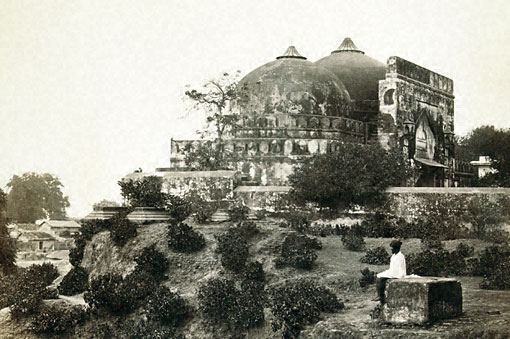

The Babri Masjid: As it was
 

4.10. Finally, the bench was so exasperated with Dr BR Mani’s way of bypassing its orders that on May 22, 2003 it passed the following extraordinary order:

“It is not necessary to comment much upon the work of the Team Leader of ASI [Dr BR Mani] for the last more than two months. We think it proper that another Team Leader should be appointed by the Director General, Archaeological Survey of India. However, Dr BR Mani shall also continue to work in the team” (para 235).

Thus the bench at the time found nothing to commend in the way Dr Mani had carried out the work on behalf of the ASI and desired that he be immediately replaced. Not desiring to show that he was being disgraced, his membership of the ASI team was however not terminated.

4.11. Justice Agarwal has not commented on this series of episodes and its implications. On the other hand, he takes to task the critics of the ASI’s conduct.

4.12. Justice Agarwal takes up some of the complaints made to the observers between April 14, 2003 and July 26, 2003. The response of Dr Mani to the complaint of April 14, 2003 was an admission that neither were animal bones being carefully recorded nor were pieces of glazed ware being sealed but he promised that now this would be done (para 3677). A similar response to the complaint of April 15, 2003 elicited a promise that the required videography and photography would be undertaken and a proper record would be kept (para 3678).

4.13. It was thus clear that the complaints were well taken. Yet Justice Agarwal takes exception to the complaint dated May 16, 2003 (para 3681) containing “the complaints regarding the recording of artefacts, brick-bat remains, etc, where the ASI instead of descriptions labelled them to serve its own objects”. The complaint, he says, was “mischievous and worthless”. Why? Because: “The ASI experts identify such item/ artefacts which ordinary people cannot. If only clear items were to be no expert would have (sic!) needed” (para 3681).

4.14. Here we are expected to look at “ASI experts” as “ordinary people” would. As a matter of fact, it is not quite so easy, in the case of broken artefacts or fragmented ‘architectural pieces’, for any ‘expert’ to imagine them as they were when they were complete pieces; and archaeologists have held different views about them. When Dr BB Lal, former director general, ASI, dug at what he called the Janma Bhumi mound in 1976-77, he was not able to identify any “pillar-base” there, as may be seen from his report published in Indian Archaeology 1976-77 – A Review (ASI, Delhi, 1980), pp. 52-53. Very properly, he did not attempt any identification of the material evidence while undertaking fieldwork and recording the finds. Only some 14 years later did he suggest such identification in the RSS journal, Manthan, October 1999; and his interpretation of the structural pieces was still open to doubt (see D. Mandal, Ayodhya: Archaeology after Demolition, Orient Longman, New Delhi, 1993/ 2003, pp. 26-40).

In the excavations at the Babri Masjid however, the “ASI experts” immediately began identifying and marking the pillar-less pillar bases. A similar act on their part was to give suggestive names like ‘divine couple’, ‘circular shrine’, etc where the terms ‘divine’ and ‘shrine’ were both subjective and motivated descriptions, not arising from any supposed professional expertise at all. At the same time, they neglected other very significant objects in total violation of professional requirements.

Peter L. Drewett, in his manual of field archaeology, notes: “Having identified the bones to species and to part of the skeleton, the bone assemblage should be quantified” (Field Archaeology: An Introduction, London, 1999, p. 156). The “ASI experts” however refused to record animal bones properly and failed even to tabulate them by species, trenches and layers in quantified form, as required by the standard manual of field archaeology we have just quoted. It is charitable to assume that the conduct of ASI “experts” in this matter arose not from gross ignorance (after all, they were “experts”) but from the fear that the presence of animal bones (cattle and caprine) could undermine their entire temple theory. One wonders therefore to whose acts the adjective “mischievous” could be more aptly applied.

4.15. With reference to the complaint on May 21, 2003, made about a pillar base in G-2 (para 3683), it is noteworthy that Shri AR Siddiqui does not at all deny the allegation that the digging was so carried out that a squarish base was being created. He just said the digging was not completed and so the objection was “premature”. That this was a wrong piece of information is shown by the fact that on May 18, 2003, the day register for this trench distinctly records: “A pillar base on plan” (para 3685); and another report of the same day (May 18, 2003) gave a more detailed description of “a structure of brickbats and rectangular in shape”, which was encountered “during digging” and which forthwith was declared a “pillar-base” (para 3688). So Shri AR Siddiqui’s reply (vide para 3683) was, to the say the least, evasive and misleading: A squarish or rectangular pillar base was in fact already recorded and he had to explain whether it really existed or had been created by removing surrounding brickbats – and this he entirely avoided doing.

4.16. On June 7, 2003 a detailed complaint was submitted, pointing out the severe breaches of prescribed archaeological methods and procedures so far pursued by the ASI: it is reproduced in para 3699. Though the high court had ordered Dr Mani’s removal as head of the ASI team on May 22, 2003, we find him still in that position on June 8, 2003 – another example of how casually the ASI treated the high court’s orders. Dr Mani thereupon delivered the following tirade against the complainants:

“There seems to be a calculated effort to defame the ASI and demoralise it’s (sic!) team member (sic!) by making statements through media and also through applications like the present one submitted by one of the parties to the case. ASI being the premier institution of the country has always been famous for accuracy and scientific approach in exploration and excavation work” (para 3700).

He goes on to claim that his team’s “recording of artifacts is perfect” – a claim ill-suited to the mouth of anyone not divine. Indeed Dr Mani’s tone is one which would have smacked of supreme arrogance and self-congratulation even if the words had come from the head of the ASI rather than a mere superintending archaeologist; and, of course, one can retort that repute acquired in times long past cannot become a cover for lapses so clearly detected by the complainants.

4.17. Since most of the issues relating to the acts of omission and commission on the part of the ASI have already been discussed in Paper III, we are here mainly concerned with how Justice Agarwal deals with the complaints.
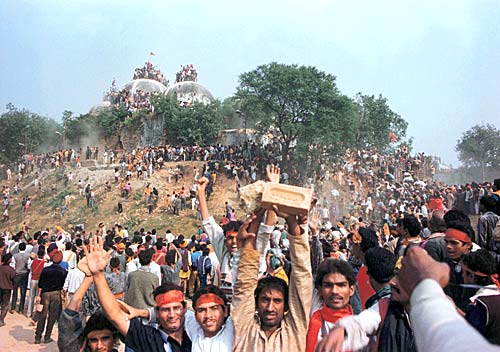

Courtesy: India Today
 

4.18. First of all, he takes no cognisance of the utter dissatisfaction of the then bench with the manner in which Dr Mani and his team had carried out the excavations until May 22, 2003. He also overlooks how, despite the court’s orders for his replacement, Dr Mani continued to be in charge on June 8, 2003. In other words, the bulk of the excavations were conducted under a person who had lost the confidence of the high court itself.

4.19. Justice Agarwal on the other hand investigates who prepared the texts of the complaints and then, finding their authors to be two witnesses, PW 29 (Dr Jaya Menon) and PW 32 (Dr Supriya Varma), gives us the dates of their presence on the sites (paras 3704 and 3705) as if they were not entitled to help in drafting complaints for other days. The comments made by Justice Agarwal in para 3711 may here be seen. Did the court similarly look into how the ASI team leader could cover in his report the excavations conducted during days he was not present at the site? In para 3712 an unfortunate slip in the complaint is held to be an astoundingly serious lapse though it perhaps arose merely due to a misreading of the figure 220cm as 270cm. Such a slip hardly means that “either they [Dr Menon and Dr Varma?] have deliberately tried to misguide the authorities (!) or the complaint [the whole of it?] lack (sic!) bona fide.”

4.20. The justice then takes up the oral evidence of the two archaeologists. PW 32 (Dr Varma) claimed that she was present when Trenches G-2 and F-3 were being excavated (para 3714). But, says the justice, digging of F-3 only started on May 30 while she was present only until May 31. However, the very dates he gives mean that Dr Varma had been able to watch the digging of the trench for two full days.

4.21. In para 3717 from an objection of his (para 3715), easily answered, Justice Agarwal draws the following conclusion:

“From the texture and the over all (sic!) facts and circumstances, some of which we have already discussed it appears to us that as soon as underneath (sic!) structures started appearing, the complainants in consultation with their alleged (!) experts, engaged in preparing a kind of anticipatory ground to assail the ASI people, their proceedings. What was submitted on spot do (sic!) not show that it was a simultaneous preparation of something which was actually observed and found objectionable by the persons thereat.”

4.22. On complaints of manipulation of materials excavated, Justice Agarwal has checked with the ASI’s records and finds (e.g. para 3725) that these records do not confirm them, as if in their record the ASI “people” would care to show how they were playing with the finds!

4.23. In para 3729 Justice Agarwal brings in the GPR Survey Report. No significance could possibly attach to it once the ground was actually excavated and there was no point in Dr Varma (PW 32) reading it and comparing it with the excavations. It is difficult to see what value can be assigned to the “anomalies” predicted in the report by the little known firm Tojo-Vikas International (Pvt.) Ltd., curiously carrying the name of the Japanese war criminal, Tojo (changed to ‘Tozo’ by Justice Agarwal – para 215). Such ‘anomalies’, the worthy company’s report had told us, “could be associated with ancient and contemporary structures such as pillars, foundation walls, slab-flooring extending over a large portion of the site” (Text reproduced in ASI’s Report, p. 5). No pillars were however found except for one broken fragment in the Masjid debris; and the presence of bricks and brickbats was not at all predicted.

4.24. It would be a sad day if the intentions and motives of the archaeologists and historians who appeared for a party whose religious faith they did not share are doubted for that reason. A preceding bench had indeed appreciated their work (para 228). But now they have become “alleged experts” (para 3717) and “virtually hired experts” (para 3879) although no proof has been offered that they lacked qualifications nor that they received any remuneration from the Muslim parties to the suit.

Of Dr Menon and Dr Varma it has been said (paras 3746 and 3774): “as admitted by these two witnesses they were partisan and interested”. In fact however neither of them made any admission of this sort. Being “interested” means “having a private interest”, especially a “pecuniary stake” (see Oxford Concise Dictionary, s.v. “interest (n.)” and “interest (vt)”); is there then a suggestion that they had something remunerative to gain for themselves by their work as archaeologists at Ayodhya?

It may be that it is hard to understand the spirit which inspired archaeologists like Dr Menon and Dr Varma and the consequence of their work at Ayodhya. It may here be worth quoting from an article in the Hindustan Times, Delhi, July 6, 2003:

“It is saddening that one should be obliged to speak in this manner of the work of the ASI that was once an institution in which the country could take justifiable pride. Today one can only say that if it did not do worse at Ayodhya, part of the credit goes to the numerous archaeologists from many places in India who maintained a constant vigil at the excavations. They did so only out of a loyalty to their profession and to secular values. When one thinks of them, one cannot help feeling sentimental about a country which, amidst all its troubles, can bring forth such men and women.”

Had Justice Agarwal looked at the ASI’s entire conduct, it might have struck him how the ASI’s behaviour from the very beginning of the excavations could engender legitimate suspicions (which in the end also proved so correct).

4.25. The DG, ASI’s addressing the bench as “Ramjanmabhoomi” instead of “Ramjanmabhoomi-Babri Masjid”, the correct designation, was not a slip but a declaration of the ASI’s partisanship in the dispute. We have seen that the first team of officials it formed for the excavation was practically entirely Hindu in composition (13 out of 14). The labourers it first employed did not include a single Muslim. Should it not have been asked, if the ASI’s intentions were of scientific excavations without any manipulation then why this deliberate exclusion of Muslims from the initial ASI team and the labour force? Even after the court’s orders, only a grudging and nominal recruitment of Muslim labourers took place.

We have seen that the complaints made about slackness in recording glazed ware and animal bones, which could militate against the presence of a temple, were genuine and partly admitted by Dr Mani himself. The high court had to pass stringent orders that its wishes must be implemented. Finally, its dissatisfaction with the ASI team leader’s conduct of the excavations was reflected in the court’s order of May 22, 2003 directing that Dr Mani be replaced as team leader though he “shall also continue to work in the team”. The spirit of the order was defied by the ASI in that while it appointed Shri Hari Manjhi, director (antiquity), as team leader, it also brazenly ensured that “Dr BR Mani continued to direct the excavation” (ASI’s Report, pp. 7-8).

4.26. Dr Mani’s hand can be seen as the dominant one in the final report. While Shri Manjhi’s name appears as the co-author of the report, the Introduction is by Dr Mani alone. He is a co-author in three major chapters (II, Cuttings; IV, Structure; V, Pottery) while Shri Manjhi, the team leader, is a contributor to none of the chapters in the report! The author of the last chapter, ‘Summary of Results’, is left unnamed – a curious way of evading responsibility. In sum, the result is that the very person with whose conduct of the excavations the high court was not satisfied was yet given full rein to ‘direct’ the excavations and write the report. Dr Mani, as we have seen, had made his commitments fairly clear by his initial actions in Ayodhya and it is not surprising that the same commitment informs the final ASI report.

4.27. Such are the plain facts, almost all of which are brought out by the documents reproduced, in whole or in part, in Justice Agarwal’s own judgement. And yet in para 3989 Justice Agarwal holds that “all objections against ASI are, therefore, rejected”.

4.28. A comprehensive clean chit is thus given in the judgement to the ASI despite the stream of motivated acts of impropriety and irregularity committed by the ASI officials that we have traced. The ASI officials arrived at Ayodhya with clear indications of commitment to one side of the dispute – shown by the very composition of their staff and labour force – and they stuck to the task of manipulating, selectively recording and perverting evidence as much as they could, increasingly constrained as they came to be by the vigilance exercised by archaeologists from the academic world. The ASI’s final report could not but be a partisan document, as we have seen in Paper III, and its rejection must form the prelude to any correct perception of the past of the disputed site.

Archived from Communalism Combat, February 2011 Year 17  No.154, Section II, Paper IV: Puppets on a String

Valley of fear, depths of despair

0

As unrest continues to brew in the Kashmir valley, and more and more innocent people lose their lives at the hands of the police or security forces, it is increasingly apparent that the Indian state urgently needs to re-examine its position and dramatically alter its tactics in Jammu and Kashmir. The Indian polity must insist on this. The strategy employed by the Indian government over the years has denied a sizeable section of the people basic human rights and estranged them from the mainstream. The wrongs that are still being inflicted on them by state forces and militant groups, the Kashmiri people’s burgeoning anger and continuing alienation feeds a conflagration that will not be extinguished unless corrective action is taken, and taken without delay. This is not a grave matter for Kashmir alone; it is a perilous situation for India as a whole. It is a blot on India’s conscience as a nation, a distressing account of systemic cruelty and studied indifference to the sorry plight of an ever-growing multitude of its citizens. And even as we urge for fundamental changes in the status quo, we must do all we can towards reparation and to ensure that the average Kashmiri’s valiant and ceaseless quest for justice yields positive results.

A report of the Independent People’s Tribunal on Human Rights Violations in Kashmir reveals the extent of deprivation of basic human rights and the depth of alienation felt by the Kashmiri people. Excerpts from the report:

Aims

There is a general perception that the human rights situation in Jammu and Kashmir is bad and largely unaddressed. The various official human rights mechanisms, including the judiciary and the State Human Rights Commission, are unable to act proactively and rein in human rights violators, including the army, paramilitary forces, police and surrendered militants. In this context, it was felt that a civil society initiative, including retired members of the judiciary, was imperative to clarify the situation and the reasons for the continued deaths and suffering.

The practice of human rights abuse is protected, if not encouraged, by legislation like the Armed Forces (Special Powers) Act, the Jammu and Kashmir Public Safety Act and the Disturbed Areas Act – where security forces are given sweeping powers to shoot, kill, arrest and detain along with blanket immunity from prosecution for such heinous acts. These powers are in complete disregard of the most fundamental postulates of international law enshrined in the UDHR (Universal Declaration of Human Rights 1948), the ICCPR (International Covenant on Civil and Political Rights), the ICESCR (International Covenant on Economic, Social and Cultural Rights), the UNCAT (UN Convention Against Torture) and the UN Convention on the Elimination of Enforced Disappearances, among others. The latter two have been signed but not ratified by India.

Keeping in view the basic principles of human rights as enshrined under the Constitution of India and various international covenants, and in order to highlight the forms and extent of human rights abuse suffered by civilians in Kashmir, the Human Rights Law Network, in collaboration with ANHAD, organised an Independent People’s Tribunal on February 20 and 21, 2010 at Srinagar, Kashmir.

The tribunal was organised with an aim to provide a platform to the victims of the ongoing armed conflict. The tribunal witnessed testimonies from all sections of Kashmiri society, including victims, their family members, social activists, journalists and academicians. In all, 37 testimonies came to be recorded during the two-day-long tribunal. Victims and their family members narrated their stories of suffering which they have experienced for the past two decades. The idea behind conducting such an event was to highlight the sufferings of all such victims and to formulate certain suggestions/ recommendations in order to minimise the use of force against the common man in the name of national security by the security agencies.

Summary

The tribunal heard testimonies from about 37 victims and their kin and we have also had testimonies/statements from journalists and members of civil society.

It is clear that there is a sense of suffering and injustice writ large on the faces of everyone who made their statements before the tribunal. We had made it clear that we are not in any way linked with the official institutions or authority and yet so many of them gave vent to their feelings in their physical and emotional state, which only strengthens our opinion that there is substantial truth in those allegations.

It cannot be gainsaid that the Armed Forces (Special Powers) Act 1958 has been in force for nearly two decades in this state. This act has been misused and is being misused wherever it is made applicable (Manipur, for example). Therefore if we take this situation into account, this draconian law has undoubtedly facilitated grave human rights abuses including “disappearances” by the very nature of the power bestowed on the armed forces.

Any abuse of powers by the armed forces is a criminal offence. It should promptly be investigated by an agency independent of the armed forces, followed by impartial prosecution. The testimonies of all witnesses clearly establish that there has been no satisfactory investigation by any agency or authority in the state, leave alone any prosecution. On the other hand, we get an impression that all institutions of the state, the executive, the legislature, the human rights commission and to a certain extent even the judiciary have failed to do justice to the victims of “disappearances” and other human rights violations.

The United Nations General Assembly in 2006 has unanimously adopted the International Convention for the Protection of All Persons from Enforced Disappearance. Earlier, there was the UN declaration to the above effect (December 1992). Article 2 of the declaration says that, “the prohibition” of “disappearances” is absolute and no state can find an excuse. Article 7 says: “no circumstances, whether a threat of war, internal political instability or any other public emergency, may be invoked to justify” these acts of violation. Hence it is not open to the state to resort to enforced disappearances, which would include all custodial deaths, on the ground of any threat to internal security or external safety and stability. It is here the state’s liability becomes absolute and we should have no hesitation in making these observations.

We have the testimony of Ms Parveena Ahangar, who is the chairperson of the Association of Parents of Disappeared Persons (APDP), which clearly establishes that 8-10,000 persons have disappeared from about 1989. Incidentally, we may point out that during the period 1984-1994, during the agitation for Khalistan in Punjab, there had been similar disappearances and recently a report based on the State’s Human Rights Commission shows that over 2,059 bodies were identified in Amritsar district and still over 1,000 bodies are lying there in the district and there are a large number of skeletons in other districts. Moreover, internationally, disappearances and “custodial deaths” fall within the definition of “torture”. Prohibition of torture and ill treatment is underlined by its non-derogable status in human rights laws. No state can justify such an act.

General findings

  1. Various instances of the security forces’ crimes have been brought to our notice. These are violations against the Geneva Conventions (Common Articles 2/3), the International Covenant on Civil and Political Rights, the Indian Penal Code and the civil law of the country. The police/paramilitary and surrendered militants have flouted Indian laws and the rules of war. As a consequence, large numbers of civilians have died, including women and children. Women, including young girls, have been harassed, raped and gang-raped and children in their early teens shot.
  2. The judicial machinery has barely functioned. Despite the stern report of the Bijbehara magisterial inquiry, recommending the severest action against the BSF (Border Security Force) officers and jawans, nothing was done. A number of cases filed in the district and high courts have been pending for years and there are numerous cases of lack of judicial action taken in terms of awarding compensation and instructing the security forces to produce the disappeared and so forth.The tribunal heard repeated examples of FIRs (first information reports) filed by the families that were distorted by the police to accuse the victims. Counter-FIRs have also been lodged by the police… Under the pretext of translating FIRs from Urdu into English, the police have completely distorted the complaints made in the original FIR. One such case with evidence was produced before the Independent People’s Tribunal.
  3. The State Human Rights Commission has no power to investigate paramilitary and military excesses though it does have the power to request investigation reports of the inquiry by the paramilitary and the military forces. The SHRC seems to have failed to exercise its powers proactively to provide justice to the victims. The general trend is that the state as well as the central government ignores the recommendations made by this commission.
  4. Rape: The worst case of mass rape was heard by the women jurists from the testimonies of women from Kunan Poshpora, who talked about the night of February 23, 1991 when the army came to their village, isolated the men and gang-raped at least 23 women of all ages from 14 to even a 100-year-old woman. The rape took place in front of their young children. There was brutal impact on their bodies and since then, they have suffered physical and mental trauma for years. They have been socially discriminated and ostracised, landing them into a traumatic state of mind that has been permanent. This is the grossest of human rights violations.
  5. Throughout the conflict people have been maimed and disabled due to the indiscriminate firing by security forces during even non-violent protests. People have also been disabled during interrogations where torture was used. We heard the testimonies from Bijbehara where forces had indiscriminately opened fire on peaceful demonstrators in 1993. Many injured persons have been disabled for life and have suffered mentally, physically and financially. Hardly any steps have been taken for their rehabilitation.

The testimonies we heard from disabled persons revealed that they were totally shocked and shattered. The disabled deposed before us to say that they could bear with the aftermath of physical injury but not with the mental pain, agony and trauma that make them feel that they die several deaths every day rather than living even once…

Custodial killings

There have been a large number of custodial killings since the conflict began. The pattern in most cases is similar even though the perpetrators may be from different forces serving the Indian state. The cases cited represent the dominant form of this method of violation of human rights. We are citing illustrative testimonies of victims, relatives of victims and others with first-hand information to illustrate our findings.

Testimonies

Masooda Parveen, representing the late Advocate Ghulam Mohiddin Regoo

Relation with victim: Wife

Resident: Pampore

District: Pulwama

“I am a mother of two. At the time of the incident my husband was a practising lawyer. On February 1, 1998, at around 9 o’clock, my husband had just returned from the mosque after offering the last prayer of the day. Two renegade militants – Bashir Ahmad and Abdul Khaliq – entered our house. Bashir’s face was partially covered with a handkerchief. He caught hold of my husband’s collar and alleged that a militant – Arshid Ahmad Ganaie – was hiding in our house. In fact, Arshid was already in their custody, in a car parked outside our house. The two people took my husband with them and a few days later his mauled dead body was returned to us. Major Poniyal of the Jat Regiment stationed at Laidpora, Pulwama, was involved in bringing all of this about. At the time of handing his body over to me they also gave me the relevant documents and the copy of the FIR.

“I approached the government authorities in order that the culprits are brought to book but to no avail. The district administration had offered me a job but later declined to acknowledge they had ever done that. When I contacted the local MLA regarding the matter, he avoided me. I approached the then chief minister, Mr Farooq Abdullah, but he shooed me away, stating that I was the wife of a ‘traitor’. My son, who is an agriculture graduate, has been constantly denied a passport by the state. I myself wanted to take the case of my husband’s gruesome murder to a UN body but was also denied a passport. I am now contesting my case in the Supreme Court with the hope that we get justice and my sons can travel abroad for their advanced studies. When the Supreme Court called for the records of our case from the police, they stated that they had lost the file. In the meantime, our harassment by the state continues as has been the case since my husband’s brutal murder.”

Gh Qadir Pandit

The case of Gh Qadir Pandit is a striking instance of the state of the judiciary and police. Even after the sessions court concluded the “custodial death”, which was reported to the Jammu and Kashmir high court, the high court directed the concerned sessions court to start investigations after three years of their filing the case. The police refused to file an FIR on the ground of jurisdictional ambiguity. The victim’s family then filed an application in the high court seeking directions to specify the police station under whose jurisdiction the case fell but no orders were passed. Mr Pandit’s brother’s comment that he was “…so disillusioned with the justice delivery system in Kashmir that I thought it best not to follow up on the case any further” sums up a common criticism of the judicial system, the SHRC and the police.

Gh Qadir Teli

Gh Qadir Teli, whose son was a victim, was himself severely tortured and stripped naked by the 21 RR (21 Rashtriya Rifles). He also filed petitions in the Jammu and Kashmir high court and SHRC about his missing son but nothing concrete happened.

“My son was a 17-year-old school dropout and had started working on our farm. He had three elder sisters and was the only substantial source of income for our family. I got him married in 2006, in district Baramulla. On the fateful day of November 25, 2006 he was not feeling well and had gone to see a doctor, Dr Habibullah Mattoo, in Sopore. While he had been waiting for his turn at the clinic, a fellow villager had called him on his mobile phone, which is when he had confirmed his location. At around 1 o’clock in the afternoon I saw a huge crowd outside my house. Some people standing close by advised me against going home at that time, as there the army had raided my house and were searching it. Disturbed by the gravity of the situation, I thought of calling my son. I went to a phone booth to make the call but his cellphone was switched off.

“During this time the rest of my family inside the house was being harassed by the army. Finally, I reached home at around 9:30 in the evening but my son was nowhere to be seen. For the next three days there was no news of him. I registered a missing report at the police station on December 8, 2006. However, the army – led by some DSP (deputy superintendent of police) Tickoo – raided my house soon after and asked for the original copy of the report, which I had to hand him out of fear. Fortunately enough, I had already made photocopies. I then returned to the concerned police station and lodged a fresh complaint.

“A few days following this the army came looking for me but somehow I managed to get away. But on another occasion the 21 RR raided my house again and took me into custody. They then took me to Handwara where I was severely tortured while being stripped naked. You can imagine what I might have gone through considering it was the body of an old man they were inflicting inhuman treatment on. They were trying to coerce me to accept that my son was a militant and that I had ammunition in my possession but I didn’t succumb. When they released me, I filed an application with the district magistrate reiterating that I had been subjected to illegal detention and torture and that the whereabouts of my son were unknown. I also filed petitions in the Jammu and Kashmir high court and the SHRC but nothing has come out of them.”

Enforced disappearance

One of the most harrowing consequences of the armed conflict in Kashmir is that people in detention go missing. The majority of missing persons are men, which leaves a large number of women awaiting news that would decide their fate, living lives of half-widows. A state like this results in a severe identity crisis amongst the women – with the immense agony of not being sure whether they are still married or widowed.

Enforced disappearances in Kashmir started in 1989 following the outbreak of armed conflict. The state has seen heavy deployment of security forces (more than 6,00,000 – the highest number of army personnel during peacetime anywhere in the world) since.

In international human rights law, disappearances at the hands of the state have been codified as enforced or forced disappearances. The Rome Statute establishing the International Criminal Court defines enforced disappearance as a crime against humanity. However, the police do not entertain missing reports with regard to these persons.

The Association of Parents of Disappeared Persons, an organisation founded by concerned persons in Kashmir, has been demanding the whereabouts of people who have been subjected to enforced custodial disappearance by various security agencies, troops and police – mostly since the break out of armed rebellion in 1988. Even though the association continues to highlight their sufferings and their demands, their genuine pleas and grievances are yet to strike the conscience of the so-called elected representatives of the people.

According to the International Convention on Enforced Disappearances, no exceptional circumstances whatsoever – whether a state of war, a threat of war, internal political instability or any other public emergency – may be invoked as a justification for enforced disappearance and the state is under an obligation to investigate acts of enforced disappearance.

Testimonies

Zahoor Ahmad Mir, representing Ali Mohd Mir

Relation with victim: Son

Resident: Nishat

District: Srinagar

“My father, namely Ali Muhammad, was killed by Ghulam Ahmad alias Papa Kishtwari on June 26, 1996. I filed a case in the high court in the year 2006. I also filed a case in the SHRC in the year 2007. After I got the case registered, it pressurised the police and only then could I get an FIR lodged against Papa Kishtwari in the concerned police station. Papa Kishtwari is a surrendered militant and is now a government-sponsored person. He even won uncontested elections. Papa Kishtwari is believed to have committed 150 murders but only 26 are registered against him. His accomplices have been left free. I want my father’s dead body. Papa Kishtwari is in jail because of me but he is not being punished. I want justice.”

Abdul Rashid Beigh, representing Fayaz Ahmad Beigh

Relation with victim: Father

Resident: Khajapora, Nowshera

District: Srinagar

“My son, namely Fayaz Ahmad Beigh, was working as a photographer in the department of Central Asian studies at the University of Kashmir. He was arrested during his duty hours by HR Parihar, SP (superintendent of police), STF (Special Task Force), at Awantipora on September 6, 1997 and was taken to some unknown destination along with his motorcycle. When my son didn’t return, I set to locate his whereabouts. I approached STF and SOG (Special Operations Group) officials through the SP, operations, Awantipora, who, after taking a lot of time, admitted my son’s detention. But my efforts brought no results. I haven’t seen my son till date. The STF agency concocted a baseless story that my son had escaped from custody.

“The SHO (station house officer), Soura, namely Abdul Rashid Khan alias Rashid Billa, is hand in glove with the criminals. He has given a legal cover to my son’s disappearance and has created false evidence by registering a false case against him. I approached the then home minister, Ali Mohammad Sagar, to seek his help in order to locate my son. He ordered a CID inquiry. The IG (inspector-general), CID, submitted its report stating that Fayaz Ahmad Beigh was arrested from the university campus and the story put forth by the STF was proved false.

“I approached the SHRC and registered a complaint (File No. SHRC /2008/09) in December 1997. The complaint was disposed of on April 3, 2000. The SHRC in its order rejected the STF/police story of Fayaz Ahmad’s escape from custody as ridiculous and recommended a compensation of Rs five lakh. The SHRC also directed the registration of a criminal case against SP Parihar and his subordinates. Unfortunately, the then state government did not pay any heed to the recommendations of the SHRC and left the case virtually unattended for years together. In the meanwhile, we also filed a habeas corpus petition (HCP No. 1411/97) in the high court wherein we prayed to show the case of detention of my son and the authority and law under which my son was detained. However, we were made to withdraw the writ petition on the ground that the case was already pending with the SHRC.

“Later on, in order to get the recommendations of the SHRC implemented, I filed a writ petition in the high court (OWP No. 263/OWP-2002). The hon’ble high court in its subsequent decision upheld the recommendations of the SHRC and directed the state government to execute the recommendations given by the SHRC. It is painful to note that the government has slept over the matter and shown no response even to the high court’s decision. In January 2004 the home department and SP, operations, HR Parihar, filed an appeal against the order passed by the high court division bench, Srinagar, on admission of the LPA (182/03). The hon’ble chief justice directed the trial court to pass an appropriate order in session of challan (239/97). On our application, the trial court, Srinagar, passed an order on December 12, 2007 that criminal proceedings cannot be started against a dead person; therefore the challan has been consigned to records after due compliance.

“The case is still pending before the division bench.”

Rape cases

Rape is a particularly heinous crime. It has been used as a method of humiliating an individual and community and destroying their honour. Since the stigma never goes away, the victim is shunned and shamed for life.

Testimonies from Kunan Poshpora village

Kunan Poshpora mass rape: On the intervening night of February 23 and 24, 1991 about 23 women from Kunan Poshpora village in the border district of Kupwara were raped by the troops of the 4 Rajputana Rifles during a search operation. As per reports, at around 11:00 p.m. army personnel in large numbers entered the village. This was followed by the segregation of women from men. While the men were asked to assemble in a village field, the women were ordered to stay put inside the houses. This is when the army men barged into the households and gang rapes followed. Reportedly, women from ages 13-80 were raped. One such woman, who is now 120 years of age, stated that she was stripped naked, dragged out of her house into the snow-filled front yard and gang-raped. A police investigation into the incident never occurred.

Bakthi (victim)

Wife of Mohd Siddiq

Resident: Kunan Poshpora

District: Kupwara

“On the night of February 23, 1991 our village was cordoned off by a large group of drunken army personnel. The next morning I came to know that other women from the village had similarly suffered. At this point the menfolk who had been assembled in the village field during the search operation the preceding night were being asked by the army to raise their hands in agreement and say aloud that no excesses had been committed in the village, and were being filmed while doing so. This is when we womenfolk went over to the field in half-naked condition to make it known to the men what had happened to us. On seeing us, the men lost their cool and refused to accept what they were being ordered to say.

“On getting home, the men too shared their stories of torture that had been inflicted on them by the army. Learning of the brutality that had been meted out to the women in the village, the men tried to file FIRs, which was a daunting task in context of the fear of reprisal by the concerned army men. There was no primary health centre nearby where we womenfolk could have got ourselves examined in order to collect medical evidence.

“At the time of the incident I was 30 years old. Within a year of the incident four women from our village – Saja, Mehtaba, Zarifa and Jana – succumbed to death stemming from the mental trauma and disgrace they had to put up with. These women had also been struggling with physical ailments subsequent to the incident. The self-humiliation resulting from our traumatic experience didn’t allow us to visit any of our relatives from other villages, nor did they pay us a visit. We also had to take our children out of school for fear of their being apprehended and tortured by the army. My son and many young men from the village grew up harbouring vengeance in their hearts for what had been done to the women in their families.

“Following the incident of mass rape in the village, proposals of marriage stopped coming from outside our village, since the news of the rapes had become common knowledge all around the valley. As a consequence, marriages between victim relatives from within our village started to take place. Many people came to our village for documenting or reporting the wrong that was done to us and we shared our stories with them yet justice has eluded us to date. Now we are disillusioned and personally I find it despairing and difficult to revisit that harrowing ordeal of ours by narrating it to people time and again. At the same time, the mental and physical pain suffered that night and after continues to haunt me. My old husband has died and now it is my last wish that the guilty army personnel be punished. I had lodged an FIR bearing No. RI/1387/83 under the Ranbir Penal Code, Sections 376, 452 and 342, at the Trehgam police station on March 2, 1991. However, nothing came of it.”

Faba (victim)

Resident: Kunan Poshpora

District: Kupwara

“I was approximately 25 years old and a mother of two at the time of the incident. At around 11:00 p.m. on February 23, army personnel barged into our house. They caught hold of my husband and were taking him away when I insisted on accompanying him. My husband stopped me by saying that I should wait for him at home, as he would be back in some time and there was nothing to worry. Therefore I stayed back and bolted the doors of my house. After a while, there was a loud knock at the door. On noticing that my house had been surrounded by the army, I did not unlock the door. At this, eight to 10 army men broke the door open, barged in and raped me and my unmarried sister. My sister is now suffering from post-traumatic stress disorder. With great difficulty we were eventually able to get my sister married to someone from the same village, whose family had suffered likewise. Post-rape, she even delivered a baby who did not survive. Within two to three months of the incident, a lady doctor was called into the village for conducting abortions on women who had conceived as a result of the rapes. My son was five to six years old at the time of the incident and he now faintly remembers what had happened to me and his aunt that night.

“The women from the village tried to preserve their clothes for some time in order to substantiate rape and showed them to the media or any other authorities who came to the village for investigating/reporting rape. Currently those clothes are in police custody.”

The judges asked the victims if any magisterial inquiry had taken place after the incident, as reports have suggested. The victims replied by saying that there were many people who came and asked questions after the incident; however, they do not know of their identities. In an aside, the victims collectively testified that they refrained from discussing the rapes with or in presence of their sons, apprehensive that they might take matters into their own hands. They added that on the next morning after the rapes a local resident, Abdul Ghani Dar, who was also a police constable, called a lady doctor to conduct check-ups of the victim women. (The said police constable’s cousin was also a victim and she had later conceived as a result of the rape. The foetus was later aborted.)

The said doctor conducted a medical check-up of all the women who had been raped and their clothes were taken to Trehgam police station later on. The doctor medically cleansed all of the raped women in order to prevent pregnancies. The victims stated that the police constable had taken the initiative of getting this done in order to save the village from humiliation. On February 17, 1993 an unidentified person killed the said policeman. His parents are still alive but his mother lost mobility and his father became a patient of depression after their son died.

The victims reported that women from Kunan Poshpora faced social rejection for many years after the incident; to the extent that they were not allowed seats in public transport by fellow passengers. Instead, they were made to sit on the floor, away from the others. On being asked by the judges what they expected from the tribunal, the victims replied in unison that they wanted the perpetrators to be punished.

The then chief justice of the Jammu and Kashmir high court, Justice Mufti Baha-ud-din, led a fact-finding mission to the village and concluded that normal investigative procedures were blatantly disregarded in this case. A Press Council of India investigation followed, which called the allegations of these women “a well-fabricated bundle of lies”. No further investigations were conducted and the matter remains unredressed till date. The government’s handling of the case was widely criticised in national and international circles, including international human rights organisations like Human Rights Watch and Amnesty International.

If such an incident had occurred in the rest of India, there would have been a sustained public outcry and agitation. The judiciary would also have responded.

Conclusion

It is clear that the rule of law does not operate as laid down in the statute books. Talks between Kashmiri leaders, including the separatists and the central government, have not led to any positive outcome. In fact, it would appear that the real mass discourse is a reflection of the mass alienation in the Kashmir valley. Demonstrations and street protests often resulting in clashes and stone-throwing have regularly led to civilian deaths fuelling another cycle of protest. The government’s focus is on containing the armed militants but not on having a sustained dialogue with the population and its leaders. The numbers of militants killed as indices of peace in the valley is misleading. The crucial indicator of mass alienation is not the infiltration of militants but resistance by the people.

Any path for a solution of the Jammu and Kashmir problem must squarely and frontally deal with this mass alienation of the people and directly confront its causes.

Recommendations

  1. The controversial Armed Forces (Special Powers) Act 1958 should be withdrawn from Jammu and Kashmir. The Jammu and Kashmir Public Safety Act 1978 and other anti-terror laws should correspond to the provisions of the International Covenant on Civil and Political Rights which India has ratified. It should be noted that India has been repeatedly criticised in the UN Human Rights Committee for the existence of the Armed Forces (Special Powers) Act which violates, crucially, several articles of the ICCPR.
  2. Keeping in view the large concentration of military and paramilitary forces in the state of Jammu and Kashmir, which is disproportionate to the civilian population and is also making civil administration ineffective in many matters, the government of India should take immediate steps to minimise the number of these forces in order to bring relief to the civilian population.
  3. We recommend the establishment of a special judicial authority making an independent and thorough inquiry into all allegations of human rights violations, including disappearances, custodial killings, rape, torture, including torture of prisoners, fake encounters, and all other cases related to excesses by security forces.
  4. Every case of killing by police and security forces in situations like protests, demonstrations, riots, etc should be followed by a judicial inquiry into the police/security forces firing/actions, followed by proper, time-bound administrative action. It is made clear that the police have no licence to kill anyone in any situation unless they can justify this action under Section 100 of the Indian Penal Code, which has to be done in a judicial procedure.
  5. Provide proper rehabilitation to families of deceased, injured and traumatised victims, especially the raped.
  6. Compensation as interim relief should be arranged promptly. Compensation should be adequate and purposeful. Compensation should be for both injury to person as well as for damage to property i.e. houses, etc.
  7. The state should immediately establish fast track courts for the purpose of trying the large number of cases which are pending.
  8. Both state as well as central governments should take immediate steps to address the sufferings of detainees who are languishing in various jails and interrogation centres in and outside the state of Jammu and Kashmir and have been complaining of torture and inhuman treatment inside the jails.
  9. The state should provide witness protection, since many of the witnesses are being threatened.
  10. It is necessary that the government should first establish a “Grievance Cell” in every town where armed forces are deployed. These cells will receive complaints regarding allegations of missing persons or abuse of law by security/armed forces, make prompt inquiries and furnish information to the complainants. The cell should have the full authority to inspect and call for every record maintained by the security forces or by the local authorities.
  11. As a confidence building measure, the government should hold talks with the Jammu and Kashmir representatives, organisations of men and women, in Srinagar. Currently talks on these matters are held in Delhi, including talks with Pakistan. The Kashmiris find themselves out of the dialogue process, as no talks are held in Srinagar.
  • Justice H. Suresh, former Judge, Bombay High Court
  • Justice Malay Sengupta, former Chief Justice, Sikkim High Court
  • Justice A. Barua, former Judge, Calcutta High Court
  • Professor Kamal Mitra Chenoy, Jawaharlal Nehru University, Delhi
  • Dr Nusrat Andrabi, former Principal, Government Women’s College, Srinagar
  • Professor Anuradha Chenoy, Jawaharlal Nehru University, Delhi
  • Shujaat Bukhari, senior Journalist, Srinagar n

The Independent People’s Tribunal on Human Rights Violations in Kashmir, organised by the Human Rights Law Network, HRLN, and ANHAD, was held in Srinagar on February 20-21, 2010.

Archived from Communalism Combat, July-August 2010, Anniversary Issue (17th).Year 17, No.153 – Cover Story 3

Introduction

0

The commission and its task

On October 29, 2004 the Government of India resolved to constitute a national commission consisting of (i) a chairman (ii) three members – one of them being an expert in Constitution and law – and (iii) a member-secretary with administrative experience, to be entrusted  with the following terms of reference:

(a) to suggest criteria for identification of socially and economically backward sections among religious and linguistic minorities;
(b) to recommend measures for welfare of socially and economically backward sections among religious and linguistic minorities, including reservation in education and government employment; and
(c) to suggest the necessary constitutional, legal and administrative modalities required for the implementation of its recommendations. The commission was asked to present a report on its deliberations and recommendations within a period of
six months from the date of assumption of charge by the chairman.

2. The actual composition of the commission was notified nearly five months later, in March 2005, by the union ministry of social justice and empowerment.

3. On March 21, 2005 the following took charge as chairman and members of the commission:
(a) Justice Ranganath Misra: Former Chief Justice of India and Ex-Chairman, National Human Rights Commission … ( Chairman )
(b) Professor Dr Tahir Mahmood: Former Chairman, National Commission for Minorities and Ex-Dean, Faculty of Law, Delhi University
(c) Dr Anil Wilson: Principal, St Stephen’s College, Delhi
(d) Dr Mohinder Singh: Director, National Institute of Punjab Studies, Delhi

4. The commission held its first meeting on the same date with Dr Sundeep Khanna, additional secretary in the union ministry of social justice and empowerment, as its acting secretary. At this meeting the commission assumed for itself the abbreviation NCRLM – National
Commission for Religious and Linguistic Minorities – and charted out its future programme of action.

5. The commission was allotted an office at the Jawaharlal Nehru Stadium in Delhi and sanctioned a secretariat of 40 posts in various cadres (later increased to 44), which were gradually filled in the coming months.

6. Mrs Asha Das, a former secretary to the Government of India, was later appointed as the member-secretary of the commission and assumed charge of her office on May 10, 2005.

7. After nearly five months of its work, the commission’s terms of reference were modified so as to add the following to its original terms of reference:  To give its recommendations on the issues raised in writ petitions 180/04 and 94/05, filed in the Supreme Court and in certain high courts, relating to para 3 of the Constitution (Scheduled Castes) Order 1950 in the context of ceiling of 50 per cent on reservations as also the modalities of inclusion in the list of Scheduled Castes.

8. In view of the extensive work required to be done by the commission to answer its various terms of reference, original and extended, its tenure was periodically extended – finally up to May 15, 2007.

Procedure adopted
1. As the commission was authorised by the government to adopt its own procedure, it was decided to gradually follow an action programme comprising of the following:
(a) assessments of data available through Census reports, National Sample Survey Organisation survey reports and National Family Health Survey and other special agencies;
(b) obtaining people’s views and public opinion on each of its terms of reference through a multilingual press notification;
(c) collecting necessary information, through personal meetings and questionnaires, from the ministries and departments of the union government and from the governments of the states and union territories;
(d) meeting representatives of and collecting relevant information from the central and state-level governmental and parastatal commissions, corporations, federations, boards and organisations, etc especially
working for the minorities, like the central and state Minorities Commissions, National Minorities Development and Finance Corporation and its state channelising agencies, Central Wakf Council and state
Wakf Boards, etc.
(e) collecting necessary information from major outfits, organisations, associations and institutions of each of the minority communities;
(f) having discussions with and collecting relevant information from public sector undertakings, financial institutions, major banks and select NGOs;
(g) visiting the states and union territories to interact with members and officers of the local governments and the local minority community leaders and representatives;
(h) inviting researchers, subject experts, academics, and representatives and spokespersons of various minorities, etc – individually and in groups – for a discussion of issues relevant to the commission’s work;
(i) examining the old and recent reports of bodies and panels like Kaka Kalelkar Commission, Mandal Commission, Backward Classes Commission, Gopal Singh Panel, etc;
(j) sponsoring seminars, symposia and workshops on the issues involved, to be organised by outside institutions with a wide participation of subject experts, academics, researchers and fieldworkers; and
(k) procuring special studies of select topics relevant to the commission’s work by assigning these to individual experts and researchers.

Archived from Communalism Combat, April 2010 Year 16    No.150, Chapter 1, Indtroduction

Constitutional and Legislative Provisions Regarding the Minorities

0

Who are the minorities?

1. The Constitution of India uses the word ‘minority’ or its plural form in some Articles – 29 to 30 and 350A to 350B – but does not define it anywhere. Article 29 has the word “minorities” in its marginal heading but speaks of “any sections of citizens… having a distinct language, script or culture”. This may be a whole community generally seen as a minority or a group within a majority community. Article 30 speaks specifically of two categories of minorities – religious and linguistic. The remaining two Articles – 350A and 350B – relate to linguistic minorities only.

2. In common parlance, the expression “minority” means a group comprising less than half of the population and differing from others, especially the predominant section, in race, religion, traditions and culture, language, etc. The Oxford Dictionary defines ‘Minority’ as a smaller number or part; a number or part representing less than half of the whole; a relatively small group of people, differing from others in race, religion, language or political persuasion”. A special Subcommittee on the Protection of Minority Rights appointed by the United Nations Human Rights Commission in 1946 defined the ‘minority’ as those “non-dominant groups in a population which possess a wish to preserve stable ethnic, religious and linguistic traditions or characteristics markedly different from those of the rest of the population.”

3. As regards religious minorities at the national level in India, all those who profess a religion other than Hindu are considered minorities, since over 80 per cent [of the] population of the country professes the Hindu religion. At the national level, Muslims are the largest minority. Other minorities are much smaller in size. Next to the Muslims are the Christians (2.34 per cent) and Sikhs (1.9 per cent); while all the other religious groups are still smaller. As regards linguistic minorities, there is no majority at the national level and the minority status is to be essentially decided at the state/union territory level. At the state/union territory level – which is quite important in a federal structure like ours – the Muslims are the majority in the state of Jammu and Kashmir and the union territory of Lakshadweep. In the states of Meghalaya, Mizoram and Nagaland, Christians constitute the majority. Sikhs are the majority community in the state of Punjab. No other religious community among the minorities is a majority in any other state/UT.

4. The National Commission for Minorities Act 1992 says that “Minority, for the purpose of the act, means a community notified as such by the central government” – Section 2(7). Acting under this provision, on October 23, 1993 the central government notified the Muslim, Christian, Sikh, Buddhist and Parsi (Zoroastrian) communities to be regarded as “minorities” for the purpose of this act.

5. The Supreme Court in TMA Pai Foundation & Ors vs State of Karnataka & Ors (2002) has held that for the purpose of Article 30 a minority, whether linguistic or religious, is determinable with reference to a state and not by taking into consideration the population of the country as a whole. Incidentally, ‘scheduled castes’ and ‘scheduled tribes’ are also to be identified at the state/UT level. In terms of Articles 341 to 342 of the Constitution, castes, races or tribes or parts of or groups within castes, races or tribes are to be notified as scheduled castes or scheduled tribes in relation to the state or union territory, as the case may be.

6. The state Minorities Commission Acts usually empower the local governments to notify the minorities e.g. Bihar Minorities Commission Act 1991, Section 2(c); Karnataka Minorities Commission Act 1994, Section 2(d); Uttar Pradesh Minorities Commission Act 1994, Section 2(d); West Bengal Minorities Commission Act 1996, Section 2(c); Andhra Pradesh Minorities Commission Act 1998, Section 2(d). Similar acts of Madhya Pradesh (1996) and Delhi (1999) however say that government’s notification issued under the National Commission for Minorities Act 1992 will apply in this regard – Madhya Pradesh Act 1996, Section 2(c); Delhi Act 1999, Section 2(g); Section 2(d). In several states (e.g. Himachal Pradesh, Jharkhand, Madhya Pradesh, Maharashtra, Uttar Pradesh and Uttarakhand), Jains have been recognised as a minority. The Jain community approached the Supreme Court seeking a direction to the central government for a similar recognition at the national level and their demand was supported by the National Commission for Minorities. But the Supreme Court did not issue the desired direction, leaving it to the central government to decide the issue (Bal Patil case, 2005). In a later ruling however, another bench of the Supreme Court upheld the Uttar Pradesh law recognising Jains as a minority (Bal Vidya case, 2006).

Rights of minorities

7. The Universal Declaration of Human Rights 1948 and its two International Covenants of 1966 declare that “all human beings are equal in dignity and rights” and prohibit all kinds of discrimination – racial, religious, etc. The UN Declaration against All Forms of Religious Discrimination and Intolerance 1981 outlaws all kinds of religion-based discrimination. The UN Declaration on the Rights of Minorities 1992 enjoins the states to protect the existence and identity of minorities within their respective territories and encourage conditions for promotion of that identity; ensure that persons belonging to minorities fully and effectively exercise human rights and fundamental freedoms with full equality and without any discrimination; create favourable conditions to enable minorities to express their characteristics and develop their culture, language, religion, traditions and customs; plan and implement national policy and programmes with due regard to the legitimate interests of minorities; etc.

8. In India, Articles 15 and 16 of the Constitution prohibit the state from making any discrimination on the grounds only of religion, race, caste, sex, descent, place of birth, residence or any of them either generally i.e. every kind of state action in relation to citizens (Article 15) or in matters relating to employment or appointment to any office under the state (Article 16). However, the provisions of these two articles do take adequate cognisance of the fact that there had been a wide disparity in the social and educational status of different sections of a largely caste-based, tradition-bound society with large-scale poverty and illiteracy. Obviously, an absolute equality among all sections of the people regardless of specific handicaps would have resulted in perpetuation of those handicaps. There can be equality only among equals. Equality means relative equality and not absolute equality. Therefore the Constitution permits positive discrimination in favour of the weak, the disadvantaged and the backward. It admits discrimination with reasons but prohibits discrimination without reason. Discrimination with reasons entails rational classification having nexus with constitutionally permissible objects. Article 15 permits the state to make “any special provisions” for women, children, “any socially and educationally backward class of citizens” and scheduled castes and scheduled tribes. Article 15 has recently been amended by the Constitution (93rd Amendment) Act 2005 to empower the state to make special provisions, by law, for admission of socially and educationally backward classes of citizens or scheduled castes/tribes to educational institutions, including private educational institutions, whether aided or unaided by the state, other than minority educational institutions. Article 16 too has an enabling provision that permits the state for making provisions for the reservation in appointments of posts in favour of “any backward class of citizens which, in the opinion of the state, is not adequately represented in the services under the state”. Notably, while Article 15 speaks of “any socially and educationally backward class of citizens” and the scheduled castes and scheduled tribes without qualifying backwardness with social and educational attributes and without a special reference to scheduled castes/scheduled tribes, Article16 speaks of “any backward class of citizens”.

9. The words ‘class’ and ‘caste’ are not synonymous expressions and do not carry the same meaning. While Articles 15 and 16 empower the state to make special provisions for backward “classes”, they prohibit discrimination only on the ground of ‘caste’ or ‘religion’. In other words, positive discrimination on the ground of caste or religion coupled with other grounds such as social and educational backwardness is constitutionally permissible and therefore, under a given circumstance, it may be possible to treat a caste or religious group as a “class”. Therefore even though Article 15 does not mention minorities in specific terms, minorities who are socially and educationally backward are clearly within the ambit of the term “any socially and educationally backward classes” in Article 15 and “any backward class” in Article 16. Indeed the central government and state governments have included sections of religious minorities in the list of Backward Classes and have provided for reservation for them. The Supreme Court, in Indira Sawhney & Ors vs Union of India, has held that an entire community can be treated as a ‘class’ based on its social and educational backwardness. The court noted that the government of Karnataka, based on an extensive survey conducted by them, had identified the entire Muslim community inhabiting that state as a backward class and have provided for reservations for them. The expression ‘backward classes’ is religion-neutral and not linked with caste and may well include any caste or religious community which as a class suffered from social and educational backwardness.

10. Though economic backwardness is one of the most important – or perhaps the single most important – reasons responsible for social and educational backwardness alone of a class, the Constitution does not specifically refer to it in Articles 15 and 16. In the Indira Sawhney case, the Supreme Court had observed: “It is therefore clear that economic criterion by itself will not identify the backward classes under Article 16(4). The economic backwardness of the backward classes under Article 16(4) has to be on account of their social and educational backwardness. Hence no reservation of posts in services under the state, based exclusively on economic criterion, would be valid under clause (1) of Article 16 of the Constitution.”

The Universal Declaration of Human Rights 1948 and its two International Covenants of 1966 declare that “all human beings are equal in dignity and rights” and prohibit all kinds of discrimination – racial, religious, etc

11. It is however notable that in the chapter of the Constitution relating to Directive Principles of State Policy, Article 46 mandates the state to “promote with special care the educational and economic interests of the weaker sections of the people… and… protect them from social injustice and all forms of exploitation.” This article refers to scheduled castes/scheduled tribes “in particular” but does not restrict to them the scope of “weaker sections of the society”.

12. Article 340 of the Constitution empowered the president to appoint a commission “to investigate the conditions of socially and educationally backward classes” but did not make it mandatory.
 

Other constitutional safeguards

13. The other measures of protection and safeguard provided by the Constitution in Part III or elsewhere having a bearing on the status and rights of minorities are:
(i) Freedom of conscience and free profession, practice and propagation of religion (Article 25);
(ii) Freedom to manage religious affairs (Article 26);
(iii) Freedom as to payment of taxes for promotion of any particular religion (Article 27);
(iv) Freedom as to attendance at religious instruction or religious worship in certain educational institutions (Article 28);
(v) Special provision relating to language spoken by a section of the population of a state (Article 347);
(vi) Language to be used in representations for redress of grievances (Article 350);
(vii) Facilities for instruction in mother tongue at primary stage (Article 350A);
(viii) Special officer for linguistic minorities (Article 350B).

Article 29
14. Articles 29 and 30 deal with cultural and educational rights of minorities. Article 29 provides that:
(1) any section of the citizens residing in the territory of India or any part thereof having a distinct language, script or culture of its own shall have the right to conserve the same; and
(2) no citizen shall be denied admission into any educational institution maintained by the state or receiving aid out of state funds on grounds only of religion, race, caste, language or any of them.
15. Unlike Article 30, the text of Article 29 does not specifically refer to minorities though it is quite obvious that the article is intended to protect and preserve the cultural and linguistic identity of the minorities. However, its scope is not necessarily confined to minorities. The protection of Article 29 is available to “any section of the citizens residing in the territory of India” and this may as well include the majority. However, India is a colourful conglomeration of numerous races, religions, sects, languages, scripts, culture and traditions. The minorities, whether based on religion or language, are quite understandably keen on preserving and propagating their religious, cultural and linguistic identity and heritage. Article 29 guarantees exactly that. There may appear to be some overlapping in language and expressions employed in Articles 15(1) and 29(2). However, Article 15(1) contains a general prohibition on discrimination by the state against any citizen on grounds only of religion, race, caste, sex, place of birth or any of them whereas Article 29(2) affords protection against a particular species of state action, viz admission into educational institutions maintained by the state or receiving aid out of state funds.

Article 30
16. Article 30 is a minority-specific provision that protects the right of minorities to establish and administer educational institutions. It provides that “all minorities, whether based on religion or language, shall have the right to establish and administer educational institutions of their choice”. Clause (1A) of Article 30, which was inserted by the Constitution (44th Amendment) Act 1978, provides that “in making any law providing for the compulsory acquisition of any property of an educational institution established and administered by a minority, referred to in clause (1), the state shall ensure that the amount fixed by or determined under such law for the acquisition of such property is such as would not restrict or abrogate the right guaranteed under that clause”. Article 30 further provides that “the state shall not, in granting aid to educational institutions, discriminate against any educational institution on the ground that it is under the management of a minority, whether based on religion or language”.
17. It would be worthwhile to note that minority educational institutions referred to in clause (1) of Article 30 have been kept out of the purview of Article 15(4) of the Constitution which empowers the state to make provisions by law for the advancement of any socially and educationally backward classes of citizens or scheduled castes/scheduled tribes in regard to their admission to educational institutions (including private educational institutions), whether aided or unaided.
18. Articles 29 and 30 have been grouped together under a common head, namely “Cultural and Educational Rights”. Together they confer four distinct rights on minorities. These include the right of:
(a) any section of citizens to conserve its own language, script or culture;
(b) all religious and linguistic minorities to establish and administer educational institutions of their choice;
(c) an educational institution against discrimination by state in the matter of state aid (on the ground that it is under the management of a religious or linguistic minority); and
(d) the citizen against denial of admission to any state-maintained or state-aided educational institution.
19. Article 29, especially clause (1) thereof, is more generally worded whereas Article 30 is focused on the right of minorities to (i) establish and (ii) administer educational institutions. Notwithstanding the fact that the right of the minority to establish and administer educational institutions would be protected by Article 19(1)(g), the framers of the Constitution incorporated Article 30 in the Constitution with the obvious intention of instilling confidence among minorities against any legislative or executive encroachment on their right to establish and administer educational institutions. In the absence of such an explicit provision, it might have been possible for the state to control or regulate educational institutions, established by religious or linguistic minorities, by law enacted under clause (6) of Article 19.

Legal framework for protection of religious minorities

20. Legislation such as the Protection of Civil Rights Act 1955 [formerly known as the Untouchability (Offences) Act 1955] and the Scheduled Castes and the Scheduled Tribes (Prevention of Atrocities) Act 1989 has been enacted by the central government to protect persons belonging to scheduled castes and scheduled tribes from untouchability, discrimination, humiliation, etc. No legislation of similar nature exists for minorities though it may be argued that unlike the latter act, viz the Scheduled Castes and the Scheduled Tribes (Prevention of Atrocities) Act 1989, the former act, viz the Protection of Civil Rights Act 1955, is applicable across the board to all cases of untouchability-related offences regardless of religion. Therefore if a scheduled caste convert to Islam or Christianity (or any other person) is subjected to untouchability, the perpetrators of the offences may be proceeded against under the provisions of the act. However, no precise information is available in regard to the act being invoked to protect a person of a minority community.

The law enforcing agencies appear to be harbouring a misconception that the Protection of Civil Rights Act 1955 has been enacted to protect only scheduled castes against enforcement of untouchability-related offences. There is thus a case for sensitising the law enforcement authorities/agencies in this regard. Having said that, one cannot resist the impression that the Protection of Civil Rights Act 1955 has failed to make much of an impact due to its tardy implementation notwithstanding the fact that the offences under this act are cognisable and triable summarily. The annual report on the Protection of Civil Rights Act for the year 2003 (latest available), laid on the table of each House of Parliament under Section 15A(4) of the act, reveals that only 12 states and UTs had registered cases under the act during that year. Out of 651 cases so registered, 76.04 per cent (495) cases were registered in Andhra Pradesh alone. The number of cases registered in nine states/UTs varied from one to 17. Only in three states, the number of cases registered exceeded 20. The report also reveals that out of 2,348 cases (out of 8,137 cases, including brought/forward cases) disposed of by courts during the year, a measly 13 cases constituting 0.55 per cent ended in conviction. This appears to be a sad commentary on the state of affairs in regard to investigation and prosecution. To say that the practice of untouchability does not exist in 23 remaining states/UTs would be belying the truth that is known to the world. It only denotes pathetic inaction on the part of law enforcing agencies. The provisions of the Protection of Civil Rights Act need to be enforced vigorously with a view to ensuring that the law serves the purpose it has been enacted for.

Articles 15 and 16 of the Constitution prohibit the state from making any discrimination on the grounds only of religion, race, caste, sex, descent, place of birth, residence or any of them either generally

21. With a view to evaluating progress and development of minorities, monitoring the working of safeguards provided to them under the Constitution and laws, etc, the central government had constituted a non-statutory Minorities Commission in 1978. In 1992 the National Commission for Minorities Act was enacted to provide for constitution of a statutory commission. The National Commission for Minorities was set up under the act in 1993. The functions of the commission include:
(a) evaluating the progress of the development of minorities under the union and states;
(b) monitoring the working of the safeguards provided in the Constitution and in laws enacted by Parliament and the state legislatures;
(c) making recommendations for the effective implementation of safeguards for the protection of the interests of minorities by the central government or the state governments;
(d) looking into specific complaints regarding deprivation of rights and safeguards of the minorities and take up such matters with the appropriate authorities;
(e) causing studies to be undertaken into problems arising out of any discrimination against minorities and recommend measures for their removal;
(f) conducting studies, research and analysis on the issues relating to socio-economic and educational development of minorities;
(g) suggesting appropriate measures in respect of any minority to be undertaken by the central government or the state government; and
(h) making periodical or special reports to the central government on any matter pertaining to minorities and, in particular, difficulties confronted by them.

22. A Constitution amendment bill, viz the Constitution (103rd Amendment) Bill 2004, has been introduced so as to add a new article, viz Article 340A, to constitute a National Commission for Minorities with a constitutional status. A bill to repeal the National Commission for Minorities Act 1992 has simultaneously been introduced.

The expression ‘backward classes’ is religion-neutral and not linked with caste and may well include any caste or religious community which as a class suffered from social and educational backwardness

23. In terms of Section 13 of the act, the central government shall cause the annual report together with a memorandum of action taken on the recommendations contained therein, in so far as they relate to central government, and the reasons for non-acceptance, if any, of any recommendation… as soon as may be after the reports are received to be laid before each House of Parliament.

24. In the absence of a definite time frame for laying the annual report of the commission, there has been considerable delay in tabling the annual reports of the commission in Parliament. The National Commission for Minorities has submitted 12 annual reports for the years 1992-93 to 2004-05. The annual reports for the years 1996-97, 1997-98, 1999-2000 and 2003-04 have been tabled in Parliament only recently, some as recently as in the winter session 2006 of Parliament. Therefore there appears to be a case for amendment of the act so as to provide for a reasonable time frame for the recommendations to be laid, along with memorandum of action taken, before the Parliament/state legislature. It may be advisable to incorporate a suitable provision in the Constitution amendment bill, laying down a definite time frame for laying the annual reports of the commission on the tables of both Houses of Parliament along with action taken notes.

25. According to the provisions of clause (9) of Articles 338 and 338A, the union and every state government shall consult the National Commission for Scheduled Castes and the National Commission for Scheduled Tribes on all major policy matters affecting the scheduled castes and the scheduled tribes respectively. Such a consultation is mandatory and can be construed to be an important constitutional safeguard for scheduled castes and scheduled tribes. A corresponding provision does not exist in the National Commission for Minorities Act 1992. In the absence of such a provision, the government of the day may or may not consult the National Commission for Minorities on major policy matters impacting minorities, depending on exigencies. Therefore the National Commission for Minorities Act 1992 needs to be suitably amended with a view to incorporating in it a provision analogous to the provision in Articles 338(9) and 338A(9). This may instil a sense of confidence amongst minorities about protection of their interests.

26. While we are on safeguards, it should be noted that a very important mechanism of ensuring the welfare of scheduled castes is constitution of a Parliamentary Committee on Scheduled Castes. The successive committees have been doing yeoman work towards safeguarding the interests of scheduled castes. Such a mechanism (of monitoring effective implementation of the constitutional and legal provisions safeguarding the interests of minorities, and also implementation of general or specific schemes for the benefit of minorities by government and its agencies/instrumentalities) is expected to be an effective step for ensuring the welfare of religious minorities.

27. The National Commission for Minority Educational Institutions Act 2004 was enacted to constitute a commission charged with the responsibilities of advising the central government or any state government on any matter relating to education of minorities that may be referred to it, looking into specific complaints regarding deprivation or violation of rights of minorities to establish and administer educational institutions of their choice, deciding on any dispute relating to affiliation to a scheduled university and reporting its findings to the central government for implementation. The act was extensively amended in 2006 (Act 18 of 2006) inter alia empowering the commission to inquire suo motu or on a petition presented to it by any minority educational institution (or any persons on its behalf) into complaints regarding deprivation or violation of rights of minorities to establish and administer an educational institution of its choice and any dispute relating to affiliation to a university and report its finding to the appropriate government for its implementation. The act also provides that if any dispute arises between a minority educational institution and a university, relating to its affiliation to such university, the decision of the commission thereon shall be final.

The commission discussed the provisions of the act as amended and felt the need to make clear-cut, concrete and positive recommendations for improving and streamlining the provisions of the act.

Criteria for Identification of Backward Sections among Religious Minorities

0

Observations of the commission

41. [T]he existing criteria for identifying the socially and economically backward, whether based on caste or tribe or class, has not been totally satisfactory for several reasons. The reliability of the lists prepared is highly questionable, as it is not based on any scientific data. In the absence of reliable data, a large-scale survey should perhaps have been undertaken before the lists were prepared. Neither in the case of SCs nor of STs was such a survey undertaken either before or after independence. The OBC lists which were prepared by the Mandal Commission and thereafter by the National Commission for Backward Classes and state governments on the basis of limited information relied heavily on subjective assessments. The procedure adopted for ‘inclusion’ has been unduly easy, especially in the case of OBCs, and has had little to do with the social and economic backwardness of those included. Both at the central level and in states, instances can be cited to establish that political considerations have largely guided inclusions. The dynamics for inclusion suggests that whether it be Jats or Vokkaligas, contingencies arising out of political compulsions have guided inclusion rather than the concern for the backward or the need for reaching out to that segment of the community. The lack of a system to regularly assess the impact on castes, tribes or classes enlisted for schemes and programmes under implementation, to exclude categories either wrongly included in the list or no longer being eligible, has further complicated the situation. Non-exclusion of the ineligible has marginalised the poorest and most backward amongst various categories, including the minorities. It is little wonder therefore that tensions between groups are increasing and the demand for exclusion of the ‘creamy layer’ is gaining ground amongst all groups.

42. There is a growing dissatisfaction amongst all categories – SCs, STs, OBCs and minorities – with the existing dispensation. Dissensions are growing within communities, since the poorest and most backward in each category, whether included in the list or not, have not been able to benefit from the services and facilities being provided for ameliorating their poverty and enhancing their socio-economic status for various reasons. The better off or socio-economically better have taken advantage of the opportunities provided through programmes. During the tours of the commission to various states, strong views were expressed by government representatives, NGOs and experts that the need for excluding the creamy layer effectively was urgent, as the benefits from programmes are not percolating to the poor backward, as the creamy layers are accessing them. It was felt that the creamy layer should be excluded from all lists, including that of SCs and STs. There was also a near consensus that ‘religion’ or ‘caste’ does not determine ‘socio-economic backwardness’. Poverty is not religion or caste-based and the socially, economically backward should be identified on uniformly applicable criteria throughout the country irrespective of caste, creed/religion affirmatives.

43. In fact, questions were often raised on the commitment of the political and executive leadership over the years towards the poorest and not the backward.

45. This commission was informed by the state representatives that in the absence of any authentic survey, a real picture cannot be obtained. It is very difficult to know how many families of a particular caste lived in slums and were deprived of basic needs of drinking water, toilets and electricity. There is no record in the district offices to assess the persons who dropped out of educational institutions and at what levels. Income of the family varies from year to year and there is no mechanism by which it is computed and authenticated. However, the following suggestions were made for determining backwardness:
(a) Religion does not make anyone backward. Separate criteria for identifying poor on the basis of religion are therefore not required.
(b) In India of the 21st century, neither caste nor class is a homogenous unit and therefore family should be considered as a basic unit. The poorest of the poor families should get opportunities for advancement. Those falling in the creamy layer category should be excluded from the lists of backwards.
(c) Family-wise data should be collected and treated as valid for at least 10 years and renewed periodically.
(d) A family which does not have any member with an educational level of high school may be considered educationally backward. Likewise, the level of education of girls in a family may also be taken into consideration.
(e) Social backwardness should include people hailing from geographically isolated and remote areas.
(f) Benefits of reservations should be made time-bound and for one generation only or for not more than 50 years.
(g) Misuse of the benefits by those submitting false/fake certificates should be dealt with seriously.

46. The population of religious minorities in the urban areas is substantial while Sikhs are more or less equally divided between the rural and urban areas; Muslims, Christians, Buddhists and Jains are more urban-based than rural-based. A substantial portion of the population of religious minorities described as other religions and persuasions is rural-based. The majority community of Hindus is more rural-based though almost 76 per cent of them live in the urban areas.

47. The population of religious minorities living below the poverty line (BPL), available from the 55th round collected by NSSO in July 1999-2000, is also indicative of the backwardness and poverty of various communities. While in the rural areas, the percentage of families below the poverty line is approximately the same for Hindus and Muslims, it is higher for Muslims in the urban areas. As against 21.66 per cent Hindus living below the poverty line, 36.92 per cent of Muslims living in urban areas belong to the BPL group. More Christians (19.82 per cent) are poor in the rural areas as against the urban (11.84 per cent). There are few Sikhs (2.95 per cent) living below the poverty line in the rural areas though almost 11 per cent of their population living in urban areas forms a part of the BPL group. Of the other religions, 33 per cent who live below the poverty line are in rural areas and 18.5 per cent below the poverty line are in the urban areas.

The dynamics for inclusion suggests that  contingencies arising out of political compulsions have guided inclusion rather than the concern for the backward or the need for reaching out to that segment of the community

48. The causes for poverty and socio-economic backwardness vary between the rural and urban areas. These differ on account of type of trade and activities which are pursued by families as also due to access to services, opportunities for self-employment, etc. For example, urban areas offer greater opportunities for self-employment and wage employment as also in the services sector. In the rural areas, the families depend more on agriculture-related activities and the poverty line is determined by assets owned by way of land, etc or otherwise. The cost of living also varies between the rural and urban areas on account of various factors. It is therefore necessary to have different scales for identifying the socially and economically backward in the rural and urban areas. While the criteria applied in rural areas is determined by the social and economic status in the areas, in urban areas the determinants have to be more economic than social.

49. It is apparent from the above that the criterion for identifying the socially and economically backward should satisfy the following norms:
(i) Religion, caste or class do not determine ‘backwardness’ and therefore there is a need for evolving a uniform criterion.
(ii) Caste, religion, class, are no longer homogenous groups. They include both the backward and forward categories, literate and illiterate, socially and economically advanced and backward also. Hence the socially and economically backward amongst all categories should be identified on the basis of uniform criteria.

50. We have already examined the criteria adopted for identifying the OBCs on the basis of class/caste and pointed out the contradictions and anomalies that hinder the identifications of the socially and economically backward of all categories, including the minorities. The existing criteria for identifying the backward classes among the minorities based on the criteria suggested by the National Commission for Backward Classes is therefore not suitable or appropriate. No separate criteria have been laid down for identifying the minorities amongst the backward communities. The Government of India has however followed a multi-pronged policy. While ensuring access to social, economical and educational programmes to the minorities through general schemes, greater thrust for accelerated growth is provided through special programmes for educational and economic development which are implemented through specialised agencies for the socially and economically backward amongst them. They are selected on the same criteria as is applied to similarly placed other groups.

51. Recognising the fact that the special programmes for SC/ST/OBCs and minorities may still not reach the poor amongst these categories, the Constitution under Article 46 provides that the state shall promote with special care the educational and economic interests of all the weaker sections. The weaker sections are caste and religion-neutral.

52. In order to reach out to the weak and poor, government evolved a strategy of identifying people living below the poverty line. The aim is to identify the poor on the basis of social, educational and economic determinants for backwardness with a view to improve their economic status.

64. For evolving criteria for identifying both urban and rural poor and the socially and economically backward irrespective of caste, class and creed, etc, different norms will have to be evolved keeping in view the social, economic and educational status of the households and the local conditions. This can only be evolved by an expert committee representing different disciplines, on the basis of evaluation study which must first be undertaken to assess the adequacy and suitability of the existing criterion.

65. In view of the foregoing, it is apparent that all lists (SC/ST/OBC) have been prepared without any scientific basis (no database, as no surveys undertaken); the anomalies in ‘identification’ and ‘inclusion’ of castes, tribes, classes, have arisen from subjectivity and political considerations which have denied benefits of ‘schemes’ and programmes approved for their upliftment to the really backward. In order to ensure that ‘benefits’ reach the poorest and weakest, it is necessary that those who have reaped advantage from government programmes are excluded on a regular basis and criteria evolved which takes into account the local conditions, the family’s social and economic status and responsibilities and in no way either encourages a stake in backwardness or adversely impacts on an individual or household’s initiative or investments necessary for enhancing status.