
Archived from Communalism Combat, November-December 2002 Year 9 No. 81-82
Email: sabrangind@gmail.com

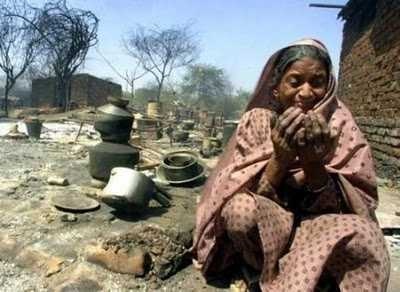
Adistinct, tragic and ghastly feature of the state sponsored carnage unleashed against a section of the population, the Muslim minority in Gujarat, was the systematic sexual violence unleashed against young girls and women. Rape was used as an instrument for the subjugation and humiliation of a community. A chilling technique, absent in pogroms unleashed hitherto but very much in evidence this time in a large number of cases, was the deliberate destruction of evidence. Barring a few, in most instances of sexual violence, the women victims were stripped and paraded naked, then gang raped, and thereafter quartered and burnt beyond recognition.
While the large number of cases of sexual violence perpetrated during the statewide carnage in Gujarat is shocking, the trivial and dismissive manner in which this chilling pattern evidenced all over the state was dealt with by the CM and his cabinet, the
authorities as a whole in Gujarat and, worst of all, by ministers in the government of India, make it doubly so.
The Tribunal notes with concern and outrage the shocking remarks made by the union defence minister, Shri George Fernandes on the floor of the Lok Sabha during the debate on the Gujarat carnage. He said, “There is nothing new in the mayhem let loose in Gujarat… A pregnant woman’s stomach being slit, a daughter being raped in front of a mother aren’t a new thing.” Such things, Shri Fernandes said, have been happening for 54 years in India and happened even on the streets of New Delhi in 1984. (Lok Sabha debate on Gujarat, April 30, 2002, reported on May 1 in The Hindu, The Indian Express, the Deccan Herald and The Times of India.)
The Tribunal recorded with pain the statements of women from all over Gujarat who had either themselves been subject to sexual violence or were direct witness to it. Many of the over 33,000 children forced to live as refugees in relief camps throughout the state were also witness to the most debased and brutal forms of violence. They were mute witnesses to gross gender crimes perpetrated on their near and dear ones — sisters, mothers, aunts and even grandmothers — with gory and military precision, evidence of some sick minds and a vicious ideology. The Tribunal shudders to think of the impact of this on young and impressionable minds.
Women victims of the carnage from Saijpur Patia, Naroda, Chamanpura, Behrampura, Danilimda, Gomtipur, Vatwa, Narol, Shah–e–Alam, Millatnagar and Bapunagar in Ahmedabad city deposed before us. Not only had they been victims of violence that took the lives of their near and dear ones, their dignity was made a special target and their homes and belongings, collected painfully over the years, were looted and then destroyed. They have been forced to become refugees in their own homeland.
In Saijpur Patia, Naroda, on February 28, a mob of around 25,000 surrounded the Muslim areas at nine in the morning. They instigated the attacks by pelting stones at the residents and throwing acid and petrol bombs at them. Thereafter, they forcefully entered the lanes, shouting slogans against Muslims, implying that they are terrorists and that they should not be allowed to live in this country. The mobs were armed with sharp swords, spears, tridents, chemicals, petrol cans, kerosene and private firearms. The mob then went on a rampage, looting and burning houses.
They then started killing people, first cutting them up with swords and then burning them. When the residents of Saijpur Patia, Naroda, tried to escape, they were subjected to the mass rapes of their sisters, wives, mothers and daughters. The helpless men — brothers, sons, fathers and husbands — were first humiliated and then killed.
The police, instead of firing on the assailants and protecting lives, misdirected the terrorised people and lead them towards armed mobs waiting for assault. Those who ran in the direction indicated by the police are no longer alive.
According to the evidence recorded by the Tribunal, the leaders of the mobs (many of whom have been identified) even raped young girls, some as young as 11–years–old. The young girls were made to remove their clothes in front of 1,000–2,000 strong mobs who humiliated and terrorised the girls. Thereafter, they were raped by 8–10 men.
The sinister aspect of these gender crimes is that they have been led and directed by elected representatives and prominent leaders of the BJP, RSS and VHP.
After raping them, the attackers inserted sharp swords, knives or hard objects into their bodies to torture them before burning them alive. In the many bouts of communally incited pogroms that have taken place in different parts of the country, never has there been this depth of perversion, sickness and inhumaneness. Even a 20–day–old infant, or a foetus in the womb of its mother, was not spared. They flung babies in the pyres that they had prepared. They cut up people, threw then in a well known as ‘teesra kuva’ and then burnt them.
The police supported the mob during the assault by shelling tear gas shells on the hapless Muslims. They also opened fire on men when they were trying to defend the women in the area. The State Reserve Police was very complacent and indifferent saying, “We have been given orders to do nothing for 24 hours in Naroda.” Women pleaded with the police and the SRP to stop acting partially and save the children at least. They begged before these policemen, laying their children at their feet, but it made no difference to them.
The sinister aspect of these gender crimes is that they have been led and directed by elected representatives and prominent leaders of the BJP, RSS and VHP. This means that the dominant political leadership of our times is actually creating or displaying role models that glorify gender crimes against women. Can any civilised society witness this without finding an urgent need to punish those guilty and making a determined effort to purge public life of these perversions?
In the attack on February 28 on Gulberg Society, Chamanpura, Ahmedabad, where a former Congress member of Parliament was a specific target, there were at least 10–12 cases of girls and women who were gang raped, assaulted with swords and rods and quartered before being burnt to ashes.
Similarly, on March 1, in Fatehpura village outside Sanjeli, and in Morwa in the Panchmahal district, women were gang raped by mobs. Fatehpura is one village where, among the survivors, are many women victims of gross gender crimes.
A womens’ fact–finding report sums up the usual procedure: “..rape, gang rape, mass rape, stripping, insertion of objects into their body, molestation… a majority of rape victims were burnt alive.”
Before they were finally killed, some were beaten up with rods and pipes for almost an hour. Before or after the killing, their vagina would be sliced, or would have iron rods pushed inside. Similarly, their bellies would be cut open or would have hard objects inserted into them. A 13–year old girl, had a rod pushed into her stomach, and was then burnt. A mother reported that her three–year–old baby girl was raped and killed in front of her, while elsewhere daughters reported on the rapes of their mothers, now dead. Kausar Bano, a young girl from Naroda Patiya, was several months pregnant. Several eyewitnesses testified that she was raped, tortured, her womb was slit open with a sword to disgorge the foetus which was then hacked to pieces and roasted alive with the mother.
In the third round of violence from April 2 to April 5, the minority community living in Mariam Bibi ki Chali and Chotalal ki Chali constantly faced the danger of getting killed and burnt. Shri Narayan Modi, the head constable of the ‘D’ staff, leading a posse of policemen and some jawans of the Rapid Action Force (a specialised wing of the police, specially created to combat communal conflict), attacked these areas, severely beat up the residents with lathis and the butts of their guns and then stripped themselves in order to insult and humiliate them.
This behaviour of the police towards women of the minority community had also been recorded in some incidents of the post–demolition violence that rocked Ahmedabad in 1992. But the scale and frequency of such shocking misconduct during the state sponsored carnage this time makes it most deplorable. It shows not just lawless behaviour by the police, but an identification with the ideology of hate and humiliation that instigated this and earlier bouts of violence against the minority community in Gujarat.
Evidence before us shows how, especially in the Gomtipur area of Ahmedabad, the police even molested elderly women. Women managed to escape a worse fate only by constantly escaping to the relief camps. Once they had left the area to protect their lives and dignity, the assailants burnt down their houses. The police in Gomtipur regularly used this trick of stripping to make women flee the area, so that they could detain the men and the boys and destroy property, since women were the ones who were trying to defend their homes and the lives of their husbands and sons.
Evidence placed before the Tribunal shows that in the later phases of violence, even in Vadodara city, vulgar and brutal behaviour of the police with women of the minority community was recurrent. Evidence on record shows that from March 15 onwards, the Vadodara police played a prominent role in terrorising Muslim residents in their localities through combing operations and illegal arrests. Women, in particular, were subject to oppressive forms of harassment in their homes, especially when their men had either fled or were away.
One case of a pregnant woman, about to deliver, as narrated by her mother, was especially poignant. On the night of April 30, she was brutally beaten with lathis and the butts of rifles, especially on her breasts. Though she had carried the baby to full term, this episode, in all probability, caused her to go into premature labour the next day and she delivered. With tears in her eyes, her mother recounted to the Tribunal how, when breast feeding her new born infant, while milk flowed from one breast, blood oozed out from the other, scarred by the beatings from the merciless Vadodara police.
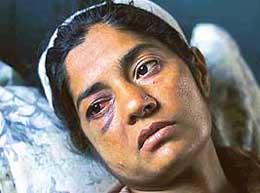
Apart from physical beatings, Muslim women in localities of Vadodara were subject to sexual and communal threats; policemen used highly abusive language before they vandalised their homes.
Apart from physical beatings, Muslim women in localities of Vadodara were subject to sexual and communal threats; policemen used highly abusive language before they vandalised their homes. The Bahar colony at Ajwa Road, Rain Bassera, Machchipith under the Karelibaug Police Station, as well as areas under the jurisdiction of the Panigate Police Station were especially vulnerable to this sexually perverse and violent behaviour of the Vadodara police.
Evidence before the Tribunal shows that women have suffered the most bestial forms of sexual violence, including rape, gang rape, insertion of objects into their bodies, stripping, and molestation. A majority of the women who suffered this violence were then burnt alive. Amongst the survivors, many have spoken about the assaults but many have been silenced, for fear of further attacks and for fear of censure from their own families and community.
These crimes against women have been grossly underreported and the exact extent of these crimes in rural and urban areas, has yet to be grappled with. These attacks have been carried out in the presence of, in many instances even at the behest of, the police and other state authorities.
In Gujarat, the degree of violence and sexual crimes against women reached unprecedented levels. Women and entire communities have been so traumatised and silenced that the full extent of this has yet to be realised. Mental trauma as well as insecurity of an extreme form are issues that need to be dealt with. The ineffectiveness and insensitivity of our criminal justice system, particularly when it comes to sexual and other crimes against women, renders the victim, her family and even the entire community in cases of mass and planned crimes of this sort, especially vulnerable. These crimes call for not simply a re–orientation in thinking and values in the matter of justice to the victims and punishment to the guilty; also urgently needed is psychological and trauma counseling for some sort of a healing process even to begin.
That sexual crimes against Muslim women took place on such a large scale in post–independent, democratic and secular India is shocking in itself. What is far worse is the shameful trivialising or denial of these crimes by agents and representatives of the central and state governments and outfits like the BJP and its affiliates like the RSS, the VHP and the Bajrang Dal. This amounts to a virtual condoning of such gross crimes against women.
Attacks on children were used as instruments of terror. In what is surely the most perverse dimension of the violence, children were used to torture and terrorise victims. In one particularly tragic incident in Tarsali, an old Muslim man was shown the head of his beheaded son on a tray before he was himself brutally slain.
Archived from Communalism Combat, November-December 2002 Year 9 No. 81-82
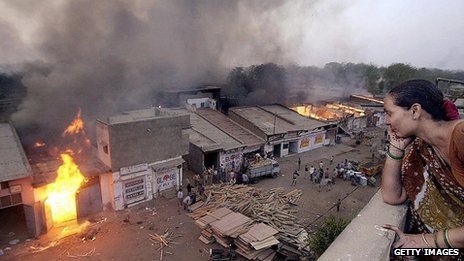
One of the most telling testimonies presented before the Tribunal was that of an expert witness on the recorded words of a police officer on Star News on March 9: “Wahan factory mein aag lagi hai, GIDC mein… haan…aag lagi hai… factory Hindu-Muslim mix thi, is mein ek partner Muslim tha, baki ke sab partner Hindu the.” (“In GIDC a factory is on fire… yes… it is on fire… the factory was jointly owned… one partner was a Muslim and the rest were Hindus.”)
Extensive evidence recorded by the Tribunal points to the devastating loss of property by the Muslim community in the state. Relying on detailed tabulation of losses computed by community leaders at the village, city and district levels, independent groups estimated the total loss to the Muslim community at not less than Rs. 3,800 crore. (Except where otherwise stated, the figures for losses given below have been computed by business representatives of the community and social activists). The pre-planning, precision and scale of destruction calls for massive reparation by the Gujarat state.
The Muslim community in Gujarat was one of the most prosperous in the country and its contribution to the economy of the state, pivotal. The fact that the economy of this section of the population has been crippled suggests a sinister motive behind the destruction.
Evidence provided by prominent businessmen belonging to both the Muslim and Hindu communities point to the systematic destruction. The destruction of two establishments on CG Road — Pantaloon Showroom and the Hero Honda Showroom — in a posh area in Ahmedabad, is illuminating. The Pantaloon Showroom is a partnership of Hindus and Muslims, with the Muslim partner owning only a 10 per cent share. The Copper Chimney restaurant, though owned by a Hindu Punjabi, was targeted. Those instigating the attack were obviously well-informed, for very few people knew that the owner had recently signed a deal with a Sheikh in the Gulf.
Information was gathered from the Registrar of Companies, the Revenue and the Sales Tax departments. Significantly, several months prior to the carnage, the widely circulated local Gujarati daily, Sandesh, had published a list of all Muslim-owned establishments in Ahmedabad with ‘Hindu’ names. Was there some unstated purpose behind the publishing of this list? Was it used as a ready reckoner by those who destroyed these establishments later?
According to Shri Narendra Brahmbutt, president of the Ahmedabad Hotel and Residents Association, the hotel sector alone has suffered a staggering loss of Rs. 260 crore. Suppliers to the hotel industry suffered losses to the extent of Rs. 60 crore. As many as 6,700 workers belonging to the majority community have been rendered jobless due to the burning and arson by the fanatic militia.
Details of losses
Muslims estimate losses due to the prolonged closure of shops, industries and commercial establishments in the state to be no less at Rs. 3,000 crore. (The Gujarat Chambers of Commerce and Industry puts the figure at Rs. 2,000 crore).
Hotel Industry
Approximately 1,150 hotels were burnt or looted on the National Highway from Vapi to Vadodara and on to Palanpur. The total estimated loss to property and investment in looting and damage alone, across the state, is Rs. 760 crore.
Transport industry
The transport godowns on the National Highway have suffered damages to the tune of Rs. 12 crore. In addition, losses suffered due to the burning down of over 1,000 trucks are estimated by transport operators belonging to Ahmedabad, Surat, Vadodara Godhra and Himmatnagar, at Rs. 60 crore. The truck operators’ insurance claims for the cumulative damage amounted to Rs. 830 crore.
Though overt violence has ended, ethnic cleansing continues in the form of the economic decimation of the minority in Gujarat. The Tribunal is particularly disturbed by the fact that it is not just the ordinary worker of the Sangh Parivar, even ministers and other Hindutva leaders are involved in instigating the economic boycott of Muslims from behind the scenes.
Industry (general):
Agriculture
Miscellaneous
While ignoring the genuine and pressing relief and rehabilitation needs of the survivors, the sponsors of the carnage and their cadre have now resorted to a crippling economic boycott against Muslims in many parts of Gujarat. In Gandhi-nagar, Mehsana and Sabarkantha districts, truck and auto drivers are facing a severe economic boycott thanks to the machinations of politicians like Gujarat ministers, Shri Nitin Patel and Shri Narayan Lalludas Patel.
In Vadodara, there have been, at least, over two dozen instances of Muslims being told by their Hindu employers not to come to work. In Por and Paliyad villages in Gandhinagar district, villagers who had returned were facing the severe impact of hunger and loss of livelihood due to the refusal by village Patels (who dominate the panchayat and who are politically associated with the BJP) to buy milk (from milch cattle) or to hire Muslim women as farm labour on the land belonging to the majority community.
Though overt violence has ended, ethnic cleansing continues in the form of the economic decimation of the minority in Gujarat.
The Tribunal is particularly disturbed by the fact that it is not just the ordinary worker of the Sangh Parivar, even ministers and other Hindutva leaders are involved in instigating the economic boycott of Muslims from behind the scenes. Home minister Shri Gordhan Zadaphiya and revenue minister Shri Haren Pandya, ministers Shri Narayan Lalludas Patel, Shri Niteen Patel, forest minister Shri Prabhatsinh Chauhan, minister for cottage industries, Shri Ranjitsinh Chawda, BJP MLAs Sushri Amita Patel and Sushri Maya Kotdani and Dr. Jaideep Patel (Gujarat VHP’s vice–president), among many others, have been named by the eyewitnesses, in this context.
Archived from Communalism Combat, November-December 2002 Year 9 No. 81-82, Economic Destruction

Mosques, dargahs, small shrines and other Muslim religious and cultural places were systematically destroyed and desecrated in the first 72–hour round of violence all over Gujarat. Copies of the Koran and other religious books were despoiled and damaged in many places all over the city of Ahmedabad, in Vadodara, Ankleshwar and Bharuch and in many smaller towns and villages all over the state.
In all, over 270 mosques and dargahs have been thus destroyed. In many cases ‘Jai Shri Ram!’ was scrolled all over the desecrated shrines. In many shrines, idols of ‘Hulladiya Hanuman’ (translated, it means ‘Riot Hanuman’) were installed. This shows
the cynical abuse of caste Hindu religious symbols as instruments of domination and subjugation of Muslims. When the Tribunal members visited and inspected some of the damaged shrines in May, they were still in their ramshackle state.
One mosque, which was rebuilt through the efforts of a Muslim religious organisation, was pulled down in July by officials of the Ahmedabad Municipal Corporation, a body that is, ironically, controlled by the Congress(I). The Noorani Masjid at Naroda Gaon was blasted using gas cylinders. Witnesses appearing before the Tribunal complained that, while desecrating the mosque at the Naroda Fruit Market, the Koran was urinated upon. The Tribunal shudders to think which religion could ever sanction such vile desecration of the sacred texts and places of worship of people of another faith.
Detailed evidence was recorded by us regarding the desecration of the tomb of Wali Gujarati, a renowned poet remembered as the founder of Urdu poetry. On March 1, his tomb, located not more than 10 metres from the office of Ahmedabad’s commissioner of police (also the police headquarters) was demolished and a saffron flag hoisted on the site. It is believed that the shrine was torn down by marauding mobs under the directions of Gujarat’s revenue minister, Shri Haren Pandya. On March 8, a tarred road was constructed at the site, leaving no trace whatsoever of the tomb that had stood there for nearly three centuries. It is shocking that a callous government and an unprincipled administration participated in the utter obliteration of this cultural monument and allowed a road to be constructed over it.
On the night of March 3, a 400–year–old mosque owned by the Wakf Board, and located near Anjali Cinema in Ahmedabad, was broken down in the presence of state ministers Shri Haren Pandya and Shri Amit Shah. As in many other cases, a ‘Hulladiya Hanuman’ idol was installed there, followed by darshans and artis.
The mosque of Malik Asin (Asas, Imadul Mulk) at Ahmedabad, built in the reign of Sultan Mahmud Begada (1458–1511), was also destroyed in the initial round of violence. A protected monument built in stone, this structure was destroyed within hours, with military precision, using a bulldozer and cranes.
Also targeted was the tomb of Ustad Faiyaz Khan in Vadodara, which was attacked and wreathed in burning tyres in early March. Extensive damage was inflicted on the façade of the structure commemorating a man who, in 1912, was acclaimed as one of the greatest among classical singers by the then ruling dynasty of Vadodara.
The underlying motive behind these attacks is obviously to obliterate all symbols of India’s composite heritage. Article 25 of the Indian Constitution, which upholds the fundamental right of every citizen to preach, practise and propagate his/her faith, was utterly and contemptuously violated during the state–sponsored carnage in Gujarat.
The Hague Convention of 1954, the ‘Convention for the Protection of Cultural Property in the Event of Armed Conflict’ stipulates that the preservation of “cultural heritage is of great importance for all peoples of the world” and that “damage to cultural property belonging to any people whatsoever means damage to the cultural heritage of all mankind.” India is a signatory to this convention.
In 1972, a protocol to this Convention was adopted, which identified “cultural heritage” as, among other things, “monuments, architectural works, works of monumental sculpture and painting, elements or structures of an archaeological nature, inscriptions, cave dwellings and combinations of features, which are of outstanding universal value from the point of view of history, art or science.”
Every State that had acceded to the Hague Convention, it held, recognised that “the duty of ensuring the identification, protection, conservation, presentation and transmission to future generations of the cultural and natural heritage situated on its territory, belongs primarily to that State.”
At its general conference meeting in 2001, UNESCO adopted a resolution that sought to define the circumstances under which an act could be construed as a “crime against the common heritage of humanity.” It reiterated the need for all member-states to accede to and observe the various conventions it had evolved over the years. And it authorised the director–general of the organisation to formulate for the next session of the general conference, a ‘Draft Declaration’ that would define the circumstances under which the “Intentional Destruction of Cultural Heritage” could be deemed to have taken place.
Evidently, besides being guilty of crimes against humanity, the chief minister of Gujarat is also guilty of crimes against the common heritage of humanity. And in its reluctance or refusal to intervene, the BJP–led government at the centre stands charged with flagrant violation of international conventions to which India is a signatory.
Archived from Communalism Combat, November-December 2002 Year 9 No. 81-82, Religious and Cultural Desecration
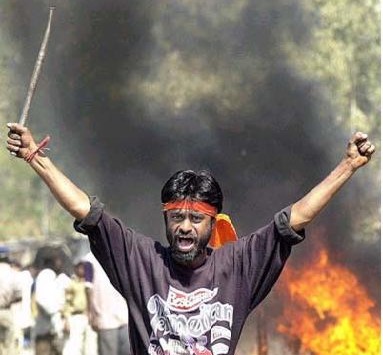
Role of the BJP and Allied Organisations:
RSS/VHP/BD
The role played by the BJP and organisations like the RSS, VHP and BD in threatening internal peace and security in many parts of India is clear. There is an urgent need to put a complete stop to these activities, which are subversive of the Indian Constitution.
The Tribunal would like to record here, the ample evidence placed before it by expert witnesses, newspaper reports and fact–finding team reports, documenting the aggressive tone and posturing of organisations like the RSS, VHP and BD, especially since the BJP–dominated National Democratic Alliance came to power at the centre. These activities and such public posturing indicate several things:
The exemption of the trishul (which in fact is a sharp, three-pronged weapon, which can cause fatal injury), from the provisions of the Arms Act, through a GR issued by the central government, is a clever ploy to encourage the militarisation and arming of a section of civil society by such groups. The swords that are also freely sold at the arms training camps, along with the air guns and rifles that are used for shooting practice, are clear pointers to the intent of these organisations. Yet, the police in BJP–ruled states and the BJP–led central government have turned a blind eye to such ominous developments.
l In the specific case of the Gujarat carnage, whether on the issue of the removal or resignation of Shri Modi from the chief minister’s post or others, it is evident that the BJP–led ruling NDA’s demeanour and actions have been strongly influenced by the utterings of the RSS and its siblings, the VHP and the BD.
The intelligence departments of three states in India — Madhya Pradesh, Maharashtra and Rajasthan — have asked for a ban on the Bajrang Dal, on the grounds that it is generating “terror” and spawning home–bred terrorists. The testimony of many witnesses, from both communities, who appeared before the Tribunal, reinforces the assessment of the state police in Gujarat’s neighbouring states.
Training
The Tribunal has led specific and detailed evidence on the method of mobilisation and training adopted by the VHP and Bajrang Dal from four recruits/former recruits. This explains the phenomenon whereby huge mobs surfaced so promptly all over the state during the carnage. It also explains the ability of these organisations to collect youngsters, indoctrinated with misconceptions and with hatred in their hearts, who were available at a signal from their leaders to commit murder, loot, arson and rape, and defy all laws, secure in the conviction that with the BJP in power, they would have full protection and need have no fear of the law and order machinery.
Reproduced here is the gist of the testimony of the four recruits/former recruits mentioned above, which provides a clear picture of the BD’s and the VHP’s mobilisation techniques:
The enrolment fee for a new entrant to a BD shakha (cell) is Rs. 55. Once admitted, you are expected to attend meetings held every night, mostly on private premises, sometimes in small temples. Secret meetings for the more select are held once a week. late at night.
At the weekly meetings, members are told, more explicitly, that the trishuls are to be used against Muslims whenever there was a riot or a fight. If you killed Muslims, the organisation was there to protect you from penal consequences.
Enrolment to the shakha entitles the volunteer to a card identifying him as a Bajrang Dal karyakarta (activist). If you help recruit 10 more youth, you are made a ‘VHP Mantri’. You are given a trishul the moment you enrol. You are told that trishuls were not meant to be kept inside a temple and worshipped but to be used to protect the Hindu faith. You are also told that the trishul should not be used to kill one’s ‘brothers’, but to save ‘our’ religion.
At the weekly meetings, members are told, more explicitly, that the trishuls are to be used against Muslims whenever there was a riot or a fight. If you killed Muslims, the organisation was there to protect you from penal consequences. If something happened to you, the organisation was there to take care of your family. If you did get arrested during the riots, all you had to do was to show your Bajrang Dal membership card and the police was sure to let you go.
The VHP Mantris are assigned the responsibility of training 60–70 boys each day. What did the training involve? The training primarily involved compiling an exhaustive list of all Muslims living in the area. Members had to collect information about Muslim places of residence, property, businesses, family, etc. in the locality: Who lived where, how much they were worth, how many children they had, etc. All the information so gathered was to be passed on in the form of a written report that was maintained by the Mantri.
The Tribunal notes with horror, the level of impunity that such unlawful, armed organisations have come to enjoy in BJP–ruled Gujarat.
Apart from the detailed account of the four recruits/former recruits to the Bajrang Dal, other witnesses from Naroda, near Ahmedabad, and from Kheda, Bharuch and Panchmahal districts also gave evidence before the Tribunal about training camps being organised in their neighbourhoods. In all these cases, an intensive training of the BD/VHP volunteers began after September 2001. An advertisement encouraging youngsters to join the Bajrang Dal in large numbers had appeared in the Gujarat daily, Sandesh in August last year.
This suggests sinister preparation and planning for the Gujarat carnage long before the Godhra tragedy, by the Sangh Parivar affiliates, their leaders confident of impunity from the long arm of the law since they enjoyed the patronage of the ruling party.
Notwithstanding the in themselves startling and brazen revelations made by professor Keshavram Kashiram Shastri, the 96–year–old chairman of the Gujarat unit of the VHP, in an interview to rediff.com, there is evidently an attempt to deny past preparation and planning, intensively so in Gujarat since last year. In the interview, Shri Shastri said that the list of shops owned by Muslims in Ahmedabad was prepared on the morning of February 28 itself. This was in response to the allegation that shops in Ahmedabad were looted on the basis of a list prepared by the VHP in advance, and that the violence was not a spontaneous outburst against the Godhra outrage.
Asked why they did it, he responded, “’Karvunj pade, karvunj pade’ (‘It had to be done, it had to be done’). We don’t like it, but we were terribly angry. Lust and anger are blind.” He said the rioters were “kelvayela Hindu chokra” (“well–bred Hindu boys”). The impunity with which Shri Shastri could speak with the candour that he did in his interview on March 12, and again on March 29, when he told the same journalist that the organisation (VHP) had been asked to pull back, is shocking, to say the least. That the Gujarat government has taken no action whatsoever against Shri Shastri speaks volumes about the BJP–VHP nexus.
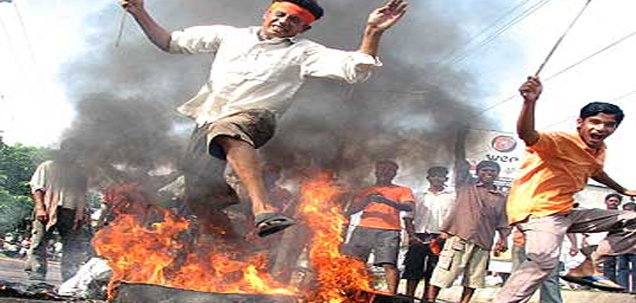
At the advanced stage of training, the more seasoned members were told they would have to participate in fights or riots (ladhai–jhagda, danga–fasaad) whenever necessary. They said that, as Bajrang Dal leaders, they would, necessarily, be the most active, but young men, too, should always be prepared. They might be woken up in the middle of the night and should be ready to participate. The recruits were promised that when they participated in a riot, the organisation would pay them double the money that they lost in regular wages. Young men were also assured that if ever they were injured or killed during a riot, their families would receive adequate compensation.
The speeches at these meetings followed a basic pattern. Leaders would be brought in to brainwash the young members against Muslims. The single point agenda, evidence before the Tribunal has recorded, indicates that the desire was to demonise the Muslim community as also to create an armed cadre of young men, indoctrinated, full of hatred in their hearts, and sufficiently trained to perpetrate the grossest forms of physical abuse on their victims.
The Tribunal collected concrete information about the kind of mental training and brainwashing imparted to young men at the secret, weekly meetings: “We were told that until now it is the Muslims who have been harassing Hindus. ‘They have molested Hindu sisters and Hindu daughters. In Hindi films today, all the top heroes are Muslims, but there are no Muslim heroines. It is Muslims who are forging ahead in our country. They don’t let their daughters out in public but they spoil our Hindu daughters. Muslims are the ones who always use force. Our country was once a Hindu nation. The Muslims invaded us by force, married our mothers and our daughters and converted us to Islam.’”
According to the witnesses, in the Bajrang Dal camps, young men are told: “Under the pretext of prayers [namaaz], Muslims gather at 2 p.m. every day and maulvis instruct them in several activities. They specially employ young men, pay them a salary and send them to college to spoil Hindu girls. Muslims are involved in several such nefarious activities.” They said that they wanted to start a similar practice amongst Hindus. That was what the secret 10 p.m. meetings were meant for. Here the members would all band together, worship/invoke Hanuman and prepare “to give Muslims a fitting reply.” The secret meetings — gupt shakhas — also gave special training in the use of arms.
The Tribunal records that in Gujarat, quite apart from the political patronage and impunity from the law accorded to these outfits, there is enough money to finance the mobilisation. The source of such funds, used increasingly for blatantly unlawful and unconstitutional activities, needs to be investigated.
Only a sick and degenerate leadership can want the whole of Indian society to descend to such demeaning levels of hatred whereby any excuse is good enough to unleash bloodshed and mass violence.
Reports in credible national dailies and periodicals show that the VHP and the Bajrang Dal have been regularly conducting arms training camps in different parts of the country, for the last two years at least. From the statements on record, the objective behind these camps is evident, as are the objectives of their organisers and the instructors who conduct them: to spread venom against the minorities, especially Muslims and Christians, and to prepare a band of heavily indoctrinated, well–trained youth ready at a moment’s notice to pounce on the minorities. “We are preparing these able–bodied persons to fight any eventuality. With the ISI spreading its tentacles, these people are being trained to challenge the anti–Hindu forces… It is not the gun that matters, but self–confidence.” (Ved Prakash Sachchan, joint convenor of the UP unit of the Bajrang Dal, in an interview to The Times of India, June 13, 2001.) Such are the declared activities at these camps. The Tribunal has on its record, details of such arms training by these outfits in different states all over the country.
Given this background and the detailed evidence gathered by the Tribunal in the course of its investigations for a fortnight in Gujarat in May 2002, on the objectives and the kind of training given in the course of these camps, it is clear that they are a means to poison minds and generate hatred among Hindu youth towards other faiths and their followers. For Indian society, the consequences of such systematic and large–scale indoctrination and training, which is blatantly unconstitutional and seriously threatens internal peace, cannot be overemphasised.
Testimonies recorded by the Tribunal from Vadodara showed that about two months prior to the Godhra incident, a big meeting (sabha) was held at Tarsali bus stand near Vijaynagar colony. About 2–3,000 people attended. It was a meeting for people from the Bajrang Dal and was attended by the international general secretary of the VHP, Shri Praveen Togadia as well a religious leader whose speech was telecast on the local television channel.
The Tribunal recorded evidence that showed objectionable and criminal statements were made and telecast. Witnesses testified before the Tribunal saying that Hindus should not interact with Muslims on a normal basis but should only maintain good relations with those Muslims who have good looking wives, so that when the time came they could do what they had to do.
In August 2001, the VHP and the Bajrang Dal had organised a VHP Bharti (Join VHP) programme. Nearly one lakh people marched through the streets of Ahmedabad even though curfew was declared. This went on until September. One of the main programmes was held at the VHP’s Vanikar Bhavan, Paldi. Their main avahan (call) was, “Muslim ko nasht kar do!” (“Destroy the Muslims!”).
Hate Speech and Hate Writing
Since the BJP came to power in Gujarat in 1998, the parent RSS and its progeny have been conducting a relentless hate campaign against the minorities, which goes against the laws of the land and violates international covenants, many of which India is a signatory to. After the Godhra tragedy, where, in an unpardonable act, 58 passengers aboard a train were burnt alive on February 27, the hate speeches and hate literature has been geared to both incite and justify the gross violence against Muslims.
At the Akhil Bharatiya Pratinidhi Sabha of the RSS, held at Chennenahalli, near Bangalore, from March 16–19, the RSS gave a clean chit to Shri Modi’s role during the Gujarat carnage. Describing the violence after the Godhra incident as a “natural reaction of Hindus”, the RSS asserted that no government could have controlled the “upsurge”.
At the conclusion of the conference, two days later, with over 2,000 innocent Muslims having been brutally killed, not to mention the other indignities heaped on the community in Gujarat, the RSS thought it fit to lecture to Indian Muslims on their “extremist leaders” and “Hindu–baiters”. A resolution adopted at the three–day conference of the Sangh, said: “Let Muslims understand that their real safety lies in the goodwill of the majority.”
The attitude of the top leadership of the VHP to the post–Godhra carnage embodied not just open support and celebration of the mass crimes, but also the threat to repeat Gujarat’s example all over India. On March 6, The Hindustan Times quoted the all–India vice–president of the VHP, Shri Hareshbhai Bhatt as saying that he was proud that Hindus have finally stirred: “What happened at Godhra was an offence. What happened after Godhra was a reaction… The VHP has taken a long–term decision that all Hindus will boycott Muslims economically, financially and socially. Muslims have to change their mindsets if they have to live here.”
Since the Gujarat carnage, the working president of the VHP, Shri Ashok Singhal, its international general secretary, Shri Praveen Togadia, and other prominent leaders have revelled in repeated public utterances gloating over the violence against Muslims, instigating further hatred against them and threatening to force all Indian Muslims into refugee camps, as in Gujarat.
On September 3, describing Gujarat as a “successful experiment,” Shri Singhal said, “Godhra happened on February 27 and the next day, 50 lakh Hindus were on the streets. We were successful in our experiment of raising Hindu consciousness, which will be repeated all over the country now.” The very next day, he expounded on his proposition. Shri Singhal spoke in glowing terms of the fact that in the state of his dreams, entire villages had been “emptied of Islam” and large numbers of Muslims had been forced to seek the shelter of refugee camps. “People say I praise Gujarat. Yes, I do.”

Courtesy: Amit Dave, Reuters
On August 9, the VHP leader Acharya Giriraj Kishore demanded that Muslims should amend certain verses (Ayaat) in the Koran.
On September 9, the chief minister of Gujarat, Shri Narendra Modi, addressing a rally in Mehsana district during his Gaurav Yatra, said: “Relief camps are actually child-making factories. Those who keep on multiplying the population (read Muslims) should be taught a lesson.” (The Hindu, September 10)
Shri Modi’s very offensive remarks created a national uproar. When, following news reports, the National Human Rights Commission demanded a copy of the taped speech of the chief minister, the Gujarat government pretended that no such tape existed, until Star News telecast the same. Undeterred by all this, Shri Togadia announced at a press conference, “The VHP will distribute all over the country one lakh copies of the cassette of Modi’s speech delivered on September 9, to make the people aware of the double standards of the so-called secularist parties including the Congress.” (The Deccan Herald, September 24).
Shri Togadia added, “The time was ripe for forming a separate army of Hindu youths who would protect the religion from attacks by jehadis.” (The Times of India, October 18, 2002)
Quite apart from the public statements and utterances that have been widely publicised in the national media after the Gujarat carnage, the plethora of hate pamphlets in circulation in Gujarat before, during and since the carnage are testimony to the calculated use of demonising tactics, by these outfits, to spur their cadres into action.
Evidence in the form of the originals and translations of these pamphlets were placed on record before the tribunal. Many of these have been in circulation, intermittently, over the past four years. But the period between February and April, 2002 saw the proliferation of such literature, some identifying the author, others anonymous, but all a foul testimony to the debasing levels of hatred that the ideologues of a ‘Hindu State’ can reduce ordinary people to. The Tribunal records with horror, the deep–rooted conspiracy and design that is evident from a perusal of all these pamphlets.
From openly asking for a blatantly anti–constitutional boycott of Muslim shops and establishments, there are also exhortations to violence against Muslim women and children that are too shocking and painful to detail here. They reveal a depth of hatred that can be no good for the people it grips and takes hold of. Only a sick and degenerate leadership can want the whole of Indian society to descend to such demeaning levels of hatred whereby any excuse is good enough to unleash bloodshed and mass violence.
The Tribunal has recorded dozens of testimonies from different parts of Gujarat that show how in the past four years, 3–4 times a year, tens of thousands of such pamphlets would flood Gujarati homes, thrust upon even those Hindus who are repulsed by their contents. From February–April 2002, the circulation of these pamphlets intensified considerably. It is astounding that no action was initiated by any wing of the Gujarat state intelligence or police against such hateful and incendiary writing; nor did the judiciary take suo motu action, which it is empowered to do.
While most of the hate pamphlets are anonymous, there were at least four for which both the VHP and BD claimed proud authorship. It is a matter of profound shame that even in these cases no action was initiated against the errant outfits and their office bearers.
One such pamphlet which bears special mention here, is one that mentions, with name and full address, a VHP office bearer as the author and publisher of this VHP/BD pamphlet: Chinubhai N Patel, Vishwa Hindu Parishad Office; Vanikar Smarak Bhavan, 11 Mahalakshmi Society, Mahalakshmi Cross Roads, Paldi, Karnavati. Tel. 6604015, 6631365 Tel. (res.) 7454699. This pamphlet, which was in wide circulation, openly propagated hatred against Indian Muslims:
“The terrorist and traitorous Muslims of this country get weapons from more than 50 Muslim nations to carry out their religious wars. They are supplied with AK–56 and AK–47 rifles, automatic machine guns, small canons, rocket launchers and several kilos of RDX… The entire country is sitting on a heap of weapons and heading towards civil war and internal strife… When Pakistan attacks India, the Muslims living here will revolt… In 1947, they only had sticks, swords and spears but now they have modern weapons… They are plotting to kill crores of Hindus and we will be fighting these traitorous Muslims in every lane and by-lane of the country… If the Parliament and the Kashmir assembly can be attacked then what safety is there for the citizens of the country?…”
Provocative statements by VHP office bearers and by elected representatives in Gujarat in the immediate aftermath of the reprehensible killing of 59 Hindus on a train in Godhra, are widely believed to have been interpreted by VHP cadres, sympathisers and other individuals in Gujarat as a call to violence, which led to widespread killings throughout the state, earlier this year.
Communalisation of the State and Civil Society in Gujarat
Undeterred by the country–wide condemnation and outrage at the Gujarat carnage, the VHP’s office bearers, especially Shri Singhal and Shri Togadia, have been touring the country and making newspaper headlines each day, pouring fresh vitriol against the minorities and undermining the constitutional scheme itself. The fact that they continue to do so, unchecked by the political executive, the law and order machinery, or by suo motu action by the judiciary, is a sorry comment on the state of the rule of law, or the lack of it, now prevalent in this country.
When the country’s chief election commissioner (CEC), Shri JM Lyngdoh decided that in the circumstances still prevailing in Gujarat, elections (free and fair) could not be held immediately as desired by Shri Modi and his party, both Shri Modi and Shri Togadia alleged that the CEC was a “Christian who was taking revenge for the attack on Christians in Dangs in 1999.” This is nothing short of the denigration of a constitutional authority on sectarian grounds.
The agenda of these outfits for Gujarat becomes clear when you see their unabashed proclamation of Gujarat as a “Hindu Rashtra” (“Hindu state”). During their tour of several areas of Gujarat in May, Tribunal members saw signboards all over the state, welcoming people to ‘Hindu Rashtra’. “Karnavati city of this Hindu Rashtra welcomes you,” proclaims a board painted in saffron, in the heart of Ahmedabad. (Karnavati is the VHP’s preferred name for Ahmedabad). In Chhotaudaipur, 200 km south of Ahmedabad, the signboard on the highway is more direct. It simply says: “Welcome to Hindu Rashtra’s Chhotaudaipur town.”
These signboards are just one part of the legacy of nearly five years of BJP rule in Gujarat. Whenever cornered, the BJP claims it has nothing to do with the ‘hidden agenda’ of the Sangh Parivar, but neither the party nor the government it runs has any difficulty with their fraternity’s open challenge to the constitutional idea of India by Hindutva’s long cherished dream of a ‘Hindu India’.
Even the Congress party, which returned to power in the Ahmedabad Municipal Corporation (AMC) two years ago, has been reluctant to pull down these boards, despite a directive to this effect issued recently by the new state Congress president, Shri Shankersinh Vaghela.
Indictment in Communal Crimes
Virtually every judicial commission of inquiry officially appointed to investigate communal riots since Independence and Partition, has indicted organisations affiliated with or allied to the RSS/VHP/BD/BJP combine, including the Maharashtra-based Shiv Sena, for their role in violent crimes against India’s minorities.
Yet, the Indian state has been reluctant to prosecute those guilty of these crimes. Such failure amounts to official complicity and shows reluctance on the part of governments to give justice to a section of its citizens. The Tribunal recommends that such crimes are dealt with seriously and swiftly and punishments accorded so that the demands of internal peace, justice and reconciliation are met.
Through their high-pitched, ‘Who casts the first stone?’ propaganda, Hindu majoritarian outfits seek to absolve themselves of any blame or responsibility for the violence and bloodshed, in the public eye. Expert evidence placed before the Tribunal shows that in conflict after conflict, these outfits defend their actions as “justifiable retaliatory acts by Hindus in self-defence” against attacks started by Muslims.
However, after detailed investigations, most judicial commissions of inquiry have concluded that Hindu communal organisations systematically inject the poison of communalism into the atmosphere and cause deliberate provocation to prompt a reaction from Muslims, a reaction which is then projected as proof of Muslims having thrown the first stone.
In their findings on the Jabalpur riots of 1967, Ahmedabad (1969), Kanyakumari (1982), Jamshedpur (1979), Ranchi (1969), Bhiwandi–Jalna, Mumbai (1970), Tellicheri (1971), the various judicial commissions of inquiry appointed by the appropriate state and central governments to probe into the violence have indicted one or other member of the Sangh Parivar and other votaries of Hindutva. That they have escaped subsequent action is, of course, another matter. A singular exception was the anti–Sikh riots in November 1984 where the Congress party and its then leadership must bear the blame for the massacre of 3,000 Sikhs in the nation’s capital.
Archived from Communalism Combat, November-December 2002 Year 9 No. 81-82, Preparation for Violenc
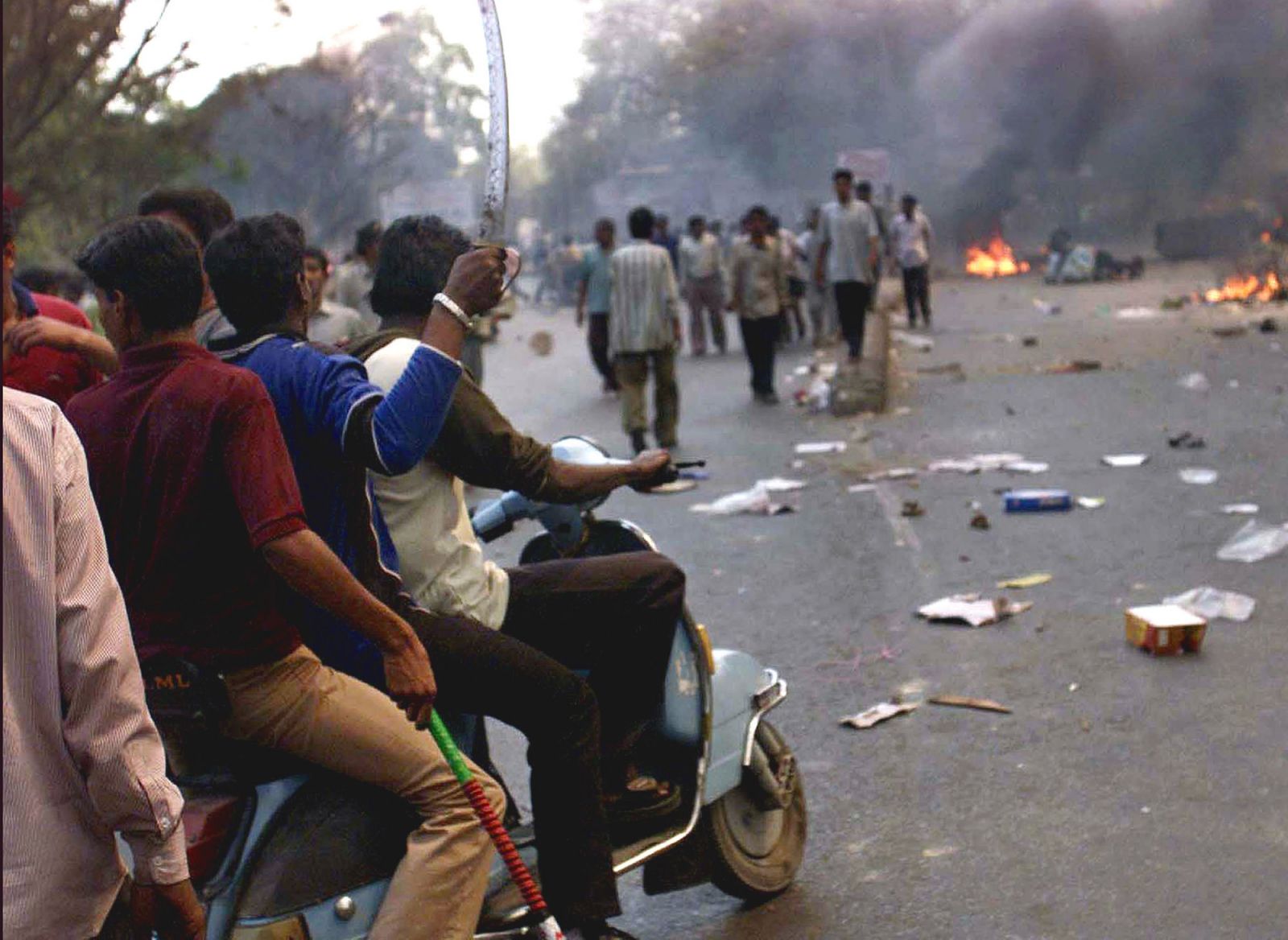
Courtesy: bpr.berkeley.edu
The post–Godhra carnage in Gujarat was an organised crime perpetrated by the state’s chief minister and his government. The state’s complicity is evident from the various acts of commission and omission of the government and its officials.
It was the chief minister who declared that the Godhra incident was pre–planned when the investigating agencies had not reached such a conclusion. Shri Modi’s cabinet, notably the minister for home, Shri Gordhan Zadaphiya, reiterated strongly that Pakistani hands were behind the Godhra act. These statements were irresponsible, given the sensitivity of the situation and the anger that they generated. Once they generated a climate ripe for apportioning blame, for the acts of a few criminals, the entire Ghanchi Muslim community of Godhra was branded. This led to a feeling of justifying the systematic massacre, plunder, loot and cultural decimation of the entire Muslim community in Gujarat thereafter.
It was the chief minister who decided that the charred, unidentifiable dead bodies be taken from Godhra to Ahmedabad in a motor cavalcade. As the cavalcade headed for Ahmedabad, senior members of his party and organisations affiliated to it shouted slogans and incited mobs to retaliate. The CM’s role in condoning this behaviour, and in using official machinery to propagate the unsubstantiated view that the Godhra tragedy was a sinister conspiracy, is condemnable.
The VHP gave a call for a Gujarat Bandh on February 28 and for a Bharat Bandh on March 1. The Gujarat BJP president, Shri Rajendrasinh Rana, was quick to announce the state BJP’s support for both the bandh calls. The state government’s reluctance to take adequate steps in the wake of the proposed bandhs amounted to an abdication of all its responsibilities and an open invitation to anarchy.
Shri Modi played an active role, along with at least three cabinet colleagues, in instructing senior police personnel and civil administrators that a “Hindu reaction was to be expected and this must not be curtailed or controlled.”
On the evening of February 27, two cabinet colleagues of the chief minister, Shri Ashok Bhatt and Shri Pratap Singh Chauhan, met at Lunavada in Panchmahal district along with others. In this meeting, the manner and methods of unleashing violence on Muslims were planned in detail.
It is clear from what happened in Ahmedabad and its environs on February 28 and all over the state on March 1–3 and thereafter, that there was deliberate connivance and support of the government.
The sectarian approach of the government and the inaction on the part of the administration allowed the violence to spread. According to dozens of testimonies before the Tribunal, even some ministers of the Gujarat government led the carnage and rapes, in many cases. The CM did not take adequate preventive measures, nor did he keep the army on stand–by. Though the situation was grim, and tension was at its peak, Shri Modi falsely claimed on March 2 (Newshour, Star News, 2/03/2002): “Gujarat mein bahut tezi se shanti prasthapit ho rahi hai, normalcy aa rahi hai… Ahmedabad ek prakar se kal raat ke baad, puri taraha incident-free raha hai.” (“Gujarat is well on the road to peace and normalcy is slowly returning here… Ahmedabad too has been largely peaceful since last night.”).
This, while the attacks in Panchmahal district, Mehsana, Kheda, Nadiad, Bhavnagar — which included hacking, lynching and burning alive of people — continued. This was done deliberately to mislead the rest of the country and the world, though what was going on in Gujarat was clear to the whole world through the print media, radio and TV.
Shri Modi claimed on March 3 (Talking Heads, Star News, 3/03/2002), that the Army was called for on the evening of February 28, and joined duty from the morning of March 1. Although 12 columns of the Army (approximately 600 troops) had reached Ahmedabad and other sensitive areas on March 1, they were kept on standby. Military intelligence puts the blame on the state government.
The facts mentioned in this report clearly establish that chief minister Shri Narendra Modi is the chief author and architect of all that happened in Gujarat after the arson of February 27, 2002.
Electoral constituencies of ministers in the state cabinet were more prone to violence; in some cases, ministers themselves were leading the mobs. It may not be a mere coincidence that Bapunagar, the constituency of the home minister , Shri Gordhan Zadaphiya, witnessed one of the worst communal scenes since the 1969 riots, when the area was the hardest hit. Some of the senior BJP leaders and ministers in Shri Modi’s cabinet were also alleged to have participated in the destruction of minority places of worship.
Minister for revenue, Shri Haren Pandya and health minister, Shri Ashok Bhatt led the mobs enthusiastically in Ahmedabad. Shri Bharat Barot, a sitting MLA, was also at the forefront. Residents of Paldi, from where Shri Pandya was elected, actually saw him lead arson attacks. Shri Pandya’s election promise the last time was “to wipe any trace of Muslims out of Paldi.” Smt. Maya Kotdani, an MLA, has also been named by a few dozen witnesses as an active participant in the violence. Gujarat ministers Shri Nitin Patel and Shri Narayan Laloo Patel led violence, arson and even sexual violence against women in Kadi and Unja in Mehsana respectively.
The utter disregard for the loss of life and property and the anguish that a section of the citizenry suffered due to unprecedented violence could be seen in the fact that until Prime Minister Shri Atal Behari Vajpayee flew into Ahmedabad and visited the Shah–e–Alam Camp, Shri Modi had not visited a single one. This, despite the fact that there were as many as 66,000 persons, according to collector’s figures, huddled in camps in Ahmedabad, while independent assessments put the figure at close to 98,000.
Instead of providing succour and assistance, which is the fundamental duty of a government towards its citizens, terror tactics through lathi–wielding policemen were employed with the residents of these camps. In areas of Gujarat outside Ahmedabad, too, there were as many as 60,000 persons internally displaced, living in terrible conditions. But the government and the administration did precious little to give them prompt and adequate relief.
The attitude of the government showed it had no regard for the life, well–being and future of students from the minority community. Traumatised and distressed students had requested a postponement of the annual examinations. But the state government, and later even the Gujarat High Court, rejected their plea. On April 10, the Gujarat government took a decision to shift out all centres located in the minority dominated areas, out of concern for the lives of students belonging to the majority community. However, minority community children were still expected to travel to examination centres located in majority dominated areas.
The CM announced Rs. 2 lakh as compensation for the victims/survivors of the Godhra tragedy. But the compensation declared by the CM for the survivors of the carnage that followed was Rs. 1 lakh for the family members of each victim. (When widespread criticism was made about the discriminatory stand of the state, the amount was equalised by reducing the compensation to the Godhra victims’ families to Rs 1 lakh, rather than by increasing the amount to Rs 2 lakh in all cases.)
As of now, there is no information on how many families concerned have been paid the compensation amount. As regards the injured, the government decided to pay compensation amounts ranging from Rs. 2,000 to Rs. 50,000. This compensation amount was decided in accordance with the norms fixed for the victims of the earthquake on January 26, 2001, a government notification said. Here, again, there is no statistical data offered. As regards the destruction of homes, properties and businesses, the state government has been perfunctory and callous in announcing compensation. There are no clear guidelines; some have been paid paltry sums ranging from Rs. 500 to a few thousand rupees, without any proper assessment of the loss suffered.
The government of Gujarat has been utterly secretive about the disbursal of the Rs. 150 crore promised by the Prime Minister Shri Atal Bihari Vajpayee for rehabilitation on April 4. The chief minister, Shri Narendra Modi, has not merely violated the spirit and the law as laid down by the Indian Constitution. He has, in effect, blatantly defied every constitutional institution, including that of the Prime Minister. Shri Narendra Modi is accountable for criminal negligence of duty in failing to provide any relief and rehabilitation to the victims of carnage in Gujarat.
On March 1, the CM announced a judicial commission of inquiry into the Godhra tragedy alone, appointing retired judge, Shri KG Shah at its head. Again, only after widespread protests, did he announce (March 5) the inclusion, in the terms of reference of inquiry of the judicial commission, of the post–Godhra carnage. The appointment of the KG Shah Commission was the subject matter of serious controversy because of the conduct of this particular judge in an earlier matter and also on the simple ground that due to the situation in Gujarat, where judges, academics, professionals and others live under threat of fanatic groups who have become a law unto themselves, the criteria of a free, fair and independent inquiry demands the appointment of a senior judge (preferably judges) from outside the state. Now, the government has included Justice GT Nanavaty (former judge of the SC) as an additional member, without specifying as to what would happen if the two judges differ on any matter.
The terms of reference of the KG Shah Commission are also controversial. They do not refer to the need to look into the causes of the disturbances/events/killings as also the need to pinpoint the groups, individuals and organisations behind the violent provocation, and also the role of the police and the administration in controlling the spread of riots and on the failure of the state government in taking prompt and effective relief measures for the victims of the riots.
The RSS and the VHP control key functionaries in the state. Chief minister Shri Modi is an RSS pracharak. Home minister Shri Zadaphiya, is a VHP activist. Shri SS Bhandari, the governor of Gujarat, who has not deemed it fit to send a true report on what is happening in the state to the centre, is also an RSS leader. As a consequence of all these factors, the Gujarat government has functioned not as a constitutionally bound, non–partisan and independent body, but one controlled by, and answerable to, the Sangh Parivar.
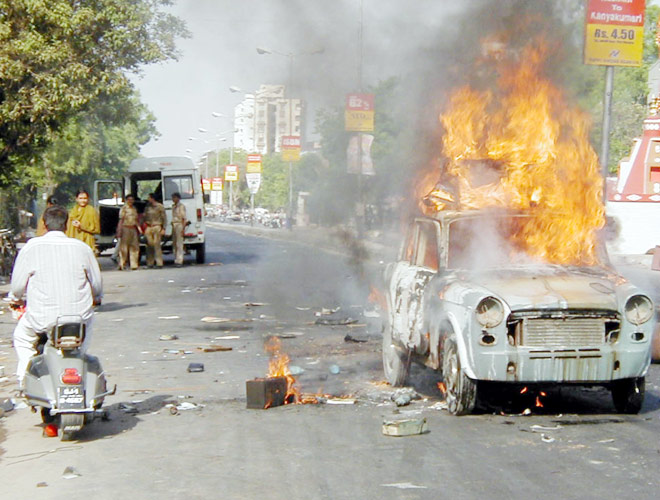
Courtesy: Amit Dave, Reuters
As a result, while the government had made certain arrests, no arrests of Bajrang Dal/VHP and BJP workers were undertaken. The arrest of at least 150 such accused, whose names figure in FIRs, are being avoided by the state government.
Not only the criminal justice system, the entire administration has failed. IAS and IPS officers who are supposed to be independent, have succumbed to the pressure of the Sangh Parivar. “There is no civil service left in Gujarat,” said the former Indian cabinet secretary Shri TSR Subramanian (The Indian Express, April 10). “What has happened is something much more fundamental than Gujarat: The civil service is gone. There is no such thing left”.
Role of CM and His Ministerial Colleagues
The facts mentioned in this report clearly establish that chief minister Shri Narendra Modi is the chief author and architect of all that happened in Gujarat after the arson of February 27, 2002. It is amply clear from all the evidence placed before the Tribunal that what began in Godhra, could have, given the political will, been controlled promptly at Godhra itself. Instead, the state government under chief minister Shri Narendra Modi took an active part in leading and sponsoring the violence against minorities all over Gujarat. His words and actions throughout the developments in Gujarat show that he has been openly defying the Constitution and indulging in actions which are positively detrimental to the interests of the country.
Shri Modi was the one who took Godhra to the rest of Gujarat. He was the one who directed the police and the administration not to act. He was the one who refused to help the likes of former member of Parliament, Shri Ahsan Jafri and the large number of people in Shri Jafri ’s home, who were all butchered later on.
He refused shelter and succour to the victims of the carnage. He refused, and continues to refuse, basic human amenities and was using coercion and other tactics to wind up refugee relief camps.
He has refused to buy land and rehabilitate persons in new locations or to give transparent accounts of the Rs. 150 crore rehabilitation package announced by Prime Minister Shri Atal Behari Vajpayee during his visit to the state on April 4, 2002. He has no remorse for the rapes, the butcherings, the loss of properties, the agony of displacement and the acute insecurity and lack of belonging felt by large numbers of the people of Gujarat.
As late as September 3, the international working president of the Vishwa Hindu Parishad, Shri Ashok Singhal made a shocking statement that received wide publicity, in which he described Gujarat as a “successful experiment” and warned that it would be repeated all over India. Shri Singhal further stated that the success of the Gujarat exepriment lay in the fact that entire villages were “purged” of Islam and Muslims.
This outrageous and pathetic statement was not only anti–constitutional but also in violation of the law itself, for which he could be prosecuted. But Shri Modi, by not expressing any outrage at Shri Singhal’s remarks, and by indulging in blatant minority–bashing himself, appears to have accepted Shri Singhal’s warning that whatever happened in Gujarat was an experiment, a precursor of things to come in the rest of the country.
He has made no secret of his hatred for the minorities, and his utterances from time to time keep emphasising that he is still an RSS pracharak (propagator) with a hostile attitude. His role as CM is nothing short of an extension of his functioning as an RSS pracharak.
His ministerial colleagues have toed his line and are, therefore, equally guilty of the commissions and omissions committed by the chief minister. These rabid, communal, anti–national and anti–constitutional statements and conduct on the part of the chief minister of Gujarat, Shri Narendra Modi and his cabinet colleagues make them unfit to hold any public office. The interests of the people of this country are not safe in their hands.
Archived from Communalism Combat, November-December 2002 Year 9 No. 81-82, State Complicity, Government of Gujarat
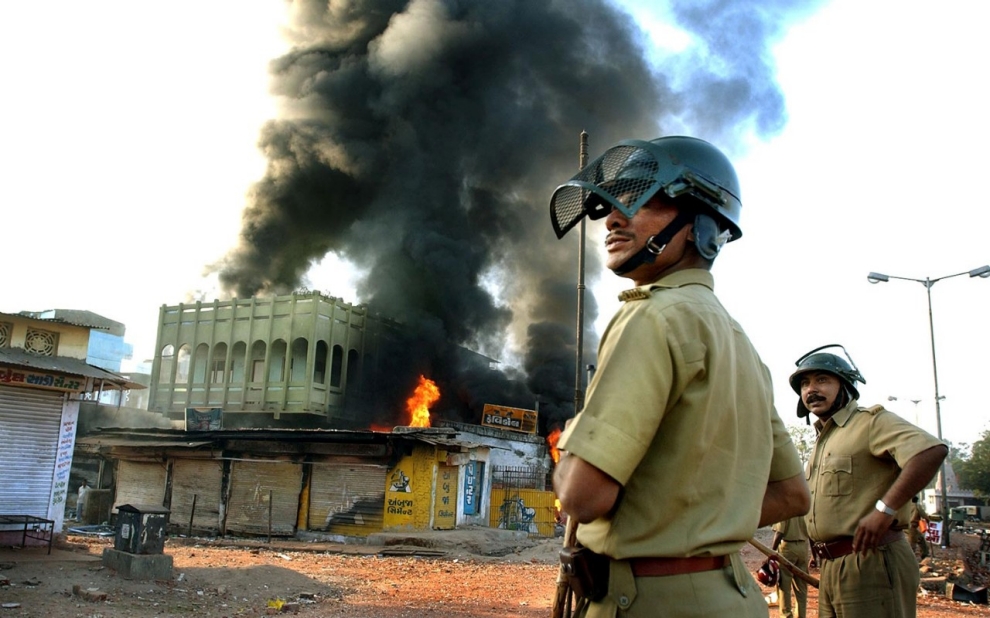
Courtesy: Reuters
Evidence before the Tribunal clearly establishes the absolute failure of large sections of the Gujarat police to fulfil their constitutional duty and prevent mass massacre, rape and arson — in short, to maintain law and order. Worse still is the evidence of their active connivance and brutality, their indulgence in vulgar and obscene conduct against women and children in full public view. It is as if, instead of being impartial keepers of the rule of law, they were a part of the Hindutva brigade targeting helpless Muslims.
To start with, the Godhra incident would not have taken place had the police taken due precautions right from the beginning. Given Godhra’s history and communal background, the police should have maintained a strict vigil as kar sevaks crossed Godhra, on their way to Ayodhya and on their return journey, more so because the climate in the country was already tense because of the VHP’s Ayodhya plan. On their way to Ayodhya, the kar sevaks had indulged in provocative acts at Godhra station. Despite these warning signs, there was not enough deployment of forces. In the circumstances, one may well ask whether this was a case of intelligence failure on the part of the police force, or a deliberate absence of pre–emptive action?
Once the Godhra tragedy had occurred, the Gujarat police made no preventive arrests. The only two arrests made on February 27 were those of Shri Mohammed Ismail Jalaluddin and Shri Fateh Mohammed, who were picked up at Astodia that night, for shouting slogans.
Since 1998, there has been a proliferation of hate speech and incendiary pamphlets all over Gujarat. The Gujarat police are guilty of not initiating or pursuing criminal action against the hate–mongers for four long years, even after hate speech and hate writing had frequently been used to create an ‘appropriate’ social climate to precipitate violence against the minorities.
There is adequate evidence recorded by the Tribunal from rural and urban Gujarat, which points to systematic data collection by the VHP/RSS/BD outfits, aided by sections of the state administration under the direct control of the fraternal BJP. Throughout the sinister planning and plotting, the Gujarat police maintained a discreet distance, adopting a non–interfering stance to blatantly unlawful activities.
On March 12, rediff.com posted an interview by the Gujarat VHP chief, KK Shastri on its website. He revealed in the interview: “In the morning (February 28), we sat down and prepared the list (of Muslim shops ands establishments to be targeted). We were not prepared in advance.” The police have not thought it fight to initiate any inquiry or action against Shri Shastri despite his self–confession of the VHP’s criminal misconduct.
The Tribunal received direct information through a testimony from a highly placed source of a meeting where the chief minister, two or three senior cabinet colleagues, the CP of Ahmedabad, and an IG police of the state were present. This meeting took place on the late evening of February 27. The meeting had a singular purpose: the senior–most police officials were told that they should expect a “Hindu reaction” after Godhra. They were also told that they should not do anything to contain this reaction.
The Tribunal also has evidence of a secret meeting, held late in the evening of February 27, in Lunavada village of Sabarkantha district. Phone calls were made to invite 50 top people of the BJP/RSS/BD/VHP. Fifty top people, the Tribunal was told, met at this undisclosed destination and detailed plans were made on the use of kerosene, petrol for arson and other methods of killing. The state intelligence did not or could not track such meetings and preparations for the gruesome violence that was to follow.
“The police tried their best, but they couldn’t stop the mobs. They were grossly outnumbered when the mobs grew,” Ahmedabad’s police commissioner, Shri PC Pandey had pleaded. But in most cases, inadequacy of forces is a mere excuse touted by serving police officers who fail in their primary duty. Even in Gujarat this time, in several cases where good officers held out against political pressure, the same small deployment was enough to act decisively and control the situation. In the vast majority of cases, however, the police either did not act or acted on behalf of the mob.
PC Pandey publicly changed his stand four months later when, on June 1, 2002, in an interview he stated that “VHP and BD were responsible for the violence in the state.”
The shocking levels of police complicity in the Gujarat carnage cannot be over–emphasised. On February 28, of the 40 persons shot dead by the police in Ahmedabad city, 36 were Muslims. This, despite the fact that it was the minority community which was being targeted by huge and well–armed mobs on that day, at both Naroda Gaon and Patiya as well as Chamanpura.
Gujarat Police has finally admitted that it killed more Muslims than Hindus in its ostensible attempts to stop what was clearly targeted Hindu violence against Muslims. Of the 184 people who died in police firing since the violence began, 104 are Muslims, says a report drafted by Gujarat police force itself. This statistic substantiates the allegations of riot victims from virtually every part of the state that not only did the local police not do anything to stop the Hindu mobs; they actually turned their guns on the helpless Muslim victims.
At some places in the state though, this trend, of more Muslims falling to police bullets than Hindus, was reversed. In both Bhavnagar and Banaskantha districts, five Hindus died in police firing on rioters. No Muslim was killed in Banaskantha, only one died in Bhavnagar. The superintendents of police of both districts were promptly removed from their posts. The number of Muslim and Hindu deaths in police firing, despite having been computed by the Gujarat police, have, so far, not been released. Coming out with the truth would only inflame the situation, it is feared.
Shri Pandey’s comments, telecast during the ‘Newshour’ bulletin of Star News on February 28, on the role of the police under his command was telling: “These people also, they somehow get carried away by the overall general sentiment. That’s the whole trouble. The police are equally influenced by the overall general sentiments.” Here we have a top police official being indulgent towards his policemen who “somehow” get carried away by “general sentiments”, when the least that could be expected of him would be a categorical assertion that those in the force who had failed to enforce ‘the rule of law’ were a disgrace to the uniform they donned and would themselves be punished in accordance with the law.
The Tribunal has enough evidence to establish that the Gujarat carnage was not simply a case of failure or abdication of duty; in far too many cases, the police were accomplices in the carnage.
On February 28, as carefully planned mass killings were engineered in 30 different locations all over the state, two senior cabinet ministers sat in the police control room in Ahmedabad and the state police control room in Gandhinagar and directly influenced police action, or inaction. Gujarat’s health minister, Shri Ashok Bhatt — who, incidentally, faces a criminal charge for the murder of a police head constable, Desai, on April 22, 1985 at Khadia in Ahmedabad — was in the police control room (PCR) at the Ahmedabad police commissionerate in Shahibaug for more than three hours on February 28. And urban development minister, Shri IK Jadeja who is considered Modi’s right hand man, had parked himself in the state police control room at Gandhinagar for four hours from 11 a.m. onwards on the same day. To have cabinet ministers sitting inside the state and city police control rooms can mean only one thing: they were there to influence the independent functioning of the police.
The police chiefs of Ahmedabad, Vadodara, Rajkot, Mehsana, Panchmahal, Dahod and Sabarkantha stand individually indicted for their failure to control unprecedented violence under their respective jurisdictions. The SPs of several of Gujarat’s 24 districts are also directly culpable. The Tribunal has enough evidence to establish that the Gujarat carnage was not simply a case of failure or abdication of duty; in far too many cases, the police were accomplices in the carnage.
When Vadodara’s commissioner of police, Shri DD Tuteja was contacted by concerned citizens and traumatised survivors to protest against the overall failure of the police to respond to complaints, he is claimed to have remarked, “Aapka naukar kiska kaam karega?” (“Who’s work would your servant do?”), implying that the police is subservient to the ruling party in power.
To begin with, police failure to quash rumours, deliberately floated to inflame passion and fuel violence, is unpardonable. In addition, from February 27 to April 10, it failed miserably in taking decisive action to control the violence that followed. The daily newspaper Sandesh was used to actively promote fear and insecurity in the minds of the majority while the minority was being targeted. However, the police did precious little to diffuse the situation.
As if this were not bad enough, the police itself committed atrocities against Muslims, especially in Vadodara (Bahar Colony, Noor Park and other areas) and Ahmedabad (Gomtipur and elsewhere). Even women were beaten and thrashed, often on their breasts and vaginas. In fact, such widespread sexual misbehaviour of the police with Muslim women marks a new low in police misconduct against the minorities.
It is a matter of public knowledge that in the past 3–4 years the VHP and the Bajrang Dal have distributed trishuls on a large scale in Gujarat. Barely disguised as a ‘religious symbol’, trishuls are sharp, three–pronged weapons that can easily cause fatal injury. Yet it took no steps to seize the weapons, stop the training camps or act against its practitioners in any other way.
Police conduct after the Gujarat carnage, with regard to the registration of crimes, conducting of investigations etc., has been marked by a desire to please political bosses and an utter disregard for the law of the land. This is nothing but calculated miscarriage of justice. The police are required to file separate FIRs for each incident. Instead, separate incidents of crime committed by different aggressors at different places at different times have been clubbed together in single omnibus FIRs. Panchnamas have either been made 3–4 weeks after the incidents or not at all. Also, if the charge-sheets filed in the Gulberg (Chamanpura), Naroda Gaon and Patiya massacres are anything to go by, the names of the main accused have been conveniently dropped.
Worse still, in places like Pandharwada, Anjanwa, Mora (Panchmahal district), Randhikpur and Sanjeli, Fatehpur and Dailol (Dahod district) as well as in villages in Bharuch, Sabarkantha, Mehsana and Himmatnagar districts, the Tribunal has evidence of the police bullying victim–survivors into filing FIRs wherein only mobs are mentioned, without naming the assailants and mob leaders whom the victim–survivors had clearly recognised during the incidents of violence. The CPs of Ahmedabad and Vadodara are also culpable for similar police misconduct.
Communalisation of the Police Administration
Evidence before the Tribunal clearly indicates that since the assumption of power by the BJP in Gujarat in February 1998, there was a calculated move to sideline Muslim police officers. Muslim officers were given non-executive posts. (they were assigned to crime investigation etc.). The eight Muslim officers, from a total of 141 IPS officers in the state, were kept away from decision–making posts.The Tribunal notes with shock that, as a result of this discriminatory practice by the Gujarat government, the younger batch of Muslim IPS officers who joined service in ’92–’93 have not known executive policing because they have simply been denied the opportunity to test their executive capabilities.
The Tribunal recorded the testimonies of many police officials who, for obvious reasons, cannot be identified. In every police chowki, the normal practice is to make head constables in–charge of a beat or outpost. Since the BJP assumed power in Gujarat, it has ensured that in the few instances where a head constable might be a Muslim, he would not be in–charge of the beats/outposts under the chowki.
Evidence led before the Tribunal indicates that ministers in the BJP government in Gujarat made public statements to ensure that Muslims in the state’s police force were sidelined. For instance, in 1999, Shri Mahen Trivedi, the minister of state for home, stated publicly at a police function: “We have told you that we don’t want Muslims in controlling posts. Why is he posted there?” (Confidential testimony of police officers before the Tribunal).
Police-parivar nexus
All vital and sensitive postings in the Gujarat police were systematically politicised and saffronised by the BJP immediately after coming to power.
Here are some examples of the police–parivar nexus:
1. Police Inspector VB Raval, (PCB, Ahmedabad City) Crime Branch: He participated in the demolition of the Babri Masjid as a kar sevak and proudly displays a photograph thereof as a trophy. This deed of his is said to have fetched him such a plum post.
2. Shri RD Makadia, DCP Zone IV: Very close to VHP leader Shri Praveen Togadia; works as his agent.
3. Shri Savani, DCP Zone V: A close ally of Shri Togadia.
4. Shri RB Jebalia, DCP Zone VI: Hails from Amreli district, as does Shri Togadia. He is said to be under a personal obligation to Shri Togadia, though he may not be outright communal.
5. Shri PB Gondia (IPS), DCP Zone III: His father is an ex–MLA (Congress.) He was offered a BJP ticket from Panchmahal dist. during the last Assembly elections. He was ready to contest but his father persuaded him not to.
6. Shri Parghi (IPS), DCP Zone I: Brother–in–law of Shri Gondia. He was seen moving in his official vehicle along with Shri Haren Pandya during the riots.
7. Shri DJ Patel, DCP Zone II: Also very close to Shri Togadia.
Himmatnagar (Sabarkantha)
8. Shri ND Solanki, SP Himmatnagar: His father is an active office–bearer in the VHP.
Politicians of all hues resort to punitive transfers, which only reinforces the oft reiterated demand for an independent police force in the country. In Gujarat, such transfers take place at the behest of the Sangh Parivar.
After the carnage, several police officers suffered for their upright behaviour in controlling violence and preventing further loss of life. From the evidence placed before the Tribunal these are:
The present government had attempted to use the police to put together a selective census of Christians and Muslims but was compelled to withdraw after a nation–wide protest. The Gujarat police, under instructions from the government, instituted a ‘Cell to Monitor Inter–Community Marriages’, a step that is in gross violation of the Indian Constitution.
Some lists of politically convenient appointments to the police department were placed before the Tribunal. (See Box) This needs further investigation and, if true, the situation must be redressed. This is imperative if a clean and politically untarnished police force is to be put in place to ensure justice and peace.
Apart from the police, the BJP has filled several posts within the state’s Home Guards with members of the VHP. The head of the Home Guards in Mehsana district is also a senior VHP functionary. (Significantly, the public prosecutor in Mehsana district, Dilip Trivedi, is also the VHP’s district chief. Moreover, the district magistrate/collector, Amrut Patel is a close relative of Shri Narayan Laloo Patel, a BJP minister and one of the prime accused for leading attacks in the district).
Over the last 5 years more than 8,000 VHP workers have been inducted into the state Home Guards, with many district chiefs being VHP office–bearers. The Home Guard’s position is a critical one for the maintenance of law and order in rural areas. Through massive infiltration over the past four years, the BJP and its rabid wings have virtually taken control of the Home Guards machinery.
The intense insecurity felt by Muslims in Gujarat is borne out by the fact that even Muslim policemen are/were afraid to put name tags on their uniforms and had sought special permission to be on duty without their name tags. Special IG, Shri AI Saiyed, with over 25 years of service, was asked to help a group on his way to Karai in Gandhinagar district. When Shri Saiyed tried to help the hapless people, he was himself attacked when the mob saw his name.
The height of the ‘fear and favour’ policy of the current political dispensation is borne out by CM Modi’s treatment of senior officials. On September 18, the Gujarat state intelligence bureau chief and his two deputies were summarily transferred on punishment postings because Star News gained access to police tapes on Shri Modi’s shocking anti–Muslim remarks made at Bahucharaji near Mehsana on September 9.
The Tribunal is of the view that a significant section of the Gujarat police is guilty of gross dereliction of duty and of flouting the Indian Constitution and Indian criminal law. Therefore, all the individual policemen named by the Tribunal in the list of accused must be promptly prosecuted.
Legal Remedies
Sections 107–110 and sections 143–152 of the Criminal Procedure Code (CrPC) give adequate preventive and punitive powers and deem it the duty of district magistrates and police chiefs to prevent breach of peace and ensure the rule of law. And the All India Service Rules (1969) provides for the punishment of errant IAS and IPS officials.
Apart from violating Indian penal and constitutional law, dereliction of duty is a clear violation of the ‘All India Services (Discipline and Appeal) Rules, 1969, Part III – Penalties and Disciplinary Authorities’. Under these rules, there already exist provisions for the dismissal from service of IAS and IPS officials guilty of “any act or omission which renders him liable to any penalty specified in rule 6.”
Communalisation of bureaucracy
The Tribunal has received substantial evidence of the deep communal-isation of the state bureaucracy. Collectors and deputy collectors are appointed on the basis of political expediency. Again, in these posts they do not perform their constitutional duty. They have in fact been subverting basic rights guaranteed through the Indian Constitution and to which they are sworn, whether in the matter of relief and rehabilitation or compensation claims or law and order.
The Tribunal, for instance, received specific complaints about three deputy collectors from Naroda, Rakhial and Ahmedabad city who have not only served more than their four–year term but are patronised by BJP MLA Sushri Maya Kotdani who is directly indicted in killings and massacres and Naroda Gaon and Naroda Patiya. Their names are Shri Manoj Macwana (deputy collector, Rakhial), Shri Manoj Patariya (deputy collector, Naroda) and Shri Gaurav Prajapati (deputy collector, Ahmedabad). Besides this, many DMs/collectors have been indicted in specific cases as in Bharuch and Ahmedabad city and their names have been included in the List of Accused with a strong recommendation from this Tribunal that they be swiftly prosecuted and punished.
Archived from Communalism Combat, November-December 2002 Year 9 No. 81-82, State Complicity, Police Misbehaviour
Join our mailing list to get the latest human rights news that matters, straight to your mailbox.
Join our mailing list to get the latest human rights news that matters, straight to your mailbox.