
Archived from Communalism Combat, November-December 2002 Year 9 No. 81-82, The Accused, Politicians & Others
Email: sabrangind@gmail.com

Archived from Communalism Combat, November-December 2002 Year 9 No. 81-82, The Accused, Politicians & Others
The crisis the country is facing today has a most respectable genesis; it is intricately linked to the history of the movement for Independence
To be less than blunt will be altogether pointless. The crisis the country is facing has a most respectable genesis; it is intricately linked to the history of the movement for independence. Mahatma Gandhi, whom we love to describe as the Father of the Nation, was the indisputable leader of that movement in the early decades of the last century. He was in search of a paradigm which could capture the imagination of the innocent, illiterate, ill-fed, ill–clad masses and inspire them to be active participants in the great endeavour to liberate the nation from foreign subjection. Religiosity, he concluded, held the answer.
His ceaseless pontification has a single message: freedom would bring back the Ram Rajya of Puranic times; in Ram Rajya, justice and fairplay prevailed in all seasons, nobody exploited anybody else and people lived happily together under the benign rule of Lord Rama. Whether Lord Rama’s treatment of his consort, Sita was impeccably correct was an issue that was conveniently brushed aside. Rama was the embodiment of all virtues, and once the country was rid of foreign rule, equity and manna would begin to drop from heaven.
The dream of Ram Rajya, the just kingdom, was the incitement Gandhiji provided his people. The paradigm, however, was sectarian to begin with. It was a Hindu paradigm; to the innocent masses, who overwhelmingly belonged to the Hindu community, the liberated land would be another Ram Rajya all right, but one the denominational identity of which could hardly remain vague. The Ram Rajya was a Hindu concept, post–liberation India would ipso facto be a Hindu domain.
The other communities were excluded. The problem lay with the Gandhian model. A subterranean attitude of the mind was simultaneously pervasive after all: we have made a gift of Pakistan to the Muslims; the rest of the great Indian subcontinent naturally belongs to us, the Hindus. It did not matter what the sophisticated thin stratum at the top thought or felt; for the nation’s multitude, the imagery of India was that of a basically Hindu land. That imagery has not weakened in the course of the past half a century and more.
The sojourn from Gandhiji’s Ram Rajya to the Ram Rajya of the Ram Rajya Parishad and the Vishwa Hindu Parishad was therefore not particularly arduous. The Parishad could claim to be the sincerest followers of the Gandhian path. And it should not be much of a surprise that the medieval savagery the country has witnessed this year had Gandhiji’s very own Gujarat as its venue. The current thought of a considerable number of Gujarati Hindus bears traces of Gandhiji’s ideological baggage. What is true for Gujarat is equally true for the rest of the country. It is not for nothing that the offspring of such eminent Congress leaders as Pandit Govind Vallabh Pant and Lal Bahadur Shastri are distinguished members of the top hierarchy of Bhartiya Janata Party leadership.
The poison tree that has impeccable roots has made nonsense of the Indian Constitution’s secular pretensions. Jawaharlal Nehru, free India’s first prime minister, was unable to conceal his emotions in those heady days: no fooling, he was going to preside over a secular India. Nehru had a noble mind. Unfortunately, it was also a flawed mind. A secular republic, Nehru thought, is one whose government tends to be equally sympathetic to all religions and communities. He would accordingly hop from temple to temple and satisfy his secular conscience by visiting mosques, gurdwaras, churches and synagogues with equal gusto. Since the number of Hindu temples in the country far exceeded the number of religious sites identifiable with other faiths, it was his visits to the Hindu institutions which caught the attention of the media and therefore of the general public.
The malady spread, and with rapidity, following Nehru’s departure from the scene. India Gandhi’s persona was an enigma: she was a modern woman par excellence; however, she had a religious streak in her, laced with strong superstitious beliefs. Sadhus and fakes of the Hindu denomination were constantly visible in her neighbourhood. Her elder son, who too became prime minister, was born of a Parsi father and wedded to a Catholic wife.
Democracy is a mug’s game though, and one must flaunt one’s denominational credentials if the prime object is the garnering of votes. Photographs exist of the young prime minister of India bowing down, bare bodied, before Hindu priests while visiting holy Hindu temples and seeking benediction. These pictures were regularly flashed across newspaper pages. The subconscious Hindu mind, nestling in the bodies of millions of honest, innocent Indians, could not but take the hint.
Soon the electronic media was drawn in. The great Puranic epics, the Ramayana and the Mahabharata, were serialised for years on end under government auspices on the Doordarshan screen. The Hindu epics were government–sponsored epics; by inference, the government had to be Hindu. For a few weeks, as a balancing stratagem, those in authority with some leftover conscience tried to run a serial on Tipu Sultan. That proved to be extremely disappointing and was abandoned pronto.
The Republic of India continued to be nominally secular, but it was Hindu secular. Hindu secularism defined itself as one which does not mind the powers that be to patronise occasionally other denominations as well. There is a catch though: others are tolerated, Hindus are the dominant entity.
The problem lay with the Gandhian model. A subterranean attitude of the mind was simultaneously pervasive after all: we have made a gift of Pakistan to the Muslims; the rest of the great Indian subcontinent naturally belongs to us, the Hindus.
The rest of the grisly story is easily summed up. The practice of Vast Pug persists in all construction activities in the public sector. A boat, built in a government workshop and owned by a government company, cannot be floated into the waters without the crushing of a coconut. Hindu totems choke public offices. You should not be surprised to find incense burning before the picture of a Hindu deity when you step into the lift in a government building or take a ride in a government car.
Secularism has lost its way. It has come to be defined as a state of existence where the government is equally chummy, at least on paper, with all religions; in reality, it is much more chummy with Hindu ascriptions. The awareness that genuine secularism is something else — a condition of being where the State is equi-distant from all religions, is indifferent to all of them and keeps all of them at arm’s length — has in the present circumstances, ceased to exist.
Competitive democracy, besides, has its own rules and an infectious disease is an infectious disease. For his sins, the present writer was once a minister in a state government which was immensely proud of its Left radical credentials. One of his most shameful memories of that tenure concerns a cabinet decision to declare a public holiday on the occasion of a solar eclipse; some eminent astrologers had predicted the end of the world on that day and the state government did not want to go against the general sentiments of the people: is it not a reasonable proposition that, on the last day of human existence, one should be in the midst of one’s near and dear ones and not be attending office?
It is going to be a long, long haul before the parameters of this society could be totally overhauled. And that will remain a very dim possibility as long as the present political establishment, infested by crooks and hypocrites and devoid of all scruples and moral compunctions, monopolises the proceedings.
Archived from Communalism Combat, September 2002, Anniversary Issue (9th), Year 9 No. 80, Rotten roots
A subtle, steady and perceptible erosion has, and is, taking place at all levels and within all constitutional institutions, including the judiciary

The Constitution is under attack not externally, but from within. The Indian State is under the administration of those who have no regard for the values enshrined in the Constitution. Every institution under the Constitution is being subverted and maligned. The executive today is a saffronised executive with no respect for the secular ideals found in the Constitution. The Prime Minister and his ministerial colleagues, who have taken oath to protect the Constitution have no compunction in periodically reaffirming their allegiance to the Rashtriya Swayamsevak Sangh (RSS) with an oath which says: “I must solemnly take this oath, that I become a member of the RSS in order to achieve all–round greatness of Bharatvarsha by fostering the growth of my sacred Hindu religion, Hindu society and Hindu culture”… This is the prayer that every member, pracharak of the Sangh utters with reverence:
“Affectionate Motherland,
I eternally bow to you,
O Land of Hindus,
You have reared me in comfort..,
O God Almighty,
We the integral part of
Hindu Rashtra,
Salute you in reverence,
For your cause have we girded up our
loins,
Give us your blessing
For its accomplishments.”
The domination of the RSS over the Indian executive is complete, with all the important portfolios retained by them, and small crumbs of no significance distributed amongst the BJP’s allies whose sole, albeit unholy, objective is to simply hang on to power. Constitutionally, the President is the executive head. However, with the appointment of APJ Abdul Kalam they have succeeded in installing a very pliable President who has neither political acumen nor constitutional knowledge.
The next is the assault on Parliament. With a Shiv Sena man as Speaker in the Lok Sabha and a sangh parivar man as vice-president chairing the Rajya Sabha, the takeover is almost complete. Thus, the two wings of the government — the executive and the legislature — are under the leadership of those who have no faith in the Constitution.
What about the judiciary? It is difficult to imagine that the government is not doing anything to saffronise the judiciary. When attempts at saffronisation of the bureaucracy have been so blatant, attempts to infiltrate the judiciary with men and women who are ideologically opposed to the Indian Constitution will not lag far behind.
At the lower level, the judiciary is dependent on the government whichever be the party in power. At the higher level, ie, at the level of the High Court and Supreme Court judges there is greater independence. But there is no transparency in the selection of judges. In any event, unfortunately, a commitment to Constitutional values neither is nor has governed the criteria for selection of judges. As Justice VR Krishna Iyer says: “The social justice perspective, a people–oriented credential, secular socialist essentials are frequently alien to the selection process of the brothers on the bench.”
For all we know, some of the the appointments to the bench could be primary members of the RSS who were appointed as judges later on. It is no wonder then that a former chief justice of a state high court has now become governor in a BJP–ruled state, the only apparent reason for his appointment being his close association with the VHP. This is in line with the perceptible policy of the government to appoint RSS pracharaks as governors in the states, yet another institution under the Constitution that is being manipulated and eroded.
When the Babri Masjid was about to be demolished, the only persons who could have stopped the demolition were the then Prime Minister Narsimha Rao and Justice Venkatachaliah, the judge who headed the Supreme Court bench before whom the matter was pending. Rao connived in the crime. Justice Venkatachaliah was naïve enough to accept an undertaking from Kalyan Singh, then chief minister of UP, which he never intended to keep.
After the masjid was demolished in full public view, resulting in the death of thousands of innocent people and large scale destruction of property in the riots that followed all over the country, there was hardly any feeling of righteous indignation on the benches of the Supreme Court. A routine contempt of court notice was issued against Kalyan Singh. In response, Kalyan Singh paraded the corridors of the Supreme Court and his token punishment lasted only until the court rose for the day.
In sharp contrast, the innocuous tone and tenor of an affidavit filed by Arunadhati Roy was sufficient to invoke a severe punishment from the Supreme Court. Later on, another judge, Justice JS Verma of the Supreme Court, in what is now known as the Ayodhya verdict, observed that the demolition of the Babri Masjid was the act of certain mischievous “miscreants who cannot be identified” when the whole world knew who were the perpetrators of this crime.
It is a sad reflection on the Indian judiciary that when on occasions it has been called upon to deal with ‘secularism’ as enshrined in our Constitution, it has dithered, it has displayed unbecoming traits leaning in favour of the majority as against the minority community.
Soon after the demolition of the Babri Masjid, someone installed a ramshackle Ram Mandir on the site of the demolished mosque and sought protection for the same from the court. It was patently an illegal structure put up by “miscreants” who were plainly trespassers in law. Yet, Justice Tilhari, who in his wisdom found that Lord Rama has a place in the Indian Constitution, gave protection to the structure and allowed worship and darshan for the Hindus (Vishwa Hindu Adhivakta Sangh vs. Union of India — Judgement delivered on 1-1-1993).
A special leave petition filed against this judgement was summarily dismissed by the Supreme Court. The government enacted an ordinance on January 7, 1993, the sole object of which was to permanently establish and legitmise the make shift Ram Mandir. When this ordinance (which later became an Act) was challenged in the Supreme Court, the majority judges (Judgement of Verma J.) upheld this very provision in the law (Section 7), which sought to maintain the status quo as on January 7, 1993, on the specious plea that in the demolition of the Babri Masjid, it was the Hindus who suffered their rights of worship which they were exercising from December, 1949 until December 6, 1992.
Further, Justice Verma observed that the “freeze enacted in Section 7(2) only enabled them to exercise “a lesser right of worship for the Hindu devotees” and as such the law “appears to be reasonable and just.” The learned judges conveniently forgot that in December 1949, the idols were forcibly installed within the premises of the Babri Masjid, after which action, they were sustained there through several interim orders. The minority judges on that bench of the Supreme Court rightly observed, “that the Act is skewed to favour one religion against another” (Bharucha J.).
Thus the issue of Ramjanma-bhoomi was kept alive by an order of the Supreme Court! It is the judiciary that kept this issue alive since 1949, by passing a series of orders which only favoured the Hindu community over the other. This trend set by the judiciary was to be exploited later by the communal elements in political parties, and to be hijacked and monopolised as their exclusive agenda by the sangh parivar, since about 1980.
It is a sad reflection on the Indian judiciary that when on occasions it has been called upon to deal with “secularism” as enshrined in our Constitution, it has dithered, it has displayed unbecoming traits leaning in favour of the majority as against minority community, reminding us unwittingly of what Justice Oliver Wendell Homes once said: behind every judgement lies an “inarticulate major premise.” However, their subjective conscience should not have allowed them to commit a breach of their own oath on the Constitution.
The only exception was the judgement in the case of SR Bommai (1994) wherein it has been said: “Article 25 inhibits the government to patronise a particular religion as State religion overtly or covertly. A political party is therefore positively enjoined to maintain neutrality in religious beliefs and prohibit practices derogatory to the Constitution and the laws… A political party that seeks to secure power through a religious policy or caste orientation policy, disintegrates the people on grounds of religion and caste” …
In this case the court took into account the manifesto of the BJP which stated that the “BJP firmly believes that construction of Sri Ram Mandir at Janmasthan is a symbol of the vindication of our cultural heritage and national self respect… And (that) party is committed to build Sri Ram Mandir at Janmasthan by relocating superimposed Babri structure …”.
The court also took into account that the leaders of the BJP had consistently made speeches to the same effect and that some of the chief ministers and ministers belonged to RSS and that the ministers had exhorted people to participate in the kar seva that led to the demolition. The court observed that all these materials were sufficient to hold that the state governments (which were dismissed following the demolition of the Babri Masjid) were not run in accordance with the provisions of the Constitution.
Yet this judgement was not even referred to by the Supreme Court when the election of the Shiv Sena leader Manohar Joshi (former chief minister of Maharashtra, and the present Speaker of the Lok Sabha) was upheld. In an election rally Joshi had sought votes stating that the first Hindu state will be established in Maharashtra with the Sena–BJP victory. The latter judgement gives the distinct impression that canvassing on the basis of Hindutva was permissible since “Hindutva is only a way of life.” What about Christianity? Is it not a way of life? Is Islam not a way of life? Thus, Hindutva got judicial reprieve and thereby the government at the Centre and in Gujarat today gets legitimacy.
In the 1992–93 riots in Bombay, none could doubt that the worst culprit was Bal Thackeray who had repeatedly incited the mobs through his mouthpiece, Saamna. Since the the Congress government was not taking any action against the Sena leader, two concerned citizens moved the Bombay High Court with all the newspaper articles and adequate documentation seeking direction to sanction prosecution of Thackeray. The two judges who heard the petition simply turned down the plea on the basis that past wounds and atrocities should be swallowed and forgotten because of apparent peace in the city. Worse still, the division bench of the Bombay High Court held that the provocative exhortations by Thackeray to his cadres on January 9, 1993 were not against all Muslims “but only against anti-national Muslims.”
What is even more regrettable is that the SLP filed against the judgement in the Supreme Court was summarily rejected, giving sanction to, ‘kill, loot and forget!’ Much later, when Bal Thackeray was arrested, a lower Court in Mumbai released him on a technicality and the Bombay High Court has had no time in the last three years to hear a review petition against the said order.
While the bomb blasts cases have been going on, almost on a day–to–day basis for the past several years, the judiciary has simply been postponing the case against those accused for the Babri Masjid demolition (which include LK Advani & Co.) for the last nine years!
On December 12, 1992, Narasimha Rao, by a notification, banned the RSS, the VHP and the Bajrang Dal under the Unlawful Activities (Prevention) Act, 1967. This ban had to be confirmed by a judicial tribunal under the Act. Justice PK Bahri, a retired judge of the Delhi High Court who sat on the tribunal confirmed the ban on the VHP but quashed the ban against the RSS and the Bajrang Dal. He however spoke of “the laudable objects pursued by VHP.” So the Ram Janmabhoomi movement became a laudable act by virtue of a judicial pronouncement.
The issue of Ramjanma–bhoomi was kept alive by an order of the Supreme Court! It is the judiciary that kept this issue alive since 1949, by passing a series of orders which only favoured the Hindu community over the other.
What the judge said about the RSS discloses his “major inarticulate premise.” According to him: “The word “Hindu” has been firmly imprinted in our national mind, was radiantly reflected in our freedom struggle against the British as well. The fight was essentially for certain ideals associated with the word Hindu, and not for mere political independence or economic rights.” No wonder then that he came to the conclusion that the accusation that the RSS is opposed to Muslims is wrong. The question is, how did the then Prime Minister select such a person to head a judicial tribunal?
When Graham Staines and his two innocent children were so tragically burnt to death on the night of January 22/23, 1999 by Dara Singh in association with members of the Bajrang Dal, the government promptly appointed Justice Wadhwa, a sitting judge of the Supreme Court to hold an inquiry, inter alia on “the role, if any, played by any…organization…or individual in connection with” the killings. Within days, before the commission could begin it’s work, LK Advani, as Union home minister had granted a character certificate to both the VHP and the BD, on the floor of the Lok Sabha. He said that he knew these organisations well and they were incapable of criminal acts. What happened thereafter is well known.
Despite the investigations and depositions of police officers and counsel before the commission that revealed the clear links between Dara Singh and the sangh parivar outfits, the learned judge was in a great hurry, despite the submissions made by the commission’s advocate, Gopala Subramaniam to nullify the link. Justice Wadhwa categorically held that Dara Singh alone was responsible and that no “authority or organisation was behind the gruesome killings.” Thus Advani stands vindicated.
Fortunately for India and the founding principles of the Indian State under the Indian Constitution, the judiciary has not been entirely influenced, ideologically. It remains, with all these major deviations, the most secular institution under the Constitution, as compared to the other two. It is still the judiciary and the judiciary alone can resuscitate constitutional values to their original intent. However, we need to be warned of the subtle, steady and perceptible erosion that has been, and is, taking place at all levels and within all constitutional and democratic institutions, including the judiciary. One of the main causes for anxiety is the lack of transparency in the matter of selection and appointment of judges. Coupled with this is the lure that is offered to judges who are about to retire-with commissions and tribunals all legislatively sanctified as reserved for retired judges as also seats in the Rajya Sabha.
Added to this list is now the governor’s post. Even when there are no constitutional or statutory commissions to head that retired judges can be appointed to, the Government can always, by its executive orders create one like the recent Constitutional Review Commission — the sole purpose of which was to make use of retired judges to create doubts about the Constitution, in the minds of the people.
Archived from Communalism Combat, September 2002, Anniversary Issue (9th), Year 9 No. 80, Your lordships, beware!
The most subversive factor in Gujarat is not so much its polarised society, but the use of organs of the State to cultivate this polarisation
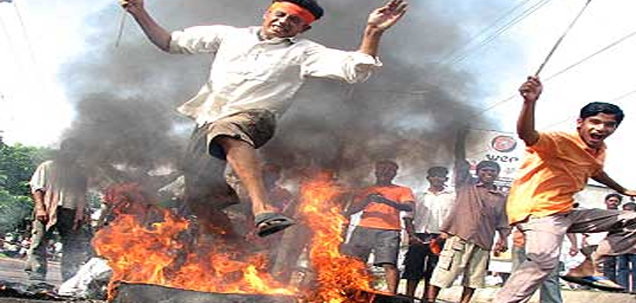
Courtesy: Dainikbahskar
There is a sense of anxiety and bewilderment when we look at the current crisis in the Indian State, and in our own lives. There is increasing corrosion of the secular commitment in politics and a loss of trust in authority and their intent to maintain the rule of law. The enormity of the problem lies in the casualness with which these principles, once held so sacrosanct, have been so easily compromised. What has happened in Gujarat is a stark example of the subversion of democratic institutions for the pursuit of sectarian power.
“Hindu Rashtra Karnavati mein aapka hardik swagat hain!” An audacious, unconstitutional and anti-national signboard symbolising an open challenge to the nature of the Indian State was placed prominently on a bridge over the Sabarmati river in Ahmedabad. Proof of official sympathy and complicity came from the fact that the signboard was not even taken down for weeks, let alone attempts to prosecute those responsible.
Similar signboards had been appearing in villages and towns across Gujarat, well before the orgy of planned violence that was unleashed in Godhra and in post-Godhra Gujarat. They have been multiplying ever since. Do these signboards not amount to a call for civil war? And yet this pernicious message spreads and a government which has taken an oath to protect the secular Indian State deliberately looks the other way.
The success of communal forces in dividing the social fabric of society along sectarian lines is a cause for comprehensive introspection. However, the systematic and deliberate agenda of a government acting counter to its oath of office raises fundamental questions of its accountability and legitimacy. The short history of independent India has had several sad and shameful chapters of sectarian violence. Larger numbers of people have died in some of those incidents. However, not even in the Sikh “riots” of 1984, (where similar action and reaction theories were shamefully trotted out) was there such a deliberate, comprehensive and sustained plan to subvert the rule of law.
There have been many moments of despair since 1947, but the minorities in India have never been made to feel so conclusively that they can have no faith in the State and its machinery. The government that allowed aggressive and lawless mobs a free a hand has indicted itself. And the confidence in a civil service, which abides by the Constitution and the law, has hit an all time low. The institution of the civil service, including the police, created to prevent the laws of the land from being violated, has failed its own people and the reason for its own existence. It should, if nothing else be ashamed of its incompetence and inability to ensure law and order and quell the violence.
The danger in situations like Gujarat arises when a set of people are elected with a declared allegiance to the Constitution, but who in fact are committed to an agenda of subverting its basic principles.
Even a newly appointed sub divisional magistrate with a conscience and a sense of duty, could have restored peace within hours. The police continually accused for its communal and criminal nature will not be able to live down this shameful period in its history. Countless people prayed for help from the police in Gujarat, and learnt while being raped, looted and killed, that a partisan police force will not perform its duty.
The most subversive factor in Gujarat is not so much its polarised society, but the use of organs of the State to cultivate this polarisation. It is for this reason that it must be understood as a State in an undeclared war against itself. There has been no indictment of the state by the central government or of the civil servants by their own community. What does this portend for the country?
What should also frighten the common woman and man in this deliberate and naked connivance of the State in these crimes against humanity is their own future. If the State can encourage these acts against a minority community, it does not take long for these to be perpetrated against any group that threatens the political party or a dominant group’s vested interest.
What has given the victims of the Gujarat carnage and citizens alike some hope for the rule of law has come from the action taken by bodies like the National Human Rights Commission and the Election Commission of India. They have acted to protect constitutional rights, profiling the positive potential that can be exercised by institutions of the State.
The Constitution with its basic features of egalitarian democratic values, with special attention for the disadvantaged, has been responsible for our strength and resilience as a nation state. This was the result of a long struggle for independence and has the sanctity of the approval of its people, who fought for and cherished the idea of a pluralistic and inclusive India. There have been groups which have questioned this sanctity, through direct conflict and confrontation. Their conflicts have been openly placed in the public domain, and many such movements have engaged in violent struggle with the state machinery. The State used its own powerful tools of reprisal and often invoked constitutional authority to quell these rebellious groups. The danger in situations like Gujarat arises when a set of people are elected with a declared allegiance to the Constitution, but who in fact are committed to an agenda of subverting its basic principles. It is imperative that this be recognised.
Communalism of any colour is unconstitutional, and anti-national, and its worldview runs counter to the principles we have set for ourselves. The hidden agendas must be exposed and fought openly on the political plane. This uni-polar nationalism advocating an ‘Akhand Bharat’ by threatening the pluralistic nature of our country, will be the reason, in fact, for its balkanisation. ‘Peace’ alone, is not the critical factor in Gujarat: it is what kind of peace. We have seen the vision of a ‘Hindu Rashtra’ in Gujarat .We have to recognise that communalism is the biggest threat to the Indian nation state. Communal acts within government are an insidious, subversive, and even greater threat.
What we have to understand as ordinary citizens is the unholy alliance between political aggrandisement, personal gain, corruption and the crumbling edifice of institutions created to maintain the rule of law. It is for us to decide whether we want boards like the one in Ahmedabad to welcome us to a divided India.
Archived from Communalism Combat, September 2002, Anniversary Issue (9th), Year 9 No. 80, Conniving state
.
With the BJP controlling the central government, the threat of subversion of the Constitution and the Parliament is very real
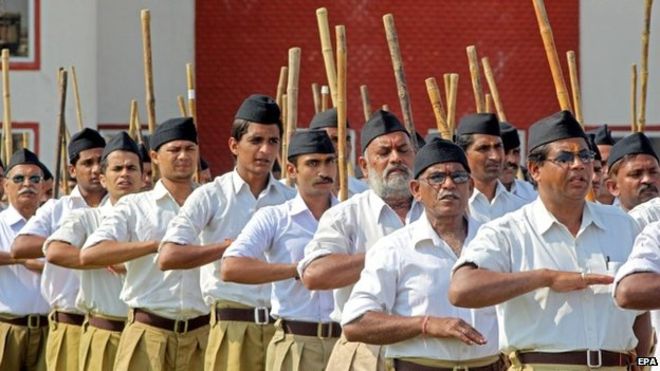
Courtesy: bbc.com
It is not a mere coincidence that the last three election manifestos of the Bharatiya Janata Party (BJP) included the issue of a review of the Indian Con-stitution. And the fact that the BJP could manage to smuggle in this issue as part of the national agenda for government — the joint common manifestos of the motley combination, which calls itself the National Democratic Alliance — betrayed the intolerance of the Hindutva forces spearheaded by its political arm, the BJP, to the present Constitution. It is also quite revealing that once it assumed office it went ahead with the formation of the Constitution Review Commission, which has since submitted its report. The attempts at tinkering with the basic features of the Indian Constitution, which has the parliamentary system as the centre–piece of the political structure, provides a sharp contrast to the involvement of elected representatives of the people as inherent in the Constituent Assembly and underlines the alien nature of this latter attempt which essentially is divorced from the people and their aspirations.
Fortunately, the composition of the Indian Parliament as of now, and the insight of a broad array of political forces into the possible dangers of the Hindutva forces in redefining the secular democratic and composite nature of the Indian State and society have largely thwarted the potential mischief–making potential of the move. The silence of the government thereafter, on implementing some of the issues raised by the constitution review is a case in point. Perhaps we will hear more about it on the eve of the coming election.
In response to his plea to lift the ban on the RSS, in 1948 the then Prime Minister Pandit Jawaharlal Nehru had observed in a letter to the then RSS chief and the most influential of Hindutva ideologues, MS Golwalkar: “In the course of the last year both the central government and the provincial governments have received a mass of information in regard to the objectives and activities of the RSS. This information does not fit in with what has been stated by you in this behalf. Indeed it would appear that the declared objectives have little to do with the real ones and with the activities carried on in various forms and ways by people associated with the RSS. These real objectives appear to be completely opposed to the decision of the Indian Parliament and the provisions of the proposed Constitution of India.”
But now that the BJP has virtually come to control the central government thanks to the servile capitulation of its so-called secular allies, the threat of subversion of the Constitution and the Parliament is very real. In the wake of the ban on the RSS, the Hindutva forces had found themselves completely on the back foot. And it is against this background that the Jan Sangh was formed in the early 50’s, since nobody was prepared to take up the Hindutva view in the Indian Parliament at that point of time. Subsequently, by the mid 60s, though the Jan Sangh had increased its strength in Parliament and tried its best to use the floor of the two Houses to further the interest of the Hindutva cause, they met with limited success. Though the Sangh elements managed to position themselves crucially within the Janata Party in the general background against the authoritarian politics of the Congress Party epitomised by the Emergency, during the late 70’s, notwithstanding the success they achieved in planting Sangh Parivar elements in important governmental positions (particularly in the media with Advani handling the I&B portfolio), the fight back by the secularists led by Madhu Limaye on the dual membership question led to the Hindutva forces suffering a set-back.
By the 1984 elections, the BJP, the new incarnation of the Jan Sangh, came down to an all time low of just two members in the Lok Sabha. But the fortunes of the Hindutva forces started looking up, with the Hindutva campaign concentrating on “pseudo secularism” against the Congress after the Rajiv Gandhi government’s completely misplaced decision to placate fundamentalist elements by reversing the Supreme Court judgment on the Shah Bano case.
The use of Parliament by the Hindutva forces reached a most crucial phase with the Ram Mandir campaign in the early 90s. The BJP used the floor of the Parliament to propagate the mandir cause and ultimately, along with the National Integration Council, the two Houses were also used to hoodwink the nation on its real game plan about bringing down the Babri Masjid. However, this gory act once again saw the BJP finding itself in splendid isolation. The spectacle of Vajpayee completely lost standing alone in the Lok Sabha in an atmosphere of all–round condemnation will continue to be part of an enduring memory in the annals of the Indian Parliament.
But the fact that Vajpayee did not outright condemn the unmaking of the Indian Constitution in Ayodhya was a crucial point in the process of the Hindutva forces’ attempt to subvert Parliament. The Hindutva forces attempt at subverting Parliament went on unabated till 1998, so long as it was in the Opposition. But these efforts did not help the BJP emerge out of its political isolation.
However, these subversive efforts assumed a new dimension with the NDA government’s assumption of office in 1998. The dubious political and ideological premise which separated the BJP from its allies was promised to be relegated to the backburner on the eve of the elections. When questioned by the media on the absence of controversial issues like the reconstruction of the Ram Temple in Ayodhya, or scrapping of Article 370 of the Constitution at the time of the release of the NDA’s common election manifesto, Vajpayee pointedly stated that the NDA, if voted to power, would have nothing to do with these issues.
The so-called secular allies of the BJP and NDA allowed themselves to suffer the self–delusion that the BJP was abandoning these issues for good. This was despite the fact that the Hindutva brigade did not make any secret about merely putting them on hold and not really abandoning them. But opportunism and lust for power prevailed in so far as the thinking of these so–called allies was concerned. To start with, the BJP was cautious and gave the impression that it was genuinely sensitive to the allies’ concern over the controversial issues. But as and when the vulnerabilities of these allies were exposed, the BJP went on the offensive, more so, after the NDA was re–elected to office in 1999.
The first major issue in its attempt to subvert the parliamentary system started with the efforts in securing endorsement for the Gujarat government’s decision to allow its employees the freedom to associate with the RSS. This was in complete contravention of the existing rules. The Opposition wanted the government to advise the Gujarat government to reverse this decision. Not only the Opposition, even a section of the NDA put its foot down, rubbishing the bid of BJP leaders at the Centre to pretend they did not wish to interfere or undermine the ‘legitimate authority’ of a state government.
The protest against this led to the stoppage of normal transaction of business in both houses of Parliament. In the face of such strong resistance, the government had to relent and appropriate advice was communicated to the Gujarat government, leading to the scrapping of the latter’s earlier order.
The next major confrontation was sparked off by Vajpayee’s infamous assertion that the ‘reconstruction of the Ram Temple was an expression of national sentiment.’ The debate on this dubious statement by the Prime Minister brought out the hypocritical commitment of the BJP to keep Hindutva agenda out of the government’s ambit. The Opposition did well to expose the sham and the Rajya Sabha, where the Opposition was in majority, voted a resolution disapproving the Prime Minister’s statement. But the flip side of this development was that so-called secular allies with otherwise impeccable credentials steeped in non–Brahminical Dravidian ideology like the DMK, MDMK or PMK sided with the government over such a crude expression of Hindutva.
The Ayodhya issue also saw government efforts at making the construction of the Ram Temple a part of the government’s agenda by offering legitimacy to the shiladaan program sponsored by the VHP and the Ram Janmabhoomi Nyas even as the matter remains pending before the Supreme Court. It is the Prime Minister who gave legitimacy to the VHP’s pernicious design by promising it a deadline on the issue.
As long as the Hindutva forces are not ideologically weeded out from the body politic, the threat of Hindutva subverting Parliament will be real. The legislature and its capacity to assert its independence flow from the executive’s accountability.
Having thus allowed the drift and once again put the entire nation on tenterhooks, the Prime Minister justified the action of the attorney general making the government a party to a religious ceremony. Another major attempt at undermining secularism as the mainstay of state policy by the Hindutva forces is related to its series of actions aimed at saffronising education. Be it the question of withdrawal of manuscripts edited by secular historians for the ‘India Wins Freedom’ series or rewriting of NCERT history text books or framing of the national curriculum policy, Union minister for human resources development, Murli Manohar Joshi misled the Parliament and the nation with half-truths and plain lies. That the Opposition nailed these lies is a different issue.
But the most serious of all attempts to subvert Parliament by the Hindutva forces was over the Gujarat development.In the first week of March itself, the treasury benches refused to accept the terming of the indiscriminate looting, killings, arson, rape of the hapless minorities in Gujarat as state–sponsored genocide. All important ministers of the government, particularly LK Advani and Arun Jaitley justified Narendra Modi’s infamous “every action has an opposition reaction” theory, linking the communal carnage to the Godhra incident. Gaping holes in the government’s line of argument can be identified in the three debates which have taken place so far in Parliament on the subject. Attacks on independent institutions like the National Human Rights Commission (NHRC) and the National Commission for Minorities have been major features of the government’s stand. On the floor of the House, Jaitley defended intolerance of the media, like the blocking of Star News coverage of the Gujarat genocide. Venkaiah Naidu was so enraged over facts quoted from the special issue of Communalism Combat on Gujarat that he demanded an immediate banning of the publication. Only a reminder that it is a legitimately published magazine brought him to his senses. The contradictory facts over the Godhra incident also bear testimony to the government’s attempts at subverting Parliament. Notwithstanding the government’s most blatant attempts to shield the Modi government and the indefensible acts of the Hindutva forces in Gujarat, the NDA–government ultimately had to be a party to a resolution in the Rajya Sabha accepting the failure of the Gujarat government and its own inaction.
To conclude, as long as the Hindutva forces are not ideologically weeded out from the body politic, the threat of Hindutva subverting Parliament will be real. The legislature and its capacity to assert its independence flow from the executive’s accountability. This is how the makers of the Constitution conceived the parliamentary system in our country. Given the obnoxious record of the BJP and the Hindutva forces, the threat is all the more serious.
In democracies the world over, the functioning of the legislature is inseparably linked to the functioning of a free press reflecting truthfully the development and proceedings in Parliament. Therefore, in the coming days, vigilance has to be redoubled to safeguard Parliament from such pernicious attempts at subversion.
Archived from Communalism Combat, September 2002, Anniversary Issue (9th), Year 9 No. 80, Subversive Sangh
A frontal attack on communalism will be ineffective if it is not part of a larger campaign for good governance

The Gujarat carnage has once again proved that the Indian Administrative Service, which heads the law and order machinery in India, cannot be trusted to act with fairness and objectivity. Rather than follow dictates of the Constitution most of them got swayed by their communal prejudices and willingly allowed themselves to be governed by the local politicians, in the process forgetting that they were duty–bound to save the lives of innocent citizens.
Three issues need to be probed; the changing nature of politics in India, the response of the civil service to it; and the legitimacy that Hinduisation has provided to both politics and administration, which has otherwise completely failed to solve the real social and economic problems of the common people.
Political pressure can be healthy if it results in greater demand on administration for efficiency and better services to the people. Pressures properly regulated and wisely tempered, improve the spirit of administration and help to keep it on an even keel. Unfortunately, the main problem today is that the politics of the country has itself become divorced from public welfare and is more concerned with narrow sectarian interests.
Politicians think that electoral behaviour can be manipulated through precipitating caste or some other populist wave at the time of elections, which does not require sustained work in the constituency. At the same time, elections require funds, which have to come through the looting of the government treasury.
The political system is accountable to those who are behind the individual MLAs/MPs; these are often contractors, mafia, corrupt bureaucrats and manipulators who have made money through using the political system and are therefore interested in the continuation of chaos and patronage–based administration.
A vast gap exists between the stated and unstated objectives of government. On paper, the avowed objective of government is to give clean administration, but many posts are auctioned to the highest bidder. Corruption is rampant. People have unfortunately accepted the position as fait accompli and resigned themselves to their fate. They, too, tend to seek short cuts and exploit the system by breaking rules or approaching mafia gangs and politicians for favours.
Democracy in most developing countries is not about people; it is about access to state power. Entry into the political arena is driven by a desire for personal gain, not by a genuine commitment to serving the people. The state’s resources are the most valued prize for both politicians and their constituencies, which leads to a client–patron relationship between the holders of state power and those seeking favours.
Patronage is controlled by individuals, not established institutions bound to follow set procedures. Where power is highly personalised and weakly institutionalised, the political process is replaced by arbitrary and informal transactions. In such an environment, access to power and material resources leads to the fudging of rules (show me the person and I will show you the rule), plundering of public treasury, dependence upon intermediaries, and decay of governance. When the fence itself starts eating the field, there is little chance of the survival of the rule of law.
Winston Churchill, on the eve of India’s Independence, had said, “Power will go to the hands of rascals, rogues and freebooters. All Indian leaders will be of low calibre and men of straw. They will have sweet tongues and silly hearts. They will fight among themselves for power and India will be lost in political squabbles.” What appeared as a scandalous outburst then may be called an understatement now!
The power–hungry IAS officer, soon after his recruitment, gives up studies, and sees no reason for making efforts to improve his skills. There is then an exponential growth in both his ignorance and arrogance.
Civil Service
India started with a competent and motivated civil service (though it was pro–rules and not pro–people), but in the course of the last thirty years the service has lost much of its dynamism and autonomy. It has ended up as being a stooge in the hands of its wily politicians. The political morose has affected the civil service, too, though reasons for the decline in its performance are many.
Some such as secrecy, cumber-some procedures and unnecessary controls are well known. Here we will highlight two more factors: unplanned expansion of the IAS in the 1970s and 80s, and lack of professionalism.
In a north Indian state, where previously one officer used to be the secretary of medical and health, now there are five secretaries doing the job of one; four are in charge of health, family planning, medical, and medical edu-cation respectively, whereas the fifth one, as principal secretary, oversees the work of these four secretaries! With the changing role of govern-ment, the bloated size of the civil service no longer relates to the nature of functions that government can or should undertake.
The proliferation of promo-tion posts (though carrying little challenge) has apparently been done to avoid demoralisation of individual civil servants due to stagnation, but the net result has been just the opposite. First, it leads to cut-throat competition within the service to get into more important slots. The old camaraderie has given place to a rat race. Instances are not lacking when IAS officers wanting a plum job, say a foreign posting, have gone to the press denigrating their competitors.
This has also resulted in the decline of superior–subordinate relations, even when both are from the IAS. Previously, the junior officer was always a colleague, now he appears more as a subordinate wanting favours from his superior. The annadata and the maibap culture of bygone feudal days now pervades the IAS. Second, this no–holds–barred competition is then exploited by politicians in playing up one against the other leading to officers becoming more pliable. Third, for IAS officers in marginalised positions govern-ment seems remote, heartless and more unjust now than ever before. Previously, IAS officers were the government, now the individual officer considers himself alienated from government. Many have gone to the tribunals and courts for promotions and postings, a phenomenon that was unknown ten years ago.
Lack of professionalism
A high degree of professionalism ought to be the dominant characteristic of a modern bureaucracy. The fatal failing of the Indian bureaucracy has been its low level of professional competence. The power–hungry IAS officer, soon after his recruitment, gives up studies, and sees no reason for making efforts to improve his skills. There is then an exponential growth in both his ignorance and arrogance.
It is said that in the house of an IAS officer one would find only three books — the railway time-table, because he is always on the move, a news magazine because that is the only book he reads, and of course, the civil list that describes how many in the system are above him. Stagnation in his intellectual calibre leads him to believe that the state structure has been created to pander to his ego. When the world is moving fast to a new goal oriented culture, the IAS officer is sliding back to the 18th century mentality.
The IAS officer is not so much worried of a transfer per se, as he is worried of being transferred to a job that carries no patronage or perks. He would use all kinds of pulls and pressures — both adminis-trative and political — to avoid it. In addition to the fear of marginalisation, another factor which contributes to the surrender of senior officers before political masters is the total lack of any market value and lack of alternative employment potential. Beyond govern-ment they have no future, because their talents are so few.

The only job for which they were suitable, that of liaison officers for the private sector, would also no longer be available to them as the process of liberal-isation of the economy gains momentum. Most IAS officers thus end up as dead wood within a few years of joining the service and their only talent lies in manipu-lation and jockeying for positions within government.
The IAS serves the State but the State structure is itself getting increasingly dysfunctional and diminished. In some north Indian states parallel authority struc-tures and mafia gangs have emerged. Tribal regions in central and north–east India are out of bounds for normal administration. In such a situation it is no surprise if the bureaucracy, too, is in a bad shape.
There is greater integration now both socially and in terms of group objectives between the members of the IAS and the politicians of that state. Many civil servants are deeply involved in partisan politics: they are preoccupied with it, penetrated by it, and now participate individually and collectively in it.
This is understandable, though unfortunate, because between expression of the will of the State (represented by politicians) and the execution of that will (through the administrators) there cannot be any long–term dichotomy. In other words, a model in which politicians will be communal, corrupt and harbourers of criminals, whereas civil servants would be secular, responsive and behave as change–agents cannot be an equilibrium position. In the long run, administrative and political values have to coincide.
Over the years, whatever little virtues the civil services possessed — integrity, political neutrality, courage and high morale — are showing signs of decay. The impact of low self–image, identity crisis and complete alienation from peoples’ concerns has led them to strange and deviant behaviour. Some of the newspaper headlines truly depict the morass to which the IAS has sunk. ‘IAS officer caught shop–lifting’, ‘Chief secretary expelled from the IAS association’, ‘Several IAS officers jailed for corruption’, etc. Now, IAS officers should include in their career graph a stint in jail, not as jail superintendent or IG Prisons, but as jail inmates!
While defending the continuation of the All India Services, Sardar Patel had said, “They are as good as we are.” At that time it was taken as a big compliment that the civil service was being compared with statesmen who had won freedom for the country. One does not know how many civil servants will like to be told today that they are like politicians. But things have moved a full circle, and perhaps many of them have become like politicians; the English–speaking politicians, corrupt, with short–term targets, narrow horizons, feudal outlook, disrespect for norms, contributing nothing to the welfare of the nation, empty promises, and no action.
Rather than try to improve the delivery system, most IAS officers are compromising with the rot and accepting a diminished role for themselves by becoming agents of exploitation in a State structure which now resembles more the one in the medieval period — authoritarian, brutal, directionless, and callous to the needs of the poor.
A few lucky and ambitious civil servants may be able to rise above all this, by joining the UN and other such organisations. Their material success will further fuel the desire of the ordinary members of the service to enrich themselves by hook or by crook. In the process they would become totally indistinguish-able from other rent–seeking parasites — politicians, inspectors and babus.
Perhaps they had not imagined that they would end up like this at the time of joining the service. Stagnation in their intellectual capabilities and a decline in self-esteem has further demoralised them. Marginalisation and corruption are thus likely to coexist in the IAS for quite sometime to come.
Hinduisation of Gujarat society has come as a golden opportunity, for both the discredited politicians and the ineffective bureaucracy, to gain legitimacy and distract the attention of the people from their day–to–day problems. If the majority community has no feelings of shame or remorse in perpetrating the orgy of violence in Ahmedabad and other places, and if they have no expectation of good governance from adminis-tration, then why should the ruling elite not exploit this situation? They cannot make teachers teach or government doctors attend to patients, or fair price shops supply foodgrains, but can surely promise a Ram Rajya. It requires much less political and administrative effort.
The rise of Hindu fundamental-ism in Gujarat serves several objectives. It helps the lower castes’ acceptance within the Hindu fold, so long as they do the dirty work of brutal confrontation against the minorities on behalf of the high castes. It also absolves the rulers from their responsibility of providing clean, equitous and humane administration.
A frontal attack on communalism will be ineffective if it is not part of a larger campaign for good governance.
Archived from Communalism Combat, September 2002, Anniversary Issue (9th), Year 9 No. 80, Servile service
That the Indian police have lost their credibility with the minorities is no longer a matter of opinion
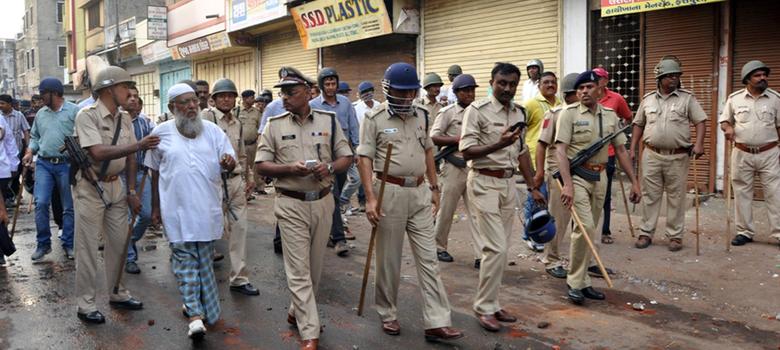
Courtesy: IANS
The recent carnage in Gujarat — some call it genocide — has been well–documented, thanks to an alert media and the dedication and diligence with which some citizen groups and NGOs have gone about the job of exposing the administrative atrophy and the collusion of the law and order machinery with a partisan political leadership. Their contribution in highlighting the criminal negligence of the police and magistracy in handling one of the worst communal episodes in the country as well as their alleged collusion with their political bosses in furthering their diabolical sectarian agenda, is undoubtedly an act of great courage and of immense value.
It is also, in a different sense, a tribute to the strength and vibrancy of the secular tradition that thankfully still runs deep in Indian society as a whole, not excluding a vast majority of Hindus. Admittedly, there has been a major ideological shift to the right in Indian society, especially in the northern and western states in recent years, in the wake of the empowerment of sundry outfits of the sangh parivar, as a sequel to the BJP’s ascendancy to power. In consequence, a certain enfeeblement of the secular sentiment has taken place because of determined and calculated assaults by the Hindutva proponents, against communal harmony and the composite nature of Indian culture.
What is even more dangerous is that such intolerance and anti–minority biases are no longer confined to the uninformed and ignorant segments of the people; they have seriously undermined the secular belief systems of a large number of the well-educated and well–to–do middle classes. Considering all these factors, it is highly creditable that Indian civil society still retains enough fire and sparkle to be able to rouse the collective conscience of the nation so as to effectively challenge the forces of obscurantism, intolerance, atavism and communal hatred that triggered the recent Gujarat happenings.
In the event, the horrendous designs and goals of the current rulers in Gujarat stand discredited and stalled, at least for the present. However the issues of police and magisterial collusion with the politicians in such matters and their failure to implement the law of the land in the process are equally alarming and need to be examined in some depth.
That the Indian police have, by and large, lost their credibility with the minorities is no longer a matter of opinion. The fast spreading virus of communalism in the force is a stark reality, which has troubled well-meaning members of the service now for several decades. The matter has engaged the attention of police leaders for long and has been debated at length in umpteen in-house meetings, seminars and conferences. It has also been written about and projected in the media ad infinitum.
Commission after inquiry commission has provided ample evidence of the increasing deterioration of the force in many different ways. It is not as if the political classes are unaware of the inherent vulnerabilities of the Indian police as constituted under the Indian Police Act of 1861 that make it open to misuse and manipulation by the State, which really means, in the current situation, the political party holding office. No political party for the last several decades has made any effort to restore to the police and magistracy some measure of functional autonomy so that they are able to uphold the rule of law and provisions of the Constitution. The sad fact is that no political party is averse to using this coercive instrument of state power in advancing its own selfish interests and political agendas, hidden or otherwise.
As late as mid–April this year, the parliamentary standing committee in the ministry of home affairs castigated the Gujarat police in severe terms for its partisan role in handling the communal frenzy in that state. It asserted in very clear terms that the police all over the country are “politicised and politically polarised.” It described the police as a “pawn in the hands of its [political] masters.”
The committee further asserted that policemen consider political “patronage essential for their survival… and police personnel are found to be divided in camps having distinct political leanings” and that this connivance of the police with the powers that be is giving rise to cynicism among people… “These are, by all means, very dangerous signs for the continuance and survival of democracy.” Recommending the preparation of a blue print for a “model police force” to be followed by all states, the committee impressed upon the home ministry to “make earnest efforts to depoliticise the institution of police before it becomes too late to retrieve it from the morass of degeneration.”
It is interesting to note that the committee that made such profound observations was presided over by the veteran Congress leader Pranab Mukherjee. Unless he was suffering from temporary dementia, surely the suave Mukherjee could not have forgotten the reign of terror let loose on the Sikhs in Delhi and many other Congress–ruled states in October-November 1984, when the police stood by and watched hundreds of Sikh men and women being murdered in cold blood and according to a plan hatched by his own senior colleagues.
Not one of those police officials, including some IPS officers, indicted by several official and non–official committees, was disciplined or so much as superseded. His party government adopted the same lackadaisical attitude to guilty police officers in the Mumbai riots in 1992–93, or earlier in Meerut. The latter case, in fact, is an interesting study in itself. Although indicted in no uncertain terms by an eminent commission of inquiry for shooting down dozens of Muslim men and dumping the dead bodies in a canal, the impugned PAC personnel could never be brought to justice because of want of government sanction to prosecute them.
The Congress party, which has been in power at the Centre and in the states for much longer than others, must also take the major part of the blame for failing to effect structural and operational reforms in the police and its law–enforcement procedures, in tune with the new constitutional and other imperatives.
During that period, UP was ruled by all political parties at some time or the other — the Congress, BJP, BSP and the Samajwadi Party of the wrestler–turned–political leader Mulayam Singh Yadav. One need not labour too hard to expose the hypocrisy and pretensions of Indian politicians, for they are in evidence at every single moment in some part of the country or the other.
The Congress party, which has been in power at the Centre and in the states for much longer than others must also take the major part of the blame for failing to effect structural and operational reforms in the police and its law–enforcement procedures, in tune with the new constitutional and other imperatives.
It is incredible but true that the Indian police continues to function under a legal framework that dates back to the mid–nineteenth century. The Indian Police Act that governs the police in India and indeed in the whole of South Asia except Pakistan, was enacted in 1861, the Indian Penal Code in 1862 and the Indian Evidence Act in 1872. Most other laws that the police are expected to enforce also belong to the 19th century.
It is not that the urgency for updating the law–enforcement organs of the State has not been underlined again and again by expert bodies, police and administrative commissions and many other forums over the years, including the national police commission [NPC], state police commissions, administrative reforms commissions and any number of inquiry commissions. Even the Supreme Court and the National Human Rights Commission are on record for having stressed the need for urgent and meaningful police reforms.
That the Indian political classes have continued to turn a blind eye to this most important subject is not because they are unaware of the total decay of the system in recent decades but because they are loath to lose this servile and obedient instrument of oppression that can be manipulated to serve their partisan interests in a most effective manner, not unlike their imperial predecessors.
The question that worries the concerned citizens of the country is why do Indian cops refuse to change with the times and why do they continue to behave in the same high–handed and insensitive manner as during the colonial era. These are by no means vacuous worries and are perfectly justified. However, in the absence of substantive reforms to update the legal architecture that governs our police and taking it out of the control of politicians, no worthwhile change can be foreseen.
One need only go through section 23 of the Indian Police Act, 1861, to realize that under the law, Indian police have no commitment to or concern with accountability to the community or earning their support. As against this, out of nine principles of conduct that govern the British police and which serve as their mool mantra right from the time a recruit joins the force, as many as seven deal with community participation and support.
Archived from Communalism Combat, September 2002, Anniversary Issue (9th), Year 9 No. 80, Partisan police
The genocide in Gujarat, as well as the earlier communal riots, have taught a painful lesson to Muslim women that the secular and women’s rights voices are too distant from their harrowing realities
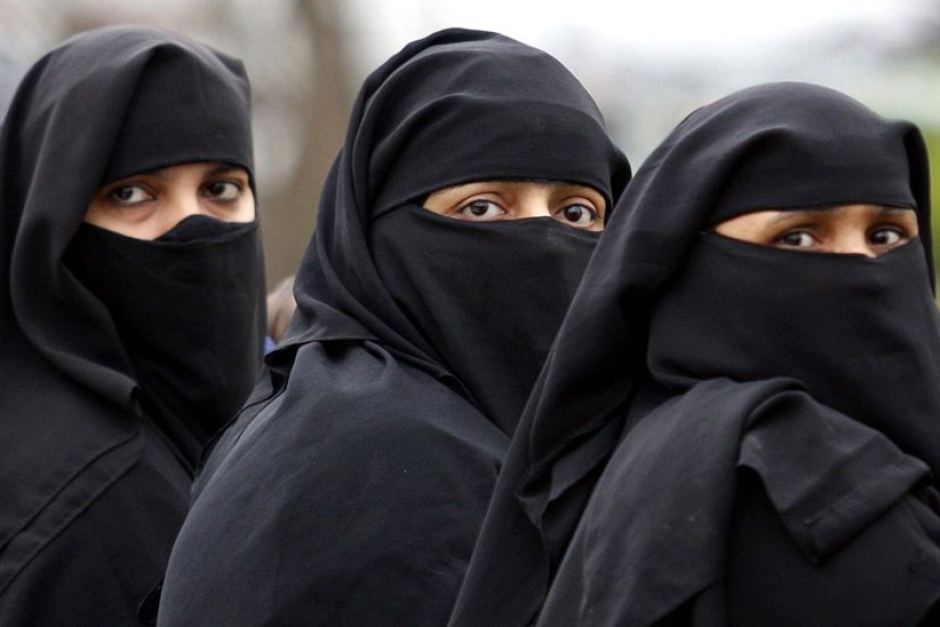
Courtesy: Amit Dave: Reuters
If Black people had accepted a status of economic and political inferiority, the mob murders would probably have subsided. But because vast numbers of ex–slaves refused to discard their dreams of progress, more than ten thousand lynchings occurred… Whoever challenged the racial hierarchy was marked a potential victim of the mob. The endless roster of the dead came to include every sort of insurgent — from the owners of successful Black business… to those who refused to be called ‘boy’ and the defiant women who resisted white men’s sexual abuses. Yet public opinion had been captured and it was taken for granted that lynching was a just response to the barbarous sexual crimes against white womanhood. And an important question remained unasked: What about the numerous women who were lynched – and sometimes raped before they were killed by the mob.
— Angela Davis1
My heart is sickened, my soul wearied, my shoulders aching with the burdens of guilt and shame… I force myself to write a small fraction of all that I heard and saw, because it is important that we all know…What can you say about a woman, eight months pregnant who begged to be spared. Her assailants instead slit open her stomach, pulled out her foetus and slaughtered it before her eyes?…What can you say?… I have never known a riot which has used the sexual subjugation of women so widely as an instrument of violence as in the recent mass barbarity in Gujarat. There are reports everywhere of gang rape, of young girls and women… followed by their murder by burning alive, or by bludgeoning with a hammer and in one case with a screw driver.
— Harsh Mander2
Two different cultural divides, one of race, the other of religion, situated within two great democracies of our times. Both ensure equality before law and equal protection of law and proclaim non–discrimination on the grounds of race, caste, sex, and religion. The conjunctures and parities in the way the language of rights unfolds within them is the focus of this essay.
The vocal, visible and highly articulate women’s movements in both countries, the United States and India, have contextualised gender concerns and examined the overarching influence of patriarchy upon the lives of women. State interventions have been invoked through sustained campaigns to release women from its clutches. But how has this articulation addressed concerns of women who are at the margin of social boundaries, whose reality is marked not only by patriarchal dominations but also by racial, religious and caste prejudices?
Within a hierarchy of social relationships, gender concerns are articulated from the context of the mainstream — for India, it is the Hindu woman and for the West, the White woman. A slogan coined by women of colour in the US succinctly captures this reality: All women are White, All Blacks are men… but some of us are brave.
What is worse, even when gender concerns of the marginalised women hit the headlines, they do so primarily to strengthen the prevailing stereotypical biases against the community at large. Rather than the explicit pro–women concern, what gets foregrounded is the anti-community undertone. No other example can better serve to explain this, than the Shahbano controversy.
The controversy arose out of a Supreme Court ruling in 19853 which upheld the right of a divorced Muslim woman for maintenance. The adverse comments in the ruling against the Prophet and Islam led to a backlash and a demand for separate statute based on Islamic jurisprudence. The then Congress government gave in to the pressure exerted by the Muslim fundamentalist lobby and enacted the Muslim Women’s Act in 1986. But over time, this statute, advertently or inadvertently, bestowed upon Muslim women, a superior economic right than the one enshrined in S.125 CrPC. But despite this, for well over a decade, the statute enacted amidst protest from human rights and women’s groups, was viewed as a marker of ‘Muslim appeasement’ and a defeat of secular principles within the Indian polity.
The denial of rights of a meagre maintenance dole was lamented by all and sundry, notwithstanding the fact that the maintenance awarded to the wife of an advocate with a flourishing practice was just Rs.25 in the first instance and Rs.179 upon appeal. So long as the debate could be used as a stick to beat the community with, these minor details didn’t seem to matter. What did matter is the fact that a communal campaign could be mounted upon a patriarchal paradigm and thereby legitimised. The irony lay in the fact that the groundwork for mounting this campaign was laid by the women’s movement, with genuine gender concerns, but firmly located within the cultural ethos of the mainstream. Within this framework, a similar appeasement of Hindus, by strengthening coparcenaries4 by various legislative measures went unnoticed.
Even when gender concerns of the marginalised women hit the headlines, they do so primarily to strengthen the prevailing stereotypical biases against the community at large. Rather than the explicit pro-women concern, what gets foregrounded is the anti-community undertone.
The communal fervour could be sustained only by denying the fact that the Act provided for an alternate remedy, far superior to the one that had been denied to Muslim women; by negating the fact that since 1988, the Act was being positively interpreted by various High Courts in the country by awarding substantial amounts as ‘settlements’; by glossing over an important development in the realm of family law, that of determination of economic entitlements upon divorce, rather than the prevailing right of recurring maintenance.
So even while homes of poor Muslim women were looted, gutted and razed to the ground in various communal riots which broke out in the country in the post-Shahbano phase, while teenage sons of Muslim women were killed at point blank range in police firings, while Muslim women were raped under floodlights in post-Babri Masjid riots, the mainstream continued to lament over ‘Muslim appeasement’ and denial of maintenance to ‘poor Muslim women / the Shahbanos’.
One could overlook even this. Perhaps there was a justification. Denial of maintenance by husbands was as loathsome as rape of women in communal riots. In the ultimate analysis, it was the Muslim woman who suffered. So far so good. But how can one logically explain the recurring motif of ‘Muslim appeasement’ even after the Supreme Court decision in the Danial Latifi5 case, when the controversy was finally laid to rest by upholding the Constitutional validity of the Act? Yet, the rhetoric continues.
The symbolism becomes even starker, when one is confronted with the gruesome sexual violations of women during the recent Gujarat carnage. While exploring possible legal portals to place these blood–curdling barbarities, one hits a dead end at each turn. As one hears the narratives of young women, running helter-skelter, slipping, falling and becoming prey to the marauding mobs, their violated and mutilated bodies being thrown into open fires, the question keeps haunting: where and how does one pin the culpability?
When violence of this scale supersedes the parameters of criminal jurisprudence which is bound by conventions of proof and evidence, medical examinations and forensic reports, when criminal prosecution itself is a closed-end process in the hands of the state machinery, what legal measures can be invoked to bring justice to the dead and the surviving? But the danger at the other end, if these violations do not form part of ‘official records’ they can be conveniently negated as NGO exaggerations or normalised as routine occurrences as our defence minister, George Fernandes did, on the floor of the Lok Sabha during the marathon debate on Gujarat.
The official discourse is geared towards denial. Uma Bharati, the woman minister of the NDA government, (who had cheered and goaded the crowd while the Babri Masjid was being demolished) asked in feigned disbelief, “Who is she whose stomach was slit and foetus taken out? No one has heard of this woman. She is a fiction created by the media.”
A further report by another statutory body, instituted presumably for the protection of women, the National Commission for Women, continued with this denial mode. In a cursory report, brought out after the commission’s whirlwind tour of the riot torn state forty days after violence broke out, it gave no details of sexual violence on the pretext that media and fact–finding teams had already done so. A member of the team, ironically a former women’s movement activist, further trivialised this through a newspaper report, by stating that only three women admitted to being raped. A cultural argument was advanced that Indian, subcontinental and even Asian women are reluctant to admit rape as it may result in abandonment. Within this cultural reality, should women be forced to share their experiences, she wondered.
The entire logic and rationality of the anti–rape movement gets turned on its head here. The catalyst for that inspired campaign of the ’80s was an isolated incidence of rape by state functionaries. The author of the article was one of the signatories to the open letter to the chief justice to reopen the case. It was this open letter, which turned Mathura into an icon of the movement. One wonders whether permission of this poor, orphan, rural, tribal young woman was ever sought before writing off the open letter. Mathura, Maya Tyagi, Rameezabi, Suman Rani, Banwari Devi, Kuntaben — all individual cases. Here the numbers did not matter. Each isolated incident was sufficient to trigger a national campaign for law reform. But when it comes to state complacency in communal carnage, when sadistic gang rapes and brutal sexual violations are buried under a more grievous and yet, more acceptable crime of murder, one tends to resort to a game of numbers. How many more young girls’ vaginas need to be slit open, how many more rods need to be inserted into as yet unformed uteruses, how many more foetus’ have to be gorged out of the bellies of pregnant women, for the state administration to take serious note of the scale of sexual violence on minority women?
The genocide in Gujarat, as well as the earlier communal riots, have taught a painful lesson to Muslim women — that when threatened with a life and death situation, in the face of blood–thirsty and sexually debased mobs, mosques, dargahs and madrassas are transformed into an oasis of security and solace. The secular and women’s rights voices are too distant from their harrowing realities.
The genocide in Gujarat (as well as the earlier communal riots) have taught a painful lesson to Muslim women — that when threatened with a life and death situation, in the face of blood–thirsty and sexually debased mobs, mosques, dargahs and madrassas are transformed into an oasis of security and solace. The secular and women’s rights voices are too distant from their harrowing realities. Communal and patriarchal identities get forged.
Women in relief camps narrated incidents of camp organisers helping out, not only with arrangements of food and first aid, but also with cleansing bleeding wounds on private parts and extracting wooden splinters buried into the deepest crevices. While women gave birth in the open in those traumatic days, they were forced to help in the birthing process. Before government aid could be accessed, hungry children were fed only through hurriedly put together community resources. Women partook in the festivity of marriage celebrations of young orphaned girls, arranged by camp leaders. They cried out, when the men were picked up in combing operations and bore the brunt of police brutalities. The bonding between people under siege is cemented through the adhesive of shared fears and sufferings. In the struggle for day–to–day survival, gender concerns and patriarchal oppressions seem remote, which in the long run will weaken the fight against patriarchy.
How should concerned groups within civil society respond to this social and political reality? When the moral basis for the rights itself shifts, where can one start the process of renegotiating and reframing the covenant of equality and equal protection? What are the myriad ways in which the seemingly innocuous laws get unfolded within the complex terrain of social hierarchies? These are difficult questions.
Angela Davis is perhaps one of the first scholars to raise some of these difficult questions. She explains how the hard won abortion right of the White women’s movement became a draconian measure of state-sponsored genocide for women of colour. Within a racially tinted population policy of the US government, involuntary sterilisations were used for mass birth control of black and coloured and Native American women. In her own words:
“It was not until the media decided that the casual sterilization of two Black girls… was a scandal worth reporting that the Pandora’s box of sterilisation abuse was finally flung open. But by the time the case of the Relf sisters broke, it was practically too late. It was the summer of 1973 and the Supreme Court decision legalising abortions had already been announced in January. Nevertheless, the urgent need for mass opposition to sterilisation abuse became tragically clear. The facts surrounding the Relf sisters’ story were horrifyingly simple. (The sisters) aged twelve and fourteen had been unsuspectingly carted into an operating room, where surgeons irrevocably robbed them of their capacity to bear children.”6
By 1976, 24% of all Native American women of childbearing age had been sterilised. A Choctaw physician told the senate: Our bloodlines are being stopped…Our unborn will not be born… This is genocidal to our people.7
Picking up cudgels with the anti-rape movement, she explains that the myth of the Black rapist is located within insidious racist ideology and women of colour, for their own survival, had to stick with their men to explode the myth. Susan Brownmiller’s8 discussion on rape and race evinces an unthinking partisanship which borders on racism:
“Given the central role played by the fictional Black rapist in the shaping of post-slavery racism, it is, at best, irresponsible theorizing to represent Black men as the most frequent authors of sexual violence. … (It) is an aggression against Black people as a whole, for the mythical rapist implies the mythical whore. Perceiving the rape charge as an attack against the entire Black community, Black women were quick to assume the leadership of the anti-lynching movement.9
The historical knot binding Black women — systematically abused and violated by White men — to Black men — maimed and murdered because of racial manipulation of the rape charge — has not been adequately analysed by feminist theorists during the anti–rape movement in the US, she laments.
Covenants of equality and equal protection may unfold diagonally opposite trajectories for the mainstream and the marginalised. Within the Western women’s movement, several Black feminist scholars, Martha Fineman, Patricia Williams, Toni Morrison, to name a few, have challenged the theories advocated by a predominantly White women’s movement and have attempted to rewrite the covenants of equality and equal protection, within the alchemy of Race and Rights.
The women’s movement in India has continued in its scholarship primarily within the ethos of the mainstream, though there are some tentative formulations, which are yet to be evolved into complex feminist theories. The challenge for the feminist legal scholarship in India is to develop a new praxis within which the covenants of equality and equal protection can be rewritten in the context of the marginalised.
Footnotes
1 Women Race & Class Vintage (1983) p.190-1.
2 ‘Cry My Beloved Country’, The Times of India, March 20, 2002.
3 Mohd Ahmed Khan vs. Shahbano Begam, AIR 1985 SC 945.
4 Coparcenary is the term used for Hindu Undivided Family (HUF) properties within which inheritance rights are confined to male heirs.
5 II (2001) DMC 714 (SC).
6 Supra n.1 at p.216.
7 Ibid p.218.
8 Against Our Will, Men, Women and Rape Penguin (1975).
9 Supra n.1 p.191.
Join our mailing list to get the latest human rights news that matters, straight to your mailbox.
Join our mailing list to get the latest human rights news that matters, straight to your mailbox.