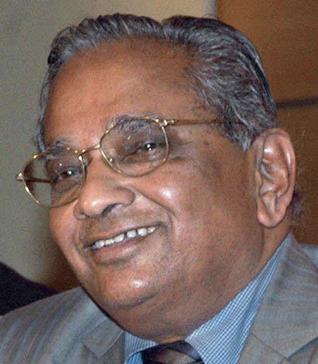
On May 10, Kaifi Azmi, poet, activist, lyricist, communist, breathed his last. For a fitting tribute to this ‘last pillar’ of Urdu poetry, ‘the last among the revolutionary poets’, we could think of none better than his daughter who has never needed to look further than Abba’s soul–stirring nazms, ‘Makaan’, ‘Aurat’ and ‘Bahroopni’ to inspire her struggles for the urban poor, gender justice and communal amity
He was always different, a fact that didn’t sit too easily on my young shoulders. He didn’t go to ‘office’ or wear the normal trousers and shirt like other ‘respectable’ fathers but chose to wear a white cotton kurta–pyjama 24 hours of the day. He did not speak English and worse still, I didn’t call him ‘Daddy’ like other children, but some strange sounding ‘Abba’! I learned very quickly to avoid referring to him in front of my school friends and lied that he did some vague ‘business’! Imagine letting my school friends know that he was a poet. What on earth did that mean — a euphemism for someone who did no work?
Being my parent’s child was for me, unconventional in every way. My school required that both parents speak English. Since neither Abba nor mummy did, I faked my entry into school. Sultana Jafri, Ali Sardar Jafri’s wife, pretended to be my mother and Munish Narayan Saxena, a friend of Abba’s, pretended to be my father.
Once in the 10th Std, my vice principal called me and said that she’d heard my father at a recent mushaira and he looked quite different from the gentleman who had come in the morning for Parents’ Day! Understandably I went completely blue in the face and said: "Oh, he’s been suffering from typhoid and has lost a lot of weight, you know… and made up some sort of story to save my skin!
It was no longer possible to keep Abba in the closet. He had started writing lyrics for films and one day a friend of mine said that her father had read my father’s name in the newspaper. That did it! I owned him up at once! Of all the 40 children in my class, only my father’s name had appeared in the newspaper! I perceived his being "different" as a virtue for the first time. I need no longer feel apologetic about his wearing a kurta–pyjama!
In fact, I even brought out the black doll he had bought me. I didn’t want it when he first gave it to me. I wanted a blonde doll with blue eyes, like all the others had in my class. But he explained, in that quiet gentle way of his, that black was beautiful, too, and I must learn to be proud of my doll. It didn’t make sense to my 7–year–old mind but I had accepted him as ‘weird’ in any case and so I quietly hid the doll.
Three years later, I pulled it out as proof that I was a ‘different’ daughter of a ‘different’ father! In fact, I now displayed it with such new found confidence that instead of being sniggered at by my classmates, I became an object of envy! That was the first lesson he taught me, of turning what is perceived as a disadvantage into a scoring point.
The atmosphere at home was completely bohemian. Till I was 9–years–old we lived at Red Flat Hall of the communist party. Each comrade’s family had just one room; the bathroom and lavatory were common. Being party members had re–defined the husband–wife relationship of the whole group. Most wives were working and it became the responsibility of whichever parent was at home, to look after the child. My mother was touring quite a lot with Prithvi Theatres and in her absence Abba would feed, bath and look after both my brother Baba and me, as a matter of course.
In the beginning mummy had to take up a job because all the money Abba earned was handed over to the communist party. He was allowed to keep only Rs. 40 per month which was hardly enough for a family of four. But later when we were monetarily better off and had moved to Janki Kutir, mummy continued to work, in the theatre because she loved being an actress.
Once, she was to participate in the Maharashtra State Competition in the title role of ‘Puglee’. She was completely consumed by the part and would suddenly, without warning, launch into her lines in front of the dhobhi, cook etc. I was convinced she’d gone mad and started weeping with fright. Abba dropped his work and took me for a long walk on the beach. He explained that mummy had very little time to rehearse her part and that as family it was our duty to make it possible for her to rehearse her lines as many times as she needed to or else she wouldn’t win the competition — all this to a 9 year old child. It made me feel very adult and very included. To this day, whenever my mother is acting in a new play or new film, my father sits up with her and rehearses her cues.
She participates in his life equally; at a price of course! She fell in love with him because he was a poet. However, she learned soon enough that a poet is essentially a man of the people and she would have to share him with his countless admirers (a large number of them female!) and friends. When I was about 9–years–old, I remember an evening at a big industrialist’s home. His wife, a typical socialite, announced in a rather flirtatious manner, "Kaifi Saheb my usual farmaish — the Do Nigahon Ka something, something – you know folks, Kaifi Saheb has written this ‘nazm’ in praise of me"… And Abba, without batting an eyelid, started reciting this poem which was in fact written for my mother.
I got completely hysterical and started screaming that the poem was written for my mother and not for this stupid woman. A deathly silence prevailed and my mother said, "Hush child, hush." She took me into a corner and said that I wasn’t to take such things to heart – after all ‘Abba’ was a poet and such were his ways; he didn’t seriously mean that the poem was written for this lady etc. I would hear nothing of it. Needless to say, that was a poem Kaifi Azmi could never use again and that woman still hates me!
Amongst his female friends Begum Akhtar was my favourite. She would sometimes stay with us as a houseguest. In fact Josh Malihabadi, Firaq Gorakhpuri and Faiz Ahmed Faiz would stay with us, too, despite there being no separate guest room, not even an attached bathroom. Luxury was never the central concern of these artists; they preferred the warmth of our tiny home to the 5–star comforts available to them.
I was fascinated by these mehfils at home. I would sit up in rapt attention, not even half understanding what they recited, but excited nevertheless. Their beautiful words fell like music on my young ears. I found the atmosphere fascinating — the steady flow of conversation, the tinkering of glasses, the smoke-filled room. I was never rushed off to bed; in fact I was encouraged to hang around, provided I took the responsibility for getting up in time for school the next day. It made me feel very grown up and included.
Soon I started attending mushairas — Sahir Ludhianvi was popular, Ali Sardar Jafri greatly respected, but Kaifi Azmi had a different magic. He was always amongst the last to recite — his deeply resonant voice pulsating with vigour, drama and power. Baba and I used to be fast asleep on the stage, behind the gao–takiyas and would invariably wake up to the thunderous applause that resonated each time his name was announced.
I never saw him either surprised or flattered by the applause. In fact, to my mother’s despair, he would never come home and tell her how the mushaira went. A non–committal ‘theek tha’ was all she could extract from him. Years later when I was about eighteen, I remember prodding him to tell me which ‘nazm’ he had recited and what the audience response was like. My mother said briefly, "Don’t even try, he’s not going to tell you. Over the years I have trained myself to bury my curiosity in a newspaper when Kaifi comes back from a mushaira."
I would have none of that — I sat across Abba’s chest and tickled him pink till he said, "Only small people indulge in self-praise; the day I do badly, rest assured I’ll come and tell you."
He has never treated his work as special. Even when he came back from a song recording, he never brought the cassette back home. A far cry from young lyricists today, who subject all their guests to their latest song, goading them to say, ‘wah-wah’! He never actually puts pen to paper till the night of the deadline. Then there is a furious cleaning of drawers, numerous letters that get replied to, a number of inconsequential things that get attended to. I’m sure the creative process is occurring simultaneous to the radio blaring, children laughing, children’s friends over, ‘taash’ going on in the house.
The family is never expected to hush up because he is writing — in fact the door of his study is always open so he can keep in touch with the outside world as well. I once changed the position of his desk away from the door because I felt he needed greater privacy. Mummy protested he would hate it. Came evening time and predictably Abba had made her change it back to the original position.
He writes only with a Mont Blanc pen and has a huge collection of them. Every now and again, he takes them all out, looks at them lovingly and then puts them back under lock and key. When a friend of mine presented me one, Abba pinched it although he possessed three identical ones and wrote my friend a ‘cute’ letter giving reasons why the pen was safer with him than with me!
He is very fond of good food and cannot eat a meal without ‘gosht’. He’s hugely ‘superior’ about being a UPite and will not condescend to eat Hyderabadi food, even though mummy has tried to cajole him over the 52 years they’ve been married! Each time we eat khatti dal, a separate arhar ki dal is cooked for him. And woe betide the person who unmindfully picks up the khatti dal ka spoon to serve him his arhar ki dal!
There is much that he and Javed have in common — both have a strong sense of propriety, are extremely takkaluf-pasand and cannot brook mediocrity. Both are hugely political animals. I used to deliberately stay away from politics and pride myself on not reading the newspaper as a reaction against all the politics that were discussed constantly in the house. But when I got involved with Javed and heard him and Abba have their discussions, (I used to listen from a distance) I gradually started taking a deeper interest. In discovering Javed I was rediscovering Abba, getting in touch once again with Urdu poetry and passionate politics, realizing how deep into my father’s ways, my roots were.
When I opened my eyes to the world, the first colour I saw was red. My parents were living at the Red Flag Hall and a huge red flag used to greet visitors at the entrance. It was only later that I realized that red was the colour of the worker, of revolution. My childhood was spent travelling with my mother’s Prithvi Theatre on one hand, and mazdoor–kisan meetings in Madanpura with my father. There used to be red banners everywhere, a lot of naare-bazi and a lot of protest poetry. As a child I was only interested in these rallies because the mazdoors pampered me.
Imperceptibly however, my roots were catching soil. Today when I’m at a demonstration, participating in a padyatra or in a hunger strike, it is merely an extension of what I saw happening as a child. On the fourth day of my hunger strike years ago in Mumbai for the housing rights of slum dwellers, my blood pressure started falling and my mother was beside herself with fear. But Abba, who was in Patna, sent me a telegram saying, ‘Best of luck, comrade!’
Again, on the eve of leaving for a padyatra for communal harmony from Delhi to Meerut years ago, I went to say good–bye to the family. I was nervous and uncertain. I had been amply warned that it was very dangerous for an actress to be roaming the streets of UP — my clothes would be ripped off, stones would be thrown, etc. The whole family was reflecting the tension.
Mummy, Baba, his wife Tanvi and Javed were all hovering around me but not saying a word. I walked into Abba’s room and hugged him from behind. He pulled me up in front of him and said, "Arre, is my brave daughter getting scared? Go, nothing will happen to you." His eyes were completely fearless. It was as though a fresh burst of oxygen had been pumped into my blood–stream. Needless to add, the padyatra was a big success. It was yet another instance of my having relied on his judgement and passing the test with flying colours.
As a father, I have always taken Abba for granted, but as a poet I continue to be overwhelmed by his work. I cannot claim to know or even understand all his work but I find his poetry striking for its strong imagery, its sheer power and its broadness of vision. His most personal problem transcends itself in a much larger vision so that his struggle no longer remains his own, but becomes the struggle of all human beings. Whether its my work with slum dwellers or women or against communalism, there’s always a nazm of Abba’s to guide me, to inspire me to carry on the struggle. Thus ‘Makaan’, ‘Aurat’ and ‘Bahroopni’ have become the pillars on which rests my work.
He is one of the few who has practiced what he preaches. There is no dichotomy between word and action. I have grown up believing that merely good intentions are not enough — you have to translate them into action.
It is impossible to arrive at any understanding of Kaifi Azmi, unless you include his work for Mijwan, the tiny village in Azamgarh where he was born and has now decided to spend the rest of his life. Abba, who had left Mijwan in his teens, returned briefly to it when he married mummy and had his first child (a son who died at the age of one). Soon after partition his family migrated to Pakistan one by one and he felt his roots in Mijwan had been severed forever.
However, in 1973, upon partially recovering from his brain haemorrhage, his left side still severely damaged, he started chanting the name ‘Mijwan’ with such persistence that my mother was forced to take him there. It turned out to be an amazing trip for him. He realized that Mijwan was and would always remain the place where he belonged. The house he was born in was occupied by various distant cousins and it would have been unfair to throw them out (the communist theory of the tiller owning the land).
(The people of Mijwan will for long remember Kaifi Azmi for the total transformation that he brought into their life in a short span of 15-20 years. While there was nothing before, the village today has a pucca approach road, electricity and telephone connections, a school and a computer centre for girls and a junior college).
…and grief
(June 10, 2002 )
I look out of the window from Abba’s room. The sky is blue, the grass green, flowers in bloom. I turn back to look inside the room. Books lined neatly on the shelves. His spectacles, writing pad, Mont Blanc pen lie in wait for pen to be put to paper and new verse to flow… Everything is the way it was… but Abba is not there…
Anees Jung, in a letter of condolence to me writes, "I know what the loss of a parent means Shabana. I also know one never loses a parent. In a strange, mystical way they become closer in death, for their spirit no longer trapped in frail frame becomes all pervasive and surrounds us like the air we breathe." Comforting words no doubt but all I feel is insurmountable grief.
Abba was not only my father; he was my friend, my mentor, my guru. In the last few months of his illness, as he lay in the ICU with tubes down his stomach, throat and neck, he could not speak and yet we managed to communicate. He would raise his eyebrow, squeeze my hand, indicate with his eyes and I would understand. In the same way that I understand what our granddaughter Shakya wants, although she is not yet able to speak. Abba in any case was given to long silences. He spoke both through his words and through his silences…
He fell silent much before the tubes were physically put to him. The Gujarat carnage shattered him. I would watch him as he looked at television coverage, face frozen in pain. With tears streaming down my eyes I asked, "Don’t you feel frustrated and defeated as you see the mindless killings, the hateful revenge, man killing man in the name of religion?’’
He wiped my tears and said quietly, "When one is working for change, one should bring into that expectation the possibility that the change may not occur in one’s lifetime and yet one must carry on working towards it."
It was his faith, his belief in the innate goodness of man that kept him going through the darkest of times.
‘Pyar ka jashn nai tarah manana hoga/ Gam kisi dil mein sahi gam ko bhulana hoga’ (‘New ways must be found to celebrate love/Grief in whosever’s heart must be overcome).
In wiping the tears of the victims of the Gujarat carnage and thousands of others who have fallen prey to communal riots, in wiping the tears of slum dwellers constantly displaced by mindless government policies, in wiping the tears of all marginalised sections of society, particularly women, would I have also paid tribute to my father, a giant amongst men?
‘Koi to sood chukaye, koi to zimma le/Us inquilab ka jo aaj tak udhaar sa hai’ (‘If only some one would repay the loan, assume responsibility/for the revolution that until now appears like a debt’).
You envelope me like the air I breathe Abba. I promise to turn my personal loss into an armour like you have always done, and carry on with the work you left behind.
You are watching over us, aren’t you?
Archived from Communalism Combat, July 2002 Year 8 No. 79, Tribute