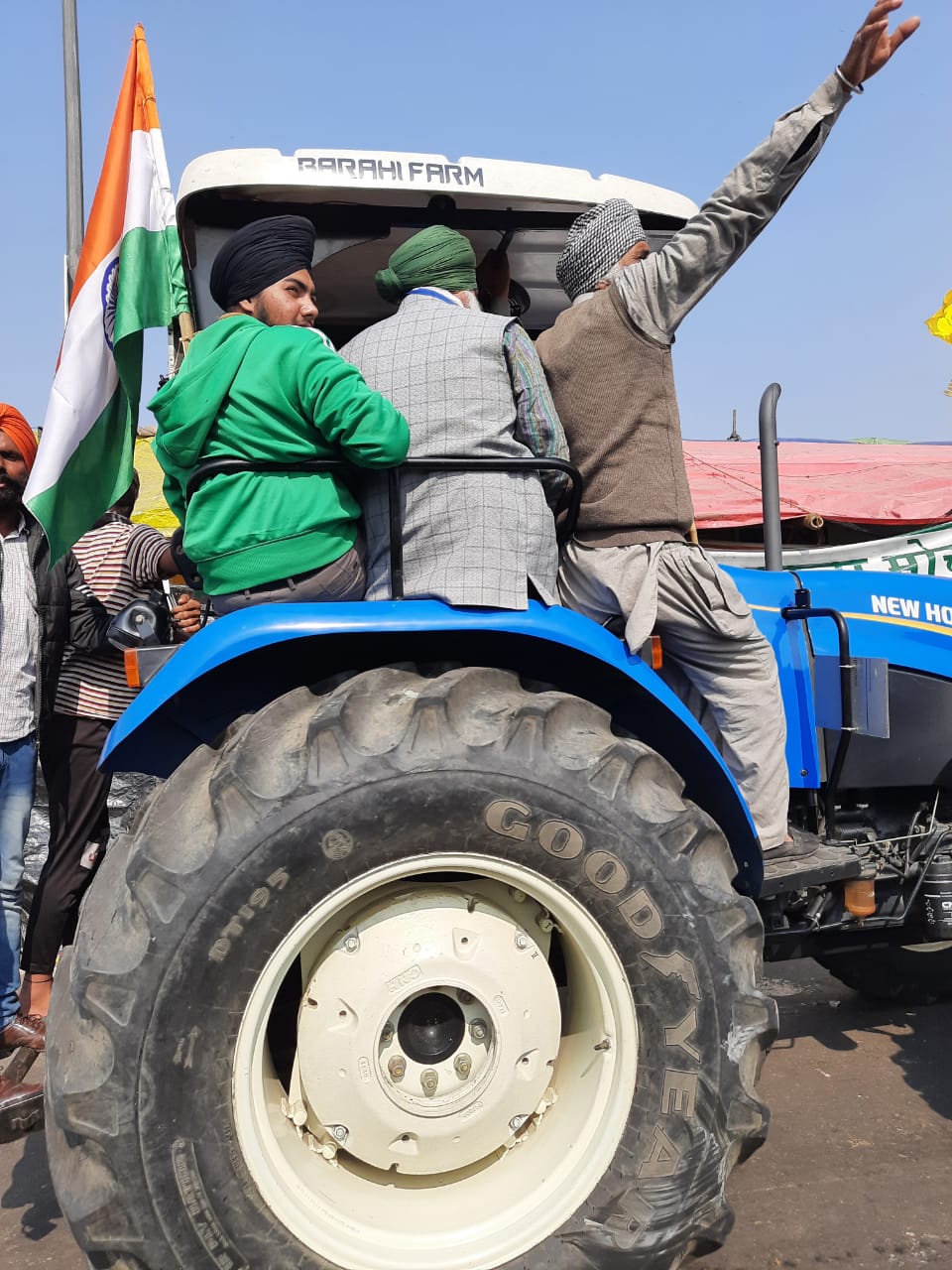
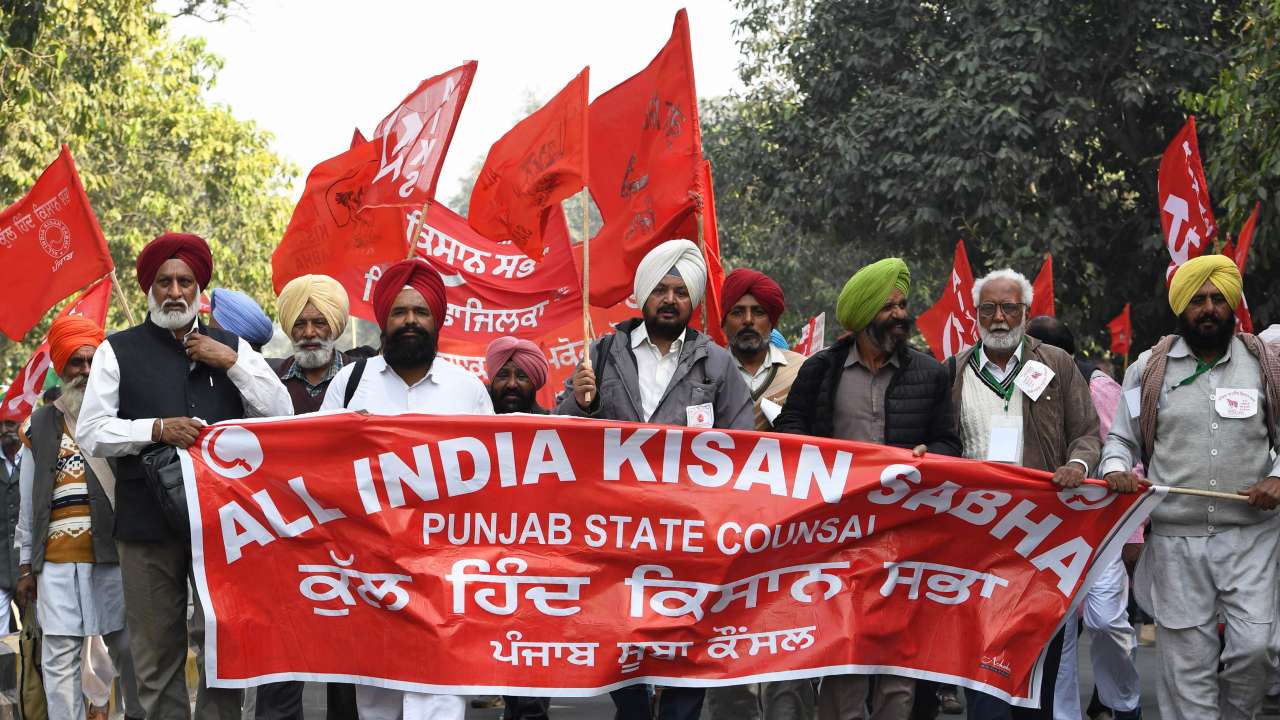
“I will hang from the stage but I will not leave the stage,” farmer leader Rakesh Tikait said, when he spoke to the hundreds of farmers who have been sitting on a peaceful protest at Ghazipur for over two months now. Late on January 28.,Tikait who has also been here at the protest said “attempts were being made to create violence, we were ready to talk, but they want to create trouble, the Police will be responsible if something happens.”
As shown on a live report by NDTV, Tikait said he will continue the sit-in protest, and even wait for drinking water to be brought. According to news reports Uttar Pradesh administration has also served a notice to Tikait and the protestors to vacate the spot, citing this is causing “public nuisance”. He had earlier said he would be available for discussions with the police and administration as a law abiding citizen, however things took a stressful turn when some officials reached the stage where the farmer leaders were speaking from urging supporters to stay calm and peaceful.
At the time of going to press, no arrests have been made yet, but according to multiple media sources, a police crackdown on the farmers protest at Ghazipur seems imminent. The CCTV cameras, water supply, food supply, have already been discontinued from the area, reported multiple media houses. According to reports, the Ghaziabad District Magistrate has also ordered all protesters at Ghazipur to vacate the spot else they are likely to be removed later at night.
Heavy police deployment was posted at the protest site since January 26, and it has now increased manifold, more barricades have been put up and buses have been lined up.
The Ghazipur border and the Delhi-Meerut highway has been sealed on one side since November 26, when the protest by farmers, demanding the repeal of the farm laws, began. After January 26 chaos, including the tear gas and confrontation at Akshardham crossing, less than 10 kilometers from the protest venue, security deployment was intensified. On January 28, security personnel also conducted a flag march at the Ghazipur border.
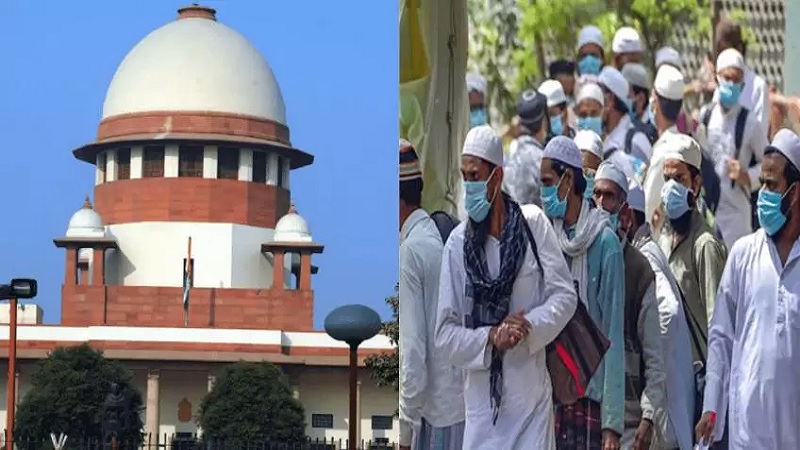
The Supreme Court has sought clarity from the Central Government about the powers under Cable TV Networks (Regulation) Act 1995 to control broadcast of content (by electronic media), that has a tendency to incite violence.
The top court was hearing a batch of petitions filed against several news reports allegedly responsible for communalisation of the Tablighi Jamaat gathering in 2020.
According to LiveLaw, a Bench led by Chief Justice SA Bobde said, “We aren’t concerned so much with what people are saying, people say anything these days. We are concerned with situations that may create violence and lead to loss of property and life.”
The petitioners have alleged that certain sections of the media used communal headlines and bigoted statements to demonise and blame the entire Muslim community of deliberately spreading the Coronavirus across the country, in the backdrop of the Tablighi Jamaat event in New Delhi, last year.
The CJI today asked the Central Government about its powers under the Cable TV Network Regulation Act and Program Code to prevent broadcast of inciteful content and threat to the law-and-order situation.
A couple of minutes into the hearing, the Solicitor General Tushar Mehta submitted that the Government can stop broadcast of objectionable content and he will bring on record the details of instances where the Government has exercised its powers under the Act. The SG said that there is a group under the Ministry to monitor broadcast content for violations of the Programme Code.
The top court Bench pointed out that there was ambiguity in section 19 of the Cable TV Act that lays down the power to prohibit transmission of certain programmes in public interest. The court desired to know if it would include a “broadcaster” or only a cable TV network.
The Bench observed that the amendment adding the definition of “broadcaster” in the Cable TV Act does not reflect in the penal provisions of Section 19 and 20, as reported by LiveLaw. The Solicitor General replied that he will look into the issue of ambiguity and will file an affidavit and they were given three weeks’ time to do the same.
In April, last year, the Supreme Court had asked the Central Government about the action taken against media outlets, under the Cable TV Network (Regulation) Act, 1995. In October, 2020, on the same matter, Chief Justice Bobde had slammed the Centre for its ‘extremely offensive and brazen’ affidavit.
The Chief Justice reportedly asked, “You cannot treat this court the way you are treating it. Some junior officer has filed the affidavit. Your affidavit is evasive and says the petitioner shows no instance of bad reporting. You may not agree but how can you say there is no instance of bad reporting shown?”
Further, in November, 2020 the court had expressed displeasure at the second affidavit filed by the Ministry too. “We are not satisfied with your affidavit. We had asked you to tell us what you have done under the Cable TV Act? There is no whisper about that in the affidavit. We must tell you that we are disappointed with the Union’s affidavit in these matters”, CJI reportedly said.
He reportedly asked, “We want to know the mechanism employed by you and this affidavit has nothing on it. Why should we refer to NBSA etc when you have the authority to look into it? If it does not exist, then you create an authority, else we will hand it over to an outside agency?”
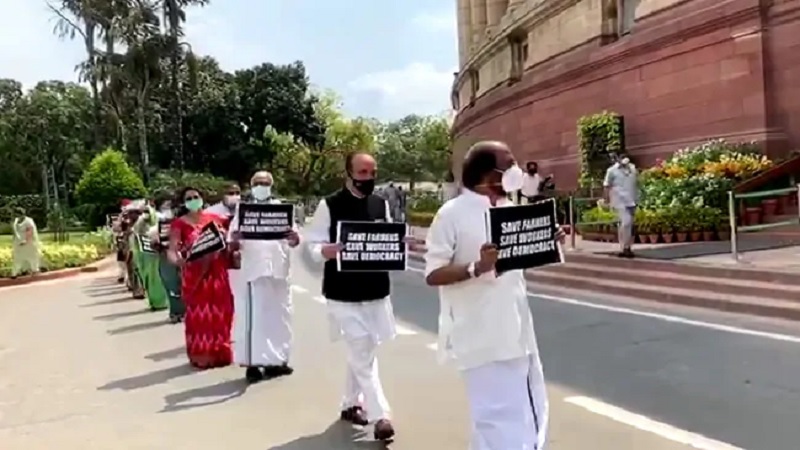
Making a massive political statement, 16 Opposition parties have decided to boycott President Ram Nath Kovind’s address to Parliament on January 29. The President is to address the joint sitting of both the Houses of Parliament when the Budget session begins, however, senior Congress leader Ghulam Nabi Azad has said his party along with 15 others will boycott it, in solidarity with the farmers protesting the new farm laws.
The Congress party & 15 other Opposition parties have decided to boycott the President’s address to Parliament on 29th Jan 2021 in solidarity with the farmers of India.
According to news reports, this is the second time that any such protest has happened during the Presidential address in Parliament. In January, 2020, the leaders of the opposition parties wore black armbands during the President’s address to both the houses, reported the National Herald. This was a mark of protest in the wake of the anti-CAA protests that were going on across the country at that time.
Now, the 16 Opposition parties have also demanded that a probe into the Centre’s role in violence on Republic Day in Delhi be conducted. According to news reports, the Congress, on Wednesday, had also held Union Home Minister Amit Shah responsible for the violence that was witnessed on Republic Day. They had demanded that he “be sacked immediately,” reported NH and the party had accused the “Modi government of being part of a concerted conspiracy to malign the farmers’ agitation by allowing some miscreants to enter the Red Fort complex and hoist a religious flag, in their bid to ensure that the farmers bury their demand for the repeal of the three new agri laws.”
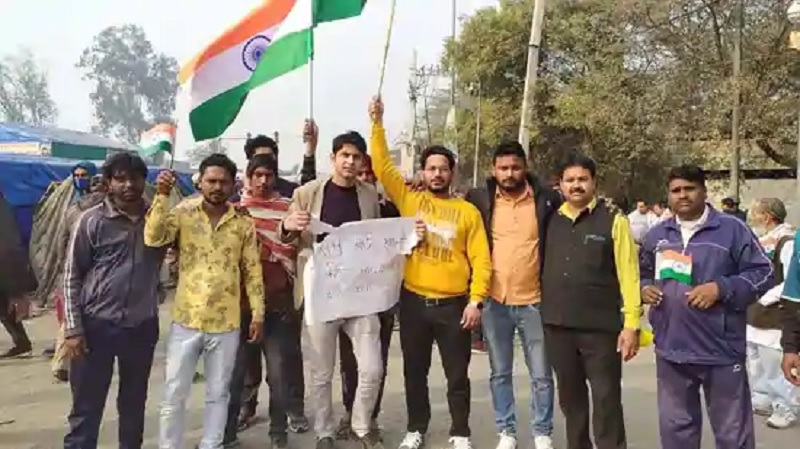
Chanting “Jai Sri Ram” and “Bharat Mata Ki Jai”, a group of people, who identified themselves as residents of villages in Narela and from near Singhu border held an anti-farmer rally on January 28. The group, with many members carrying the National Flag, has demanded that the protesting farmers “vacate Singhu border”.
They chanted slogans such as “India will not tolerate insults to the Tricolour”, which seems a reaction to the misinformation being spewed that the National Flag was removed or disrespected by farmers on January 26. It has already been reported by multiple news outlets and fact checkers that when hundreds of farmers reached the Red Fort on January 26, the Tricolour atop the fort continued to fly high as always. Some farmers hoisted a ‘kesari’ Sikh flag on another vacant pole at the Fort’s ramparts. The flag, hoisted by the farmer was the “Nishan Saheb” – a flag representing Sikh faith which was soon maliciously interpreted as a ‘Khalistani flag.’ Farmers were also seen unfurling the Indian national tricolour flag along with Kisan Ekta and Nishan Sahibs.
However, as the controversy continued for days, this group claiming to be local residents of nearby villages, along the Singhu border, say they have “given farmers a 24-hour ultimatum to vacate the place…” According to News24, these people are demanding that the road be emptied and that they will not tolerate that policemen were injured. “We were tolerating them for two months. But we will not tolerate them insulting the Tricolour”, said a resident who said he was from Narela (in Delhi). He added that if the farmers did not vacate in a day, people from 40 villages from Narela will descend on the farmers and “sort them out”.
This brings back chilling memories of a statement made by BJP leader Kapil Mishra in Jafrabad just before the February 2020 Delhi violence.
The angered mobs, which the reporter said included members of “some Hindu outfit”, said they are ready to take matters into their own hands if the farmers do not leave.
At midnight on January 27, news that the main power supply was cut off at the farmers protest site on the Ghazipur (Uttar Pradesh) – Delhi border filtered in on social media. Earlier on the same day, there had been an increased deployment of UP and Delhi Police as well as more central security forces at Ghazipur border. The blackout at midnight, however, has put the area on a higher alert now.
The street lights were an element of security on the road in the foggy winter nights, especially as many, including women and children would be asleep in the tents and tractor trolleys. The volunteers take turns to stay awake on guard duty.
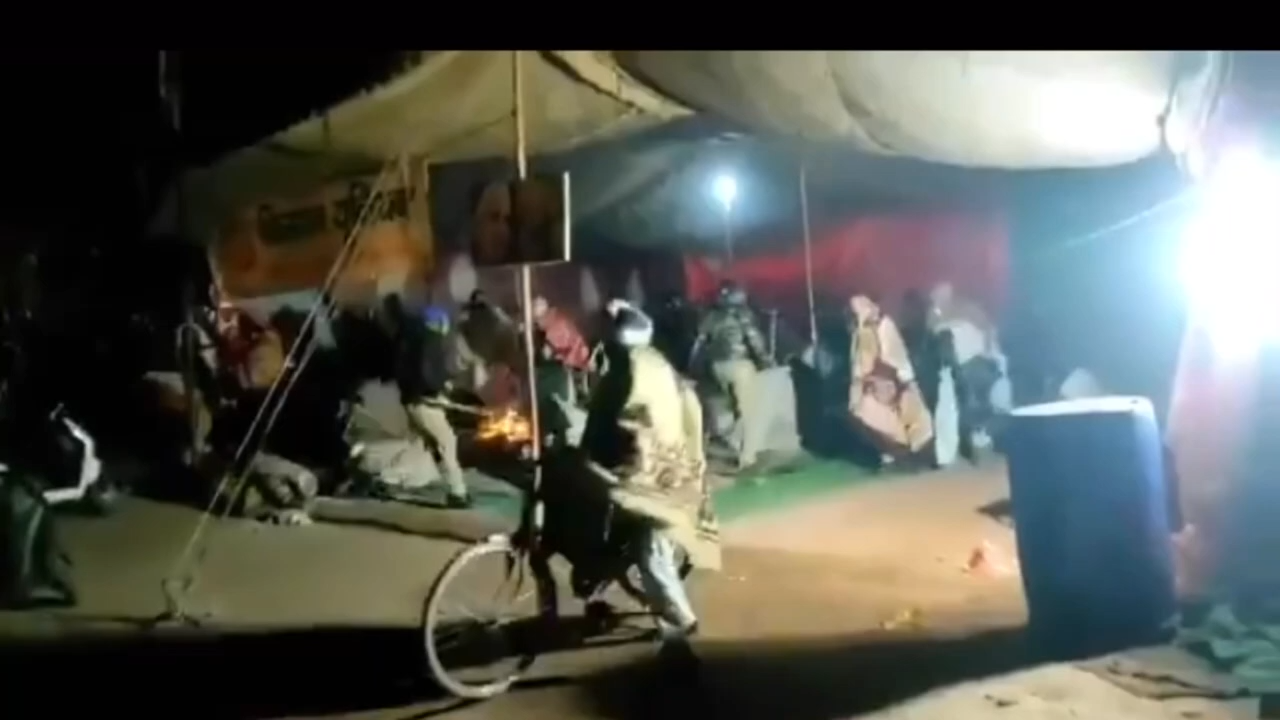
Another news of a police crackdown, then followed, visuals from a farmers protest at Baraut, Baghpat in UP. The video shows the farmers being chased away from the tent late at night. There seems to have been a sudden lathi charge at midnight upon the farmers who have reportedly been sitting on protest there for over a month, according to social media users who shared the video across platforms.
कल देर रात बड़ौत में पुलिस ने सोते हुए किसानों पर लाठियां बरसाई!
According to a report in Navbharat Times, police also uprooted the farmers’ tents. It was reported that some farmers were also hurt during this period, however the Baghpat administration has denied this and said that no force was used. This dharna (sit-in protest) site was on the Delhi-Saharanpur highway. Baghpat ADM Amit Kumar Singh issued a statement to the media saying, “We had a letter from NHAI” informing that their work on the highway “was being hampered and delayed” due to the farmers protest. He added that the farmers left on “their own peacefully”.
Another protest venue at Chilla border, on the Delhi-Noida Link road was also vacated as the Bharatiya Kisan Union (BKU)’s Bhanu faction called off its 58-day protest there. Traffic on the road, connecting Noida to Delhi, has now been restored. Tents used by Rashtriya Kisan Mazdoor Sangathan (RKMS) President V. M. Singh and Bharatiya Kisan Union (Bhanu) leader Bhanu Pratap Singh who dissociated their organisations from the farmers’ movement were also reportedly removed. Farmer Union had already stated that the two leaders had already been removed from the coalition group a month ago.
“Right from the start, VM Singh took pro-government positions. As a result, on Dec 14, he was REMOVED as Convenor of the AIKSCC. So, he is taking a decision on behalf of a committee he is no more a convenor of,” said farmer Union officials, similarly, BKU leader Bhanu Pratap Singh was also publicly dissociated from the SKM on the same day.
However, lakhs of farmers who have been sitting on a peaceful protest on the borders of the national Capital are still there. Traffic restrictions continue on those roads as advised by the police. The elevated road leading to Ghazipur from Delhi was also opened to traffic, as the farmers protest continued on the other side, and under the flyover on its service lane, even on that side, the farmers have left a lane vacant for ambulances and emergency vehicles to pass. But security has also been tightened on the areas where the protests are, including at Tikri Border and other areas where farmers are continuing to sit in protest against the contentious farm laws. Farmer volunteers have also been ensuring that the protest sites remain safe and are on the lookout for any suspicious movements on the sites.
Delhi | Security tightened at #TikriBorder where farmers are continuing protest against #farmlaws
According to those farmers on the ground, more people are expected to join in a few days. The proposed march to Parliament February 1, Budget Day has been cancelled and farmers will now hold ‘jan sabhas’ or public meetings across India on January 30, or Martyrs Day, when Mahatma Gandhi was shot dead by Nathuram Godse. Farmers will also sit on a one day anshan or hunger strike on January 30. Many farmers, including the elderly have been sitting on a relay hunger strike for two months demanding that the farm laws be repealed.
The Samyukt Kisan Morcha (SKM) held an emergency meeting chaired by Balbir Singh Rajewal after the Kisan Republic Day Parade, and discussed the violent incidents in New Delhi. The SKM stated that “a dirty conspiracy was hatched with Kisan Mazdoor Sangharsh Committee and others against the peaceful struggle of other farmer organizations, who had set up their own separate protest site after 15 days of beginning of this Farmers’ agitation. They were not part of the organisations which jointly undertook the struggle. When the farmer organizations declared a programme of Kisan Parade on January 26, anti-social elements like Deep Sidhu and others, along with the said farmer organization attempted to torpedo the farmers’ agitation.”
According to the SKM, the Kisan Mazdoor Sangharsh Committee and others “announced that they would march on Ring Road and unfurl a flag on the Red Fort,” and they did so as a part of a “deep rooted conspiracy to knock down the peaceful and strong farmers’ struggle”
The constituents of Samyukt Kisan Morcha have strongly condemned this incident, and the “anti-social elements, who tried to damage the peaceful farmers struggle.” They have appealed to the farmers to stay on the protest venues and continue a peaceful struggle and have resolved “not to allow the government and other forces inimical to the peaceful movement to break this struggle.” The statement was issued after the emergency meeting of 32 organizations called on January 27 to chalk out the future programme. It was signed by the farmers movement leaders Balbir singh Rajewal, Jagjeet Singh Dallewal and Dr. Darshan Pal.
Meanwhile in Delhi, the Archaeological Survey of India has said that the Red Fort will remain shut till January 31.
Farmers had a very successful Tractor Rally on January 26 in Delhi. The attempt to malign their non-violent effort, through the Red Fort violent incident, is a standard tactic the Government uses through their supporters masquerading as farmers. What the Government fails to realise that the farmers’ protest has now spread to all parts of the country and more and more people are supporting the farmers. The absurdity of FIR against non-violent Ms Medha Patekar and Sri Yogendra Yadav for inciting violence speaks for itself.
The Government must realise that a large majority of people have rejected the Farm Laws, and the Government must accept the inevitable and forego their ego. How can we displease the bread-givers who toil day and night to keep us fed and healthy. Their protest is fully justified and all of us support them in this endeavour. In the end they will win, and the sooner the Government scraps those Corporate-favouring Laws, the better.
Farmers in the country are agitating against the three Farmers’ Bills passed by the Government without any consultation with the stakeholders and the opposition political parties. The Government claims that it is good for the farming community whereas the farmers think otherwise. There is a stalemate and the Modi Government is adamant that the Bills will be implemented come what may. In this situation temperature is rising to the detriment of the nation. Let us think coolly about the situation.
Quoting from the Swaminathan Report on Agriculture of 2006:
“To those who are hungry, God is Bread – Mahatma Gandhi, 1946 Everything else can wait, but not agriculture – Jawaharlal Nehru, 1947
A majority of the hungry live in rural India and also depend on agriculture for their livelihood.”
Our own survival depends on what the farmers grow. They are our important lifeline. If they survive we will survive. Hence their well-being should be our prime concern. Over three lakh farmers have committed suicide over past years, and we do not seem to be worried. They have committed suicides because they have been unable to pay back the loans taken for their farming and this is because the price obtained for their produce has not been able to give them the profits envisaged.
An industrial goods manufacturer calculates the cost of manufacturing, adds overhead costs and then puts a price on the goods after adding the amount of profit he desires to make. Thus he is ensured of the profit amount and the loan repayment if any.
In the case of the farmer, a lot has been said and discussed about the Minimum Support Price (MSP). MSP has to be the price based on cost of farming plus 50%. Once the correct MSP has been determined for the crop it is the Government’s duty to buy the crops at the agreed MSP rates to keep the farmers alive.
The Farmers’ agitation has focused on two points, namely scrapping the Farm Laws and fixing the MSP of the crops. There is great fear among the farmers that once the Laws are enacted they will be at the mercy of the Corporates and India will gradually shift to Corporate Farming. Also doing away with MSP will endanger the farming community against the financial might of the Corporates. Farming community and the farmers will at the end have to give up farming.
As Kavya Datla writes in Down to Earth in an article entitled: ‘Farm Laws 2020: Who are they meant to serve’ –
“It is also difficult to ensure that the big corporates do not enslave the already marginalised farmers. By allowing both verbal and written contracts, the Centre places the farmers at the vulnerable end of the bargain with no redress. It is highly likely that big corporates bury the farmers in an avalanche of legal resources. There is no denying that there is a widely disproportionate access to legal resources between farmers and corporates and there seems to be no real law in place to safeguard the interests of the farmers. Both farmers and consumers run the risk of exploitation by placing the market in the hands of big businesses. To build trust among farmers and the states would be to include a mandate for MSP, as recommended by the Swaminathan Committee, within the ambit of the bills. Another would be to plug the holes in the current system instead of trying to dismantle and introduce a new structure.”
The Farmers’ Agitation has awakened the population about the problems farmers face and of which the city-dwellers are unaware of. Supporting the farmers is like supporting our food giver. Lakhs of farmers committing suicide has not made news headlines, and over 130 farmers dying in the current Protest has not made the news item either. Thanks to the various social organisations and NGOs and awakened public these facts are now being circulated although the Government pretend to be deaf to the reality. All of us must unite and force this Government to cancel the draconian Farm Laws hurriedly enacted.
Jai Kisan! Long Live our Farmers and their families!
*The author is convener of Jharkhand Nagrik Prayas
The All India Kisan Sangharsh Coordination Committee (AIKSCC) unequivocally repeats, reiterates and places on record that it stands firmly, resolutely and unwaveringly with and in support of the ongoing Farmers’ Protest at Delhi and rest of India, said the AIKSCC National Working Group (WG,) its highest decision making body on January 28, 2021.
“There is no question of the AIKSCC disassociating itself from the ongoing protest and movement. It is noted with regret that some media channels are wrongly reporting that AIKSCC has withdrawn support to the Farmers’ Protest – nothing can be further from the truth,” said the Working Group in a press release.
Earlier, former AIKSCC member V. M. Singh had dissociated from the Sanyukta Kisan Morcha (SKM). However, while Singh has made his statement as the Rashtriya Kisan Mazdoor Sangathan (RKMS) President, some news organisations took this to mean that the AIKSCC has split from the coalition group. The organisation published its official statement to dispose of any such confusion.
The statement – signed by WG members such as Sri Avik Saha, Dr. Ashish Mittal, Atul Kumar Anjan, Ashok Dhawle, Darshan Pal, Hannan Mollah, Jagmohan Singh, Kavitha Kuruganti, Kiran Vissa, Medha Patkar, Pratibha Shinde, Prem Singh Gehlawat, Raju Shetti, Raja Ram Singh, Satnam Singh Ajnala, Satyawan, Sunilam, Vemulapalli Venkataramaiya and Yogendra Yadav – reiterated that the organisation stands shoulder to shoulder with the farmers movement and any attempt to spin any other narrative amounts to sabotage of the ongoing struggle.
Officials said that as the largest platform of farmers and farm workers organisation of India, the AIKSCC represents the interest and concerns of its constituents and thus firmly stands with the demands for repeal of the three anti-farmer Acts, legal guarantee of Minimum Support Price (MSP) and withdrawal of the Electricity Amendment Bill 2020. These are non- negotiable, said the AIKSCC.
“Any statement made by any person in any capacity whatsoever that is contrary to the above clear stand and position of the AIKSCC is incorrect, unauthorised and not the official position of AIKSCC and should not be taken cognisance of under any circumstances,” said the AIKSCC.
Accordingly, the Working Group appealed to all farmer leaders to unite and not give-in to the desperate diversionary and divisive attempts by this anti-farmer regime.
In light of the Republic Day incident, farmers cancelled the plan to march to Parliament on February 1, Budget Day. Instead, peasants will observe Jan Sabhas across India and one-day sit-in fast on January 30, Mahatma Gandhi’s death anniversary.
Justice Rohit Arya of Madhya Pradesh High Court has dismissed the bail pleas of comedian Munawar Faruqui and his co performer Nalin Yadav. Justice Arya had reserved orders on their bail applications after noting that people who take undue advantage of others’ religious sentiments and emotions must not be spared.
By his order dated January 28, 2021, the court observed, “This Court refrains from commenting upon contentions of the parties touching on merits but, regard being had to the material seized and the statements of the witnesses and that the investigation is in progress, no case is made out for grant of bail.”
Justice Arya said that, “The evidence/material collected so far, suggest that in an organized public show under the garb of stand-up comedy at a public place on commercial lines, prima facie; scurrilous, disparaging utterances, outraging religious feelings of a class of citizens of India with deliberate intendment, were made by the applicant.”
He highlighted that, “It is the constitutional duty of every citizen of the country and also of the States to promote harmony and the spirit of common brotherhood amongst all the people of India irrespective of religious, linguistic, regional or sectional diversities and to value and preserve the rich heritage of our composite culture (Article 15A (e) and (f) of the Constitution of India.”
Emphasising on the role of the State, he said, “States must endeavour that ecosystem and sustenance of coexistence in our welfare society is not polluted by negative forces and must strive for achievement of goals as enshrined under Article 51A(e) and (f) of the Constitution of India in particular as these provisions are part of our vibrant Constitution and not dead letters.”
The High Court further rejected the contention of Faruqui that he had not uttered any statements as alleged in the criminal complaint. Considering the video footage of the show and witness statements, Justice Rohit Arya opined, “At this stage it is difficult to countenance the submissions of the learned counsel for the applicant as complacency of the applicant cannot be ruled out, besides vulnerability of his acts in public domain. It is not a case of no evidence. More so, the investigation is in progress.”
The judge went a step ahead and remarked, “The possibility of collection of more incriminating material and complacency of other persons cannot also be ruled out. Further, it has come on record that a similar nature of offence has been registered against the applicant at Police Station Georgetown, Prayagraj, State of Uttar Pradesh.”
Munawar Faruqui and five others were arrested on January 1, 2021 by the Indore Police on allegations that he made derogatory remarks against Hindu Gods during a recent stand-up show. Subsequently, a complaint was filed by Eklavya Singh Gaur, chief of Hindutva organisation Hind Rakshak Sangathan. On January 5, the Sessions court had dismissed his bail application.


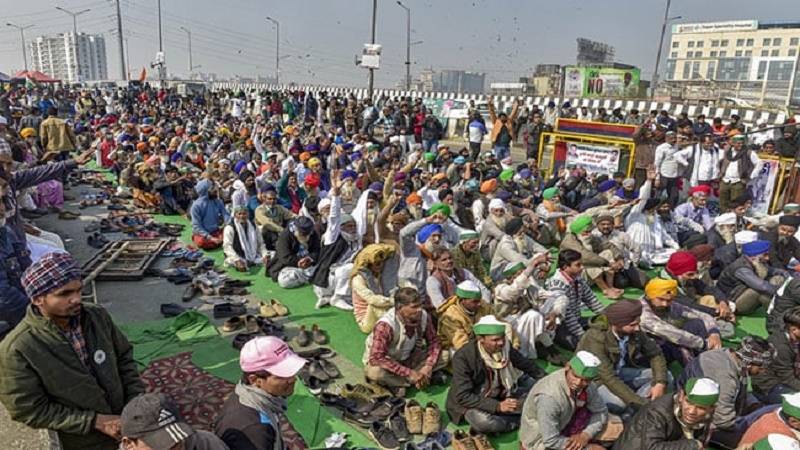 Image Courtesy:ndtv.com