A recent Karnataka High Court order granting anticipatory bail to a rape accused has taken sexual violence jurisprudence back by decades. In what can be termed as a substantially regressive rationale for giving bail to a rape accused which could affect the trial of the case, the court said that the fact that the complainant slept after the alleged crime is unbecoming of an Indian woman.
The accused was booked under charges of rape, cheating and criminal intimidation under the Indian penal Code (IPC) and under penal section of Information Technology Act under section 66B [Punishment for dishonestly receiving stolen computer resource].
The single judge bench of Justice Krishna Dixit in order dated June 22, considered the government pleader’s contention that the charges against the accused were serious and an offender like him should not be let out in the society. The court said that seriousness of the charges is not the only criteria to deny bail and whether there is prima facie case, also needs to be considered.
The court disbelieved the allegation of the complainant that she was subjected to rape on the false promise of marriage given that the accused presented a letter as proof whereby the complainant was ready to reach compromise to withdraw this case; also the court speculated why the complainant did not approach the court earlier when the accused was allegedly asking her for sexual favours.
Further, the court also questioned why the complainant went to her office at 11 pm; why she did not object to consumption of drinks (sic); why she allowed the accused to stay with her till morning. The court said that the complainant’s explanation that she fell asleep after the alleged crime is “unbecoming of a woman; that is not the way our women react when they are ravished”.
The court granted anticipatory bail to the accused on the principle of ‘granting of bail is rule and denial is exception’ as also keeping in mind the Covid-19 pandemic posing a threat to infection in prisons. When the pleader for the complainant contended that if granted bail it would be difficult to secure the accused person’s presence for investigation or trial, the court said it would levy stricter conditions.
The rape accused was thus granted pre arrest bail subject to the following conditions:
(i) petitioner shall execute a Personal Bond for a sum of Rs.1,00,000/- (Rupees one lakh) only with two sureties for the like sum;
(ii) petitioner shall cooperate in the investigation/further investigation at all times and appear before the jurisdictional police, if & when, so directed;
(iii) petitioner shall not leave the jurisdictional limits of the trial Court without its prior permission;
(iv) petitioner shall mark his attendance in the jurisdictional Police Station every second and fourth Saturday of the calendar month between 9.00 am and 3.00 pm;
(v) the petitioner shall not tamper the evidence or influence/deter the witnesses/victims; nor shall he do anything prejudicial to peace & order in the civil society;
(vi) it is open to the jurisdictional police or the complainant to seek cancellation of bail if & when petitioner commits breach of any of the above conditions or perpetrates any offence hereafter.
While considering whether there is prima facie case against the accused, the court has seemingly disregarded the complainant’s allegations in toto, based on extremely regressive and perilously patriarchal views. The bone of contention is not why the accused was granted bail but the rationale on which he was granted bail which is problematic. This order will not only adversely affect the trail in this case but it also sets a bad precedent for sexual violence jurisprudence.
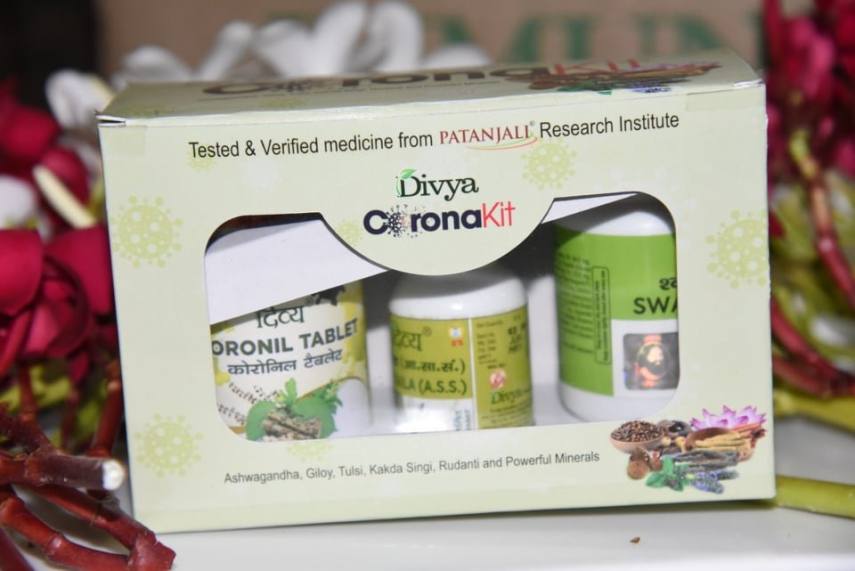
Yoga and Ayurved entrepreneur Ramdev, and his FMCG company Patanjali Ayurved Ltd, and Divya Pharmacy, that industrial unit that makes the ‘medicines’, seem to now be in a sticky situation that may even need political intervention to prevent it from sinking deeper. The controversy over its claim of manufacturing a ‘drug kit’ that ‘cures’ Covid-19 is now entering legal waters as even the Licence Officer, Uttarakhand Ayurved Dept has called out its claims, and is sending them a notice asking them how they got permission to make the Covid-29 ‘medicine’ kit.
The officer told news agency ANI, “As per Patanjali’s application, we issued them license. They didn’t mention coronavirus, we only approved license for immunity booster, cough & fever. We’ll issue them a notice asking how they got permission to make the kit (for COVID19): Licence Officer, Uttarakhand Ayurved Dept”
As per Patanjali’s application, we issued them license. They didn’t mention coronavirus, we only approved license for immunity booster, cough & fever. We’ll issue them a notice asking how they got permission to make the kit (for COVID19): Licence Officer, Uttarakhand Ayurved Dept pic.twitter.com/I7CWKoJhbK
The tall claims made by Patanjali had already been called out by the Ministry of Ayurveda, Yoga & Naturopathy, Unani, Siddha and Homoeopathy (AYUSH) itself which made a public statement ordering Patanjali to stop advertising and publicising its claims till they were examined.
In fact, the April 1 order of the ministry against misleading information on AYUSH drugs said, “Whereas in view of the emerging threat in the country due to COVID-19 outbreak, it is imperative to apply and implement various measures for maintaining public safety in all aspects and to control dissemination of misleading information about AYUSH drugs and services”
Making false claims was declared a “punishable offence” by the Ministry of Home Affairs order on March 24. The National Disaster Management Authority (NDMA) too had on the same day issued instructions to all Central and State/UT Government Authorities “under the provisions of Disaster Management Act, 2005 to take effective measures including making of false claim as punishable offence so as to prevent the spread of COVID-19 in the country.”
The ministry had “in exercise of the powers of Central Government, conferred under Section 33 P of the Drugs and Cosmetics Act, 1940,” directed all concerned regulatory Authorities in the country to “stop and prevent publicity and advertisement of AYUSH-related claims for COVID-19 treatment in print, TV and electronic media”. They authorities were asked to take action against those violating the NDMA guidelines.
The rules and regulations however did not prevent Ramdev from launching the product and publicising it on social media, and news channels.
“We will even conduct tests on people on ventilators, says Baba Ramdev. This is not an immunity booster but a coronavirus cure,” news reports quoted Ramdev as saying. Balkirshna, the MD of his company had already claimed that they “started working on Corona medicines from December 2019.” He is quoted by Livemint saying, “We’ve prepared the first Ayurvedic-clinically controlled, research, evidence and trial based medicine for COVID19.”
“We conducted a clinical case study and clinical controlled trial, and found 69% patients recovered in 3 days & 100% patients recovered in 7 days,” said Ramdev, adding that “0% death rate and 100% recovery rate has been observed.”
Ramdev had announced a kit containing ‘medicines’ called “Coronil and Swasari” and claimed that it had cured Covid-19 patients with 100% results in a medical trail jointly conducted by Patanjali Research Institute (Haridwar) and the National Institute of Medical Sciences(Jaipur). He said, “The first clinical controlled study was conducted on 280 patients in Delhi and Ahmedabad among many other cities.”
The ministry of AYUSH issued a strong statement that it was not aware of the “facts of the claim and details of the stated scientific study.”
As revealed by an Indian Express investigation the trials for Ramdev’s Ayurvedic ‘corona kit’ used allopathic drugs. The trial was also conducted only on asymptomatic and mildly symptomatic patients.
The study based on these trials at the National Institute of Medical Sciences (NIMS), are not peer-reviewed, Dr Ganpat Devpura, Principal Investigator, NIMS, Jaipur told IE, “This is just an interim report with a sample size of 100 Covid-19 patients. The final report and the findings will be published after 15-25 days and then it will be sent for peer review.” He also admitted that allopathic medicines were administered to patients during the trial when they developed symptoms, “Yes, if patients had developed symptoms like fever, symptomatic treatment was given.”
Balkrishna, Managing Director, Patanjali Ayurved Ltd, however, claimed the controversy was resolved, “The resolution of AYUSH controversy, finally!” and attached a note from the ministry which only states that the papers had been received.
This is the receipt note:
All that the note states is that the Ministry of Ayush has received the “documents of the clinical trial including site of a clinical study and medical research, Institutional Ethics Committee clearance, registration details of CTRI, study protocol, sample size and study results data.” Balkrishna however is falsely claiming that the matter has been resolved.
Meanwhile the licencing authority has also said Patanjali was allegedly in violation of relevant sections under the provisions of Drugs and Magic Remedies (Objectionable Advertisements) Act, 1954, and asked why action should not be taken to cancel the licence for manufacturing these medicines, reported the IE.
They also spoke to Rohit Kumar Singh, Additional Chief Secretary (Health) in Jaipur who said that the state government did not have any knowledge about these trials and did not receive any request for authorisation. Even doctors said they can’t claim that Patanjali’s ‘medicine’ cured patients. “NIMS had only asymptomatic patients. It can’t be said that this particular medicine treated them successfully within a few days,” said Dr Narottam Sharma, Chief Medical Health Officer, Rajasthan University of Health Sciences.
Rajasthan Health Minister Raghu Sharma has now instructed officials to take action if any attempt is made to sell this drug as a potential medicine of Covid-19 in the state.
On his part Ramdev too has been posting the receipt of documents as a validation of his claims. Calling it “News of extreme disappointment for those who oppose and hate Ayurveda …”
It is clarified that the @moayush has not removed any doctor or medical officer from duty or service at any time in the recent past. pic.twitter.com/Tr8KoQpsY9
— Ministry of AYUSH?? #MyLifeMyYoga (@moayush) June 25, 2020
RSS is the Hindutva gurukul, (university) which specialises in training it’s cadres in the internalising of half-truths and lies, based on the manufacturing of history. A recent proof of this is evidenced in Ram Madhav’s claim that, Indian democracy survives due to “leaders in the government who fought for that very freedom and are committed to liberal democratic values, not just as a matter of compulsion but as an article of faith.”[i] Described as an ‘RSS ideologue by commercial television channels, Madhav was speaking on the 45th anniversary of the Emergency. His falsified claim is that RSS-BJP leaders fought against the Emergency, not out of compulsion but as an article of faith in democracy. Both claims are while lies. This can be seen not just from the claims of critics of the RSS, but from all contemporary RSS documents available.
Let us take first, address the claim that the RSS-BJP rulers are/have been committed to the liberal democratic values, as an article of faith. The most prominent ideologue of the RSS, MS Golwalkar, also known as the ‘Guru of Hate’ [whom PM Modi credits for grooming him into a political leader] while addressing as many as 1350 top level cadres of the RSS, in 1940, declared, “RSS inspired by one flag, one leader and one ideology is lighting the flame of Hindutva in each and every corner of this great land.”[ii]
With such a philosophical liking for totalitarianism the RSS has hated the sharing of power. This can be seen from the outfit’s strong opposition to the federal structure of the constitution, a ‘Basic’ feature of the Indian republic. Golwalkar, declared in 1961, “Today’s federal form of government not only gives birth but also nourishes the feelings of separatism, in a way refuses to recognise the fact of one nation, and destroys it. It must be completely uprooted, the constitution purified and (a) unitary form of government be established.”[iii]
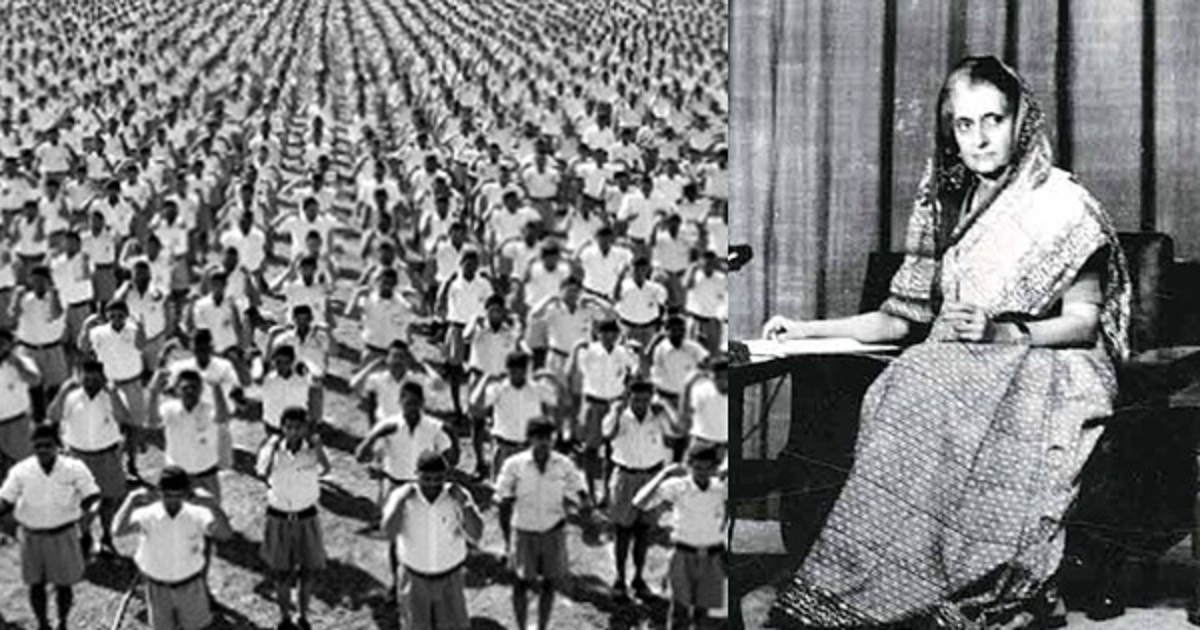
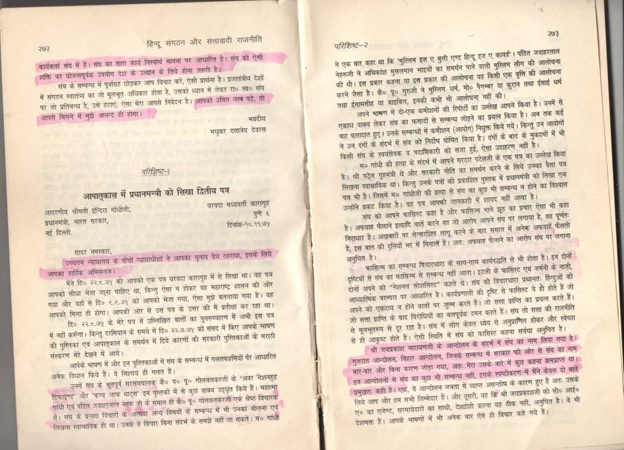
As far as the Emergency is concerned, the RSS claim of fighting against it, needs also to be evaluated in the light of contemporary narratives as also from RSS’ own documents. In this connection two narratives, one by a veteran thinker and journalist of India, Prabhash Joshi and the other, by TV Rajeswar, former Intelligence Bureau [IB] chief, who was the deputy chief of IB during the Emergency, are of immense importance. They recounted the days of Emergency (or state authoritarianism) when the RSS surrendered to the repressive regime of Indira Gandhi, assured both her and her son, Sanjay Gandhi, of their cooperation to enforce faithfully the draconian 20-point programme, announced by the Emergency regime. Large number of RSS cadres came out of jails by submitting maafinaamas (mercy petitions). This contemporary, historical narrative by Prabhash Joshi, appeared in the English weekly, Tehelka on the 25th anniversary of the Emergency.[iv] According to Joshi, even during the Emergency “there was always a lurking sense of suspicion, a distance, a discreet lack of trust” about the RSS’ joining the anti-Emergency struggle. He went on to write, that
“Balasaheb Deoras, the then RSS chief, wrote a letter to Indira Gandhi pledging to help implement the notorious 20-point programme of Sanjay Gandhi. This is the real character of the RSS…You can decipher a line of action, a pattern. Even during the Emergency, many among the RSS and Jana Sangh who came out of the jails, gave maafinamas. They were the first to apologise. Only their leaders remained in jail: Atal Behari Vajpayee [most of the time, in hospital], LK Advani, even Arun Jaitley. But the RSS did not fight the Emergency. So why is the BJP trying to appropriate that memory?”
Prabhash Joshi’s conclusion was that “they are not a fighting force and they are never keen to fight. They are basically a compromising lot. They are never genuinely against the government”.
TV Rajeswar, who served as Governor of Uttar Pradesh and Sikkim penned a book, ‘India: The Crucial Years” [Harper Collins], in which, he corroborated the fact, that, “Not only they (RSS) were supportive of this [Emergency], they wanted to establish contact apart from Mrs Gandhi, with Sanjay Gandhi also”.[v] Rajeswar in an interview with Karan Thapar disclosed that, Deoras,
“quietly established a link with the PM’s house and expressed strong support for several steps taken to enforce order and discipline in the country. Deoras was keen to meet Mrs. Gandhi and Sanjay. But Mrs. Gandhi refused.”[vi]
According to Rajeswar’s book,
“RSS, a right-wing Hindu nationalist organisation, was banned in the wake of the Emergency. But its chief, Balasaheb Deoras, quietly established a link with the PM’s house and expressed strong support to several steps taken to enforce order and discipline in the country. Sanjay Gandhi’s concerted drive to enforce family planning, particularly among Muslims, had earned Deoras’s approbation.”[vii]
Rajeswar also shared the fact, that, even after Emergency, the “organisation, (RSS) had specifically conveyed its support to the Congress in the post-emergency elections.”[viii] It will be interesting to note that even according to Subramanian Swamy during the Emergency period, most of the senior leaders of RSS had betrayed the struggle against the Emergency.[ix]
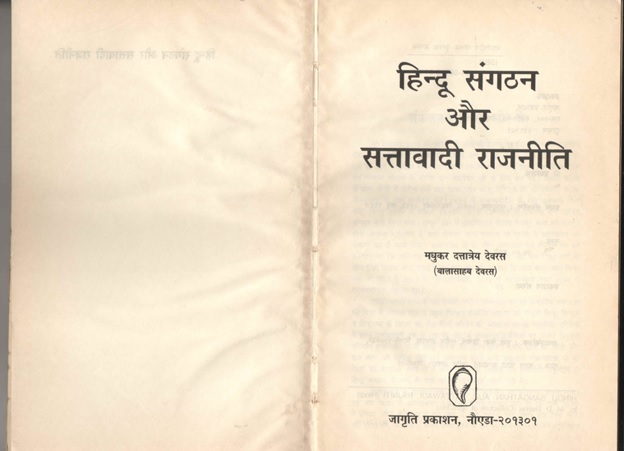
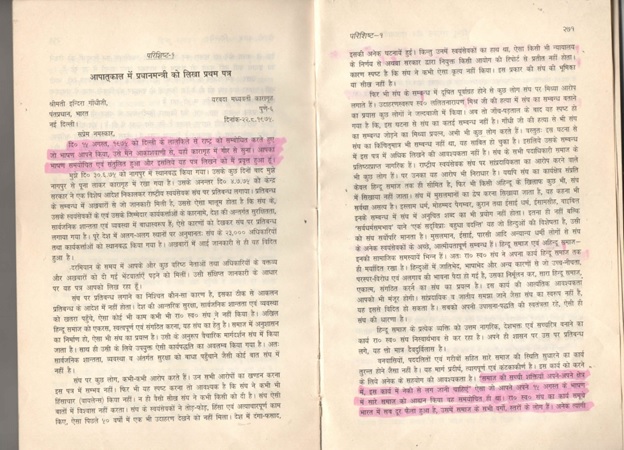
Contemporary documents in the RSS archives corroborate the narratives proffered by Prabhash Joshi and Rajeswar. The 3rd Supremo of RSS, Madhukar Dattatraya Deoras wrote the first letter to Indira Gandhi within two months of the imposition of Emergency. It was the time when state terror was running amok. In a letter dated, August 22, 1975 he began with the following praise of Indira:
“I heard your address to the nation which you delivered on August 15, 1975 from Red Fort on radio in jail [Yervada jail] with attention. Your address was timely and balanced so I decided to write to you”.[x]
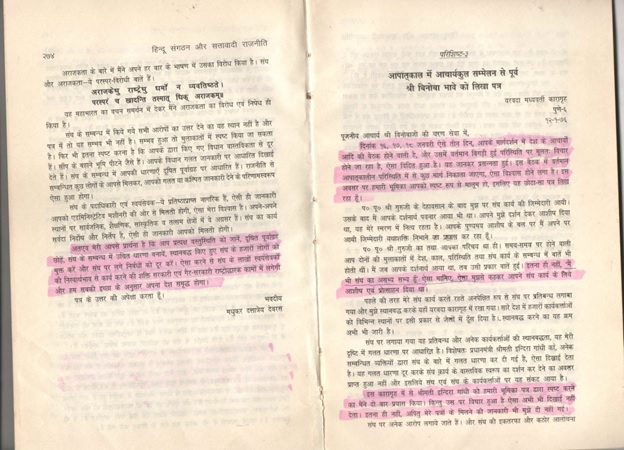
Indira Gandhi did not respond to it. So Deoras wrote another letter to Indira on November 10, 1975. He began his letter with congratulating her on being cleared by the Supreme Court of disqualification (in the elections) which was ordered by the Allahabad High Court, “All the five Justices of the Supreme Court have declared your election constitutional, heartiest greetings for it.” It is to be noted that opposition was firmly of the opinion that this judgment was ‘influenced’ by the Congress. In the course of the letter, he declared that “RSS has been named in the context of Jaiprakash Narayan’s movement. The government has also connected RSS with the Gujarat movement and the Bihar movement without any reason…Sangh has no relation with these movements…”[xi]
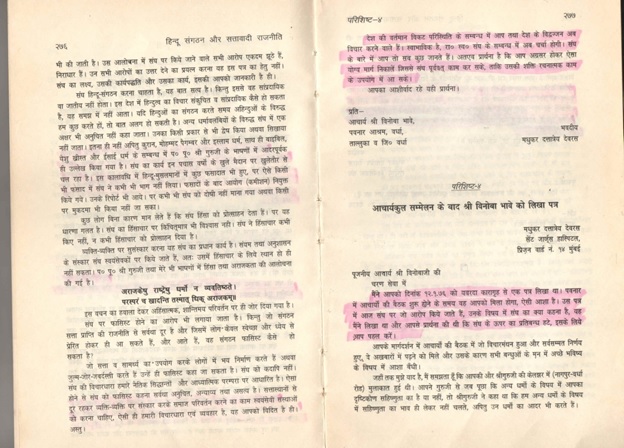
Since Indira Gandhi did not respond to this letter also, RSS chief got hold of Vinoba Bhave who supported the Emergency religiously and was a favourite of Indira Gandhi. In a letter dated January 12, 1976, he begged that the Acharya should suggest a way to ensure that the ban on the RSS was removed.[xii] Since the Acharya, too, did not respond to Deoras letter, the latter in another letter without date wrote in desperation,
“According to press reports, respected PM [Indira Gandhi] is going to meet you at Pavnar Ashram on January 24. At that time there will be discussion about the present condition of the country. I beg you to try to remove the wrong assumptions of PM about RSS so that ban on RSS is lifted and RSS members are released from jails. We are looking forward to the time when RSS and its members are able to contribute to the plans of progress which are being run in all the fields under the leadership of PM.”[xiii]
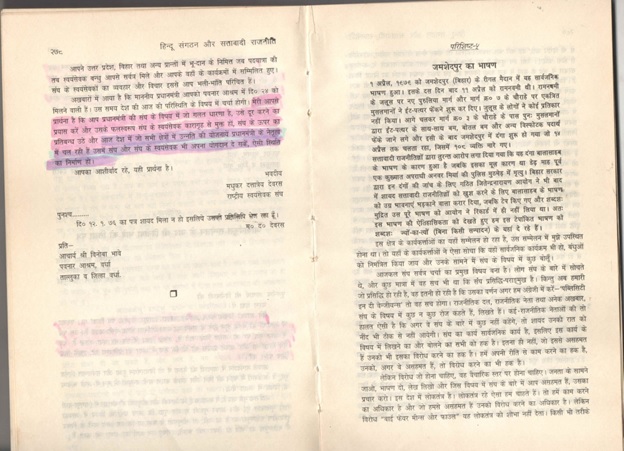
All these letters in Hindi are being reproduced from a publication of the RSS at the end of this article.
Significantly, former President of the Indian Republic, Pranab Mukherjee was invited by the RSS chief, Mohan Bhagwat as the chief guest at the graduation ceremony of its new recruits. These recruits are trained to work over-time (on social and political steps) to convert India into a theocratic (Hindu) state. Pranab Mukherjee has been known, and held responsible too, as one of the top leaders of Congress, responsible, for Emergency excesses. The tragedy of the RSS in power at the Centre is that India, while a constitutional democracy, is governed by a love of power, which compels its spokespersons to indulge in doublespeak.
Despite these facts, it is shameful, that thousands of RSS cadres continue to get monthly pension for ‘persecution’ during Emergency. BJP ruled states like Gujarat, Madhya Pradesh, Rajasthan and Maharashtra have decided to award a monthly pension of Rs 20,000 to those who were jailed during the Emergency period for less than 2 months and Rs 10,000 to those who were jailed for less than a month. This rule took care of the financial interest of those RSS cadres who submitted mercy letters completing only one or two months’ jail term. For securing such a significant pension, there is no condition that the beneficiary should have been in jail for the whole period of the Emergency.
Interestingly, in the case of anti-British freedom struggle, not a single person from RSS cadres is fit to claim a freedom fighters pension. Neither does India remember hundreds of Communist youth, branded as Naxals, who were killed in brute extra-judicial killings (“fake encounters”) during the Emergency. Interestingly, the Shiv Sena too, a former Hindutva co-traveler of the RSS openly supported the Emergency.
The author can be reached at notoinjustice@gmail.com
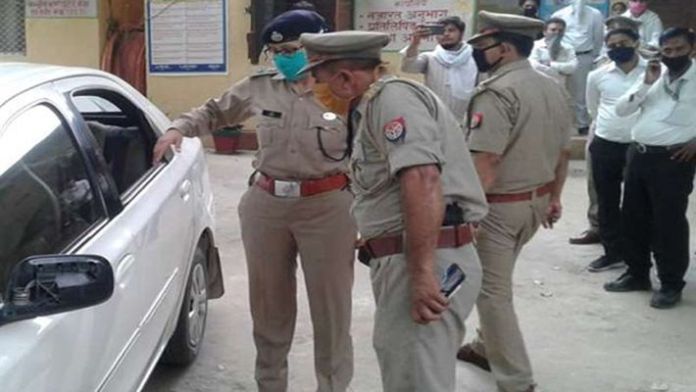
On the morning of Tuesday, June 23, unidentified miscreants near Dibiyapur in Uttar Pradesh’s Auraiya allegedly attacked a car carrying two judges who were on their way to the district court, The Indian Express reported.
Amar Ujala reported that while the judges were on their way to the Kakor court complex, some persons in a white Bolero allegedly followed the car and pelted stones on it. While the windowpane broke, the judges escaped unhurt.
The police said that the two judges – Additional (ADJ) – I Rajesh Chaudhary and Additional District Judge (ADJ) Fast Track Court – I Ram Net lodged an FIR against unknown persons at the Dibiyapur police station. The police are also investigating the absence of a gunner who was previously assigned to one of the judges, said IE.
The Superintendent of Police (Auraiya), Suniti, told IE, “The gunner tasked with providing security to Judge Chaudhary had not informed his superiors on whether he was going on leave or not.”
Giving the details of the attack, the SP said that in their complaint, the judges mentioned that their car was attacked from the left by unidentified persons while they were on their way to court. They raised doubts that the attack could have been in relation with one of the cases they were hearing. In light of the attack, the police has now roped in two forensic teams – one from Kanpur and the other from Lucknow, to help investigate the matter.
The Royal Bulletin has reported that seeing the sensitivity of the matter, the forensic team had begun the investigation under the leadership of scientist Hakim Singh from the Forensic Science Laboratory, Lucknow. The investigation was carried out by simulating the incident with the help of the driver under the supervision of the forensic teams and police officers from the Auraiya Kotwali and Dibiyapur police station.
To a Kashmiri Pandit (KP) who refused to migrate out of the Valley atthe onset of the bloody insurgency in the 1990s, the paradox is apparent whenever union ministers reiterate their commitment to safe and honourable return of KPs to the Valley. The Non-Migrant KP has seen it all; his lot remains ignored. Adversity has taught him to sift sincerity from the political bluster. When Pravesh Sahib Singh Verma exhorts Delhi to vote for BJP to avoid the fate that befell KPs in Kashmir, non-migrant KP doesn’t missexploitation of his tribe in the electoral rhetoric. Having gone through the rough and tumble of hate and appeasement, the Valley-based KP finds himself to be the butt of pathetic neglect and ridicule by his own.
Post-migration, a plethora of KP outfits mushroomed. While some among them genuinely worked for the welfare of the community during the humungous humanitarian crisis; most were proxies of political outfits. Unfortunately, these zealous cadres turned antagonistic to those who chose to stay back. Vocal activists not only abused the left-over members; they even labelled them ‘traitors’ who had ‘abandoned their religious faith’. Nothing is farther from the truth.
A majority of this ‘leadership’ were those who had long back severed connections with the Valley and established themselves well either in the mainland or abroad. Amaturishly, they were overwhelmed not by reason but by hate- a leadership deficit. Abandoning the welfare of the community as a wholethey dabbled in politics, failing miserably on both the counts.Today, the non-migrant stands disillusioned, an outcast.
Dwindling Numbers.
In the early 1990s, almost entire KP community fled to the safety of plains, leaving behind a minuscule number. With political executive in the state ( now a UT) abdicating its responsibility and New Delhi lost in the woods, the exodus of KPs continued unabated. While in 1992, their number in the Valley had reduced to just 32,000 souls, 1998 recorded a sharp fall to 19,865. As per a surveyconducted by Valley-based KPs in August 2019, their numbers have shrunk to 808 households adding up to just 3445 souls, scattered over 242 places. The district-wise breakdown is here.
No
Anantnag
Bandipur
Baramulla
Budgam
Ganderbal
Kulgam
Kupwara
Pulwama
Shopian
Srinagar
Total
Families
142
32
223
44
15
72
12
102
49
117
808
Population
604
137
949
187
64
307
54
434
211
498
3445
Note: For security reasons, most families have abandoned their homes to relocate in respective district headquarters. Seventy-two families have shifted to Srinagar.
The Reasons for their dwindling numbers are evident. Besides the denial of economic rights and dignity by successive governments, vote bank politics by all political parties, including the BJP, and the venom spewed by their own on electronic media have rendered their stay in the Valley, untenable. Rather than relapsing into fits of intemperate displays in TV frames, one wishes these ‘spokespersons’ did something concrete on the ground. There is a lot they can do. It is time they followed an age-old adage-to regain what is lost; it is essential to retain one foot on the ground. Outshouting others on air has never won a ‘war’.
Closing Ranks for Survival.
Living within a fragile security paradigm and an intensely polarised neighbourhood, non-migrant KPs displayed immense grit and maturity to close their ranks to voice their grievances. In the early 1990s, they organised themselves into a “Hindu Forum’ headed by likes of Late Shri H. N. Wanchoo, Late Dr T. N. Gangoo, Late Dr B. M. Bhan and others. Thereafter, the ‘Hindu Welfare Society, Kashmir’, an NGO, replaced the Forum. Given severe constraints, both these organisations performed their roles admirably. In 2005, the ‘Kashmiri Pandit SangarshSamity’ (KPSS) was set up as the political voice of KPs in the Valley. Dr Vijay Sazawal (USA), Late Shri Shiban Duda and Late Shri M. K. Kaw lent unstinted support to KPSS and voiced their grievances in New Delhi’s power corridors. Presently, Sanjay Tickoo and a determined group of youngsters head the struggle in the Valley
Besides bread and shelter issues, KPSS agitated other significant Community concerns, like usurpation of KP religious assets by the terrorist-landmafia- bureaucrat- politician nexus, inefficaciousness of ‘The Jammu & Kashmir Migrant Immovable Property (Preservation, Protection and Restraint on Distress Sales) Act, 1997’ and many more. In 2009, KPSS had the gumption to stage a photo-exhibition, in the heart of Srinagar, highlighting the wanton destruction and desecration of temples by Islamists. The visitors included separatists of all hues. It is to the credit of KPSS that long-forgotten religious festivities, like Janam Ashtami Procession, Dusshera etc., were revived in the Valley. Much that the exiles may denigrate the non-migrant for not migrating; the truth is whatever revival of KP/Hindu religious traditions has taken place in the Valley is because of daring KPSS.
Neglect and Discrimination.
Non-migrants KPs have devised a novel way to express their despair. All their petitions commence with a prayer ‘If you can’t save us, then it is better to execute us under any Euthanasia Law rather than slaughtering us (Non-Migrant Kashmiri Pandits/Kashmiri Hindus living in Kashmir) for some hideous political revenge.’
Two different Parliamentary Standing Committees on Home Affairs in their reports, in 2009 and 2014, explicitly observed ‘pathetic’ conditions in which non-migrant KPs are staying in the Valley. Both committees recommended ‘special budgetary (and other) provisions for KPs left behind in the Valley for fulfilling genuine needs of housing, employment and improving their living conditions’. Politicians and bureaucrats have consigned these reports to archives.
In India, politics is a coveted profession. Across the political spectrum, numbers count. True, even migrant-KPs don’t constitute a votebank but retaining sections of them in sub-human conditions and degradation adds to the electoral fortunes of some parties. Dumping a handful of KPs in the Vally is of no political consequence to anyone. Hence, they continue to live abandoned.
Irrespective of ideology, all parties when in power siphoned off the funds meant for Kashmiri migrants to build their cadres in the Valley. Sanjay Tickoo acknowledges ‘New Delhi is quick to recognise and act on our concerns. But, it is the state political functionaries who obstruct benefits from reaching us’. Neglect of non-migrants KPs is writ all over their plight.
Relief Denied
Quoting an EarlyTimes expose, Sanjay Tickoo says “Political parties have swindled Rs.2,340 Cr,from funds, meant toprovide financial assistance to Kashmiri Migrants, to build their cadres in the Valley. Now that they have been caught with their hands in the till none has reacted to this expose”. A large number of non-migrant Muslims and Sikhs are registered as migrants and are enjoying Government doles. Even during PDP-BJP Government, thousands of political foot soldiers in the Valley have registered for cash relief under this category. All these ‘political migrants’ stay in the comforts of their homes in the Valley under exclusive security cover.
Despite numerous representations, the Government is callously indifferent to the pleas for cash relief by needy non-migrant KPs who have relocated to safer places within the Valley. When thousands of ‘political workers’ of other communities receive cash relief under false pretexts, denying same to a few needy non-migrant KPs smacks of discrimination; communally and politically expedient.
Shelter Denied
Besides cash relief, thousands of ‘political workers’ have been allotted government accommodation in the Valley. In comparison, all those non-migrant KPs who have relocated in distress to district headquarters live in rented accommodation, a luxury they can’t afford. Several appeals and petitions to the Government for allotting accommodation to the small number of non-migrant KPs find no favour. Isn’t it a travesty of justice and fair play?
Employment Denied
Conceding to their genuine demand, in 2013 the Centre extended benefits under Manmohan Singh led UPA Government’s ‘PM Employment Package’ to non-migrant KPs also. Some KP ‘leaders’ tried to prevent this benefit from reaching these needy people by miring the issue in a legal dispute. After a protracted legal battle, KPSS’ claim was upheld by the Hon’ble High Court in 2016. It is bewildering that ever since the court ruling, their file has gone into a ‘bureaucratic orbit’, a term coined by George Fernandes for politico-bureaucratic inertia. Exasperated, KPSS following-up the case was curtly told by the concerned officer that there were instructions to bury the file deep.
In the backdrop of politico-bureaucratic neglect, these are but a few travails that non-migrant KPs undergo in the Valley. Unless the ‘left-over’ KP is taken care of, rebuilding Bharat in Kashmir would remain a hollow slogan. New Delhi would be well advised to address the genuine grievances of these aboriginals for they are the foundation of Kashmir BJP wishes to build. The ruling party must ensure that it does not sacrifice their right to a dignified life at the altar of its political greed. KP TV ‘warriors’, too, need to tone down their belligerent rhetoric. Instead, they must work for the betterment of the community and the nation at large.
Don’t abandon the non-migrant KP as a pariah. Otherwise, he will pack up and leave. That would be the final migration of KPs from the Valley.
The article has also been published in NAAD June 2020 edition and in Daily Excelsior and is being published with permission
The spread of Coronavirus in India and the subsequent misery of the migrant population has exposed the underbelly of dismal healthcare in our country. There is a daily outcry of shortage of hospital beds, doctors, nurses, ICUs, absence of functioning rural healthcare centres, etc.
It is a great pity that while our neighbouring small nations like Bhutan and Sri Lanka provide free universal healthcare for all their citizens, India is still struggling with healthcare schemes that cover only partially a small section of our population that have to struggle meaninglessly for a gold/red/blue, etc. card to become eligible for partial healthcare facility. Almost all advanced nations like the U.K, France, Switzerland, Canada and a host of others provide free universal healthcare for all of their citizens irrespective of income status. Other countries like Cuba, Hong Kong, Singapore, New Zealand, etc. also cover all their citizens with universal healthcare. Why India does not think in this direction and consider providing free healthcare for its citizens a top priority is a mystery unsolved.
The argument that we do not have money for providing free healthcare for all is a fictitious argument because if defense requires double the budget, the money somehow is made available. Defense is top priority but citizens’ health is at the bottom of the list. If citizens are not healthy, whom are we trying to protect with the piling of armaments?
What is the present scenario? India’s Annual budget is Rs. 27,84,200 crores (2019-2020). Out of this allocation for health sector is a mere 2%, i.e. Rs. 63,538 crores whereas the defense budget is 11%, i.e. 2,82,733 crores. Thus India’s Defense budget is five and a half times the Health budget.
Let us see how other nations, who provide free universal healthcare to all its citizens, do their allocation for healthcare from their budget.
Country Health Budget as a % of total Budget
Switzerland 34.7
Cuba 28
U.K. 19.7
Sri Lanka 11
Bhutan 9
India 2
India’s current population is 136 crores and average annual expenditure incurred by its citizens on their healthcare is Rs. 2,465. This means that to cover all its citizens with free universal healthcare, an annual fund of Rs. 3,35,240 crores is required to be allocated to the health sector, i.e. 12% of Budget. Is that impossible? If the health of its citizens is top priority for a nation, can we give an excuse that due to non-allocation of required resources the health sector will continue to suffer?
Indian Government’s apathy towards healthcare delivery to its citizens is borne out by the following facts as stated by Saif Kamal in Health and Life –
“There is only one Government allopathic doctor per 10,189 people, only one Government hospital bed per 2,046 people, and one state run Hospital per 90,343 people. Out of 1 million doctors in the country, only 10% of them work in public health sector. They lack good infrastructure, proper management, dedicated staff and many other things which are required to provide reasonable and appropriate healthcare.”
Malnutrition is a serious problem in India. According to Unicef at least 3,000 children die due to malnutrition every day in this country and every year 10,00,000 children die below the age of five.
In Global Health ranking India’s position is 145th out of 195 countries, even below Nepal. Bhutan and Sri Lanka.
Medical costs are one of the primary causes of poverty in India. Around 63 million Indians fall into poverty each year because of health care bills, and 70 percent of all charges are paid directly by patients.
Due to lack of proper and adequate healthcare delivery from the state run hospitals, patients are forced to seek relief from private hospitals where the charges are abnormally high. This results in the poor patient being forced to incur very high out-of-pocket expenditure and this forces him to sell his assets, property or land and drives him ultimately below the poverty line.
When we compare Per capita expenditure on Health for various countries, we find India at the bottom of the list as shown below –
Country Per capita expenditure on Health (US $)
Switzerland 6,944
Norway 4,802
U.K. 3,500
Sri Lanka 71
India 35
Comparing Healthcare Expenditure as a % of GDP –
Country Percentage of GDP
France 8.7
Switzerland 8.5
U.K. 7.9
India 1.02
A large country like India, where 70% of total population resides in rural areas, continues to be biased in its healthcare delivery in favour of the urban population. Instead of relying on preventive care and well equipped Primary Health Centres in semi-urban and rural areas, the emphasis has been on city hospitals which become overcrowded and suffer from population pressure.
The Constitution incorporates provisions guaranteeing everyone’s right to the highest attainable standard of physical and mental health. Article 21 of the Constitution guarantees protection of life and personal liberty to every citizen. The Supreme Court has held that the right to live with human dignity, enshrined in Article 21, derives from the directive principles of state policy and therefore includes protection of health. Further, it has also been held that the right to health is integral to the right to life and the government has a constitutional obligation to provide health facilities.
Failure of a government hospital to provide a patient timely medical treatment results in violation of the patient’s right to life. Similarly, the Court has upheld the state’s obligation to maintain health services.
It is therefore imperative that we make free universal healthcare for all our citizens a goal to be achieved in the nearest future. A healthy nation is a happy nation and the exorbitant amount that the rural population has to shell out today for healthcare from their meager personal earnings leading to extreme poverty can be totally avoided.
*The author is the convener of Jharkhand Nagrik Prayas.
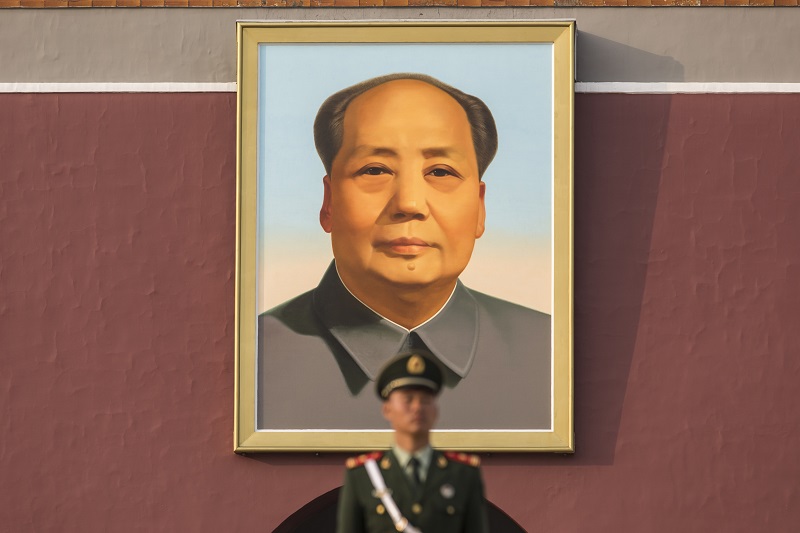
During the Chinese revolution, progressive forces of the world lent every possible support to it. At that time, it was widely believed that most of the Chinese people consumed opium and were always in a stupor. Additionally the country’s economy lay totally shattered. It was said that the people in China went to the market with a bag full of currency notes and returned with a pocketful of goods. It was the Communist party and its dynamic leader Mao-Tse-Tung who were trying to give a new life to the Chinese people. After the conclusion of the 30-year revolutionary march a new government assumed power. The progressive and liberal people all over the world celebrated the epoch making event. The Chinese revolution aroused great hopes among the people who were still struggling to free themselves from the clutches of imperialists. They expected (now People’s Republic of) China to help them if not materially, at least morally.
After China became a People’s Republic, Jawaharlal Nehru, among world’s eminent leaders, extended a warm welcome to the new nation and saw it as a symbol of resurgent Asia. In order to fortify our friendship with China, Nehru sent a goodwill mission to that country. The delegation was led by Tapasvi Sunder Lal and among others consisted of Shakir Ali Khan, who was popularly known as Sher-e-Bhopal and R. K. Karanjia, the editor of Blitz. While the people of China were struggling, India sent a medical mission to China under the leadership of Dr. Kotnis. Later a film was made on the services rendered by Dr. Kotnis and his team members. The film titled Doctor Kotnis Ki Amar Kahani became very popular. Nehru did everything possible to consolidate our friendship with China. “Hindi Chini bhai-bhai” became a very popular slogan both in India and China. Nehru thought that both India and China could jointly work for the creation of a new world. For many years, the US and other Western countries refused to recognise the existence of Communist China. Nehru did a lot to secure an appropriate position for China in the comity of nations.
He insisted that China should be invited to the historic Bandung conference. Both India and China agreed that ‘Panchsheel’ should guide the relations between the two nations. But various liberation movements of the world felt disappointed when the People’s Republic of China refused to play the role which Soviet Union had played after the establishment of socialist regime there. Soviet Union aided liberation movements, including the South African movement against apartheid and the Palestinian movement.
Besides liberation movements, the Soviet Union also helped newly liberated nations to build their economic base. Nehru continued to help China but issues relating to border disputes alienated the two countries. Not only with India,China also had border disputes with other countries including Vietnam. And the day came when China and India came face to face in 1962. It seems that China nearly abandoned Communist ideology and devoted its entire energy in turning the country into an economic power. In my opinion China’s war-like postures and the 1961 communal riots in Jabalpur (Madhya Pradesh) shattered Nehru completely. Nehru might have lived longer but for the war with China and Jabalpur communal riots.
China established communist regime with great socio-economic ideals but it soon abandoned them and turned into an ultra nationalist country. On the other hand, Nehru continued to uphold high ideals. Gandhi, Patel and many other Indian and world leaders considered him a visionary. He always favoured a peaceful solution of disputes between nations, and was prepared to sacrifice narrow interests of the country for that. He was bitterly criticised by opposition parties after an outbreak of violent clashes with China. One well-known Member of Parliament called him a traitor while participating in the Lok Sabha debate on the Chinese aggregation. I know the name of the MP but I am not mentioning his name because he is no more.
Not only did China betray us but it also joined hands with Pakistan which was an ally of the US and a totalitarian country. There is evidence that during the armed conflict between India and Pakistan in 1965 the Chinese leaders did everything possible to add fuel to fire and later even tried to sabotage the Tashkent meeting.
Like Nehru, Prime Minister Modi also tried to develop friendly relations with China and like Nehru he must be feeling betrayed. But let the opposition avoid using the unparliamentary language which they used against Nehru. At this hour let us collectively face the crisis and we can analyse pros and cons of the situation after normalcy returns.
*The author is a veteran journalist and political analyst.
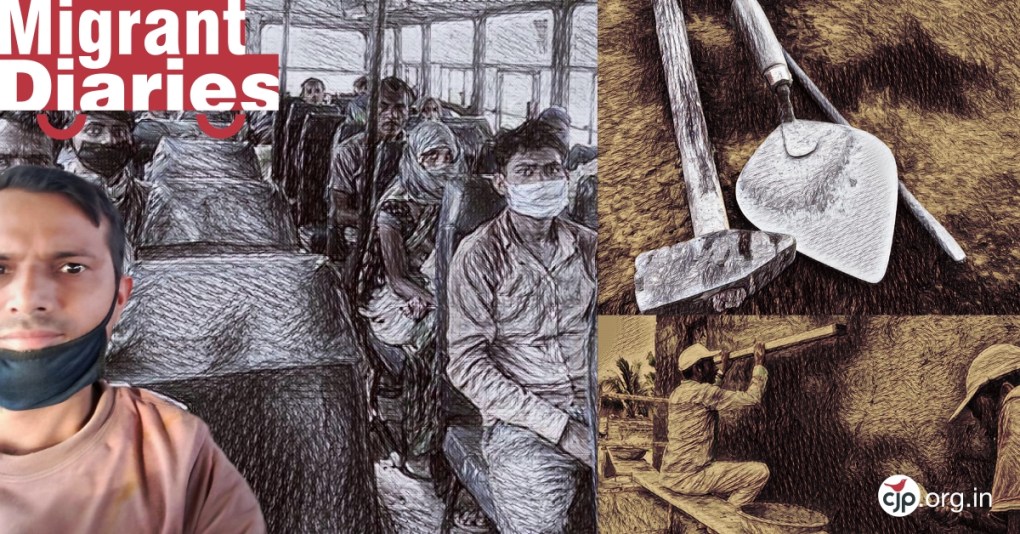
39-year-old Mohammed Jamaluddin is a skilled mason, who has been working in Mumbai for the past 13 years. But in wake of the coronavirus pandemic, he was forced to leave the city and undertake an arduous journey back home to his village in Birbhum, West Bengal. At first, he undertook two consequent journeys by bus, then travelled in the back of a truck, then a short distance even on foot, before again boarding a truck just so he could go home to his family!
Once he reached his village, he called to tell us, “The bus transport was provided by the government. But the journey was really painful and lack of proper coordination made it very challenging for homeward bound poor and helpless migrants.”
Jamaluddin, had never thought he would have to leave Mumbai this way. He had come to the city in 2007, and worked as a labourer for seven months. But he had to return to his village after that. “I returned to Mumbai in 2009, and since then I am working here. Initially used to work as a helper, but now I am a skilled mason. We are called ‘Naka Workers’, because every morning we stand at the naka (road crossings) and then the Mukadam, our contractor hires as many workers as he needs for the day. Everyone used to get work daily,” he recalls how he went about his work in Mumbai before the pandemic wreaked havoc on his life and livelihood.
Jamaluddin remembers the time when he would earn only Rs 110 when he worked as a helper. “As a skilled mason I earn Rs 1,000 each day, and get work 23-25 days a month on an average, so I earned between Rs 23,000-25000,” he says. Telling us about sharing accommodation with other migrant workers from West Bengal in Mumbai, Jamaluddin says, “There were more than 200 of us, seven of us shared a room, and we divided the Rs 5,000 rupees rent amongst ourselves.”
Jamaluddin had an annual work schedule and worked in Mumbai from October to June. As soon as the monsoon hit, work would slow down. He says, “During the rainy season I would always go back to my village and spend time with my wife, daughter who is three-years-old now, and my mother. I also have three brothers, but they live with their families.”
The visits home were spent relaxing and finishing any pending work in the house and sharing future plans with his wife. Jamaluddin says, “I would send Rs 15,000 back home and keep the rest. I have to save money because soon my daughter will start going to school, and I want to give her good quality education.”
When the lockdown was announced Jamaluddin did not panic. “All of us had some money so we brought ration for one month. But when the lockdown was extended, it was a real struggle for us. Our money was over and so was the ration. Then requested ration from various people but only Citizens for Justice and Peace (CJP) gave us rations that were enough for nearly a month,” he says. “While getting the food was a big relief, our real problem was that seven of us lived in one 100 sq ft room. A police post near our locality made it impossible for us to step out, but we managed to survive somehow,” he remembers the hot summer months almost trapped in the room.
He was keeping track of the news and heard that the trains were soon going to start. “I hoped we could return to our village but there was also news that the Chief Minister Mamata Banerjee had not given permissions for the train. We still filled up the emergency travel forms, but the police never called us. Living with six others in one small room during the scorching summer was really getting difficult. The whole day we were drenched in sweat, nights were a bit cooler but two of my roommates fell ill,” he recalls.
“By May 15, we began discussing if we should start walking to West Bengal, and hire whatever transport we find along the way. I was the only one suggesting that we wait for a few more days, as surely there will be some arrangements made. But everyone was frustrated and wanted to reach their village anyhow. That day, three of my roommates from Malda, West Bengal decided to go by truck, and paid Rs 3,500 per head,” says Jamaluddin.
On May 17 Jamaluddin’s other three roommates left paying Rs 4,000 per head for the journey back home. “Luckily, I heard about buses being arranged from Majiwada Thane to Chhattisgarh, so I went there and boarded the bus on May 18. I was so happy but my joy was short lived, as soon as I reached Madhya Pradesh, I saw that there was a waiting station for migrants from Bihar, Uttar Pradesh but there was nothing for West Bengal,” he says.
MOHAMMED JAMALUDDIN WITH OTHER MIGRANT WORKERS ON A BUS
Jamaluddin made enquiries and was shocked at the response. “They asked why I came here, that it wasn’t the route to West Bengal,” says Jamaluddin recalling feeling shattered. But later he found that the police had made some arrangements and one bus left for Chhattisgarh from Madhya Pradesh. “We were 21 people, it took us two days to reach Bilaspur, Chhattisgarh. There we boarded trucks leaving for Kharagpur, West Bengal, there were a total of 35 people in the truck and we had paid 200 rupees per head,” he says recalling another arduous leg of the journey.
Jamaluddin reached Kharagpur on May 21 but was in for another shock. “There was a camp in Kharagpur from where officials were sending migrants to their villages, but an officer questioned us about where we came from, how did we come, did we have permission. I told him the route we took, by bus till Chhattisgarh and then via truck. However, he said they had not been informed about all this and told us to leave! ‘You go to Mumbai again or go anywhere but don’t wait here’ he said, it was raining at that time,” Jamaluddin recalls feeling crestfallen at this point.
A stunned Jamaluddin I tried to explain the tough journey he and his colleagues had just survived but the officer was not ready to listen. “He forced us to leave from there. So, twelve of us started walking on the highway, towards Birbhum,” still coming to terms with the heartless treatment they had been meted out by the police. But Jamaluddin’s luck was about to change. “We had only walked a few kilometres and met a man who appeared like god for us, who asked us where we were going. I told him the entire story,” he recalls that chance meeting with a good samaritan who took them to a petrol pump near the highway, owned by his friend. “He asked us to wait there for the night and told us that the next day, May 22 there will be trucks going from here to Birbhum and other places to collect and drop stones,” says Jamaluddin.
The man told Jamaluddin and his friends that he will arrange for them to travel on these trucks too. “We were happy, the kind man even arranged food for us so that night. We ate and slept at the petrol pump. The next morning, we grouped according to our districts, and three of us boarded the truck headed towards Birbhum,” says Jamaluddin. As feared, at the Birbhum check post the truck was stopped by the police, who asked to see permission papers, “We had none, our truck driver gave Rs 1,000 to the police officer and then we were allowed to go. We pooled in money and repaid our driver,” says Jamaluddin showcasing how bribery is often the only resort for helpless people. They reached Birbhum that night and were made to wait at the Panchayat School. “I wondered if things would have been better if I had gone with my roommates earlier,” says Jamaluddin.
On May 23, they were sent to the government hospital for screening, and subsequently quarantined for 12 days. But, according to Jamaluddin, that was yet another horrifying experience. “Conditions at the quarantine were very bad, we were not provided food by them, and asked our families to bring rations for us. We cooked food ourselves every day and ate, there was no responsibility shown by the local government,” he says recalling his ordeal.
“It was a very bad experience for me but I am grateful to have met many good people who helped us for food, water, biscuits along the way. In each state, there were people distributing supplies and helping migrants returning home, just like the man who helped us reach Birbhum. I also want to thank all of you at CJP, and everyone across our country who are helping the poor. I have no trust left in the government,” he says. “We are not at fault. This Covid-19 has come from other countries but it is the poor who have to suffer,” says Jamaluddin expressing anguish at how he feels that the authorities abandoned the poor in this crisis situation.
Meanwhile, economic compulsions have made Jamaluddin realise that he has no other option, but to return to Mumbai. “I am waiting for things to get normal so that I can again go back to Mumbai and work, because there is no work in my village, and even if there is a job the payment is so little,” he says.


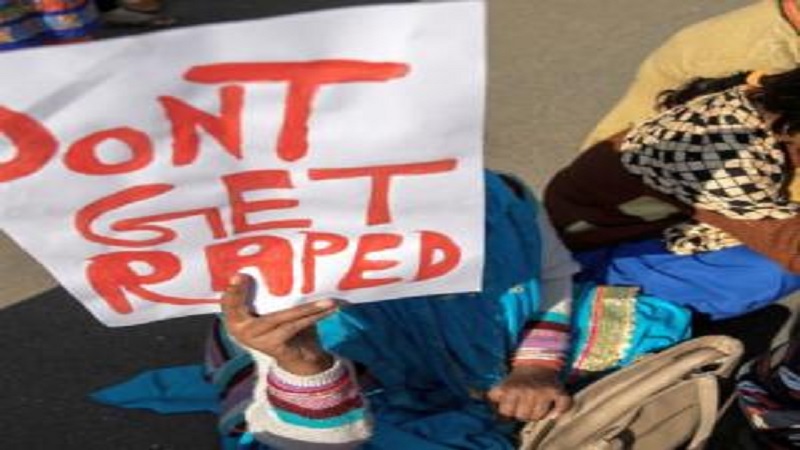 Image Courtesy:rediff.com