New Delhi: Leprosy is back in India. Health officials and activists celebrated 13 years ago when India announced that leprosy had been eliminated as a public health concern. Alarm bells rang as the Central Leprosy Division of the health ministry reported that 135,485 new leprosy cases were detected in India in 2017. That meant every four minutes somebody was diagnosed with leprosy in India. This is nowhere close to elimination.

India will eliminate leprosy by 2018, Finance Minister Arun Jaitley told parliament in a budget speech on February 1, 2017, in an admission that the disease abounds. Activists working in the field say the target is impossible to achieve.
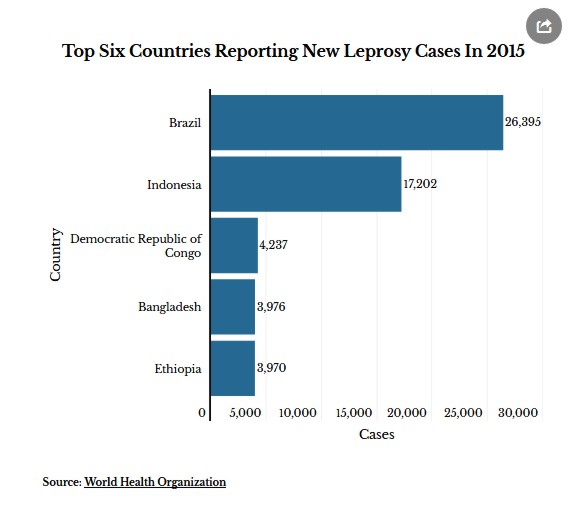
Of the new cases detected, nearly half (67,160) have been diagnosed at an advanced stage. And the number of new detections is high. For instance, in Telangana’s Adilabad district, a small village called Kushanpally with 250 houses (1,040 people) turned up 19 cases. “Pockets of high endemicity report thousands of new cases every year,” the World Health Organization (WHO) noted in 2016, adding that in 2015, India had accounted for 60% of the global total of new cases.
There is no reliable pan-India study or survey on the incidence of leprosy, and activists say the government is reluctant to record new cases for fear of losing its ‘elimination’ status.
Unwanted and neglected
Rachna Kumari was married at 18 and had two children by the time she was 21. Life was good in Munger, Bihar. Her world suddenly collapsed when she was diagnosed with leprosy. Her family disowned her and asked her to leave home.
Heartbroken, she fought with herself to find the courage to battle the disease and reclaim her life, alone. After being cured, she decided to dedicate her life to fighting discrimination in any form. Today, she sits on the panel of the International Federation of Anti-Leprosy Associations that works for leprosy patients. She works with Lepra Society’s Referral Centre in Munger, Bihar. “My dream is for the world to be leprosy-free. I tell every new leprosy patient not to feel ashamed but hold their head high and not have any fear,” she said, “If we all work together with sincerity, we can eradicate leprosy just as we did with polio.”
India has more than three million people with deformities caused by leprosy. They are relegated to the margins of society and feel neglected and unwanted, living mostly in 750-odd leprosy colonies. Society largely treats them as social outcasts.
Being infectious, leprosy can spread easily. If not detected in time, it spreads through skin and peripheral nerves, damaging the nerves of the hands and feet to render them dead to sensation. This naturally leads to disabling injuries. This is why leprosy is feared and stigmatised so much.
Most of us do not contract leprosy as our immune system is strong and we have built a resistance to mycobacterium leprae, the bacterium that causes the disease. It is those with weak immunity that fall prey to it. Invariably, it is the poor who are malnourished and do not have easy access to medical facilities.
Elimination is not eradication
Since India received funding from the WHO to tackle leprosy, it was under pressure to show progress, activists and experts say. The government hurriedly announced in 2005 that leprosy was eliminated–which implies that incidence is one case per 10,000 (0.01%). Some experts questioned the manner in which this elimination was achieved–for instance, by stopping active case-seeking (and counting on self-reporting, which invariably leads to under-reporting), and by not counting single-lesion cases (which are considered less serious).
Thanks to India’s vast population, even fewer than “1 in 10,000 cases” can number in the lakhs overall. Despite achieving elimination of leprosy as a public health problem in 2005, India had the largest number of leprosy patients in the world, the WHO noted in 2016.
Also, the ‘one in 10,000’ figure was arrived at by taking an average of all the states, disregarding the vast variations between states. For instance, large and underdeveloped Uttar Pradesh had a high incidence, while developed states such as Kerala had a low figure. Bunching all these together to achieve elimination status proved a costly mistake.
‘Elimination’ was confused with ‘eradication’–the latter refers to the complete and permanent reduction of new cases to zero–and the threat of leprosy was prematurely considered over. The government machinery that worked for leprosy elimination slackened, and its personnel were transferred to other health departments considered in more urgent need. Front-line workers stopped household visits to identify undetected cases.
Under-reporting of cases
Stoppage of active surveillance after the elimination announcement has led to severe under-reporting of cases in India, studies such as this one from Munger, Bihar, have pointed out.
Finding an increase in ‘heightened disability’ among the new cases detected, a midterm evaluation of the National Leprosy Eradication programme in late 2016 said that this indicated “that the cases are being detected late in the community and there may be several cases which are lying undetected or hidden”. These hidden cases are dangerous because untreated patients are “an active reservoir in the community which transmit the disease to [the] susceptible”, the review said. It also found a large number of children among those detected.
Yet, several activists and researchers who work with leprosy patients told IndiaSpend, while insisting they not be named, that the government is resisting documentation of new cases. They pointed out, for example, that for several years after 2005, the number of new leprosy cases detected hung around the figure of 130,000 annually as it was deliberately kept within the elimination range (0.01% of India’s 1.3 billion population).
The official number of new patients “is largely coming from passive reporting as there is no nationwide move to detect cases”, Ashim Chowla, chief executive of Lepra Society, Secunderabad, told IndiaSpend.
Places such as Delhi, Chandigarh, Dadra and Nagar Haveli, Odisha, West Bengal and Lakshadweep, which were at the forefront of elimination targets, are now among the worst affected. Kerala, for instance, which has the best health indicators in India and once had the lowest rates of leprosy, now has a large number of leprosy patients–probably because of the high number of migrant labour that comes in from Uttar Pradesh, Bihar, West Bengal and Odisha, where wages are lower.
Early detection and treatment
In case of leprosy, early detection and treatment before any disability sets in is important, as is rehabilitation of those who have been disabled so that they can live independently and carve out a dignified life. But society is rife with stigma and discrimination. Health activists have to fight numerous myths that have caught on because of poor understanding of the disease. One such myth is of leprosy being divine punishment for past sins.
Stigma prevents most patients from seeking medical treatment until it is too late, activist Vineeta Shanker, executive director of Sasakawa India Leprosy Foundation, points out. Nerve damage is irreversible and once disabilities set in, social rehabilitation becomes very challenging.
“We have to struggle even with the highly educated as well as opinion makers,” Chowla said. “Fairly recently, the Pope said that child abuse was like ‘leprosy in our house’. Because of the stigma involved, patients try to hide it. Changing attitudes takes time; even the government does not have the wherewithal to deal with something so complicated and produce quick results. This requires involvement of all stakeholders and drivers of change.”
Recently, parliament passed an amendment to remove discrimination against leprosy patients in various laws, especially those governing marriage and divorce, across faiths. There were 119 such laws, which blatantly discriminated against leprosy patients–for instance, by holding leprosy a valid reason for divorce, and considering leprosy an “incurable and virulent” disease. The government is also working on a draft bill to eliminate discrimination against persons affected by leprosy.
There are practical problems in detection, too. All parts of the patient’s body need to be examined, in good light, but most places where patients are examined are poorly lit. Male staff often shy away from asking women, especially in villages, to take off their clothes for examination. Many women refuse to do so. This means small diseased patches, of which even the patient is unaware, go undetected.
Once detected, the government treats leprosy patients for free. Patients are administered a multidrug therapy–a combination of different drugs–which is very effective and usually cures within six to 12 months.
As essential as early detection and treatment is post-treatment follow-up to detect relapse and identify drug-resistant strains.
The success of the anti-tobacco movement gives Chowla hope. “Leprosy needs something similar with corporate, private institutions and NGOs putting their commitment behind eradicating the disease,” he said. Since leprosy mainly affects the poor, it does not get the attention it deserves. The challenge is to end transmission by detecting cases and immediately putting them on multi-drug therapy, which should be made available even in the remotest parts of India. “There is no solid infrastructure at the moment that is geared to either detect and treat or end discrimination against patients,” he said.
Targets Of New Global Strategy For 2020 - Zero disabilities among new pediatric patients.
- Achieve a disability rate of less than 1 case per 1 million people.
- Zero countries with legislation allowing discrimination on basis of leprosy.
- Sustained and committed efforts by national programmes along with continued support from national and international partners.
- Increased empowerment of people affected by the disease, together with their greater involvement in services and the community bringing us closer to a world without leprosy.
Source: World Health Organization (June 2017)
Earlier this year, the Supreme Court directed states and the central government to roll out awareness programmes about leprosy, something India should have proactively done seven years ago when it became a signatory to the United Nations resolution on the elimination of discrimination against persons affected by leprosy and their family members.
The court said campaigns should not use frightening images of leprosy affected people but utilise positive images and stories of those who had been cured. The judgment came as huge relief by focusing attention on the need to urgently deal with the disease, Nikita Sarah, Head of Advocacy, The Leprosy Mission Trust, India, said.
A good workable strategy in India may be to integrate leprosy care with other areas of healthcare so that the perception of it being a dreadful disease that has to be treated separately disappears.
One of the main challenges in the fight against leprosy is that there is no vaccine against it yet, Mary Verghese, Executive Director, The Leprosy Mission Trust India, told IndiaSpend. The only way to end transmission, she said, is to ensure that people know how to recognise early signs and symptoms of leprosy and come in immediately for treatment. Increased resource allocation towards leprosy control is imperative, she said.
(Ramesh Menon is an author, independent award-winning journalist, documentary film-maker and adjunct professor at Symbiosis Institute of Media and Communication.)
Courtesy: India Spend