The JNU VC has fed this information to the Times of India. The title of the table below, published in the Times of India, should be Get the Numbers WRONG, as barring two rows, all the numbers are incorrect. And the interpretation that our VC gives to these numbers is even WRONGER!
First of all, JNU has no exclusively M.Phil. intake at all. It either admits students to an integrated M.Phil./PhD or a Direct PhD programme. As per the 142nd Academic Council, the approved intake for the M.Phil./PhD programme for 2017-18 is 1072. Everybody in the combined M.Phil./PhD programme will enter at the M.Phil. level, this figure of 1072 is much less than the 1345 (sum up Row 1) allowed by the UGC Regulations 2016.
The conclusion: THE NUMBER OF JNU STUDENTS IN M.PHIL. DO NOT EXCEED THE BOUNDS DEFINED BY THE UGC REGULATIONS 2016.
Second, as per the 142nd Academic Council, the approved intake for the Direct PhD programme for 2017-18 is 178, a figure which is just a fraction of the 3894 students allowed by the UGC Regulations 2016. Assuming that every year, 1072 students from M.Phil. get added as well to the PhD programme from the previous year’s integrated M.Phil./PhD programme as well, the fact is that every year just 1250 students start working for the PhD degree, i.e. just a third of the 3894 PhD scholars allowed each year.
The conclusion: THE NUMBER OF JNU STUDENTS IN PHD DO NOT EXCEED THE BOUNDS DEFINED BY THE UGC REGULATIONS 2016.
The only argument for reducing intake is therefore the caps on research students that were first introduced by the UGC 2009 Regulations and then repeated in 2016, whereby a Professor can guide a maximum of 8 PhDs and 3 MPhils, an Associate Professor can guide 6 PhDs and 2 M.Phils, and an Assistant Professor, 4 PhDs and 1 M.Phil. In a combined M.Phil./PhD integrated programme, it makes sense then to look at the PhD data in the table rather than the MPhil.
And what does one see there?
NO VIOLATION OF THE UGC REGULATIONS AT ALL (look at the first two rows in the PhD section): ALL THREE CATEGORIES IN JNU HAVE SIGNIFICANTLY LESS NUMBER THAN THE MAXIMUM NUMBER OF SCHOLARS IN EACH. For example, where Assistant Professors as a group could have 636 students, JNU’s data indicates that they are only 534 PhD students enrolled.
With the case for an intake reduction disappearing, enter the VC as Robin Hood, trailing behind a shifting goalpost. The issue is no longer the UGC Regulations 2016 but how there must be an ‘equitable distribution’ of students. This is highly problematic:
Well, first of all, students are not LADDOOS to be distributed amongst the devotees. Students are as actively involved in the choice of supervisor as faculty are, and their decision about supervisors is guided by area of specialisation and topic of research. IS THE GOAL OF THIS REDISTRIBUTION TO ELIMINATE THE STUDENT’S RIGHT TO HAVE A SAY IN THE MATTER?
Second, in a faculty member’s career in the institution, there can be periods in which there are only a few research scholars or even working with her for a variety of reasons — such as engagement in her own research (e.g., writing a book, doing a research project), the demands of university administration, and other factors. CONSIDERATION OF DATA FOR JUST A YEAR OR TWO IS SIMPLY MISLEADING.
Third, should a university administration not be happy that in general, the university faculty, and particularly its professors, are so willing to shoulder the responsibility of research supervision? And SINCE SUPERVISORS ARE FORMALLY ASSIGNED TO STUDENTS BY CENTRES/SCHOOLS/SPECIAL CENTRES, WHERE IS THE QUESTION OF US ‘GRABBING’ STUDENTS?
Last year, in February, JNU teachers were called anti-nationals, living off the taxes paid by the toiling masses. This year, we are being accused of anti-national again – but this time, for working too hard!
Ayesha Kidwai is Professor at JNU and President, JNU Teachers’ Association
Marches in over 20 cities across country to protest US President Trump
Mexico City March against Donald Trump, February 12, 2017; Photo Credit: AFP
Tens of thousands of Mexicans protested Sunday against US President Donald Trump, hitting back at his anti-Mexican rhetoric and his depictions of them as “rapists” and "criminals" and to demand “the respecting of Mexico.
"Mexico must be respected, Mr Trump," said a giant banner carried by protesters in Mexico City, who waved a sea of red, white and green Mexican flags as they marched down the capital's main avenue.
In what is shaping up to be Mexico's biggest anti-Trump protest yet, over 20 cities joined the call to march. Dozens of universities, business associations and civic organisations are backing the protest.
"It is time we citizens combine forces and unite our voices to show our indignation and rejection of President Trump, while contributing to the search for concrete solutions," said the coalition behind the marches.
Protester Julieta Rosas was wearing a T-shirt with a picture of Trump sporting an Adolf Hitler mustache.
"We're here to make Trump see and feel that an entire country, united, is rising up against him and his xenophobic, discriminatory and fascist stupidity," said Rosas, a literature student at the National Autonomous University of Mexico (UNAM).
"We are all migrants. We are all one. This is a time to build bridges, not walls," said 73-year-old protester Jose Antonio Sanchez, who was marching with his nine-year-old granddaughter.
Until its re-accreditation, NHRC will not be able to represent India either in the UN’s Human Rights Council or the UN General Assembly.
In a major embarrassment to India, an organisation affiliated to the United Nations High Commissioner for Human Rights (OHCHR) has recommended that the re-accreditation of the National Human Rights Commission (NHRC), be kept on hold till November 2017 by the OHCHR, according to a report published by Scroll.
The recommendation has been made by the OHCHR affiliate, Global Alliance for National Human Right’s Institutions (GANHRI). This means that until re-accreditation, NHRC will not be able to represent India either in the UN’s Human Rights Council or the UN General Assembly.
The report effectively damns the way the NHRC has been conceived under the Protection of Human Rights Act, 1993, its selection and appointment process all of which make the rights body critically dependent on the government of the day and vulnerable to political pressure. As highlighted by Scroll:
Only 92 of the NHRC’s staff—a mere 20%—are women, the report notes, and that since 2004, there hasn’t been a single woman on the governing body.
The legislative requirement of having an ex-CJI (Chief Justice of India) as chairperson and choosing members of the senior judiciary severely restricts the potential pool of candidates who can be appointed, especially women.
The report questions why top cops and serving or retired police personnel should be accommodated in the investigating wing of the commission. This question becomes crucial because the NHRC is tasked with investigating human rights violations by the government and its agencies, including the police.
Citizens’ rights groups within India have for long been pointing to these very lacunae that the NHRC suffers from.
Devika Prasad, coordinator of the Police Reforms Programme of the Commonwealth Human Rights Initiative (CHRI), has been quoted by Scroll as saying that given the paramount mandate of the NHRC—to protect citizens from rights violations by the State—having an investigative unit stacked with, and headed by a police officer, is incompatible with the very idea of natural justice. “For a start, the NHRC could do with having a unit which has policemen in it, but also comprises other competent personnel having diverse experiences and the requisite skill-sets”, she suggests.
The report of the GANHRI’s sub-committee on accreditation (SCA) expresses serious reservations about a senior civil servant being the NHRC’s Secretary General (the present incumbent is Satyanarayan Mohanty, an IAS officer), and also asks why the Chairperson of the National Commission for Schedule Castes and Tribes—an elected MP—has voting powers in the commission.
While noting that the NHRC does need to work with the government in many cases, the SCA report categorically states that the commission needs to be completely independent and insulated from government and political influence.
The SCA report has also severely criticised the mammoth backlog of over 40,000 cases pending before the NHRC. Henry Tiphagne, General Secretary of All India Network of NGOs and Individuals working with National Human Rights Institutions (AiNNI) has rightly pointed out that in all the 24 years of its existence, the NHRC has not had a member of civil society in its topmost echelons, and it is time for the government to rise to the occasion and intervene in order to form a truly independent commission which recognises and practises diversity.
After maintaining a studied silence for some days, former chief justice of the Supreme Court and the present NHRC chief, HL Dattu while talking to the Hindu sought to play down the implications of the severe castigation of NHRC as part of a “regular process which happens every five years”.
Asked to comment on the SCA’s castigation of NHRC for “political appointments”, “police officers being part of its investigation unit” and “lack of pluralism in its staff “, he said: This (India’s Protection of Human Rights Act, 1993), was framed in such a way. And anyway, six eminent people – including PM, Speaker, Rajya Sabha deputy chairperson, leaders of Opposition in the Lok Sabha and the Rajya Sabha, and minister in-charge of human rights ministry – are part of the committee selecting the chairperson and members of NHRC. We have to give due credit to their wisdom”.
New Delhi: When Narendra Modi made his maiden visit to Saudi Arabia last year, it was widely hailed as another masterstroke by the Indian prime minister with commentators dubbing his act as ‘Modi scoring big with befriending Saudi.”
Modi’s supporters in media and outside argued that by befriending Saudi, Modi had effectively neutralised the influence of India’s arch-rival, Pakistan. However, the latest data shows that 50% Saudi jobs meant for Indians shifted to Pakistan and Bangladesh under Modi as India’s prime minister.
The Narendra Modi government had come to power on the promise of creating two crore jobs early but half of its tenure has passed and the unemployment rate is continuously increasing. This has been admitted in the Rajya Sabha by Minister of State for Planning Rao Inderjit Singh.
Photo: Hindustan Times
Backwards are the largest sufferers. In reply to a question during Question Hour, Singh had said that overall unemployment was rising, but the rate was highest among the Other Backward Classes (OBCs).
Ironically, the government not only failed in creating jobs back at home but it indirectly shifted more than 50% gulf jobs meant for Indian workers to Pakistan and Bangladesh.
The complication of newly introduced eMigration system caused havoc and Saudi employers in turn started shifting the job opportunities towards neighbouring Bangladesh and Pakistan.
The unnecessary formalities in visa possessing created utmost delay in e-migration clearance for non-skilled and semi-skilled workers who go to gulf countries in search of jobs.
The government data shows that there are more than 50% decrease in number of migrant workers who go to Saudi Arabia for jobs since the Modi government came to power.
In 2013, there were 3,53,565 Indians who went on job visa to Saudi Arabia while in 2016 only 65,356 could go there for jobs.
In 2013, there were only 12,654 Bangladeshis who got employment in the Gulg country but in 2016 their number rose to 1,43,913. While in 2013 the number of Pakistanis who got employment in Saudi Arabia were 6,36,721, this number increased to 7,71,867 in 2016.
It is to be noted that the Ministry of Overseas Indian Affairs (MOIA), the Government of India, rolled out its eMigration Project to all the POE offices perhaps without taking its adverse fallouts and implications into consideration.
As a result, over half a million job opportunities from India have already been lost to other neighboring nations like Bangladesh, Pakistan and Sri Lanka where there is no such complicated formalities like eMigrate System or Minimum Referral Wages.
Furthermore, if this policy does not change, there are fears that India will lose to the tune of $30 billion annually in the form of foreign remittance which is one of the major sources of strengthening our vibrating economy.
India gets the highest amount of remittances in the world at roughly $70 billion, almost three times the amount of FDI that comes into the country.
By far, the largest amount comes from the Gulf countries – Qatar, Bahrain, Oman, Saudi Arabia and Kuwait – which sent a combined $32.7 billion, almost half of all remittances received. Below is the foreign remittances data as compiled by the World Bank.
It resulted into steep decline in remittances from Saudi Arabia which is the largest employer of Indian workers.
During his UAE visit in August 2015, PM Modi had promised to the Gulf employers that the complicacy of eMigration system will be resolved in 30 days, but that is yet to happen.
Oscar-winner Meryl Streep has responded to the President Donald Trump’s recent labelling of her as “over-rated” following her Golden Globes speech, saying “yes, I’m the most overrated and over decorated actress”.
The 67-year-old star slammed Trump in her scathing speech while accepting the Cecil B DeMille Award at Globes last month. She took swipes at his divisive rhetoric without naming him as she cautioned against powerful people using their position to “bully others”.
Later, responding to Streep’s comments, Trump tweeted at the time, “Meryl Streep, one of the most overrated actresses in Hollywood, doesn’t know me but attacked last night at the Golden Globes.”
The actress took aim at Trump yet again while speaking at the Human Rights Campaign’s 2017 Greater New York Gala Dinner, according to The Hollywood Reporter.
“Yes, I am the most overrated, over decorated and currently, over berated actress, who likes football, of my generation. But that is why you invited me here! Right?,” she said.
Without mentioning Trump’s name, she continued, “Which brings us to now. We should not be surprised that fundamentalists, of every stripe, are exercised, and fuming.
We should not be surprised that these profound changes come at a steeper cost than we originally though. If we live through this precarious moment- if his catastrophic instinct to retaliate doesn’t lead us to nuclear winter, we will have much to thank our current leader for.
“He will have woken us up to how fragile freedom is. The whip of the Executive, through a Twitter feed, can lash and intimidate, punish and humiliate, delegitimize the press and imagined enemies with spasmodic regularity and easily provoked predictability.”
Streep was honoured at the event for her acting career and also her support of the LGBT community over the years.
The actress also talked about some of her previous roles in films that addressed LGBT issues.
“In ‘The Hours’ all I did was kiss Allison Janney, take, after take, after take, after take… that wasn’t hard… I am fairly proud of my jolly portrayal of a gay conversion therapist on Lisa Kudrow’s show ‘Web Therapy’ – I feel our Vice President might want to check out those episodes, as my character’s views seem to be in line with his own,” Streep quipped.
Rather than delink police forces from the IPS, it is imperative to improve the leadership provided by the elite service.
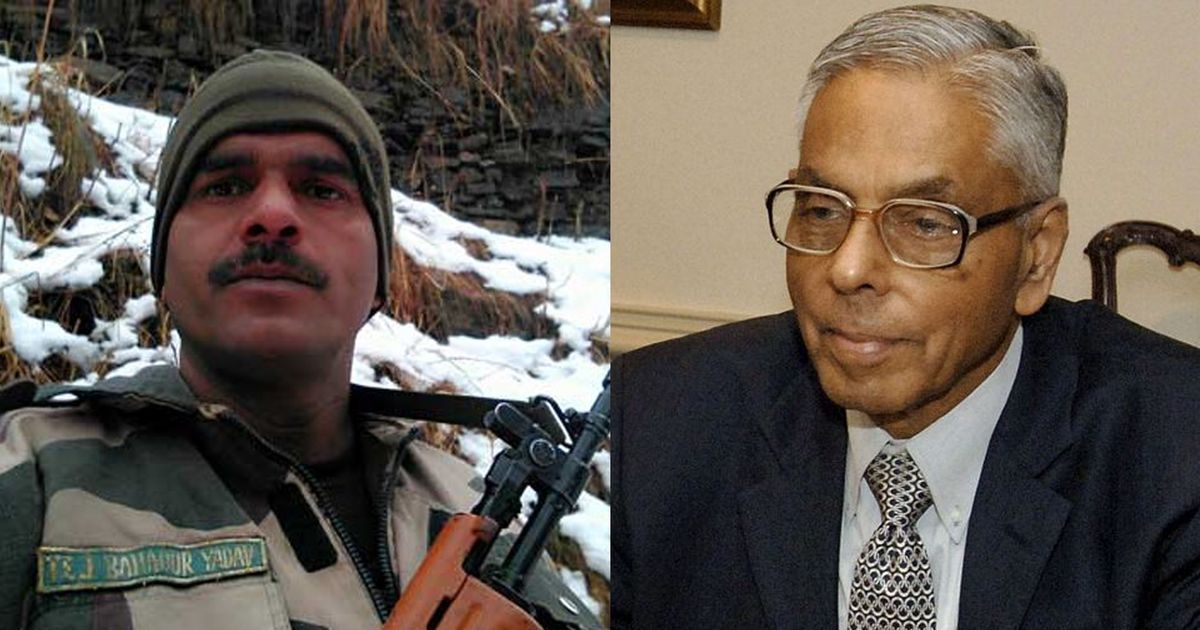
Image credit: BSF Jawan Tej Bahadur Singh (L) and MK Narayanan (R)|YouTube and Wikimedia Commons
The uploading of a series of Facebook videos in January by a disgruntled constable of the Border Security Force, Tej Bahadur Yadav, about the apparently poor quality of food and tough working conditions has understandably caused a lot of outrage and concern. The surfacing of similar social media posts in the wake of Yadav’s viral videos created a narrative of exploitation of the brave sacrificing jawans at the hands of an allegedly corrupt, callous and feudal cadre of officers. That living conditions, equipment, training and promotional avenues of our Central Armed Police Forces – which include the Border Security Force, Central Reserve Police Force, Central Industrial Security Force, Indo-Tibetan Border Police, Sashastra Seema Bal, National Security Guard, and the Assam Rifles – should improve further is not disputed. There is an awareness that our troops need to be leaner and better resourced and modernisation is a strategic imperative.
But, in view of the current mandate of internal security challenges as well as budget constraints, this transition will take much longer than the attention span of 24×7 media. One of the uninformed suggestions emerging out of the current debate is that the leadership of the forces needs to change fundamentally so that leaders are more aware of ground realities, have adequate experience, and are committed to a long-term career to lead the force rather than short casual stints.
The top leadership in the police, intelligence and investigative organisations, both in the Central government and state governments, currently come from a common pool of leaders belonging to the Indian Police Service. Somewhere up there, Jawaharlal Nehru and Sardar Vallabhbhai Patel, the architects of the All India Services who argued passionately in the Constituent Assembly for the adoption and evolution of the British-era Indian Civil Service and the Imperial Police into the Indian Administrative Service and the Indian Police Service, are sure to be wringing their hands in despair. The national needs that led them to champion the concept of the All India Services have not gone away. If anything, the challenges to India’s stability and prosperity have become more complex and acute. It is, of course, obvious that the Indian Police Service cannot consider itself a holy cow any longer. Constructive criticism as well as meaningful change are both urgently required. While meeting these challenges would require rethink and reform at all levels, including that of the IPS, abolishing it or drastically curtailing its pre-eminence in our internal security architecture would be ill-advised.
The Tej Bahadur Yadav theory of what ails our internal security goes something like this: Why do our jawans get poor facilities? Why do they choose to leave the forces in large numbers each year? Why do we have recurring incidents of fratricide and suicide? A common refrain is: because they are led by Central Armed Police Forces officers who are themselves disgruntled and resentful of the IPS presence in their organisations. So, the obvious solution is to remove the latter from the former. The argument goes that this will motivate the Central Armed Police Force officers to work with greater dedication for the welfare of their jawans.
Clearing misconceptions
Anecdotal evidence and outright fudging is marshalled as evidence to create a supposedly compelling case for radical surgery of these forces. There is no doubt that the Indian Police Service and the police organisations it leads both need reform and rejuvenation, but not for imaginary reasons based on ignorance or vested interests.
First, to clear some common misconceptions about our Central Armed Police Forces and the role of the IPS in these organisations. Barring the Central Reserve Police Force, which goes back in origin to the British Raj, every other such organisation has been created and nursed into its present shape by successive generations of IPS officers. As they have grown, the relatively small and stable size of the IPS cadre has meant that fewer IPS officers have been made available to man their tactical-level leadership positions, which are now filled by the forces’ own cadre officers. The IPS presence in these organisations has never been lower. For example, the Border Security Force has less than 50 IPS officers serving in an organisation with nearly 4,500 officers. The Indo-Tibetan Border Police has nearly 1,400 officers, of whom about 15 are from the IPS. To suggest that this limited presence is the root cause for the neglect of our jawans is stretching credulity. As things stand, more than 80℅ of Central Armed Police Force officers retire at the level of deputy inspector general or above. Compare it to the Indian Army where less than 5℅ of officers retire at the roughly comparable level of brigadier and above. Clearly, stagnation is not a credible reason for incidents such as the one involving Tej Bahadur Yadav to take place. Even the Army, which has a unified officer cadre, is not immune to occasional lapses and resultant controversies.
The unique position of the All India Services, the talent pool they represent, the exposure they have very early in their career, and the expectations from them are such that plain vanilla comparisons of career slopes can lead to misleading conclusions. The Constitution includes policing in the state list, and maintains a balance with an All India Service like the IPS for coordination between state and central organisations. Divesting the IPS of their current role as leaders of police forces in the state and the Centre goes contrary to the constitutional framework. Besides, in pure human resource terms, there is no empirical evidence that non-IPS leaders are better than those from the IPS in terms of their innate merit, that any larger public interest will be served or that coordination between central agencies or between central and state agencies will improve by undermining the current leadership structures. So, stagnation is a false premise more oriented to the interest of the proponents rather than the constitutional framework or managerial needs.
Similarly, some have pointed out high attrition rates in our Central Armed Police Forces as a symptom of the supposed rot within. Current attrition rates for these organisations are at around 2℅ overall. Any HR manager in the private sector would kill for such low numbers. What is, of course, a matter of concern is the relatively low levels of pay and other facilities given to jawans, compared to the Army. Successive pay commissions have retained the edge given to the armed forces. Ultimately, this is an issue that can be resolved by greater discussion with all stakeholders till a consensus is reached. Given the enormous responsibilities being shouldered by the police forces, it certainly merits a more sympathetic approach. However, given the hybrid nature of the Central Armed Police Forces, where they perform a plethora of duties in aid of state administration and police authorities, closing them to the IPS would damage our federal structure and impact our internal security.
BSF jawan Tej Bahadur Yadav video about service conditions went viral.
Police reforms
Coming to the wider issue of reforming the Indian Police Service to better equip it for its role as strategic leaders of our internal security, this is a topic that needs far more serious reflection and debate. Even before the Tej Bahadur Yadav incident, the service’s credibility and utility have been called into question from various quarters. Its elite nature, and its varied opportunities have ensured that it remains a coveted brand that attracts some of the finest youth from premier universities to join the police and occupy leadership positions. But, from time to time, there is criticism about the efficacy of such an elitist service and even demands for fundamental changes to leadership structures in the police. The general response of the IPS has been to deny deficiencies and blame other factors for individual command failures and performance shortfalls. The IPS cannot actively seek reform and renewal of others while sparing itself.
Nineteenth-century police reform in Britain is often held as a mirror in any conversation on police reform. The English ruling class created an independent and professional police force, thereby bestowing the police with the legitimacy to maintain order. True, the police in the United Kingdom do not carry arms, but they are equipped with the most potent weapon of policing – the consent of the people for policing society.
Young IPS officers, working as police superintendents of districts, have limited work experience and possibly know less about the intricacies of day-to-day policing than the station house officers of police stations. But, the IPS brand introduces them to an alien district immediately on arrival as trustworthy, unless proved otherwise. One of the core recommendations of the National Police Commission, appointed by the government in 1977 to review the policing system, centred on the appointment of police chiefs, so that they carry legitimacy. This aspect needs to be strengthened by ensuring that young superintendents of police are given the requisite institutional backing and resources to do their job in line with public expectations.
A second non-negotiable aspect of police leadership in the Indian context is the ability for strategic thinking; the knack for seeing the larger picture. A parallel can be drawn to the United States Army’s realisation after the Vietnam War that their military leaders need knowledge of history, sociology and international relations far more than proficiency at tactical platoon-level drill. The diversity of challenges for a graduate of the US Military Academy, West Point, today ranges from the South China Sea to the mountains of Afghanistan and the streets of Mosul, Iraq. When our current generation of police chiefs in India were trained at the National Police Academy in Hyderabad, there were no computers or mobile phones. No academy could have prepared them for the job they do today. The way West Point deals with this problem is by focussing on strategic thinking and encouraging their graduates to go on long sabbaticals to the best of US academic and research institutions for periods ranging from three years to five years, to maintain an intellectual edge throughout their careers and afterwards. That is how they come to head the army and intelligence set-up and play a pivotal role as equal partners with the foreign policy and security establishment in deciding on the role of the US in a changing world.
In understanding the role of the IPS or in seeking changes, the two factors of enhancing legitimacy and developing strategic thinking have to be core principles. Changes should be made only to enhance the legitimacy of police leaders and to give them the intellectual resources to provide strategic leadership. Uninformed criticism can always be wished away, but there is now an apprehension among serving and retired police officers that the legitimacy of police leaders and their intellectual depth to provide leadership are sharply declining. If this continues, at some point, the IPS will be perceived as no different from the rest of the police force. There is a problem in police leaders appearing ordinary or people beginning to think that whoever has political patronage can become a police chief, irrespective of intellectual depth and strategic vision. These developments will corrode the IPS brand, cultivated over long years of dedicated service to the nation.
Recruitment process
The Indian Police Service has produced two national security advisers, including current incumbent Ajit Doval.
India has seen some great police leaders such as Rustamji, Rameshwar Nath Kao, BN Mullik, Ashwini Kumar, Julio Rebeiro, KPS Gill and so on. The IPS has already produced two national security advisers in MK Narayanan and Ajit Doval. But, IPS officers, both serving and retired, recognise that the chiefs now have a much diminishing role and most are unable to go beyond adding their name to the succession board in the chief’s office. Therefore, the time has come for serious thinking on systemic reform keeping in mind the two fundamental objectives: enhancing legitimacy and strategic thinking. Recruitment, training and career planning of IPS officers must lay greater emphasis on both these factors.
Currently, recruitment to the IPS is through two routes: two-thirds of officers get in through the combined civil service examination conducted by the Union Public Service Commission, and one-third via promotion from among eligible State Police Service officers. The view that the traits required of a good police officer are different from other civil services and that they should, therefore, be recruited through a separate examination hardly shows any understanding of modern policing. The critical question is whether separating IPS recruitment will enhance the legitimacy of the service or attract officers who are more capable of strategic management. We do not think so. Given the centrality of good policing in democratic expectations of good governance, police leadership should continue to be recruited with other civil servants assigned leadership roles. In fact, the combined civil service examination is as good a way of finding talent, and holding another examination will be wasteful, unnecessary and will not lead to hiring of talent with a different background, talent-set or attitude.
But, with the expansion of police organisations at the state and central levels, there is a net shortfall of IPS officers. There is also a need to accommodate the aspirations of direct recruit assistant commandants in the Central Police Organisations. The growing strength of the Central Armed Police Forces requires their seamless integration into our internal security architecture. So, two changes can be thought up. First, the promotion quota should be increased to 50%. Second, the slots created by the increase should be used to promote officers from these forces to the IPS, which would require waiving off the condition applied to State Police Service officers that the officer should have managed a police sub-division for five years. Central Armed Police Force officers deployed on internal security duty can be asked to take the Union Public Service Commission’s examination on criminal law and then be inducted against this enhanced quota and allotted to states.
Training, intellectual growth
The Indian Police Service training, both basic and in-service, also has to undergo a complete paradigm shift, almost along the lines of the West Point Academy. Unfortunately, the outdoor training of the IPS is no different from similar training for other ranks. In fact, these infantry-style training programmes are not followed in any developed part of the world, but have been perpetuated by inertia and lack of vision. As far as academic input is concerned, the National Police Academy hires faculty members with police backgrounds. They have no academic or research experience. Unfortunately, the general lack of quality in India’s higher education system has a direct bearing on academic standards at the police academy.
But the real issue is that these officers, after some years, have to be taken away from street policing and put back in the university system, and this is where the US system scores so high. “Want to do a PhD, join the US Army”. Most US Army generals go on sabbatical, often without any financial support, to the best universities for three to five years. Within India, the Intelligence Bureau does create a facilitating environment for intellectual growth, though they continue to have an outdated obsession with protecting their organisation from enemy agents and have not allowed their officers to go out to international academic institutions. In-breeding and closed competitions can lead to problems. Over the years, the IPS has acquired a macho, gung-ho ethos that might provide fodder for Bollywood scripts but does not really meet our national need for a thoughtful, research and evidence-driven police leadership. Police leaders will look increasingly ordinary and at sea if they lose their intellectual edge. To attract the best talent to the IPS at the recruitment stage and to then fail to renew it with exposure to global best practices and cutting-edge research seems to be a criminal waste of resources.
Establishing legitimacy
Beyond recruitment and training, the loss of legitimacy of the IPS is also related to the way officers are selected for posting and promotions. There are problems in implementing any system of a “narrowing pyramid” in the police since that may further politicise the police. But, we recommend the system followed by the United Kingdom, where officers cannot get more than two promotions in command posts (assistant chief constable and above) unless they move out of their jurisdiction. This means no one can be posted as a police chief unless he or she decides to leave the parent cadre. In the Indian context, this would mean that once an officer is an inspector general of police, he or she has to move out on deputation or else cannot be posted as police chief. Carefully cultivated political equations are neutralised if the officer moves out, and the officer cannot be appointed police chief by any act of omission and commission.
There are two further requirements, again following the UK model. First, all posts of inspector general and above should be through a selection process involving short-listing and interviewing by a committee. Second, cadre rules must be made flexible. There is no harm if government organisations search for the right talent-fit by employing human resource professionals and talent hunters. The current system of limiting selection to within a state cadre should be done away with as was done in the United Kingdom long ago, because there is no other way of preventing conflict of interest and officers focusing on cultivating relationships as a career-long obsession and benefitting from compromises made along the way.
The above suggestions are only a preliminary outline of what is required. We hope that they are the start of a much needed national conversation about the role of the IPS. Despite the emotive issues raked up by Constable Tej Bahadur Yadav and the predictable chest-beating that has accompanied it, the case for reforming the IPS based on a more sober assessment of our internal security needs remains compelling. If changes cannot be brought about, the day is not far when, giving short shrift to the vision of Nehru and Patel, the IPS may well be discarded by some decisive political leader. For far too long, we in the IPS, too, have been guilty of not admitting to the writing on the wall. An ostrich-like attitude will imperil not only the role of the IPS as envisaged by our founding fathers, but will also impose huge costs on our internal security.
Dr Sudhanshu Sarangi and Abhinav Kumar are both serving IPS officers.
In a naked defiance of the Election Commission guidelines, Dainik Jagran newspaper has carried out an exit poll in favour of the BJP in Uttar Pradesh even though six more phases of polling are still left.
The newspaper, often accused of being pro-BJP, carried the exit poll by using a sample of 5,700 voters, who cast their votes in the first phase of elections on 11 February.
Its ‘finding’ said, “The BJP will become the numero uno party in the first phase. The Mayawati-led Bahujan Samaj Party (BSP) will be at second position while the Samajwadi Party-Congress alliance is not likely to get a positive response from the voters. The findings were first published by Dainik Jagran website.”
It further added, “The region is crucial to the BJP because it swept all the 12 Lok Sabha seats in Western UP in the 16th general election. The other important thing to be noted is that BJP-led NDA government has three Union Ministers from the region – Mahesh Sharma, Retired General VK Singh, and Sanjeev Baliyan.”
Jagran was among the first media groups Prime Minister had chosen to speak to after becoming the prime minister.
Jagran’s decision to carry out an exit poll in defiance of the EC guidelines is a serious development and the action was bound to have invited punitive action, even closing down of the publication, in any other matured democracy.
While it remains to be seen what action the EC, often perceived to be toothless in the face of violations favouring the BJP, would initiate against the Jagran group, the news has only prompted an otherwise beleaguered saffron party to go to town claiming victory in western Uttar Pradesh, that went to polls on 11 February.
But, the BJP isn’t alone in claiming victory in the first phase of UP polls. A day after the first phase of polling, major parties in Uttar Pradesh claimed that they had swept the round and were on the road to form government in the politically crucial state.
Samajwadi Party party chief Akhilesh Yadav said that the downfall of those who had “befooled” the people promising “achche din” has started while Mayawati asserted that she will prove pollsters wrong as she did in 2007 when they predicted her defeat.
BJP Chief Amit Shah claimed ‘achhe din’ will come in Uttar Pradesh after counting of votes on 11 March.
Claiming that SP was ahead of rivals in the first phase, Akhilesh said the trend will continue and the alliance will get majority.
“We could have got majority alone, but after alliance with Congress we will comfortably win over 300 seats,” Akhilesh said in Badaun.
“The downfall of those who had befooled people promising ‘achche din’ has started. After 2017, they will be wiped out in 2019 also. They (BJP) should tell as to what have they done for people,” he said.
Addressing a rally in Sitapur, Mayawati claimed it was a “clean sweep” for BSP in the first phase.
“The first phase of UP polls was encouraging for BSP. It was a clean sweep for our party. It’s a positive signal that we are going to form government in the state,” she told an election rally here.
She dubbed as “fake” the surveys and opinion polls that said BSP will not come to power and said that they will be proved wrong as in 2007, when her party got majority.
“You should not believe in such surveys. If BSP came to power all development schemes will be restarted and names of schemes and places that were changed will be restored,” she said.
Shah said BSP is the main rival from BJP in first two phases of Uttar Pradesh Assembly polls and Samajwadi Party in the rest five.
“As per the trend of first phase, we will get more than 50 seats (out of 73). In the first two phases we will be getting more than 90 seats (out of total 140). The main rival in these two phases is BSP. In the next phases, the rival will be SP,” Shah told reporters in Lucknow.
He claimed that issues like payment of cane dues, loans at zero per cent interest to farmers, anti-Romeo squads to check crime against women, and some other key points in BJP manifesto had attracted youths and common people and they were supporting BJP.
Slamming Akhilesh, Shah said he has conceded defeat by sacrificing 105 (of the 403) seats to Congress.
On the chief minister’s charge that ‘acche din’ have eluded the people, he said, “By saying this, Akhilesh has accepted that he has failed. After ruling for five years, he is asking when will ‘acche din’ come. It will come after March 11, when BJP will form government.”
The first phase of UP polls in 73 assembly constituencies witnessed 64.22 per cent voter turnout yesterday. Voting will be held in 67 Assembly constituencies spread over 11 districts on February 15.
The other five phases will be held on February 19, 23 and 27 and on March 4 and 8.
Amidst raging controversy over the involvement of a BJP IT Cell member in spying for Pakistan’s ISI, the RSS chief Mohan Bhagwat has said that no one has the right to judge others’ patriotism.
“Doosre ki bhakti naapne ka adhikar kisi ko nahin hai, mujhe bhi nahin hai (No one has the right to measure anybody’s patriotism. I too don’t have the right),” Bhagwat said yesterday while releasing a book here.
“Even if you think that you are running the show in the country, you cannot measure anybody’s patriotism, or after evaluating it come out with a judgment on it that if this is the kind of ‘bhakti’ (devotion) you have, then it is patriotism, otherwise it isn’t,” Bhagwat was quoted by PTI.
Bhagwat’s latest comments are in sharp contradiction to the BJP leaders’ habit of frequently label those anti-nationals, who criticised the Centre’s Narendra Modi government.
Several high profile names including Shah Rukh Khan and Aamir Khan have had to pay heavy prices for criticising the Modi government policies.
Many top BJP functionaries including some cabinet ministers have in the past have asked Modi’s critics to go to Pakistan.
However, the arrest of Dhruv Saxena, who has been working in BJP’s IT Cell since last year, for spying for Pakistan has left the right-wing Hindutva brigade in an awkward position.
He unveiled the book ‘Bharat ki Khoj Me Mere Paanch Saal’ authored by journalist Vijay Monohar Tiwari.
Earlier, addressing the Hindu Sammelan in Betul district three days ago, the RSS Chief had said, “Whoever lives in Hindustan and has respect for its traditions, are all Hindus.
Muslims may have different way of performing prayers, but their nationality is Hindu.”
“All Hindus are accountable for Hindustan,” he had added.