Thane, Feb 2 (PTI) A mob of nearly 200 people were booked for allegedly resorting to road blockade after police took objection to pictures of religious figures put up at the welcome arch of Padma Nagar in Bhiwnadi here, police said today.
The incident took place yesterday when members of Padmashali community, who live in majority in that area, staged rasta roko when pictures of some religious deities and figures were removed by police, a police official said.
Padma Nagar corporator Murli Maccha was permitted by Bhiwandi Nizampur Municipal Corporation to erect a temporary arch at the entrance of the ward with a rider that it should not contain any religious pictures or message, since model code of conduct is in force ahead of the local body elections, the official said.
However, violating the order, the corporator had put pictures of deities and some religious messages, which was objected by some people and later police it pulled down.
Soon some 200 people staged an agitation against police action and resorted to rasta rokho and also brunt tyres on the streets.
A case has been lodged in this regard under relevant IPC sections in this regard and no arrests have been made so far.
Few people from the mob have been identified, police said.
नई दिल्ली। अमेरिका के नवनिर्वाचित राष्ट्रपति डोनाल्ड ट्रंप ने हाल ही में सात मुस्लिम देशों पर बैन लगाया था, अब ट्रंप के इस आदेश की आंच भारत पर भी आने लगी है। अमेरिकी दूतावास ने एक कश्मीरी एथलीट को वीजा देने से मना कर दिया। जबकि इस एथलीट के पास सारे डॉक्यूमेंट्स मौजूद थे, इसके बावजूद उसे इंटरनेशनल वर्ल्ड चैंपियनशिप के लिए वीजा नहीं दिया गया।
वीजा न देने की वजह जानने पर अमेरिकी दूतावास ने एथलीट से कहा कि 'वर्तमान नीति' के तहत उसके किसी भी सवाल का जवाब भी नहीं दिया जाएगा। कश्मीर के इस एथलीट का नाम तनवीर हुसैन है और वह 'स्लो शू-रनिंग' चैंपियन हैं। 25 फरवरी को न्यूयॉर्क में होने वाली वर्ल्ड चैंपियनशिप में तनवीर भारत का प्रतिनिधित्व करने वाले थे। लेकिन दूतावास से वीजा ने मिलने की वजह से अब तनवीर के चैंपियनशिप में भाग लेने पर सवालिया निशान लग गया है।
तनवीर ने मामले की जानकारी देते हुए बताया कि, 'शू-रनिंग की वर्ल्ड फेडरेशन की ओर भारतीय फेडरेशन को चिट्ठी भेजी गई थी। इसके बाद भारतीय फेडरेशन ने उनका चयन चैंपियनशिप के लिए किया था।' पिछले वर्ष इटली में हुई वर्ल्ड चैंपियनशिप में तनवीर ने भारत को प्रतिनिधित्व किया था। इटली में उनके प्रदर्शन से प्रभावित होकर इस साल भी अमेरिका में होने वाली चैंपियनशिप के लिए उसका चयन किया गया था।
तनवीर ने कहा कि, उसके सारे डॉक्यूमेंट्स पूरे थे और साथ ही वर्ल्ड फेडरेशन की भेजी गई चिट्ठी भी थी। इसके अलावा जहां पर चैंपियनशिप होनी है उस शहर के मेयर की चिट्ठी भी दूतावास को ई-मेल कर दी गई है। जब मंगलवार को तनवीर वीजा के इंटरव्यू के लिए अमेरिकी दूतावास गए थे और तब पहले उसके डॉक्यूमेंट्स को स्क्रीन किया गया। फिर उससे खेल से जुड़ी उपलब्धियों को दिखाने के लिए कहा गया। इस पर तनवीर ने उन्हें कुछ न्यूजपेपर्स की कटिंग दिखाई। लेकिन बाद में दूतावास के अधिकारियों ने उसे बताया कि वर्तमान नीतियों के चलते तनवीर को वीजा नहीं दिया जा सकता है। इसके अलावा दूतावास ने किसी भी सवाल का जवाब देने से इंकार कर दिया।
Social media has become an integral part of our lives these days. There are various notions prevalent about whether one should use social media, and if at all it is to be used, then how. Some people view social media only as a tool to pass their time and beyond a certain limit, see any engagement as wastage of time. Many parents are wary of social media out of concern for their daughters who might be harassed by anti-social elements and hence warn them to stay away. At the same time, social media helps one to connect with many people whether we may know them personally or not and it is through such communication that exchange of thoughts takes place. I also joined social media thinking of exploring the possibility of whether this media can be used as a viable alternative option to traditional media. So I started communicating with people through media such as WhatsApp and Facebook. I have been using Facebook for the past six years now. While I think about social media as an alternative to traditional media, it also becomes imperative for me to discuss about safety and security of girls/women in detail. Of course, it is also related in the context of the recent Amar Khade incident.
First of all, we need to take into account that in our brahminical patriarchal society there are certain rules that girls are supposed to follow, as far as use of mobile phones is concerned. Many a times it is just out of necessity that a girl is allowed to use a mobile phone albeit with certain harsh restrictions. The reason being the caste based society considers the girl as the 'honour' of the family. So her parents fear that through mobile phone she may come in contact with someone and get emotionally involved, thus marrying the person out of her own volition and this can result in loss of 'honour' for the family. That's why parents try to limit the use of mobile phones as far as possible and hence check call records and other details on mobile phones. In such a situation, for many girls to be able to use and access social media freely itself becomes a daunting task. Defying traditional restrictions she tries to express herself through social media. But our brahminical patriarchal society looks at her as a form of readily available entertainment instead of looking at her as an individual human being. That's why, often, these girls have had to face sexual exploitation in the online world.
Misusing photos of the girls, using these photos to send vulgar messages and to tag girls in nude photos without their consent are some of the things which happen quite regularly on Facebook. Even on WhatsApp groups, jokes making fun of girls continue to circulate blatantly. But society trapped in the brahminical patriarchal mindset doesn't object to such indecent incidents. That is why such messages become viral through "likes" and "shares". As a neo Buddhist woman, when I look at these incidents I realize that in the social media it is the dalit adivasi women who have to face both caste based discrimination and patriarchy. Starting from the charge of 'child of reservations' I have to bear baseless stereotypes of 'girls are like this only'. The backlash experienced during the recent Samvidhan Morcha in Latur was dangerous when we were reminded as "you dalit adivasi women are doomed to be prostitutes…..and my father has not one but four mistresses….", all this is something which was said quite openly without any fear. When I observe these things, I realize that it is only the dalit and adivasi women who have to bear the brunt in this social order.
Basically being Ambedkarites, many of us girls use social media as an alternative media for spreading awareness and knowledge dissemination. The purpose is to stay up to date by staying in communication with professors, students, bureaucrats, intellectuals, writers and reading their articles, new research etc. The purpose is also to stay connected with people from small towns and have communication for exchange of thoughts. I must admit that this exercise has benefitted me a lot at a personal level. But while undertaking this journey one has to communicate with unknown people too and here one has to face many difficulties. Upon accepting the 'friend' request one gets immediately flooded with 'hi','hello' messages. Sometimes people do comment quite objectionably on women's sexuality. Just recently one of my Ambedkarite friends had to face a lot of trouble from one such self-proclaimed Ambedkarite man. Though she didn't know him personally she accepted his 'friend' request on Facebook thinking he shared similar ideology. But he tried to take advantage of the same.
For many of his friends, his behavior was quite shocking since this person used to talk quite vehemently on social issues and preach to people in a way. So when his act came into light, many thought his Facebook account may have been hacked. But later it was revealed he had similarly tried to harass other girls too. After observing this entire incident, I want to ask as to how are we going to deal with some of the self-claimed Ambedkarites if they end up harassing our Ambedkarite women? Many of my friends (women) have expressed their opinion that even earlier too this man had posted gender biased things and we didn't have much of a reaction from Ambedkarite youth then. Today many of them appear quite disturbed by this whole episode and I feel if they had taken a stand in the past at the right time, probably, we would not have seen this incident altogether.
I would like to highlight another important issue here, and that is credibility. Many tried to justify saying the account may have been hacked when this incident first came to light. When a couple of women complained against him, even then they said these are very small issues and tried to silence us by saying we have some bigger issues to handle. Some felt this was a useless discussion and some of them felt this was a personal fight. Now what are we supposed to assume here? Do you have less/low confidence on the women who come from dalit adivasi families from where you also come? Or do you feel a woman getting publicly humiliated sexually is an insignificant thing? How can you assume insult inflicted on women in public life so insignificant when these are the same women for whom Phule – Babasaheb fought their entire lives?
Finally, I only want to say that this whole incident must be understood in its entirety. We must learn the necessary lessons. Even girls do need to take necessary precaution while befriending boys. It is because our own thoughts may have changed, however the society at large remains in the same traditional mentality and this is what's being reflected in the social media.
Dalit, adivasi and other backward classes women have to fight on both the fronts i.e. caste and women's slavery while making efforts in building an egalitarian society. The strength of the morale does keep fluctuating while fighting at the two fronts simultaneously, which are family and society. It is only of late that women have managed to come out of patriarchal families and are able to think on their own. So we must ensure that we have dealings with them in cooperative and coordinated manner. For example, when these women take to the streets for their demands, we instead of criticising them as "what's the point in getting onto the streets" should have this at the back of mind that they have earned their right to come on the street too only after certain struggle and fight with their families and society. Their mistakes must be explained to them without belittling them, lest they may stop expressing themselves due to demoralization.
Babasaheb had said, "I measure the progress of a community by the degree of progress which women have achieved." So the struggle of women in the society is everybody's struggle and each one of us will have to fight it, and this, you must remember.
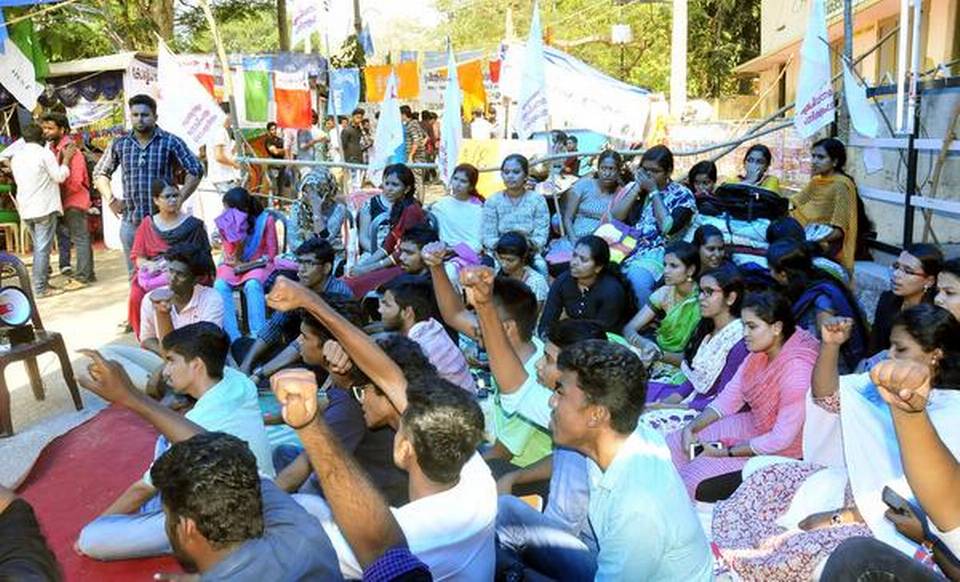
Reports of exploitation, humiliation, violence, and rampant nepotism are still flowing out of the private-sector law college popularly known as the Law Academy, in Thiruvananthapuram twenty whole days after the commencement of the students’ struggle there. At the centre of the controversy is the principal, Lekshmi Nair, who seems to have ‘inherited’ that position in the institution owned by her family: clearly, the students are determined to teach her a good lesson. Rarely have we seen all student organizations, from the far-right to the far-left, rally against one person with equal determination; but from the complaints of students – subsequently confirmed by the University of Kerala to which this college is affiliated – it appears that there is no reason to be surprised.
SFI students staging a protest near the law academy in Thiruvananthapuram
But the irony of utter lawlessness and blatantly feudal despotism perpetuated in an institution devoted to legal education in a democratic nation itself seems lost, for the authorities’ commonsense about liberal education in Kerala has been that it should be neither liberal nor education nor anything to do even remotely with the practice of democracy. I have been saying this over and over again, and really, feel utterly breathless at this.
I have spent some time with this Lekshmi Nair in my youth – she was briefly at the University Women’s Hostel in Thiruvananthapuram, when I was a resident there in the mid-1980s, as a young college student. She struck me as the quintessential rich man’s insolent brat, oozing privilege from every pore. Her website lists academic achievements including high scores in the BA History course which she reputedly completed at Government Women’s College (where I was a student myself) but she never struck me as someone with any love for learning or at least, whatever she read seemed to have no impact on her at all. She was however, a defiant young woman and we heard stories about why she had to stay in a hostel in town though her family and home were close by – something that we (those residents who were connected to left student organizations) resented because poorer young women students from far away were often unable to secure a place in the hostel into which this woman seemed to have sashayed in. Those stories I will not discuss. Suffice to say that from these stories she appeared to be like very many young women she is humiliating and punishing now – women who behave and choose in ways not acceptable to the social and sexual mainstream, and dare to defy family authority. It is quite possible that these stories were false, misleading, but the very fact that these stories(which I personally refused to endorse) circulated against her means that she was, however briefly, at the receiving end of patriarchal attitudes that punished not only her gender but also her youthfulness. That, really, makes me wonder: how is it that so many of the tyrants who run our public and private educational institutions today forget their own vulnerable youth? Those days of course no one deferred to rich men’s little monsters and their tantrums; those things, we thought, happened in distant Karnataka, where ‘capitation fee’ colleges bred horrors who indulged in sadistic ragging and other sorts of violence. In other words, no one thought that Lekshmi Nair could grow to lead the hellish institution that Law Academy seems to be.
Clearly we were both naïve, and blind to what lay ahead of us in the future.
Naïve, because we were still blissfully unaware of the history of Nair dominance in local politics in Thiruvananthapuram. Only in my recent research on the local history of a highly underprivileged locality in Thiruvananthapuram did I wake up to its full, shocking extent – to the way in which the male scions of powerful Nair families slid, elbowed, and smoothed their way into all major political parties here, controlling both elite and working class politics from the 1930s to the present. There were of course Nair activists who were definitely more than power-brokers, notably, ‘Jooba’ Ramakrishna Pillai, the organizer of the scavengers’ union of the 1930s, and Chalai Bhaskaran Nair, the trade union leader who led the loaders at the Chalai Market who, sadly enough, remains only in the memories of the workers who he fought alongside. The Nair politician who thrived was the power-broker par excellence – the mediator who stood between the traders and workers, and profited from deals with both sides. In the course of fieldwork I heard many anecdotes about how Nair second-cousins reached out to and secured each other’s interest even while seemingly arrayed against each other as Congress and Communist party activists in the field of politics. After 1950, when community competition between the elites of powerful communities came into full play, Nair men, often rich landlords, came to capture key positions and resources in political parties here (interestingly, the open acknowledgement of this is largely in the accounts of the Nadars of the present-day Kanyakumari district of Tamil Nadu, who openly refer to the Pattom A Thanu Pillai government in Thiruvananthapuram of the 1950s and early 60s as ‘Nair rule’). Lekshmi Nair’s political connections, then, were enduring ones: indeed, what the present crisis has revealed is the steel frame of Nair power in local politics, and not Lekshmi Nair’s petty obsession with power, which were evident even in the cookery show that she used to offer on the Kairali channel. Kalathil Velayudhan Nair, who is listed as one of the founders of the Law Academy, was a Nair heavyweight, for sure, and a smooth operator in politics and definitely, the Law Academy founders’ connections with ‘socialism’ (as claimed in the website) are tenuous. The enormous influence wielded by Nair heavyweights (even now) at the University of Kerala is a legacy carried forward from the days of the Travancore University, undisturbed till quite recently, and surely intact in the 1980s. I had a KU diary from 1988 which listed the professors there, and there were just a few who did not have the Nair tail behind their names. The BJP’s eagerness to jump into the fray, clearly, is an expression of its anger against that section of Nairs who still have much to gain from associating with the CPM; the CPM’s reluctance to proceed against the Law Academy is clearly related to its determination to refrain from alienating precisely this group.
We were blind in the 1980s, I said, because there was no way we could foresee the frenetic expansion of private sector higher education in Kerala, though signs were showing even in the 1980s (when for example, the Law Academy finally had the land it leased assigned to it in the mid-80s). The numbers of engineering colleges, for example, which were just 15 in the government and government-aided sector and three in the self-financing sector in 1997, grew to 84 by 2005 with most of the new ones set up in the self-financing sector. Nevertheless, researchers find that they have not fulfilled the purpose of producing employable labour, being notoriously deficient in facilities, and adept at a whole range of strategies to evade scrutiny and student protest. Also, by the early aughts, higher education ceased to be the concern of the small section of aspirants to government and government-aided colleges (according to available research, Kerala fell behind other states in access to higher education relative to population, but this relies on data that does not count unaided ‘parallel’ colleges), since by this time, SSLC and HS pass percentages had risen quite strikingly. Secondly, it seems evident that the growth of the self-financing sector mirrors the aspirations of the new Malayali middle class that arose out of the Gulf migration and other developments such as the expansion of land value as land increasingly became real estate. It is no coincidence that its expansion is largely in engineering and medical education, which are of course fervently believed to confer upward mobility on the family of the student, and not, say, in polytechnic institutes or technical high schools, which are still largely in the government sector. Thirdly, higher education which has been progressively identified as a non-merit good in the state is now booming business – cheap and hugely profitable.
Many of these colleges have evolved cost-minimizing strategies, which, to say the least, are terrifying. As an ex-manager in one of these institutions told me recently, this is next only to Kerala’s cancerous construction sector as a profit-spinner. The plan is always simple: acquire a piece of land (in the recent outrage, we have heard of many instances in which the promoters managed to bribe their way to bypassing necessary requirements), usually in the hilly mid-land terrain, clear and sell the vegetation, dig up the top soil and boulders, sell it all for a huge profit, and combining the proceeds with loans, build some basic infrastructure. Then set up a swank office in cities, hire cool-looking-sounding business graduates at low wages of course, to bluff and lie about facilities to potential students and parents. In the meantime, pull the strings to clear hurdles with academic authorities, set up faculty, much of which can be ‘ghostly’ (i.e. present only during inspections and so on). Once students take the bait, focus on building appallingly oppressive structures that subject students to a veritable reign of terror and parents to the constant fear of the loss of their investment, so that the bluff is never called off! Until now this structure has worked flawlessly. Critics like me have turned fairly hoarse with shouting from the rooftops about the treatment of students as mere raw material to be processed in whichever way these educational racketeers and gullible parents deem fit – and that this industrial process is both inhuman and appallingly inefficient.
In short, the issue that ought to be at the centre of public concern in the wake of the Law Academy imbroglio should not be limited to punishing a despicable brat. It should, rather, be on unearthing and condemning the racket that higher education has become in an era in which community organizations represents a new corporate interest. It ought to direct us towards the very specific nature of the capitalism that has emerged in Kerala in the post-1990s – towards reflecting critically on the nature of the new capital that threatens to destroy all that we possess – our ecological security, financial resources, and as evident now, our young people – that is our future as human beings and citizens itself.
I am not saying that the students should not teach the thieving, insolent, privilege-drunk brat a fine lesson; indeed, I hope it serves as a good lesson to the very many institutions which adopt her ways too. But we need to do more than taming the brat.
The building of Ram temple in Ayodhya which was brought up by BJP in its manifesto for the Uttar Pradesh Assembly elections has drew sharp criticism from the political opponents in Mathura district with Congress alleging that the party is “cashing in” on the issue.
Image: Getty Images
“BJP recollects temple issue only during elections, since it wants to cash in on it in the Assembly polls,” Pradeep Mathur, the Congress candidate from Mathura Assembly constituency said.
He also questioned BJP that who had stopped it to construct the temple since the party in power at the Centre.
Mathur said that people would not be misguided anymore as they have figured out that it is a “jumlewali” party.
The BSP candidate Yogesh Dwivedi accused BJP of using the Ram temple issue as a trump card in the Assembly polls, starting from February 11.
“Why BJP has not raised the temple issue in over two and a half years, even though the party is having its government at the Centre….BJP considers Ram temple as a trump card to win the elections,” he said.
Whereas, BJP national spokesperson Shrikant Sharma slammed the opposition over the issue, saying it is incorrect that the party only remembers Ram temple during elections and that “it is a matter of faith, away from politics”.
“It was an issue for BJP, and would continue to remain so till the magnificent temple is constructed in Ayodhya,” he asserted, adding that the temple will be constructed withing the framework of the Constitution RLD candidate from Goverdhan Assembly constituency Kunvar Narendra Singh said, “The temple issue has been raised again through election manifesto by BJP simply to cash in on religious feelings of the people through votes.”
Another RLD candidate, Ashok Agrawal who is contesting from the Mathura constituency said the temple should only be constructed with the conscientious of Muslims.
“I am also in favour of the temple in Ayodhya, however it should not be constructed hurting feelings of a sect and it should be constructed only with the conscientious of Muslims,” he said, alleging that BJP wants polarise the votes by raking up the issue.
First phase of polling for Uttar Pradesh Assembly will begin from February 11
Let me tell you two stories that happened to two different people. Both concern religion in North America.
Register how you feel about each of them.
Story one: “Why are you not Christian?” a man asks you.
Story two: You wake up to find someone has left a Bible on your doorstep.
Which of these sounds more violent, more threatening to you? Or neither?
Now, imagine yourself a Muslim woman wearing a headscarf in a Western country and repeat the two stories to yourself again. How would you feel?
Now let me complete each story and give you some context.
Story one
“Why are you not Christian?” the man asked, kindly, in broken English.
“We believe in Jesus and the Bible,” I said, wanting to comfort him, “and we have a lot of Christians in Egypt where I come from.”
This happened to me in Houston, Texas around 2007 or 2008. The man was a plumber coming in to fix my sink. He found it difficult to express himself in English but seemed to care about saving my soul, however misguided that was.
It didn’t occur to me to be offended or afraid. This was a time when America was on the cusp of electing either a black president, a female president or at least a female vice president. Houston, despite what all my American friends had told me before I left Egypt, was not a generally racist place to live.
Half of the surgery fellows working with my husband at the Texas Heart Institute were Muslim. Some strangers said “Assalamu Alaikum” (peace be upon you) to me on the streets, or stopped me and my friends to comment on the beauty of our colourful headscarves.
Story two
You wake up to find someone has left a Bible on your doorstep. This happened to a friend in North America, soon after Donald Trump was elected president. She felt it was a threat or a subtle act of violence. She wondered how her neighbours would feel if she placed a Qur’an on their doorsteps.
When I heard my friend’s story, it got me thinking about the possible intentions of the person who placed that Bible on her doorstep.
I trust that my friend’s feeling of being threatened was real in that context. But I wondered if the story might have been different. What if the story had included a note inside the Bible, showing who had left it, or giving an invitation to exchange holy books?
What if the Bible on the doorstep had been the beginning of a dialogue rather than a way to scare someone away? And if the person who left the Bible on my friend’s doorstep didn’t have bad intentions, why didn’t they do it in person and look her in the eye?
What does a Bible on a doorstep mean?
Context and power
There are differences between story one and two, chief among them are context and power. The political context and who the actors are make a difference to the story. An elderly, Hispanic plumber fixing my sink? Not a threat to my 20-something self in Houston, accompanying my surgeon husband doing a fellowship at a prestigious nearby hospital.
Had I been asked the same question by a white man, in an angry voice, in another context, my reaction would probably have been very different.
I am telling this story in the era where we are lamenting the rise of fake news and exploring our roles as educators to respond to it, as if a technical solution to figuring out if something is a lie will fix our problems. It won’t. Because it’s not a technical problem.
Education and understanding
Donald Trump’s executive order banning people from seven Muslim-majority countries from entering the US is not fake news. It’s real news. And as a community, we have to deal with it.
Power is the ability not just to tell the story of another person, but to make it the definitive story of that person. The Palestinian poet Mourid Barghouti writes that if you want to dispossess a people, the simplest way to do it is to tell their story and to start with, ‘secondly’. Start the story with the arrows of the Native Americans, and not with the arrival of the British, and you have an entirely different story. Start the story with the failure of the African state, and not with the colonial creation of the African state, and you have an entirely different story.
The media does this all the time. So do politicians – we see Donald Trump right now, talking about banning Iraqi refugees and immigrants from entering the US, without mentioning the role of his country in causing the instability that motivated the immigration in the first place.
Adichie also says:
The single story creates stereotypes, and the problem with stereotypes is not that they are untrue, but that they are incomplete. They make one story become the only story.
In my view, the best way to ensure that we and our children see more than the stereotypical story about people who are different from us is to expose them and ourselves to multiple stories. The bare minimum is to expose ourselves to other cultures on their own terms.
So, for example, we don’t learn about Native Americans from Pocahontas or from Western films. We learn from Native Americans themselves. If we don’t have direct access to them (I live a long way away in Egypt), find them online. Read or listen or even, if you’re lucky, converse.
I know what you’re thinking. I’m Muslim, talking about Muslims in America. What brought this on? But in the midst of my concern over Muslims in America, I also noticed Trump’s presidential memo to advance approval of the Dakota Access Pipeline, I can see the injustice in this, and the irony: on the one hand, a “nation of immigrants” that is neither honouring immigrants, nor honouring the original residents of this land.
We will always have blind spots towards cultures that are unfamiliar to us. But the more deeply we establish understanding of the “other”, the more we try to empathise, with social justice as our underlying value, the more likely we are to become empathetic, critical, global citizens. As educators, we must expand and diversify the people in our in-groups, and help students do this too.
Education expert Sean Michael Morris, on the day of Trump’s inauguration, urged us to change the way we teach. He wrote:
An education that convinces us of what needs to be known, what is important versus what is frivolous, is not an education. It’s training at best, conscription at worst. And all it prepares us to do is to believe what we’re told.
This goes for parents and mentors as well as those of us in more formal teaching roles.
Building empathy
The best way not to believe what we’re told is not to go fact-checking each and every thing we hear. Instead, I propose we start building our ability to understand people who are different from us, in context, rather than relying on harmful stereotypes. To know them as individuals, as they would like to be known, not as some dominant power (or US president) has decided we shall know them.
This is not quick or simple. But it can allow us to form a view of the world that rises above deception and to see what’s important in our humanity. And it will change the way we vote. When we empathise with others, we imagine how our decisions can impact them.
Remember those two stories I mentioned earlier? Back in 2007 and 2008, I felt comfortable and safe praying in a mosque in Houston. Now, I would not, given the latest news of Islamophobic violence in mosques coming from North America, most recently the terrorist attack on a mosque in Quebec City that left six people dead.
My friend with the Bible on her doorstep, a dual citizen, was unable to attend a conference in the US a few days ago.
But that isn’t the biggest tragedy. The tragic stories are those of families torn apart by this executive order. Parents who cannot reach their children. What we need now, more than ever, is empathy.
Opposition had feared the BJP would announce populist measures that could sway voters in the five states going to the polls this month.
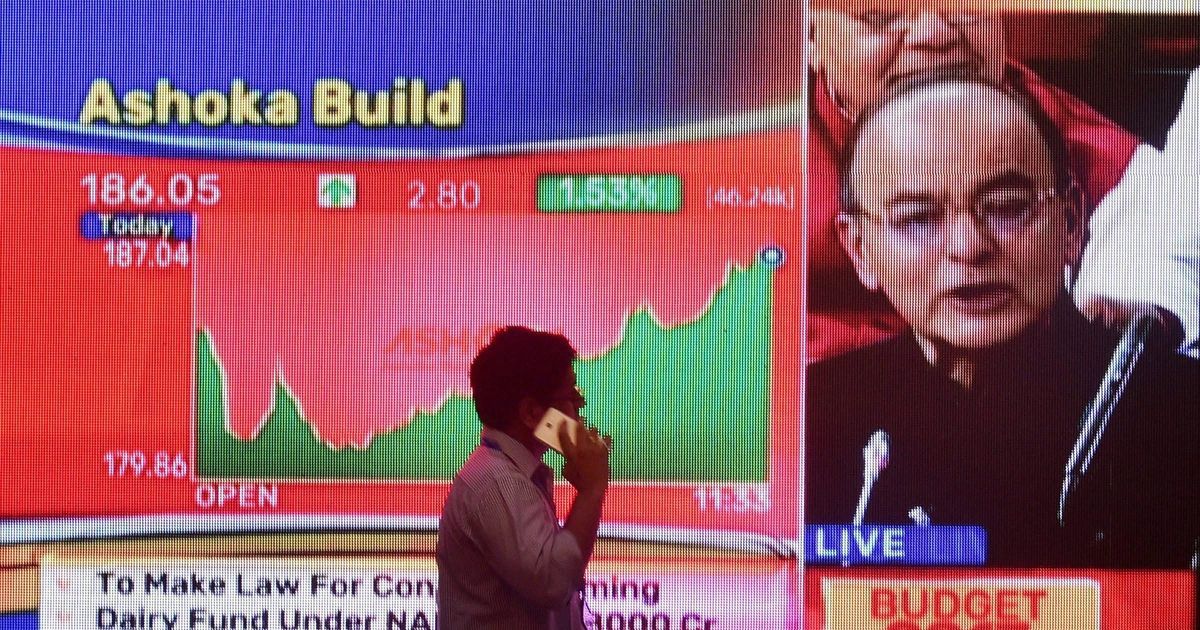
When the Modi government decided to advance the presentation of the Union Budget to February 1, there were serious apprehensions in the Opposition camp which felt that the Bharatiya Janata Party would use this platform to make populist announcements to woo the voters before the coming assembly elections in five states.
It was widely expected that finance minister would announce specific sops for the rural poor, farmers, scheduled castes and the middle classes to offset the adverse impact of demonetisation. There was talk of a loan waiver for farmers, the transfer of payments to Jan Dhan accounts and the possible introduction of Universal Basic Income under which people below the poverty line would receive a sum of money to boost their incomes.
Fearing that this would place them at a disadvantage, Opposition parties, including the Congress, Samajwadi Party and the Left parties, asked the Election Commission to direct the government to defer the presentation of the Budget till after the elections to ensure a level playing field for all stakeholders. Their plea was rejected by the Election Commission, though it did ask the government to refrain from announcing any specific schemes for the poll-bound states. In fact, Congress vice-president Rahul Gandhi pre-empted the announcement of any sops for the poor when he presented Prime Minister Narendra Modi with a charter of demands in December asking the government to deposit Rs 25,000 in the account of one woman in each family that is below the poverty line.
As it turns out, the Opposition’s fears were unfounded. There was palpable relief in the Opposition camp after Jaitley finished his Budget speech because it had no big bang announcements. Although Prime Minister Narendra Modi was quick to describe the budget as an “uttam budget” aimed at improving the lives of the poor, Dalits and farmers, the Opposition felt these that these announcements would have little impact in the coming elections as the Budget had nothing specific to offer for the vulnerable sections that have been hit by demonetisation.
BJP leaders worried
While the Opposition was predictably comforted by Jaitley’s Budget, there was despair in the BJP, which had hoped that he would announce special financial packages for the rural poor and the farm sector to boost the party’s prospects in the upcoming assembly polls. BJP ministers may be gushing over the Budget but party leaders privately admit that it had failed to generate the necessary excitement for their voters. Undoubtedly, the government made a valiant attempt to shed the tag of a “suit boot ki sarkar” with Jaitley underlining that while preparing the Budget, he had focused on spending more on rural areas, infrastructure and poverty alleviation. The finance minister announced that the total allocation for rural, agriculture and allied sectors had been raised by 24% over last year’s outlays. In addition, the Budget provided for a Rs 5,000 crore micro-irrigation fund and higher targets for farm credit and crop insurance. Jaitley also sought to pacify the unhappy middle classes by halving the tax liability for those having an annual income between Rs.2.5 lakh-Rs 5 lakh from 10% to 5%.
But the Opposition was not too concerned with these announcements. “ We have no reasons to worry,” remarked a senior Congress leader. “People had such high expectations from the Budget that these announcements will not cut much ice with them.”
Opposition leaders maintained that they would have been worried if the finance minister had announced immediate bailout packages for the underprivileged. The provisions contained in this Budget are too general and will have a long-term impact and that too, if these are implemented efficiently. “Raising farm credit is fine but only the farmer knows the problems he encounters in accessing that cash,” remarked a Samajwadi Party leader.
Missed opportunity
Describing the Budget as a missed opportunity, former Maharashtra chief minister Prithviraj Chavan maintained that the finance minister was constrained from going too far on populist schemes because he had to keep an eye on the fiscal deficit. “If the government wanted to go down that road, it would either have to tax more or borrow more….it is not in a position to do either,” Chavan said. “I doubt if it will impact the assembly elections in any major way.”
With the finance minister making none of the expected announcements, the reactions of opposition leaders to the budget were on predictable lines. Rahul Gandhi said the Budget had promised fireworks but it had turned out to be a damp squib. “The Budget had nothing to offer to the farmers or the youth..it also failed to keep its promise on job creation,” he said. West Bengal chief minister Mamata Banerjee described the budget as “misleading and baseless.”
While Opposition leaders were undoubtedly reassured by the 2017 budget, they also admit that their relief may prove to be short-lived. The Modi government, they believe, can be expected to come up with special schemes like the Universal Basic Income or a farm loan waiver in next year’s Budget with an eye on the 2019 Lok Sabha polls. “The next budget has to be a populist one,” remarked a senior Congress office bearer. “It will be this government’s last budget before the general election.”
Justice R Mahadevan said in the court that all the police stations must be told about this court order.
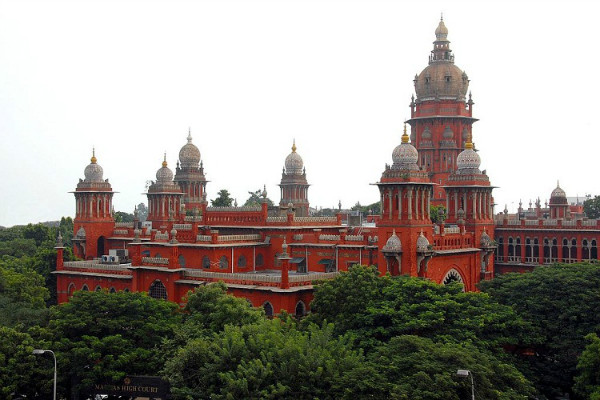
The Madras High Court on Wednesday warned the Tamil Nadu police not to harass family members of Marina protesters for enquiries.
Justice R Mahadevan said in the court that all the police stations must be told about this court order.
The petition was filed by a differently abled man, Selvam who stated that his son, Srinivasan was charged by Arumbakkam police for a case of violence.
Justice Mahadevan directed the government pleader that people who have been charged for the violence can be enquired but not their family members, reported The Times of India.
Selvam had asked the court to direct the police not to harass him for making enquiries and also restrain the police from summoning family members of other protesters.
He said that police came in search of his son and when he told them that he had gone to college and was part of an NCC camp, they did not believe him.
They also contacted the college principal to check if his son had actually participated in the NCC camp.
Several thousands of students had come together recently for a protest against jallikattu ban.
After the protests were called off, on January 23, police had asked the protesters to leave the area.
Later, police carried out lathi charge and arrested many youngsters for protesting and indulging in violence.