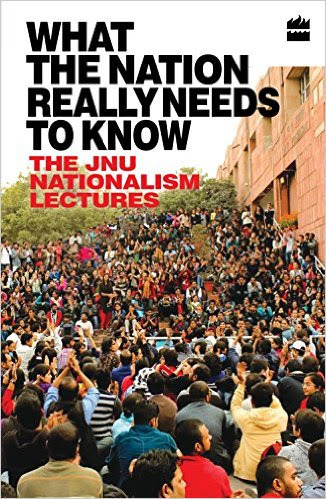
The massive outbreak of protests in February 2016, in the wake of sedition charges being filed against some students of the Jawaharlal Nehru University, took the form not only of sloganeering, human chains and streetplays, but also a lecture series on nationalism, attended by thousands of students, every day for almost a month. To mark the first anniversary of the attack, the Jawaharlal Nehru University Teachers' Association (JNUTA) is releasing a compilation of the lectures, titled What the Nation Really Needs to Know: The JNU Nationalism Lectures. We present some extracts:
Edited by Rohit Azad, Janaki Nair, Mohinder Singh & Mallarika Sinha Roy on behalf of JNUTA
(EXTRACTS)

Image Courtesy Harper Collins Publishers India
Gopal Guru, 'Taking Indian Nationalism Seriously'
“As we have seen in the recent controversy that surrounded JNU, the right-wing forces used nationalism as a moral weapon to morph the expression of the critical voices. Such a position which the right-wing parties tend to acquire through self-authorized claims over nationalism acquires strength from a skewed and flawed conception of moral duty. One can very well explain this skewed nature of moral duty by citing a well-known phrase that is used for putting nationalism on the high moral ground. It goes like this: ‘Do not think what the nation does for you but think what you can do for the nation.’ To put it differently, you have a duty to protect the honour of the nation, but the reverse is never the case, in the sense that these political forces never raise the point as to what moral duty the nation has towards a large section of tormented humanity. The question, ‘What can the nation do for you?’ is completely ruled out in this skewed notion of public morality. To put it differently, other moral concerns are subordinated to the dominant notion of moral duty to nation. The recent controversy that was created in the name of nationalism in JNU had this intention of subordinating other moral ethical questions to a skewed morality, which turned JNU into a haven of deshdrohis (anti-nationals). It indicates that the nation has been used by certain parties to tarnish the image of JNU; to destroy the international reputation that it enjoys…
“The developments in and around JNU have compelled some of us to raise the following set of questions that we need to address particularly in the interest of the nation. First, if talk of the nation from a certain point of view is impossible, why should one talk about nationalism? If we leave the nation unattended, what implication does it have for engagement with right-wing conceptions of nationalism? Second, if at all one decides to talk of nationalism, in what language should one talk about nationalism? Third, if we separate the nation from the theory question or the moral question and send the discussion on holiday as the right-wing supporters of nationalism seem to be doing, what implications does it have for the social groups that exist on the margins and even outside the margins of the Indian nation?”
Lawrence Liang, 'A Gadfly: The Jurisprudence of Dissent'
“If you look, for example, at a case, LIC vs Manubhai Shah, the court says freedom of speech and expression is the lifeline of any democracy, and stifling, suffocating or gagging this would sound a death knell to democracy and usher in autocracy and dictatorship. So, one way of thinking about the relationship between free speech and politics is to think of it as what allows or gives you a certain breathing room. It provides a safe space for you to exercise any political opinion that you want – and there have been no safer spaces till now than universities in this country as the safeguards for this right to dissent – and on that count JNU, if universities are a mirror of the health of a democracy, presents an extremely healthy picture in which a diversity of opinion, a healthy regard for disagreement, and a tradition for dissent has been the marking features of JNU. It is for this reason that I think we need to ensure that JNU fights for the freedom of speech and expression not only for this university but for everyone else in this country.”
Romila Thapar, 'The Past as Seen in Ideologies Claiming to be Nationalist'
“Nationalism emerges as a concept or an idea in modern times as a response to historical changes. It is difficult to locate it in pre-modern societies. So, we don’t look for nationalism in the centuries-long past, we look for it when society changes to the point where it is required. When it emerged in Europe in the seventeenth and eighteenth centuries, it was a time of emerging capitalism and the start of colonialism, both of which were to expand. Together with this came the growth of the middle class and its aspiring to participate in governance through democratic representative systems. Small territories were integrated within larger territories. It brought together many groups and encouraged a secular identity to ensure inclusive unity. This is characteristic of most nationalisms. Defined by a new sense of social awareness and identity, there is in nationalism inevitably an inclusive and overarching identity. History is essential to a national ideology but it has to be a shared history that binds people together. History has to be the bond. It cannot be a history dominated by only one identity because nationalism doesn’t exist only on one identity. It has to be all-inclusive. National history of course locates a golden age in the past, a utopian age which is the exemplar. It is often the kind of society that is held forth as being the ideal society, not realizing of course that whatever society you take as the Utopia from the past, remains in the past, it belongs to the history of the past…
“As with all nationalisms of all kinds, Hindu religious nationalism also turned to history. But interestingly, it appropriated the two dominant colonial theories – the Aryan foundation of Indian civilization and the two-nation theory. These they now describe as the indigenous history of India. Ironically, it is claimed that these histories are cleansed of the cultural pollution of Indian historians influenced by Western ideas! That their own ideas are rooted in colonial theories is conveniently ignored. The core of this ideology is the identity of the Hindu. The Hindu is the only one who can claim the territory of British India as the land of his ancestry – pitribhumi, and the land of his religion – punyabhumi. Muslims and Christians are described as foreigners since they came from outside the territory of British India and their religions originated in other lands. The ancestors of the Hindu and his religion having been indigenous to India – he therefore, is the primary citizen. The true claimants to the ancient civilization can only be Hindus, descendants of the Aryans, and this is one reason why it has to be proved that the Aryans were indigenous to India, irrespective of whether they were or not. Being indigenous, they are the inheritors of the land. There are, however, glitches in this argument. Those of us who have pointed out the problems get our daily dose of abuse on the internet, and we are described as ignorant JNU professors and worse, even if in fact most are not from JNU.”
Prabhat Patnaik, 'Two Concepts of Nationalism'
“Yesterday, I saw in the papers that Arun Jaitley has accused Rahul Gandhi of betraying his father, grandmother and great-grandfather, saying that while they had stood for nationalism, Rahul Gandhi was hobnobbing with the ‘anti-nationals’ of JNU. The real point, however, is that the ‘nationalism’ Nehru had talked about and the ‘nationalism’ in terms of which those with whom Rahul Gandhi is hobnobbing are considered ‘anti-national’, are not identical terms.
“In other words, there is a deception whereby the concept of nationalism as an inclusive, egalitarian, democratic concept is substituted by an aggrandizing nationalism; and the moral high ground that the former has historically occupied in the eyes of the people is then sought to be appropriated by the latter. The claim is that the nationalism the government stands for is the same as what Gandhi had stood for, but that the JNU students stand for something altogether different.
“In fact, you may recall, Gandhi had been insistent that 55 crores of rupees which were due to Pakistan should be handed over to that country, against a lot of pressure at that time, including from within the Congress. So, what Gandhi had stood for as ‘nationalism’ is very different from what this government is calling ‘nationalism’. But this verbal trick is playing a very important role in misleading people and we should be sensitive to that…”
“This attempt at destruction of thought is a very serious phenomenon and it is not surprising that the most outstanding institutions in the country, whether it is the Film and Television Institute of India, or he fine arts department of M.S. University, Baroda, or JNU, or the Hyderabad Central University, or the Jadavpur University, are the ones currently under attack.
“There is another feature of these institutions that I would like to draw your attention to, namely that they are all publicly funded institutions. You don’t find any opposition arising in private universities or private institutions. I’m not blaming the students of private universities or institutions, but because they are constrained willy-nilly to get commoditized, a process of destruction of thought which necessarily comes with the commoditization of education, has already become institutionalized there. It is the few places which, because of their character of being publicly funded, have avoided getting commoditized until now, and which therefore still constitute sites of critique, of discussion, and of intellectual vibrancy and excellence, that are now being targeted.
“A government that destroys the best institutions of the country, that destroys thought, is effectively making the country parasitic on foreign countries for ideas. It is a matter of supreme irony that this very government (and the Hindutva forces behind it) talks of nationalism! Indeed it justifies its act of promoting parasitism on advanced countries for ideas in the name of nationalism! Making the country completely dependent on imperialism for ideas is sought to be justified in the name of nationalism!”
Satyajit Rath, 'विविधता और एकता के जैववैज्ञानिक पहलू'
“So, how should speech be? वाक्य। वाक्य, as in ‘that which ought to be said’ or ‘that which can be said’. तो वाक्य कैसा होना चाहिए? And a really nice description comes to mind: सार्थं तथ्यं हितं वाक्यं लघु युक्तमनुत्तरम्। सार्थ होना चाहिए, तथ्य होना चाहिए, हितकर होना चाहिए, ऐसा वाक्य। लघु होना चाहिए; छोटा होना चाहिए। और अनुत्तरणीय होना चाहिए, कि उसका जवाब नहीं।
“This is one tradition, but keep in mind that we in the subcontinent have an extraordinary diversity of traditions. So making an unanswerable argument in and of itself is not necessarily safe for you. I will remind you, in the बृहदारण्यकोपनिषद, there is one, well, more than one, but there is a particular याज्ञवल्क्य-गार्गी संवाद। तो गार्गी जी ने सवाल पूछे, याज्ञवल्क्य जी जवाब दे रहे थे। फिर एक सवाल पे आ गए तो याज्ञवल्क्य जी या तो उत्तर जानते नहीं थे, या तो देना नहीं चाहते थे, जो कुछ भीहो; तो जो अनुत्तरणीय सवाल पूछा गार्गी जी ने, तो याज्ञवल्क्य जी ने कहा, – क्या कहा? (संस्कृत पढ़े बहुत दिन हो गए…) – ‘गार्गि, मातिप्राक्षी’, do not overstep (or over-question); ‘मा ते मूर्धा व्यपगत’। यानि कि ‘your head will fall off (or be removed)’, ‘तुम्हारा सर कट जाएगा’। So the unanswerable question can also be addressed in our traditions, with violence. ये भी एक विरासत है हमारी। ये भी एक परंपरा है।
“So we have a multiplicity of traditions that we need to integrate, as Amartya Sen I think said, in our multiple identities as human beings…
“Take the cells in your body. In the first place every one of your cells has a somewhat different genome sequence. लेकिन वो छोड दीजिएगा| There are cells in your body which do not have your entire genetic complement. And these are the cells in your body, for example, that make antibodies. Everybody has heard of antibodies, so let us not worry about what they are and so on and so forth, everybody has heard of antibodies; वैक्सिन्स दिए जाते हैं, एंटीबॉडीज़ बनती हैं, प्रोटेक्शन करती हैं, वगैरह, वगैरह, वगैरह। Now, if you take the cells that make antibodies, every one of those cells individually — we’re talking about billions of cells — every one of those cells is different from every other cell. The diversity of your antibody repertoire is immense. We’re talking about diversity in the millions. Right? Here is an example of diversity in your body, of your own cells. So you turn around and ask the same question — is this diversity simply being ‘tolerated’, या इस का कोई मतलब भी है? And repeatedly over the past fifteen years — and I will stop here because I am now referring to relatively recent biological science in the making — over the past fifteen years it has steadily become more and more apparent that, as we restrict the antibody repertoire, so do we limit the ability of the body to make effective immune responses against microbial diseases. There is positive value in diversity even in biological systems.
So a last point, or more correctly an epilogue. What I’m trying to say is, when we find something that we think is problematic, we have options and choices. One option is,पीठ फेर के चले जाना। और ये कहें कि इसका कोई मतलब नहीं। The other option is, खड़े होकर पूछें, अच्छा सचमुच? सबूत है? क्या है? समझाइए तो? Because ultimately, everything that we are trying to do deals with trying to build more and more nuanced, more and more complex models of understanding. That’s what scholarship is about, that’s what a university is all about. Many of my friends in the natural sciences have this tendency of saying: ‘यार ये सोशल साइंस अपन कुछ नहीं समझते, वो क्या करते हैं; we are looking for objective truth’. सुना है? अब, सत्य के साथ मेरा बड़ा पेचीदा रिश्ताहै,क्योंकि सत्य के कई पहलू हैं। And I will remind you again of our own tradition in terms of the dimensions and perspectives of truth. Again, याद होना चाहिए, सभा है तो सभा के बारे में कहें, तो: ‘न सा सभा यत्र न संति वृद्धा:’: That is not a sabha where there are no vriddha, no elders. ‘न ते वृद्धा: ये न वदंति धर्मम्’: They are not elders who do not talk about the right way. ‘नासौ धर्मौ यत्र च नास्ति सत्यम्’: That is not the right way which does not have the truth. And the last line,‘न तत् सत्यम् यत्छलेनानुविद्धम’: वो सत्य नहीं है जो छल-छलावे से ओत-प्रोत और बंधा हुआ है।