PTI reports that the Nagpur bench of the Bombay High Court today quashed the election of the BJP MLA from Gadchiroli on a plea that he didn't disclose details about the office of profit he was holding at the time of filing his nomination papers for the 2014 Assembly elections.
"A petition against the sitting MLA Deorao Holi was filed by Narayan Jambhule of Forward Block who had contested unsuccessfully against him in the 2014 polls," Jambhule's advocate Pradeep Wathore told PTI.
The petitioner had claimed that Holi did not disclose details about the Office of Profit he was holding while filing his nomination.
The counsel stated the Returning Officer concerned ignored the fact that Holi was a serving Medical Officer with the state government at the time of filing his papers.
"A departmental enquiry was proposed against him that time and recovery of Rs 8.68 lakh was pending against him," Wathore said without elaborating.
He said the HC bench in its order has declared Holi disqualified and stated that his nomination form should not have been accepted by the returning officer of Gadchiroli (ST) Assembly constituency.
When contacted, Holi told PTI he would challenge his disqualification in the Supreme Court after studying the order.
A 3rd year civil engineering student at Indian Institute of Technology Kharagpur, Lokesh Meena aged 20 years committed suicide for no apparent reason by walking 20 kilometers from the campus and throwing himself before a moving train. Meena was missing from Radha Krishnan Hall since Sunday morning. After the matter was reported to the hostel warden in the evening by his friends a search ensued.
The news was published by the national daily on the first anniversary of Dalit Research Scholar, Rohith Vemula's death.
Since morning however, friends of Meena had tried to locate him at various classrooms, hostels and even canteens. But after failing to find him out, the matter was reported to the warden. Immediately a complaint was lodged at Hijli police outpost. A team of team officials started a search operation. Around evening a body was recovered from the railway tracks between Jakpur and Madpur.
The institute officials along with police reached the Kharagpur sub-divisional hospital and identified the body of Lokesh. The student was a resident of Dhasa district in Rajasthan, Digheria village.
Father of Lokesh – Rammpal Meena was informed by the IIT officials. He took a flight to Kolkata and reached the campus on Monday morning. He identified his son.
A post mortem was conducted on the body which was later handed over to the family.
Kharagpur GRP informed that the incident had taken place on Sunday around 8am. “We got an information around 9:30. A loco engine which was moving on the middle line mowed him down as Lokesh jumped before the moving train. The engine driver informed the railway staff at Jakpur station. We then rushed to the spot,” said a senior GRP official.
A police team who interrogated friends of Lokesh were informed that the student was suffering from anxiety and depression. “We have been told that Lokesh was detected with Tuberculosis and also had other health issues. We have also got the information that the student had spoken to someone at length just before committing suicide. We are now trying to speak to his father who has already arrived in the Kharagpur campus. Now we are trying to find out if any personal loss or family affair was the triggering point for Lokesh to end his life,” added another senior police official.
SP Bharati Ghosh said that a student had committed suicide. “The local Kharagpur town police station has ended an investigation. The GRP is also conducting a separate inquiry,” added SP Ghosh.
Director of IIT-Kharagpur, Partha Pratim Chakraorty said it was a very sad day for the institute. “Lokesh was a good student and didn’t have any issue related to academics. Also the friends didn’t inform us about any apparent depression or signs of anxiety,” said Chakraborty. “We have a counselling centre at IIT-Kharagpur which is a first of its kind among the higher education institutes. The centre has intervened many a times and ensured that students get back to their usual self, leaving all anxiety behind. Unfortunately in this case they couldn’t get time to meet Lokesh,” added the director.
100 Academics Rally Around EFLU Students Charged With Defamation For ‘Raising SC/ST Issues’
“From the courts, the underprivileged expect humane recognition of the inequities of their predicament and wise support for their cause. But what they have received is a demoralising and intimidating signal,” the statement signed by more than 100 academics said.
More than 100 academics from across the country have issued a statement expressing their “grave concern” that five students from the English and Foreign Languages University (EFLU) in Hyderabad have been convicted for defamation of a professor and sentenced to six months imprisonment. These students, the statement says, were raising the issue of discrimination against SC/ST students in EFLU’s German department. The signatories include Susie Tharu, Anand Teltumbde, Janaki Nair, Kancha Ilaiah Shepherd, Kalpana Kannabiran, Mary E. John and numerous others.
The students’ protests and allegations against Professor Meenakshi Reddy that have been termed ‘defamatory’ relate to her allegedly discriminatory treatment of students from SC, ST and minority groups, particularly Munavath Sriramulu, an ST student and one of those charged with defamation. Sriramulu filed a case against Reddy under the SC/ST Prevention of Atrocities Act in January 2013. The case is yet to be investigated. Sabrangindia had reported on the discriminatory conviction when it happened.
“The countrywide discussion raised through the struggles following Rohith Vemula’s death in January 2016 drew public attention to the extent of caste discrimination in our universities. SC, ST, OBC and minority students figure disproportionately in the statistics for failure, drop out, expulsion, rustication and even suicide.
Educational institutions and those who run them (teachers and administrators) have been forced to acknowledge that they are implicated in this terrible attrition of young citizens and know they must initiate reforms. Yet, far too little is being done to discuss this evidence, rethink rules, temper teachers’ attitudes, reform syllabi or challenge ideas of merit that discriminate against the marginalised. A teacher’s job is to help the actual students in the classroom to learn; not to uphold abstract standards of merit. From the courts, the underprivileged expect humane recognition of the inequities of their predicament and wise support for their cause. But what they have received is a demoralising and intimidating signal.”
The statement further says:
“Sreeramulu failed in some courses in each of his initial semesters, and was subsequently not promoted and asked to leave. He protested this decision in various ways and complained about discrimination in the department (“not welcomed or encouraged”; “our answer sheets came back covered in red marks”; “it was never clear what exactly the rules were”; “others received preferential treatment”; “UGC mandated remedial classes were not seriously taught”; “there are seven teachers in the department but no SC, ST or OBC among them; there is no one to understand my pain”). Following an investigative report filed with the NHRC, a committee consisting of external members and EFLU faculty was constituted by the university to examine the issue. Even before the committee finalized its report, the University unilaterally prepared its own version of minutes which rejected Sreeramulu’s case. In protest, the two SC/ST faculty members resigned from the committee and expressed their dissent in writing. In despair, Sreeramulu resorted to a fast.
This was the point at which the [student] organisations came in. Sreeramulu fought hard to stay in the course, but did not succeed. After he was evicted from the university, despite being disturbed and fighting a tension-related flare-up of his vitiligo, he has worked as a tourist guide, a German and English tutor for foreign students and passed the UGC JRF examination in German. Dalit Camera, a popular Youtube channel, interviewed with him at the time when he was protesting against his failure and subsequent expulsion from the German department. The interview provides us, among other things, a sense of his hold over spoken English. This is an intelligent and capable student, with a flair for language, it might seem.”
According to Reddy’s complaint to the court, Sriramulu, along with Mohan D., Satish N., Upender R. and Ravi C., all associated with various student organisations who have helped Sriramulu in his struggle, have defamed her by calling her casteist and ‘feudal’ in videos that are available on the internet and on posters that were put up on campus. She claimed that these allegations were baseless and Sriramulu’s academic troubles were not caused by discrimination. The “false charges”, she claimed to the court, came only after he failed to perform well.
The students have claimed that Sriramulu’s was not a one-off incident, alleging that professors at the institute, specifically Reddy, routinely did not give SC/ST students the grades they deserved or allowed them to attend remedial classes that the university is meant to provide. The students also cited the examples of two female Dalit students who were driven to dropping out because of the faculty member’s behaviour, one of them also allegedly driven to attempt suicide. The professor, they alleged, also humiliated SC/ST students by “asking them to go to their places and do their work and not attend foreign language courses”.
On December 13, the court ruled in favour of Reddy, citing videos uploaded to Youtube by the independent media group Dalit Camera as evidence. One of the students charged with defamation, Ravi C., is the founder of Dalit Camera, a media organisation that says it highlights “the voice of the people” whose “words are not covered in the other media and are therefore not available for public discussion.” The students were sentenced to six months simple imprisonment. The professor had also asked that compensation be paid to her, but the court did not impose any fines.
The academics’ statement condemns the court’s use of Dalit Camera videos as evidence against the students:
“We also deeply regret that the interviews and documentation developed by Dalit Camera have been used as the basis for the sentences. This original and courageous journalistic initiative has received worldwide recognition for its bold and altogether original use of social media. By making available voices and perspectives that have hitherto been obscured or overlooked in public discussion, Dalit Camera has on many occasions transformed the understanding of key events. Forums such as Dalit Camera are invaluable because they confront us with the injustice and indignity Dalits face today and, importantly, the insight they have into their predicament. In its light conventional media houses often lose their aura and established authorities show up as limited and unjust. But that is a part of the ethical and epistemological value of the initiative. The Honourable Court, it would seem, has sadly failed to appreciate this.”
The students, who were arrested after the court’s judgment, are out on bail and have filed an appeal in the session’s court.
Previous instance This is not the first time students from marginalised communities have claimed discrimination at EFLU. In April 2016, Dalit PhD student Koonal Duggal alleged that he was “treated like a criminal” when security guards physically removed him campus in the middle of a speech he was delivering at Ambedkar Jayanti celebrations on campus.
“They dragged me from the venue in front of the other students and teachers, and treated me like a criminal. They also called me anti-university, anti-national for singing a song by Faiz Ali. Is it a crime a to sing a song?” Duggal had said tat the time. Following the incident, Duggal filed an Atrocities Act case against the university proctor. “When I enquired why I had to be removed from the venue, I was informed that the security guards have received an order “restricting” my entry into EFL University campus, where I currently study. I was told that I should go and talk to Prakash Kona Reddy, who as the Proctor had issued the order. I was never priorly informed on such a restricting order. I have not participated in any unlawful activities,” Duggal’s FIR said.
The university has claimed that Duggal was “a key member in a lot of anti-university activities,” but has refused to elaborate on the matter.
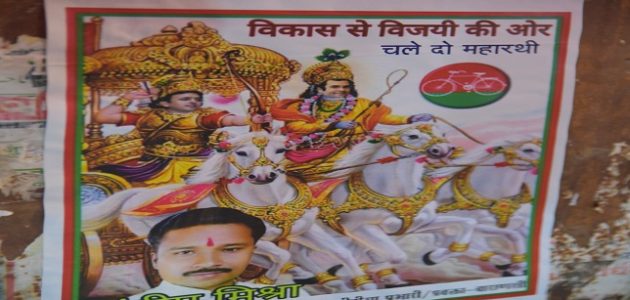
Set with the Mahabharat as backgrop, the Banaras administration under the Election Commission has registered an FIR against the controversial SP poster even as the Congress has complained to the EC against Narendra Modi for invoking Lord Ram in a recent speech
A poster featuring chief minister, Uttar Pradesh as Arjun and vice president of the Indian National Congress, Rahul Gandhi as Sri Krishna has attracted firm action by the district administration. The media reports that action was taken after the poster went viral on social media and also spotted put up in parts of Banaras city. District Election Officer, Yogeshwar Mishra has been quoted as saying that no violation of the Election Code of Conduct would be taken lightly.
Ironically, this action by the district level officials under the election commission comes at a time when the Congress had approached the EC with a complaint against prime minister Narendra Modi for invoking Lord Ram.The Congress complaint was in connection with a speech made by the Prime Minister through video conference on January 12.
Congress said Modi utilised the event “as part of election campaign in the name of religion by invoking and making statements regarding ‘Bhagwan Shri Ram’, ‘Ayodhya’, ‘Ram Rajya’ ‘Hanumanji’ and ‘Bharat’ repeatedly.” This was done througha Video Conference with Modi addressing voters at Faizabad on January 12. Referring to the Prime Minister’s inaugural address to Ramayana Darshnam Exhibition at Vivekanand Kendra, Kanyakumari, Congress said he utilised the event “as part of election campaign in the name of religion by invoking and making statements regarding ‘Bhagwan Shri Ram’, ‘Ayodhya’, ‘Ram Rajya’ ‘Hanumanji’ and ‘Bharat’ repeatedly
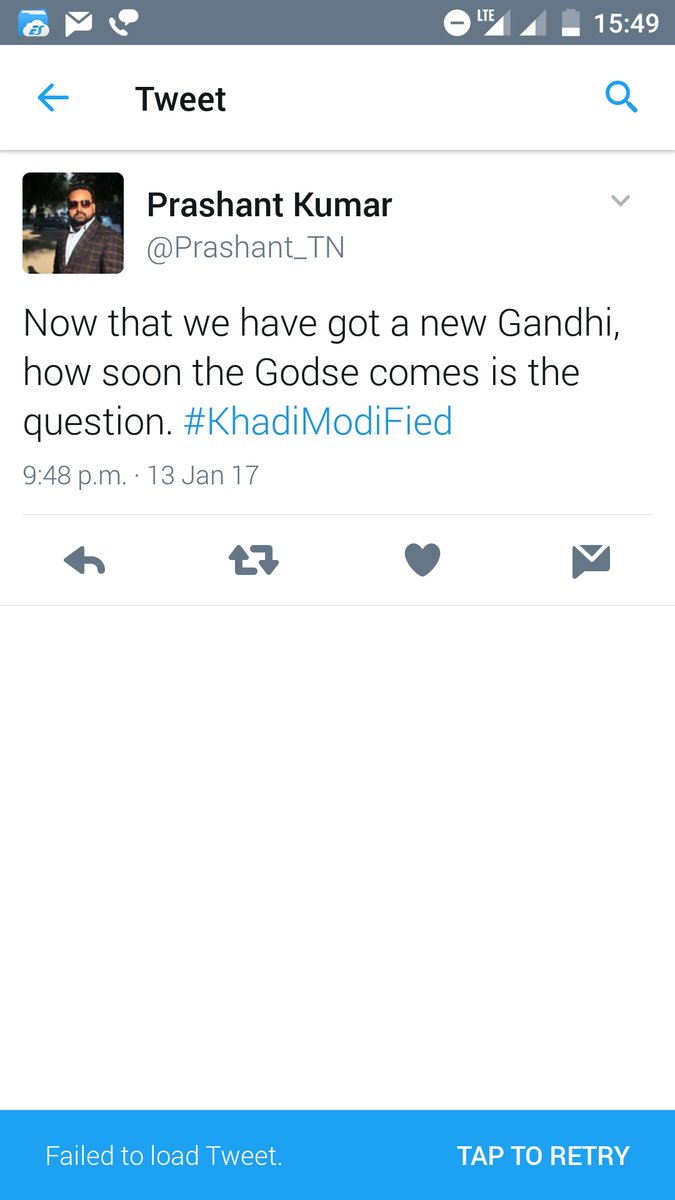
Incessant trolling by right-wing brigade recently forced a Times Now journalist to issue public apology and delete his tweet on Prime Minister Narendra Modi.
Kumar’s tweet said, “Now that we have got a new Gandhi, how soon the Godse comes is the question. #KhadiModiFied”
As expected, the journalist was inundated with tweets from the right-wing troll army, most of whom tagged his employer Times Now and Vineet Jain, the Managing Director of Times of India group, asking for his sacking.
Faced with barrage of unpleasant tweets, Kumar, whose Twitter bio says ‘Covers politics, principally UP Politics. PERSONAL space. Views completely MINE, not my channel’s/employers’ soon clarified.
He wrote, “I m appalled at crtn individuals who r maliciously misinterpreting my tweet abt PM. Those deliberately doing it shud be ashamed of thmslvs.(sic)”
I m appalled at crtn individuals who r maliciously misinterpreting my tweet abt PM. Those deliberately doing it shud be ashamed of thmslvs. pic.twitter.com/ebOJ1oNXGS
But, this failed to pacify his right-wing Hindutva detractors, who continued to harass him on the microblogging site.
On Sunday he posted an apology, “Frnds, dis tweet hs been cmpltly misinterpreted by many. He is my PM too. Views r absolutely mine and not my channel’s. Apologies. Thanks. (sic)”
Frnds, dis tweet hs been cmpltly misinterpreted by many. He is my PM too. Views r absolutely mine and not my channel's. Apologies. Thanks. https://t.co/Qtzh6f0Rmi
Muzaffarnagar, Jan 19 (PTI) A group of people who claimed themselves to be BJP supporters, burnt an effigy of Union Minister Sanjeev Balyan here and protested over denying party tickets to members from their caste to contest in the UP Assembly elections, beginning February 4.
Hundreds of people, led by the state general secretary of Akhil Bhartiya Vishwakarma Mahasabha- Nafesh Panchal, held a demonstration and burnt effigy of the Muzaffarnagar MP Balyan in Rampuri locality last evening.
They accused the BJP leader for choosing 'outsiders' over the members from their caste.
Restricted freedoms and intensifying governmental control raise the risk for social and geopolitical conflict. A contribution to the openGlobalRights debate on closing space for civil society.
The closing of civic space is not just about people’s right to organize or protest in individual countries. This year’s Gobal Risks Report, published last week by the World Economic Forum ahead of its annual Davos meeting, looks in detail at the risks posed by threats to governments clamping down on fundamental civic freedoms. The report points out that, “a new era of restricted freedoms and increased governmental control could undermine social, political and economic stability and increase the risk of geopolitical and social conflict.”
Indeed, the recently launched CIVICUS Monitor shows that more than 3.2 billion people live in countries in which “civic space” is either closed or repressed. It also shows that conditions very few countries—16 out of 134 countries with verified data—are genuinely open. This means that scope for citizen action is constrained and getting worse in much of the world, including some countries where one might least expect it. The spillover effect to other countries also cannot be understated.
Scope for citizen action is constrained and getting worse in much of the world, including some countries where one might least expect it. Glaringly absent from the WEF report, however, are any examples of countries where these trends are evident, so here are five examples from five different parts of the world of countries that demonstrate just how much citizen action is under threat in 2017.
Burundi
Already one of the worst places in the world for civic freedoms, 2017 didn’t begin well for human rights activists in Burundi after the government shut down Burundi’s oldest human rights organisation, Ligue Iteka. Journalists and media organisations have also been targeted. The situation in Burundi is so bad that the government is silencing the very people and institutions that could monitor rights abuses and undemocratic developments. Far from signifying a lull in human rights violations, the lack of information flowing from the country reflects the silencing of critical expression and the prevailing climate of fear, and this also explains why no significant public demonstrations have taken place in recent months.
Honduras
One deeply worrying dimension of Honduras’ high crime rates is the impact this is having on citizen action. Journalists, environmental activists, and gay rights campaigners have been among those most vulnerable to violence. This is made worse by the fact that government efforts to investigate and prosecute violence against members of these groups have made little progress. The murder of world-renowned environmentalist Berta Caceras in March 2016 was a tragedy in itself but made worse by the fact that this attack was far from isolated, and that peaceful protests have been met by police brutality and with suspected surveillance of media outlets.
Flickr/Comisión Interamericana de Derechos Humanos (All rights reserved)
A memorial to Berta Cáceres, a murdered Honduran environmentalist and human rights activist.
Philippines
President Rodrigo Duterte successfully courted controversy in 2016 but his flamboyant political style had very real consequences for the Filipino people. Thousands of citizens were killed in extrajudicial killings openly encouraged by Duterte as part of a so-called war on drugs. Activists and NGOs fear that the war is merely a thinly veiled excuse to permanently silence dissent against Duterte and his government. Mirroring many other similar political contexts, the assault on civilians comes hand in hand with direct attacks on the media, with President Duterte even endorsing the killing of "corrupt" journalists.
Turkey
The Arab Spring may seem like ancient history for citizens in Turkey trying to assert their rights to peacefully assemble and express themselves. The people of Turkey saw their democratic rights shrink at an alarming pace in 2016. On a single day in November the Turkish government suspended 370 NGOs, due to their alleged links with the opposition groups, including the Gulen movement, the Kurdish PKK and left wing organisations. The fragile political and security situation in Turkey is not a sufficient justification for limiting citizens’ rights to peacefully assemble and express themselves. Yet, the Turkish government, under President Recep Tayyip Erdoğan is employing similar tactics to many other governments by using security threats as a cover to tighten its own grip on power. Turkey is also one of many countries where gay rights activists have been targeted for speaking out: a pride parade planned in Istanbul in June 2016 was banned and then disrupted by authorities.
United States
The strength of the United States’ Constitution means that US citizens have some of the best protected democratic rights and freedoms in the world. And yet, recent events suggest that even the constitution—the vision of the US founding fathers—may be under threat. President-elect Donald Trump has shown little respect for the First Amendment to the constitution, which guarantees freedom of expression. In November, he controversially tweeted that those who burn the American flag should be sent to jail, even though the Supreme Court deemed this act legal since 1969 on First Amendment grounds. Trump has also repeatedly attacked the freedom of the press, including through litigation and at his most recent press conference this month, where he refused to speak to CNN and called the media outlet “fake news”. The harsh policing of #BlackLivesMatter and Standing Rock protests have called into question Americans’ right to peaceful assembly. Maina Kiai, the United Nations Special Rapporteur on these issues, noted serious concerns about how citizen action is being curtailed in the US. Ominously, he concluded that, “people have good reason to be angry and frustrated at the moment. And it is at times like these when robust promotion of assembly and association rights are needed most.”
There perhaps lies the most concerning aspect of the global trends on civic space: measures to limit the scope for citizens to organise and mobilise come just as people the world over are frustrated with established political institutions and actors. If we do not create the spaces and opportunities for people to vent these frustrations and articulate their aspirations in constructive ways, we could see social conflict intensify across the world. This problem is about far more than a few country examples. When this unrest spills across borders, especially when it stems from big powers like the United States, it creates a very real risk for further geopolitical instability—a risk we can no longer afford to ignore.
Dhananjayan Sriskandarajah is Secretary General of CIVICUS, the global civil society alliance with members in more than 175 countries.
वाह रे मोदी सरकार और उसके मंत्री किसान मरे तो मर जाए हम नहीं रोकेंगे और मारने के लिए उकसायेंगे। ऐसा पहली बार हुआ है जब किसी केंद्र सरकार के मंत्री ने भरे मंच से किसी किसान को आत्महत्या करने के लिए कहा हो। केंद्रीय मंत्री कोई ऐसा वैसा नहीं कृषि राज्य मंत्री है।मोदी सरकार के कृषि राज्य मंत्री संजीव बालियान सत्ता के घमंड में इस कद्र चूर हैं कि उन्हें किसी फरियादी किसान का दर्द नहीं दिखाई देता है उलटा किसान को खता है की जाओ कर लो जाके आत्महत्या। राजस्थान के टोंक जिले में किसानों के कार्यक्रम में एक किसान ने मंत्री के सामने अपनी फरियाद रखते हुए कहा कि अगर उसकी समस्या हल नहीं हुई तो वो आत्महत्या कर लेगा तो इस पर मंत्री संजीव बालियान ने कहा की जाओ कर लो।
मंत्री महोदय के सामने एक किसान खुदकुशी की बात कह रहा है। बजाए उसे समझाने के संजीव बालियान कह रहे हैं कि जाओ कर लो। राजस्थान के टोंक जिले में किसान मेले में कई किसान अपनी फरियाद लेकर पहुंचे थे। इन्हीं किसानों में से एक गिरिराज भी अपनी फरियाद लेकर पहुंचा था। गिरिराज के गांव में पिछले 15 दिनों से बिजली नहीं आ रही है। ये तब है जब भाजपा वाले और पीएम मोदी पूरे देश में भाजपा शाषित प्रदेशों में विकास का ढिंढोरा पीट रहे हैं। भाजपा नेता कहते हैं कि भाजपा शाषित राज्यों में 24 घंटे बिजली आती है।
पिछले 15 दिनों से बिजली नहीं आने की वजह से किसान गिरिराज के खेत में लगी फसल सूख चुकी हैं और जो बची हैं वो भी सूखने की कगार पर हैं। इसी से परेशान होकर वो मंत्री और इलाके के विधायक के सामने बिजली ठीक कराने की फरियाद कर रहा था। कुछ देर के लिए वो मंच के सामने ही बैठ गया, जब उसे वहां से हटाया गया तो वो कह रहा था कि फसल खत्म हो जाएगी तो वो भी मर जाएगा।
गिरिराज मीडिया के सामने भी कह रहा था कि उसकी समस्या दूर नहीं हुई तो वो आत्महत्या कर लेगा। संजीव बालियान इससे पहले भी कई बार अपने बयानों से विवादों में रहे हैं। सवाल है कि अगर किसान बार-बार खुदकुशी की बात कर रहा था तो मंत्री होने के नाते संजीव बालियान ने उसे क्यों नहीं समझाया ?