एक चौकानेवाली घटना जिसमें मनुष्य को अपमानित किया गया है और उनके जो न्यूनतम मूल्य है उसका भी इनकार किया गया है।कानून के नियमों के अनुसार हर एक व्यक्ति को जो न्यूनतम मूल्य है मिलने चाहिए जो उनका मौलिक अधिकार है। एक आत्म घोषित राज्य गुजरात के सोमनाथ जिले में गाय सतर्कता समूह वैन को छीन लिया गया और मृत गाय स्किन्निंग(skinning) के कथित अपराध में साथ दलित समुदाय से संबंधित लोगों को कार को बांधकर पीटा गया है।
सोशल मीडिया पर जो वीडियो हलचल मचा रहा है, उसमें ये दिखाया गया है कि उच्चजाति के लोगों के एक समूह ने चार दलित लोगों को एक वैन को बांधकर उन्हें लाठी औरलोहे के स्ट्रिप्स (strips) से उनकी पिटाई की गयी है और पूछा गया है कि कैसे वे गाय त्वचा की खरीदी कर सकता है।उन दलित लोगों को बेरहमी से मारने के बाद, आत्म घोषित गाय सजग समूह में से एक व्यक्ति ने सोशल मीडिया पर एक विडियो डाला है।
उसमें चेतावनी दी गयी है कि यदि गाय की हत्या और गाय का चमड़ा (skin) पाया गया तो इसी प्रकार का उपचार उनको दिया जाएगा। यह भी चेतावनी दी गयी है कि गाय (गौ-माता) को किसी भी तरह से स्पर्श नहीं करना चाहिए जिन्दा या मुर्दा नहीं तो हश्र यही होगा। इसी प्रकार सदियों से दलित महिलाओं के साथ बलत्कार किया जा रहा है, जला दिया जा रहा है, मार दिया जा रहा है और अनेक इस प्रकार के जुल्म दलित समुदाय झेलता आ रहा है।इस असहिष्णु देश में ऐसी घटनाएं क्षत-विक्षत रोज होती जा रही है लेकिन आज दलित समुदाय इस प्रकार के राष्ट्रवाद को बर्दाश्त करने के लिए तैयार नहीं हैं। प्रश्न यह उठता है कि क्या उनके पवित्र गाय को नुकसान पहुँचाया जाता है।
भले ही मरी हुई गाय (गौ माता) हो, जो उनके बचों द्वारा ही खुले में फेक दिया जाता है। सामान्य रूप में दलितों ने गुजरात के सौराष्ट्र क्षेत्र से भारत भर में अपनी आवाज उठाने के लिए एक अनूठा रास्ता मिल गया है। विशिष्ट अपनी आजीविका के लिए (dehumaninized) कब्जे संलग्न करने के लिए उन्हें सम्मोहक से पहले उन पर लगाये गए हिंसा के खिलाफ आपनी आवाज उठाई।
शारीरिक रूप से उनके मानव गरिमा का उलंघन करने के कारण उन्होंने एक संक्षिप्त सन्देश को सारे देश में पहुंचाया है कि-आत्म घोषित उनके गौ माताओं (matas) को निपटाने के लिए उन्होंने मरें हुए गाय के शवों को सरकारी कार्यालयों के सामने डाल दिया है और यहाँ फैसल किया है कि वे मरें हुए गायों (माताओं) को ढोने काम नहीं करेंगे जो सदियों से करते आ रहे थे। जो उनका यहाँ हिन्दू–धर्म में पेशा था। आज ओ काम उन्होंने गौ-माताओं को ढोने का उनके प्यारे बचों के लिए छोड़ दिया है ऐसी घोषणा उन्होंने की है।भारत में दलित ही ऐसा समुदाय है जो ऐसे हिंदुत्व बयानबाजी के खिलाफ अपनी आवाज नैतिक और सांस्कृतिक प्रक्रिया के तौर पर करता है जो उनका मौलिक अधिकार है।
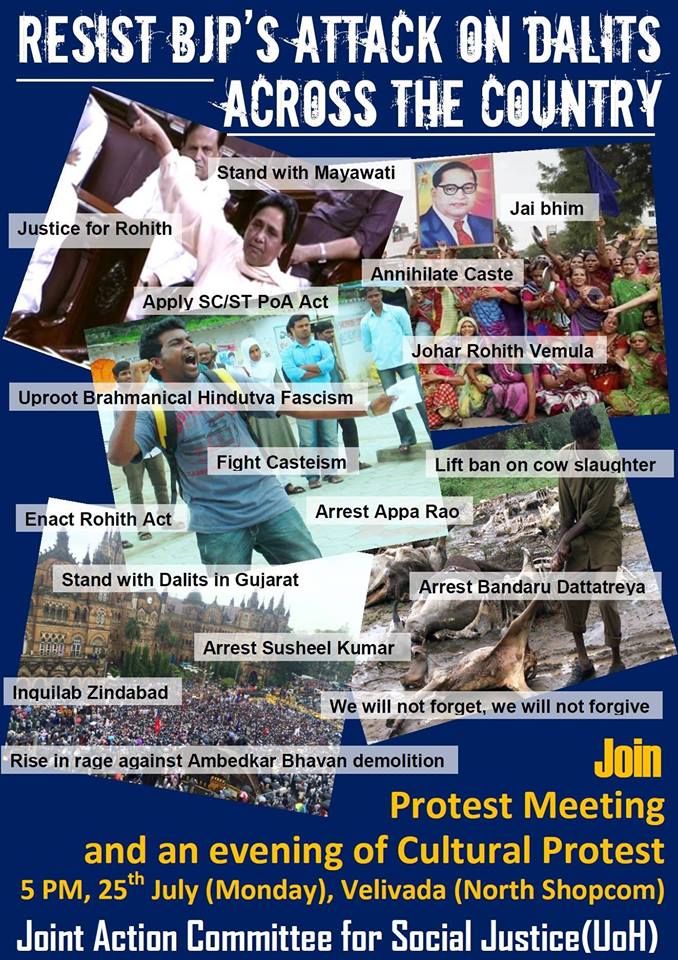
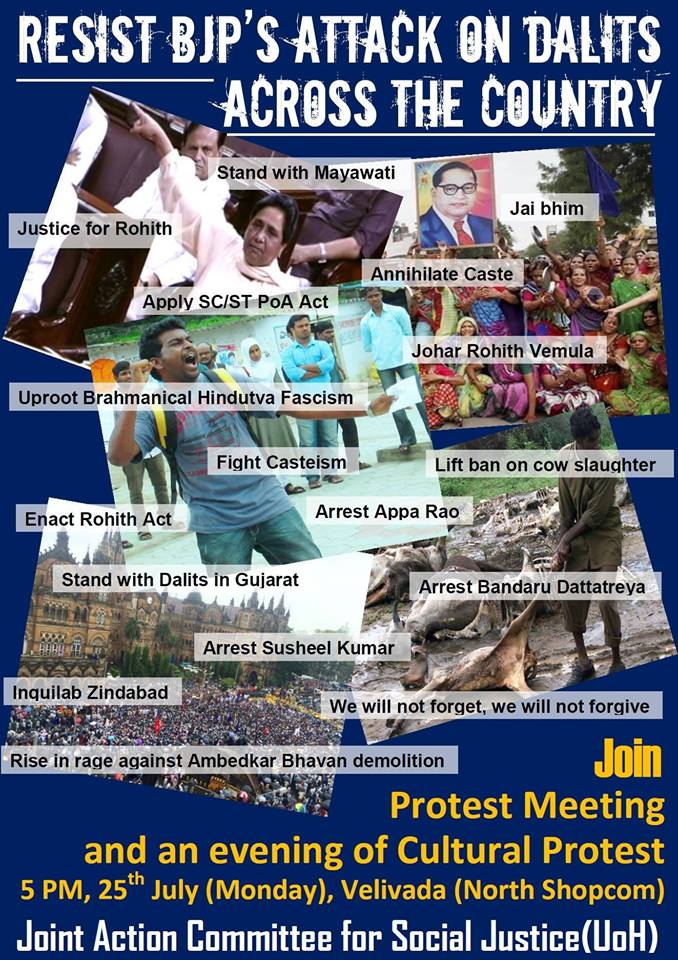
Students and Faculty of the University of Hyderabad (UoH), the site of a relentless struggle since the death of Rohith Vemula on January 17, 2016 will today protest the increasing attacks on Dalits across the country (Gujarat, Karnataka, Madhya Pradesh), made worse by a hostile regime of the Bharatiya Janata Party (BJP) at the centre.
Today's protest comes in the midst of renewed attempts by the administration of the university to stifle protests, debates and discussion. On July 17, 2016 the administration issued a circular 'banning' protests and demonstrations on the campus. The Student's Union has responded strongly against this repressive and regressive move by the administration.
The UoH Students Union will not allow any such move, said the President Students Union of UoH. He demanded that the university administration ensure the safety of students. “The right-wing bigots have no place in our university”, the JAC said in a statement.
The VHP had, on July 23 demanded that the University of Hyderabad, which was at the centre of a controversy earlier this year over the suicide of Dalit research scholar Rohith Vemula, should suspend the faculty members indulging in “anti-national activities”. Further declaring its intent to take law into its own hands, the VHP-Bajrang Dal (BD) combine have ‘demanded the eviction of students who live in the hostels in an unauthorised manner.’ “We demand strict action against some faculty members who indulge in anti-national activities. We also seek suspension of students who take out rallies supporting anti-national elements and terrorists,” Telangana VHP President M Ramaraju said. “Bajrang Dal will undertake Chalo Hyderabad University programme on July 28 to protest anti-national activities in the varsity.” Ramaraju further threatened that if police failed to arrest those attacking ABVP leaders, Bajrang Dal would enter into university on July 28 and nab them.
The Students Union of UoH has strongly condemned the statement of VHP president (Telangana) in which he threatened that the Bajrang Dal would enter the university on July 28. The UoH Students Union will not allow any such move, said the President Students Union of UoH. He demanded that the university administration ensure the safety of students. “The right-wing bigots have no place in our university”, the Joint Action Committee (JAC) has said in a strong statement.
Meanwhile the students union and other bodies have announced a protest today, July 26, against the mounting atrocities against Dalits all over the country under the present central government.
The student’s union invite to the protest says:
Join us for a protest against atrocities on Dalits and minorities on July 26, 2016 at 05 pm at Velivaada, North Shop Complex:
Resist BJP’s Attack on Dalits and Minorities of the Country: • A Dalit boy was brutally killed in Navi Mumbai: CRIME: Loving a fellow human being (categorized as Upper Caste) • Two Dalit men from Beed in Maharashtra were beaten up brutally by a mob of about 25. CRIME: Overtaking the vehicles of Upper Castes by a bike owned by Dalits consisting a picture of Dr.B.R.Ambedkar pasted on their bike • Three Dalits were brutally assaulted by Bajrang Dal in Karnataka: CRIME: Eating beef. • Four Dalits were brutally assaulted for skinning a dead cow at Gir Somnath District in Gujarat. Stripped, handcuffed with metal strips, tied to a van and were attacked with iron rods in the most deplorable and inhuman manner. : CRIME: Skinning a dead cow • Fifty Dalit families in Madhya Pradesh wrote to the chief minister, Sivaraj Singh Chauhan seeking permission to kill themselves, as Rohith Vemula requested for arrangement of Euthanasia facility for not allowing to read Ambedkar and against social boycott of five dalit research scholars at University of Hyderabad. In Madhya Pradesh, the land allotted to Dalits by Government was forcefully taken away by powerful political lobbies. CRIME: Birth itself. • In June 2016: Cow vigilantes in Rajasthan stripped and beat up three people who were suspected to be transporting cows for alleged slaughtering. • In March 2016 : Mustain Abbas was killed in Haryana, allegedly by gau rakshaks, when he was transporting a newly-purchased bull for use in his fields. • Also in March: Two Muslim cattle traders, including a 12-year-old boy, were hanged from a tree in Jharkhand, allegedly by a cow protection group. CRIME: Herding Cattle • Five Dalit Research Scholars Socially Boycotted at University of Hyderabad, for asserting the voice of Dr.B.R.Ambedkar and voice against casteist RSS and BJP, leading to mounting of political pressure from BJP and Sangh Parivar, subsequently resulting in the Suicide of Rohith Vemula. CRIME: Pursuing independent academic research for the marginalised • Mohammad Akhlaq was lynched by supporters of Sangh Parivar and BJP in a horrifying manner. CRIME: Consuming BEEF.
Join Protest Meeting and an evening of cultural protest at 5 PM Venue: Velivaada, Shopping Complex, North Campus
This academic term at the central university began with a questionable degree of policing by the administration and authorities.The Times of India reported today that a week after the academic session began, students at the University of Hyderabad (UoH) expressed distress at the constant surveillance on campus. Students alleged that security guards are restricting their movement, especially of girls, on the campus and CCTVs have been installed at all major junctions and places where students gather, in a move that has now turned intimidating.
The varsity authorities had decided to tighten security following a clash between members of ABVP and a few students on July 16 over the killing of Hizbul Mujahideen commander Burhan Wani in Kashmir. The university, soon after, issued a circular restricting students from holding any public meetings or protests inside the campus. Since then, students claim they are experiencing intrusive surveillance on the campus.
"Due to the CCTV cameras at the shopping complex, students who want to support protests or raise their voice against various issues are not coming forward, fearing that the cameras will capture their identity," said Mitaji, a research scholar in the sociology department.
Students also said that for the first time, the administration has restricted entry of women into the men's hostel. "I was not allowed to give medicine to my friend in the men's hostel as the security guards stopped me at the entrance and threatened to call senior security personnel," said Debomita Mukherjee, an MA student of sociology.
"For research purposes, we often have to work together with our male friends. But now, the security guards are not only stopping us from sitting together in the hostel but are also raiding men's hostels to remove women," said another research scholar.
Members of the Gender Sensitization Committee Against Sexual Harassment (GSCASH) recently submitted a representation to the chief warden and chief security officer in this regard. They called the university's move a clear violation of the Saksham Committee Report (2013) by the University Grants Commission, which states that 'campus safety policies should not result in over monitoring, policing or curtailing the freedom of movement, especially for women.'
The University of Hyderabad (UoH) has been the site of a determined contestation between the politics of the extreme right wing and the Sangh Parivar. This has particularly been sharper since 2015 when the Ambedkar Students Association (ASA) was targeted by members of the RSS-driven Akhil Bharatiya Vidyarthi Parishad (ABVP). The suspended Vice Chancellow Appa Rao Podille was brought back in a serious act of misdemenour while the MHRD-ordered Inquiry into the crisis emanating from the death of research scholar Rohith Vemula was still under way. Then in June 2016 the UoH administration tried ti suspend two faculty members and thereafter hurriedly revoked the suspension. Despite the change of guard at the top (Smriti Irani's being replaced by Prakash Jawdekar as MHRD Minister), the Modi Regime persists wit a deeply anatgonistic attitude towards the universities and students movements.
कंधमाल मेरे लिए कोई नया विषय नहीं है। काउंटरकरेंट्स डॉट ऑर्ग ने दो नवंबर 2003 को अंगना चटर्जी का लिखा एक लेख प्रकाशित किया था- 'ओड़िशाः अ गुजरात इन द मेकिंग।' यह लेख 2008 में कंधमाल में हुए आधुनिक भारत में ईसाइयों के खिलाफ सबसे बर्बर दंगों के पांच साल पहले छपा था, जिस दंगे में तिरानबे लोग मारे गए, आदिवासी ईसाइयों और दलित ईसाइयों के साढ़े तीन सौ से ज्यादा पूजा-स्थलों को नष्ट कर दिया गया, लगभग साढ़े छह हजार घरों को जला या ढाह दिया गया, चालीस से ज्यादा महिलाओं का बलात्कार किया गया, यौन हिंसा, बेईज्जती की गई और अनेक शैक्षिक संस्थानों, सामाजिक सेवाओं और स्वास्थ्य संस्थानों को तोड़-फोड़ दिया गया या लूट लिया गया। छप्पन हजार से ज्यादा लोगों को अपनी जमीन छोड़ कर भागना पड़ा। इस त्रासद और खौफनाक घटना के बाद काउंटर करेंट्स ने तथ्यों का अध्ययन, विश्लेषण, विचार और जमीनी रिपोर्ट सहित दर्जनों लेख छापे थे।
मैं 2015 में कंधमाल के दौरे पर गया था और कंधमाल के जमीनी हालात पर विस्तार से रिपोर्ट लिख सका। मैंने कंधमाल हिंसा में अपने पति को गंवा चुकी दर्जनों ऐसी महिलाओं से बातचीत की। जब मैं उनका इंटरव्यू ले रहा था तो उन लोगों ने मेरी तरफ कुछ ऐसे देखा था जैसे कोई उनकी बेहद दयनीय हालत और परेशानी में थोड़ी राहत पहुंचाएगा। वे तमाम लोग हिंदुत्ववादी ताकतों की ओर से धमकी का सामना कर रहे थे और अपने गांव में नहीं लौट सकते थे। उनमें से ज्यादातर देश के अलग-अलग हिस्सों में घरेलू नौकरों, टेलर और इसी तरह के दूसरे बहुत छोटे-मोटे काम करके अपने तबाह हो चुके परिवारों को जिंदा रखने की कोशिश में लगे हुए थे। वे शायद ही जानते रहे हों कि मेरी तरह का कोई बेहद मामूली पत्रकार उनके लिए कुछ भी खास नहीं कर सकता था। उनकी आंखों में बसी उम्मीद से मैं सचमुच स्तब्ध था।
यह सब देख कर भी मैंने खुद को शांत बनाए रखा था और अपनी 'ड्यूटी' पूरी कर रहा था। मैं तबाह हो चुके घरों के अलावा एक ऐसे घर में भी गया जिसमें एक बुजुर्ग महिला को जिंदा जला दिया गया था। एक चर्च, जिसे गौशाले में तब्दील कर दिया गया था। मैं रैकिया में हजारों पीड़ितों के जुलूस में साथ था। रैकिया कंधमाल में आरएसएस-संघ परिवार की हिंसक गतिविधियों का केंद्रीय स्थल था। मैंने तमाम मुसीबतों और सरकार की उदासीनता के बावजूद उन पीड़ितों की ओर से पेश की गई सामूहिक चुनौती और उनका हौसला देखा, जिन्होंने सांप्रदायिक सद्भाव के लिए साथ आकर एक आंदोलन खड़ा कर दिया। लोगों के साथ जुलूसों में साथ चलते हुए मैं इस बात को लेकर आश्वस्त था कि आरएसएस-संघ परिवार के लोग अब कंधमाल में 2008 को कभी नहीं दोहरा सकेंगे।
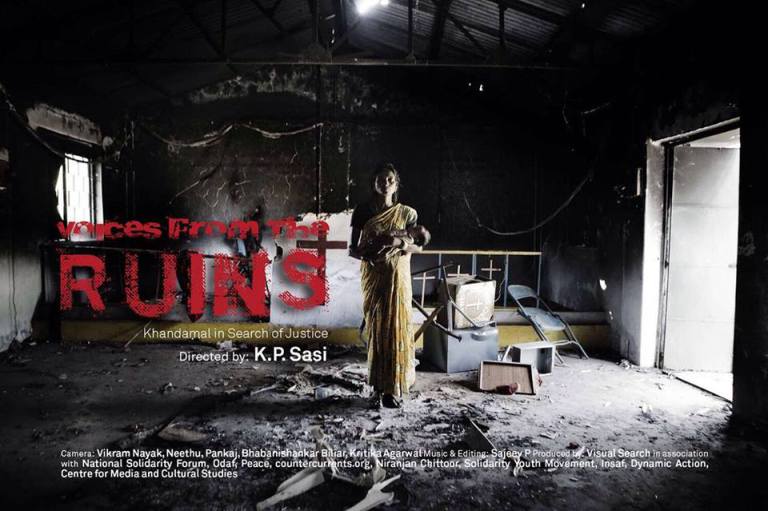
इसी महीने की उन्नीस तारीख को मैं कालीकट में केपी केशव मेनन हॉल में उन दर्शकों के बीच था, जो केपी शशि की डॉक्यूमेंटरी फिल्म 'वॉयसेज फ्रॉम द रुइन्सः कंधमाल इन सर्च ऑफ जस्टिस' देख रहे थे। शशि मेरे अच्छे दोस्त रहे हैं और मैंने उनसे भी कंधमाल की उन घटनाओं के बारे में काफी सुना। मैंने इस फिल्म के शुरुआती संपादित रूप भी देखे। मैं जानता था कि इस फिल्म को बनाते हुए उन्हें किस दर्द और मुसीबतों से गुजरना पड़ा होगा। जब मैं अंधेरे में बैठा स्क्रीन पर चल रही इस फिल्म के दृश्यों से गुजर रहा था, तब असल में मैं एक बार फिर से कंधमाल की हिंसा को जिंदा होते देख रहा था। हिंसा की नंगी और खौफनाक कहानियां, पीड़ितों की लाचारगी, उन हिंदुओं की हिम्मत, जिन्होंने अपनी जान पर खेल कर बहुत सारे ईसाइयों को बचाया, इंसाफ तय करने में सरकारी और न्यायिक उदासीनता और आखिरकार एक ऐसे उदार भारत के निर्माण की उम्मीद, जो मजहबी भाईचारे के जरिए सांप्रदायिक ताकतों की धूर्त और बेईमान मंशा को खारिज करेगी, हराएगी। समूची फिल्म और खासतौर पर आखिरी दृश्य ने मेरे जज्बातों को बेचैन कर दिया और मैं रो पड़ा।
इस फिल्म को देखने के तुरंत बाद मुझे इस पर अपनी राय जाहिर करने के लिए मंच पर बुलाया गया। मैंने अपने आंसू पोंछे और मंच पर गया। अब भी मैं अपने आंसू नहीं रोक पा रहा था। मैं भीतर से बेहद परेशान और शर्मिंदा था। मैंने दर्शकों को कहा कि यह फिल्म दरअसल भावनाओं के जरिए एक क्रांतिकारी कार्रवाई पैदा करती है। शशि की फिल्म हजारों किलोमीटर दूर हुई एक घटना के बारे में लोगों के जज्बात को झकझोरने में सक्षम है और अब यह तय करना हमारी जिम्मेदारी है कि पीड़ितों को इंसाफ मिल सके।
हालांकि मैं शशि की फिल्म को देखते हुए अपनी भावनाओं पर काबू पाने की कोशिश कर रहा था, लेकिन यह केवल रुलाने वाली फिल्म भर नहीं है। यह कंधमाल की हिंसा का एक बेहद शांत मन से किया गया अध्ययन है। यह फिल्म अतीत में जाकर उन चीजों के बारे में गहराई और विस्तार से बताती है कि आरएसएस-संघ परिवार के लोग कैसे लगातार नफरत के अभियान चला कर धीरे-धीरे कंधमाल की नसों में घुस गए। माओवादियों द्वारा स्वामी लक्ष्मणानंद की हत्या को कैसे सांप्रदायिक ताकतों ने आदिवासी और दलित ईसाइयों के कत्लेआम के लिए इस्तेमाल किया। यह फिल्म दिखाती है कि वह कत्लेआम उस स्वामी की हत्या की कोई तात्कालिक प्रतिक्रिया भर नहीं था, बल्कि अल्पसंख्यकों पर एक सुनियोजित हमला था। इसके बाद यह फिल्म न्याय देने की प्रक्रिया का भी विश्लेषण करते हुए बताती है कि कैसे यह पीड़ितों को इंसाफ देने में नाकाम रही। आखिर में यह फिल्म वहां के पीड़ितों की ओर से अपने पैमाने पर खड़ा किए गए एक ठोस प्रतिरोध आंदोलन और तमाम राजनीतिक खेमेबंदियों को तोड़ कर साथ आए पीड़ितों के समर्थन को दिखाते हुए एक उम्मीद के साथ खत्म होती है।
कंधमाल के मसले पर इतना भावुक हो जाने वाला मैं अकेला नहीं था। 2015 में मैंने देखा था कि स्वामी लक्ष्मणानंद की हत्या के आरोप में फूलबनी जेल में बंद सात निर्दोष दलित-आदिवासी ईसाइयों से मिलने के बाद भारतीय कम्युनिस्ट पार्टी (मार्क्सवादी) की पोलित ब्यूरो सदस्य बृंदा करात अपने आंसू पोंछ रही थीं। विचित्र है कि उस सांप्रदायिक हिंसा से संबंधित किसी भी मामले में सिर्फ यही लोग दोषी ठहराए गए और अब तक जेल में बंद हैं। हां, भारत कंधमाल में इन गरीब आदिवासियों-दलितों को इंसाफ देने में नाकाम रहा। शशि अपनी फिल्म में इस हकीकत को पूरी ताकत से सामने लाते हैं। यही वजह हो सकती है कि मैं इस फिल्म को देखते हुए रो पड़ा।
‘You know these faces. Does that make the tragedies more important?’
Facebook/Never Forget Pakistan
What happens when the tragedy of other people suddenly takes on the faces of people you know?
A human rights group has done exactly that: it has superimposed pellet injuries which are currently being inflicted on Kashmiri people on the faces of popular Indian actors, famous people including Facebook founder Mark Zuckerberg and even Prime Minister Narendra Modi. The series of images titled ‘India Can’t See’ created by Never Forget Pakistan were uploaded on Facebook on Monday. Even as the images go viral, shocking people into looking at the pellet injuries differently, the CRPF has stated that while it sympathises with the people injured, it claimed it had no other choice.
“We feel very sorry for them as youngsters have to bear injuries due to the firing of pellet guns. We ourselves are trying to use it in bare minimum so that there are less injuries. But we use them under the extreme situation when crowd control fails by other means,” CRPF DG K Durga Prasad said on Monday.
The Indian Express had reported that half of the 317 people who had sustained pellet injuries had been hit in the eye.
The ‘India Can’t See’ campaign has gone beyond just shock value. The image of each famous personality on which pellet injuries are superimposed is accompanied by letters and the names of real victims.
Would we still be silent if it were them, the campaign asks. “Why do we need to glamourize a tragedy in order for people to pay attention. Have we all become that numb?”
What makes pellet guns so lethal? These small metal balls, which may or may not be covered by rubber, are shot at a close range. According to a report by Aviral Virk in The Quint, reports suggest that the CRPF has been using bare metal pellets and from a close range, causing more permanent damage than crowd control.
Pellet guns are also supposed to be fired below the knee. However, 92 Kashmiris have undergone eye surgeries in just one of Srinagar’s hospitals, indicating that the below-the-knee rule is not being followed.
A number of pictures and stories of Kashmiri youth and children as young as four being hit by pellet guns have been circulating on the social media.
Home Minister Rajnath Singh has said that the government would look for replacement to the pellet guns.
It has happened to me, and it can happen to anyone.
In plain sight of my unsuspecting family, I was radicalised during my teenage years. It did not matter that I lived a privileged life — not all terrorists fit the stereotype of poor, illiterate people who have nothing to lose.
The events changed my life, and would have ended it were it not for divine intervention. What I realised was that anyone can be systemically brainwashed to the point of committing violence.
How did it happen? How does someone growing up with a silver spoon connect with an ideology of anger and hate?
13-year-old me in 1997-98, during a visit to my house (under construction at the time) in Lahore.
Where it all begins In the late 1990s, my family moved back to Lahore from Saudi Arabia. I was enrolled at an elite boarding school, where I would meet our 9th grade Islamic Studies teacher, a stocky man with a flowing orange beard, always dressed in a spotless white shalwar kameez and a black waistcoat.
He claimed to have fought against the Soviets in the 80s. He regaled us with stories from his time as a Mujahideen fighter in Afghanistan. His lectures had little to do with our syllabus, and included colourful, emotional sermons on the devilry of Hindus, Christians and Jews, as well as Sufis, Shias, Ahmadis, and whoever he considered to be heretics, polytheists and kafirs.
For him, fighting the enemies of Islam was our divinely ordained duty. If we did not strike the heretics down wherever we found them, we were no better than men who ‘wear mehendi on their feet and bangles on our wrists’, that is, we were no better than women.
He termed this blanket call for violence in the name of honour as ‘jihad’.
For 13-year-old me, this message was inspiring. I was also insulted by his labels — I was not at all womanly, and I certainly did not own any bangles.
He instigated my sense of honour, and this was enough to spur me into action.
13-year-old me in 1997-98, during a visit to my house (under construction at the time) in Lahore.
It took only a month for me to go up to him and ask how I could further the cause of jihad. He suggested donating money. If I could spare 10 rupees for Allah, I could buy a bullet that would tear through a kafir’s chest in Kashmir. I started giving him whatever meagre sum I could, before spending the rest of my pocket money at the canteen. Rs50, Rs10, Rs5 — he had promised me I would receive a portion of the bullet’s 'sawab' .
Then, I wanted to learn more. My teacher offered me books if I was willing to pay for them. I could not read Urdu well, so I delved into the English translation of the Holy Quran and the Sahih Bukhari (a collection of hadith).
But balancing daily reading school work wasn’t enough for a teenager infatuated by the idea of martyrdom. Eventually, I found myself before my teacher, expressing my decision to go fight the infidels in Kashmir.
He did not respond immediately and put me off for another few weeks. I went to him several times until he agreed.
The plan was this: on the last day of school, I would leave for the training camp in AJK. I was to bring Rs700 and meet my teacher at his house. We would then go to the bus station at Minar-i-Pakistan, where I would be joined by a travelling partner.
Once I reached the camp, I was to write a letter to my parents informing them of my decision, and of my desire to embrace martyrdom in the way of jihad.
Divine intervention As fate would have it, my grandmother fell gravely ill the night before I was to leave. It was perhaps the last day before the Eid break, or the winter break, and I reached my hostel room to see my family already there, waiting for me.
My belongings were packed and ready and we immediately left for the hospital. My grandmother had contracted an incurable strain of Hepatitis C from a routine injection at the hospital, and survived the next few months in extreme pain. Greatly distracted by her illness, my parents decided I would commute to school from home for the rest of the school year.
I began living at home.
The tragedy wreaked havoc on my mother's emotional state, and it became a difficult time for my family. In such a state of sadness and loss, I could not leave them. In any case I had little time to myself on campus to consider meeting my teacher.
Somehow, someway, I kept putting off my trip to his house. By the time my summer vacations ended, I had shelved my plans of leaving for jihad completely.
Finding my way to jihad The spirit of what I knew then to be ‘jihad’ stayed with me and still shapes my life to this day.
There was an empowering sense of purity and certainty in my connection to the source of absolute truth. I felt mercy and forgiveness radiating from the Quran and the hadith, especially when I read them in a language I could understand. Most of all, I felt fulfilled: I was aware of the Creator in the smallest details and happenings of life.
But there was much that I now know to be gravely misguided. I was made to feel disdain against those who chose ‘inferior’ beliefs; I dehumanised those I wanted to fight, and I belittled the act of taking a life to the point where it seemed like nothing at all — like brushing away a troublesome insect.
When I realised that I had once walked a dangerous path, filled with both darkness and light, I tried to read and learn as much as I could to answer my questions and seek out the truth. I must report that every answer has led me to even more questions, and I have learned just enough to know that I know nothing.
I have come to see Islam as a vast ocean of knowledge, an expanse of philosophy, wisdom and truth, and in my sinful life so far I have just barely scratched the surface.
I cannot claim to be any kind of expert, but as a seeker and a student, it is evident to me that the extreme reduction of Islam to a list of do’s and dont’s is a great corruption of our religion. Perhaps it is the real cause behind how Muslims are now split into so many hostile divisions with mutual hatred and enmity.
In the years since my failed attempt at joining a training camp, I have felt the call of what I now believe is the real jihad.
I have worked in multiple careers; financial services, telecom, advertising, publishing, and even as a part-time debate coach at my alma mater. But each time, even after settling into a career, I have left the path in front of me to begin a new one. I have been restless, unable to find satisfaction or peace in worldly pursuits.
After December 16, 2014, my heart once against felt this long-forgotten call to jihad. This time the pull was irresistible. I could not go back to the way things were, and relieved myself from corporate responsibilities completely.
I decided instead to focus full-time on a new mission: addressing the problem of religious extremism in our society.
From the author's comic book series, Paasban — the Guardian.
From the author's comic book series, Paasban — the Guardian.
I do this because I hold myself partly responsible for all the innocent men, women and children who have lost their lives in terrorist attacks.
I do this because I am indebted to those who have sacrificed themselves to protect us, and because I wish to be of service to the unnamed millions who continue to be misled into a false, hateful form of religion rather than the pure and everlasting truth of Islam.
For those of you who have made it this far in this very long post, I hope you have felt a calling as well. If you do feel the call, first learn, then do as you see fit to the best of your ability and position.
This is a dangerous time for those who dare to speak the truth, so if you can take action or speak out, you too must play your part. I do this because I cannot stand by while another 16-year-old is brainwashed into thinking he will go to heaven for killing a 12-year-old, is then labeled a ‘terrorist’ to be shot by his own kind, or blown up by a drone fired by a foreign country.
I do this because tomorrow, if God forbid one of your children or loved one is harmed, I don’t want to look in the mirror and realise that I could have done something, said something to stop it.
This article was first published in Dawn.comand is being re-published with permission
Watch the author speak about the socialisation of violent extremist beliefs within Muslim communities.
Mob of alleged Bajrang Dal men had beaten Dalits in Chikamagaluru with sticks and iron rods on July 10.
Image: MB Maramkal
An alleged assault by Bajrang Dal members on eight Dalit men suspected of stealing a cow, killing and eating it in a Karnataka village has led to two police complaints against both parties. The police first booked the Dalit men for displaying cruelty to animals, and registered a counter-complaint against the Bajrang Dal members a day later.
Though the incident took place on July 10, it has only surfaced now, against the backdrop of protests in other parts of the country against a brutal assault by cow protection vigilantes on Dalits found skinning a dead cow in Gujarat.
Police booked victims The residents of Kundur village – a small Dalit colony of about 150 residents in Chikamagaluru district of Karnataka – alleged that around 30-40 Bajrang Dal men had descended on their village and brutally beat up their fellow villagers with sticks and iron rods after tying them up.
The villagers said that the attackers did not allow the assault to be filmed by ensuring no villager came close to the house in which the men were being thrashed. The villagers said that the assailants also ensured that none of the victims sustained open injuries.
The house belonged to a 56-year-old disabled man, Palraja, who now has a fractured arm. While three of the eight men managed to flee the assault after escaping their bonds, the remaining Dalit men have several bruises all over their bodies.
Palaraja's home, where he and others were attacked. (Photo credit: MB Maramkal)
The police from the nearby Jayapura police station arrived at the spot on the day of the attack but arrested Palraja, Dhanu, Muttappa, Sandeep and Ramesh – all of whom had been attacked – on grounds of “cruelty towards animals” on the basis of a complaint filed by the Bajrang Dal activists. They were subsequently released on bail.
The following day, the Dalit men filed a counter-complaint after which seven of the alleged attackers were arrested under the Scheduled Castes and Scheduled Tribes (Prevention of Atrocities) Act.
‘Gift’ of cattle? According to Palraja, an estate owner by the name of Nagappa Gowda had caught an old cow grazing on his crops and handed it over to the Dalit men after no one came forward to claim it.
Villagers said that this was not the first time that Dalits have slaughtered and consumed cattle handed over to them by owners of the region’s coffee and pepper estates.
Guru Rao, a native of the nearby Koppa village, said that in the absence of hattis (cattle sheds or areas to keep cattle in villages), cattle were left free to roam around and invariably entered the estates.
“They [cattle] trek for miles together and end up in the estates,” said Rao. “Owners of these estates watch for a week or two to see if the owner of the cow or buffalo comes to get them. When cattle owners fail to do so, estate owners hand over the animals either to butchers or Dalit youths.”
Police apathy Palraja said that the police initially “failed to take note of injuries sustained by us on our body parts”.
He added that the police only did so when their lawyer, who came to jail to get signatures on their bail petitions, questioned the police.
“Our lawyer questioned the police asking why they failed to take cognisance of the injuries sustained by us,” said Palraja. “He asked them to book a case against Bajrang Dal activists.”
Palraja added that it was only after the lawyer’s complaint that they were treated at the government hospital in Koppa where doctors found that Palraja had sustained a fracture on his left elbow.
K Ashok, state convenor of Komu Souardha Vedike (Communal Amity Forum) blamed the growing influence of the Bajrang Dal in the region for the attack.
Ashok said that the Bajrang Dal had turned its ire upon Dalits after indulging in violence on churches and mosques in the past, as well as trying to impose their own code of conduct on women and youth in the area.
“Who are these people to question Dalits’ food culture?” asked Ashok. “Dalits in the country have historically consumed beef.”
Ashok blamed police inaction for the attack on Dalits at Kundur village.
Cattle thefts to blame? Santosh Babu, the Chikamagaluru superintendent of police, defended his team. “The police have acted impartially,” he said. “It booked a case and arrested the Bajrang Dal activists on the basis of complaint filed by Palraja.”
Babu added that the tension over cattle in the area would end once organised cattle smugglers were stopped.
“My suggestion to the government is that it should repeal the 1964 cow slaughtering Act [Prevention of Cow Slaughter and Cattle Preservation Act] to end slaughtering of cows surreptitiously by anti-social elements,” said Babu.
According to this law, only infirm and aged animals can be slaughtered after a doctor's certification.
Babu added that the soaring price of beef had given thieves an incentive to steal cattle and smuggle them to slaughterhouses in other areas.
Cattle thieving was a matter of concern, admitted local Congress leader HM Satish. He added that every month, 10-15 cases of stolen cows were reported in and around the neighbouring villages of Kopa and Balehonnur Hobli.
Police records show that in June, 10 cases of stolen cows were reported in the Kopa taluk of which Kundur village is a part.
Local resident Guru Rao said that cow thieves usually hailed from neighbouring districts like Udupi as well as Dakshina Kannada, which borders Kerala – where there is no restriction on the slaughter of cattle and consumption of beef.
Babu said that he had visited Kundur village and instructed the local police to keep a vigil on anti-social elements in an effort to assure Dalits of their safety.
But Dalit activists do not think that’s enough. The Komu Souardha Vedike has planned a torchlight procession on July 28 to highlight alleged police lapses and what they call the “increased goondaism and moral policing by the Bajrang Dal.”
No minister or senior official from the Social Welfare Department of Karnataka has visited this Dalit hamlet so far. Home minister G Parmeshwara, a Dalit, has not spoken on the issue either.
The allegedly fake Maoists encounter in Kandhamal has brought the communal violence hit district into focus, once again. Reportedly, the Special Operation Group (SOG) and Odisha Police gunned down six villagers that included three women and 15 month toddler while six other survived the gun injuries on July 8, 2016. The villagers were returning to their villages after collecting their wages for work under the Mahatma Gandhi National Rural Employment Guarantee Schemes (MGNREGS) from Balliguda town in overloaded auto-rickshaw covering 20 kilometres.
With no fair weather road to the village, the auto-rickshaw got stuck in the mud as there was heavy downpour then. The six deaths of three women and a child showed that women were already seated in the auto-rickshaw while the men were pushing the auto out of the rain soaked mud when the security forces started the indiscriminate firing that killed.
Odisha Police officials have, in turn, claimed that they had specific intelligence inputs of Maoists presence in the district. The police further claimed that since it was pitch dark and there was a heavy downpour, they did not have time to verify whether they are Maoists or not, almost conceding that those who were killed, were not Maoists. The security forces appeared to have functioned with certainty, dead sure of Maoists passing by and hence, the ambush. Under ‘normal’ circumstances, security forces would have celebrated such a trophy catch/killing with first, a parade of those caught; but this encounter took place close to the village where the victims’ hail from; this alerted nearby villagers to rush to the spot in response to the sounds of gun-shots. The six injured have survived to tell their stories. While anti-Maoist operations usually take place at night, and this time the regular game plan to portray innocent villagers into ‘dreaded Maoist’ could not succeed as the post mortem report too, has stated that the bullets were fired from a three to four meters distance, all from the same direction.
These deaths of Adivasi and Dalit villagers have put the Naveen Patnaik government in Odisha on a back foot even as a reasonable compensation package was announced: 5 lakh rupees each for the families of the dead was announced, a home at government expense and a government job for one family member of those who’s life was snatched away.
Was this fake encounter simply an accident? Ten villagers were killed in the Kandhamal district alone over the last four years and in each case, the police and administration appear to have succeeded in portraying them as Maoists sympathisers. Last year, on July 15, 2015 too, a Christian couple, who went on to a hill top to make a phone call to access network links and speak to their son working in Kerala as a daily wage earner were gunned down in a similarly cold blooded fashion by special operation groups(SOG). Initially, the SOG buried the bodies hurriedly; later apprehending they would be caught, the bodies were exhumed and taken for post mortem a distance away, bypassing four police stations and hospitals. The reports revealed that this was not simply a case of shooting down the couple: the woman had been gang raped and had severe and several injuries on her private parts.
This is the first time that both political parties and local media, that initially echoed the narrative of victims dying in crossfire, later actually factored in the the version of the villagers. In earlier cases –possibly because all the victims were Christians — there was not such a hue and cry as there has been in the latest case. Tragically, this means, that almost any action or absence thereof, by the state within Kandhamal district, invariably, needs to be seen from the prism of religious identity. In the latest killing, the national president of the Bharatiya Janata Party (BJP) made an appeal for the chief of the chairman of the National Commission for Scheduled Castes/Tribes leading and investigation. It also became an opportunity for the BJP to target the Special Operation Group of the Odisha Poolice.
Even the claim, made repeatedly, and again with this fake encounter, by the police that they have had specific intelligence inputs about Maoist movements, is not quite believable. Each time there has been sporadic violence since the 1970s, the administration comes up with this same lame excuse. Although a steady stream of attacks on the Christians had started since 1960s, the state government rejected any consistent pattern behind this and always claimed that these incidents were the result of intelligence failures. Public discourse seemed to accept this theory put out by the state. Similarly, this latest killing, too, has been seen a failure by the intelligence agencies.
This appears to be part of a strategy to create a sense of terror and keep the Dalit and Adivasi communities, as well as minorities under perpetual fear and terror. This is a way to keep them subjugated and under a sense of dominance.. Even during the communal violence that rocked the district in 2007(December)and 2008 (August), the state government had claimed that it was due to a failure of intelligence.
It is with regret that I say this: I do believe that both the intelligence agencies as well as the state administration have succumbed to the discourse unleashed by majoritarian casteist and communal forces; politicians backed by the petty traders lobby have been successful in feeding rumours as a part of well calculated design: rumours of ‘Maoist presence’ almost everywhere are deliberately spread to ensure an atmosphere that is conducive to for locale extortionists and businesses to continue, unchallenged. Here, tea stall owners and petty Rashtriya Swayamsevak Sangh (RSS) workers work as stringers and journalists of newspapers as well as informers for the intelligence agencies. What the intelligence officials dish out are the theories/stories peddled by these pressure groups; this is not unpartisan information gathered by professionals with an open mind committed to Constitutional values. This manner of functioning suits all: locally the petty traders and vested interests with their nexus and at the top the state government that can claim credit for anti-Maoist acts. Apart from all these developments, a recent state government survey to ascertain whether or not mining is undertaken in the Kandhamal district, is indicator of what the state is actually interested in. In the struggle for control over jal, jangal, zameen, the resistance of locals could thereafter be crushed.
A recent conversation, with a senior police official, now retired, revealed the power of these intelligence agencies. Men and women of the church who are perceived to be active o local social issues are monitored and kept a tab on; if found inconvenient they could be transferred simply by some such intelligence inputs being made.
In 2008, the Kandhamal violence had claimed around 100 lives, destroyed 6500 households and 350 churches and other charitable institutions. It appeared to be clearly part of a wider design that included petty traders, communal and caste forces in nexus with the state administration to eliminate Adivasi, Dalits and Minorities, who constitute 80% of the population in the district and 45% of the population in the state of Odisha.
There is every chance that the report of the Mahapatra Inquiry Commission, constituted in the aftermath of Kandhamal violence dubbed the 2007-2008 Kandhamals violence as ‘ethnic violence’ even before the testimonies of the survivors were recorded or their affidavits collected. This appears to be part of the obfuscation by the state administration, more interested in dividing communities even if this escalates conflict. Even the state government appointed Special Investigation Team (SIT) is unlikely to ensure truth telling or justice: the high ranking officers are likely to rubber stamp what the local police say. Every new mechanism that is introduced –Commissions of Inquiry, SITs etc end up becoming cover ups that protect structural offenders and re-inforce the violence that takes place against Adivasis, Dalits and minorities.
It is high time that the state administration recognises chronic intelligence failures for what they are and gets to the bottom of –through unbiased investigation — the larger game plan behind this pervasive nexus so that Kandhamal type of encounters are not repeated, in perpetuity. We remain in hope.
Housing is a necessity for a decent life. What would basic housing for all mean? Maybe a small house in a village, a second hand motorbike, some farm equipment. Electricity, a toilet with running water. A radio. Maybe it would mean a small apartment in a town or a city, a TV. But three out of four Indians do not own what is in this simple list. Don't we have enough money in India to make this list happen? Or is the money only there for some Indians, always in the pockets of a few?Following two documents are the sources of data for the video: