Ahmedabad, July 2008
The so-called breakthrough in the Ahmedabad blasts case raises more questions than it answers
Repeated terror attacks are invariably followed by near instantaneous polarisation in our public sphere – in class-rooms and mohallas, in buses and train compartments and in our newsrooms. A polarisation that echoes the Hindu vs Muslim divide, carefully fomented by ideological processes that threaten at heart the survival of India as a society and as a nation.
Rational discourse barely gets an edge in as hate hysteria claims our psyche. Peace, reason, dialogue all seem passé as intelligence experts bay for blood and press for a tighter security regime. Overnight the police, intelligence and other investigating agencies – which have been repeatedly hauled over the coals for their failures, rank complicity and unprofessional conduct – emerge unscathed as our protectors in times of terror.
The most recent example of this is in case of the Ahmedabad blasts on July 26 when miraculously, within 21 days of the tragic event, we have a complete solution to the case presented to us by the Gujarat police.
Ironically, both men at the helm in Gujarat, the state’s chief minister, Narendra Modi, and the director general of police (DGP), PC Pande, stand seriously indicted for criminal conspiracy and mass murder of the state’s 2,500 Muslims in 2002. A significant section of the Gujarat police, especially its crime branch, has been found guilty of unprofessional and criminal conduct vis-à-vis the state’s minorities. Unfortunately, such discriminatory policing enjoys highest political sanction in Gujarat.
The swift solution presented to the public by the Gujarat police on August 16, 2008 contains several loopholes that require explanation. We also need to question the ethics of entrusting such a sensitive investigation of bomb terror to a police force and an administration that stands severely tainted by the carnage of 2002. Or are such elementary questions prohibited in today’s India?
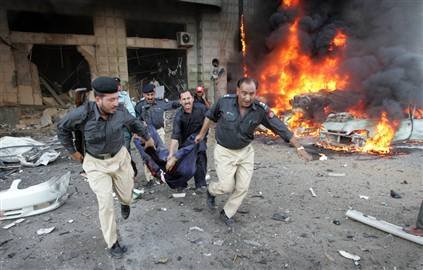
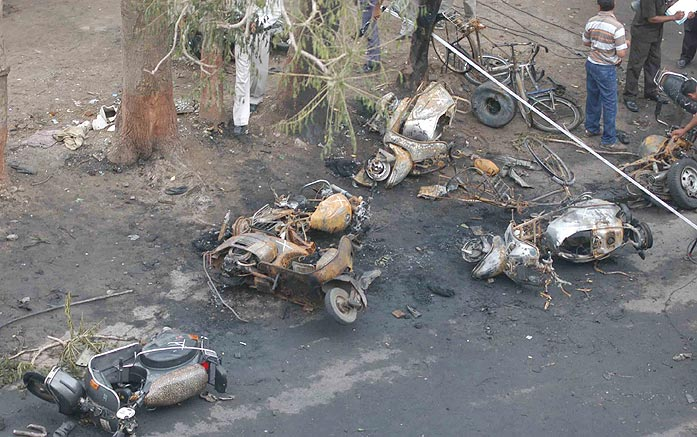
To begin with however we take a look at the investigations into the Ahmedabad bomb blasts of July 26, 2008. Fifty-six people were killed and over 150 injured in the serial blasts that hit Gujarat’s major commercial nerve centre last month. A total of 19 blasts took place in 10 different areas of the city and apart from the minority-dominated Sarkhej and Juhapura all of them occurred in the labour-dominated eastern parts of the old city. Most of these were crowded and congested areas battling peak evening hour traffic: Sarkhej, Maninagar, Bapunagar, Thakkarbapanagar, Naroda, Raipur, Narol and Sarangpur. The Civil Hospital and LG Hospital campuses were the last to be hit, about 40 minutes after the first round of blasts, and 27 people were killed here.
At a press conference held at the police commissioner’s office late that same evening the chief minister, Narendra Modi said confidently that ammonium nitrate and gelatine sticks had been used in the bombs. He also said that the Ahmedabad Crime Branch would be handling the investigation. Intelligence sources said the needle of suspicion pointed to the Students Islamic Movement of India (SIMI) and the Lashkar-i Tayyeba.
A. Outfits named: In Ahmedabad, as elsewhere, the moment the bombs exploded both the political class and “intelligence sources” held SIMI and Lashkar responsible for the attacks even as they admitted their ignorance about how these outfits operate.
B. Arrests of the alleged accused: By August 16, 2008, when the Gujarat police claimed they had ‘cracked’ the case, 10 persons in all, nine of them Gujarat residents, had been arrested. Mufti Abu Bashar from Azamgarh in Uttar Pradesh was named as the mastermind.
Abdul Halim, an alleged activist of the banned SIMI who the police claimed was wanted in the 2002 Gujarat riots (we are not told for what offence), was arrested in Ahmedabad (Deccan Herald, July 27, 2008). The police claimed that he had been in hiding since 2002.What is the actual evidence of Halim’s involvement? Reports suggest that far from absconding, Halim was an active community leader in Dani Limda and police claims that he had been absconding were untrue.
Media reports quoting authorities stated that Abdul Halim allegedly told the Crime Branch that he was associated with Syed Abdul Karim ‘Tunda’, the top Lashkar-i Tayyeba operative wanted in connection with several blasts in the country between 1993 and 1998 (DNA, August 1, 2008).
The Gujarat police must also explain the prompt arrest of Sajid Mansuri, who we are told was the link between the planners and executors of the blasts. The police said he had been on the run for over seven months. How was Mansuri suddenly located and conveniently arrested 20 days after the Ahmedabad blasts? (DNA, August 17, 2008).
When was this information, which is now being offered so readily by the authorities, actually collected? We are talking here of 15 and 12 year-old facts, so what were the authorities doing with this knowledge until now? Incidentally, Halim’s family has denied all the ‘facts’ obtained by the Crime Branch allegedly under torture.
In Ahmedabad, as elsewhere, the moment the bombs exploded both the political class and “intelligence sources” held SIMI and Lashkar responsible for the attacks even as they admitted their ignorance about how these outfits operate
On August 18, 2008 The Times of India reported on the arrests of an alleged ISI agent, Vishal Upadhaya of Jharkhand, an engineering student, in 2007 and of a former jawan, Shailesh Jadhav of Satara, who was arrested in Pune in 2008 for his alleged links with the ISI. Has there been any follow-up of these arrests, any further investigations?
The facts surrounding the arrest, by the Crime Branch, of another alleged accused, Zahid Shaikh, are also under serious dispute. Ahmedabad city Detection of Crime Branch (DCB) officials claim that Zahid attended two terror training camps in Kerala and Gujarat and the two masterminds of the Ahmedabad blasts, Mufti Abu Bashar and Abdul Subban Qureshi alias Tauqir, were constantly in touch with him. Zahid, a resident of Gujarat, owned a mobile (repair) shop at the Alishan Complex in Dani Limda and lived, along with several members of his family, not far from the Sarkhej highway. Zahid’s sister, Saleha, refuted the charges levelled against him. “They (the DCB) say Zahid had gone to various places for training and had arranged for vehicles used in the blasts. But he has not left home for the past five months. They also said some meetings were held at our house but we are not aware of any such meeting,” she said (The Indian Express, August 18, 2008).
C. Substances Used: On the very day the blasts occurred Narendra Modi asserted that ammonium nitrate and gelatine sticks were used in the bombs, also stating that the Ahmedabad Crime Branch would be handling the case (DNA, July 27, 2008). An obvious part of the investigation ought to have been probing the leakage of these volatile substances right from the production stage up to retail sale to the end user (in this case the terrorists).
The chain begins with industrial producers who are given special licences to manufacture hazardous substances of this nature. Investigations could possibly reveal clandestine sales by producers. Next in line are the retailers, also licensed, who are supposed to maintain a proper stock register precisely because of the potential hazards of the materials they deal in. Here too underhand sales are possible. Investigators should have examined and tallied all the relevant records to determine if any quantity of these substances was not legally accounted for at either stage.
Nothing in the Gujarat police ‘breakthrough’ makes any mention of any investigation into these leaks.
According to DCB officials, LPG cylinders, each of a five-litre capacity, were used in the blasts at the LG and Civil hospitals. The cylinders were found to have been manufactured at Meerut in UP while their distributors were traced to Kalupur in Ahmedabad. The DCB named at least two manufacturing agencies from Meerut, Mayur and Golden Click, who are said to have sent the cylinders to Ahmedabad. The Kalupur distributor was reportedly detained for questioning (The Indian Express, August 4, 2008).
CC: How did the Crime Branch conclude that the source of the cylinders used was/is a Kalupur distributor? Do cylinders have any identification marks or serial numbers?
D. How were detonators leaked from manufacturers?: According to initial media reports, the detonators used both in the blasts at Ahmedabad and in the unexploded bombs in Surat, according to markings recovered from the sites, were manufactured by AP Explosives (P) Ltd, a company based at Bommalramaram village and Mandal in the Nalgonda district of Andhra Pradesh, about 170 km from Hyderabad. AP Explosives makes detonators and detonating fuses. (The Indian Express, July 30, 2008). Nothing in the announced ‘breakthrough’ of the Gujarat police indicates how the detonators had been accessed from AP by the terrorists or what these linkages mean in terms of the network of terror.
Another report two days later said that an explosives-manufacturing company in Rajasthan, in which the state government has a major stake, may have been the source of the detonators in the 27 bombs defused by police in Surat (The Times of India, August 2, 2008). The detonators found in the unexploded Surat bombs were said to have originated from the Dholpur-based Rajasthan Explosives and Chemicals Ltd (RECL).
A joint sector company in association with RIICO, a Rajasthan government undertaking, RECL makes more than 25 lakh detonators every month. Integrated circuit detonators, such as the ones used in Surat, are supplied to mines to trigger explosions mainly for stone quarrying and coal mining. Investigators say the terror outfits may have procured these detonators from mining companies who engage a large number of contractors, especially in stone quarrying which is big business in Rajasthan.
RECL had reportedly already given the Gujarat police a list of all those who had bought detonators from them. The superintendent of police, Dholpur, Gaurav Srivastava said that batch numbers of product consignments would help identify the dealer from whom the detonators then went to the terror outfits. “As many as 1,500 detonators are usually packed in a single carton on which the batch number is properly written. The manufacturing companies maintain a record of the batch numbers of cartons supplied to the dealers.”
RECL’s senior manager (works), K. Edward Kelly said there are more than 80 approved dealers who sell the detonators to firms involved in mining activity. “Detonators are transported in trucks and are sold through registered dealers. The records are properly documented. The ultimate delivery is the prerogative of the dealers and we have no control over it,” said Kelly. He also said however that his company does take measures to prevent the detonators reaching the wrong hands. Most of the company’s dealers are in Andhra Pradesh. RECL detonators are supplied to states like Bihar, Jharkhand, Assam and Rajasthan.
Disposable squad?
This is not the first time that terrorists have used RECL detonators. Police found that they had been used in some of the serial blasts that rocked Coimbatore in 1998 when about 46 people were killed and more than 200 injured in 13 explosions. In another incident, 1,500 detonators from RECL were recovered from a man in the Hazaribagh district of Jharkhand in August 2005. He was said to be a supplier of arms to Maoists in Jharkhand (The Times of India, August 2, 2008).
Forensic investigators have concluded that the improvised explosive devices (IEDs) used in July’s serial bombings in Gujarat were assembled by the same bomb-makers responsible for a string of earlier attacks in AP, UP and Rajasthan. Experts from the Gujarat police and the National Bomb Data Centre have determined that the IEDs deployed in Ahmedabad and Surat were identical in their design to the devices used in the May 2008 serial bombings in Jaipur; the November 2007 attacks on trial court buildings in Lucknow, Varanasi and Faizabad; the August 2007 bombings at the Gokul Chat Bhandar in Hyderabad; and the March 2006 attack on the Sankat Mochan temple in Varanasi (The Hindu, August 7, 2008).
Twenty days later we are told at the press conference announcing the “breakthrough” that the “material for the explosions was brought from Madhya Pradesh and assembled in Ahmedabad and Vadodara”.
CC: Have the AP and Rajasthan leads fallen by the wayside?
Were any follow-up investigations carried out to probe the Rajasthan connection? Why were they dropped? Why are the Rajasthan and Gujarat police quiet now on the supply of detonators from AP and Rajasthan? Are the 1,500 detonators within each carton properly/serially numbered? If that is the case it should be very easy to trace the source of the leakage which would then lead to the network involved in the terror attack and its modus operandi.
Did the investigations in the earlier blasts also reveal a common pattern? Were the detonators used in those explosions also manufactured in the Rajasthan and AP factories?
E. The vehicle trail: A ‘failed plan’ to explode over a dozen bombs in Surat put investigators on an interstate trail of vehicles suspected to have been used in the Ahmedabad explosions. The Surat police seized two cars containing RDX and detonators packed in separate bags. The bombs were yet to be assembled. The seized vehicles, it was claimed, bore fake numbers from Vadodara but their authentic registration had been traced to Navi Mumbai in Maharashtra. Both vehicles were CNG-run WagonR cars.
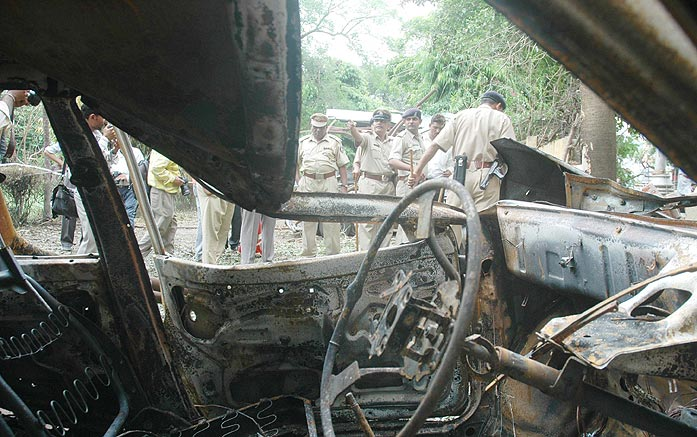
A connection between Surat, Ahmedabad and Navi Mumbai was found. It was a CNG-run WagonR that was reduced to mangled steel outside the Civil Hospital. The car seized by the Surat police, which contained a can of RDX, was also a CNG-run WagonR. The car has enough boot space to carry gas cylinders similar to those found at the Civil Hospital (The Telegraph, July 28, 2008).
Was the Indian Mujahideen an organisation known to the Intelligence Bureau before the recent spate of bombings? Was this organisation linked to any known terrorist/extremist groups, their activities and their terror attacks? What are the antecedents of Kenneth Haywood? Who within the central IB and the MHA were responsible for letting Haywood leave the country?
The Maharashtra ATS says that it has detained car thieves from Navi Mumbai and Thane but is cagey on all other details (The Times of India, August 18, 2008).
CC: Since vehicles have been seized, why has the vehicle trail been dropped? (The culprits of the 1993 Bombay blasts were traced through vehicle numbers and registrations.) Why are the Gujarat and Maharashtra police suddenly silent on this? The Surat vehicles bear Vadodara number plates yet their registration has been traced to Maharashtra; both the ATS Maharashtra and the Gujarat police are reluctant to release any details about the vehicles’ registration.
F. Missing CCTV records: On August 1, 2008 newspaper reports revealed that vital CCTV data which could have provided useful clues to the identity of those involved in the Ahmedabad terror attacks was missing or tampered with. The ATS’s great hope of putting a face to the Ahmedabad blasts had been dashed said the reports. The hard disk of CCTV footage that it had seized from the Talasari toll naka (check post) was ‘corrupted’ and did not contain any footage of the suspected terrorists crossing the naka in the cars stolen from Navi Mumbai.
The ATS had seized the hard disk after it received specific information that the suspected terrorists had stolen four cars from Navi Mumbai and crossed the Talasari toll naka while fleeing to Gujarat where explosives were then planted in these cars. Since the Talasari toll naka has an elaborate network of CCTV cameras which not only record the registration number of the vehicles crossing the naka but even take pictures of the driver, the ATS had hoped it could finally put a face to the men behind the terror attacks. The Thane police told the media that a few weeks earlier they had been informed by toll naka officials that the CCTV apparatus was malfunctioning. As the entire apparatus was installed and maintained by a private firm it took some time for the police to fix the problem. Police say it is possible that the cars crossed the naka during this time
(Mumbai Mirror and The Times of India, Pune).
CC: From reports appearing in sections of the media it appears that CCTV data at the Talasari toll collection centre were either missing for those crucial dates or tampered with. It is now up to the investigating agencies to verify whether there was in fact some defect in the CCTV or the data was intentionally tampered with. None of this information was made public at the ‘breakthrough’ press conference.
If the CCTVs were malfunctioning, and this had been reported to the authorities, how often has such malfunctioning been reported before this? Who was the person on duty for the relevant dates, operating the CCTV or manning the Talasari toll naka? Who monitors the functioning of toll nakas? Serious questions need to be asked of whichever agency controls the entire toll collection operation, state or private.
G. Terror threat email: In a 14-page manifesto emailed to the media minutes before the serial bombings, an organisation calling itself the “Indian Mujahideen” claimed responsibility for the Ahmedabad attacks. Titled “The Rise of Jihad”, the manifesto said the bombings were carried out to avenge the 2002 anti-Muslim violence in Gujarat. “In the light of the injustice and wrongs on the Muslims of Gujarat,” it said, “we advance our jihad and call all our brethren under it to unite and answer these irresolute kafireen (infidels) of India” (The Hindu, July 27, 2008). The email from the Indian Mujahideen, which reached the media five minutes before the first bomb went off in Ahmedabad, was sent from the Yahoo mail account of “alarabi-gujarat” through an internet connection used in the name of Camp Kell White. The Internet Protocol (IP) address was traced to a Kenneth Haywood, living in Navi Mumbai.
As we go to press, Haywood has been allowed to flee India despite a ‘lookout notice’ against him, which means that his name is intimated to all airports and border checkpoints. Immigration at airports falls under the jurisdiction of central intelligence while airports fall under the purview of the ministry of home affairs (MHA).
Ahmedabad, July 2008
CC: Was the Indian Mujahideen an organisation known to the Intelligence Bureau (IB) before the recent spate of bombings? (At his August 16 press conference DGP Pande said that SIMI minus the S and I equalled IM – Indian Mujahideen.) Was this organisation linked to any known terrorist/extremist groups, their activities and their terror attacks?
What are the antecedents of Kenneth Haywood? Who within the central IB and the MHA were responsible for letting Haywood leave the country?
H. Other email threats: An accountant, Deepak Shivshankar Pandey, was arrested by Mumbai Crime Branch officials on July 31, 2008 for allegedly sending an email to a news channel in which he threatened more blasts. Though Pandey hailed from Mumbai, he was arrested in Ludhiana. The police said the email was traced back to the Punjab city from where he was then arrested (The Asian Age, August 1, 2008). According to Pudhari, a prominent Marathi daily published from Pune, Pandey is a committed activist and member of the RSS. Pudhari also reported on August 4 that Pandey had earlier been arrested for sending emails to the Maharashtra chief minister, Vilasrao Deshmukh, and deputy chief minister, RR Patil, threatening to blow up religious places.
CC: Is there a link between this arrest and the other terror emails?
I. Farce of the Surat bombs: All the confidence exuded by DGP Pande as he talked of how police had solved the Ahmedabad serial blasts and the arrest of 10 SIMI activists as prime suspects fizzled out when media persons quizzed him about the Surat bombs and why they never went off (DNA, August 16, 2008). Pande was unable to answer whether the bombs were planned before or after the Ahmedabad blasts.
In another strange twist to the case of mysterious live bombs found and defused in Surat over several days the local police revealed that the Surat bombs were actually planted hours before the Ahmedabad serial bomb blasts took place. Surat police commissioner (CP) RMS Brar categorically confirmed that a citizen who had spotted the bombs and informed the police said that he first spotted the bomb at 11 a.m. on Saturday, July 26. (The Asian Age, August 1, 2008). The first bomb blast in Ahmedabad took place at around 6.45 p.m. i.e. nearly eight hours later.
The Surat CP concluded from this that the Surat bombs were planted before the Ahmedabad serial blasts and that if they had actually exploded they would have caused much more havoc than all the Ahmedabad bombs put together. He also said that fortunately none of the Surat bombs had timers and the live bombs had all been defused by the local bomb disposal squad before they exploded.
- On July 29, a bomb was recovered from a treetop at Mini Hira Bazaar in Varachha.
- On July 29, a bomb was recovered from a flyover at Hira Baug Circle in Varachha and later defused.
- On July 29, a live bomb was recovered from a treetop near Mohan Chawl in Varachha whereas another bomb was recovered from an advertising banner stuck on the Flyover Bridge.
- On July 30, a live bomb was recovered from where it was hanging atop a tree near the Surat Municipal Corporation swimming pool in Kapdoara.
- On July 30, a live bomb was found hidden near a signboard at Mahidharpura Hira Bazaar.
- On August 3, a live bomb was recovered from a billboard at a bus stop in the Athwalines area (The Times of India, August 19, 2008).
CC: How can the Surat police confidently assert – five days after the Ahmedabad blasts – that they have subsequently defused bombs in Surat that were actually meant for explosion before the Ahmedabad blasts?
VM Parghi, an officer of the Gujarat police who was seriously indicted by the courts for perjury in the Best Bakery case (see CC, March 2006), is the man from the Gujarat (Surat) police who has been investigating the Surat bombs. Can this investigation have credibility?
The fact that the Surat bombs were defused in such a cavalier manner also prompted a section of the media to raise questions about the nature of these bombs.
J. Alleged phone calls to Pakistan: Police sources said that a life convict in a Sabarmati jail, said to be close to Pakistan-based fugitive Rasool Parti, would be interrogated in connection with the blasts. They said grilling Gulam Mohammed, jailed under the Prevention of Terrorism Act (POTA) in connection with the murder of Congress leader Rauf Valiullah (1991), could help them trace the link to Pakistan where they believe the blast conspiracy was hatched. Five months ago the Crime Branch reportedly discovered that Mohammed was making phone calls from the jail to Pakistan and Dubai where many absconding criminals from India are suspected to have fled. (The Telegraph, August 1, 2008).
CC: How is it that information about phone calls to Pakistan from a jail in Gujarat, a clandestine and illegal act, was not made public before the Ahmedabad blasts?
K. Failure of intelligence: The Gujarat police have been severely criticised for inefficiency or worse in intelligence-gathering (The Times of India, July 27, 2008).
Maharashtra’s Anti-Terrorism Squad (ATS) suspects that the conspiracy to carry out the bomb blasts in Ahmedabad was hatched by SIMI during a meeting in Gujarat in January. Around 15 SIMI men, including its chief, Safdar Nagori, his deputy, Shibli Abdul, and Sajid Mansoori and Asif Kagzi, two high-ranking activists from Gujarat, are said to have attended the two-day training camp in a forest area near Halol, around 50 km from Baroda, on January 13-14, the ATS said (DNA, August 4, 2008).
According to the Gujarat police, Safdar Nagori, the SIMI Madhya Pradesh unit chief who was arrested along with 12 others on March 27, 2008 from Indore (and has been in a Madhya Pradesh jail since then), had trained SIMI activists in the Halol jungle. Now we are told that another training camp also took place 30 km from Indore while yet another one was held in Kerala.
The Gujarat police’s breakthrough mentions the Halol training camp. It also emerges that the ATS Maharashtra had detained Nagori for almost a month before the Ahmedabad blasts and then sent him back to the Rewa jail where he is still in custody (The Times of India, August 17, and DNA, August 18, 2008).
CC: If the ATS had gained such incriminating evidence of a training camp attended by Nagori and others, including Mansuri, why were these leads not followed through? Why did they not inform the Gujarat police of the training camp when they learnt of it? If they did, how is it that the Gujarat police were clueless about the terror training camp held in the Halol forest in January 2008? Is it at all credible that SIMI, a banned organisation, could hold such arms training camps in Modi’s Gujarat? Besides, how did information about this camp, which took place on January 13-14, 2008, six months ago, miraculously surface through the Mumbai ATS only after the Ahmedabad blasts? What were the ATS Maharashtra and the Ahmedabad Crime Branch doing with this information all this time? What evidence do they have to definitively say that this meeting actually took place in January 2008?
What were the Madhya Pradesh, Gujarat, Kerala and Maharashtra authorities doing with this collective knowledge of training camps until now?
Why did the Gujarat police not go in for early arrests or impose surveillance on suspects if they did know that the perpetrators were in the state?
Did the states of Madhya Pradesh, Maharashtra and Rajasthan lack coordination and fail to share crucial details of the interrogation?
Was it plain complacency or worse on their part?
The breakthrough claim of the Gujarat police raises more questions than it answers.
Criminal antecedents of the Gujarat police and administration
The same individuals who occupy top positions in the state executive and administration have now presented us with an open-and-shut case. Of the 10 persons arrested for planning and planting the bombs, nine hail from Gujarat. Apart from Modi and Pande, 66 others (ministers, civil servants and policemen) face serious charges of being part of a mass criminal conspiracy – deliberate dereliction of duty to protect the lives of innocent members of the minority community. Despite glaring evidence of the conspiracy, the Gujarat police have consistently refused to register a first information report (FIR) and the matter is pending before the Supreme Court.
The tragic burning alive of 59 persons in the Sabarmati Express at Godhra was itself manipulated to suit a sinister game plan orchestrated by the state’s chief minister, aided by central intelligence and the country’s home minister at the time, LK Advani. Both tried their hardest to project what the then district collector, Jayanti Ravi, had termed an ‘accident’ as an ‘ISI-led conspiracy’.
Prompted by members of his sangh parivar and aided by submissive officers like PC Pande, the chief minister allowed the burnt corpses to be carried in open cavalcades into Ahmedabad city thus stoking hatred against the Muslim minority which had already been declared guilty in this diabolical plan for the Godhra burnings.
An obliging police commissioner delayed the imposition of curfew in Ahmedabad until the afternoon of February 28, 2002 even though 26 violent incidents had already been registered the previous day. In the six-and-a-half years since the genocide of Gujarat 2002 the state administration and police continue in their efforts at subversion of the criminal justice system. This includes instances of perjury on oath before the Supreme Court of India. Given such antecedents, how can one be sure that the same government machinery has functioned professionally and with integrity during investigations into the recent bomb blasts?
Pande’s appointment to the highest police post in the state has been challenged in the apex court. Citizens for Justice and Peace – an organisation of which this writer happens to be secretary – has questioned the decision of the state government to appoint him as DGP when another case charging him of gross dereliction of duty during the genocide in 2002 is pending in the Supreme Court.
At the last hearing of this writ petition in early August CJP filed an affidavit in the Supreme Court. Attached to it were two letters, written on April 19 and 29, 2002 by Pande, the then police commissioner of Ahmedabad to K. Chakravarti, the then DGP, Gujarat, complaining about the role of sangh parivar leaders, including a BJP minister, Bharat Barot, in the continuing communal violence in the city. While he spoke the truth to the DGP in these confidential letters in April 2002, Pande has continued to delude the Supreme Court even in his counter-affidavit filed on July 31, 2008.
Do we still remember that a big question mark hangs over the Gujarat police for the involvement of some of its senior officers in politically-driven encounter (extrajudicial) killings? Two senior officers of the Gujarat police, Modi’s blue-eyed boy, DG Vanzara, and Narendra Amin are still in custody for these crimes. The Ahmedabad Crime Branch is notorious for the illegal detention of prominent Muslims, especially those who offered relief and shelter to the victims in 2002, detentions that were carried out by officers like Tarun Barot and Vanzara.
Significantly, Tarun Barot, a police officer indicted by the Concerned Citizens Tribunal – Gujarat 2002 for his close links to international president of the VHP, Praveen Togadia, is part of the crime bureau that probed the recent blasts.
Yet faced as we are with a cynical system that delays judicial trial of gross human rights abuses, a media that reports honestly on the blood on the streets but wears blinkers on the ideological and systemic rot in the system, we are today expected to put aside the unsavoury track record of the Gujarat government, bureaucracy and police and accept, unquestioningly, their claim that they have solved the Ahmedabad blasts case in 21 days.
Archived from Communalism Combat, July-August 2008 Year 15 No.133, Gujarat, Cover Story


.png)