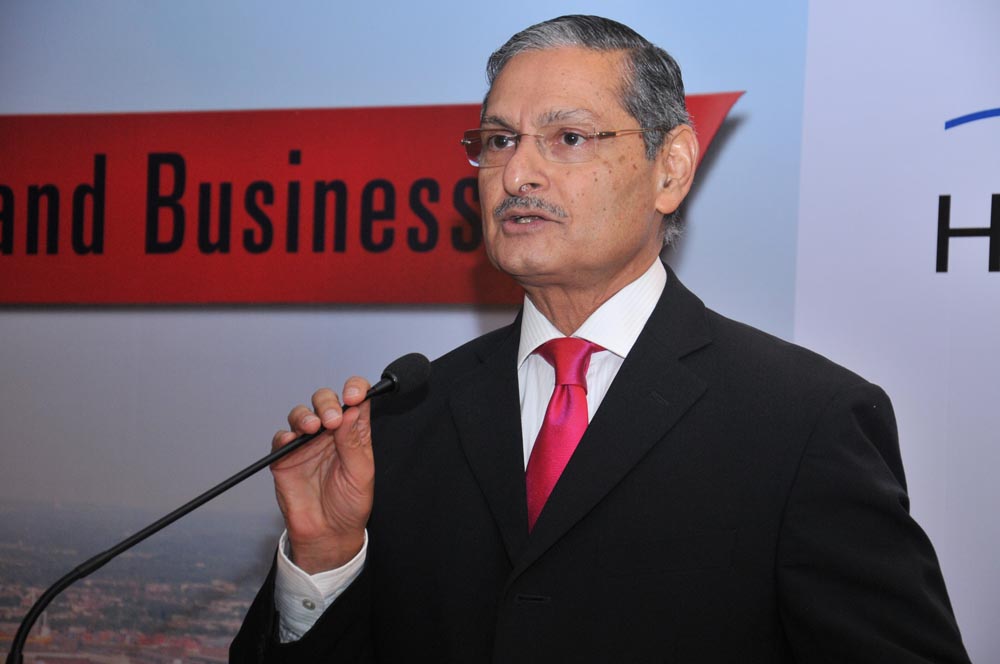
Cyrus Guzder
I hope the organisers of the CII Gujarat Annual Day function will excuse me for apparently ex-ceeding my brief by directly ad-dressing the causes and consequences of the current civil disturbances in Gujarat. However, I propose to break with our customary practice of being politically correct in the belief that I am still being faithful to the CII’s outlook to business life which is modern, liberal, tolerant and caring of people.
Business As Usual – Soon?
"The business of business is business", said Milton Friedman, the celebrated American free market economist. Most businessmen all over the world would, at first thought, agree with him. So why are we, a collection of businessmen, meeting today to discuss among other things, such distinctly "non–business" themes such as Secularism?
The answer lies partly in the implied other half of Friedman’s statement, that: "the business of government is government."
So, if government governs well, business should be free to concentrate on business.
Another great American thinker, Peter Drucker said while referring to the huge role that business plays in a healthy society. "It is the social responsibility of business to make a profit." Meaning, thereby, that businesses must remain profitable, if they are to continue to employ people, create wealth and enrich societies in the many ways that they do.
But what happens, when governments don’t govern? Or, they mis–govern?
They can misgovern by errors of commission; for example, by persecuting a section of their citizens, as is happening in Zimbabwe or Iraq; or by errors of omission, by failing to govern, by failing to maintain law and order, and by failing to provide to citizens their fundamental rights to life and to work.
And when there is such a failure of government leading to disruption in civil life; the striking of terror among labourers, shopkeepers, teachers, judges; the closure of markets; an exodus of people who are consumers of the products we make and services we offer — then is it sensible, indeed is it even ethical, for business to say: "our business is only business…" and then to bury their heads in the sand and debris of the rubble created by almost four weeks of unlawful and barbaric behaviour? Because, when labour flees and markets close and consumers stop buying, what future do our businesses have?
In my view, we have no alternative — if we are concerned for the future well–being of industry and trade in Gujarat — to pause for a moment’s reflection on the causes and consequences of the events of the last four weeks.
It will be a sad mistake, I believe, for us to indulge in wishful thinking that riots and civil commotion are just a part of our life, they come and go like the occasional hurricane off the coast of Florida, that the damage will be repaired, (courtesy government grants and Insurance claims), and soon we’ll be back to "business as usual." Because, what we are experiencing in Gujarat are not mere riots; nor will all the damage be repaired; nor will business bounce back. Gujarat has been wounded deeply this time, it is still bleeding, and as we shall see, the seeds are being sown for still worse to come.
Who does Gujarat belong to?
Your famous poet and social historian Narmadashankar Lalshankar (who died in 1886) is remembered for his great poem "Jay Jay Garvi Gujarat", in which he celebrated all those cultural icons which provided a sense of identity to all who lived in Gujarat. In asking "who does Gujarat belong to?" he listed all the castes, communities, religions, sects; then says, not just these, because Gujarat does not belong to any particular group; he continues, that Gujarat belongs to all those who speak Gujarati; and then, not satisfied, goes on to say that Gujarat also belongs to non–Hindus, the Parsis, Muslims and the non– ‘savarna’ communities. Narmad believed passionately that, around such a cultural imagination — truly secular in spirit — a sense of belonging could be forged for the Gujarati people.
Narmad followed a great Jain tradition of compassion and tolerance; and Gandhi followed Narmad, converting a whole nation to espouse the idea of ‘ahimsa’. So what has brought this great tradition, in this great state, to a point where a recent documentary title sums up the present situation: "Genocide in the land of Gandhi?"
It may be best, though distasteful, to confront certain facts directly. The more openly we speak about these, the more likely we are to be able to deal with them:
- The horrific incident at Godhra was a crime against humanity and it is to be utterly condemned. Its culprits need to be found, tried and dealt with in the most severe way that our laws provide, including if necessary with the death penalty. In the words of Professor Bandukwala, "Whoever committed that crime was surely one of the worst enemies of the Muslims."
- The civil disorder in Ahmedabad, as it escalated into a combination of looting, arson and attacks on people, quickly revealed one clear pattern: that the maximum number of atrocities were committed against Muslims and Dalits.
- The vernacular press in Gujarat played a highly regrettable role in the run up to, and during, the disturbances. Many Muslim establishments bearing non-Muslim names, were specifically listed by these papers; and all of these were subsequently torched to cinders:
- An amazing de–humanisation could be seen in the behaviour of those on the streets. Most were young in age — in their twenties or less. To hear 12 and 15–year–old boys screaming for rape and murder, reflects a brutalisation that is difficult to comprehend in a land that was the breeding ground of ‘ahimsa’. A new and disturbing trend is now to hear women also expressing themselves in support of brutal retribution.
- As the genocide spread from Ahmedabad to other cities and the countryside, a systematic attempt could be seen to target and destroy the economic base of the Muslim community.
A Riot… or Genocide?
Let us reflect on two dimensions of this tragedy. First, the specific targeting of the Muslim sectors of employment and commerce does not hurt Muslims alone. It requires no great intelligence to understand that they are a part of the larger economic chain in the Gujarat economy. So attacking Muslim traders, shops, establishments, factories — deals a blow to the economy of Gujarat, and hurts the larger community as well.
Second, the notion that a ‘kriya’ (action) gives rise naturally to a ‘pratikriya’ (reaction) needs to be firmly dismissed as being both fallacious and dangerous. We’ve heard this time and again in the history of mankind, as a justification for violent and aggressive behaviour. Again, to hear this from a leader in the land of Mahatma Gandhi leads one to wonder how a non–violent doctrine which once united the whole of India, has degenerated so rapidly into an alibi for not being able to — or not being willing to — maintain law and order.
Likewise, leaders of the Shiv Sena in Bombay, when threatened with a suit for damages by the owners of a fine private hospital in Thane that was recently set on fire by Sena activists, (because their leader died in that hospital after sustaining injuries in a car crash) pleaded that the rioters be excused, because they were "naturally" emotionally upset by the death of their leader.
If it was your charitable trust that had set up and was running this fine hospital and now it had to be shut down because it was destroyed beyond repairs, how valid would you find this argument?
Consider the arithmetic of the situation:
- Fifty–six ‘kar sevaks’ are killed (let it be repeated) in an utterly condemnable atrocity.
- As a ‘natural’ reaction, somewhere between 600 innocents, that too in another city, are killed; and then hundreds more are burnt or butchered in the other towns and villages in Gujarat.
- So, if the government does nothing to swiftly punish the perpetrators of Godhra, Ahmedabad and the killings elsewhere, they, and we the public that elects our governments, have accepted (or condoned) the principle that, 18 innocent lives are fair retribution for each kar–sevak killed.
- What if this chain of reasoning is carried one step further? For the thousand people now dead, would it be a "natural" emotional counter–reaction, in the ratio of 18:1, for 18,000 more innocents to be slaughtered? You cannot fault the logic, or the arithmetic?
- Therefore, the citizens of this state — and particularly we businessmen — must do everything we can to refute this utterly dangerous proposition, that an act of violence can lead naturally to a counter–action of violence. It is nothing but a self–serving political argument, which if given greater currency, will surely wreak terrible damage on the economy of Gujarat and of India.
Who Loses?
Earlier, I had said that we can no longer contemplate the recent events as a passing storm and expect that soon it should be business as usual.
In today’s economy, it can no longer be so.
- Workers can vote with their feet. Much good labour may desert the State, adding to poverty and unemployment in Gujarat and other states.
- The poorest, daily–rated worker always suffers the most in a riot. There are more Hindu daily rated workers than Muslims in most of our cities, so the majority community — at the lowest level of subsistence — is also dealt an economic blow.
- For every one person killed in riots, a dozen more may lose their breadwinner and hundreds more become homeless. What do we gain by impoverishing our consumers?
- Economies need stability and confidence in their future to attract investment. The flight of capital from this State cannot be counted at this moment; but in a while, it will be evident. It is safe to predict that hundreds of crores of investment will be turned away over the next few years, if normalcy doesn’t return NOW. Is this a price that the citizens of this State should pay in the long run, so that a few leaders may have the temporary satisfaction of "teaching some people a lesson."
- Finally, (staying only with the economic arguments) Indian business and industry, for ten years, have never lost an opportunity to berate the government at the Centre for not doing enough to help Indian industry become globally competitive. Yet, what happened in Gujarat, without industry (except for CII) raising its voice, will directly result in Gujarat becoming less competitive in future.
Its access to a good workforce, experienced managers and Indian and foreign investment is already being undermined. We know that already British Gas (due to invest $500 m in the State) the foreign strategic partners of Maroli Port, McDonalds, Samsung, LG, and a host of others are openly discussing a review of their investments in Gujarat.
Are We A Secular State?
Thanks to much confusion in the way we use English, we seem to have lost our understanding over the last 50 years of the correct meaning of the word ‘secular’. (It is interesting that there is no equivalent word for ‘secular’ in Indian languages!) The English word has always been used in contra–distinction to the word ‘religious’. While a purist definition would actually imply ‘anti–religious’, the generally accepted meaning the world over, is that a secular state is one where the State remains indifferent to, and neutral between, the religious beliefs and practices of its citizens. In short, the separation of Religion from the State.
The Constituent Assembly debates on the subject were heated, with many attempts to propose the concept of equal support for all religions, an idea contained in the phrase ‘sarva dharma samabhava’ — a phrase now so misused and confounding in its practical application, that it ought to be given a holiday. This should stop our political leaders from rushing around the country, at your and my expense, worshipping at shrines of whichever religions are politically expedient for them.
Dr. Rasheeduddin Khan, former Director of the Indian Institute of Federal Studies, has often being quoted on his well-accepted definition of secularism:
"… the secular character of the State is exhibited when it remains distant from, and distinct from, religion–dominated politics. In pursuit of State activities, it should show a respectful indifference to religion and keep a vigilant distance from political communalism.
"… the State in India is not a federation of religions; nor an aggregation of religious communities. It is an association of citizens – free and equal – irrespective of caste, colour, sex, language, region or status. A modern State is based on a Constitution… therefore a secular State should act as a secular State, no less and no more."
In short, a society is secular when any individual can go about his business confident that no one will harm him on the basis of his religion. Religion belongs to the home, the family, the temple or church or mosque — but not in public life.
Why have we found it so difficult to operate secular forms of governance in India? Let us state some more unpalatable truths.
Pre–modern India was very communal. If it was a Hindu State, there was no equality before the law, no equality of citizenship. It depended on your caste; even punishment depended on your caste. If it was a Muslim State, all others were second–class citizens. It is only in modern India that some concept of equality before the law is surfacing.
Yet, in the 1970s, Indira Gandhi brazenly undermined this spirit by building her vote–bank of Kshatriyas, Harijans, Adivasis and Muslims, known as KHAM. Even now, when a major political leader in Bihar aggressively attempts to unite Yadavs and Muslims, we don’t bat an eyelid. With over 35% of Gujarat’s population consisting of Patels, Banias and Brahmins, is it surprising that caste politics is still in full play?
If we are failing as a secular State, it is because equality before the law is not being practised. Unless we try to remove caste and religion from public life, secularism is going to be very difficult to uphold.
Can We Teach Minorities A Lesson?
Consider another set of numbers.
The population of Muslims in India is approximately 120 million. If they were a nation on their own, with a population of that size they would be ranked the 9th largest nation in the world! Does it make sense to threaten a war against such a large community in our midst, with slogans such as "go to Pakistan – or the Kabrastan?"
The moment people begin to believe such slogans, seeds of deep insecurity will be sown in a vast population dispersed across every part of our country, cities and villages. Should such a community turn hostile, then in today’s world of advanced weaponry and suicide bombers, it is not difficult to envisage the majority community being subject to immense threat and risk, that may endure for generations.
Omkar Goswami, CII’s chief economist, in a recent article, quoted a few lines from a poem (‘Remorse for Intemperate Speech’) by YB Yeats:
"Out of Ireland we have come.
Great hatred, little room
Maimed us at the start
I carry in my mother’s womb
A fanatic heart."
The Sangh Parivar may derive satisfaction from pulling Muslim minorities down a peg or two; but the appalling consequences of their actions will be to breed a whole new generation of terrorists both in their own fold and among the communities of Muslim and Dalit victims. Imagine an "intifada" type situation permeating the cities of India, where will the Hindus then turn? Especially when all the international goodwill we have recently built up will vanish and we shall be regarded as not different from our neighbours across our northwestern borders.
Is it not, therefore, our duty as educated, secular and modern thinking Indians, to roundly condemn their hateful and suicidal slogans? Should we not be putting every pressure on government to clamp down sharply on the distribution of pamphlets spreading virulent nonsense about minorities?
Minority Rights… or Human Rights?
One lesson of history is worth remembering: that a society that turns against other minorities, soon ends up by turning on its own. Consider, too, that our nation is replete with minorities — not just Christians, Buddhists, Sikhs, Jains, Parsis and others; but most strikingly, Hindus have the largest minorities of all! Indeed, who or what is the Hindu majority? What happened to Brahmin superiority in Tamil Nadu? What’s happening to upper castes as the lower castes form coalitions? Is the numerical superiority of Dalits in several states fully appreciated? Adivasis are now organising and striking back. Indeed going back a little in time, have we forgotten that over half the Mughal elite that ran the Mughal administration were Rajputs?
The issue for all of us in CII is not to sweep these embarrassing caste – political issues under the carpet; but to take a clear stand with governments that we do not believe in an India segmented by caste. We don’t make our soap, shoes, TVs, cycles and pharmaceuticals for this caste or that. And, we would wish to recruit our work force from all communities based on competence and productivity.
It’s high time we spoke up for industry and commerce and declared that we don’t believe in religious rights or minority rights, but only in human rights.
Business Can & Must Act
For these economic reasons alone – and without even touching on the more fundamental ethical, social and cultural issues — we have a duty to take an unequivocal, public position in advocating at least the following:
- The government of the state — on its own or seeking whatever assistance if needs — must ensure the maintenance of law and order throughout the state, in an impartial and non–partisan manner.
- Extraordinary efforts must be made, swiftly, to bring to book the culprits of Godhra; and to identify the key leaders of the riots and the genocide that ensued. Special courts or judicial procedures should be put in place to accomplish this.
- If the government is tardy in its response, every support and assistance must be given to the Citizens’ Public Inquiry Commissions that may have to be set up, chaired by eminent retired judges, to carry out independent investigations and place their findings before the public. (This was done in Mumbai after the 1992/93 riots and only then did the true facts of what happened emerge, thus permitting charges to be framed against the culprits.)
If the government attempts to obstruct such efforts, we must publicly resist them. Once the opportunity to book culprits is lost, the seeds of new terrorism will be sown.
- We should extend unqualified support to the rehabilitation programmes under formulation by CII’s Gujarat chapter; and those already being run by voluntary organisations; offering finance and human resources.
- We should accord the highest priority, in the plans of CII, to build back business confidence and restore economic activity in the state.
- CII should ask to become involved in planning projects relating to upgradation of services and infrastructure in the Walled City of Ahmedabad, where living conditions have remained conducive, over decades, to eruption of disturbances at regular intervals.
- In the longer term, CII should endorse and lend support to the creation of Mohalla Committees (along the lines of those in Mumbai, Bhiwandi and Vadodara) to create more "Ram–Rahim tekdas."
- CII should join the voices against politically motivated transfers by government, of upright and capable civil servants and police officers. CII has a vested interest in ensuring that administration remains in clean and competent hands.
- If we don’t have the time to do voluntary work ourselves, can we enable our womenfolk — (behind every manager stands a great woman) — to spend time with voluntary organisations to pacify the disconsolate and render relief to the thousands of victims in relief camps?
- Above all, we shall have to stop being a silent constituency and gather courage — as Deepak Parikh of HDFC did yesterday — to speak up for upholding the secular values in our Constitution.
We should condemn fundamentalist leaders of all religions. Bhindranwale never spoke for all Sikhs; neither the Imam Bukhari nor Shahabuddin speak for all Muslims; nor do Ashok Singhal or Uma Bharti speak for all Hindus.
Show the Way:
With tens of thousands of Muslims huddled in relief camps, and with government reluctant to reach out to them as they should, can we, as individuals, make any difference?
I’d like to close by quoting Professor Bandukwala, who barely escaped with his life from Vadodara while his house and library were gutted by the mobs. In a recent talk at Bombay, full of compassion and wisdom, he recalled a fable of Tagore, about a man on the shore watching the sun set over the sea.
The sun proclaimed "Now, darkness will descend, and you will be lost." The humble man, who was with his family and friends lit a small candle and said, "this is no sun, but it will give us light enough to find our way."
Thank you.
(We have reproduced above the full text of his address at the CII Gujarat Annual Day, Ahmedabad, 30 March 2002)
Archived from Communalism Combat, July 2002 Year 8 No. 79, Forum