
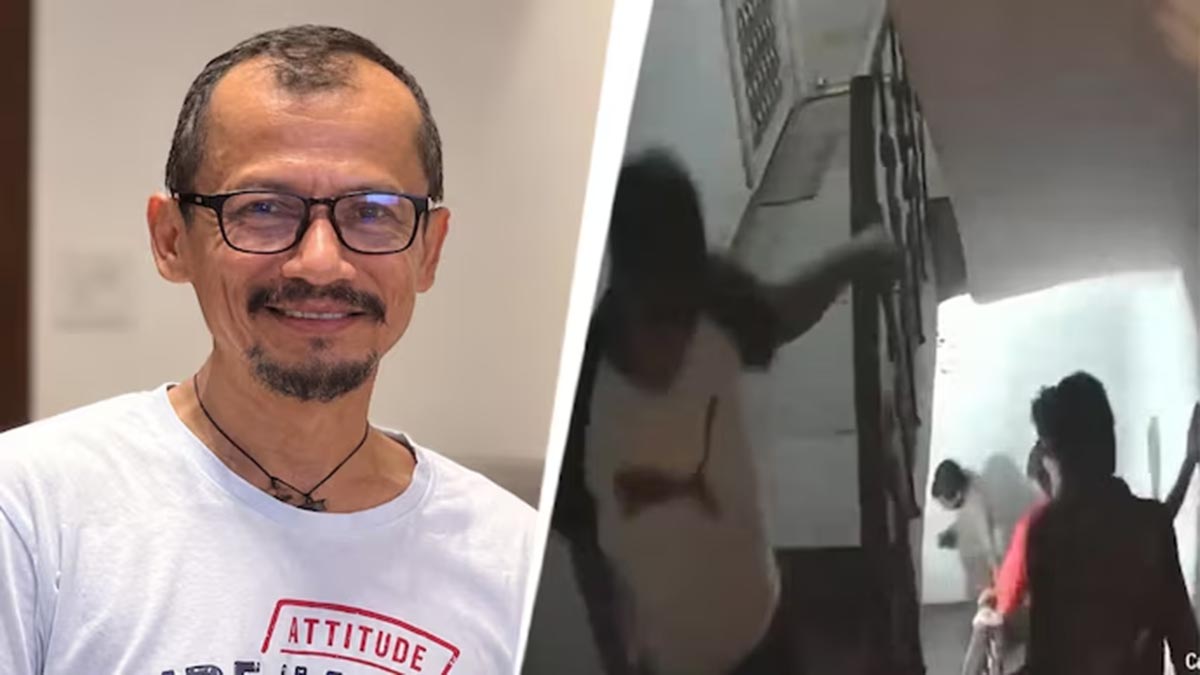
At around 11.30 p.m. on September 6, Chongtham Vikram Singh, a 55-year-old Manipuri musician and music teacher who had lived in Delhi for nearly two decades, went downstairs from his home in Kilokari, southeast Delhi. What followed was not a heated exchange that briefly got out of hand. According to the report of The Indian Express, Singh was allegedly assaulted by a group of men associated with a nearby dhaba after he objected to noise and commotion outside his home.
The violence did not end on the street. Singh was allegedly chased towards his third-floor residence and attacked again. His family heard him screaming. When his son opened the door, he reportedly found several men kicking and punching his father. Singh was eventually taken to hospital with severe injuries. He died the following morning.
A Manipuri music teacher, Chongtham Vikram Singh, living in Delhi’s Ashram area was mob lynched by 8 people following a dispute over alleged noise and nuisance outside his residence.
Police said seven accused have been arrested and a minor detained in connection with the case.… pic.twitter.com/4V0LVeVLiJ
— Mohammed Zubair (@zoo_bear) September 7, 2026
Delhi, India. A music teacher from Manipur beaten to death at Kilokari under Sunlight colony police station, South Delhi. Chongtham Vikram has been residing in the area for atleast 10years in the area. He objected to loud noises and nuisance created in front of his house. What… pic.twitter.com/CJm0P5ZFAy
— huidrom athouba (@HuidromAthouba) September 7, 2026
The police have arrested seven adults and apprehended a juvenile. The FIR invokes Section 103(2) of the Bharatiya Nyaya Sanhita along with Section 3(5). Section 103(2) is particularly significant because it concerns group murder where specified identity-based grounds are alleged.
Singh was a Meitei from Manipur living in Delhi. Northeast community organisations have specifically demanded that the possibility of identity-based targeting be investigated. The North East Media Forum, while acknowledging that the motive remains under investigation, called for any possibility of racial or identity-based targeting to be thoroughly examined, pointing to continuing concerns over discrimination and intimidation faced by people from the Northeast.
According to The Hindu, Singh’s son told police that his father had mentioned being threatened by people associated with the nearby dhaba after earlier complaints about excessive noise. If established, that would make the incident considerably more serious than a spontaneous altercation: it would raise questions about a pattern of intimidation that preceded the fatal assault.
Arrests are not accountability
There is an uncomfortable history behind the reactions from Northeast communities. People from the Northeast living in Delhi have repeatedly spoken about racial stereotyping, slurs, discrimination and violence. That history is precisely why the killing of a Manipuri man inside the national capital cannot be understood only through the immediate trigger alleged by the police.
The Delhi Police have arrested the accused and the administration has promised lawful action. Union Minister Kiren Rijiju has said that a strong chargesheet will be filed within two weeks. The Indian Express reported that CCTV recordings captured the accused leaving the building after the assault and, around ten minutes later, Singh’s family carrying him towards hospital.
Congress president Mallikarjun Kharge described the killing as a “chilling reminder” of what he called “utter lawlessness” under the BJP government. Congress leader and Leader of Opposition, Lok Sabha Rahul Gandhi asked what Union Home Minister Amit Shah’s Ministry of Home Affairs and the Delhi Police were doing to stop what he described as growing lawlessness, particularly against people from the Northeast. Arvind Kejriwal also condemned the killing, while Manipur MP Bimol Akoijam demanded exemplary punishment.
Chongtham Vikram Singh ji, a renowned musician from Manipur, went downstairs to ask some men to lower the noise outside his home. He was beaten to death for it.
A father, killed outside his own home, in his own country’s capital. After many such incidents, every Northeast family…
— Rahul Gandhi (@RahulGandhi) September 8, 2026
The merciless lynching of Chongtham Vikram Singh ji, a well-known musician from Manipur, by a mob is yet another chilling reminder of the utter lawlessness under the BJP.
Students are unsafe. Women face atrocities every day. People from Northeast India face discrimination.… pic.twitter.com/uGfjNCYvbn
— Mallikarjun Kharge (@kharge) September 8, 2026
The senseless murder of renowned musician from Manipur, Chongtham Vikram Singh ji, in the heart of Delhi is a national shame. He was brutally beaten and murdered only for asking some people to make less noise.
Is this what it’s come to? Is there no safety for a young father…
— Priyanka Gandhi Vadra (@priyankagandhi) September 8, 2026
The streets are already asking the question
People gathered outside Sunlight Colony Police Station demanding justice. A candlelight march was held. Northeast student and community organisations condemned the killing. These protests are not simply demands for punishment after a murder. They reflect a deeper anxiety: if a person can be attacked outside his own home after objecting to a disturbance, what protection does an ordinary Northeast resident actually have?
The North East Students’ Society at Delhi University and the North East Media Forum have both demanded a serious and impartial investigation. Their insistence that identity-based targeting be examined is important precisely because the burden of proving whether prejudice played a role lies with the investigation—not with the victim’s community.
A Manipuri (Meitei) music teacher Chongtham Vikram was beaten to death yesterday by at least 6-7 men in Ashram, New Delhi.
The men, allegedly drunk, came to his house and beat him to death after he objected to them over making noise at the night at the dhaba just opposite his… pic.twitter.com/c97JkpC9BV
— Meitei Heritage Society (@meiteiheritage) September 7, 2026
Who was Chongtham Vikram Singh?
Chongtham Vikram Singh was a guitarist associated with Manipur’s early rock music movement, having performed with bands including Ultra Vires, Phoenix and Eastern Dark. He had spent years teaching music in Delhi and had built a life there. He was the son of celebrated Manipuri singer Chongtham Kamala, associated with Matamgi Manipur, widely regarded as the first Manipuri feature film. His cousin Lakshmipriya Devi directed Boong, the first Indian film to win a BAFTA. For nearly 17 years, Delhi was his home.
Related:
Days of Demands, Hours of Protest: Swatantra Bhardwaj finally detained in assault case
Pune’s DJ Controversy, Ganeshotsav and Assault: The politics of who gets to make noise
The Normalisation of Suicide at IITs: Institutional blindness and failure