
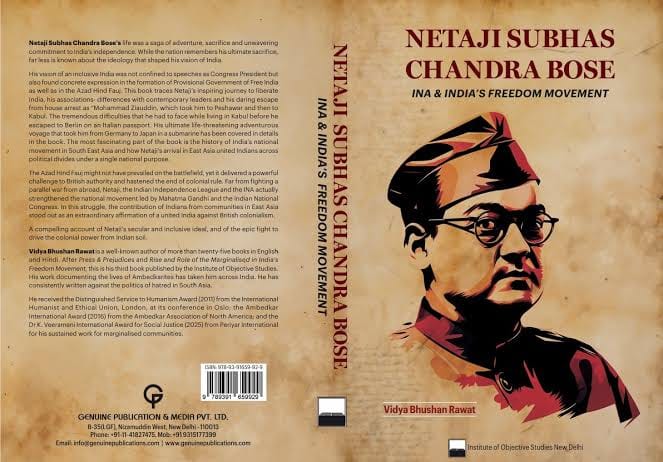
Subhas Chandra Bose is often remembered through competing narratives: the heroic nationalist who challenged British imperialism, and the revolutionary whose pursuit of foreign assistance led him to Nazi Germany and Imperial Japan. Given the ideologically superficial and emotive treatment of Bose, he has often been appropriated by the Right, who brush aside his left-leaning and secular beliefs.
Vidya Bhushan Rawat, public intellectual, activist and author of more than 25 books in English and Hindi approaches Bose through the lenses of secularism, social justice and the contributions of marginalised participants in India’s freedom struggle. His Netaji Subhas Chandra Bose: INA & India’s Freedom Movement examines what shaped Bose’s political convictions, who prepared the ground for the Indian National Army (INA), and why Southeast Asia became a centre of Indian anti-colonial mobilisation.
Published by the Institute of Objective Studies, New Delhi, this 454-page book seeks to recover a freedom movement that cannot be reduced to a single leader, community or political tradition. Its most compelling passages connect Bose’s personal trajectory with the forgotten histories of Indian soldiers, expatriate revolutionaries and political networks that preceded his arrival in East Asia.
A secular upbringing and an unconventional strategy
The author places Bose’s secular outlook within the social history of his upbringing. The book describes his background in a secular aristocratic Kayastha family associated with service under Bengal Nawabs for centuries. This context matters because Bose’s nationalism cannot be understood without acknowledging his deeply secular views. His political project demanded the mobilisation of Indians across communal divisions.
His escape from British surveillance similarly reflected a willingness to pursue unconventional routes to independence. The author recounts his journey under the assumed identity of Mohammad Ziauddin, through Peshawar and Kabul, and onwards towards Europe and Japan. The author quotes the notes of Uttamchand Malhotra, an Indian shopkeeper in Kabul who maintained that Bose’s initial motive was to travel to the Soviet Union and how Bose was as critical of the Axis powers as he was of the British. However, the actions of Bose’s another host in Kabul, Bhagat Ram Talwar compromised his plans making him end up as a state-guest in Germany. ‘The Indian Spy’ by Mihir Bose highlighted Talwar as ‘a double agent working for both Germany and Britain’.
The author’s account invites readers to examine Bose’s choices in their historical context without treating the consequences of his alliances as beyond scrutiny.
The Singapore mutiny of 1915 & Komagata Maru: Rise of Giani Pritam Singh in Southeast Asia
One of the book’s most striking contributions is its discussion of the Singapore mutiny by Muslim Rajput soldiers in February 1915. The episode reveals a history of military resistance that predates Bose’s leadership of the INA by decades.
The scale of the repression is chilling. The author’s account records that 41 soldiers were executed, 63 were sentenced to transportation for life, 69 received sentences of 10–20 years, and 52 were killed while attempting to flee. Approximately a quarter of the regiment was killed or removed. These figures convey the severity of the colonial response and the determination to turn the punishment into a public spectacle.
The book describes how, on March 22, 1915, twenty-one alleged principal instigators were sentenced following court-martial proceedings. A crowd of approximately 6,000 civilians assembled to witness the event. Sixteen men received sentences of transportation or imprisonment, while five were sentenced to execution by firing squad: Subedar Dunde Khan, Jamadar Chishti Khan, Havildar Rahmat Ali, Sepoy Hakim Ali and Havildar Abdul Ghani.
The author’s account argues that the spectacle of punishment was intended not merely to discipline soldiers but to instil fear among the wider civilian population, including Indians and Chinese living in Singapore.
Their story also cautions against treating Bose’s later mobilisation as the beginning of Indian military resistance to British rule.
The author’s account connects the growth of Indian revolutionary activity in Southeast Asia with the experiences of Indians subjected to racial discrimination and imperial coercion elsewhere. His discussion of the Komagata Maru episode describes how passengers were denied the right to land in Canada and the coercive treatment that followed. The book records the ship’s passengers being held under restrictions and the Canadian authorities’ use of armed force during the confrontation.
These experiences helped create a wider climate of resentment among Indians overseas. The book also discusses the Ghadar movement, the influence of revolutionary ideas among soldiers and expatriates, and the networks through which anti-British activity travelled between North America, Southeast Asia and India. The connection is important: East Asia did not suddenly become fertile ground for Indian nationalism when Bose arrived. Political grievances, expatriate networks and earlier revolutionary initiatives had already helped prepare the ground.
This is where the book’s treatment of Giani Pritam Singh becomes significant. The book presents him as an energetic revolutionary who sought Japanese assistance for the Indian independence movement. Its account of his interactions with Major Fujiwara shows that the process of building the Indian Independence League and the subsequent INA involved negotiations and organising before Bose assumed leadership.
Pritam Singh also requested Japanese assistance in establishing contact between the Indian Independence League and Bose in Berlin, as well as a broadcasting station to disseminate anti-British messages to India through Tokyo.
Yet the relationship with Japan was not free of reservations. The author records Pritam Singh’s awareness that many Indians viewed Japanese policy in Korea, Taiwan, China and Manchuria as expansionist and aggressive. It is also important to note that the first chief of the INA was Major General Mohan Singh who was later dismissed by the Japanese as he refused to follow their diktats. Rash Behari Bose was given the responsibility to lead it till Subhas arrived in Japan.
The history of the INA, therefore, begins before Bose’s arrival in Southeast Asia. The author’s recovery of these earlier networks challenges the tendency to make the movement appear as the creation of one extraordinary individual alone. The only factor is that Subhas’s presence and leadership ignited all Indians and gave them hope of an independent India.
Nehru, Bose and the politics of disagreement
The author’s discussion of Jawaharlal Nehru and Subhas Chandra Bose is among the book’s more politically significant sections because it moves beyond the familiar portrayal of two rivals locked in permanent hostility.
Their disagreements over political strategy and international alliances were real.
The author recounts Nehru’s opposition to Nazi Germany and Fascist Italy, while Bose maintained that assistance from the Axis powers could serve India’s struggle for independence. Their disagreement was therefore not simply personal: it concerned whether the enemies of Britain could become legitimate partners in the struggle against British rule.
Yet, the author places this disagreement within a wider ideological conversation. He emphasises Bose’s commitment to socialism and social justice, looking for an Indian approach rather than simply adopting European or British models. Bose’s writings sought to connect democracy and socialism with India’s own historical experience. His critique of private property as an institution and his search for an Indian form of communism indicate that his political imagination extended beyond the immediate objective of ending colonial rule.
The personal dimension further complicates the rivalry narrative. The author refers to Nehru’s emotional response to news of Bose’s death, drawing on Rudrangshu Mukherjee’s Nehru and Bose: Parallel Lives. He also discusses documentary material concerning a ₹2 lakh trust for Bose’s daughter, Anita, involving Nehru and B.C. Roy in 1954. These details do not erase their political differences, but they caution against turning disagreement into a claim of personal enmity or indifference.
The author’s larger point is that Bose and Nehru must be understood through their competing strategies, and historical circumstances— not recruited retrospectively into opposing political camps.
Recovering a plural freedom struggle
The book does not require Bose to be beyond criticism. His international alliances and strategic compromises remain subjects for scrutiny. But neither should those controversies erase his secular commitments or the diverse networks that helped sustain the struggle for independence. That way, it is not the biography of Netaji Subhas Chandra Bose but a chronicle of Indian National Army as well as India’s freedom Movement. Students of Indian history interested in understanding the diversity of India’s freedom movement and important role played by the expatriates in Southeast Asia will find this book extremely useful. The glorious role played by the Sikhs and Muslims in building up the INA movement has mostly been neglected and author must be complimented for bringing highlighting the issue in details.
The larger lesson is that the INA and its affiliation with the Japanese did not emerge from a historical vacuum. It drew upon an earlier landscape of resistance, migration, discrimination and revolutionary organising. By recovering these connections, the author invites readers to look beyond the cult of Netaji and recognise the wider, plural history of Indians who challenged the British Empire.
Netaji Subhas Chandra Bose, INA and India’s Freedom Movement
Author: Vidya Bhushan Rawat
Publisher: Institute of Objective Studies, New Delhi
Related:
India’s Post Truth Era in ICHR’s Book on Netaji Subhash Chandra Bose
Netaji and Gandhiji would never support CAA: Chandra Kumar Bose
When History substitutes Governance: Hindutva’s Politics of Manufacturing Pasts
Temple Leases, Food Morality: Rajasthan’s new Panchayat order