
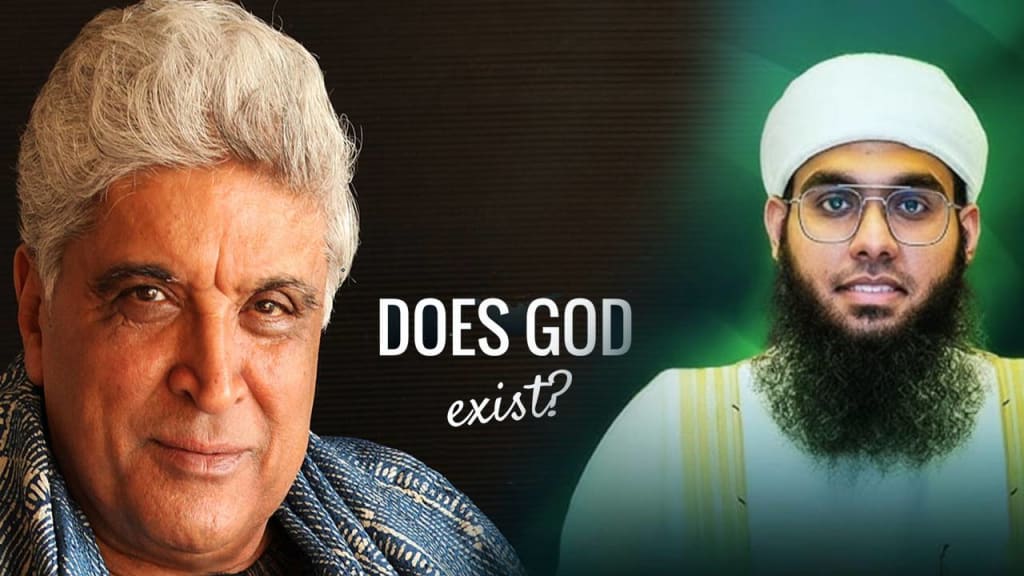
In the aftermath of the recent high-profile debate between Javed Akhtar and Mufti Shamail Nadvi on “Does God Exist?”, a narrative has taken hold on social media. Supporters of the mufti are celebrating a resounding victory, claiming that “religion has won” and “Batil (falsehood) has lost.” However, a closer, dispassionate analysis of the arguments reveals a fundamental misunderstanding of what actually transpired.
This debate was, at its core, a philosophical exercise, not a theological trial. Even if we accept Mufti Nadvi’s logical arguments for a Creator, they do not automatically validate the specific beliefs of his religion. To confuse a philosophical “First Cause” with a religious “Personal God” is a leap of faith, not logic. Here is a breakdown of why this debate cannot be claimed as a victory for organized religion, based on a scientific and critical review of the proceedings.
- The “First Cause” is Not a Religious Victory
The central pillar of the Mufti Nadvi’s argument was the “Argument from Contingency” (or the Cosmological Argument)—that the universe is contingent and thus requires a “Necessary Being” or a First Cause to exist. While this is a powerful philosophical concept, utilizing it to prove a specific religion is a bait-and-switch tactic.
- The Trap of the “First Cause”:Proving that a “Necessary Being” exists only leads us to Deism—the belief in a creator who set the universe in motion. It does not lead us to Theism—the belief in a God who sends books, prophets, and laws.
- Javed Akhtar’s Real Contention:As noted in the debate, Akhtar’s primary objection is not necessarily against a distant, abstract “First Cause” (which he dismisses as irrelevant). His intellectual battle is with the character of God as portrayed by religions—a God who demands worship, intervenes in human affairs, and allows massive suffering.
- The Metaphysical Reality:Both debaters agreed that God is not a physical entity. If the “Necessary Being” is a metaphysical reality not subject to physical proof, then it is equally not subject to religious anthropomorphism.
- The Flaw of Imposed Rules
A significant procedural flaw in the debate was the framing of the rules.
- Unilateral Rule Setting:At the outset, the mufti set the parameters: no scriptural evidence, only logic. In a fair debate, one participant cannot unilaterally impose the epistemology. By restricting the debate to “logic only,” the Mufti Nadvi attempted to shield religion from the scrutiny of history and
morality, arenas where religious dogmas often falter.
- Breaking His Own Precedent:The most critical breakdown occurred when Javed Akhtar raised the logical problem of evil and suffering (e.g., children dying in Gaza).
The mufti, unable to answer this strictly through the “logic” he demanded, retreated into religious apologetics. He invoked concepts of “divine wisdom,” “tests,” and “afterlife justice”—all of which are religious beliefs, not logical proofs. This violated his own rule that religious arguments were inadmissible.
- The Problem of Evil: Logic vs. Apologetics
The clash over the existence of evil was the debate’s turning point, and it highlights why the “religion won” narrative is flawed.
- Logic, Not Just Poetry:Critics often dismiss Javed Akhtar’s arguments as emotional poetry. However, the Problem of Evil is a rigid logical argument. If God is All-Powerful and All-Good, evil cannot exist. Since evil exists, God is either not All-Powerful or not All-Good. This carries as much logical weight as Mufti Nadvi’s “First Cause” argument.
- The Logical Fallacy of “The Test”:The mufti attempted to argue that God and Evil coexist simultaneously, and while God created Evil, He is not responsible for it (attributing it to free will or tests). This is a logical fallacy. If a “Necessary Being” is the source of all reality, it cannot absolve itself of the reality it created.
- The Atheist’s Conclusion:For Javed Akhtar, the existence of suffering is not just a complaint; it is positive evidence that a benevolent, intervening God does not exist.
- The False Binary of Theist vs. Atheist
The debate also suffered from the rigid binary through which both sides view the world.
- Religious Blindness:Religious apologists tend to view every non-religious individual as a hard core atheist. They fail to recognize deists, agnostics, or spiritual seekers who reject organised religion but accept a higher power.
- Atheistic Blindness:Conversely, atheists often group all believers into the category of “religious fundamentalists,” ignoring those who view God philosophically rather than dogmatically.
The real issue facing humanity is not the abstract existence of a deity, but the concrete existence
of suffering. While the Mufti Nadvi offers religious belief as the solution and Javed Akhtar offers secular values and collective human effort, the debate highlights that since suffering is a universal human experience, it demands a universal, secular framework for integration rather than a solution limited to the boundaries of a single faith.
- The Irony of “Western” Arguments
Perhaps the greatest irony of the debate lies in the tools used by Mufti Nadvi.
- Imported Philosophy:The “Argument from Contingency” and the “Cosmological Argument” are deeply rooted in Western philosophy (Aristotle, Plato) and later adapted by Muslim philosophers (like Avicenna).
- Theological Contradiction:Historically, orthodox religious authorities often opposed these philosophical methods, tagging supporters of logic, science, and philosophy as heretics orkafirs. It is paradoxical that modern religious apologists now rely on the very same “Western philosophical arguments” their predecessors despised to defend their faith.
- From Indoctrination to Education
Ultimately, the discussion shouldn’t be about which specific religious God supposedly
revealed, but rather acknowledging that the greatest divine gift is the human capacity for reason. If we rely on this reasoning rather than the ‘ready-made’ arguments of religious doctrine, we can identify the actual, tangible causes of human suffering. The way forward requires a shift from indoctrination to education—moving humanity from the comfort of unquestionable beliefs to the scrutiny of accountable facts.
- The Paradox of “Universal” Religion
While many might accept the spiritual concept of ultimate accountability before God, the problem arises when religion oversteps this boundary. Organized religion rarely stops at spiritual accountability; it intervenes in logic, scientific development, and politics. Furthermore, there is a fundamental contradiction in its claim of ‘universal acceptability.’ In reality, every religion is bound by its own regional characteristics—specific nomenclature, dressing styles, ‘godly’ languages, and cultural practices. A system that is so deeply rooted in a specific regional culture cannot truly claim to be universal without imposing that culture on others.”
Conclusion
The debate was a collision of two different worlds: the philosophical search for a First Cause and the humanistic demand for justice. While Mufti Nadvi may have presented a coherent argument for a Deistic Creator, he failed to bridge the gap to a Theistic God who cares about human worship.
Javed Akhtar’s critique remains unanswered: We do not need to prove the existence of a Creator as much as we need to question the silence of that Creator in the face of human suffering. Until religion can solve the problem of evil without resorting to circular belief, it cannot claim victory over reason.