
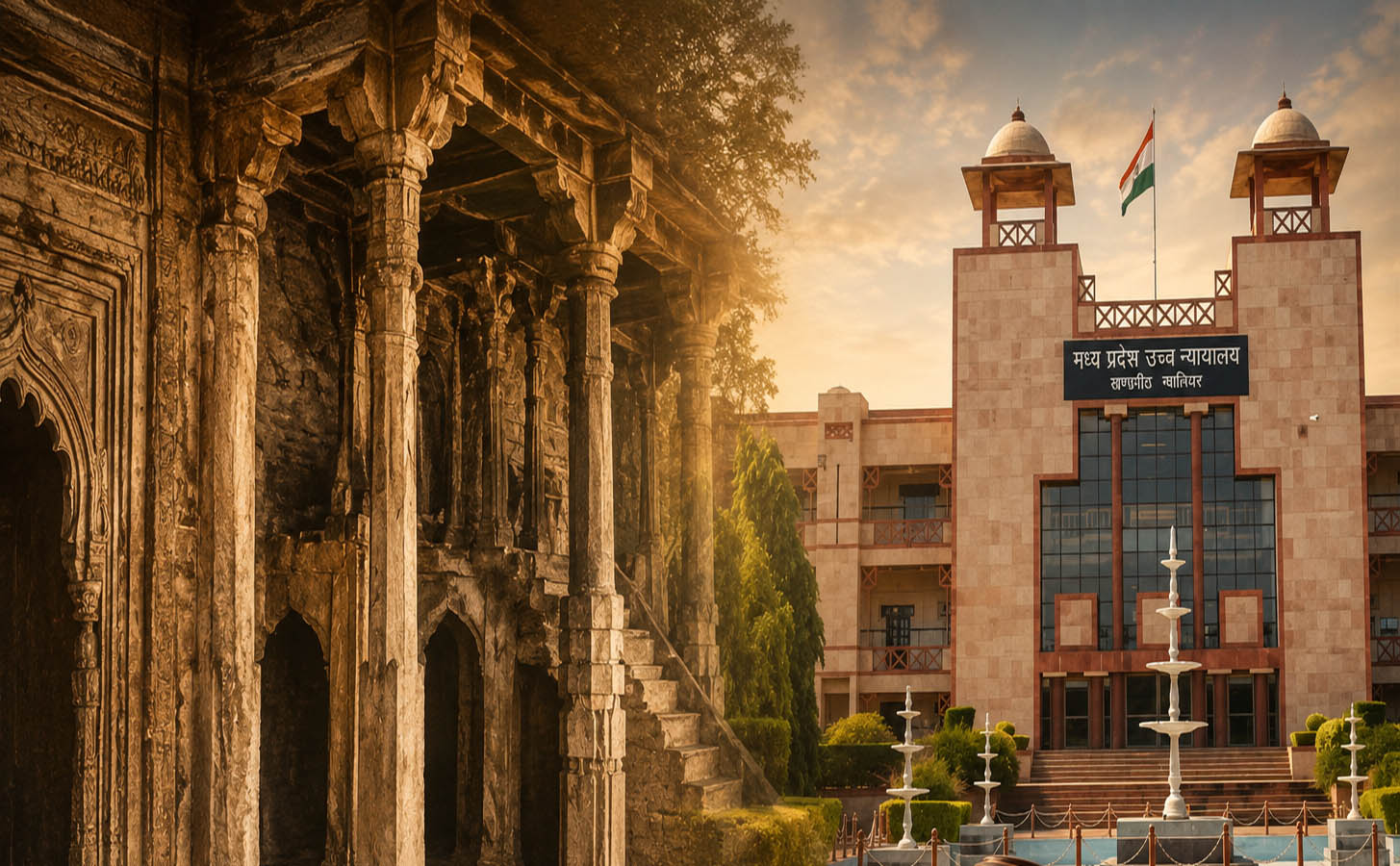
In one of the most consequential religious-site judgments since the Supreme Court’s ruling in the Ayodhya dispute, on May 15, the Madhya Pradesh High Court declared that the disputed Bhojshala-Kamal Maula complex in Dhar is fundamentally a Hindu religious and educational structure — a temple dedicated to Goddess Vagdevi (Saraswati) and a Sanskrit learning centre established during the reign of Raja Bhoj of the Paramara dynasty in 1034 AD.
The 242-page judgment delivered by the Division Bench of Justice Vijay Kumar Shukla and Justice Alok Awasthi goes far beyond a conventional determination of competing religious claims. The Court purportedly undertook an exhaustive examination of archaeological surveys, inscriptions, architectural remains, historical literature, colonial gazetteers, legislative history, constitutional principles, Hindu endowment law, Islamic waqf doctrine, and the jurisprudential framework evolved by the Supreme Court in the Ayodhya judgment.
At the heart of the ruling lies the Court’s conclusion that the present structure standing at Bhojshala was constructed after the destruction and alteration of an earlier temple complex and that the continuity of Hindu worship at the site “has never been extinguished”.
The Bench ultimately quashed the 2003 arrangement framed by the Archaeological Survey of India (ASI) to the extent that it permitted Friday namaz while restricting Hindu worship inside the complex. At the same time, the Court attempted –not very convincingly–to balance competing religious claims by observing that the Muslim community may apply to the State for allotment of an alternative site in Dhar district for construction of a mosque.
The ruling is likely to have profound legal and political implications, not merely because of its conclusions regarding Bhojshala, but because of the constitutional and evidentiary methodology adopted by the Court — one that unmistakably draws from and expands the contentious principles articulated in the Supreme Court’s decision in Ayodhya Verdict.
Dismantling the 1991 Places of Worship (Special Provisions) Act
What is crucial for the citizen and legal mind to understand and assimilate is what the Courts are themselves doing to an existing law, the 1991 Places of Worship (Special Provisions) Act. Passed in the wake of the Babri Masjid demolition on December 6, 1992, this law that received resounding support of the legislature after it was tabled by the Narasimha Rao government (that incidentally also was in power when the illegal act of the demolition took place) is currently under constitutional challenge in the Supreme Court of India.
Ironically, the last time that the “challenge to this law” was heard by the apex court was in December 2024 when the matter was supposed to be heard after four weeks. While this has not happened, verdicts such as the Bhojshala verdict, again, seek to undermine this law. The Supreme Court’s December 12, 2024 order –albeit directed at trial courts—asked them to refrain from registering new suits and passing any effective orders (including survey orders), in cases challenging the religious character of places of worship pending the challenge to the Places of Worship (Special Provisions) Act of 1991.
This order was passed by a bench, led by Chief Justice of India Sanjiv Khanna and comprising Justices PV Sanjay Kumar and KV Viswanathan and the Judges had then emphasised emphasised that such proceedings violate the Places of Worship (Special Provisions) Act of 1991. This law prohibits altering the religious character of places of worship as they stood on August 15, 1947.
The Court’s intervention in December 2024, after years of pendency and delay (notice was issued on these petitions in 2021) came amidst a rising tide of petitions and suits challenging the status of religious sites, many of which are medieval mosques and shrines. At the time, a November 2024 survey order by a trial court regarding the 16th-century Sambhal Jama Masjid in Uttar Pradesh escalated communal tensions, culminating in violent clashes that claimed four lives in November. While the court had then stated that it would begin hearing the challenges to this law, the Places of Worship (Special Provisions) Act, 1991, this has not yet happened. Read on those developments here.
Context and broader implications of the PWA 1991
The 1991 Act was introduced to prevent the conversion of the religious character of places of worship, with an exception only for the Babri Masjid site, which was the subject of the Ayodhya dispute. The Act, which has been subject to increasing challenges, seeks to ensure that no new legal disputes are initiated over the status of religious places, especially those with historical significance, as of August 15, 1947.
Read this crucial reference on ‘When and How Ram Vilas Paswan made a strong pitch for the Places of Worship Act, 1991 here: A powerful leader from Bihar, unkindly known as the shrewd weatherman of Indian politics, Ram Vilas Paswan, then a member of the National Front, spoke powerfully from the Opposition benches, in support of the proposed law and scathingly of the BJP’s destructive politics of demolishing places of worship (Babri masjid, December 6, 1991) while not sparing the Congress either.
Read about the Babri Masjid demolition and also extensive analyses of the flaws in the Babri Masjid judgement here, here and here.
Even as we understand and analyse the flaws behind the ‘Bhojshala’ verdict –and there are several—it is crucial to also understand what the courts are themselves doing to this law. Across several states and sites, courts are reaching the same destination through different presumptions and conclusions. As a result, now the ‘Bhojshala Order’ just like several others that are being conclusively passed while the constitutional challenge to a vital law hangs in judicial limbo, effectively is doing to the Places of Worship (Special Provisions) Act, 1991, what neither parliament nor the Supreme Court has been willing to do. The Act is not being amended. It is not being struck down. It is being made rendered ineffective and inapplicable to those it was written to protect, one site at a time, through a different doctrinal route each time.
Incidently, the Bhojshala verdict delivered on Friday (May 15) by the Indore Bench of the Madhya Pradesh high court is the latest expression of this pattern. It is also the most ambitious. The Bench comprised Justices Vijay Kumar Shukla and Alok Awasthi. It has held the 1991 Act inapplicable to Bhojshala. The ground is that the site is a centrally protected monument under a different statute. The route that this bench has introduced was not, until now, judicially available. This verdict now sets another precedent for those litigating sime verdict adds a sixth procedural pathway to a map that already had five.
As the Hindustan Times has reported, litigation similar to Bhojshala is now alive in courts from Uttar Pradesh through Karnataka. The geographic spread is itself the analytical fact. What follows is the spread, read against the Act it is dismantling.
Section 4 of the 1991 Places of Worship Act law says that the religious character of a holy site “shall continue to be the same as it existed” as it was on August 15, 1947, the day of independence. The only exception, under Section 5, said: “…nothing contained in this act shall apply to the place or place of worship commonly known as Ram Janma Bhoomi-Babri Masjid situated in Ayodhya.”
However be it Gyan Vapi Mosque (Varanasi) or the or the suits related to the 13.37-acre land of Katra Keshav Dev Temple, seeking the removal of the 17th-century Shahi Idgah mosque, there are cases pending across courts that violate this law passed by Parliament. At least 18 suits for possession of land after removal of Shahi Idgah Masjid as well as for restoration of the temple and for permanent injunction are pending before the high court. The case was first heard on October 18, 2023 and the next hearing date is not available.
Apart from the Sambhal Shahi Masjid site in western UP, the site of the Idgah maidan dispute in Hubali, the Baba Boudhangiri syncretic shrine in Chikmagalur, Karnataka and the Malali Mosque in Malali village Mangaluru are already under similar litigation by far right Hindu organisations.
A dispute rooted in competing historical claims
The Bhojshala dispute –on which the MP HC pronounced its verdict on May 15–concerns an ASI-protected medieval structure in Dhar, Madhya Pradesh, long claimed by multiple religious communities. While Hindu groups have since the early 1990s claiming that the structure has historically been regarded as Bhojshala — a temple of Goddess Saraswati and a renowned centre of Sanskrit learning established by Raja Bhoj, the celebrated Paramara ruler associated with scholarship, literature and temple patronage, the site has Mosque located there too..
The Muslim community, however, has been worshipping here at the Kamal Maula Mosque, claiming that the site functioned as a mosque for centuries and relying upon historical references from the Khilji period as well as a 1935 Ailan issued by the erstwhile Dhar State recognising it as a mosque.
A separate set of claims was raised by Jain petitioners, who argued that certain recovered idols and iconographic features suggested that the site was originally a Jain temple associated with Goddess Ambika or Jain Vidyadevi traditions.
The dispute had for years been governed by a 2003 administrative arrangement framed by the ASI under which Hindus performed puja on Tuesdays while Muslims offered namaz on Fridays.
The litigation intensified after petitions were filed seeking recognition of the site as a Hindu temple and restraining namaz within the complex. During the proceedings, the High Court ordered a scientific survey of the site by the ASI — an order that briefly reached the Supreme Court before the survey process was ultimately permitted to continue under judicial supervision. The resulting ASI report became the backbone of the High Court’s eventual conclusions.
The Court’s Central Finding: Bhojshala was a Saraswati Temple and centre of Sanskrit learning
The High Court concluded that the cumulative historical and archaeological material overwhelmingly established Bhojshala as a temple dedicated to Goddess Saraswati and a Sanskrit educational institution associated with Raja Bhoj.
The Bench recorded:
“We have noted the continuity of hindu worship at the site through regulated over time has never been extinguished. We record finding that historical literature placed established that the character of the disputed area was Bhojshala as a Centre of Sanskrit learning associated with Raja Bhoj of Parmar dynasty and the literature and architectural reference including those connected with the period of Raja Bhoj indicate the existence of temple dedicated to the goddess Saraswati at Dhar.” (Para 210)
Crucially, the Court clarified that it was not adjudicating a civil title dispute in the conventional sense. Unlike the Ayodhya litigation, which arose from suits concerning ownership and title over land, the Bhojshala matter, according to the Bench, primarily concerned determination of the “religious character” of the disputed structure through archaeological, historical and documentary evidence.
This distinction allowed the Court to focus extensively on patterns of worship, inscriptions, architectural continuity, historical references and archaeological findings rather than conventional proprietary claims.
The ASI Survey: The foundation of the judgment
The most decisive aspect of the ruling was the Court’s reliance on the scientific survey conducted by the Archaeological Survey of India.
The Muslim parties had strongly challenged the fairness and methodology of the survey, raising objections regarding excavation practices, debris contamination, recovery of artefacts and interpretation of findings. The Court, however, categorically rejected allegations of bias or procedural impropriety.
The Bench noted that the survey had been carried out by a core technical team of senior archaeologists under the supervision of an Additional Director General of the ASI. It also recorded that officers belonging to the Muslim community participated in the process and that representatives of all contesting parties were present during videography and photography throughout the survey proceedings.
The Court held:
“We find that the survey was conducted by adopting scientific method in a fair and impartial manner. The presence of representatives of the petitioners and the respondent can be very well seen in the videography. The method which has been adopted by the experts was as per their expertise. The carbon dating method is used to determine the age of material itself and not for the age of construction period.” (Para 195)
Rejecting allegations regarding plastic waste and modern debris allegedly found at the site, the Court accepted the ASI’s explanation that such material was located only in upper heterogeneous debris layers containing modern dumped material, wrappers and conservation waste, and did not compromise the archaeological integrity of deeper strata.
The Bench further accepted the ASI’s clarification that carbon dating was not necessary because the purpose of the survey was not to determine the age of isolated organic material but to identify the architectural period and historical evolution of the structure itself.
Some facts about the History & structure
For 700 years, the Kamal Maula Mosque had been a place of worship for Dhar’s Muslims. Following the demolition of the Babri Masjid on December 6, 1992, and the political ascendance of Hindutva majoritarianism, the efforts to twist and misrepresent archaeology and history both at Faizabad-Ayodya and elsewhere had begun. In fact, in May 2003, a year after the Gujarat pogrom, Communalism Combat, had published a detailed list –sourced from the Vishwa Hindu Parishad (VHP)—of dozens of such “site on Hindutva’s hit list.” These may be read here.
Coming back to the Kamal Maula Mosque. History tells us that, in 1903, a British-era education officer named K.K. Lele while viewing a structure that locals called “Raja Bhoja ka Madrassa” decided to call it Bhojshala. Every British officer before him had called it a mosque. John Malcolm visited Dhar in 1822 and removed an inscribed panel from the structure. Of the building, he said only that it was a “ruined mosque.” William Kincaid, writing in 1888 about his years in Malwa, documented local legends about Raja Bhoja extensively and never once mentioned a Bhojshala. Then, in 2003, after the matter was contested in the courts, that is one hundred and twenty-three years later, the ASI submitted a 2,000-page report to the Madhya Pradesh High Court where this nuance around nomenclature was erased and only “Bhojshala Temple” appeared throughout. For locals, the structure that had stood in Dhar since 1304 CE is the Kamal Maula Mosque. Yet this history stands erased by this verdict of the MP High Court.
“Evidence of a pre-existing Temple structure”
The High Court repeatedly returned to one central conclusion drawn from the voluminous but flawed ASI report: that the existing structure was built upon and through the remains of an earlier temple complex dating to the Paramara period.
The Court observed that the remains of the earlier structure still survive beneath the present complex and that numerous inscriptions, sculptures and architectural fragments embedded within the existing structure clearly belonged to an earlier Hindu religious monument.
The judgment notes that hundreds of large and small inscription fragments were found in and around the structure, demonstrating that the site once possessed a substantially different architectural and religious identity.
The Court noted from the brief findings of the survey:
“Fragments of inscriptions, sculptures and architectural members suggest that superstructure of this stone structure was later modified and converted into mosque.” (Para 173)
The ASI findings also became central to the Court’s conclusion that the pillars and pilasters used in the present structure originally belonged to temples. There was no attempt by the Court to test the independence or autonomy of the ASI itself or seek expert autonomous opinion on the structure.
The Bench referred extensively to sculptural remains depicting:
- Ganesh,
- Brahma with consorts,
- Narasimha,
- Bhairava,
- divine and semi-divine figures,
- animal and human carvings,
- and temple motifs such as kirtimukhas.
According to the Court, many of these figures had been intentionally defaced, mutilated or chiselled out before reuse in the later structure.
The Court specifically noted that anthropomorphic depictions are generally inconsistent with mosque architecture and treated the mutilation itself as evidence that temple material had been repurposed during construction of the mosque structure.
The Bench also relied on the ASI’s observation that the present structure lacked architectural symmetry and appeared to have been assembled hurriedly from reused material of varying periods and styles.
The Paramara Dynasty, Raja Bhoj and the dating of the site
A substantial part of the judgment is devoted to dating the earlier structure to the 10th–11th centuries CE during the rule of the Paramara dynasty.
The Court relied upon:
- Paramara-era pottery,
- Indo-Sassanian coins,
- Sanskrit and Prakrit inscriptions,
- temple architectural remains,
- iron objects,
- mutilated Vishnu sculptures,
- and historical references associated with Raja Bhoj.
The Bench referred to the ASI’s finding that the earliest coins recovered from the site belonged to the Indo-Sassanian period, corresponding to the time when the Paramara kings ruled Malwa from Dhar.
One of the most important inscriptions discussed in the judgment contained two Prakrit poems consisting of 109 stanzas each associated with Raja Bhoj.
The Court noted that the inscriptions reportedly opened with invocations such as:
“Om Sarasvityanamah”
“Om Namah Shivay”
The Bench regarded this as significant evidence that the site possessed a deeply rooted Sanskritic and Hindu religious identity prior to later Islamic inscriptions. Importantly, the Court also observed that the Sanskrit and Prakrit inscriptions predated all Arabic and Persian inscriptions found at the site.
Bhojshala as a great centre of Sanskrit learning
The High Court accepted the argument that Bhojshala was not merely a temple, but a renowned educational institution associated with Sanskrit learning under Raja Bhoj.
The Court relied on several historical texts and administrative publications, including:
- the Imperial Gazetteer of India (1908),
- publications of the Royal Asiatic Society,
- G. Yazdani’s Mandu: The City of Joy,
- archaeological reviews from 1972–73,
- and educational records from the Dhar State.
The Bench repeatedly referred to the famous “serpentine grammatical inscriptions” found at the site — Sanskrit grammatical formulae carved in serpent-shaped arrangements on floor slabs and architectural members.
These inscriptions became central to identifying the structure as “Bhojshala” or “Hall of Bhoja”. Historical literature cited before the Court described the structure as: “Raja Bhoja ka Madrassa” or Raja Bhoja’s School.
The Court treated these records as corroborative evidence establishing the site’s longstanding association with scholarship, Sanskrit education and Goddess Saraswati.
The Court’s Conclusion: The existing structure was built from Temple remains
The judgment repeatedly emphasises that the current structure reflects unmistakable evidence of reuse of temple material after demolition or dismantling of an earlier Hindu religious structure.
The ASI report, extensively reproduced in the judgment, stated that the structure appeared to have been assembled rapidly using material from an earlier building without regard for symmetry or consistency.
The Court pointed to:
- reused basalt pillars,
- temple-style columns,
- mutilated deity carvings,
- reused sculptural blocks,
- and fragmented inscriptional material embedded within the mosque structure.
According to the Court, the cumulative architectural evidence clearly established that temple components had been dismantled and incorporated into the later Islamic structure.
Why the Court rejected the Mosque claim
One of the most consequential portions of the judgment concerns the Court’s rejection of the claim that the disputed structure was originally and validly a mosque. The Muslim parties had relied on historical references from the Khilji period and the 1935 Ailan recognising the structure as a mosque.
The Court, however, concluded that none of the historical material produced by the Muslim side established that the structure existed as a mosque prior to the already established 1034 AD Hindu religious structure. More significantly, the Bench held that there was no evidence establishing the site as valid waqf property.
The Court undertook a detailed discussion of Islamic waqf doctrine, referring to Sir Dinshaw Mulla’s Principles of Mahomedan Law. It observed that a valid waqf requires:
- ownership by the waqif,
- dedication of the property to Almighty God,
- and extinction of the waqif’s ownership.
The Bench held that no evidence showed that the disputed land had ever been dedicated as waqf property.
It observed:
“No material suggests that the part of the land No.604 (Old No.313) is a Waqf property and the same was dedicated or could be dedicated to Waqf. It is imperative under Muhammadan Law that property must belong to waqif and the owner must belong to waqif and the owner must dedicate the property to the Almighty. Historical material placed before us could not show that waqf has been created and therefore, there can be no presumption regarding existence of a mosque in the disputed area which is prima facie established to be constructed as Bhojshala and temple of goddess Vagdevi (Saraswati) a place of learning Sanskrit language in 1034 AD.” (Para 192)
The Court further reasoned that land already vested in a Hindu deity could not validly become waqf property.
The 1935 Ailan declared constitutionally unsustainable
The Court also rejected reliance on the 1935 Ailan issued by the ruler of Dhar State recognising the site as a mosque. The Bench held that the order could not automatically survive after the Constitution came into force.
Invoking Articles 13 and 372 of the Constitution, the Court observed that pre-Constitution executive orders remain operative only if they conform to constitutional principles. According to the Court, the Ailan was inconsistent with the overwhelming archaeological and historical evidence establishing the site’s Hindu religious and educational character.
The Court further held that because the site had already been notified as a protected monument under the Ancient Monuments Preservation Act, 1904, the Dhar ruler lacked authority to alter its essential legal status in 1935.
The Jain claims and the British museum idol
The judgment devotes considerable attention to claims raised by Jain petitioners who argued that certain idols and iconographic features established the site as a Jain temple. Particular emphasis was placed on an idol presently located in the British Museum and identified by some petitioners as Ambika, a Jain goddess. The Court, however, rejected the argument that the disputed structure was a Jain temple.
The Bench held that no historical literature, ASI findings or architectural material supported the conclusion that the site functioned as an exclusively Jain religious structure.
It observed:
“Whether the idol is of Saraswati or of Ambika would not render much assistance to his submission that the disputed area was a Jain temple as we held that no material has been placed before us either by way of historical literature, architectural features or in ASI survey suggesting that the disputed area was a Jain temple.” (Para 209)
The Court noted that Saraswati is worshipped in both Hindu and Jain traditions as a deity associated with learning and wisdom.
The Bench also referred to iconographic features such as books held by the deity, accompanying figures and seated ascetic forms.
In one of the most controversial observations in the judgment, the Court stated that Jainism and Hinduism evolved alongside each other and referred to statutory provisions under the Hindu Marriage Act and Hindu Succession Act to note that Jains, Buddhists and Sikhs are treated within broader Hindu legal frameworks for certain civil purposes.
The Court therefore concluded that the presence of Jain-associated iconography did not alter the essential Hindu character of the site.
The Saraswati Idol and the possibility of repatriation
The High Court also considered requests seeking the return of the Saraswati idol presently believed to be housed in the British Museum.
The Bench noted that representations had already been submitted to the Union Government seeking repatriation of the idol and observed that the Government of India may consider taking steps to bring the idol back and reinstall it within the Bhojshala complex.
The Court referred to inscriptions associated with the idol mentioning Vararuci, an official in the Paramara kingdom, who had commissioned images of Vagdevi and Ambika.
How the High Court imported the Ayodhya framework into Bhojshala
Perhaps the most legally significant feature of the judgment is its explicit adoption of principles articulated by the Supreme Court in the Ayodhya verdict. The High Court treated the Ayodhya decision not merely as persuasive precedent, but as a foundational jurisprudential framework for resolving historical-religious disputes.
The Court identified several governing principles:
- disputes over ancient religious sites must be decided on the civil standard of “preponderance of probabilities” rather than proof beyond reasonable doubt;
- courts must focus on continuity of worship, patterns of religious use and historical belief;
- destruction or removal of idols does not extinguish the underlying religious endowment;
- ASI reports deserve substantial evidentiary weight because they are prepared by technical experts;
- and archaeological remains, inscriptions and religious motifs possess strong probative value in determining the historical religious character of a site.
The Court also emphasised that faith cannot always be tested through rigid secular logic or documentary proof and that longstanding continuity of belief deserves legal recognition where corroborated by historical circumstances.
Final directions of the court
The High Court ultimately:
- declared the religious character of the disputed site to be Bhojshala, a temple dedicated to Goddess Saraswati;
- recognised the site as a Sanskrit learning centre associated with Raja Bhoj;
- quashed the 2003 ASI arrangement permitting namaz at the site;
- directed the Union Government and the ASI to formulate arrangements for administration and management of the temple and Sanskrit learning centre;
- clarified that the ASI would continue exercising overall statutory control over the protected monument;
- and observed that the Muslim community may apply for allotment of alternative land for construction of a mosque in Dhar district.
The Bench further stated:
“Every Government has the constitutional obligation to ensure preservation and protection of not only the ancient monuments and structures including temples of archaeological and historical importance, but also of sanctum sanctorum as well as the deity of spiritual importance. There is a constitutional duty even to sanction funds for providing basic amenities to pilgrims, proper arrangements for shelter places, maintenance of law and order and the preservation of purity and pristine character of the deity. We have noted the continuity of hindu worship at the site through regulated over time has never been extinguished. We record finding that historical literature placed established that the character of the disputed area was Bhojshala as a Centre of Sanskrit learning associated with Raja Bhoj of Parmar dynasty and the literature and architectural reference including those connected with the period of Raja Bhoj indicate the existence of temple dedicated to the goddess Saraswati at Dhar.” (Para 210)
Why the judgment will matter far beyond Bhojshala
The Bhojshala judgment is likely to become one of the most consequential religious-site rulings in India after the Supreme Court’s Ayodhya verdict, not merely, because of what it decided, but because of the legal framework, it normalises and expands. The judgment represents a significant moment in the evolution of Indian constitutional jurisprudence on contested religious spaces, where courts are increasingly being called upon to adjudicate centuries-old historical, theological and civilisational disputes through the language of archaeology, faith, continuity of worship and constitutional law.
At the heart of the ruling lies a judicial methodology that goes far beyond the facts of Bhojshala itself. The High Court explicitly imported and applied core principles from the Ayodhya judgment — particularly the reliance on “preponderance of probabilities”, continuity of worship, archaeological interpretation, and the survival of religious endowments despite destruction of structures or idols. In doing so, the Court has effectively reinforced and expanded a legal template through which competing historical claims over religious sites may increasingly be litigated and judicially resolved.
The judgment is particularly significant because it elevates archaeological evidence to a position of extraordinary constitutional and evidentiary importance. The Court repeatedly treated the ASI report as a highly persuasive and technically authoritative document capable of determining not merely architectural history, but the religious character and historical evolution of the site itself. Although the Court formally acknowledged that expert reports are not conclusive, the structure of the judgment demonstrates that the ASI findings became the backbone of almost every major conclusion ultimately reached by the Bench.
This growing judicial centrality of archaeology is likely to have implications far beyond Bhojshala. The ruling strengthens the idea that excavation reports, inscriptions, iconography, architectural fragments and material remain can decisively shape constitutional adjudication concerning religious identity and historical memory. In practice, it signals a judiciary increasingly willing to reconstruct medieval histories through archaeological interpretation and then attach contemporary legal consequences to those reconstructions.
Equally significant is the Court’s treatment of continuity of worship. The Bench repeatedly emphasised that Hindu worship at the site had “never been extinguished”, even if regulated or interrupted over time. This formulation mirrors a crucial aspect of the Ayodhya framework: that religious continuity may survive political conquest, structural alteration or physical destruction. The judgment therefore deepens the doctrinal move away from viewing religious disputes purely as questions of title and possession, and toward a broader inquiry into historical faith, devotional memory and civilisational continuity.
The ruling may consequently influence future litigation concerning other disputed religious sites where arguments are framed around claims of interrupted worship, historical destruction or continuity of sacred identity despite architectural transformation.
At the same time, the judgment raises serious constitutional, factual and secularism-related concerns. The Court repeatedly entered deeply partisan and contested theological and historical terrain, particularly while discussing the relationship between Hinduism and Jainism. Its observation that Jainism is “a branch of Hinduism”, supported through references to personal law statutes such as the Hindu Marriage Act and Hindu Succession Act, is likely to invite substantial criticism from constitutional scholars, historians and members of the Jain community. Critics are likely to argue that civil statutory classification for limited legislative purposes cannot automatically determine independent religious identity or theological distinctiveness.
The judgment also raises larger concerns regarding the role of courts in resolving historical controversies that are often shaped by fragmentary evidence, competing interpretations and politically charged narratives. By relying heavily on bodies like the ASI that are neither independent nor autonomous, the kind of “literature, inscriptions and archaeological reconstruction” that the ASI has indulged in without the expertise of subject experts –that too, to determine the “religious character” of a centuries-old structure—is seriously questionable. The Court has moved the judiciary further into the terrain of subjective adjudication — an area where legal institutions may struggle with methodological and (absence of expertise) limitations.
Another critical aspect of the ruling is its treatment of waqf doctrine and mosque status. The Court concluded that no valid waqf existed because there was insufficient evidence showing dedication of the property by a lawful waqif. It further suggested that a mosque constructed upon a pre-existing Hindu religious structure could not acquire legitimacy in the absence of valid waqf dedication. This reasoning and subsequent conclusion is inherently problematic. Besides, it could have repercussions on future litigation involving mosque structures standing over sites claimed to have earlier religious histories.
Importantly, the judgment also reflects the continuing constitutional afterlife of the Ayodhya verdict. Ayodhya was initially presented by many as a singular and exceptional resolution to an unusually complex dispute. However, judgments such as Bhojshala indicate that the legal principles evolved in Ayodhya are now becoming part of a broader and expanding jurisprudential framework governing religious-site litigation across India.
The Bhojshala ruling therefore marks more than a adjudication of a long-running dispute in Dhar. It signals the consolidation of a new judicial approach in which courts are increasingly prepared to engage with questions of untested sacred geography and ‘historical grievance’ through constitutional adjudication. This kind of approach is unlikely to be healthy for a modern constitutional approach that is required to lean not on majoritarian contestation of historical fact –like in Faizabad-Ayodhya but on a sober evaluation of all aspects of such engendered conflicts.
The complete judgment may be read below:
Related:
Babri-Ayodhya verdict: Will appeal for peace apply to Hindutva hardliners in future?
Reading SC order on Ayodhya: Condemn the Sin but Concede to Sinners
Political dimensions of Ayodhya verdict
Ayodhya Verdict: Has Faith Prevailed Over Justice?