
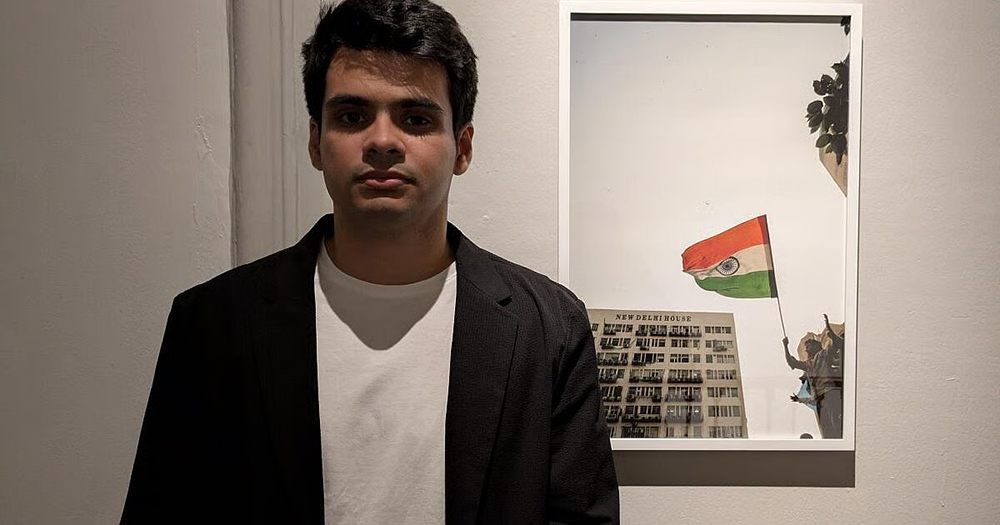
Hours before photographer Raihan Vadra’s exhibition No Idea Is Final was scheduled to open at Delhi’s Bikaner House on October 21, 75 of the 105 photographs planned for display were removed after the venue’s management objected to their political content. The photographs documented youth-led protests across Delhi over the preceding six months. By the time visitors entered the exhibition, two rooms had been stripped of most of their works, leaving behind empty red walls, exposed nails and a catalogue of photographs that the public could see on paper but not on the gallery walls.
The removal, which Vadra said was enforced under the threat of cancellation, is a disturbing instance of a cultural institution restricting the documentation of public dissent. The photographs were not being presented as inflammatory propaganda or accompanied by political slogans. They recorded protests, demonstrators and police action, capturing events unfolding in the capital. Yet their proximity to the political present was enough to make them unacceptable to the venue’s management, according to the artist.
#WATCH | Delhi: On the Bikaner House Exhibition and photo removal controversy, Raihan Vadra, son of Congress MP Priyanka Gandhi Vadra and Robert Vadra, says, “Yesterday, my show was supposed to open at 7 pm. The show was called ‘No Idea is Fine’. 24 hours before it was to open, I was first approached by the Bikaner House management and told that some of the images are against their policy. I said, ‘Let me know which ones; let’s have a discussion. I didn’t hear back from them till the next day… when the Deputy Resident Commissioner reached out and said that we have to remove all these images, which were street photography images of the youth movements in Delhi over the last year. I said, ‘I shared the layout a week earlier; why didn’t you bring it up earlier?’ They said, ‘We couldn’t see the layout.’ So I said, ‘You still had 1 week to tell me you couldn’t see the layout. I would have sent it; we could have had the discussion earlier. Now, in 4-5 hours, what am I going to do?’ I asked them to give it to me in writing as to why they are removing these photographs, individual reasons; they didn’t. Then at 3 pm, the head of Bikaner House, the principal resident commissioner, came, and he also said the same thing. I also said the same thing to him. He said, ‘Your policy says political content’. For the most part, I had removed imagery of political parties and of political leaders. Maybe there were a few photographs; I said, ‘We could discuss. If they are against your policy, I’ll replace them.’ He said, “No, none of these 70 images will be put up.’ They sent me a notice at 3.30 saying, ‘If you don’t remove it by 5 PM, the building is sealed, and the exhibition is canceled.’ Then we complied. We flipped the photographs. So you could only see the back of the frame. They had a problem with that. We took those down, piled them up on the side. They had a problem with that. We put them in storage. I left two photos of the Indian flag, and they said, ‘Take it down.’ I said, ‘This can’t be against your policy. How can it be against your policy?’ I said, ‘Give it to me in writing that you want me to take down a picture of the Indian flag.’ They didn’t. So those were there, and then I went home to change. They took one down themselves. So one is remaining, if you had seen it.”
— ANI (@ANI) October 22, 2026
VIDEO | Delhi: Artist and photographer Raihan Vadra, the son of Priyanka Gandhi Vadra and Robert Vadra, on Thursday said the Bikaner House administration pulled down many of his pictures of the recent Delhi protests ahead of a solo exhibition.
Speaking to PTI about the possible reasons behind his photographs being taken down, he says, “I had to tell them that an art institution should not have such a policy. I mean, most art is political, right? You cannot function as an artistic institution and then say that political content is not allowed. But that was my interpretation. Either that, or they should have reviewed the images a week earlier. I had shared a layout with them a week before, and they responded to it. I told them this, but yesterday they said that they had not been able to view the layout. I said, ‘That was on October 15. You had six days to tell me that you couldn’t view the layout and ask me to send it again. You’re telling me just four hours before my show that you couldn’t see the layout. Now, 70 photographs have to be removed. What am I supposed to do?’ And then, you have to expect a reaction, right? You cannot expect me to sit quietly in a corner and say, ‘Okay, thank you for removing my photographs’. Three years of my work is now just sitting in a corner, and the walls are empty.”
(Full video available on PTI Videos – https://t.co/bIyFWTfmBd)
— Press Trust of India (@PTI_News) October 22, 2026
In an exclusive interview with ThePrint, Vadra said Bikaner House had objected to the “political nature” of the photographs despite having approved his exhibition proposal on June 30 last year. He said the exhibition layout had also been shared with the management in advance, without objections being raised until the final hours before the opening.
“They made us take them down. We spoke to them, but they threatened that they would cancel the show if we didn’t take them down. So, there wasn’t much of an option left,” Vadra told ThePrint.
The artist said he was informed that the photographs were inappropriate given the prevailing political climate and the timing of the exhibition. The management reportedly maintained that the images violated Bikaner House’s booking policy, which prohibits political content. But the rationale raises a fundamental question: if photographs documenting protests can be excluded because the political circumstances surrounding them are considered inconvenient, what meaningful space remains for artists to record contemporary events?
Protest photographs deemed too political
Vadra’s exhibition brought together three years of photographic work, including wildlife photography, abstract pieces, street photography and documentation of youth movements. The protest photographs formed a substantial part of the collection, capturing demonstrations against issues including alleged irregularities in the NEET examination and protests against Chief Election Commissioner Gyanesh Kumar.
According to The Wire, the photographs included images of police personnel overpowering demonstrators, a man holding a copy of the Constitution and crowds participating in political demonstrations. One image reportedly featured Congress leader Rahul Gandhi amid the commotion surrounding a protest march. These were not detached images of an abstract political landscape. They documented people exercising their right to protest and the police response to demonstrations in the national capital. Their removal therefore raises concerns beyond an individual artist’s exhibition: it concerns whether public cultural spaces will permit visual records of dissent when those records intersect with politically contentious events.
Speaking to The Wire, Vadra questioned why an artist living in Delhi and witnessing the protests should be prevented from exhibiting what he had documented. “Forget the context and my background, but even as an artist who lives in Delhi and went to a lot of these protests – I can’t have a show here?” he asked.
Vadra said he had already removed photographs containing slogans and other overt political messaging because he did not want the exhibition to become a vehicle for political commentary. He maintained that the remaining photographs were visual documentation rather than an attempt to advance a political position.
A press note issued before the exhibition similarly described the photographs as documentation of protesters and armed personnel, without additional commentary, and stated that none contained derogatory or inflammatory material.
An ultimatum hours before the opening
Vadra told ThePrint that the management first contacted him on October 20, the day before the exhibition was due to open. He said the layout had already been shared with the venue a week earlier, on October 15, and that the administration had acknowledged receiving it. According to his account, the management subsequently raised objections to the photographs but did not provide a satisfactory resolution before the final hours of preparation. The principal resident commissioner of Bikaner House, Rohit Kumar, later inspected the exhibition and informed Vadra that works considered political would have to be removed.
Speaking to India Today, Vadra said the administration had objected to 75 photographs across two rooms. He recounted that he had initially asked the management to identify the specific photographs it considered objectionable and explain its concerns in writing, offering to discuss possible replacements. Instead, he said, he was warned that the exhibition would be cancelled if the works were not removed within the stipulated deadline.
Vadra and his team initially attempted to turn the photographs around, leaving the backs of the frames visible. That arrangement was reportedly rejected, and the photographs ultimately had to be taken down and placed in storage.The compressed timeline left little room for negotiation.
Vadra also told The Wire that he was informed that the Rajasthan state government had weighed in on the matter and that a consensus had been reached that photographs depicting the protests could not be displayed. Bikaner House management’s reported reliance on a prohibition against political content also raises questions about how that rule is interpreted and applied. Vadra said he had pointed to earlier exhibitions at the venue that featured political figures and questioned why his documentation of contemporary protests was being treated differently.
Even the Tricolour became a point of contention
The dispute extended beyond the protest photographs. Vadra said the management also asked him to remove two photographs featuring the Indian national flag. In a statement posted on Instagram, he wrote that the management had compelled him to remove most of the artworks and had also directed him to take down the two images of the Tricolour. He initially refused, insisting that he would not remove a photograph of the Indian flag. In his account to ThePrint, Vadra said he eventually had to comply with the venue’s demands to ensure that the exhibition could continue.
The artworks of Congress General Secretary Priyanka Gandhi Vadra’s son Raihan Vadra that was asked to be removed from the art exhibition titled ‘No idea is final’ at Bikaner House.
Indian National Flag picture remains here https://t.co/MzWkeoVI71
— Anand Singh (@Anand_Journ) October 22, 2026
Congress MP Pawan Khera criticised the move, writing on X that when even the Tricolour was not safe from censorship, the problem lay not with the art but with the political establishment. He described the removal of the photographs as an example of a government seemingly threatened by the documentation of protests.
The government has become so afraid of inconvenient truths that it would rather censor reality than confront it.
Articles, photographs, artworks, books — anything that challenges its carefully manufactured narrative is silenced.
The irony is that every attempt to suppress an idea only draws more attention to what the government is so desperate to hide.
Censorship cannot make reality disappear; it only exposes a regime terrified of what people might see.
Congratulations on your fourth solo show, @raihanrvadra. The sky is the limit!
— Pawan Khera 🇮🇳 ಪವನ್ ಖೇರಾ (@Pawankhera) October 22, 2026
Congress leader Priyanka Gandhi Vadra also defended her son. As reported PTI, she criticised the removal of the photographs, arguing that they contained no derogatory commentary and simply documented events. She warned that restrictions imposed on one young artist could be extended to others.
In a separate post on X, she wrote: “When someone with power becomes afraid of the expression of another, he doesn’t know it, but he has already lost the very power he is trying to protect.”
.@raihanrvadra
When someone with power becomes afraid of the expression of another, he doesn’t know it, but he has already lost the very power he is trying to protect.
You stand for what is true and everything beautiful will find its way to you.
I am proud of you, always will be.
❤️ mama
— Priyanka Gandhi Vadra (@priyankagandhi) October 22, 2026
VIDEO | Delhi: Artist and photographer Raihan Vadra, the son of Priyanka Gandhi Vadra and Robert Vadra, said the Bikaner House administration pulled down many of his pictures of the recent Delhi protests ahead of a solo exhibition.
Robert Vadra says, “There was a lot of pressure on him to remove everything, and this happened just two hours before the opening of his exhibition. It was shocking because the authorities had received the PDF file a week in advance and had been informed about the exhibition. Setting up an exhibition takes two days, and the authorities had visited the venue, seen the displays, and raised no objections. However, just a few hours before the opening, the situation changed without any explanation…Despite this, I think he was brave enough to go ahead with the exhibition using whatever remained. As I said, I am proud of him. Everyone who had been invited attended the exhibition because this is also his profession…Bikaner House comes under the Rajasthan government, and I can only say that if we believe in democracy, there is no point in mixing politics with the creative world. Everyone should be allowed to express themselves.”
(Full video available on PTI Videos – https://t.co/bIyFWTfmBd)
— Press Trust of India (@PTI_News) October 22, 2026
बड़ा बुज़दिल हुक्मरान है – तस्वीरों से डरता है
@raihanrvadra आपकी खींची हुई तस्वीरें मौजूदा वक्त का दस्तावेज़ हैं, एक प्रदर्शनी से तस्वीरें हटाने की कोशिश करने वाले आपकी कला को कोई नुक़सान नहीं पँहुचा सकते, आज पूरा देश आपकी तस्वीरों को देखना चाहता है।
ज़िंदाबाद रहिये…..। https://t.co/FdrBtmZEm0
— Imran Pratapgarhi (@ShayarImran) October 22, 2026
Empty walls, exposed nails and a catalogue of what was censored
The physical consequences of the removal were visible throughout the exhibition. According to ThePrint, the two rooms from which the photographs were taken down were left largely bare, with exposed nails marking where the works had hung. The remaining exhibition included wildlife photographs and abstract works, while a catalogue allowed visitors to view images that the venue would not permit on its walls.
The empty spaces have become an unavoidable reminder of what the exhibition was supposed to contain. The photographs have not disappeared, but their exclusion from the gallery changes how visitors encounter the work: the public can now see a record of the images, alongside the visible evidence that they were removed.
Vadra told India Today that curtailing artistic expression was wrong and questioned the decision to remove such a large body of work simply because it might be considered objectionable. He also said he had regarded Bikaner House as a space where artists could exhibit their work freely, having held his first exhibition there in 2021 and returned in subsequent years.
“You can’t call yourself a cultural institution or a stakeholder in the arts if you’re going to curtail freedom of expression,” he told India Today.
Vadra told ThePrint that he intended to find another venue in Delhi to display the removed photographs. The exhibition is also scheduled to travel to Bengaluru in December, where he plans to show the collection. Speaking to The Wire, he acknowledged that he anticipated possible difficulties with future venues but said he remained determined to exhibit the work in the city where the protests had taken place.
“I can’t have a show here with only wildlife, just showcasing how beautiful things are. It would’ve been dishonest to myself,” he said.
Related:
Jamia’s Missing Students’ Union: Two decades without elections, and a protest met with rustication
India’s Electoral Crisis is fast becoming a civil-liberties crisis