
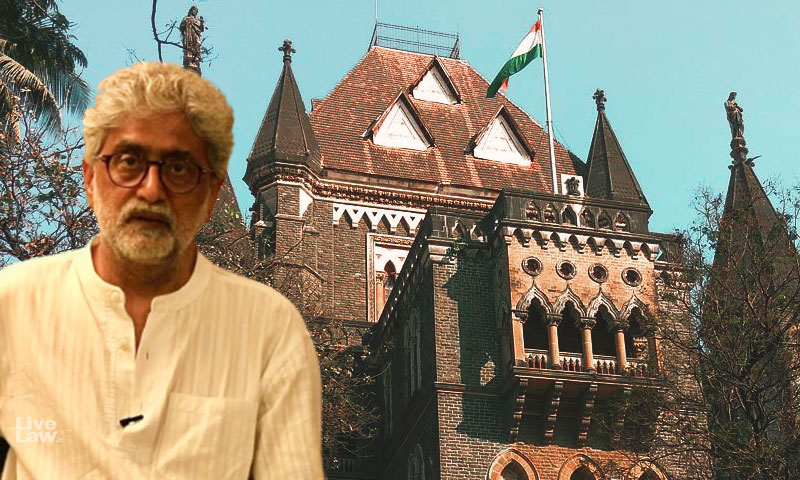
The Bombay High Court on Wednesday, December 17, relaxed the bail conditions imposed on human rights activist and Elgar Parishad–Bhima Koregaon case accused Gautam Navlakha, permitting him to relocate from Mumbai to his permanent residence in Delhi. The relief was granted by a division bench of Justices Bharati Dangre and Shyam C. Chandak, which acknowledged the personal, financial, and social hardship Navlakha has faced since his release on bail.
According to reports by LiveLaw, Navlakha had approached the High Court challenging a condition of his bail that restricted him to the territorial jurisdiction of Mumbai without prior permission of the special NIA court. He argued that continuing to reside in Mumbai—away from his family, home, and support system in Delhi—had become financially unsustainable, especially as the trial in the case has yet to commence, as reported by The Hindu.
When the matter was taken up, Additional Solicitor General Anil Singh, appearing for the National Investigation Agency (NIA), placed before the court a set of conditions that could be imposed if Navlakha were allowed to shift to Delhi. According to LiveLaw, these included depositing his passport, not leaving Delhi without the special court’s permission, reporting to the local police station every Saturday, and appearing before the special NIA court in Mumbai whenever directed. The bench accepted these conditions on record and indicated that a formal order permitting the relocation would be passed.
Brief about the previous proceedings
Senior advocate Yug Chaudhary, representing Navlakha, emphasised that the 73-year-old activist has been living in rented accommodation in Mumbai for nearly two years since being granted bail in 2023. As per Bar and Bench, Chaudhary told the court that Navlakha is a long-time resident of Delhi, owns a house there, and had lived there with his partner prior to his arrest. He also pointed out the difficulties Navlakha and his partner faced in securing accommodation in Mumbai due to the pendency of the case. With the trial nowhere in sight, Chaudhary warned that forcing Navlakha to remain in Mumbai could push him into financial ruin.
The defence assured the court that Navlakha would strictly comply with all conditions and attend proceedings whenever required. While suggesting that certain appearances could be made through video conferencing from the NIA office in Delhi, the bench made it clear—according to LiveLaw—that it was not inclined to allow participation in the trial from Delhi. However, it expressed openness to permitting him to stay in the capital until the trial formally begins.
The NIA opposed the plea, arguing that granting such relief could set an undesirable precedent, since several other accused in the case are also not residents of Mumbai and may seek similar permissions. Despite this, the bench noted that there had been no allegation or instance of Navlakha attempting to abscond or misuse his liberty. On December 15, the judges had observed that Navlakha appeared to feel “completely uprooted” from his social circle, friends, and family, and emphasised that he was a free person while on bail.
As reported by The Hindu, the court observed that forcing an accused to remain away from his home indefinitely, especially when the trial has not begun, raises concerns of fairness. “The applicant feels that he is forced to stay in Mumbai when his house is in Delhi. He has assured that he will come back to Mumbai when the trial begins,” the bench noted, adding that Navlakha’s conduct while on bail had been unblemished.
Navlakha had earlier approached the High Court after a special NIA court rejected his request on June 19 to relocate to Delhi. Under his existing bail conditions, he was required to remain within Mumbai’s jurisdiction, making any relocation subject to court approval
Background of the case
Navlakha is among 16 individuals arrested in connection with the violence that broke out on January 1, 2018, at Bhima Koregaon village near Pune, during commemorations marking the 200th anniversary of the Battle of Bhima Koregaon. The violence followed the Elgar Parishad conclave held a day earlier at Pune’s Shaniwar Wada. The prosecution alleges that speeches and activities linked to the conclave incited violence and promoted Maoist ideology. Navlakha, a long-time civil liberties advocate, has been accused of acting as a co-conspirator and of propagating Maoist ideology under the directions of leaders of the banned Communist Party of India (Maoist)—allegations he has consistently denied.
Detailed reports may be read here, here, here and here.
Why is this significant?
With the High Court now relaxing the restrictive bail condition, the order should be seen as a reaffirmation that bail conditions must not be so onerous as to become punitive, particularly when trials are indefinitely delayed. The order underscores the principle that conditions of bail must balance the interests of investigation and trial with the accused’s right to dignity, livelihood, and family life, especially in cases where incarceration has already been prolonged and the commencement of trial remains uncertain. The court’s emphasis on Navlakha’s age, financial precarity, clean conduct while on bail, and absence of flight risk reflects a growing judicial recognition that bail jurisprudence cannot be reduced to mechanical territorial restrictions. Instead, it must account for proportionality and the lived realities of undertrial accused, particularly in long-running UAPA prosecutions where delays have become endemic.
Related:
Gautam Navlakha’s letter on release from custody
Unjust detention: Gautam Navlakha’s bail victory highlights insufficient evidence
Bhima Koregaon accused Gautam Navlakha granted bail by the Bombay HC
Take accused Gautam Navlakha to hospital immediately, SC directs NIA
Taloja Jail denies new spectacles to visually challenged Gautam Navlakha!