
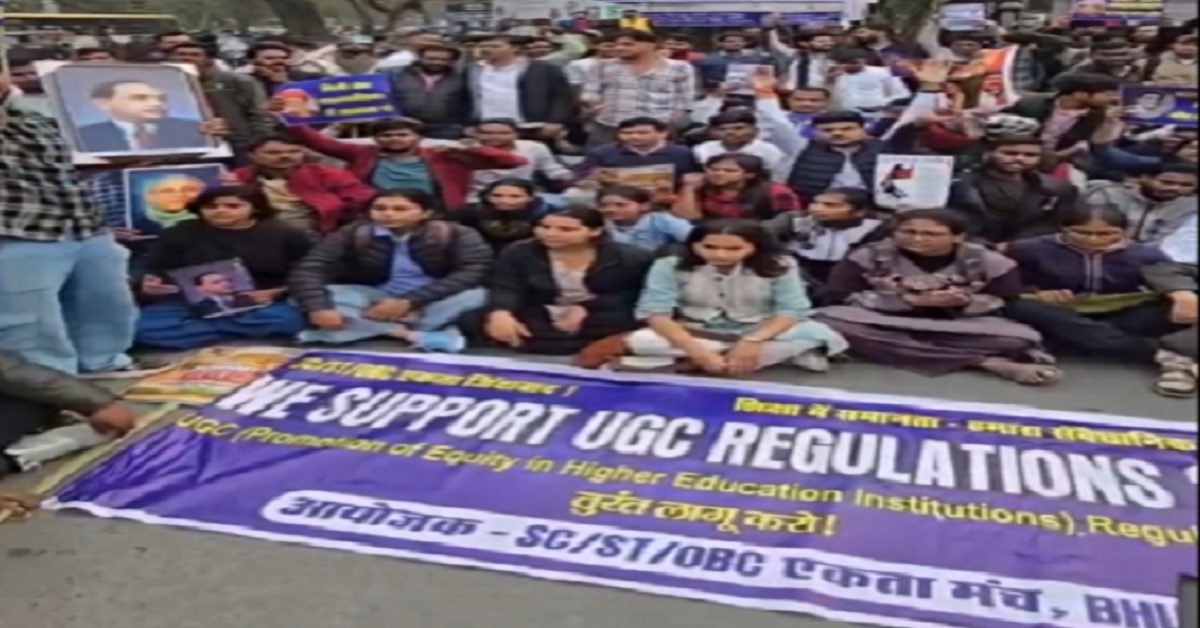
When a student at Allahabad University was arrested and warned for uttering the word “Brahmanvaad”, the message was unmistakable: in today’s university, critique itself can be treated as a crime. A term long embedded in academic, sociological, and constitutional discourse was transformed overnight into a provocation warranting police action. This was not an aberration, nor a matter of hurt sentiments. It was a signal moment—one that revealed how quickly Indian universities are sliding from spaces of inquiry into zones of ideological enforcement.
What followed has only deepened that concern. Across campuses, students protesting the Supreme Court stay on UGC (Promotion of Equity in Higher Education Institutions) Regulations, 2026 have faced intimidation, surveillance, violence, and criminal process. Instead of debate, there has been policing. Instead of institutional introspection, securitisation. And instead of engagement with the substance of caste discrimination, there has been an aggressive narrowing of what may even be spoken.
Together, these developments mark a dangerous convergence: the criminalisation of speech, the judicial suspension of equity safeguards, and the shrinking of democratic space within institutions meant to nurture critical thought.
देशभर में यूजीसी एक्ट के समर्थन में बहुजन छात्रों के प्रदर्शन हो रहे हैं, लेकिन मुख्यधारा का मीडिया चुप है। pic.twitter.com/Nqdq8CpJhd
— Hansraj Meena (@HansrajMeena) February 4, 2026
A judicial stay that did not calm campuses—but exposed a fault line
The immediate trigger for nationwide student mobilisation was the Supreme Court’s decision to stay the UGC Equity Regulations 2026, observing that the framework appeared “too sweeping” and required closer scrutiny. The stay was framed as a neutral act of caution. On campuses, it was experienced as something else entirely: a sudden withdrawal of long-awaited recognition.
As reported by India Today, students argued that the regulations were halted before they could even be tested. No implementation, no data, no demonstrated misuse—only a speculative fear that accountability mechanisms might be abused. The contrast was striking. In a legal system where far-reaching executive actions are often allowed to operate while constitutional challenges remain pending for years, a framework designed to protect marginalised students was frozen at inception.
The context matters. The 2026 regulations did not emerge in a vacuum. They were the product of years of litigation, including the long-pending petition filed by the mothers of Rohith Vemula and Payal Tadvi, both of whom died by suicide after alleged caste-based harassment. Over time, the Supreme Court itself sought reports, monitored compliance, and pressed for reform. A Parliamentary Standing Committee reviewed the draft regulations in late 2025, recommending substantive changes—many of which were incorporated.
Yet, at the very first hearing after notification, the framework was stayed.
For students already navigating hostile campuses, the implication was stark: caste discrimination may be acknowledged rhetorically, but meaningful institutional safeguards remain deeply contested.
Campuses Respond: Different languages, the same demand for justice
The response to the stay has varied across universities, shaped by institutional histories and student politics. But taken together, protests at JNU, BHU, and Delhi University reveal a shared insistence that equity cannot remain a matter of administrative goodwill.
JNU: The defence of ideological space
At Jawaharlal Nehru University, students organised torchlight processions demanding immediate implementation of the regulations and renewed calls for a statutory Rohith Act—a central anti-discrimination law for higher education.
Placards and slogans opposing Brahmanism and Manusmriti dominated the march. Defending the language used, JNUSU representatives told PTI that the slogans were ideological critiques, not attacks on any caste group—an important distinction grounded in established free-speech jurisprudence. Political critique, even when sharp or unsettling, lies at the heart of constitutional democracy.
Student leaders also raised a pointed question: why was extraordinary urgency shown in staying these regulations when countless cases involving civil liberties remain pending for years? The warning from the campus was clear—if justice is indefinitely deferred within universities, it will not remain confined there.
UGC गाइडलाइन के समर्थन में जेएनयू स्टूडेंट्स का मार्च#JNU #UGCRegulations2026 pic.twitter.com/S9tlsULus0
— Dalit Dastak | दलित दस्तक (@DalitDastak) February 4, 2026
BHU: Evidence, reports, and institutional failure
At Banaras Hindu University, the protest took a different form. Hundreds of SC, ST, and OBC students marched carrying letters, official reports, and citations, demanding Equal Opportunity Centres, Equity Committees, transparency in grievance redressal, and public disclosure of compliance.
As reported by India Today, students cited the Thorat Committee Report (2007) and the IIT Delhi study (2019), both of which document systemic discrimination and its links to mental health crises, dropouts, and suicides. The emphasis here was not symbolic resistance but institutional accountability.
A heavy police presence and alert proctorial boards accompanied the march—an unsettling reminder of how quickly claims of discrimination are met with securitisation rather than reform.
Delhi University: From regulation to law
At Delhi University, Left-backed student groups led an “Equity March” through North Campus, framing the issue as a legislative and constitutional question. According to The Times of India, speakers argued that without statutory backing, grievance mechanisms remain fragile, easily diluted, and subject to withdrawal.
The demand for the Rohith Act surfaced repeatedly—reflecting a growing consensus that enforceable rights, not discretionary guidelines, are essential to address structural caste discrimination.
Violence, policing, and the price of naming caste
Even as students mobilised, reports of violence and intimidation surfaced from multiple campuses. As per reports, a BHU student allegedly being beaten by upper-caste peers for sharing a poster supporting the UGC protests in a WhatsApp group. At Allahabad University, students discussing equity regulations were reportedly attacked, with allegations pointing to ABVP-linked groups.
Most chilling was the Allahabad University episode itself: students allegedly assaulted, and one student arrested or warned for speech alone. If the use of the word “Brahminism”—a staple of academic critique—can invite police action, the boundary between maintaining order and enforcing ideological conformity has all but vanished.
For many protesters, these incidents crystallised the argument for equity regulations: without enforceable safeguards, marginalised students are left vulnerable not just to bureaucratic neglect, but to physical and legal harm.
चप्पा चप्पा गूंज उठेगा , जय भीम के नारों से pic.twitter.com/5eb3H59nXr
— Dr. Om Sudha (@dromsudhaa) February 4, 2026
This is shocking and absolutely unacceptable in university campuses. Students who were peacefully discussing equity regulations in University of Allahabad were reportedly beaten up by Brahmanical forces of ABVP. This is exactly why we need equity regulations. The safety of… pic.twitter.com/beFHX0xoSh
— Rehna Raveendran (@Rehna_AntiCaste) February 4, 2026
A BHU student was brutally beaten by upper-caste students simply for sharing a poster about the UGC protest in a WhatsApp group.
To stop this kind of hooliganism and violence on campuses, strong and enforceable UGC regulations are absolutely necessary.
pic.twitter.com/vUKPXjAjm1— Harshita Narayani ✨ (@DearAspirant) February 4, 2026
Faculty Unease and the Limits of the Framework
Faculty responses have complicated the picture rather than resolved it. The JNUTA noted that the regulations fail to address the deep-rooted and systemic nature of discrimination. At protest gatherings, faculty speakers acknowledged these limitations—pointing to the absence of punitive provisions, excessive power vested in principals, and the exclusion of elite institutions like IITs and IIMs.
Yet the consensus among many educators was striking: even an imperfect framework represented a rare institutional acknowledgment that caste discrimination exists on campuses. To halt it before implementation was not correction—it was erasure.
Media silence, political quiet, and democratic erosion
A recurring concern across protests has been the muted response of large sections of the mainstream media and the conspicuous absence of sustained parliamentary debate. Students questioned how a nationwide mobilisation demanding discrimination-free campuses could unfold without political engagement at the highest levels.
When speech is criminalised, safeguards are stayed, and violence is normalised or ignored, trust in democratic institutions begins to fracture—not through apathy, but through lived experience.
देशभर में यूजीसी एक्ट के समर्थन में बहुजन छात्रों के प्रदर्शन हो रहे हैं, लेकिन मुख्यधारा का मीडिया चुप है। pic.twitter.com/Nqdq8CpJhd
— Hansraj Meena (@HansrajMeena) February 4, 2026
More Than a Regulation: A test of university democracy
As highlighted by the incidents above, the battle over the UGC Equity Regulations has outgrown the regulations themselves. It has become a test of whether universities will remain spaces of critique or instruments of control; whether caste can be named without punishment; and whether equality will be treated as a constitutional obligation or an administrative inconvenience.
When students are arrested for words, protections are suspended before they are tried, and dissent is met with force rather than reason, the crisis is no longer confined to campuses. It speaks to the health of the republic itself.
The question now confronting India’s universities is no longer about guidelines or committees. It is about whether democracy—messy, uncomfortable, and argumentative—still has a place in the classroom.
.Related:
Hate Speech Before the Supreme Court: From judicial activism to institutional closure
When Protest becomes a “Threat”: Inside the Supreme Court hearing on Sonam Wangchuk’s NSA detention
Another Campus, Another Death: Student suicides continue unabated across India
My birth is my fatal accident, remembering Rohith Vemula’s last letter
‘Diluted Existing Rules’: Rohith Vemula, Payal Tadvi’s Mothers Slam UGC’s Draft Equity Regulations