
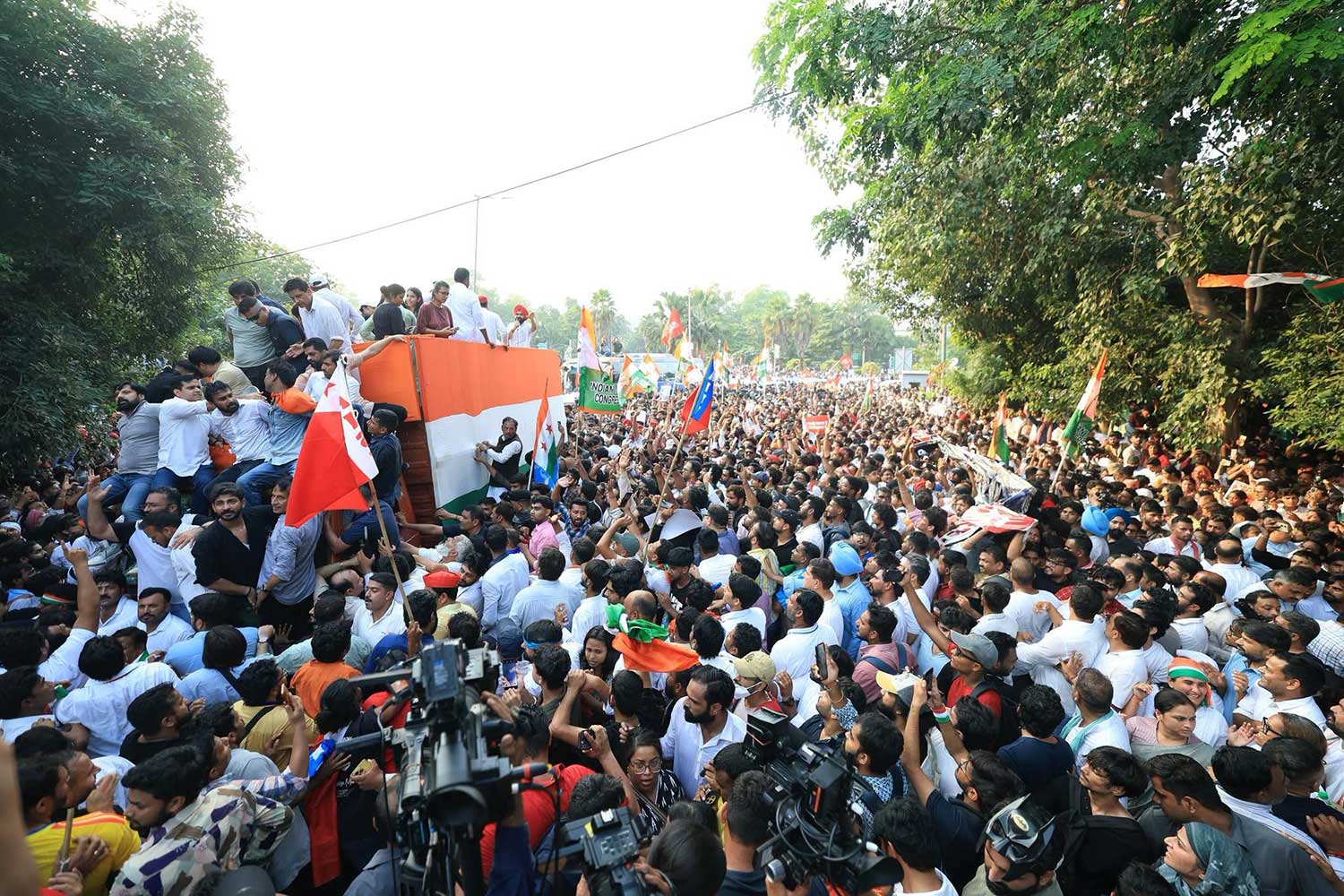
Thousands of people poured onto the streets of central Delhi on Monday, October 12, as opposition parties, lawyers, students and civil society groups joined the INDIA bloc’s ‘Chalo Delhi – March for Democracy’, demanding the removal of Chief Election Commissioner Gyanesh Kumar, an immediate halt to the Special Intensive Revision (SIR) of electoral rolls, and an end to police repression against democratic dissent.
JUST IN | Protesters head towards Barakhamba Junction as Rahul Gandhi calls for an INDIA bloc march.
📹 @kaurlavpreet_ https://t.co/l3ITr8ozlS
— The Hindu (@the_hindu) October 12, 2026
JUST IN | Protesters head towards Barakhamba Junction as Rahul Gandhi calls for an INDIA bloc march.
📹 @kaurlavpreet_ https://t.co/l3ITr8ozlS
— The Hindu (@the_hindu) October 12, 2026
VIDEO | Samajwadi Party president Akhilesh Yadav joins protests in Delhi.
#Delhiprotest https://t.co/IN4BRAvCa4
— Press Trust of India (@PTI_News) October 12, 2026
The march, led by Leader of Opposition in the Lok Sabha Rahul Gandhi and other INDIA bloc leaders, headed towards the Supreme Court from Barakhamba Road, with crowds stretching between Mandi House and Connaught Place. The protesters’ central demand was that allegations of large-scale voter deletions and irregularities in the revision of electoral rolls must be addressed, and that the institution responsible for conducting elections must be held accountable.
#WATCH | Delhi: A bus carrying Lok Sabha LoP Rahul Gandhi and other leaders of the INDIA bloc ready to leave from the Constitution Club of India.
The alliance has called a march to the Supreme Court today. They have also announced that they would file a petition before the apex court in connection with CEC Gyanesh Kumar matter and their allegations with respect to the SIR process.
— ANI (@ANI) October 12, 2026
Congress leader Sachin Pilot at Mandi House as the INDIA bloc’s march to the Supreme Court begins in Delhi. https://t.co/4CrIQURETA
— Hemant Rajaura (@hemantrajora_) October 12, 2026
#WATCH | Delhi: INDIA bloc MPs, including Dharmendra Yadav, Sanjay Raut, Arvind Sawant, Mahua Majhi, Mahua Moitr, and other opposition leaders, raise slogans against CEC Gyanesh Kumar during their protest at the Constitutional Club. https://t.co/f2YbP22JAV
— ANI (@ANI) October 12, 2026
Our Hon’ble Chairperson @MamataOfficial, along with our MPs, was present at the Constitution Club in New Delhi.
Today, alongside INDIA Bloc leaders, we marched to the Supreme Court, demanding justice for every rightful voter who had been wronged by Gyanesh Kumar and Mo-Shah.
The fight for the rights of our voters and the integrity of our democracy continues!
— All India Trinamool Congress (@AITCofficial) October 12, 2026
The mobilisation was not confined to the Congress or the larger opposition parties. The Communist Party of India (Marxist), Communist Party of India (Marxist-Leninist) Liberation, CPI, student organisations and civil society groups also joined the march.
🚨 INDIA Bloc March | October 12
INDIA Alliance leaders, MPs and party representatives, including CPI(ML) Liberation General Secretary Dipankar Bhattacharya, PBM Ravi Rai, AISA President Neha and CPI(ML) leader Balaji, are arriving at Mandi House to begin a march to the Supreme Court.
The march will submit a petition demanding the removal of CEC Gyanesh Kumar, an immediate halt to the SIR process, and an end to police repression against democratic voices.
.
.
.(Visuals: @anishsingh21)
— CPIML Liberation (@cpimlliberation) October 12, 2026
interesting – @neha_aisa joins opposition march…in the same bus as @kharge and @MPDharmendraYdv.
Follow @newslaundry for updates from the Opposition march today, in collab with @SreenivasanJain https://t.co/BSW2D8bIW0
— Manisha Pande (@MnshaP) October 12, 2026
Scenes from Barakhamba Road, New Delhi from @atti_cus https://t.co/MzhRpMRILx
— Article 14 (@Article14live) October 12, 2026
CPI(ML) Liberation and the All India Students’ Association (AISA) called for Kumar’s removal, the scrapping of the SIR process and an end to police repression against democratic voices. Their representatives, including CPI(ML) Liberation General Secretary Dipankar Bhattacharya, arrived to participate in the march. The CPI, the All India Students’ Federation (AISF) and the All India Youth Federation (AIYF) likewise joined the mobilisation, declaring that barricades and the deployment of security personnel could not silence demands for accountability.
Opposition Parties (Left parties + SP) Civil Society and CJP join in the Chalo Delhi March led by LoP Rahul Gandhi
@jahnavi_sen reports for The Wire
#VoteChori #ECI #Delhi #INDIA https://t.co/IrhtDTIRwO
— The Wire (@thewire_in) October 12, 2026
The presence of student and youth organisations was particularly significant in the context of the police action reported during the October 10 protests. The CPI(M) General Secretary M. A. Baby and Brinda Karat also addressed the media at A. K. Gopalan Bhawan alongside student and youth protesters who alleged police brutality.
CPI(M) General Secretary M A Baby and senior leader Brinda Karat addressed the media at AK Gopalan Bhawan in New Delhi, along with student and youth protesters against SIR who were subjected to police brutality. https://t.co/4BgBNJ9q36
— CPI (M) (@cpimspeak) October 12, 2026
INDIA Bloc March | CPI(ML) Liberation and AISA comrades join the INDIA Alliance march from Barakhamba to the Supreme Court, demanding the removal of Vote Chor CEC Gyanesh Kumar, scrapping of the SIR process and an end to police repression against democratic voices! https://t.co/0KJpIaJPqN
— CPIML Liberation (@cpimlliberation) October 12, 2026
The gathering also drew people beyond the established party structures. As the march moved through central Delhi, the participation of lawyers, students, activists and citizens underscored the breadth of concern over the SIR exercise and the treatment of those opposing it.
VIDEO | Delhi: CPI(M) leader Brinda Karat says, “What is happening in Delhi is unprecedented. We want this government to stop its dictatorship. We will not stop now.”
(Full video available on PTI Videos – https://t.co/d8jp61yd2p) https://t.co/StD6SgJc3c
— Press Trust of India (@PTI_News) October 12, 2026
The scale of the mobilisation was striking. The Indian Express reported that thousands had gathered for the march, while The Wire reported that Congress sources estimated the turnout at around 50,000. Participants had arrived from neighbouring states, including Uttar Pradesh, Rajasthan and Haryana, as well as Mumbai, according to The Wire. Left parties, the Samajwadi Party, civil society organisations and the Campaign for Judicial and Public Accountability (CJP) were among those participating in the mobilisation.
A march for electoral accountability
The march followed days of mounting anger over the SIR exercise and the treatment of protesters who had taken to Delhi’s streets on October 10. The opposition has alleged that the revision process risks disenfranchising legitimate voters, while demanding accountability from the Election Commission of India (ECI) and its chief, Gyanesh Kumar.
Protesters have arrived in Delhi from neighbouring states, including Uttar Pradesh, Rajasthan and Haryana, as well as Mumbai, to join the march. Congress sources estimate the turnout at 50,000.
@antarabaruah reports
— The Wire (@thewire_in) October 12, 2026
The INDIA bloc announced that it would approach the Supreme Court over the allegations. Bar and Bench reported that Rahul Gandhi filed a petition before the apex court concerning alleged large-scale voter deletions and irregularities in the SIR process. The opposition has demanded that the exercise be halted and that Kumar resign over the allegations of ‘vote chori’.
The march was therefore not merely a show of opposition unity. It sought to take a dispute over electoral rolls and the functioning of the Election Commission directly to the country’s highest constitutional court, placing the question of electoral integrity at the centre of a mass political mobilisation.
The alliance’s message was forceful. In a statement posted by the Indian National Congress, the party declared that the march was intended to protect democracy and the Constitution and ensure accountability for those accused of stealing votes.
At the Constitution Club of India, opposition MPs raised slogans against Kumar. Leaders and representatives of the alliance, including Samajwadi Party president Akhilesh Yadav, Trinamool Congress chairperson Mamata Banerjee, Shiv Sena (UBT) leader Sanjay Raut and Congress leader Sachin Pilot, joined the mobilisation. Communist Party of India (Marxist) leader Brinda Karat also criticised the government, telling the Press Trust of India (PTI), “What is happening in Delhi is unprecedented. We want this government to stop its dictatorship. We will not stop now.”
BREAKING: Leader of Opposition Rahul Gandhi, files petition before the #SupremeCourt over alleged large-scale voter deletions and irregularities in the Special Intensive Revision (SIR) of electoral rolls.
The Opposition has demanded a halt to SIR and the resignation of Chief Election Commissioner Gyanesh Kumar over alleged ‘vote chori’.
@RahulGandhi
— Bar and Bench (@barandbench) October 12, 2026
CPI, AISF & AIYF at the Forefront of the INDIA Bloc’s March to Supreme Court!
Turn Delhi into a fortress, deploy barricades, fill the streets with security personnel but you cannot silence people’s demand for accountability. The demand is clear: CEC Gyanesh Kumar must resign! https://t.co/5knjYPUNYP
— CPI – Communist Party of India (@CPI_National) October 12, 2026
Barricades, restrictions and a city turned into a security zone
As protesters converged on Barakhamba Road and prepared to move towards the Supreme Court, the police response was conspicuous. Roads were crowded with security personnel, and multiple layers of barricades were erected along the route.
Journalist Raunaq Bali reported at least four layers of barricades and police personnel on Bhagwan Das Road, towards the Supreme Court. Loudspeaker announcements repeatedly informed people that restrictions under Section 163 of the Bharatiya Nagarik Suraksha Sanhita (BNSS) were in force and asked them to leave the area peacefully.
There are at least 4 layers of barricades and police personnel on Bhagwan Das Road towards Supreme Court. Loudspeakers are repeating the announcement that restrictions under S. 163 BNSS are in force in this area and persons are requested to leave the area peacefully. https://t.co/uU3a4PT46z
— Raunaq Bali (@RaunaqBali) October 12, 2026
The security arrangements stood in sharp contrast to the crowds gathering to assert their right to democratic participation. As the bus carrying opposition leaders moved slowly through the packed streets, protesters continued to assemble, raise slogans and press their demands. PTI also reported protesters climbing barricades near Barakhamba Road during the ‘Dilli Chalo’ march.
VIDEO | Delhi: Protesters climb barricades near Barakhamba Road during INDIA bloc’s ‘Dilli Chalo’ march against CEC Gyanesh Kumar. https://t.co/S4zwZFjfLE
— Press Trust of India (@PTI_News) October 12, 2026
The restrictions also come against the backdrop of the reported denotification of Jantar Mantar as a protest site. PTI reported that the Congress criticised Prime Minister Narendra Modi and Union Home Minister Amit Shah over the decision, accusing them of treating democracy as a matter of political convenience.
The question confronting the authorities is not simply how to manage a large gathering. It is whether restrictions on public spaces and the deployment of extensive security arrangements are being used in ways that make the exercise of the right to protest increasingly difficult. Section 163 BNSS permits preventive orders in specified circumstances; its invocation does not, by itself, settle the constitutional question of whether restrictions on peaceful assembly are necessary and proportionate.
Lawyers take to the streets and the courtroom corridors
The mobilisation also brought lawyers into the protest, following reports of detentions and alleged police violence against lawyers during the October 10 demonstrations. In a striking show of dissent, lawyers at the Delhi High Court gathered to recite the Preamble to the Constitution. Bar and Bench reported that the demonstration came days after lawyers were detained and allegedly attacked during the earlier protests. The Indian Express separately reported that lawyers wore black ribbons and read the Constitution to protest police action against their colleagues.
Several lawyers gather in Delhi High Court to recite the preamble to the constitution.
This comes days after several lawyers were detained and allegedly attacked during the October 10 protests.
#Lawyers https://t.co/6X6SXOWSz8
— Bar and Bench (@barandbench) October 12, 2026
Senior advocates also joined the mobilisation outside the court. Senior Advocate Abhishek Manu Singhvi led a group of lawyers walking from the Supreme Court towards Modern School in protest against Kumar and the alleged police brutality against lawyers, according to a post by advocate Paras Nath Singh.
Lawyers led by Dr. Abhishek Manu Singhvi walked from the Supreme Court to Modern School, protesting against Gyanesh Kumar and police brutality against lawyers. I am proud to be a part of that crowd. We will not let democracy die or be rigged in our beloved country. @DrAMSinghvi https://t.co/d0q89OQeVH
— Paras Nath Singh (@parasnsingh95) October 12, 2026
Senior Advocate Rebecca John articulated the constitutional stakes of participating in the demonstration. Speaking to The Wire, she asserted, “We have the right to our roads, and we have the right to protest.”
“We have the right to our roads, and we have the right to protest”: Senior Advocate Rebecca John on Why She is Joining the protest
#VoteChori #Delhi #India https://t.co/W5tyYaDux0
— The Wire (@thewire_in) October 12, 2026
Yogendra Yadav, who also joined the mobilisation, stressed that the march was not intended to pressure the judiciary but to strengthen its role as the guardian of the Constitution. The distinction matters: the opposition’s stated objective was to bring allegations concerning the electoral process before the court, while asserting that democratic accountability cannot be reduced to a matter of political disagreement.
Protesters have arrived in Delhi from neighbouring states, including Uttar Pradesh, Rajasthan and Haryana, as well as Mumbai, to join the march. Congress sources estimate the turnout at 50,000.
@antarabaruah reports
— The Wire (@thewire_in) October 12, 2026
From October 10 to October 12: The streets remain a site of resistance
Monday’s march unfolded two days after Delhi witnessed a sweeping police crackdown on people attempting to march to Jantar Mantar to demand Kumar’s removal. Reports of detentions and alleged assaults on protesters and lawyers have since prompted further demonstrations, including the recitation of the Preamble by lawyers at the Delhi High Court.
The protests on October 12 thus carried a demand that extended beyond the immediate question of the SIR. They also challenged the growing use of police restrictions and preventive measures against those seeking to demonstrate in public spaces.
The crowds moving from Mandi House and Connaught Place towards Barakhamba Road, the lawyers reading the Constitution, and the student and youth organisations joining opposition leaders all formed part of the same wider assertion: that electoral integrity and the right to dissent are questions of democratic accountability, not simply matters of law and order.
For the INDIA bloc, the march was an attempt to bring the allegations of electoral manipulation before the Supreme Court while demanding consequences for the Election Commission’s leadership. For the lawyers and civil society participants, it was also a protest against the alleged use of police power to suppress democratic voices.
Detailed reports may be read here, here and here.
Related:
Vote for Democracy seeks answers from ECI and TCS on ECI’s electoral database access and security
Barricades and detentions fail to stop Delhi protesters marching against CEC
Protest Denied, Dissent Policed: India’s crackdown on those challenging the Election Commission
Bihar adds 14 lakh voters after SIR, questions remain over those excluded from 2025 assembly polls
Why Majoritarianism today is the single most acute threat to democracy