
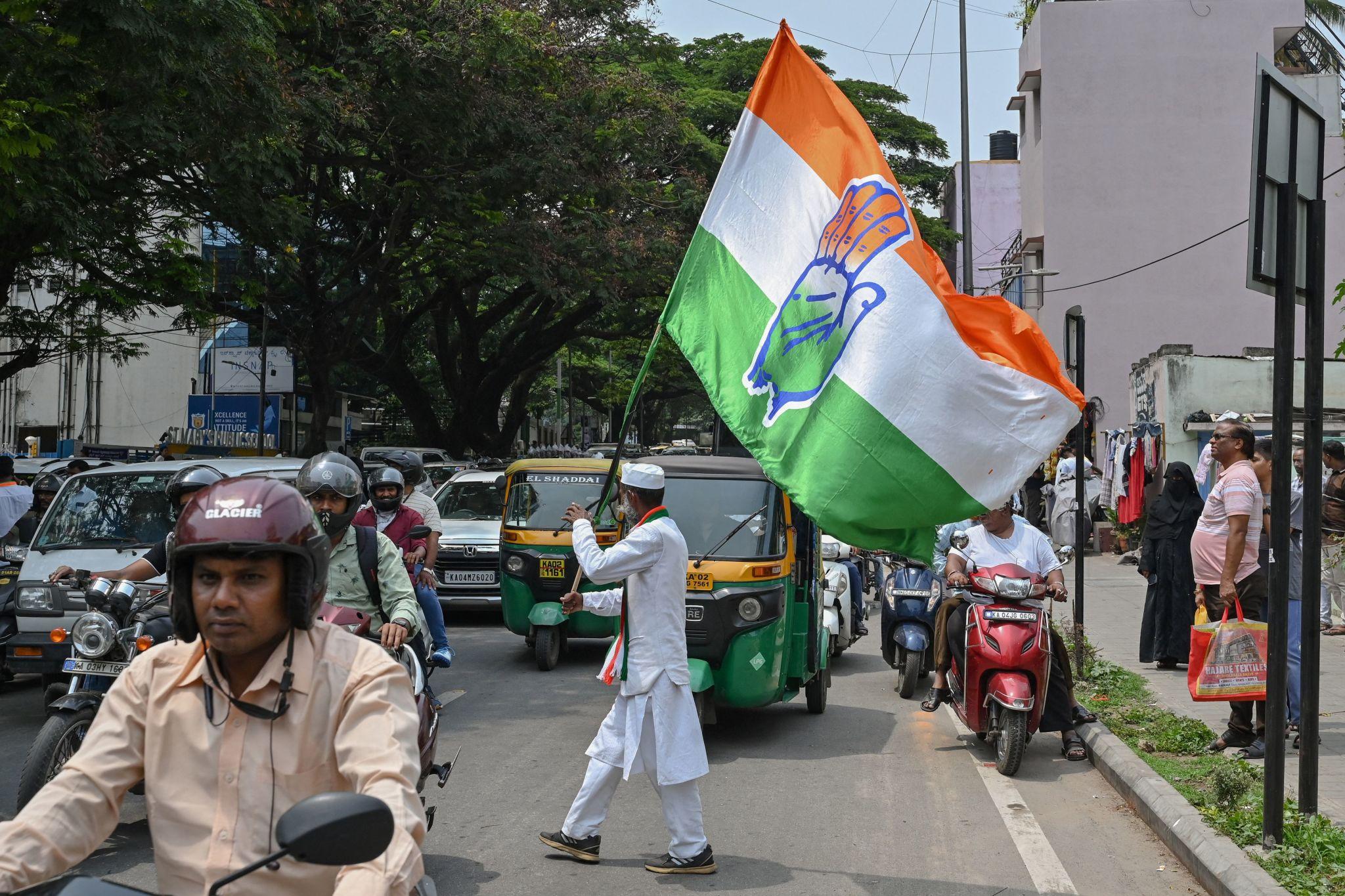
For decades, the Indian National Congress has been described as the “natural” home of Muslim voters in Karnataka – a party Muslims often choose less out of enthusiasm and more out of political compulsion in the face of an ascendant and majoritarian BJP. Yet, today, against the backdrop of the Davangere South by poll, a sharper question is being asked within the community: what has this loyalty actually delivered in terms of representation and respect?
The Davangere South trigger
The ongoing Davangere South by-election has crystallised these long-simmering grievances. The Congress decision to field Samarth Mallikarjun, heir to the Shamanur political family, instead of a Muslim candidate in a constituency with around 75,000–80,000 Muslim voters out of roughly 2.3 lakh has sparked visible anger and protest on the ground. Reports of community leaders and youth expressing resentment, coupled with calls for a Muslim candidate, have put the national party on the defensive. Senior Muslim functionaries have privately and publicly acknowledged disquiet over a pattern where Muslim votes are treated as guaranteed, but Muslim claims to candidature are treated as negotiable.
The Davangere episode is not an isolated misstep. For many Muslim leaders, it is merely the latest entry in a long ledger of slights, broken expectations, and what feels like deliberate undercutting of community leadership within the Congress.
The 2012 MLC election: a warning sign
The 2012 MLC election in Karnataka, when the BJP was in power and Congress sat in opposition, is remembered by many as an early warning. The party had to pick three candidates from the Assembly to the Legislative Council: C Motamma, an established woman leader; MR Seetharam; and Iqbal Ahmed Saradgi, a senior Muslim leader from Kalaburagi.
At this point, Opposition Leader Siddaramaiah is said to have demanded the Council seat for his close associate CM Ibrahim. When the party declined, Byrathi Suresh rebelled and contested the MLC election as an independent. The rebellion shook the party internally and created an atmosphere of uncertainty. In the end, Motamma and Seetharam won with 19 votes each, while Saradgi lost, and Byrathi Suresh emerged victorious with a significantly higher margin than any other candidate.
For many Muslim observers, the incident left two bitter impressions. First, that the factional tussle triggered around CM Ibrahim effectively jeopardised the lone Muslim candidate’s prospects. Second, that the party’s “damage control” later – including action against Suresh that quietly faded away – suggested that ensuring a Muslim win was never the system’s first priority. Within the community, it is now recalled as an early blow that foreshadowed how internal Congress power games could repeatedly come at the expense of Muslim representation.
Hebbal 2016: the CK Jaffer Sharief legacy sidelined
The 2016 Hebbal Assembly by-election is another case that fuels the current sense of grievance. The seat fell vacant after the death of BJP MLA Jagadish Kumar. In 2013, Congress’ CK Abdul Rehman Sharif – grandson of veteran leader and former Union Railway Minister CK Jaffer Sharief, a man credited with significant railway reforms and influence at the national level – had lost the seat by a relatively narrow margin of around 5,000 votes.
Given his political lineage, prior performance, and the constituency’s demographics, local Congress workers and observers believed Rehman Sharif was positioned to win the by poll if given a second chance. Instead, the contest saw accusations of internal manipulation and factional interference, with senior leaders and power brokers allegedly working in ways that undercut his campaign. The result was a decisive defeat – he reportedly lost by over 20,000 votes – and, in the subsequent 2018 election, the ticket went to Byrathi Suresh, who won and continues as MLA and now minister from Hebbal.
For many Muslims aligned with the Congress, Hebbal embodies a recurring pattern: Muslim candidates are projected as winnable only up to the point that they remain subordinate to entrenched caste and money networks. When their independent stature grows, or when they begin to look like serious power centres in their own right, they find themselves replaced or undermined.
Mysuru, Tanveer Sait, and the coalition years
The 2018 Congress–JD(S) coalition and the Mysuru city corporation elections brought another example into focus. Tanveer Sait, a long-time Muslim leader from Mysuru and son of heavyweight Azeez Sait, had been a minister in the previous government. However, local pressures and his tactical proximity to JD(S) leaders reportedly put him at odds with Siddaramaiah and sections of the Congress high command.
Though Tanveer Sait went on to win the 2023 Assembly election, he was denied a cabinet berth and instead accommodated only as a working president of the Karnataka Pradesh Congress Committee. For a leader with ministerial experience and a strong local base, this demotion is seen within the community as another case where the party’s internal calculations trumped recognition of a Muslim leader’s stature and seniority.
Roshan Baig: reformer to outcast
If there is one episode that symbolises the cost of dissent for Muslim leaders in the Congress, it is the ouster of Roshan Baig. A veteran leader and the only Muslim to have held the Home portfolio in Karnataka, Baig is widely credited with important police reforms and with establishing the Hajj Bhavan in Bengaluru, which has become a model for similar facilities elsewhere.
In 2019, following the Congress’ dismal Lok Sabha performance, winning only one seat from Karnataka – Baig publicly criticised Siddaramaiah, then AICC general secretary KC Venugopal, and state leadership for their handling of the elections. His outburst was followed by swift disciplinary action, culminating in his suspension and political isolation.
For many in the Muslim community, the message was clear: decades of loyalty and policy contributions did not protect Baig once he took on the central leadership. The party’s willingness to discard a senior Muslim face over internal criticism reinforced the perception that Muslim leaders are tolerated only so long as they remain unquestioningly loyal.
CM Ibrahim: a national figure walks away
The trajectory of CM Ibrahim adds a national dimension to this story. A stalwart who held key Union portfolios like Civil Aviation, Tourism, and Information & Broadcasting in the Deve Gowda and Gujral governments, Ibrahim has occupied prominent positions in both the Congress and JD(S). Over the years, however, his relationship with the Congress leadership—especially Siddaramaiah—deteriorated, and he eventually walked away from the party’s fold.
For grassroots Muslim cadres, Ibrahim’s estrangement is often cited as proof that even the tallest Muslim leaders are dispensable when their interests collide with dominant caste factions or leadership ambitions inside the Congress.
Lok Sabha numbers: the structural deficit
Beyond individual stories, the structural underrepresentation of Muslims in Karnataka’s parliamentary politics is stark. For a state with around 12–13% Muslim population, Karnataka has sent only one Muslim MP to the Lok Sabha in the last 20 years – Iqbal Ahmed Saradgi from Gulbarga in 2004 and Mansoor Ali Khan in 2024.
Data from recent elections shows that the Congress, BJP and JD(S) together have fielded only 11 Muslim candidates across four Lok Sabha polls between 2004 and 2019 – less than 10% of the 112 candidates the three parties collectively put up in that period. In 2004, there were four Muslim candidates from major parties; in 2009 and 2014, there were three each; by 2019 and 2024, that number dropped to just one. None of these candidates belonged to the BJP.
Political scientists and community leaders point to multiple reasons: the lack of clearly decisive Muslim “vote bank” parliamentary constituencies; the refusal of parties to groom Muslim leaders beyond community silos; and the rise of majoritarian polarisation as a deliberate electoral strategy. Delimitation in 2008, they argue, also reshaped constituencies in ways that further reduced the perceived winnability of Muslim candidates.
The case of Mansoor Ali Khan in Bengaluru Central, who recently lost by around 30,000 votes, is often read through this lens. From the community’s perspective, the issue is not just his defeat, but the sense that Kuruba, Lingayat and other caste blocs—who have long benefited from Muslim support in their own constituencies—did not mobilise with the same intensity for a Muslim candidate when it was their turn to reciprocate
Assembly level signals: Gangavati and beyond
The 2023 Assembly election in Gangavati added another layer to this community alienation. Iqbal Ansari, the Congress candidate, lost by 7,000–8,000 votes. Local accounts attribute the defeat not to lack of appeal but to internal sabotage: Lingayat and Kuruba factions, allegedly shaped by senior local leaders, were unwilling to back Ansari fully because his victory might have strengthened his claim for a cabinet berth in the future.
Similar stories are whispered from other constituencies where Muslims form a decisive part of the Congress vote base but remain underrepresented in ticket distribution and cabinet appointments. At the same time, Muslim voters have consistently rallied behind non-Muslim Congress candidates, from Bidar and Kalaburagi to Raichur, Koppal and Ballari—often playing a critical role in their victories.
A politics built on asymmetry
Taken together, these episodes and numbers suggest a deep asymmetry at the heart of Congress–Muslim relations in Karnataka. On one side stands a community that has repeatedly voted for the Congress to keep the BJP at bay and to defend secular space. On the other stands a party that has been increasingly cautious, even reluctant – about translating that loyalty into proportionate representation.
Davangere South has therefore become more than a by poll. It is a symbol. For many Muslims, it confirms a pattern: when there is a clash between dynastic claims, dominant caste interests, and Muslim representation, the latter is almost always the first to be sacrificed.
Conclusion: A Lesser Evil
The central grievance emerging from Karnataka’s Muslim electorate is not that the Congress has never fielded Muslim candidates, nor that it has never elevated Muslim leaders. The grievance is that these gestures have become rarer, more conditional, and more vulnerable to internal sabotage, even as the community continues to vote for the party in large numbers.
In an era where majoritarian politics is openly dismissive of Muslim concerns, the Congress still benefits from being seen as the lesser evil. But “lesser evil” is not a sustainable political identity. For a party that speaks the language of diversity and inclusion, Karnataka’s record on Muslim representation – particularly in Parliament – stands as an uncomfortable indictment.
Unless the Congress begins to treat Muslim representation not as a risk but as a rightful outcome of long-term loyalty, the disconnect between its rhetoric and its ticket distribution will only widen. Davangere South is a test, but it is also a mirror. The question facing the party is simple: will it continue to rely on fear of the BJP to hold Muslim voters, or will it finally acknowledge and repay a political debt that has been accumulating for decades?
(The author is Editor in chief, NewsHamster (NH), a portal that majorly covers Bengaluru and Karnataka related stories.)
Related:
Karnataka: Hindutva groups call for economic boycott of Muslim vendors at Siddheshwar Temple
In line with the approaching Karnataka polls, BJP MLA KS Eshwarappa gives anti-Muslim speech