
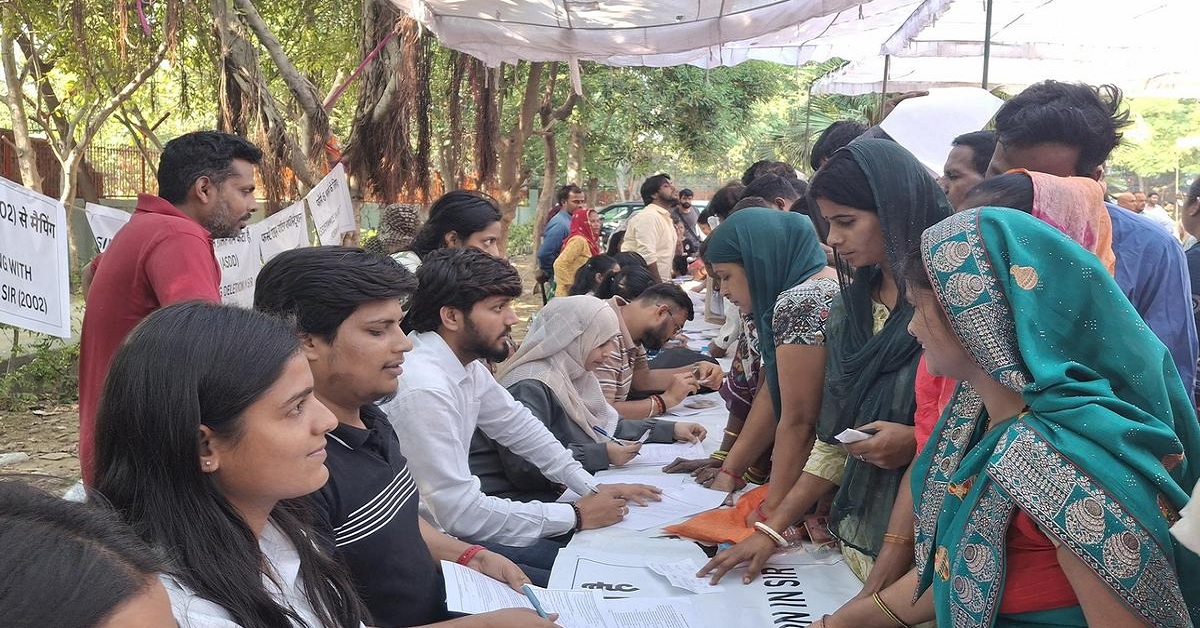
Delhi’s Special Intensive Revision (SIR) of electoral rolls has come under fresh scrutiny after a public audit in East Delhi’s Trilokpuri found that 416 of 1,236 voters whose names were removed from the draft electoral roll had allegedly been wrongly classified as absent, shifted, dead or duplicate. The findings were presented at a Jan Sunwai, or public hearing, on October 27, where residents described discovering that their names had disappeared despite living at the same addresses or submitting enumeration forms.
The audit, reported by The Hindu examined voters across four polling booths in Trilokpuri. It offers a ground-level account of how the revision has affected residents and why independent verification of deleted names matters, particularly when the deadline for filing claims and objections is October 30.
47.57 lakh voters missing from Delhi’s draft roll
Delhi had 1, 45, 10, 299 registered electors when the SIR began on June 30, 2026. The draft electoral roll, published on August 31, retained the names of 97, 53, 577 electors whose enumeration forms had been received and digitised.
The remaining 47, 56, 722 electors were left out of the draft roll after their enumeration forms were not received during the exercise. They were classified under categories including Absent, Shifted, Dead and Duplicate (ASDD), along with other reasons.
The enumeration exercise involved Booth Level Officers (BLOs) visiting households, distributing forms and assisting voters with their details. The large number of names excluded at the draft stage has since raised questions about whether all those classified as unavailable or ineligible were properly verified.
The exclusion of a name from the draft roll does not, by itself, establish that the person is ineligible to vote. Those whose names are missing can seek inclusion through the claims and objections process, but they must act within the prescribed period and follow the procedure laid down by the election authorities.
The public hearing was organised by Jan Sarokar, Mazdoor Kisan Shakti Sangathan (MKSS), the National Federation of Independent Women (NFIW) and Voter Adhikar Manch. Civil society groups involved in the Trilokpuri hearing have called for the claims deadline to be extended by a month, arguing that voters need sufficient time to identify their exclusion and seek correction.
According to The Indian Express, the draft roll retained about 97.5 lakh voters, while approximately 47.5 lakh were classified as uncollectible. The scale of the exclusions makes it important to examine not only how many names were removed, but also the reasons recorded for each removal and whether those reasons reflect the voter’s actual circumstances.
Jan Sunwai (Public Hearing) in Trilokpuri: what the Trilokpuri public audit found
At a Jan Sunwai (Public Hearing), the four-day audit covered 1,236 voters across 700 households in polling booths 42, 43, 79 and 80 in Trilokpuri, including Indira Camp and nearby residential areas. Volunteers went door to door to check the circumstances of people whose names had been marked for removal.
According to the organisers, 416 of the 1,236 voters verified were wrongly classified under the deletion categories. That amounts to approximately one-third of those surveyed.
The findings also showed that 55% of voters marked absent were still living at their registered addresses. Three people recorded as dead were found alive.
These findings relate to the voters examined in the four polling booths. They cannot be treated as a citywide error rate or used to conclude that one-third of all 47.57 lakh excluded voters were wrongly removed. Their significance lies in documenting specific cases where the recorded reason for exclusion did not match the circumstances found during the audit.
The organisers presented these findings at the Jan Sunwai on October 27, which brought residents together to discuss the deletions, question the verification process and seek assistance with restoring their names.
Residents say their names disappeared despite submitting forms
The Jan Sunwai brought forward accounts of residents who said they had submitted enumeration forms but were nevertheless excluded from the draft roll. Others said no Booth Level Officer had visited their homes or that they had not received the forms needed to complete the exercise.
One of them was 29-year-old Suresh Kumar Patel, a JCB driver whose family has lived in Indira Camp for decades. He told The Indian Express that he had filled in his enumeration form in front of the BLO, including details from the 2002 electoral roll.
Yet, when the draft roll was published, his name was missing while his father’s name remained on the list. He said he was unaware of the deletion until volunteers conducting the audit visited his home.
His case illustrates the problem faced by voters who believe they have completed the required procedure but discover only later that their names have not been retained.
Other residents described similar difficulties. Some said their family members had been marked absent despite continuing to live at the same address. Others said they had repeatedly approached election officials but had not been able to resolve the problem.
The accounts raise questions about how enumeration forms were collected, uploaded and checked, and whether voters were informed when their names were not included in the draft roll.
Voters marked dead, absent or shifted
Among the cases highlighted in the audit was that of 67-year-old Vijender, who had been classified as dead despite being alive. His wife, Kamlesh, said she had submitted her form along with his, but only her name appeared in the draft roll.
Questioning the circumstances in which the entry had been made, she said, “I haven’t caught hold of the Booth Level Officer (BLO) after that, I want to ask him what rush he was in to declare him dead already?”
Another resident, Pinki, said at least five members of her family had lost their names, including her mother-in-law Anita, who had reportedly voted for 50 years.
“Look at this, at least five people from our family, including my mother-in-law, Anita, who has been voting for 50 years, have had their names cut. How are they cutting votes like this?” she asked, according to The Hindu.
Aniket, a relative who had come to register as a first-time voter, said the family had submitted forms for six members three times after errors in their first two submissions. Despite these efforts, four members were marked absent.
“I have gone and submitted the forms for six members not once but thrice, after there were a few errors the first two times, and four of them have been marked absent,” he said.
Another resident, Rahis, was marked absent despite reportedly submitting his enumeration form. His wife visited the voter centre and the Sub-Divisional Magistrate’s office to find out why his name had been removed. His wife and four children remained on the draft roll.
The hearing also highlighted the cases of elderly residents Chandrawati, 72, and Ramji Lal, 78, who said their names had been removed despite voting from the same address for more than 50 years.
“We live alone and all we survive on is my 2,000 rupees pension. No BLO came to our house, nor did we fill any form,” Chandrawati said, as reported by The Hindu.
These accounts do not establish that every disputed deletion was incorrect. They do, however, show why a recorded classification must be open to verification, especially when a person has been marked dead or absent without the circumstances being properly established.
From finding a deletion to getting a name restored
For voters whose names are missing, discovering an error is only the first step. They must also understand the procedure for seeking inclusion, gather the required documents and submit their applications to the appropriate election officials.
At the Trilokpuri hearing, a voter facilitation camp helped 280 families fill out more than 500 forms. Applicants still had to submit the forms individually to their BLOs or the election office.
The need for such assistance points to a gap between making a correction procedure formally available and ensuring that affected voters can actually use it. Residents who are unaware of their exclusion, unfamiliar with the forms or unable to visit election offices may struggle to complete the process within the prescribed period.
The distinction between different reasons for deletion also matters. A person marked dead, a voter who has temporarily travelled for work and someone who has moved to another address may require different kinds of verification. Treating these circumstances as interchangeable risks making the correction process more difficult for people whose eligibility has not actually changed.
The audit also found that only 87 of the 416 voters identified as wrongly classified had filled Form 6 to seek inclusion in the electoral roll. The figure highlights the distance between identifying a possible error and completing the process to get a name restored.
Form 6 is ordinarily used to apply for inclusion in the electoral roll. For voters who were already registered, however, the circumstances in which they were removed and the procedure they must follow to return to the list have become important points of dispute.
Why public audits matter in electoral roll revision
A public audit allows residents and civil society groups to check electoral records independently rather than relying exclusively on the classifications recorded during the official revision. By visiting homes, speaking to voters and comparing their accounts with the reasons recorded for deletion, volunteers can identify cases that require further examination.
The Trilokpuri exercise also demonstrates how a public hearing can bring individual cases together. Residents who may otherwise have approached election offices separately were able to describe their experiences, seek assistance and question how the revision had been carried out.
Public audits cannot replace the statutory responsibilities of election officials. Nor can the findings from a limited number of polling booths establish the overall accuracy of an electoral roll. Their role is to identify discrepancies, make the process more transparent and provide information that can be checked by the authorities.
For a wider audit to be meaningful, voters need access to deletion lists and the reasons recorded against their names. They also need a clear procedure for checking those details, raising objections and obtaining a decision within a reasonable period. Where an entry is disputed, election officials should explain how the claim was verified and whether any correction was made.
This is particularly important when a voter has been marked dead, absent or shifted. Such classifications can have direct consequences for a person’s ability to participate in an election, and errors should not be left for voters to discover only when they check the draft roll or attempt to vote.
The issue extends beyond Trilokpuri. Wherever intensive revision exercises are conducted, independent checks can help identify gaps between the official record and the circumstances of people whose names have been removed.
October 30 deadline puts pressure on excluded voters
The timing of the audit is significant because the deadline for filing claims and objections in Delhi’s SIR process is October 30. The Election Commission of India extended the deadline from September 30, while the final electoral roll is now scheduled to be published on December 4.
The Delhi Chief Electoral Officer’s office said more than 31.26 lakh of the 33.14 lakh notices issued during the revision had been disposed of, with the cases concerned set aside for consideration in the final roll. These notices relate to voters whose details could not be matched with the 2002 electoral roll or whose enumeration forms were flagged for logical discrepancies.
The notice process is separate from the exclusion of approximately 47.57 lakh voters whose enumeration forms were not received during the exercise. The figures should therefore not be conflated: a person missing from the draft roll and a person whose details have attracted a notice are not necessarily in the same procedural position.
The CEO’s office has also said that special enrolment camps have been conducted across polling stations to help voters check their names and submit applications. However, the existence of camps does not by itself establish how many excluded voters have successfully secured inclusion.
For those who believe they have been wrongly removed, the immediate concern is whether they can submit their claims before the deadline and whether those claims will be properly examined before the final roll is published.
The public audit has put individual cases on record, but the larger question remains whether the election authorities can verify disputed entries, make the correction process accessible and ensure that eligible voters are not left out because of errors in the revision. With the claims deadline approaching, the focus must remain on the people whose names are missing and on whether they can obtain an effective remedy in time.
Related:
SIR Karnataka: Six major ‘conspiracies’ exposed in the final electoral roll
EXCLUSIVE – SIR: The total disenfranchisement of the Indian Voter is 16 crores, not 13.60 Crores?