
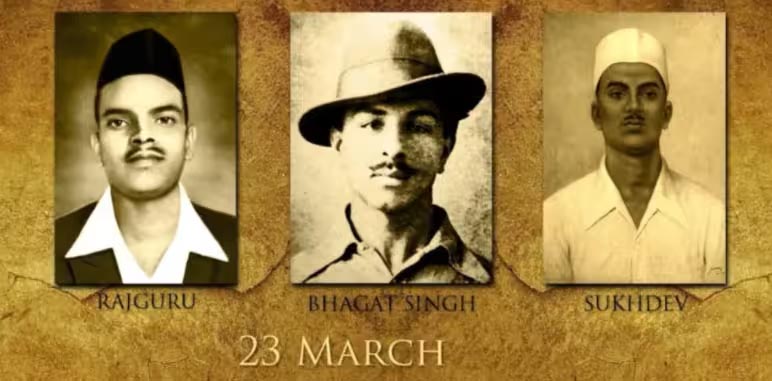
There is no dearth of proof in the archives that reveal several documents, sourced directly from publications of the Rashtriya Swayamsevak Sabgh (RSS) which conclusively establish the fact that RSS denounced movements led by revolutionaries like Bhagat Singh, Chandrashekar Azad and their associates. Not only that, but this supremacist ideology has also had a deep dislike for the more reformist and moderate movements conducted by leaders like Gandhiji against colonial British rulers.
Here is a passage from the chapter, ‘Martyr, great but not ideal’ of Bunch of Thoughts, the collection of writings of MS Golwalkar decrying the whole tradition of martyrs. After declaring that his objects of worship have always been successful lives and that ‘Bhartiya culture’ [which surely –for him –means RSS culture] does not adore and idealize martyrdom and do not treat “such martyrs as their heroes”, he went on to philosophise that,
“There is no doubt that such man who embrace martyrdom are great heroes and their philosophy too is pre-eminently manly. They are far above the average men who meekly submit to fate and remain in fear and inaction. All the same, such persons are not held up as ideals in our society. We have not looked upon their martyrdom as the highest point of greatness to which men should aspire. For, after all, they failed in achieving their ideal, and failure implies some fatal flaw in them.” [Bunch of Thoughts, p. 283.]
Could there be a statement more insulting and denigrating to the martyrs than this?
This will or should be shocking for any Indian who admires the martyrs of the Freedom Movement to know what Hedgewar, founder of RSS felt about the revolutionaries fighting against the British. According to his biography published by the RSS,
“Patriotism is not only going to prison. It is not correct to be carried away by such superficial patriotism. He used to urge that while remaining prepared to die for the country when the time came, it is very necessary to have a desire to live while organizing for the freedom of the country.”
[CP Bhishikar, Sanghavariksh Ke Beej: Dr. Keshavrao Hedgewar, p. 21.]
It is indeed a pity that Bhagat Singh, Rajguru, Sukhdev, Ashfaqullah Khan and Chandrashekhar Azad did not come into contact with this contemporary great patriotic thinker. If they had the great opportunity to meet him, these martyrs could have been saved from giving their lives for ‘superficial patriotism’.
Even the word ‘shameful’ is not appropriate to describe the attitude of the RSS leadership towards those who had sacrificed everything in the struggle against the British. The last Mughal ruler of India, Bahadur Shah Zafar had emerged as the rallying point for patriotic Indians and symbol of the Great War of Independence of 1857.
Golwalkar wrote thus while mocking him:
“In 1857, the so-called last emperor of India had given the clarion call-Gazio mein bu rahegi jub talak eeman ki/takhte London tak chalegi tegh Hindustan ki (Till the warriors remain faithful to their commitment/Indian swords will reach throne of London.) But ultimately what happened? Everybody knows that. [Golwalkar, M.S., Shri Guruji Samagar Darshan (collected works of Golwalkar in Hindi)
Bhartiya Vichar Sadhna, Nagpur, nd., volume 1, p. 121.]
What Golwalkar thought of the people sacrificing their lot for the country is obvious from other observations and recollections. He had the temerity to question the great revolutionaries who wished to lay down their lives for the freedom of the motherland the following question as if he was representing the British:
“But one should think whether complete national interest is accomplished by that? Sacrifice does not lead to increase in the thinking of the society of giving all for the interest of the nation. It is borne by the experience up to now that this fire in the heart is unbearable to the common people.”
[Ibid. pp. 61-62.]
Is this also the reason that RSS produced no fighters or martyrs during the Freedom Movement?
Is it not the duty of every patriotic Indian who respects these great martyrs to share these anti-national and degenerate ideas of the RSS against both the anti-colonial freedom struggle in general and martyrs in particular?
Disclaimer: The views expressed here are the author’s personal views, and do not necessarily represent the views of Sabrangindia.
Related:
78th Martyrdom Anniversary of Gandhi & Identity of his Assassins: Sardar Patel
November 26: How RSS mourned the passage of India’s Constitution by the Constituent Assembly