
For many in India, and particularly in Gujarat, 26 March will always be remembered as a ‘black day!’ On that day in 2003, in keeping with an election promise, Narendra Modi, the then Chief Minister of Gujarat introduced, the draconian ‘Gujarat Freedom of Religion Act’. Earlier that morning, Haren Pandya, a former Home Minister of Gujarat and Modi’s bête noire, was found assassinated in mysterious circumstances. Till today, the truth of Pandya’s death (who killed him and why?) has not yet been officially revealed. Pandya’s father, the late Vitthalbhai Pandya (who died in January 2011) was quite convinced of who was behind the killing of his son and he went from pillar to post (right up to the Supreme Court) hoping that the full truth of Haren’s murder would be revealed. Several non-partisan political analysts have also written volumes on this murder. A two –part BBC Documentary ‘ The Modi Question’ which was released in January 2023 ( but banned in India) , highlights the murder of Pandya and why he was a stumbling block to Modi’s ascendancy to power!
As for the ‘Gujarat Freedom of Religion Act, 2003’, it is easily one of the most draconian ones in the history of any democracy in the world. Modi piloted this bill! During his election campaign in 2002, he ranted and raved against the Muslims and Christians and promised to bring in an anti-conversion law. True to his promise, he did so a few months later. At that time, the entire Opposition, in total disagreement with the bill, walked out of the Gujarat Assembly! It then took a full five years, until 2008, for the Gujarat Government to frame the necessary rules for the implementation of that law!
In February 2006, in keeping with letter and spirit of his anti-Constitutional law, at a Shabri Kumbh (a mass gathering of Hindus) programme in the Dangs (supported by the Gujarat Government), Modi warned the Christians “It is my constitutional duty to prevent conversions. Our Constitution disapproves of them, and yet some people turn a blind eye.” Morari Bapu accused the Christians of bringing in planeloads of missionaries from the Vatican “who come here to carry out conversion activities but when we organise a ‘ghar wapsi’ why should it be termed as bad?” Both Modi and Morari Bapu, unequivocally also endorsed the ‘ghar wapsi’ programmes, which were part of that Kumbh!
In 2009, the ‘Gujarat United Christian Forum for Human Rights’ and several other eminent citizens challenged the constitutional validity of the Gujarat Freedom of Religion Law, in the Gujarat High Court. A notice was sent by the Court to the Government to respond, they did not do so (obviously, they could not).The petitioners later withdrew their petition with an intention of making it stronger. In August 2021, the Gujarat High Court did not allow the Gujarat Government to make amendments to the already draconian law.
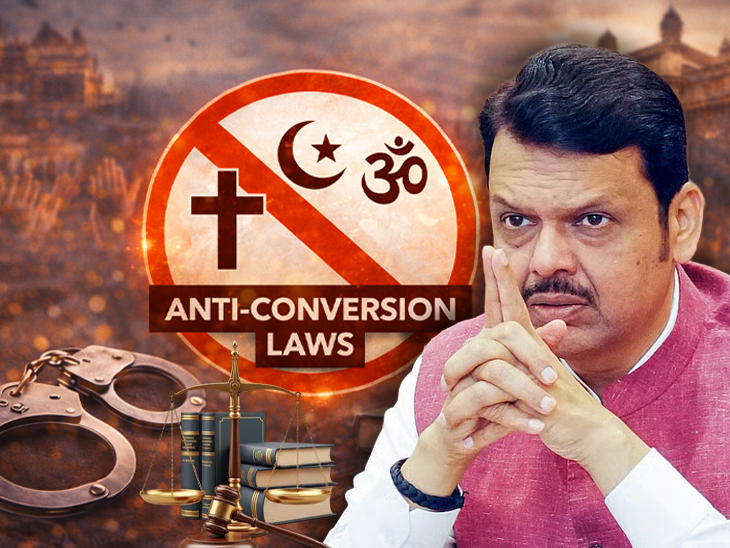
The bogey of ‘forced’ conversion and the introduction of anti – conversion laws (strangely called ‘Freedom of Religion’) are part of a well-oiled strategy of the ‘Sangh Parivar’ .These laws are blatantly unconstitutional. The States of Arunachal Pradesh, Chhattisgarh, Gujarat, Haryana, Himachal Pradesh, Jharkhand, Karnataka, Madhya Pradesh, Odisha, Rajasthan, Uttarakhand, and Uttar Pradesh already have these laws in place. On March 5, Maharashtra became the 13th State to do so, when the Government of Maharashtra approved a draft anti-conversion bill requiring prior permission from a designated authority for religious conversion. Called the ‘Dharma Swatantrya Adhiniyam 2026 (Religious Freedom Act, 2026), the proposed law specifically aims to prevent individuals or organizations from carrying out forced or unlawful religious conversions. It seeks to protect individuals’ freedom of religion by prohibiting coercive or deceptive practices and imposing stringent penalties for violations.
On March 11, a collective of the Peoples Union for Civil Liberties (PUCL), Citizens for Justice and Peace (CJP) and the Bombay Catholic Sabha(BCS) among thirty civil society and human rights organisations held a well-attended media conference at the Press Club in Mumbai. At the Conference, several well-known citizens lambasted the Maharashtra Government for introducing this draconian legislation and without due process.
In a detailed statement released on the day, the signatory organisations said, “the text of the draft law has not yet been made public, raising serious concerns about transparency, democratic process, and the potential implications of the legislation for fundamental rights. The participating civil society organisations emphasise that legislation with far-reaching implications for religious freedom, privacy, and personal liberty cannot be drafted and introduced without public consultation, scrutiny, and debate. A growing pattern of anti-conversion laws framed around “love jihad” The proposed Maharashtra law appears to follow the pattern of anti-conversion legislation already enacted in several states under the banner of “freedom of religion” laws. While framed as measures to prevent coercion or fraudulent religious conversions, these statutes have frequently been justified politically through the narrative of “love jihad”—a conspiracy theory alleging that Muslim men systematically lure Hindu women into marriage in order to convert them. This claim has no legal basis.”
Further, the statement said, “The Maharashtra proposal also comes at a time when the constitutional validity of similar anti-conversion laws across several states is already under challenge before the Supreme Court of India. A batch of writ petitions –first filed by Citizens for Justice and Peace (CJP), Mumbai that is the lead petitioner in the Supreme Court– has been pending before the Supreme Court since 2020, raising fundamental constitutional questions about the scope of freedom of conscience, personal liberty, equality before the law, and the limits of State power in regulating religious conversion and interfaith relationships. Hearings in the matter that have happened intermittently with pressing demands made by CJP for an interim stay on the most egregious provisions are also scheduled today”
The ‘bogey’ of forced conversion is once again being made into an issue! There is absolutely no evidence to substantiate this frivolous claim. It is a manipulative ploy, used by the Sanghis to defocus from the real issues, which grip the nation. India has proved to have a spineless Government, literally being held to ransom by the United States. We have lost our long-cherished identity as a non-aligned nation. The ordinary citizen is suffering due to a terrible scarcity of LPG (Smriti Irani seems to have done the disappearing trick instead of protesting!). The Epstein files have revealed names of some prominent Indians- a great shame to the nation. The Election Commission has proved to be a ‘caged parrot’ of the ruling regime! Corruption is the DNA of a Government, which has abdicated its responsibility to govern. Prices are skyrocketing, even as the poor become poorer and the crony capitalists friends of the regime continue to amass scandalous amounts of wealth. The common person is denied the legitimate right of ‘roti-kapda-makaan’ and Adivasis of ‘jal-jungle- jameen’. The country is in the doldrums as never before! Besides, the ‘hindutvadis’ are a frightened group: they are aware that their so -called brand of ‘religiosity’ goes against human nature: the rights and freedoms, which are inalienable to every citizen. Therefore, the ‘forced conversion’ gimmick is a convenient way to change the narrative and deflect from burning issues, which literally throttle the country today!
On November 14, 2022, a two-judge bench of the Supreme Court consisting of Justice M.R. Shah and Justice Hima Kohli observed that forced conversions may “ultimately affect the security of nation and freedom of religion and conscience of citizen.” The bench directed the Central Government to inform the Apex Court what steps it intends taking to curb deceitful or compulsory religious conversions. The bench was hearing a PIL by Ashwini Kumar Upadhyay, who has been filing several petitions of this kind in the past. Upadhyay wants a law against ‘fraudulent religious conversion’ and ‘religious conversion by intimidation’, threatening, deceivingly luring through gifts and monetary benefits, as it offends Articles 14, 21, and 25.
Significantly, in April 2021, a three-judge bench of Justices Rohinton F Nariman, B.R. Gavai and Hrishikesh Roy had dismissed a similar petition by the Upadhyay himself and had even threatened to impose heavy costs if he persisted with the petition. The bench at that time had opined that any religious conversion law would be violative of the constitution as the constitution clearly allows joining of any religion of one’s choice and that is why the word “propagate” is in the Constitution. The bench termed “very harmful” the petition that asked a strict central law to check religious conversion and observed that adults are free to choose their faith. The bench also cautioned senior advocate Gopal Sankaranarayan, who represented Upadhyay in the matter, “What kind of a petition is this? This is a very harmful petition. If you are going to argue this, we are going to impose a heavy cost on you”, said Nariman; he added, “There is a reason why the word ‘propagate’ is there in the Constitution. You have to have some meaning for that word. There is no reason why somebody above 18 cannot choose one’s own religion or somebody else’s religion,” The petition was immediately withdrawn!
The point therefore is not whether one has the right ‘to convert another’; but whether a citizen of India, has the right to choose a religion of one’s choice. Article 25 of the Constitution of India unequivocally “guarantees the freedom of conscience, the freedom to profess, practice and propagate religion to all citizens”. Besides, Article 18 of the Universal Declaration of Human Rights, asserts that “Everyone has the right to freedom of thought, conscience and religion; this right includes freedom to change his religion or belief, and freedom, either alone or in community with others and in public or private, to manifest his religion or belief in teaching, practice, worship and observance”.
As early as 1935, Dr. B. R. Ambedkar made the most daring and path-breaking speech of his career, announcing that, because of the intransigence of privileged caste Hindus and the failure of a decade of nonviolent protests, he had decided to abandon Hinduism and to seek another faith. He urged the leaders at the Yeola Depressed Classes conference to consider their religious identity a choice, not a fact of destiny. In a highly emotional voice he said, “If you want to gain self-respect, change your religion. If you want to create a cooperating society, change your religion. If you want power, change your religion. If you want equality, change your religion. If you want independence, change your religion. If you want to make the world in which you live happy, change your religion”. About twenty years later, on 14 October 1956 (apparently the date on which King Ashoka became a Buddhist) Ambedkar together with his wife and at least 365,000 of his followers, mainly Dalits, decided to exit Hinduism and embrace Buddhism.
Is then an adult citizen of India free to choose the religion of one’s choice? The Supreme Court has to act with alacrity, maintaining the unconstitutionality of these draconian laws and strike them down in toto once and for all! Will it have the courage to take on the ‘hindutva’ brigade? That perhaps is another matter!
March 14, 2026
(The author is a human rights, reconciliation & peace activist and writer. Contact: cedricprakash@gmail.com )
Related:
Maharashtra’s Anti-Conversion Bill: Legislating suspicion in the name of “love jihad”