
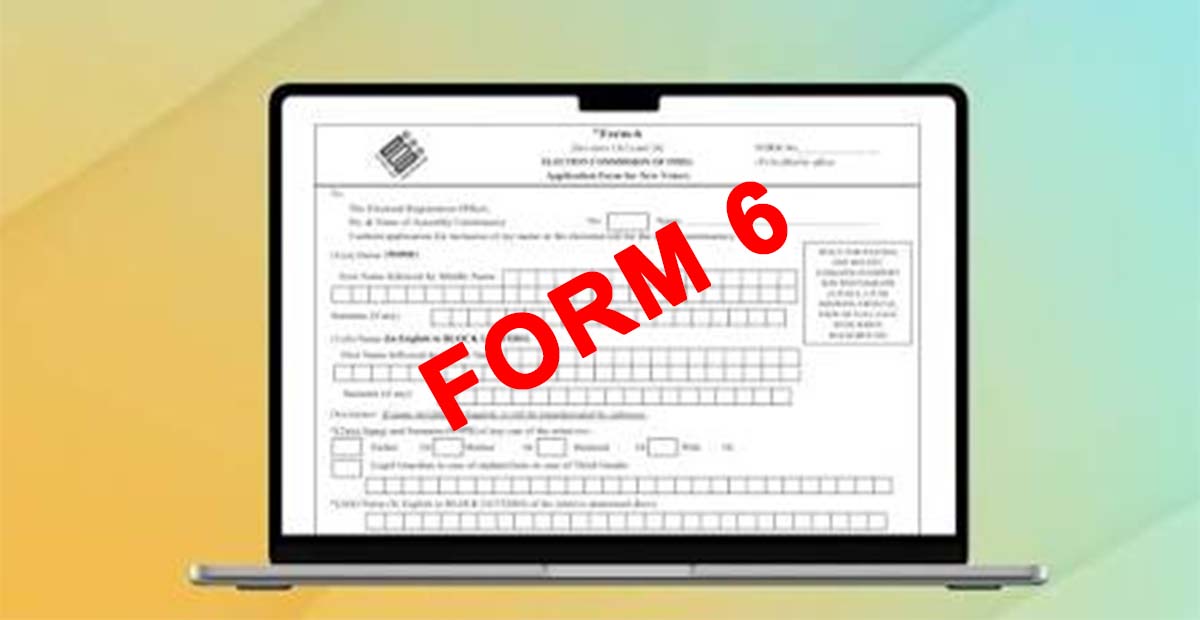
The Election Commission of India (ECI) has introduced a significant change to the online process for voter registration. Applicants seeking enrolment through the ECINET portal are now required to answer a new set of questions relating to the electoral status of their parents during the last Special Intensive Revision (SIR) of electoral rolls. This requirement has not been introduced through any public press note or notification. It appears only in the online version of Form 6 available on the ECINET portal.
The newly inserted section, described as a “declaration form”, requires applicants to state whether either of their parents was included in the last SIR. If the answer is yes, the applicant must provide the Assembly Constituency number, the polling station (Part Number) and the Serial Number under which the parent appeared in the last SIR. If the parents were not included, the applicant is required to provide their names and, wherever available, their Elector Photo Identity Card (EPIC) numbers.
The introduction of this declaration changes the information sought from first-time applicants. However, the statutory Form 6 prescribed under the Registration of Electors Rules, 1960 has not been amended through any publicly available Gazette notification to incorporate this additional requirement.
The existing offline declaration form may be accessed from here:
Form 6 is a statutory form governed by the Registration of Electors Rules
Form 6 is the statutory application prescribed for inclusion of a person’s name in the electoral roll. It derives its legal authority from the Representation of the People Act, 1950 and the Registration of Electors Rules, 1960. Article 326 of the Constitution guarantees registration as an elector to every adult citizen who is ordinarily resident in a constituency, subject only to the disqualifications provided by law.
Since Form 6 forms part of the Registration of Electors Rules, its contents are governed by delegated legislation rather than administrative practice. Under Section 28 of the Representation of the People Act, 1950, the Central Government may frame or amend the Rules only after consultation with the Election Commission, and such amendments must be notified in the Official Gazette and laid before Parliament.
The existing offline Form 6 may be accessed from here
Whenever statutory electoral forms have been modified in the past, those changes have been carried out by amending the Registration of Electors Rules through Gazette notifications issued by the Ministry of Law and Justice. The legal requirement assumes significance because the additional parental declaration presently appears only during online submission through ECINET. The downloadable Form 6 available for offline submission continues to reflect the notified statutory format and does not contain this declaration.
The result is that the online and offline versions of Form 6 no longer correspond with each other, raising the question of whether a substantive addition to a statutory form can be introduced through the online portal without a corresponding amendment to the Rules.
The 2022 amendments illustrate how changes to statutory forms were previously made
The present position is markedly different from the process followed in 2022 when the electoral registration forms were comprehensively revised.
The Election Laws (Amendment) Act, 2021 amended several provisions of the Representation of the People Act. Pursuant to those amendments, the Ministry of Law and Justice notified the Registration of Electors (Amendment) Rules, 2022 through a Gazette Notification dated June 17, 2022, and the revised Rules came into force on August 1, 2022.
The amended notification can be accessed from here
Those amendments substantially reorganised the electoral registration framework. Form 6 ceased to be a composite application and became a form meant exclusively for registration of a new elector. Applications relating to shifting of residence from one Assembly constituency to another were transferred to Form 8, whose scope was expanded to include correction of entries, change of residence within or across constituencies, replacement of EPIC cards and recording of disability status. Consequently, Form 8A, which earlier dealt with transposition of entries within the same constituency, and Form 001, relating to replacement of EPIC cards, were both discontinued.
The amendments also introduced Form 6B for furnishing Aadhaar details by existing electors. Importantly, this change was accompanied by amendments to the statutory Rules and a separately prescribed form. The framework also expressly provided that furnishing Aadhaar was voluntary and that non-submission would not result in denial of registration or deletion from the electoral roll.
The significance of the 2022 exercise lies in the legal process that accompanied it. Every change to the statutory forms was preceded by amendments to the Registration of Electors Rules and brought into force through Gazette notification. By contrast, the parental declaration now appearing in the online Form 6 does not appear to be supported by any corresponding amendment to the statutory Rules that has been placed in the public domain.
The modified Form 6 raises questions beyond the parental declaration
The issues surrounding the modified Form 6 extend beyond the newly introduced parental declaration. They also affect electors whose names have been deleted during the Special Intensive Revision.
The Election Commission has stated that electors whose names were deleted during the SIR may seek re-enrolment by filing Form 6 during the claims and objections process. This instruction raises an important legal question because, following the amendments that came into force on August 1, 2022, Form 6 is prescribed exclusively for the registration of a new elector.
The declaration contained in Form 6 requires every applicant to state that he or she has not been previously included in any electoral roll. A person seeking restoration after deletion during the SIR cannot truthfully make such a declaration because the very basis of the application is that the person was already enrolled and was subsequently removed from the electoral roll.
The statutory declaration and the process of re-enrolment therefore appear difficult to reconcile. The issue assumes greater significance because the declaration itself warns that furnishing false information or making an incorrect declaration constitutes an offence under Section 31 of the Representation of the People Act, 1950, punishable with imprisonment for a term which may extend to one year, or with fine, or with both. No public clarification has been issued explaining how deleted electors are expected to comply with this statutory declaration while applying for re-enrolment.
The parental declaration inserted into the online Form 6 gives rise to another set of practical questions. Young applicants may not know the Assembly constituency, Part Number or Serial Number under which their parents were enrolled during the previous SIR. The position becomes even more complicated where parents have shifted residence over the years, where they were themselves deleted during the SIR, or where proceedings challenging those deletions are still pending. The Election Commission has not clarified whether inability to furnish these particulars would affect the processing of an application or whether the declaration is intended only for record purposes.
The absence of category-wise disclosures leaves important questions unanswered
The concerns arising from Form 6 are part of a broader issue relating to the transparency of the Special Intensive Revision itself.
While the Election Commission has released aggregate figures relating to additions and deletions, it has not published category-wise information that would enable independent reconciliation of the final electoral rolls.
For instance, although the Commission has announced the number of newly added electors, it has not disclosed the categories under which these electors were added or the districts and Assembly constituencies where these additions have taken place. Without such information, it is difficult to independently assess how the additions have affected constituency-wise electoral rolls.
Similar questions arise in relation to Form 6A, which governs the enrolment of overseas electors. No constituency-wise or district-wise data has been published indicating where such electors have been added following the SIR.
The same absence of detailed disclosure extends to Form 7, which is used for objections and deletion of names from the electoral roll. While overall deletion figures have been released, there is no publicly available information identifying the constituencies where these deletions occurred or the categories under which they were sustained after verification.
Likewise, no detailed constituency-wise information has been published regarding Form 8, which deals with correction of entries and shifting of residence. It remains unclear how many electors were shifted between constituencies, how many merely corrected their particulars, and what impact these changes had on the final electoral rolls.
Without category-wise disclosures relating to Forms 6, 6A, 7 and 8, it is difficult to reconcile additions, deletions, corrections and transfers reflected during the SIR. It also remains unclear whether there is any overlap between these categories or how the aggregate figures released by the Commission translate into the final constituency-wise electoral rolls.
Taken together, these issues raise questions not only about the introduction of the parental declaration in the online Form 6 but also about the manner in which changes affecting statutory electoral forms have been implemented during the SIR. The absence of a publicly notified amendment to the Registration of Electors Rules, the use of Form 6 for re-enrolment despite its post-2022 structure, and the limited category-wise disclosure of additions and deletions leave several aspects of the exercise without a clear statutory or administrative explanation.
Related:
Judgement delivered, paradox prevails: every voter a citizen, but what is the fate of 51.8 million excluded?
SC greenlights SIR, upholds ECI’s power to revise electoral rolls
The Bihar Verdict 2025: How an election was engineered before votes were cast