
A VFD Exclusive
How the ECI illegally disfranchised the voting rights of 16 crore Indians
The Special Intensive Revision (SIR) of electoral rolls raises a question that extends beyond the number of names deleted: how many electors should have been on the rolls when the exercise began? A comparison must account for those registered during the 2024 Lok Sabha elections and those who became eligible (turned 18 years) in 2025 and 2026.
The calculation presented here places the number affected at approximately 16 crore, not 13.60 crores, as is widely estimated and understood. This calculation combines 11.80 crore in reductions and draft exclusions across three SIR phases with an estimated additional shortfall of above 4 crore voters. This is the basis of the allegation of large-scale disenfranchisement. However, (it must be noted) that the additional shortfall remains an estimate, and the figures combine different stages of revision.
The electorate covered by SIR
According to the supplied figures, the three phases of SIR began with a combined electorate of approximately 95.63 crore. Four jurisdictions—Assam, Himachal Pradesh, Jammu and Kashmir, and Ladakh—are identified as outside this SIR calculation.
Their respective electorates are listed as 2,45,72,114 in Assam, 57,11,969 in Himachal Pradesh, 88,02,348 in Jammu and Kashmir, and 1,90,576 in Ladakh. Together, they account for 3,92,77,007 electors, or approximately 3.93 crore.
Accordingly, the total electorate– as of 2024 Lok Sabha in the States and UTs taken under SIR in all the three phases– is 97, 79, 65, 560 – 3, 92, 77, 007 = 93, 86, 88, 553 Voters.
However, the ECI has taken (calculated) the base line figures differently. The ECI has done this by taking different dates and different years as its base calculation figure. This “strategy,” we argue, creates more room for confusion and also provides space for manipulations and arbitrary actions.
The figure(s) of the Indian Electorate taken by the ECI for the three phases of the self-designated SIR are as under: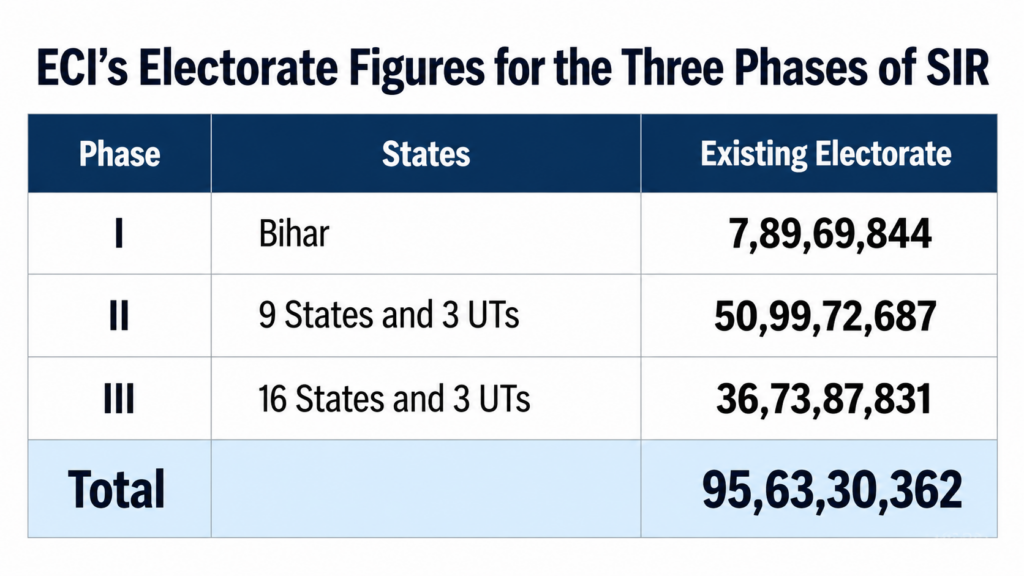
93, 86, 88, 553 Lok Sabha Electors (2024)
The total deletions during the three phases of SIR amount to approximately 11.80 crore. These comprise 47 lakhs in Phase I, 5.18 crore in Phase II and 6.15 crore deletions in the Phase III draft electoral rolls.
However, according to a report by Deeksha Bhardwaj published by India News on September 25, 2026, Election Commission officials stated that 2.73 crore new voters in the 18–28 age group had been added to electoral rolls since the SIR exercise began in 2025. This is the reported figure for additions up to Phase II.
Over 2 Crore Gen Z Voters Added To Electoral Rolls Since SIR In 2025: Poll Body
By @deekbhardwaj
https://t.co/8rQLMNLrVU https://t.co/XBFBHgioAc
— NDTV (@ndtv) September 25, 2026
The combined existing electorate used for Phases I and II was 7,89,69,844 + 50,99,72,687 = 58,89,42,531. Against this baseline, the reported addition of 2.73 crore new electors forms the basis for estimating the number of new electors registered during Phase III.
Estimated new electors in Phase III
Applying the same proportion of new registrations to the Phase III electorate, the calculation is 273 × 3674 ÷ 5889 = approximately 1.70 crore. This is a projection based on the figures for the first two phases, not an officially reported figure for Phase III.
The analysis argues that these newly registered electors are not reflected in the baseline electorate used for SIR. It therefore combines the 2.73 crore reported additions in Phases I and II with the estimated 1.70 crore additions in Phase III, arriving at 4.43 crore new electors. When these additions are considered alongside the approximately 11.80 crore deletions, the combined figure is 16.23 crore (11.80 crores + 2.73 crores+ 1.70 crores).
In eight States and Union Territories (UTs), namely Andaman & Nicobar Islands, Arunachal Pradesh, Chandigarh, NCT of Delhi, Odisha, Puducherry, Punjab and Uttarakhand, the electorate taken for SIR is 13.72 lakh lower than that recorded for the 2024 Lok Sabha elections. Adding this difference to the earlier figure gives 16.23 + 0.1372 = 16.3972 crore, i.e., approximately 16.40 crore.
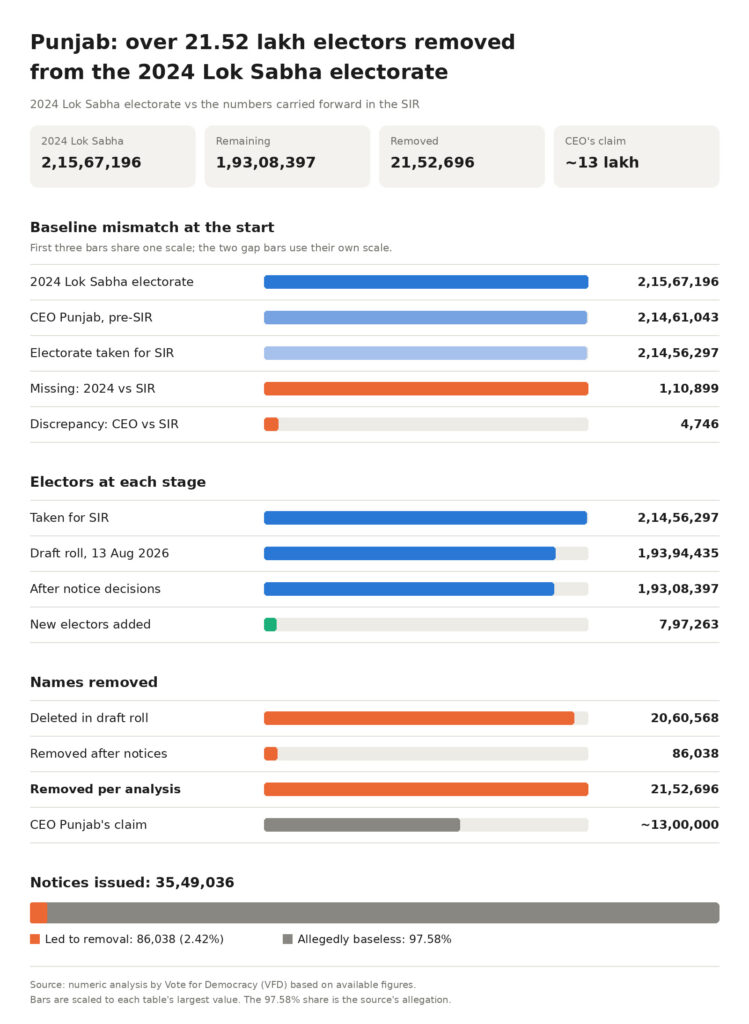
Punjab: over 21.52 lakh electors removed from the 2024 Lok Sabha electorate
Punjab’s figures further illustrate the difference between the electorate recorded for the 2024 Lok Sabha elections and the numbers carried forward during the SIR. There were 2,15,67,196 electors in Punjab during the 2024 Lok Sabha elections. In the SIR, the electorate was taken as 2,14,56,297, meaning that 1,10,899 electors were missing at the very beginning. However, the Chief Electoral Officer (CEO), Punjab, had published 2,14,61,043 electors before the SIR, showing a discrepancy of 4,746 electors.
The draft rolls published on August 13, 2026, listed 1,93,94,435 electors, with 20,60,568 names deleted. Thereafter, another 86,038 names were removed from the draft rolls following decisions on 35,49,036 notices issued. This raises questions about the basis of the notices and the harassment caused by arbitrary action, particularly when 97.58% of the notices were allegedly baseless.
As a result, only 1,93,08,397 electors remained from the 2024 Lok Sabha electorate. A further 7,97,263 new electors were added. While the CEO claimed that only 13 lakh electors had been removed, the figures indicate that 21,52,696 electors from the existing electorate had been removed.
In all, the analysis puts the combined figure at approximately 16.40 crore, including deletions during SIR, reported additions of new electors up to Phase II, estimated additions in Phase III and the difference in the electorate recorded for eight States and UTs. The estimate combines figures from different stages of SIR, and the Phase III additions are projected rather than officially reported.
(This is a numeric analysis by experts with Vote for Democracy (VFD) based on available and projected figures)
Who controls access to voter records? ECINet audit raises fresh questions
Vote for Democracy seeks answers from ECI and TCS on ECI’s electoral database access and security