
This paper examines the rise, theological architecture, and ideological erosion of the movement led by Abu Bakr al-Baghdadi. Drawing upon primary sources, classical Islamic jurisprudence, and the tradition of Islamic humanism, this paper argues that Baghdadi’s project represented not an authentic revival of the Islamic caliphate but a sophisticated theological rupture — a weaponised pseudo-scholasticism that cannibalised and distorted the Islamic tradition for the purposes of political domination, mass violence, and millenarian nihilism.
The paper proceeds in four major movements. First, it situates Baghdadi biographically, tracing his formation from an obscure religious student in Baghdad through his radicalisation at Camp Bucca and his eventual ascension to the leadership of the Islamic State of Iraq and the Levant. Second, it dissects the theological architecture of his ideology, identifying six primary pillars: the absolutism of divine sovereignty (hakimiyyah), the weaponisation of excommunication (takfir), the hegemonic caliphate claim, apocalyptic eschatology, ultra-literalist hermeneutics, and sectarian hatred. Third, it traces the intellectual genealogy of these doctrines from Sayyid Qutb and the Muslim Brotherhood through Abu Muhammad al-Maqdisi and Abu Musab al-Zarqawi to Baghdadi’s own synthesis. Fourth, it proposes a comprehensive Islamic humanist response grounded in the higher objectives of Islamic law (maqasid al-sharia), the primacy of reason (aql), contextual Quranic hermeneutics, and the recovery of pluralist and humanitarian traditions within the faith.
The Crisis of Authority
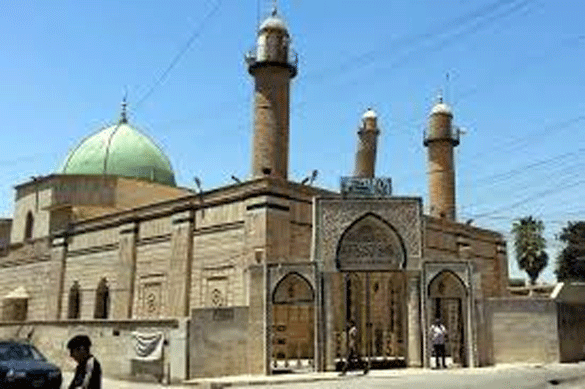
When Ibrahim Awad Ibrahim al-Badri mounted the pulpit of the Great Mosque of al-Nuri in Mosul on the last Friday of June 2014 and announced that he was henceforth to be known as Caliph Ibrahim — Commander of the Faithful — the act registered across the Muslim world as something more disturbing than mere political theatre. It was, in the first instance, a breath-taking claim of religious authority, one that had not been formally asserted since the abolition of the Ottoman caliphate in 1924. Yet it was also, and more fundamentally, a theological provocation of the gravest kind: the assertion that God’s sovereignty on earth could be concentrated in the person of one man, backed by a private army, and enforced through mass violence, slavery, and public execution.
Baghdadi was not, as some early commentary suggested, a simple warlord who had stumbled into religious rhetoric. He was, at heart, a theologian — one who had earned a doctorate in Islamic studies from the Islamic University of Baghdad and who understood, with considerable precision, the power of religious language to mobilise, to legitimise, and to sanction violence. His message was internally consistent: divine law demanded obedience, the existing Muslim world had apostatised by submitting to human-made governance, and the sword was the only instrument adequate to the scale of that apostasy. In this reading, cruelty was not a deviation from his theology — it was the very expression of it.
To defeat the ideology that Baghdadi represented — and that continues to inspire violence across the world even after his death in a United States Special Forces raid in October 2019 — it is necessary to understand it from the inside. This demands something more rigorous than a catalogue of atrocities or a chronology of military defeats. It demands a sustained theological engagement: an examination of the doctrinal claims upon which the Islamic State’s authority rested, a tracing of their intellectual genealogy, and a systematic refutation grounded in the very tradition that Baghdadi claimed to represent.
That refutation is the business of this paper. It proceeds from a foundational conviction of Islamic humanism: that the Quranic tradition, rightly understood through its historical contexts, its ethical objectives, and its overarching commitment to mercy and justice, is not merely consistent with the dignity and freedom of every human being but actively demands it. The Quran’s insistence that God sent the Prophet Muhammad as a mercy to all the worlds — and not as a commissioning agent for a caliphate of terror — is the ultimate theological rebuttal to everything Baghdadi built.
Historical Background: The Making of a Caliph
Ibrahim Awad Ibrahim al-Badri (Baghdadi’s real name) was born in 1971 in the town of Samarra, north of Baghdad, into a family that claimed descent from the tribe of Quraysh — the tribe of the Prophet Muhammad. That genealogical claim, contested by many scholars who found no independent verification of it, would later become central to his bid for caliphal legitimacy. His early religious formation took place within the Sunni Muslim communities of central Iraq, and he proceeded to the Islamic University of Baghdad, where he eventually completed a doctorate in Quranic studies with a concentration in jurisprudence and Islamic history. This academic background was unusual among jihadist leaders and afforded him a scholarly credibility that figures such as Abu Musab al-Zarqawi had conspicuously lacked.
His radicalisation appears to have accelerated dramatically in the years following the United States-led invasion of Iraq in 2003. The dismantling of the Iraqi state, the de-Baathification of the army and civil service, and the emergence of virulent sectarianism between Sunni and Shia communities created conditions of extreme political and social dislocation that extremist ideologies were uniquely well positioned to exploit. Al-Badri was detained by American forces in early 2004 and held at Camp Bucca, a detention facility in southern Iraq that has been described by former inmates and intelligence analysts alike as an unwitting incubator for the very extremism the United States sought to suppress. Thousands of jihadist militants, former Baathist officers, and would-be ideologues were held together in conditions that facilitated networking, indoctrination, and the forging of alliances that would later prove decisive in the formation of the Islamic State.
Released in mid-2004, al-Badri — now increasingly operating under the alias Abu Bakr al-Baghdadi — rose through the ranks of the organisation that would eventually become the Islamic State of Iraq. He served as a sharia adjudicator and propagandist, ensuring that the group’s activities were clothed in religious legitimacy. Following the deaths of senior leaders in a United States raid in 2010, Baghdadi was elevated to the leadership of the Islamic State of Iraq. He proved a more capable administrator, strategist, and propagandist than his predecessors. He exploited the civil war in Syria — which erupted in 2011 — to expand his organisation’s reach, dispatching fighters across the border and eventually attempting to absorb the rival jihadist group Jabhat al-Nusra under his authority. This manoeuvre brought him into direct conflict with the central leadership of al-Qaeda, which disowned the Islamic State in February 2014.
The capture of Mosul — Iraq’s second city — in June 2014 provided the dramatic platform for Baghdadi’s caliphal declaration. The subsequent months represented the high-water mark of his movement: at its territorial zenith the Islamic State controlled an area roughly the size of the United Kingdom, spanning parts of Iraq and Syria, governed by Diwans (ministries), sharia courts, a tax system, and an oil revenue stream. It attracted foreign fighters from dozens of countries and produced multilingual propaganda of considerable sophistication. The physical caliphate was progressively dismantled by military campaigns between 2014 and 2019; Baghdadi himself died on 26 October 2019 during a Special Operations Forces raid in Idlib Province, Syria. His death, however, did not extinguish the ideological project he had embodied.
The Theological Pillars of Baghdadi’s Project
Baghdadi’s ideology was not improvised from raw ambition. It was constructed with theological deliberateness upon six interlocking doctrinal pillars. Understanding each pillar in detail is essential not merely for analytical purposes but for the practical work of refutation: an ideology can only be effectively dismantled where it stands, and it stands on specific claims.
The concept of hakimiyyah — the absolute sovereignty of God — was the ideological keystone of Baghdadi’s entire project. He did not originate the concept; he inherited it, primarily from the Egyptian Muslim Brotherhood theorist Sayyid Qutb, whose prison writings of the late 1950s and early 1960s had transformed it from a theological observation into a revolutionary programme. In Qutb’s formulation, the recognition that God alone possesses the right to legislate entails a corresponding rejection of all human-made legal systems as acts of idolatry — specifically the unforgivable sin of associating partners with God (shirk).
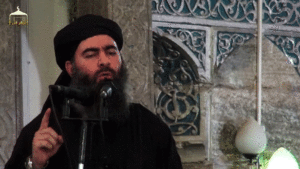
Baghdadi absorbed this framework entirely. In his speeches and in the extensive propaganda apparatus of the Islamic State — including the English-language magazine Dabiq and its Arabic counterpart Rumiyah — the contrast between divine law and the corrupt governance of existing Muslim states was presented as absolute, binary, and requiring violent resolution. Any Muslim who voted in an election, accepted employment in a secular state bureaucracy, served in a national army, or carried a state-issued passport was, in this reading, guilty of participating in a system of collective apostasy. This radical extension of hakimiyyah provided the theological foundation for what proved to be the Islamic State’s most audacious and destructive innovation: the systematic murder of fellow Sunni Muslims — imams, teachers, civil servants, police officers — on the grounds that they were apostates from the true faith.
The Islamic humanist response to hakimiyyah does not deny the sovereignty of God but challenges the inference that Baghdadi drew from it. The Quran’s own political ethics are far more complex, contextual, and attentive to human welfare than the hakimiyyah doctrine allows. Governance in the Quranic tradition is grounded in consultation (shura), justice (adl), and the protection of those under authority — values that are inconsistent with the dictatorship Baghdadi exercised.
From the absolute sovereignty of God flowed Baghdadi’s second and most lethal pillar: the industrialisation of takfir, the practice of declaring a Muslim to be an apostate and therefore — in the most extreme reading of Islamic law — a legitimate target for violence. Excommunication has a long and contested history within Islamic theology. Classical jurisprudence treated it as a grave legal matter, surrounded by procedural safeguards, requiring extraordinary certainty of proof, and generally avoided precisely because of the civil strife (fitna) it inevitably generated. The Prophet himself is reported to have warned his followers in the gravest terms against recklessly accusing their brothers and sisters in faith of unbelief.
Baghdadi’s organisation swept aside these safeguards with systematic ruthlessness. It did not merely declare Yazidis or Shia Muslims to be unbelievers — a horrifying enough stance that provided the theological licence for the Yazidi genocide and the massacre of Shia civilians — it extended takfir to any Sunni Muslim who refused to pledge allegiance to the caliphate, who participated in the political processes of existing states, or who belonged to rival jihadist organisations. The Open Letter to al-Baghdadi, signed by more than 120 leading Muslim scholars from around the world in September 2014, addressed this doctrine directly and at length, citing the Prophetic injunction that any person who declares the shahada — the testimony of faith — cannot be killed except for specific, legally determined violations. The letter emphasised that mainstream Sunni jurisprudence imposed such demanding conditions on excommunication that it could not legitimately be used to justify mass violence of the kind the Islamic State was perpetrating.
Takfirism, in the Islamic humanist analysis, is not merely a legal error; it is a theological inversion. It transforms the humility before God that authentic faith demands into a presumptuous claim to divine judgment, placing finite human beings in the seat of infinite divine authority. The Quran reserves final judgment on matters of faith and apostasy to God alone, and the tradition of Islamic scholarship has, with near unanimity, insisted that this reservation be respected.
The third pillar of Baghdadi’s theology was his claim to the caliphate itself. In classical Sunni political thought, the caliphate was the office of the Prophet’s successor as guardian of the Muslim community — an office with stringent requirements of scholarly learning, moral character, lineage, and, critically, communal consensus (ijma). Baghdadi claimed all of these, and upon his 2014 declaration in Mosul, demanded that every Muslim in the world pledge allegiance to him, on pain of spiritual — and ultimately physical — consequences.
The claim rested on two foundations, each deeply contested. First, Baghdadi asserted genealogical descent from the Quraysh, the Prophet’s tribe — a traditional caliphal requirement. His family did indeed make such a claim, but no independent scholarly verification was offered, and many scholars dismissed it as opportunistic fabrication designed to satisfy a formal requirement without substantive merit. Second, he pointed to the territorial control exercised by the Islamic State as practical evidence that a functional Islamic state — with courts, taxation, and defence — had been established, meeting the material conditions for a valid caliphate.
Both claims were systematically demolished by Muslim scholars. The Open Letter pointed out that a caliphate requires the consensus of the global Muslim community expressed through its recognised scholarly leadership — a consensus that was conspicuously absent from Baghdadi’s unilateral self-appointment. Historical precedent was equally unhelpful to Baghdadi: The Rashidun caliphs were selected through deliberation among the Prophet’s closest companions, not through military conquest and self-proclamation. The very concept of a caliphate that demanded global submission under threat of death contradicted the historical reality of the classical caliphate, which had always been characterised by a degree of political pluralism and which had never claimed theological authority over individual conscience.
The fourth pillar of Baghdadi’s theology was its apocalyptic character, and it is in some respects the most psychologically powerful and analytically interesting of the six. Unlike al-Qaeda, which concentrated its justifications for violence on political grievances against Western imperialism and apostate regimes, the Islamic State was animated by a conviction that it was not merely fighting a political war but fulfilling divine prophecy regarding the end of time. Specific hadith traditions regarding a final battle between the forces of true Islam and the forces of unbelief — located in the Syrian town of Dabiq — were not merely cited but made constitutive of the movement’s identity. The choice of Dabiq as the title of the English-language propaganda magazine was calculated and deliberate.
This eschatological framing was extraordinarily powerful as a recruitment tool precisely because it removed the ideology from the realm of rational deliberation. If one’s violence is understood not as a political act subject to human evaluation but as a divinely scripted role in the final drama of history, then conventional arguments — about proportionality, civilian casualties, or legal constraints — become irrelevant by definition. Setbacks and defeats could be reframed as preludes to prophesied martyrdom and ultimate divine vindication. The more the world opposed the Islamic State, the more its followers could perceive themselves as inhabiting the role of the persecuted righteous awaiting cosmic vindication.
The Islamic humanist response to apocalyptic theology is not to deny the eschatological dimension of Islamic faith but to insist, with the weight of classical scholarship, that the relationship between sacred history and human action is characterised by responsibility, restraint, and mercy — not by the nihilistic acceleration of violence in the hope of triggering divine intervention. The classical Islamic tradition approached apocalyptic hadith with considerable interpretive caution, recognising their metaphorical and contextual dimensions.
The fifth pillar of Baghdadi’s project was its hermeneutical method: a rigid literalism that insisted on reading Quranic verses and hadith in isolation from their historical contexts, their ethical objectives, the diversity of jurisprudential opinion within the tradition, and the fundamental principle that the Quran must be understood holistically rather than through selective extraction. This method — characterised by critics as the cut-and-paste approach to scripture — allowed Baghdadi’s organisation to cite individual verses in support of practices that the weight of Islamic scholarship had consistently regarded as forbidden or impermissible.
The most egregious example was the treatment of the so-called Verse of the Sword (9:5), which commands fighting against polytheists who have broken their treaties. Baghdadi’s ideologues cited this verse as a universal, permanent mandate for offensive warfare against all non-Muslims and all Muslims who refused submission. They insisted that it abrogated the hundreds of verses commanding peace, mercy, forgiveness, and equitable treatment of non-Muslims. Classical Islamic scholarship, by contrast, had consistently read this verse in its specific historical context — the breaking of treaties by the Meccan polytheists — and had explicitly rejected the claim that it constituted a universal licence for aggression. The Quranic injunction in verse 2:190 — to fight those who fight you but not to transgress — had never been abrogated in mainstream scholarship; it expressed a foundational ethical constraint on the conduct of armed conflict.
Beyond this specific misreading, Baghdadi’s theology required the erasure of fourteen centuries of Islamic intellectual history. The sophisticated legal reasoning of the four Sunni schools of jurisprudence, the philosophical contributions of figures such as al-Farabi, Ibn Sina, and Ibn Rushd, the spiritual depth of Sufi thought, the hermeneutical richness of classical tafsir — all of this was dismissed as innovation (bidah) and deviation from the pristine original. What remained was a radically impoverished version of the faith: hollowed of its cultural and intellectual complexity, stripped of its ethical nuance, and weaponised for the purposes of domination and violence.
The sixth and final pillar of Baghdadi’s theology was its profound sectarianism. The Shia Muslim community was portrayed not as a divergent school within the broad family of Islam but as a category of existential enemy deserving extermination. Sufi shrines were demolished. Yazidi communities were subjected to genocidal violence. Christian communities, which had maintained a continuous presence in Iraq and Syria for nearly two thousand years, were expelled or murdered. This sectarianism drew heavily from the most extreme strands of Wahhabi polemics against alternative Islamic traditions, intensified by Zarqawi’s particular fury against Shia Muslims and translated into a systematic programme of ethnic and religious cleansing.
The Quranic basis for this sectarianism was, to put it charitably, threadbare. The Quran repeatedly affirms the diversity of human communities as a divine creation to be respected (49:13) and commands justice even toward those with whom one is in conflict (5:8). The Prophet Muhammad’s own practice — including the Covenant of Medina, which guaranteed the rights of Jewish, Christian, and pagan communities alongside Muslims — provided a direct historical rebuttal to the Islamic State’s model of religious uniformity enforced by violence.
Intellectual Genealogy: From Qutb to the Caliphate
Baghdadi did not construct his theology in isolation. He was the heir to a specific intellectual tradition that had been developing within Sunni Islamism for most of the twentieth century, and his own particular synthesis represented the culmination of a trajectory that can be traced with reasonable precision.
The foundational figure in that trajectory is Sayyid Qutb, the Egyptian literary critic and Muslim Brotherhood theorist who was executed by the Nasser government in 1966. Qutb’s most influential work, Milestones, written during his imprisonment in the late 1950s, advanced a revolutionary reading of the concept of hakimiyyah that broke decisively with the gradualist, social-reform orientation of the Brotherhood’s founder, Hassan al-Banna. Qutb argued that modern Muslim societies — including ostensibly Muslim states such as Egypt — had fallen into a state of pre-Islamic ignorance so profound that only a vanguard of true believers, physically and spiritually separated from the corrupt society, could wage the violent jihad necessary to overthrow the existing order and establish God’s sovereignty. It is difficult to overstate the influence of this text on subsequent generations of jihadist ideologues; Osama bin Laden, Ayman al-Zawahiri, and Baghdadi himself all drew directly from Qutb’s conceptual vocabulary.
The immediate intellectual channel through which Qutb’s ideas reached Baghdadi’s generation was the Jordanian-Palestinian scholar Abu Muhammad al-Maqdisi, whose extensive writings from prison elaborated a rigorous Salafi creed that combined Wahhabi purism with the revolutionary political conclusions of Qutbism. Al-Maqdisi’s most important contribution was his systematic application of the charge of apostasy to Muslim rulers who governed by human-made law — an application that radicalised the takfir doctrine beyond even Qutb’s formulation. Al-Maqdisi became the mentor of Abu Musab al-Zarqawi, the Jordanian militant who founded the organisation in Iraq that would eventually evolve into the Islamic State. Zarqawi added to this inheritance a particular ferocity toward Shia Muslims, whom he regarded not merely as theologically deviant but as agents of a cosmic conspiracy against Sunni Islam.
Baghdadi, rising through the ranks of Zarqawi’s successor organisation following his mentor’s death in a United States airstrike in 2006, inherited this entire theological toolkit. He was, however, more systematically educated than his predecessors, and he gave a more scholarly, jurisprudential veneer to the same core doctrines. Where Zarqawi had been a violent street-level operative who acquired his theology opportunistically, Baghdadi was a trained religious scholar who could deploy the classical categories of Islamic jurisprudence with the facility of someone who had spent years immersed in the tradition. This credential was essential to the Islamic State’s claim to be not merely a jihadist organisation but the legitimate restoration of the caliphate.
The wider Wahhabi tradition also contributed, more ambiguously, to this intellectual inheritance. The teachings of Muhammad ibn Abd al-Wahhab (1703-1792) — emphasising strict monotheism, the prohibition of innovation in religious practice, and the legitimacy of violence against those declared polytheists — provided an ideological arsenal that Baghdadi’s organisation drew upon selectively. Saudi-funded institutions, mosques, and madrasas had disseminated this tradition across the Muslim world since the 1970s oil boom, creating a doctrinal environment in which Baghdadi’s particular syntheses could find receptive audiences. The Saudi religious establishment itself condemned the Islamic State as a deviant movement, and mainstream Salafi scholars characterised it as a modern manifestation of the ancient Kharijite heresy — a sect that had been condemned by the Prophet’s own companions for its extremism. But this condemnation sat awkwardly alongside the structural role that Wahhabi educational institutions had played in creating the conditions for Baghdadi’s rise.
The intellectual genealogy is therefore clear in its broad outlines: The Muslim Brotherhood’s political vision, radicalised by Qutb’s revolutionary hakimiyyah; al-Maqdisi’s systematic Salafi jurisprudence of apostasy; Zarqawi’s sectarian fury; and the wider context of Wahhabi purism — all synthesised by a trained scholar who understood how to dress revolutionary violence in the authoritative language of classical Islamic jurisprudence. Each stage in this genealogy represented an intensification of the rejection of mainstream Islamic authority and a corresponding embrace of violence as the primary instrument of theological purification.
Socio-Political Conditions Enabling the Rise of the Islamic State
Theology does not operate in a social vacuum. The extraordinary resonance of Baghdadi’s message — which attracted foreign fighters from dozens of countries and inspired attacks across four continents — cannot be explained by doctrinal analysis alone. The Islamic State’s rise was simultaneously a product of specific socio-political conditions and an exploitation of them.
The American-led invasion of Iraq in 2003, and the chaotic, ill-planned occupation that followed, created the foundational conditions for the Islamic State’s emergence. The dissolution of the Iraqi army and the de-Baathification of the civil service threw hundreds of thousands of trained, armed, and profoundly alienated Sunni men into a social order from which they were now excluded. The subsequent political arrangements, which concentrated power in Shia-dominated governments that were widely perceived as Iranian proxies, intensified Sunni grievances to the point of desperation. Baghdadi understood these grievances with the clarity of personal experience and made their exploitation the centrepiece of his recruitment strategy.
The Syrian civil war, which erupted in 2011 following the Assad government’s violent repression of peaceful protests, provided the Islamic State with both a territorial base and a continuous flow of recruits radicalised by the experience of watching civilian populations subjected to barrel bombs, chemical weapons, and starvation sieges by a regime that called itself the guardian of Arab nationalism. The combination of political marginalisation, economic collapse, and a sense of civilisational humiliation provided what Baghdadi’s propagandists accurately identified as fertile soil for their message of restoration, dignity, and divine vengeance.
Beyond the immediate regional context, the global appeal of the Islamic State’s message pointed to structural conditions that extended far beyond Iraq and Syria. Economic marginalisation, social exclusion, the experience of Islamophobia, and the crisis of identity among Muslim minorities in Western societies all contributed to the vulnerability of young people in Birmingham, Brussels, and Beirut alike to recruitment narratives that promised belonging, purpose, and significance. The Islamic humanist response to this reality must therefore be not merely theological but socio-economic: extremism flourishes in conditions of hopelessness, and those conditions cannot be addressed by fatwas alone.
The Islamic Humanist Critique
Islamic humanism is not an import from the Western Enlightenment awkwardly grafted onto an alien religious tradition. It is a recovery of modes of thought, ethical commitments, and interpretive practices that have deep roots within the Islamic tradition itself — in the classical rationalist theology of the Mutazilites and the Maturidis, in the philosophical humanism of the Andalusian Golden Age, in the legal theory of scholars such as al-Ghazali and al-Shatibi, and in the prophetic practice of a Muhammad who described himself as sent to perfect noble character. Against Baghdadi’s theology of power and death, Islamic humanism offers a theology of mercy and life.
The most powerful analytical instrument that Islamic humanism offers against Baghdadi’s literalism is the framework of maqasid al-sharia — the higher objectives of Islamic law — developed most systematically by the Andalusian scholar Abu Ishaq al-Shatibi in the fourteenth century but rooted in centuries of earlier jurisprudential reflection. This framework argues that the Sharia is not an end in itself but a means to specific human goods: the protection of life, the protection of intellect, the protection of faith, the protection of lineage and social order, and the protection of property. Any legal ruling, any interpretation of scripture, any exercise of political authority that demonstrably undermines these goods is, on this account, a false interpretation — regardless of the literal support it can muster from individual texts.
When the maqasid framework is applied to the practices of the Islamic State, the verdict is unambiguous and devastating. Mass executions destroy life. The suppression of education and critical thought destroys intellect. The imposition of a singular, totalitarian theology by violence destroys freedom of conscience in matters of faith. The systematic looting of minority communities and the destruction of the cultural heritage of human civilisation — including the deliberate dynamiting of ancient Assyrian ruins at Nimrud and the burning of the Mosul Library — destroys the accumulated property and intellectual heritage of humanity. The Islamic State was not, on any serious reading of the maqasid tradition, implementing Islamic law; it was systematically violating every value that Islamic law exists to protect.
The Quranic tradition places extraordinary emphasis on the exercise of reason. The Arabic root aql — denoting the faculty of rational comprehension — appears in various forms dozens of times in the Quran, almost always in the context of a divine invitation to observe, reflect, reason, and understand. The Quran repeatedly chastises those who follow custom and inherited authority without thinking for themselves and praises those who use their rational faculties to perceive the signs of God in creation and in human history. This Quranic rationalism was developed into sophisticated philosophical and theological traditions by scholars from al-Kindi and al-Farabi in the early medieval period through to Ibn Rushd (Averroes) and his commentaries on Aristotle, which profoundly shaped European scholasticism.
Baghdadi’s ideology was built on the systematic suppression of this rationalist tradition. It demanded blind obedience (taqlid) to a single, politically driven interpretation, condemned philosophical inquiry as heresy, and treated the exercise of independent legal reasoning (ijtihad) with the same suspicion it reserved for all human intellectual autonomy. The Islamic humanist response revives the Maturidi theological tradition’s insistence that good and evil are not merely arbitrary divine commands but realities that can be discerned through human reason — that cruelty and injustice are wrong not merely because God forbids them but because they contradict the nature of a rational moral universe that God has created. If an action is inherently cruel, it cannot be the will of a just God; and if an interpretation of scripture mandates cruelty, the fault lies with the interpretation, not with the God it purports to serve.
Against Baghdadi’s monolithic theocracy, Islamic humanism opposes a tradition of principled pluralism that is as old as the Prophet himself. The Covenant of Medina — the constitutional document established by Muhammad shortly after his migration from Mecca — created a multi-religious community of Muslims, Jews, and pagan Arabs with shared rights, shared obligations, and a shared commitment to mutual defence. This document is not a marginal curiosity of early Islamic history; it is a foundational precedent for the proposition that a polity guided by Islamic values can accommodate and protect the religious diversity of its members rather than demanding their conformity.
The historical record of the classical Islamic caliphate, for all its complexities and failures, is broadly consistent with this pluralist precedent. Non-Muslim communities — Christians, Jews, Zoroastrians, and others — lived under Islamic governance with a degree of legal autonomy and religious freedom that was, by the standards of the medieval world, considerable. The dhimmi system, which imposed certain civic disabilities on non-Muslims, is not defensible by contemporary standards of human rights; but it is radically different from the genocidal elimination of religious diversity that the Islamic State practised. Baghdadi’s model was not a restoration of the historical caliphate; it was a totalitarian innovation that had no serious precedent in Islamic political history.
At the ethical core of the Quranic message lies an affirmation of the sanctity of every human life that is among the most powerful moral statements in the world’s religious literature. The Quran declares that to kill one innocent soul is as if one killed all of humanity, and to save one soul is as if one saved all of humanity (5:32). This principle — cited in the Open Letter to al-Baghdadi as one of the central refutations of the Islamic State’s theology — reflects a Quranic anthropology that treats every human life as of infinite worth. It is complemented by the equally powerful declaration that God has honoured the children of Adam (17:70) — a statement of universal human dignity that applies to every human being regardless of faith, ethnicity, or political allegiance.
The theology of human dignity (karamah) that flows from these verses provides the most fundamental Islamic humanist rebuttal to Baghdadi. A theological system that produces mass graves, public beheadings, the enslaved auction of Yazidi women, and the deliberate targeting of mosques full of worshippers has not merely made errors of legal interpretation; it has committed the deepest possible betrayal of the faith it claims to represent. The Quran’s God is not the tyrant that Baghdadi worshipped; the Quran’s Islam is not the cult of death that Baghdadi built.
One of Baghdadi’s most consequential misappropriations was of the concept of jihad itself — a term whose Arabic root denotes effort, struggle, and striving that has been consistently understood by mainstream Islamic scholarship to encompass a wide spectrum of spiritual, moral, intellectual, and social endeavours, with armed conflict representing a specialised subset governed by strict ethical conditions. The inner jihad against one’s own moral failures, the intellectual jihad of scholarship and inquiry, the social jihad of working for justice and the welfare of the community — these were the primary forms of jihad in the understanding of scholars such as al-Ghazali, whose Ihya Ulum al-Din constitutes perhaps the most sustained exploration of the spiritual life in the Islamic tradition.
Even armed jihad, in the classical tradition, was understood as a defensive instrument, subject to conditions of proportionality, protection of non-combatants, and declaration by legitimate political authority — conditions that the Islamic State’s campaigns of aggressive, indiscriminate violence violated in every particular. Reclaiming jihad for Islamic humanism means restoring its primary meaning as a commitment to justice, moral discipline, and social reform, and insisting that armed struggle, where it is permissible at all, must be conducted within the ethical limits that the tradition has always imposed.
Quranic Hermeneutical Counter-Arguments
The most direct response to Baghdadi’s abuse of scripture is a rigorous, contextual hermeneutics — a systematic approach to the interpretation of the Quran and hadith that reads texts in their historical, linguistic, and ethical contexts and refuses the de-contextualising literalism upon which the Islamic State’s ideology depended.
Classical Islamic hermeneutics has always insisted on the importance of the occasions or causes of revelation in understanding Quranic verses. This principle holds that the meaning and application of a given verse cannot be understood apart from the specific historical circumstances in response to which it was revealed. The Prophet’s companions and their successors preserved extensive traditions about these circumstances precisely because they understood that without them, verses could be misapplied in ways that were both historically erroneous and ethically disastrous.
Baghdadi’s organisation systematically ignored these contextual traditions. Verses revealed in the context of specific military conflicts during the early Islamic period were universalised into permanent, global mandates. Verses addressing the particular situation of the Prophet’s community in Medina, surrounded by hostile powers and subject to constant attack, were stripped of their situational character and treated as timeless directives applicable to twenty-first-century conditions that bore no resemblance whatsoever to seventh-century Arabia. The humanist hermeneutical response insists that this de-contextualisation is not merely a scholarly error but a form of textual violence — a violation of the integrity of the revealed text and a betrayal of the tradition of scholarship that exists precisely to prevent such violations.
Baghdadi’s organisation treated certain verses as abrogating — that is, annulling — a wide range of other verses that enjoined peace, mercy, and equitable treatment of non-Muslims. This abrogation (naskh) argument, in its extreme form, claimed that a handful of so-called sword verses from the later Medinan period of the Quran had cancelled out the peaceable and pluralist verses from the Meccan period and the earlier Medinan period. This claim is not only historically unfounded — classical scholars disagreed significantly about the scope and application of abrogation, and many rejected broad claims of the kind that Baghdadi’s ideologues advanced — it is hermeneutically incoherent.
The Quran begins every chapter but one with the formula: In the name of God, the Most Merciful, the Most Compassionate. These are not decorative formulas; they are programmatic statements about the character of the God in whose name the text speaks and about the spirit in which it should be read. The Quran describes the Prophet Muhammad as a mercy to all the worlds (21:107) — not to Muslims alone, not to those who agreed with him, but to all created beings. The divine names that recur most frequently throughout the Quran are those of mercy, compassion, and generosity. Any interpretive method that reads these data as subordinate to a handful of contextually specific verses of warfare is not merely making a legal error; it is inverting the entire ethical orientation of the text.
The most significant institutional expression of Islamic humanist hermeneutics in response to Baghdadi’s ideology was the Open Letter to al-Baghdadi, released in September 2014 and eventually signed by more than 120 leading Muslim scholars from across the world. This document was remarkable in several respects. It was written not in the language of Western liberalism but in the classical Arabic of traditional Islamic scholarship, engaging Baghdadi on his own terminological and textual ground. It was not a political declaration but a fatwa-length juridical refutation, working through the Islamic State’s specific claims in detail and demonstrating, with copious references to the Quran, the hadith, and the classical jurisprudential tradition, that each of those claims violated established Islamic legal and ethical principles.
The letter addressed, in turn: the impermissibility of declaring fellow Muslims apostates without meeting the stringent conditions of classical jurisprudence; the requirement that a legitimate caliph be chosen by a council of recognised scholars rather than self-appointed; the absolute prohibition on the killing of non-combatants, clergy, women, and children in armed conflict; the illegitimacy of enslaving people or selling them in markets; the obligation to treat members of other faiths with justice and respect; and the dangerous misuse of the abrogation argument to dismiss vast portions of the Quranic ethical teaching. The letter concluded by warning Baghdadi that he had transformed Islam into a religion of harshness and brutality and that his actions constituted a grave offence against the faith, against Muslims, and against all of humanity.
The letter was not without its limitations. Some critics noted that it represented the perspective of established religious institutions whose authority the Islamic State had already rejected, and that it was unlikely to persuade committed adherents of the ideology. Others pointed out that the letter did not challenge the underlying assumptions of Salafi theology as thoroughly as a fully humanist critique would require. Nevertheless, as a demonstration that the Islamic State’s theology was not — as its propaganda claimed — the authentic expression of mainstream Islamic scholarship, but rather its radical repudiation, the letter remains an invaluable document.
Strategies for Ideological Defeat
The defeat of Baghdadi’s ideological legacy requires a multi-dimensional strategy that operates simultaneously on theological, educational, political, social, and psychological registers. No single approach is sufficient; each is necessary but none alone is adequate to the scale of the challenge.
The foundation of any effective counter-strategy must be a sustained programme of theological deconstruction — systematic, rigorous, publicly accessible refutation of the specific doctrinal claims upon which Baghdadi’s ideology rested. The Open Letter to al-Baghdadi provides an excellent template, but its impact has been limited by its accessibility only to those already engaged with classical Islamic scholarship. What is needed is a programme of translation, popularisation, and dissemination that brings the scholarly refutation of takfirism, false caliphal claims, and hermeneutical distortion to the widest possible audience within the Muslim world.
This requires investment — financial, institutional, and reputational — in the production of counter-theological materials that are both academically rigorous and accessible to non-specialist audiences. Islamic universities, particularly institutions such as al-Azhar in Cairo, Deoband in India, and Zaytuna College in the United States, have a crucial role to play. So do national religious establishments in Muslim-majority countries, provided they command sufficient credibility among the populations they seek to influence. The message must come from voices that are recognisably part of the tradition — not from governments seeking to weaponise religion for political purposes, and not from Western actors whose interference is likely to be counterproductive.
Baghdadi’s ideology thrived in the conditions created by educational systems that prioritised rote memorisation of religious texts over critical engagement with their meaning, historical context, and ethical implications. Any sustainable strategy for preventing the recurrence of movements like the Islamic State must therefore include a fundamental rethinking of religious education across the Muslim world — and, indeed, in Muslim community institutions in Europe and North America.
Educational reform in this context means moving from indoctrination to inquiry: teaching the diversity of opinion within Islamic jurisprudence rather than presenting a single school’s positions as absolute truth; introducing students to the history of Quranic revelation and the classical tradition of contextual interpretation; developing critical thinking skills that enable young people to evaluate competing claims rather than simply accepting the authority of the most confident voice. The Quran itself repeatedly invites its readers to think, observe, and reflect; an educational system that produces uncritical receivers of a pre-packaged orthodoxy is not Quranic in its spirit, whatever its content.
The curriculum must also reclaim the humanist heritage of Islamic civilisation — the extraordinary flowering of science, philosophy, medicine, mathematics, and art that characterised the Abbasid period and the Andalusian Golden Age. Baghdadi’s ideology required the erasure of this heritage because it demonstrated, powerfully and concretely, that Islamic civilisation had been at its most creative, most influential, and most admired by the world when it was engaged in open intellectual exchange rather than self-imposed isolation. Reclaiming that heritage as constitutively Islamic — not as a historical accident that needs to be apologised for or explained away — is an important part of the counter-narrative.
The Islamic State was, among other things, a phenomenon of social media. Its sophisticated multilingual propaganda machine — producing magazines, films, and social media content in English, French, German, Russian, and numerous other languages — enabled it to reach radicalised or radicalisation-vulnerable young people in Birmingham, Brussels, and beyond with a message that was emotionally compelling, aesthetically sophisticated, and attuned to the specific psychological vulnerabilities of its target audience. Defeating that propaganda requires counter-narratives that are equally sophisticated, equally emotionally intelligent, and equally attuned to those vulnerabilities.
Effective counter-narratives must be produced by credible, authentic Muslim voices — not by government information agencies or Western media institutions whose messages will be dismissed by precisely the audience they need to reach. Former members of extremist organisations who have genuinely renounced their involvement and can speak with authority about the gap between the utopia promised by recruitment narratives and the grim reality of life within the Islamic State are particularly valuable voices. So are Muslim scholars, activists, artists, and community leaders who can articulate a vision of Islamic identity that is simultaneously faithful to the tradition and fully engaged with the realities of contemporary life.
The content of effective counter-narratives must also address the specific appeals that extremist recruitment messages make: the promise of belonging and brotherhood, the sense of cosmic significance, the claim to be on the right side of history, the expression of righteous anger at real injustices. Counter-narratives that simply assert that the Islamic State is un-Islamic, without addressing the underlying emotional needs that its recruiting exploits, are unlikely to succeed. Young people need not just theological refutation but alternative sources of meaning, belonging, and purpose.
Ideology does not operate in a vacuum, and counter-ideology alone cannot defeat extremism that is rooted in genuine political grievances. The sectarian marginalisation of Sunni communities in post-2003 Iraq, the Assad government’s mass violence against civilian populations in Syria, the experience of discrimination and social exclusion among Muslim minorities in Western Europe — these were real phenomena, and Baghdadi’s organisation exploited them with considerable skill. Any serious counter-strategy must therefore include advocacy for the political reforms and social investments that address the grievances that extremist movements feed upon.
This means, in the Iraqi and Syrian contexts, advocacy for genuinely inclusive political arrangements that protect the interests of all communities rather than reserving power for one sect or party. It means insisting on accountability for the atrocities committed not only by the Islamic State but by all parties to those conflicts, including state actors. It means supporting civil society organisations, independent media, and cultural institutions in Muslim-majority countries that provide alternatives to both authoritarian governance and extremist ideology. And it means, in Western contexts, opposing the rhetoric and policies of Islamophobia that reinforce the isolation and alienation of Muslim communities and thereby strengthen the recruiting narratives of radical movements.
Sunni-Shia reconciliation is not merely a pious aspiration; it is a strategic necessity for the defeat of extremist movements that depend upon sectarian hatred for their recruitment and their theological justification. The systematic demonisation of Shia Muslims that characterised Baghdadi’s ideology — and that drew upon a tradition of Wahhabi polemics stretching back several centuries — cannot be defeated without a sustained programme of inter-sect dialogue, historical honesty about the origins and instrumentalisation of sectarian divisions, and mutual recognition of the shared ethical commitments that transcend sectarian boundaries.
This is not a project that can be completed quickly, and it cannot be imposed from outside. It requires the willingness of scholars, community leaders, and ordinary believers from both traditions to engage in the difficult, sometimes painful work of confronting historical grievances without allowing those grievances to determine the future. Platforms for intra-Islamic dialogue, jointly sponsored by Sunni and Shia institutions, can play an important role in this process — as can the development of shared theological statements that affirm the common ground of Islamic ethical commitment even in the absence of full doctrinal agreement.
Extremist movements are structurally dependent on patriarchal control: the suppression of women’s agency, the instrumentalisation of women’s bodies as markers of group honour, and the exclusion of women from theological and political authority. Baghdadi’s organisation exemplified this dependence in its most extreme form, reviving the institution of sexual slavery, imposing totalising restrictions on women’s freedom of movement and dress, and excluding women entirely from any role in governance or scholarship.
The Islamic feminist scholarship that has developed powerfully over the past three decades — represented by scholars such as Amina Wadud, Fatima Mernissi, Kecia Ali, and many others — provides both a theological refutation of these practices and an alternative vision of gender relations within an Islamic framework. This scholarship demonstrates, through rigorous engagement with the primary sources, that the Quranic vision of gender relations is characterised by equity, complementarity, and mutual respect rather than by the hierarchy of domination that patriarchal readings have historically imposed. Amplifying these voices, supporting institutions that train women as scholars and religious leaders, and insisting on women’s full participation in the theological work of counter-extremism are all essential elements of a comprehensive humanist response.
The ultimate socio-political answer to Baghdadi’s theology of divine sovereignty enforced by violence is the construction of societies in which political participation is inclusive, governance is accountable, the rule of law protects the rights of all citizens, and peaceful avenues for political reform are genuinely available. This is not to claim that liberal democracy as currently practised in Western societies is the only or the ideal form of Islamic political organisation. It is to insist that the conditions under which extremist ideologies flourish — the closure of peaceful avenues for reform, the concentration of power in unaccountable hands, the systematic exclusion of minority communities — are themselves forms of political injustice that must be addressed if the ideological appeal of violent alternatives is to be diminished.
The promotion of the rule of law, accountable governance, and human rights in Muslim-majority societies is therefore not an imperialist imposition but a demand of Islamic humanism itself — grounded in the Quranic principles of justice (adl), consultation (shura), and the protection of human dignity (karamah) that mainstream Islamic political thought has consistently affirmed. Organisations such as the Cordoba Foundation and scholars such as Abdullahi An-Naim have argued persuasively that these principles are not merely compatible with contemporary human rights standards but that they provided their historical antecedents.
Beyond the Caliphate of Apocalypse
Abu Bakr al-Baghdadi built his authority on a theological architecture of extraordinary ambition and equally extraordinary moral depravity. Drawing upon the Qutbist doctrine of divine sovereignty, the classical language of Islamic jurisprudence, the apocalyptic traditions of Islamic eschatology, and the sectarian passions of a post-invasion Iraq torn apart by violence and humiliation, he constructed a movement that for a few terrifying years held territory, governed populations, and inspired violence across the globe.
That architecture was, however, built on doctrinal sand. Its literalism was selective; its historical claims were false; its genealogical pretensions were unverified; its jurisprudential reasoning was condemned by the overwhelming weight of mainstream Islamic scholarship; and its treatment of human beings as disposable instruments of a theological project was a direct violation of the Quranic affirmation of human dignity that constitutes the deepest ethical commitment of the faith. The Open Letter to al-Baghdadi demonstrated that the most powerful rebuttal to this theology was not a Western political argument but a Quranic verse wielded by scholars who knew the tradition from the inside and could demonstrate, with precision and authority, that Baghdadi had not revived Islam — he had betrayed it.
The physical caliphate was destroyed through military force, and Baghdadi himself died in humiliation rather than in the glorious martyrdom his eschatology had promised him. But the ideology he articulated remains alive — online, in the minds of isolated and alienated young people, in the prison networks of detained fighters, in the successor organisations that have already reconstituted themselves in Syria, Iraq, Afghanistan, and sub-Saharan Africa. Defeating that ideology requires more than drones and special operations forces. It requires what has been argued throughout this paper: a revival of Islamic humanism, a recovery of the tradition of mercy, reason, pluralism, and human dignity that constitutes the ethical core of the Quranic revelation.
The Quran’s own vision of the human person — as the vicegerent of God on earth (2:30), honoured above much of creation (17:70), endowed with reason, moral agency, and the capacity for both justice and injustice (76:3, 90:10, 91:7-10) — is the ultimate theological rebuttal to Baghdadi’s vision of the human being as an instrument of divine violence. A theology that sees the face of God in the dignity of every human person (5:32, 49:13, 95:4), that understands the caliphate not as a vehicle for domination but as a trust of justice and service (4:58, 38:26, 57:25), and that reads the Quran not as a warrant for perpetual war but as a call to mercy, wisdom, and peace (16:125, 21:107, 41:34, 5:8, 8:61) — such a theology is not merely a counter-narrative to extremism. It is the authentic Islamic tradition that Abu Bakr al-Baghdadi sought to destroy and that must be reclaimed.
The ghost of the caliphate of apocalypse can only be finally exorcised by a more compelling vision — one that sees Islam not as a religion of fear and compulsion but as a religion that, in the Prophet Muhammad’s own words, was sent as a mercy to all the worlds (21:107). Building that vision, in mosques and madrasas, in classrooms and digital spaces, in the courts of law and the chambers of government, in the patient, sustained work of scholarship, education, and community (3:104, 16:90, 39:9, 58:11, 49:10) — that is the work of Islamic humanism. It is more difficult than declaring a caliphate, and more demanding than detonating a bomb. But it is the only work that will endure (13:17, 28:77, 41:33).
Bibliography
Fatima Mernissi. The Veil and the Male Elite: A Feminist Interpretation of Women’s Rights in Islam. Translated by Mary Jo Lakeland. New York: Basic Books, 1991.
Open Letter to al-Baghdadi. Signed by 126 leading global Muslim scholars, 2014. https://rissc.jo/open-letter-to-al-baghdadi/
Sayyid Qutb. Milestones. Chicago: Kazi Publications, 1990.
Robert G. Rabil. The Syrian Jihad: Al-Qaeda, the Islamic State and the Evolution of an Insurgency. London: Hurst Publishers, 2015.
The Amman Message. Issued by His Majesty Abdullah II of Jordan and affirmed by over 200 leading Islamic scholars, 2004. https://ammanmessage.com/
The Marrakesh Declaration. Issued by the Forum for Promoting Peace in Muslim Societies, 2016. https://www.abc-usa.org/wp-content/uploads/2021/05/Marrakesh-Final-04-12-18.pdf
Amina Wadud. Quran and Woman: Rereading the Sacred Text from a Woman’s Perspective. Oxford: Oxford University Press, 1999.
….
V.A. Mohamad Ashrof is an independent Indian scholar specializing in Islamic humanism. With a deep commitment to advancing Quranic hermeneutics that prioritize human well-being, peace, and progress, his work aims to foster a just society, encourage critical thinking, and promote inclusive discourse and peaceful coexistence. He is dedicated to creating pathways for meaningful social change and intellectual growth through his scholarship…..
Courtesy: New Age Islam