
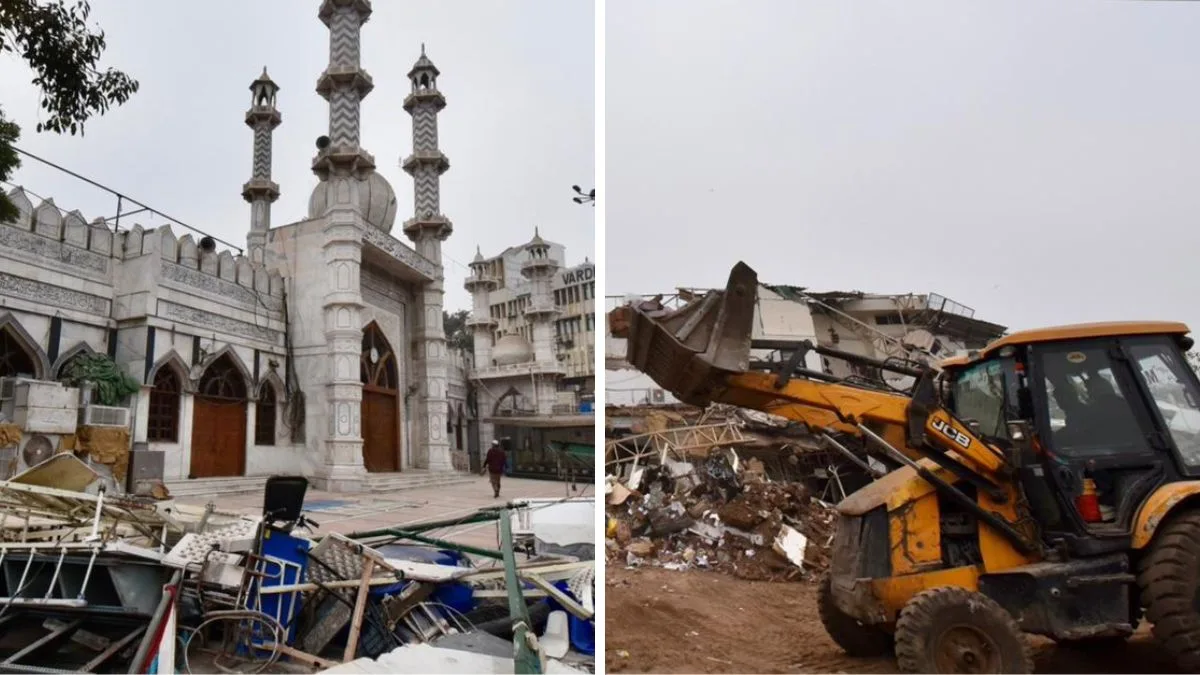
On any ordinary weekday, Chandni Mahal in Old Delhi functions as an extension of the city’s informal economy — tailoring shops, small traders, pedestrians, residents, and commuters sharing narrow lanes in constant motion. On Wednesday morning (January 7), however, the neighbourhood bore the marks of an emergency security operation. Police barricades blocked access to lanes leading to Turkman Gate, an anti-riot vehicle was stationed prominently in the middle of the road, and Delhi Police personnel conducted foot patrols through the area, as reported by ThePrint.
The heightened security followed a violent confrontation during a court-mandated anti-encroachment drive conducted by the Municipal Corporation of Delhi (MCD) on land adjoining the Faiz-e-Ilahi Masjid, located near Ramlila Maidan.
Legal Origins of the Demolition: From survey to High Court direction
The demolition drive was the culmination of a legal process initiated months earlier. One Preet Sirohi had approached the Delhi High Court seeking removal of alleged encroachments at the mosque complex. In response, a joint survey was conducted by the MCD, the Delhi Development Authority (DDA), and the Land & Development Office (L&DO) under the Ministry of Urban Development.
According to the Joint Survey Report (JSR), authorities identified:
- 2,512 square feet of encroachment on a road belonging to the Public Works Department (PWD), and
- 36,428 square feet of MCD land encroached upon for non-religious, commercial uses, including a baraat ghar (wedding hall), parking facilities, and a private diagnostic centre (ThePrint).
Relying on these findings, the Delhi High Court, in its November 12, 2025 order, directed the PWD and the MCD to remove the encroachments. However, the court also directed that the mosque management committee must be granted a hearing before any coercive action was taken. This order formed the legal foundation for all subsequent administrative and enforcement actions. (The Times of India)
Administrative hearings and the MCD’s December 22 order
In compliance with the court’s direction, the MCD held two hearings on November 24 and December 16, attended by representatives of the mosque management committee, DDA officials, and L&DO officers (The Indian Express).
During these proceedings:
- Hafiz Matloob Karim, general secretary of the mosque committee, denied the existence of a wedding hall, stating instead that a vacant portion of the premises was used “occasionally” for marriage functions.
- the mosque predated Independence;
- it was adjoined by a graveyard with no clear demarcation;
- He submitted that a charitable clinic was being run for the needy at marginal charges.
- The committee asserted that the mosque was a “waqf by user” property, arguing that no title deed was required under waqf law.
A representative of the Delhi Waqf Board referred to a February 1940 agreement under which 0.195 acres of land had been leased to the mosque.
In its order dated December 22, the MCD rejected these submissions, stating that:
- No documentary evidence had been placed on record to establish lawful possession or ownership of the land beyond the 0.195 acres the mosque management committee, or the Delhi Waqf Boar;
- Religious structures such as a masjid, dargah, or graveyard could not be used for commercial activities like marriage functions or diagnostic services;
- Any structure beyond the 0.195-acre tract constituted encroachment and misuse of public land.
The order explicitly held that such use was a “blatant misuse of public land” and directed removal of all structures beyond the demarcated area (Hindustan Times).
Mosque committee moves the High Court again
Challenging the MCD’s decision, the mosque management committee filed a fresh writ petition before the Delhi High Court, seeking to set aside the December 22 order. The petition emphasised that:
- The mosque predated Independence;
- It was adjoined by a graveyard with no clear demarcation;
- the wedding hall and diagnostic centre had already ceased operations;
- The committee had no objection to removal of commercial encroachments but sought protection for the graveyard. (The Hindu)
On Tuesday (January 6), a day before the demolition, Justice Amit Bansal heard the plea. The court recorded that the petitioner’s counsel stated there was no grievance regarding removal of the wedding hall or diagnostic centre, both of which had ceased operations.
The judge also noted:
- The MCD’s assurance that no action was proposed on the 0.195 acres containing the mosque and graveyard;
- The absence of any argument that the graveyard extended beyond this leased land.
While issuing notices to the MCD, DDA, and other authorities and seeking counter-affidavits within four weeks, the court declined to grant an interim stay, clarifying that any action taken would be subject to the final outcome of the writ petition (ThePrint).
The Demolition Begins Before Dawn
Although the demolition was scheduled to begin at 8 am on January 7, MCD teams arrived at the site around 1 am, accompanied by extensive police deployment. According to police officials cited by PTI and ANI, nearly 30 bulldozers and 50 dump trucks were mobilised. Heavy police deployment, including riot-control units, were present for the operation.
The Clash: What happened between 12:40 am and 1:30 am
At approximately 12:40 am, shortly after the MCD teams and police reached the area, a crowd gathered near the police barricades at Turkman Gate. Despite prohibitory orders under Section 163 of the Bharatiya Nagarik Suraksha Sanhita (BNSS) — which restricts unlawful assembly — the group allegedly refused to disperse.
According to the FIR lodged at Chandni Mahal Police Station, based on a complaint by Constable Sandeep:
- Around 30–35 people raised slogans against the police administration;
- Several individuals attempted to breach barricades;
- Repeated announcements were made through a loud-hailer directing the crowd to disperse;
- The crowd refused to comply, attempted to break barricades, and began pelting stones;
- One individual allegedly snatched and damaged a police loud-hailer.
The FIR, which contains the version of the police, further states that five police personnel, including the Station House Officer (SHO), sustained injuries during the clash. The injured officers — including Head Constable Jal Singh and Constable Vikram — were taken to Lok Nayak Jai Prakash Hospital, treated, and later discharged (ThePrint, The Hindu).
Police Response: Tear gas and crowd dispersal
Senior police officers told ThePrint that tear gas shells were fired from one side of the mosque complex where stone-pelting was concentrated. The crowd was dispersed within about 30 minutes, after which the demolition commenced around 1:30 am.
Joint Commissioner of Police Madhur Verma stated that minimal force was used and that normalcy was restored shortly thereafter (ANI).
Arrests, FIR sections, and ongoing investigation
Police detained five individuals, including a juvenile. Four adults — Mohd Arib (25), Mohd Kaif (23), Mohd Kashif (25), and Mohd Hamid (30) — were arrested, while a 17-year-old was apprehended (PTI, The Hindu). Additionally, 10–15 individuals were detained for questioning (PTI).
The FIR invokes multiple provisions of the Bharatiya Nyaya Sanhita, including:
- Section 221 (obstructing a public servant),
- Section 132 (assault or criminal force to deter a public servant),
- Section 121 (voluntarily causing hurt to deter public servant),
- Section 191 (rioting),
- Section 223(A) (disobedience of a lawful order),
- Section 3(5) (joint liability), along with provisions of the Prevention of Damage to Public Property Act, 1984.
Police said CCTV footage, body-worn camera recordings, and social media videos are being examined to identify additional suspects and possible instigators (ANI).
Conflicting Accounts: Locals vs police
Members of the local Aman Committee insisted that residents had cooperated with authorities. Mohammed Shehzad, a committee member, told ThePrint that nearly 150–200 locals had met police and MCD officials in advance, assuring cooperation. “It must have been outsiders,” Shehzad said, arguing that residents would not risk administrative backlash.
However, the FIR contradicts this narrative. Constable Sandeep stated that he recognised at least five local residents among those involved in the violence and claimed he could identify more if produced before him (ThePrint).
Political and public reactions
The incident triggered political reactions across party lines. Congress leader Salman Khurshid said the situation “could have been handled differently” but added that since the court had found the action valid, “nothing else can be said” (ANI).
The BJP accused opposition leaders of justifying violence. Party spokesperson Shehzad Poonawalla criticised remarks by Samajwadi Party leaders who described the stone-pelting as an “action-reaction” (PTI).
Delhi Home Minister Ashish Sood stated that the mosque was untouched and the action was strictly in accordance with court orders (ANI).
Meanwhile, Samajwadi Party MP Mohibbullah Nadvi, who was present in the area prior to the violence, is under investigation. Police said he left before the demolition began but will be summoned to join the probe (ANI).
The larger context and present status
The Faiz-e-Ilahi Masjid had previously drawn attention after CCTV footage showed Dr Umar un-Nabi, accused of being involved in the Red Fort suicide bombing on November 10, 2025, offering prayers there hours before the attack. Authorities, however, have consistently stated that the demolition drive was entirely unrelated to that incident (ThePrint).
As of now:
- The mosque and graveyard remain intact;
- The commercial structures have been demolished;
- Five arrests have been made;
- The High Court has sought replies from authorities, with the matter listed for further hearing in April.
Delhi Police and the MCD maintain that the action was lawful, proportionate, and undertaken strictly under judicial directions, while urging the public not to be misled by misinformation circulating online. Police sources stated that social media posts falsely claiming the mosque itself was being demolished circulated shortly before the violence; and that these posts contributed to people gathering at the site (The Hindu, PTI).
Related:
When the Rule of the Bulldozer Outpaces the Rule of Law: One year after this landmark judgment
Free Speech in India 2025: What the Free Speech Collective report reveals about a year of silencing