
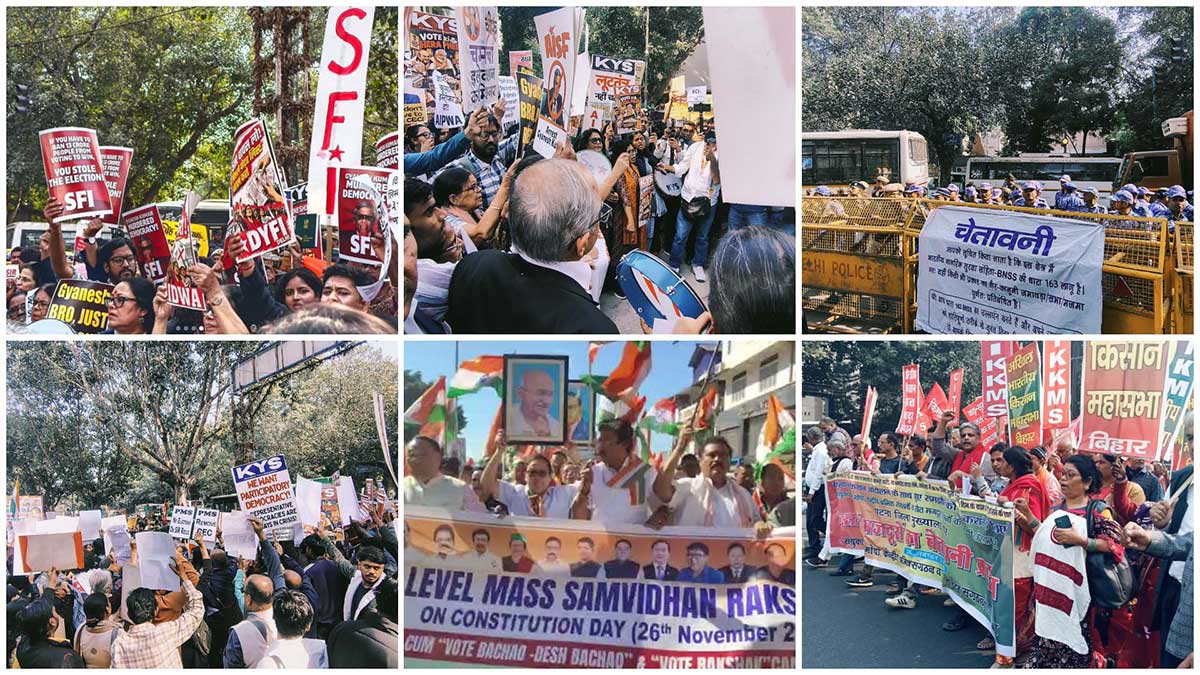
November 26, 2026, is witnessing a series of protests and political mobilisations across the country, with farmers’ organisations, opposition parties and activists taking to the streets to raise concerns ranging from electoral integrity and the Special Intensive Revision (SIR) of electoral rolls to farmers’ outstanding dues, agricultural distress and the protection of constitutional rights.
The demonstrations coincide with Constitution Day, commemorating the adoption of the Indian Constitution by the Constituent Assembly on November 26, 1949. The day also marks six years since the beginning of the nationwide farmers’ movement against the three contentious farm laws introduced by the Union government in 2020.
Among the major demonstrations planned for the day are the Samyukt Kisan Morcha’s (SKM) nationwide protests, the Congress’s Samvidhan Raksha Marches against alleged electoral manipulation, a Bharatiya Kisan Union-led agitation over unpaid sugarcane dues in Punjab, and a Save Democracy, Save Constitution rally organised by the Cockroach Janta Party (CJP) in Nagpur.
While several of these mobilisations are taking place simultaneously, authorities in Delhi and Lucknow have reportedly denied permission for some of the proposed marches, adding another dimension to the protests.
See you TODAY at 12.30! https://t.co/Lh7RHqBEUZ
— Neha (@neha_aisa) November 26, 2026
‘Run for Constitution’ मैराथन
आज राजस्थान विश्वविद्यालय के मुख्य द्वार पर @nsui अध्यक्ष @VinodJakharIN जी के नेतृत्व में NSUI राजस्थान द्वारा मैराथन का आयोजन किया गया।
इसमें शामिल होकर सभी युवा साथियों ने संविधान और लोकतंत्र की रक्षा का संकल्प लिया।
मोदी सरकार लगातार देश की संस्थाओं और नागरिक अधिकारों पर हमला कर रही है, जो कि संविधान के खिलाफ है।
हम न संविधान को झुकने देंगे, न ही लोकतंत्र को मिटने देंगे।
— Congress (@INCIndia) November 26, 2026
నేడు కాంగ్రెస్ భారీ ర్యాలీ..| Congress to Hold Massive Rally Today on Constitution Day In Hyderabad |hmtv
https://t.co/l4UdnVI1dC
#congress #hmtv #hyderabad #cmrevanthreddy
— hmtv News (@hmtvnewslive) November 26, 2026
Lucknow, Uttar Pradesh: The Social Parivartan Morcha, an alliance of AIMIM and Azad Samaj Party (Kanshi Ram), will hold a mega rally at Ramabai Ambedkar Maidan on Constitution Day to showcase its strength ahead of the Assembly elections. The alliance aims to mobilise Dalits, Muslims, OBCs and other marginalised communities around issues of social justice, political representation, the Constitution and reservation.
— IANS (@ians_india) November 26, 2026
“Every name deleted from the rolls is a voter silenced. No Constitution Day without Voter Rights”: AISA President Neha Bora (@neha_aisa) at the ‘People Against SIR’ protest at Mandir Marg on November 26. https://t.co/v1bpzqMasN
— The Wire (@thewire_in) November 26, 2026
On #ConstitutionDay, citizens of Delhi step out to exercise their fundamental right to peaceful protest & reclaim democracy & @DelhiPolice puts barricades in their way!
Does the Police, funded by taxpayers money, exist to facilitate our rights or defeat them?
Down with SIR ✊ https://t.co/5m7WSeTHvD— Maadhyam (@maadhyam_engage) November 26, 2026
Six years of the farmers’ movement: SKM announces nationwide demonstrations
The Samyukt Kisan Morcha has called for nationwide demonstrations on November 26, marking six years since the farmers’ movement began in 2020. The organisation announced on November 23 that protests would be organised at nearly 100 locations across the country, with participating farmers submitting a charter of demands to President Droupadi Murmu through their respective district collectors.
The movement began on November 26, 2020, when thousands of farmers marched towards Delhi to oppose the three agricultural laws passed by Parliament in September that year. As the protest grew, farmers established large protest sites at the Singhu, Tikri and Ghazipur borders, sustaining a year-long agitation that eventually compelled the Union government to repeal the three laws in November 2021. However, the SKM maintains that several assurances given by the government following the withdrawal of the laws remain unfulfilled.
Through its latest memorandum, the farmers’ organisation has demanded that the Union government honour its written assurances of December 9, 2021. Among its principal demands is a legal guarantee for Minimum Support Price (MSP), alongside measures to address agricultural indebtedness and the continuing financial distress of farming households.
The SKM has also demanded a comprehensive loan waiver for farmers and agricultural workers, as well as compensation of Rs 25 lakh for the families of farmers and agricultural workers who died by suicide.
Another significant demand concerns crop insurance. The organisation has called for the replacement of the Pradhan Mantri Fasal Bima Yojana with a publicly owned Crop and Livestock Insurance Corporation, arguing for a different institutional framework to address the vulnerabilities faced by agricultural communities.
The organisation has also expanded its current demands to include opposition to what it describes as the exploitation of farmers through inadequate MSP arrangements, the proposed India-US trade deal, the SIR exercise and the removal of Chief Election Commissioner Gyanesh Kumar.
Delhi Police denies permission for SKM march: In the national capital, the SKM had planned a protest march from Kali Bari on Mandir Marg to Jantar Mantar, scheduled to begin at 1 pm on November 26. However, the Delhi Police clarified that it had not received any formal application seeking permission for the proposed march and, consequently, no authorisation had been granted.
In a public notice, Deputy Commissioner of Police (New Delhi) Sachin Sharma said the police had received information that the SKM and other activists intended to organise a procession from Kali Bari to Jantar Mantar.
The police also pointed out that prohibitory orders under Section 163 of the Bharatiya Nagarik Suraksha Sanhita (BNSS), 2023, remain in force across the New Delhi district. These orders prohibit unauthorised gatherings, processions, demonstrations, speeches, sloganeering and dharnas.
Despite the restrictions, the farmers’ mobilisation continued. According to Hindustan Times’ live updates on November 26, farmers affiliated with the SKM and the KKU joined the People Against SIR protest in Delhi, which also received support from left student unions. The groups had planned to march towards Jantar Mantar, but the police reportedly sought to contain the protesters at Mandir Marg. Heavy police deployment was reported along the road, beginning near Laxmi Narayan Temple.
Meanwhile, farmers from Haryana had planned to assemble in Bahadurgarh and march towards the Tikri border as part of the anniversary mobilisation.
Congress announces nationwide ‘Samvidhan Raksha Marches’ against alleged vote theft
Constitution Day has also become the occasion for a nationwide political mobilisation by the Indian National Congress, which has announced Samvidhan Raksha Marches across states to protest alleged manipulation of electoral rolls and what it describes as the weakening of democratic institutions. The programme was announced by Congress general secretary (Organisation) K C Venugopal, who said every Pradesh Congress Committee (PCC) would organise a large-scale march in its respective state on November 26. Congress president and Leader of the Opposition in the Rajya Sabha Mallikarjun Kharge was scheduled to participate in the march in Lucknow, lending national political significance to the mobilisation.
According to Venugopal, the marches are intended to make the protection of constitutional values, democratic accountability and citizens’ voting rights the central focus of the party’s Constitution Day campaign.
Each march was planned to begin at a statue of Dr B R Ambedkar or Mahatma Gandhi. Following tributes to the two leaders, Congress workers and participating citizens would collectively read the Preamble to the Constitution and take an oath to uphold its foundational principles of justice, liberty, equality and fraternity. The announcement comes amid the Congress’s increasingly vocal allegations of electoral irregularities and its criticism of the Election Commission of India (ECI).
‘Vote Chori’ allegations and questions over electoral integrity: At the centre of the Congress’s campaign are allegations raised by Leader of the Opposition in the Lok Sabha Rahul Gandhi, who has repeatedly questioned the integrity of electoral rolls and highlighted alleged irregularities in different constituencies.
In his statement announcing the marches, Venugopal referred to what the Congress describes as evidence of large-scale electoral manipulation, including alleged fake and duplicate voter entries in Karnataka’s Mahadevapura constituency, attempts to delete thousands of genuine voters in Aland, and irregularities in Haryana and other states.
Venugopal accused the Election Commission of failing to initiate an impartial investigation into these allegations. He alleged that instead of addressing the concerns raised by the Opposition, the poll panel had dismissed the findings, demanded affidavits from Rahul Gandhi and failed to provide information sought by investigating agencies.
The Congress has also questioned the Election Commission’s handling of the Special Intensive Revision of electoral rolls, particularly its timing, methodology and potential consequences for vulnerable sections of the population. The exercise, which was first undertaken in Bihar ahead of the Assembly elections, has subsequently been extended to several states and Union Territories.
According to Venugopal, more than 65 lakh names were missing from Bihar’s draft electoral roll, while cumulative deletions across the three phases of the SIR were estimated to have exceeded 13 crore. He argued that the exercise, despite being presented as an effort to clean up electoral rolls, risked excluding legitimate voters, particularly those already facing social and economic marginalisation.
The Congress has specifically identified poor people, Dalits, Adivasis, religious minorities, migrant workers and women who have changed residences following marriage as communities particularly vulnerable to exclusion.
Venugopal criticised what he described as a process that effectively forces citizens to repeatedly establish their eligibility to remain on electoral rolls.
“The stated aim is clean rolls. The effect is to make citizens prove they belong,” he said.
Congress questions Election Commission’s independence: The party’s criticism also extends to the legal framework governing the appointment and protection of Election Commissioners. Venugopal referred to amendments that replaced the Chief Justice of India with a Union Cabinet Minister on the selection committee responsible for appointing Election Commissioners.
The Congress has argued that this change gives the Union government greater influence over appointments to an institution constitutionally expected to function independently. He also criticised the legal immunity granted to Election Commissioners for acts performed in the discharge of their official duties, arguing that the changes have weakened institutional accountability.
Invoking Article 324 of the Constitution, Venugopal maintained that the Election Commission was intended to function as an independent constitutional authority, insulated from political and executive interference. “When a citizen’s vote is stolen, every other right guaranteed by the Constitution becomes meaningless,” he said, asserting that the campaign was not merely about electoral politics but about the future of Indian democracy.
The Congress has also intensified its Vote Rakshak campaign alongside the marches. Under this initiative, party workers are expected to reach polling booths, identify voters whose names have been deleted from electoral rolls, verify their details and assist affected citizens in seeking restoration of their voting rights.
Venugopal appealed to students, young people, farmers, workers, women, Dalits, Adivasis, OBCs, minorities and members of civil society to participate in the demonstrations. He described the mobilisation as a collective effort to defend constitutional democracy rather than a campaign restricted to the Congress.
Lucknow march reportedly denied permission: The Congress’s planned mobilisation in Lucknow also encountered restrictions from local authorities. According to reports, the party said on November 25 that permission had been denied for the Samvidhan Raksha March scheduled to take place in the city with Kharge’s participation. Subsequently, the party indicated that the programme would be organised at its state headquarters instead.
Congress leaders nevertheless maintained that party workers were prepared to participate in the mobilisation. In a statement reported by ANI, party leader Syed Asim Waqar said the Congress remained committed to the campaign despite the denial of permission. The proposed Lucknow march was intended to be one of the principal events in the nationwide programme, with Kharge’s participation expected to lend it greater political weight.
The Congress’s Constitution Day mobilisation also follows a march organised in Gujarat on November 25, a day ahead of Constitution Day, under the slogan ‘Vote Chor Gaddi Chhod’. The demonstration was led by Gujarat Congress president Amit Chavda, former Union minister Bharatsinh Solanki and Congress leader Randeep Singh Surjewala, among others. Participants recited the Preamble and pledged to defend constitutional values.
Meanwhile, Congress communications chief Jairam Ramesh invoked Ambedkar’s November 25, 1949, address to the Constituent Assembly, recalling his warning about the dangers of political hero-worship and the possibility of it paving the way for dictatorship. Ramesh described Ambedkar’s caution as particularly relevant in the present political climate.
Nagpur: Cockroach Janta Party to hold ‘Save Democracy, Save Constitution’ rally
In Nagpur, the Cockroach Janta Party (CJP) has announced a ‘Save Democracy, Save Constitution’ rally to mark Constitution Day. The demonstration is scheduled to take place at Samvidhan Chowk on November 26 at 4 pm. The rally has been announced by CJP founder Abhijeet Dipke, who has appealed to citizens to participate in a collective effort to defend democracy and the values enshrined in the Constitution.
According to The Times of India, Dipke announced the rally at a press conference on Wednesday, November 25, identifying alleged electoral irregularities as among the issues that the demonstration intends to raise.
CJP co-founder Ashutosh Ranka also called upon people to participate, arguing that the Constitution, which defines the country’s governing framework and democratic commitments, has come under direct attack in recent years. Ranka emphasised that protecting the constitutional values associated with Dr Babasaheb Ambedkar and safeguarding democratic institutions should be a collective responsibility.
VIDEO | CJP co-convenor Ashutosh Ranka (@AshutoshRanka) is in Nagpur for their Save Democracy, Save Constitution rally planned for today.
He says, “Look, today is a very important day for our country. The Constitution, which governs our nation and represents its ideology, has been under direct attack over the past few years. If the Constitution does not survive, nothing else will survive either. Protecting the values of Babasaheb and safeguarding the values of our country should be everyone’s responsibility and our most important duty. Therefore, we appeal to the people of the country to come forward and take a stand to protect the Constitution. The Constitution was created to safeguard our country and defines the values that our nation stands for. Only if the Constitution survives will we survive.”
#CJP #AshutoshRanka #SaveDemocracySaveConstitution
(Full video available on PTI Videos – https://t.co/bIyFWTfmBd)
— Press Trust of India (@PTI_News) November 26, 2026
Actor and activist Prakash Raj is also expected to attend the rally.
The party has indicated that its concerns extend beyond electoral politics. Dipke said that issues such as school education, employment and healthcare must receive greater attention during election campaigns, rather than allowing political discourse to remain confined to electoral calculations.
CJP has also announced plans to undertake grassroots outreach across Maharashtra following the Nagpur rally. According to The Times of India, teams led by the party’s volunteers will travel through districts in Vidarbha and Marathwada to assess drought conditions and document the difficulties faced by farmers.
CJP national organisation in-charge Ajinkya Shinde said the teams intended to spend three days each in the two regions, meeting farmers, hearing their concerns and examining issues relating to drought relief. The party also plans to extend its ‘Kya Bolti Public’ campaign to Delhi, Bihar, Jharkhand, Uttar Pradesh and Rajasthan. Dipke has further called for greater political representation for young people. The Nagpur rally therefore brings together concerns about electoral accountability, democratic participation, public welfare and the need for greater political representation.
Constitution Day protests bring together concerns over democracy, voting rights and agrarian distress
The simultaneous protests on November 26 reflect the convergence of several political and socioeconomic concerns across the country.For the SKM and other farmers’ organisations, the day marks six years since a historic agricultural mobilisation that forced the Union government to withdraw three farm laws. However, their continuing demands over MSP, agricultural debt, crop insurance and unpaid dues indicate that the repeal of the laws did not resolve the larger questions surrounding farmers’ economic security.
Meanwhile, the Congress’s nationwide Samvidhan Raksha Marches and the Nagpur rally organised by CJP place electoral integrity, institutional independence and the protection of constitutional democracy at the centre of Constitution Day observances. The restrictions imposed on proposed demonstrations in Delhi and Lucknow have also raised questions about the space available for public mobilisation and peaceful assembly.
As farmers, political parties and activists organise demonstrations across different parts of the country, November 26 is emerging not merely as a day of ceremonial remembrance of the Constitution, but also as an occasion for public mobilisation around the rights, institutions and democratic guarantees it promises. The central issues being raised by these protests, from the right to vote and the independence of constitutional institutions to farmers’ livelihoods and economic security, point to a wider debate over the extent to which constitutional promises are being translated into lived realities.
Related:
Only 74 of 14,567 Form-7 objections found valid in Maharashtra’s Bhusawal Assembly constituency
Only 21% of eligible women receive maternity benefits amid digital barriers and debt traps: Survey
Form 6: ECI’s “assurance of no prosecution” to deleted voters is a violation election law & rule