
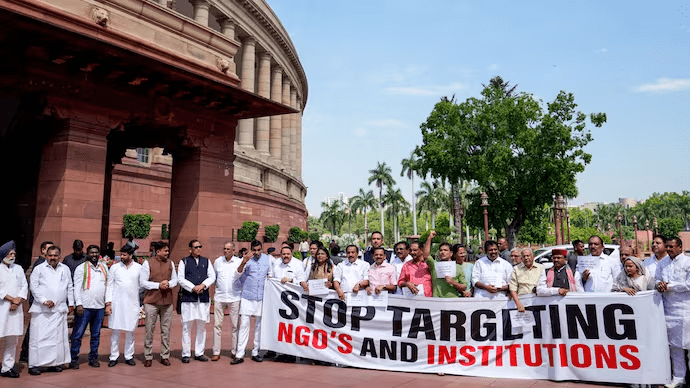
The Foreign Contribution (Regulation) Act (FCRA) 2010 under the Ministry of Home Affairs was intended to regulate foreign donations and funding coming into India for individuals, associations and non-governmental organisations (NGOs). The Foreign Contribution (Regulation) Amendment Bill, 2026 introduced in the Lok Sabha on March 25, 2026, suggest the creation of an authority to take over and manage assets of entities whose FCRA certificates lapse, are cancelled or not renewed. There are no systems in place for an appeal mechanism when renewal of FCRA certificate is denied, nor is the organisation offered an opportunity to be heard before the renewal is denied.
The government may cancel the FCRA certificate if the entity violates any provision of the law or under other specified circumstances. These include violating terms and conditions of the certificate or renewal, not engaging in any reasonable activity in its chosen field for two consecutive years, or if the government thinks it is necessary in public interest.
On the face of it, this amendment does not even seem to be aligned with the rule of law. It means the government can arbitrarily decide (without any system of accountability to fair practice) to take over the assets of an organisation which has no recourse to challenge this. Giving the growing state enabled resentment against minority religious groups and the increasing violence towards those criticising the government, this amendment looks very much like a targeted attack.
Christians who constitute 2.5% of India’s population in India receive 15% of the foreign contributions coming into the country and are major contributors to humanitarian and charitable work. It is well known that Christian institutions have provided much sought after educational and health facilities not just in cities, but have also met crucial gaps in these services in areas that are inaccessible, remote or rural. Bringing in amendments that affect these core functions will affect the poorest communities that have no other options available either for health care or education. The government facilities should have performed these roles but their outputs are abysmal. Ironically, if an entity has received foreign funds for the initial setup and then continued activities using domestic funds, it becomes liable under these new amendments to be taken over by the designated authority, which can transfer it to a ministry, a state department or sell it.
The government would surely keep track of the number of children in Christian educational institutions, or the number of patients receiving subsided care in Christian hospitals. It is astonishing that this seems to be of no consequence and seems to be more by design than chance. Cutting away lifelines of education and healthcare can produce irreparable damage, but these affected communities, invariable from the traditionally marginalised Dalit and Adivasi groups, have absolutely no say in decisions that adversely affect their lives.
A government that truly values democratic principles would understand that many of its own gaps in terms of social justice, equality and democracy are plugged by the charitable and missionary organisations. It is an enormous investment to build infrastructure, create the necessary human resources while ensuring the best standard of care. How will handing over these vital facilities to an ‘authority’ ensure the same quality? Dismantling these facilities through vindictive laws and policies is easier than building up these same institutions that have contributed to the well-being of thousands. Many of these institutions can get badly affected by the planned amendments of the Government and never fully recover. Children who are forced to dropout for want of other options will forever have to give up their dreams of even a barely decent future. Without offering a comparable or better alternative, is it justified for the government to bring in such anti-people laws?
Another important contribution of these charitable institutions and organisations is to create confident individuals who are able to demand their rights and entitlements from the government rather than being passive recipients of services that are often undignified, inadequate and unsatisfactory. Women, adolescent, Dalit/Adivasi (tribal) grounds, communities in urban deprived areas etc. have benefited from numerous interventions including self help groups. It is evident that the government is threatened by dissent, collective bargaining, people’s collectives, unions etc. The notion of freebie is often disconnected from being a right and rather projected as the benevolence of a political leader. It is a dependency rather than an empowerment or rights based model. It keeps people as beneficiaries to be controlled rather than tax paying citizens who are vocal about their rights. While opening the door to the market and privatisation even for crucial social welfare policies, the space for discussion on distributive justice is narrowing and even penalised.
We need to introspect on where we are heading as a nation. The narrative that Christian institutions receive foreign funds to convert, especially poor Indians, does not have any basis. This can be ascertained by the thousands of ‘right wing’ supporters who have benefited from Christian institutions while retaining their majoritarian religion. The students’ protests have showed us that there is growing concern about the quality of education that young people in India are able to access. Does the country need laws targeting charitable institutions, particularly at a time when government schools and hospitals are being dismantled at an alarming rate?
Under these draconian amendments, it is the organisations that are critical of the government, engage with rights based work and minority groups that are being actively targeted and systematically eliminated. India is a signatory to the International Covenant on Civil and Political Rights (ICCPR) and UN Declaration on Human Rights Defenders. Any restriction to individual freedom is only legitimate if it is not overbroad, and is strictly necessary for national security, public safety, public order, public health o protection of rights and freedoms of others. In 2016, three United Nations Special Rapporteurs jointly urged the Indian government to repeal the FCRA, warning that it was being used to silence organizations whose priorities did not align with those of the government.
There are concerns that the amendments will be passed in the Parliament on the 12th of August. This is inspite of multiple submissions challenging it by Christian leaders. There is no doubt that this Amendment will be selectively applied to the Christian community much like the Freedom of religion Act. The targeting of Christian educational and healthcare institutions will be a big blow to the most vulnerable communities – people living in urban deprived areas, indigenous communities, senior citizens, children with special needs, abandoned and single women, devadasi women being rehabilitated from generations of sexual exploitation, migrant workers, people with stigmatising diseases like leprosy, tuberculosis, HIV/AIDS etc. Why do these communities have no say in whether an institution or organisation ‘deserves’ to have the FCRA or not? With the sword of FCRA hanging over their heads, the base of work may shift to more ‘safe’ areas in cities and with more privileged communities which defeats the very core of the Church’s mission.
There is absolutely no requirement for the FRCA Amendments as currently being envisaged and the government should desist from using state power to criminalise and harass legitimate works of charity and nation building. The government should instead seriously examine the dismantling of government schools and healthcare infrastructure. That is a more pressing need. Those who have, and who continue to benefit from the selfless work of Christian institutions need to raise their voices and no longer just be silent observers.
(The author is national secretary, Jesuit Commission for Ecology and Justice, New Delhi)
Related:
FCRA amendments could discourage NGO activities: SC
FCRA licenses cancelled: What happens now to the social work and institutions run by these NGOs?