
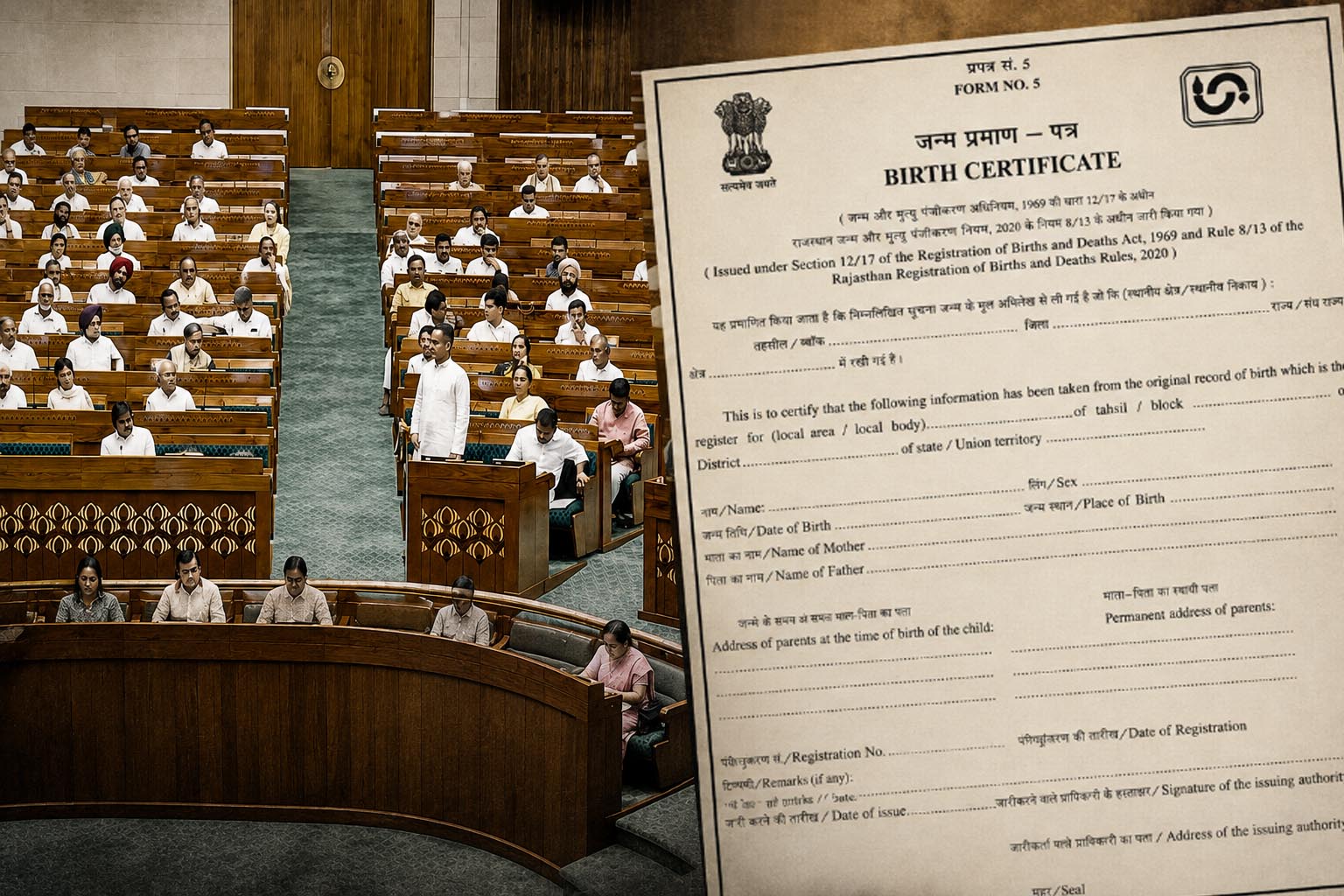
The Parliament has passed the Registration of Births and Deaths (Amendment) Bill, 2026 without any substantive debate, introducing what appears to be a procedural change but could significantly alter access to one of India’s most crucial identity documents. Introduced in the Lok Sabha on July 29 and passed on August 1 amid opposition protests over the alleged police crackdown on the July 20 CJP student protests, the Bill amends Section 13(3) of the Registration of Births and Deaths Act, 1969 by creating a two-tier mechanism for delayed birth registration. The Bill was subsequently passed by the Rajya Sabha on August 4, again amid similar disruptions, leaving critical questions around safeguards, necessity and potential exclusion largely unexamined.
Until now, any birth or death reported more than one year after its occurrence required an order from the District Magistrate, Sub-Divisional Magistrate or an authorised Executive Magistrate. The amendment retains this framework for delays between one and two years but introduces a new requirement that registrations delayed beyond two years can only be approved by a Judicial Magistrate First Class, after verification of the event.
The government presents this as a measure to “make provisions of delayed registration more stringent” and encourage timely reporting. Its Statement of Objects and Reasons argues that the amendment follows consultations with States after the 2023 amendments and is intended to strengthen delayed registration procedures. Yet the amendment’s significance lies far beyond delayed registrations.
A birth certificate is no longer merely a record of birth
The importance of the amendment can only be understood alongside the Registration of Births and Deaths (Amendment) Act, 2023. The 2023 legislation fundamentally transformed the legal status of birth certificates by making them the principal proof of date and place of birth for school admissions, electoral rolls, passports, Aadhaar, driving licences, government employment and numerous other public services. It also authorised the creation of integrated digital civil registration databases by the Union and State governments, with data-sharing obligations to the Registrar General.
The result was that a document historically intended to record vital events became the foundational gateway to legal identity and access to the State itself.
Once a birth certificate acquired this central role, the consequences of delayed registration also changed. The 2026 amendment is therefore not simply about administrative procedure—it reflects a tightening of control over access to India’s primary identity document.
Judicialisation without justification
The amendment introduces a sharp procedural divide. Births and deaths reported within two years remain within the executive machinery. Beyond two years, however, applicants must now approach the judiciary. The Bill itself provides almost no explanation for why the threshold should be two years rather than one, three or five. Nor does it explain why the executive becomes sufficiently unreliable after that point that judicial intervention becomes necessary.
The Statement of Objects and Reasons merely states that stricter provisions will encourage timely reporting. It offers no empirical evidence that delayed registrations beyond two years are particularly susceptible to fraud, no data showing misuse under the existing system, and no assessment of whether less restrictive alternatives—such as stronger documentary verification or specialised scrutiny by civil registration authorities—were considered.
If the government’s concern is fraudulent registrations, the amendment does not alter the evidentiary framework governing delayed applications. It simply changes who makes the decision. That raises an obvious question: if evidentiary standards remain unchanged, why is a judicial magistrate expected to reach more reliable conclusions than an executive magistrate?
The legislation offers no answer.
A heavier burden on those already excluded
The assumption underlying the amendment appears to be that delayed registrations are inherently suspicious. That assumption sits uneasily with India’s social realities. Delayed birth registration is often a consequence of structural deprivation rather than fraud. Children born in remote villages, tribal regions, migrant settlements, informal urban communities, conflict-affected districts or among economically marginalised families are frequently registered years after birth. Documentation gaps may arise because families lacked access to hospitals, registration offices, transport, literacy or awareness of legal requirements.
Many adults only seek birth certificates decades later because they suddenly become necessary for education, employment, welfare benefits or identity documentation. For precisely these groups, requiring litigation before a Judicial Magistrate adds another procedural hurdle involving court appearances, legal costs, documentation, travel and delays. The amendment therefore risks placing the greatest burden on those who were already excluded from timely registration because of State failures rather than personal neglect.
Identity governance through courts
The amendment also reflects a broader shift in India’s governance of identity documents. Over the last decade, foundational identity records have acquired increasing significance in questions of citizenship, welfare, migration, electoral participation and access to public services.
In that context, transferring difficult registration cases from executive authorities to judicial officers offers political insulation. Decisions refusing documentation can increasingly be characterised as judicial determinations rather than executive discretion. But judicialisation does not necessarily improve accessibility.
Courts are designed to adjudicate disputes, not function as mass civil registration authorities. Requiring judicial orders may reduce allegations of arbitrary executive decision-making, but it also makes errors more difficult—and more expensive—for ordinary citizens to challenge. Administrative mistakes can often be corrected administratively. Judicial mistakes typically require further litigation.
Passed without Parliament examining the evidence
Equally troubling is the manner in which the legislation was enacted. The Bill was introduced in the Lok Sabha on July 29 and in the Rajya Sabha on August 4 after being cleared by the Union Cabinet on July 20. Opposition members were protesting the police action on student demonstrations and demanding the presence of the Prime Minister and Home Minister. Amid continuous disruptions, the Bill was passed by voice vote in under three minutes without substantive debate. The Hindu’s report noted that Parliamentary Affairs Minister Kiren Rijiju later blamed the Opposition for forfeiting its opportunity to discuss the legislation, while Opposition protests continued over unrelated issues including the July 20 police action and the Ram Temple donation controversy.
The manner in which the Bill was passed is as significant as the amendment itself. Cleared by the Lok Sabha without any substantive discussion amid continuing Opposition protests, the legislation escaped the parliamentary scrutiny that such a consequential change warranted. Parliament was never afforded the opportunity to interrogate the government’s central assumptions: why was two years chosen as the threshold for judicial intervention? What evidence suggests that delayed registrations beyond this period are particularly vulnerable to fraud? How many delayed registrations are recorded each year, how many have actually been found to be fraudulent, and how many genuine applicants are likely to face additional procedural hurdles as a result of this amendment? The Statement of Objects and Reasons merely states that the changes will make delayed registrations “more stringent” and encourage timely reporting, but provides no empirical basis for these assertions. In the absence of such evidence, and in the absence of parliamentary debate, the amendment appears less like a carefully justified reform and more like another expansion of procedural barriers around access to legal identity.
Bureaucratic certainty over inclusive registration
The amendment ultimately reflects a larger policy trajectory. Rather than making civil registration easier, more universal and more accessible, the State has increasingly responded to concerns about identity fraud by raising procedural barriers and expanding verification mechanisms.
The 2023 amendment elevated the birth certificate into the country’s most consequential identity document. The 2026 amendment responds not by strengthening registration infrastructure or simplifying access for vulnerable populations, but by requiring judicial scrutiny for a category of applicants the State now implicitly regards as more suspect.
This reflects a broader administrative philosophy: that preventing the wrongful inclusion of fraudulent claims justifies increasing the risk of wrongly excluding genuine citizens. Whether that trade-off is proportionate, evidence-based or constitutionally defensible remains unanswered—not because Parliament debated and accepted the government’s reasoning, but because the House never meaningfully examined the question at all.
The bill may be viewed below:
Related:
Parliamentary response reveals severe infra crunch affecting rural healthcare
A Silenced Parliament: Impact of deleted questions on democratic representation