
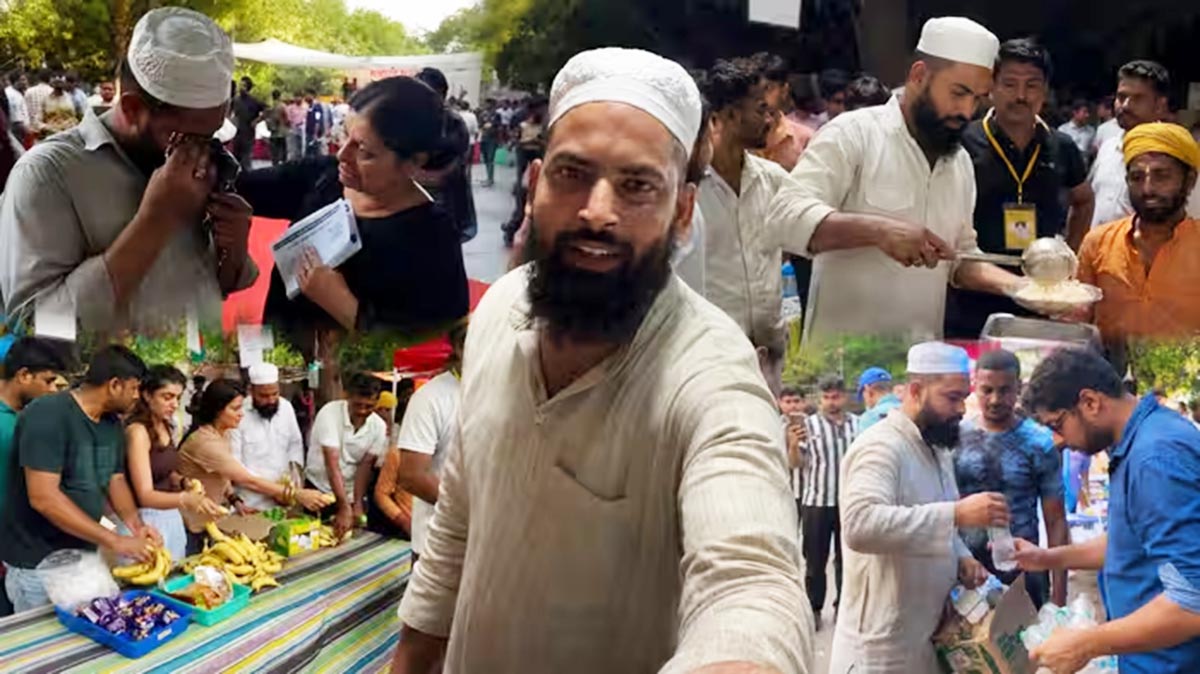
For weeks, Mohammad Junaid Malik was one of the quiet constants at Delhi’s Jantar Mantar. Long before his name appeared in court filings or political statements, students knew him simply as the young volunteer who made sure there was always drinking water, tea or a hot meal waiting after another long day of protest. As the vibrant student and youth agitation, first launched by the Cockroach Janata Party, over alleged examination irregularities gathered momentum through June and July, Malik’s makeshift community kitchen became almost as familiar as the protest stage itself.
Mohd Junaid Was Arranging Foods And Water At CJP Protest Since Day One.
जंतर मंतर प्रोटेस्ट में पहिले दिन से प्रदर्शनकारियों को खाना बांटने में सहयोग करने वाले मोहम्मद जुनैद भाई…@abhijeet_dipke @CJP_for_India @Cockroachisback pic.twitter.com/mpTcEEv44p— khalid Chougle (@ChougleKhalid) July 25, 2026
मुहम्मद जुनैद के घर वालों को सिर्फ इसलिए पुलिस ने उठा लिया था, क्योंकि Mohammad Junaid ने जंतर मंतर में प्रदर्शनकारी छात्रों को 34 दिनों से खाना खिला रहे थे, पानी पिला रहे थे!
घर वालो का आधार कार्ड, पासपोर्ट, सब ज़ब्त कर लिया था पुलिस ने!
इस सरकार को हिन्दू-मुस्लिम की एकता नहीं… pic.twitter.com/QwU7BSXEEy
— Sadaf Afreen صدف (@s_afreen7) July 26, 2026
देश भर के छात्रों की सेवा के लिये लगातार मौजूद रहने वाले जुनैद को डिटेन करना और उनको परेशान करना इस सिस्टम का सबसे शर्मनाक चेहरा था, देश भर के लोग अपने अपने स्तर पर बच्चों की सेवा कर रहे थे, जुनैद ने भी इंसानियत के नाते छात्रों की मदद की।
सरकार से अनुरोध है कि ऑंदोलन में लोगों की… pic.twitter.com/vJ3GJW03aY— Imran Pratapgarhi (@ShayarImran) July 27, 2026
The 26-year-old is a law graduate and a judicial services aspirant, and was not among the movement’s organisers. According to the petition he has now filed before the Supreme Court, he neither held any official position nor helped shape the protest’s strategy. His role was considerably simpler: feed people. Yet by the final week of July, the volunteer who had become known for distributing food had himself become one of the protest’s biggest stories, alleging illegal detention, intimidation and harassment of his family by police—a set of claims that are now before the Supreme Court.
The volunteer behind the community kitchen
Malik says he first arrived at Jantar Mantar after noticing that students camping at the protest lacked even basic drinking water in Delhi’s summer heat. As he told India Today, what began with a table of water bottles and biscuits gradually evolved into a volunteer-run kitchen serving tea, juice and food packets around the clock. The operation, he insisted, relied not on institutional funding but on ordinary people bringing supplies or contributing money for meals.
“People come on their own. Some bring food, others bring water. Our work is simply to organise everything and make sure nobody goes hungry,” he told India Today.
Over the next 35 days, according to his Supreme Court plea, Malik coordinated food and water distribution every day beginning June 20, 2026. Videos of the community kitchen spread widely across social media, earning him praise from students, volunteers and even “leaders” of the CJP, who publicly thanked him during the protest. For many following the agitation online, he became “the man feeding the students.”
The night everything changed
That visibility, Malik now claims, also drew unwanted attention. As reported by LiveLaw, his petition states that after media coverage of the community kitchen, police repeatedly became interested in a single question: Who was paying for the food? According to Malik, the answer never changed. The meals, he says, were financed through public donations, volunteers and supporters who either transferred money or directly supplied food and water. There was no central financier.
According to Malik’s petition, the turning point came shortly after midnight on July 24. Having visited Ram Manohar Lohia Hospital for an anti-rabies injection after a dog bite, he says he was stopped while returning by men who identified themselves as Delhi Police officers. In interviews with India Today and The Lallantop, Malik alleged that he and others accompanying him were blindfolded, their phones seized and taken to an undisclosed location.
His petition before the Supreme Court provides a more detailed account. As per the LiveLaw report, he alleges he remained in police custody through the night, was compelled to unlock his mobile phone, had its contents examined, and was repeatedly questioned by senior officers about the funding behind the protest kitchen. The questioning, according to the petition, focused less on the food itself than on identifying those allegedly financing the wider protest. Malik claims officers threatened him with serious consequences, including possible action under the National Security Act. if he failed to reveal the source of funding. He says he consistently replied that there was no hidden financier, only ordinary citizens helping feed protesters.
Claims of harassment
After returning to Delhi, Malik defended his actions in a series of emotional media interviews. Speaking to India Today, he said: “I have zero criminal cases against me. I am not a criminal. We are only fighting for students.”
He added: “If giving someone food or drinking water is considered a crime, then I will commit that ‘crime’ a thousand times over.” The remark quickly became one of the most widely shared quotations associated with his case.
Malik’s allegations extend well beyond his own detention. His Supreme Court application says police questioned his father about family bank accounts, raided the family’s Ghaziabad residence, searched the house, demanded identity documents and financial records, and detained relatives in Meerut—all without legal paperwork or compliance with established procedure. The petition argues that these actions were intended to pressure him into abandoning the protest and disclosing its alleged funding network. Calling the actions an abuse of state power, the application says the treatment of his family violated their rights under Article 21 of the Constitution.
Police response
Police authorities have disputed significant parts of Malik’s account. According to a report by Scroll, Ghaziabad Police acknowledged questioning Malik’s father but denied arresting him, describing it as a routine inquiry. Mussoorie Police similarly confirmed questioning his father regarding financial sources before releasing him. Meerut Police denied detaining any of Malik’s relatives, while Delhi Police said it was looking into the allegations.
From volunteer to petitioner
Malik has now approached the Supreme Court through an intervention application in the writ petition filed by RJD MP Manoj Kumar Jha concerning alleged police excesses during the CJP protests. Filed through Advocate-on-Record Neha Rathi, the application seeks protection against further coercive action toward his family and asks the Court to ensure that any investigation complies strictly with the law.
Perhaps the most striking aspect of Malik’s story is that he was never one of the protest’s public leaders. He did not deliver speeches, negotiate with officials or lead marches. Instead, his visibility came from doing something almost mundane—making sure students had food and water. By the time the protest entered the courtroom, however, the man remembered for handing out meals had himself become one of its most prominent litigants.
Malik’s story also raises uncomfortable questions about the intersection of protest, policing and religious identity. By his own account, he was not a student leader, political strategist or public face of the agitation; he was a volunteer running a community kitchen. Yet much of the scrutiny he describes, from repeated questions about who was funding the food to the alleged raids on his family’s home, came to centre on him. The fact that he is a Muslim became impossible to ignore, with the lingering suspicion that he had been singled out despite his role being limited to providing food and water. While the matter is now before the Supreme Court, Malik’s case has become emblematic, for many, of how an act of humanitarian solidarity can become entangled with suspicion when filtered through the lens of religious identity.
Related:
July 2026: A dissent that was brutally put down, a crackdown after the protest ended
A deleted tweet, an NSA order, and the shadow of past crackdowns
Youth Uprising: A protest, a brute crackdown, a continuing countrywide response
Mumbai stands with students, but the state pushes back