
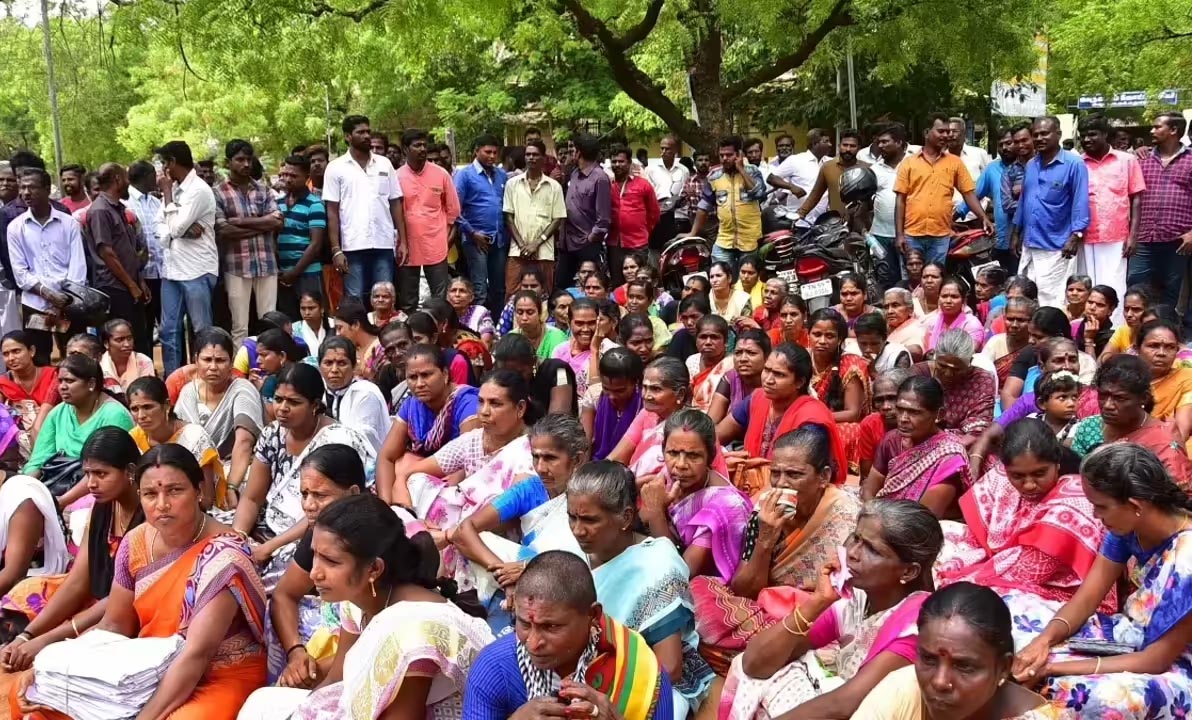
More than forty years after the first wave of Sri Lankan Tamils fled across the Palk Strait, their presence in India can no longer be described as temporary refuge. It is a protracted displacement that has quietly calcified into permanence without recognition. The anti-Tamil pogrom of 1983 in Sri Lanka — followed by successive phases of civil war between the Sri Lankan state and the Liberation Tigers of Tamil Eelam (LTTE) — triggered an exodus that continued well into the 2000s.
Between 1983 and 2012, over 3,03,000 Sri Lankan Tamils entered India in four distinct waves, as documented in the 2023 report After 40 Years, Sri Lankan Tamil Refugees in India Need Durable Solutions. Today, according to the Ministry of Home Affairs’ Annual Report (2023–24), more than 57,000 remain in refugee camps in Tamil Nadu and Odisha, while nearly 33,000 reside outside camps in Tamil Nadu.
These figures represent not a transient population but a settled community spanning generations. Many arrived as children in the 1980s. Many more were born in India. Among them are nearly 29,500 Indian-origin Tamils — descendants of plantation workers taken to Ceylon under British rule — whose citizenship questions were supposedly addressed under the 1964 Sirimavo-Shastri Pact. Yet decades later, many remain effectively stateless.
The humanitarian emergency of 1983 has become a structural condition of rightlessness.
From solidarity to suspicion
In the early years, Sri Lankan Tamil refugees were received with empathy in Tamil Nadu. Shared language, culture, and ethnicity fostered a sense of kinship. Refuge was extended not merely as policy but as solidarity.
That political climate shifted dramatically after the assassination of former Prime Minister Rajiv Gandhi in 1991 by LTTE operatives. Public sentiment hardened. Administrative vigilance intensified.
Non-camp refugees were moved into camps. Surveillance mechanisms were strengthened. Identity checks became routine. Refugees report periodic inspections requiring them to be physically present in camps for verification. The implicit message is clear: their presence remains conditional.
Although the Tamil Nadu government provides monthly financial assistance, the support is subsistence-level. Refugees are permitted to work outside camps, yet their formal classification as “foreigners” bars them from property ownership, government employment, political participation, and long-term financial security. Many educated refugees are confined to informal or precarious labour.
The camps are not detention centres — but neither are they spaces of dignity. They are administrative enclosures sustained by indefinite temporariness.
Repatriation as a hollow promise
The end of Sri Lanka’s civil war in 2009 theoretically opened the door to voluntary repatriation. In practice, it has not functioned as a meaningful solution.
The 2023 refugee report notes that despite the Sri Lankan government forming a committee in 2022 to facilitate returns, only a negligible number of refugees had repatriated by early 2023. UNHCR data similarly reflect extremely low return rates.
The reasons are layered. Economic instability in Sri Lanka persists. Many refugees lost land, documentation, and livelihoods. War trauma remains unresolved. For second-generation refugees born in India, Sri Lanka is not a lived homeland but a distant inheritance.
Media interviews in The Hindu and other national outlets consistently indicate that an overwhelming majority prefer integration in India over repatriation. After forty years, return is no longer a practical aspiration for most. It is a formal option detached from social reality.
Legal Limbo: Protection without belonging
For decades, Sri Lankan Tamil refugees were technically classified as “illegal migrants” under India’s foreigner laws because they entered without valid passports or visas. This label carried the theoretical risk of detention or deportation.
The Immigration & Foreigners (Exemption) Order, 2025, issued under the Immigration and Foreigners Act, 2025, removed penal liability for registered Sri Lankan Tamils who entered on or before January 9, 2015. This administrative step eliminated criminal exposure and softened the “illegal migrant” stigma.
However, the Order did not recognize them as refugees. It did not confer residency rights. It did not open a pathway to citizenship. They remain legally classified as foreigners — without nationality, without passports, without full civil identity.
The relief is procedural, not transformative.
The CAA and the politics of exclusion
The 2019 Citizenship Amendment Act (CAA) fast-tracked Indian citizenship for persecuted non-Muslim minorities from Afghanistan, Pakistan, and Bangladesh. Sri Lankan Tamils were excluded from its scope.
This exclusion has drawn sustained criticism. The Dravida Munnetra Kazhagam (DMK), in an affidavit before the Supreme Court, argued that the CAA is discriminatory in limiting its protection to three countries and six religions while excluding Tamil refugees who fled ethnic persecution. Reporting by The Hindu has highlighted these constitutional objections.
The Union Government has defended the CAA as a narrowly tailored law addressing specific historical circumstances. Yet the omission of Sri Lankan Tamils raises uncomfortable questions. If the moral justification of the CAA is protection of persecuted minorities, why exclude those who fled one of the longest ethnic conflicts in South Asia?
The selective humanitarianism embedded in the CAA exposes a deeper inconsistency in India’s refugee governance.
Naturalization blocked in practice
In theory, the Citizenship Act, 1955 allows naturalization after eleven years of residence. In practice, Sri Lankan Tamil refugees have faced administrative barriers.
A 1986 Ministry of Home Affairs communication reportedly instructed state authorities not to process naturalization applications of Sri Lankan refugees who arrived after July 1983. Though rarely debated publicly, this directive has effectively frozen citizenship claims for decades.
Thus, while the statute appears neutral, policy implementation has been exclusionary. Refugees who have lived in India for thirty or forty years remain without a viable path to citizenship.
Judicial Interventions: Islands of relief
The Madras High Court has periodically disrupted this inertia. In February 2023, Justice G. R. Swaminathan delivered a notable judgment directing the issuance of passports to individuals born in India under Section 3 of the Citizenship Act, which grants citizenship by birth for those born between 1950 and 1987 irrespective of parental nationality.
In other case, in October 2022, the High Court bench of Justice G. R. Swaminathan recommended that principles underlying the CAA could logically extend to Sri Lankan Hindu Tamils, describing them as victims of racism.
These interventions offer relief to individual petitioners and expose bureaucratic rigidity. Yet they remain case-specific. They cannot substitute for systemic reform.
Security concerns and collective suspicion
Authorities often cite concerns about residual LTTE ideology among sections of the refugee population. Over the years, some arrests have been made in connection with alleged smuggling or revivalist activity.
Security considerations are legitimate. However, collective exclusion based on historic militancy is disproportionate. Democratic governance requires distinguishing between individual criminal conduct and community identity.
Other countries with large Sri Lankan Tamil diasporas — including Canada and the United Kingdom — have managed security screening while still granting citizenship. Security vetting and integration are not mutually exclusive.
To indefinitely withhold rights from an entire refugee population due to past insurgency risks converting precaution into discrimination.
The stateless generation
Perhaps the most compelling dimension of this crisis is generational. Thousands of Sri Lankan Tamils in Tamil Nadu were born in India. They studied in Indian schools, speak with local accents, and participate in local economies.
Yet they cannot vote. They cannot hold secure title to property. They cannot access the full range of civil and political rights guaranteed to citizens.
They are not transient outsiders. They are socially embedded but legally excluded. Their condition is neither classic refugeehood nor voluntary migration. It is structural statelessness.
Matua identity cards, CAA camps and the politics of assurance in Bengal
In Thakurnagar in North 24 Parganas — the spiritual headquarters of the Matua community — the year of 2025 witnessed scenes that resemble a political mobilisation drive as much as a religious gathering. Loudspeakers make repeated announcements, volunteers sit behind rows of wooden desks scrutinising Aadhaar cards and voter IDs, and long queues of men and women wait under plastic sheets clutching old refugee papers. What is being distributed is not merely a card, but a promise — or at least the suggestion — of protection.
Ground reports, including detailed coverage by The Wire, describe how camps run by factions of the All India Matua Mahasangha are issuing “Matua eligibility cards” and “Hindu identity cards.” Applicants pay ₹50 or ₹100, submit photographs and identification documents, and are told that possession of these cards will make it easier to apply under the Citizenship Amendment Act (CAA).
The camps are associated with leaders aligned with the Bharatiya Janata Party (BJP), including Union Minister of State for Ports, Shipping and Waterways Shantanu Thakur and his brother Subrata Thakur — descendants of the Matua founding family tracing back to reformer Harichand Thakur. As reported by The Wire, differently coloured cards (pink and yellow) are being issued by rival factions, each presented as proof of Matua and Hindu identity.
Legally, these cards are not citizenship documents. They do not confer nationality, voting rights, or statutory recognition under the Citizenship Act. Yet thousands are lining up to obtain them.
Electoral anxiety and the promise of protection
The surge in applications is unfolding against the backdrop of the Election Commission’s Special Intensive Revision (SIR) of electoral rolls in West Bengal. The revision exercise has triggered widespread anxiety among refugee-origin communities who lack older documentation or whose names were missing in previous electoral revisions.
In this climate of uncertainty, the BJP has framed the CAA as a shield. In December 2025, Union Home Minister Amit Shah, speaking in Kolkata, publicly assured the Matua community that individuals who have applied for citizenship under the CAA would retain their voting rights and need not fear disenfranchisement. Media reports quoted him as reiterating that refugees from religious persecution would be protected and treated as citizens.
These assurances carry considerable political weight. The Matuas — largely Namasudra Hindus who migrated from East Pakistan and Bangladesh — constitute one of Bengal’s most influential Scheduled Caste communities. Concentrated in districts such as Nadia and North 24 Parganas, they play a decisive role in dozens of assembly constituencies. The BJP’s gains in the 2019 Lok Sabha elections in Matua-dominated belts were widely attributed to its citizenship plank. However, subsequent state and panchayat elections indicated shifting loyalties, making continued consolidation electorally significant as fresh polls approach.
The visible intensity of the certificate drives — the public messaging, digitisation desks, and symbolic use of religious space — suggests that citizenship outreach is not occurring in a vacuum. It is unfolding in synchrony with electoral timing.
Symbolism, documentation and political strategy
For many Matua families, citizenship documentation has remained incomplete for decades. Some possess Aadhaar cards but lack legacy electoral roll entries. Others lost birth certificates long ago. The New Indian Express report highlighted cases such as that of Laturam Sikdar and Padma Sikdar in Nadia district, who reportedly received citizenship certificates after applying under the CAA framework following anxiety triggered by electoral roll revision announcements.
Such cases are cited by BJP leaders as proof that the CAA delivers security. At the same time, leaders of the Trinamool Congress (TMC) have questioned the legality of issuing religious certificates through private camps. As reported by The Wire, TMC MP Mamata Bala Thakur has argued that the Citizenship Act does not require any religious certificate issued by a socio-religious body and accused the BJP of collecting documents from vulnerable communities under misleading assurances.
The fees collected, the absence of statutory backing for the cards, and the overlap between religious identity and electoral messaging have intensified scrutiny. Yet for many in the queues, legal nuance is secondary. In an environment where documentation determines belonging, even unofficial paper can feel like insurance.
Selective urgency and the Sri Lankan Tamil contrast
The developments in Thakurnagar acquire deeper significance when viewed alongside another long-standing refugee question in India — that of Sri Lankan Tamils in Tamil Nadu.
For over four decades, Sri Lankan Tamil refugees — many of whom fled ethnic persecution during the civil war involving the Liberation Tigers of Tamil Eelam — have lived in camps in Tamil Nadu. As discussed earlier, over 57,000 remain in camps and tens of thousands more reside outside camps. Despite decades of residence, generations born in India, and repeated appeals by Tamil Nadu’s political leadership, they remain without a clear pathway to citizenship.
Notably, the 2019 Citizenship Amendment Act excluded Sri Lankan Tamils from its fast-track naturalisation framework, even while extending protection to Hindu, Sikh, Buddhist, Jain, Parsi and Christian migrants from Bangladesh, Pakistan and Afghanistan. The contrast is stark: while Matua Hindus from Bangladesh are being publicly assured that citizenship applications will safeguard their voting rights, Sri Lankan Tamil refugees — who have lived in India for up to forty years — continue to exist in legal limbo.
In West Bengal, citizenship drives are visible, vocal, and politically foregrounded as elections approach. In Tamil Nadu, long-settled refugee communities await structural reform without comparable urgency from the Union government.
This divergence raises uncomfortable questions about selective prioritisation. When citizenship becomes electorally salient, administrative energy appears to intensify. When communities lack equivalent electoral leverage at the national level, reform stagnates.
Citizenship as electoral currency
The Matua certificate camps in Thakurnagar reveal how citizenship, documentation, religion, and electoral politics intersect in contemporary India. For the community, the card represents reassurance against bureaucratic erasure. For the ruling party at the Centre, it consolidates a key voter base before polls. For opposition parties, it exemplifies the politicisation of identity and documentation.
But when placed alongside the unresolved plight of Sri Lankan Tamil refugees in Tamil Nadu, the contrast exposes a broader pattern: citizenship policy is not merely a humanitarian instrument — it is also an electoral strategy.
In one state, camps distribute identity cards amid public assurances of voting rights.
In another, refugees of forty years remain without statutory belonging.
Between these two realities lies a central question: Is India’s citizenship policy guided by uniform principles of protection and integration — or by political calculus shaped by the electoral map?
As state elections draw closer in Bengal, the queues in Thakurnagar are not just about paperwork. They are about power, protection, and the politics of belonging — a politics that appears far more urgent in some regions than in others.
A question of constitutional integrity
After forty years, the issue is no longer about temporary asylum. It is about justice, equality, and constitutional coherence.
The Immigration & Foreigners (Exemption) Order, 2025 removed criminal liability but not exclusion. The CAA fast-tracks citizenship — selectively. Naturalization exists in theory but is obstructed in practice. Political resolutions by Tamil Nadu’s government, led by M. K. Stalin, remain subject to Union discretion.
Protection without integration becomes containment. Containment without timeline becomes neglect.
Sri Lankan Tamils in India are no longer merely refugees seeking safety. They are a community woven into the social fabric of Tamil Nadu, awaiting formal recognition of what has long been a lived reality.
Forty years is not temporary protection. It is a generation denied belonging.
Related:
First set of citizenship certificates issued to over 300 under CAA: MHA
Kolkata man commits suicide, family claims CAA rules led him to it
CAA: An attempt to legitimise expansionist nationalism
CAA discriminatory against Tamil refugees from Sri Lanka: DMK