
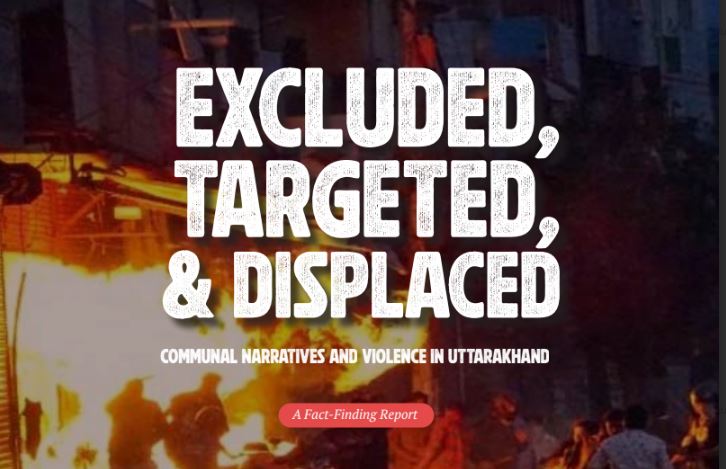
A fact-finding report released by the Association for Protection of Civil Rights (APCR) documents a series of incidents of communal violence, intimidation, evictions, and displacement affecting Muslim individuals and families across multiple districts of Uttarakhand between 2021 and 2025.
The report, titled “Excluded, Targeted, & Displaced: Communal Narratives and Violence in Uttarakhand,” is based on field investigations, victim testimonies, police records, court documents, official notices, and media reports. It records incidents from districts including Uttarkashi, Tehri, Chamoli, Nainital, Dehradun, Haridwar, and Haldwani, and examines how criminal allegations, administrative actions, religious mobilisation, and government policies intersected with communal narratives on the ground.
According to APCR, the report traces how these incidents unfolded over time, the nature of violence and displacement experienced by affected families, and the responses of the police and state authorities in each case.
Details of the Report: A pattern takes shape
According to APCR, communal violence in Uttarakhand cannot be understood as a series of isolated incidents. From 2021 onwards, Muslims across districts have faced targeted violence, economic boycotts, evictions, intimidation, and attacks on religious spaces, often following rumours, allegations, or political mobilisation by Hindutva groups. These incidents occurred across Uttarkashi, Tehri, Chamoli, Nainital, Dehradun, Haridwar, and surrounding regions, affecting shopkeepers, migrant workers, religious institutions, and long-settled families—many of whom had lived in Uttarakhand for decades.
The report notes that many affected Muslim families trace their migration to Najibabad, Uttar Pradesh, dating back to the 1970s and 1980s, well before Uttarakhand became a separate state in 2000. Despite this, they are repeatedly branded as “outsiders.”
The Haridwar Dharm Sansad, 2021: APCR identifies the December 2021 Haridwar Dharm Sansad as a critical flashpoint. At this three-day conclave, multiple Hindutva religious leaders delivered speeches calling for violence against Muslims, the establishment of a Hindutva rashtra, and the suppression of Islam and Christianity. Speakers named in the report include Yati Narasinghanand, Prabodhanand Giri, Yatindranand Giri, Sadhvi Annapurna, Swami Anand Swaroop, and Kalicharan Maharaj.
Police complaints were filed following public outrage, but the report notes that the event contributed to the normalisation of openly violent anti-Muslim rhetoric in the state.
Administrative drives and communal framing: In 2023, the Uttarakhand government initiated a statewide drive to identify and remove “illegal structures” on government land. Right-wing groups framed this as action against “land jihad” and “mazar jihad.” By May 2024, Chief Minister Pushkar Singh Dhami claimed that 5,000 acres had been recovered.
APCR records that mosques and mazars were disproportionately targeted, while comparable scrutiny was not applied to religious structures of other communities. This framing, the report states, created public legitimacy for demolitions and heightened communal tensions.
Purola, 2023- allegations and aftermath: In Purola, Uttarkashi district, a case alleging the kidnapping of a minor Hindu girl by Ubaid Khan and Jitendra Saini triggered widespread unrest. In court, the girl later stated that she had not been abducted and that the police had coerced her statement. Despite the acquittal, right-wing protests escalated.
Muslim families were forced to flee or sell properties. A Hindutva Maha Panchayat was organised, prompting intervention by the Uttarakhand High Court, which reminded the state of its duty to maintain law and order. Following the incident, the Chief Minister announced background verification measures, stating that people would be able to live in Uttarakhand only after verification.
Uttarkashi, 2024- mosque targeting and mob violence: On October 24, 2024, a rally led by Swami Darshan Bharti demanded demolition of the Uttarkashi mosque. The rally turned violent: five police personnel and over 30 civilians were injured, and Muslim shops were vandalised and looted.
Despite assurances to the High Court, a Hindutva Mahapanchayat was allowed on 1 December 2024, where speakers—including BJP MLA T Raja—issued threats involving bulldozers. APCR records that this directly violated the spirit of the High Court’s directions.
Testimonies document shopkeepers suffering losses of ₹50,000 to ₹1 lakh, broken shutters, looted goods, and lasting fear.
Tehri region- Srinagar, Chauras, Kirti Nagar: In Srinagar, Muslims reported being pushed out from Kirti Nagar and Chauras, following “love jihad” allegations. At least 15 shopkeepers were evicted and forced to return to Najibabad.
APCR records how communal narratives entered schools, with teachers recounting speeches about “love jihad” and “land jihad” at official functions. Muslim government employees reported being labelled outsiders and accused of occupying land or jobs.
In Chauras, after allegations about a relationship between a Hindu woman and a Muslim man, at least five Muslim shopkeepers fled, despite no complaint from the woman’s family.
Gauchar, Chamoli- Escalation from a minor dispute: On October 15, 2024, a parking dispute between two men—one Hindu, one Muslim—escalated into communal mobilisation. Right-wing groups intervened, leading to the eviction of at least 10 Muslim shopkeepers.
Families who had lived in Gauchar for 45 years fled overnight. APCR documents mob intimidation at hospitals, vandalism of shops, and police-escorted evacuations.
Nanda Ghat- Forced overnight displacement: Nanda Ghat witnessed one of the most severe incidents. Following an eve-teasing allegation against a Muslim barber, a sequence of protests culminated in large-scale vandalism on September 2–3, 2024. Shops were looted, ₹4 lakh in cash stolen, vehicles thrown into rivers, and a makeshift mosque destroyed.
Police advised Muslims to leave for their own safety. Thirty to thirty-five people were escorted out in police vehicles, effectively evacuating the community. Despite High Court directions later ensuring protection, most families did not return.
Nainital, 2024- Violence following a criminal allegation: In April 2024, after the arrest of Mohammad Usman under POCSO and BNS provisions, protests turned violent. APCR documents stone-pelting, vandalism of Muslim shops, attacks on eateries, and an assault on Nainital Jama Masjid, which is located next to the police station.
Despite repeated requests, additional forces were not deployed for hours. No FIR was registered for damage to the mosque, even after multiple hearings.
Expansion to Haldwani: Following Nainital, right-wing groups moved into Haldwani, pressuring Muslim shopkeepers to change names or shut businesses. Long-standing establishments reported threats after their religious identity became known.
Legislative changes and institutional targeting: APCR documents the passage of the Uniform Civil Code (2024) and subsequent 2025 amendments, along with changes to anti-conversion laws and minority education governance. These laws increased penalties, expanded definitions of unlawful conversion, and altered the structure of madrasa regulation, raising concerns among Muslim communities about loss of autonomy.
The UMMEED portal and demolitions: The report records that the UMMEED portal digitisation drive required all waqf properties to register within a short deadline. Due to technical failures and documentation requirements, 75% of waqf properties remained unregistered. These were automatically classified as “disputed.”
Between June and November 2025, APCR records the demolition of over 300 Muslim shrines and dargahs, including registered properties such as Hazrat Kamal Shah Dargah in Dehradun. The Supreme Court later issued contempt notices in some cases.
Conclusion drawn by the report
The APCR fact-finding report concludes that the incidents documented across Uttarakhand between 2021 and 2025 cannot be viewed in isolation. Based on field investigations and verified records, the report finds that Muslim individuals and families were repeatedly subjected to violence, threats, vandalism, economic exclusion, evictions, and displacement following communal mobilisation, allegations, or administrative action.
The report records that in several locations, police protection was either delayed or inadequate, FIRs relating to attacks on Muslim property and religious places were not consistently registered, and affected families were advised to leave areas “for their own safety.” Many of those who fled had lived in these towns for decades and were forced to abandon homes, shops, and livelihoods without any formal rehabilitation or assurance of return.
APCR further notes that administrative measures—such as demolition drives, verification exercises, and regulatory actions—often coincided with periods of heightened communal tension, deepening insecurity among minority communities. Taken together, the report documents a sustained impact on the safety, dignity, and ability of Muslims in Uttarakhand to live and work without fear, and places these findings on record for judicial, institutional, and public scrutiny.
The report may be read below:
Related:
Bihar under BJP: Hate attacks against Muslims spiral, one dies
India’s Silent Push-Out: Courts, states, and the deportation of Bengali-Speaking Muslims
Weaponising Sufism and Wahhabism to Subjugate Muslims