
The Incident: A robot, mistaken identity — and outrage
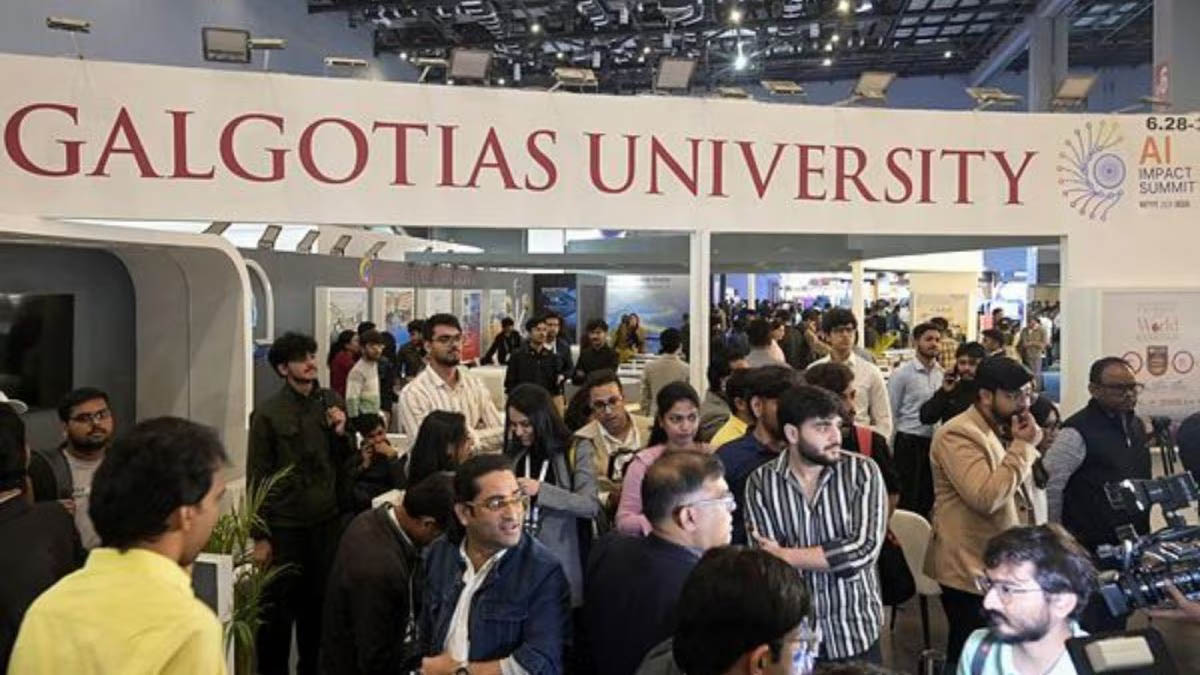
During a high-profile technology expo meant to showcase India’s AI talent, a faculty member from Galgotias University introduced a robotic dog dubbed “Orion,” describing it as a product of the university’s Centre of Excellence.
Almost immediately, keen observers and technology enthusiasts identified the robot as a Unitree Go2 — a commercially available quadruped robot manufactured by a Chinese company, not an original research output of the university.
Videos from the summit circulated widely on social media, and within hours the episode had sparked ridicule, criticism, and questions about transparency and authenticity in India’s tech showcases.
Reports claimed that organisers asked the university to vacate its stall and even had the power at the pavilion switched off in response to the controversy — though the university later contested whether an official expulsion order was issued.
In short: what was meant to signal India’s AI capabilities became a cautionary tale about careless representation, inadequate academic ethics, and short-term showmanship.
Why it matters: Beyond a single mistake
This episode is not just a PR (public relations) embarrassment — it also opens up deeper questions about the culture of higher education in India, the politics of innovation, and the gap between rhetoric and reality in national technological ambition.
1. Education ethics and quality control
Universities — especially those with public visibility — are expected to uphold standards of transparency and academic integrity. Presenting an imported product as original research, even unintentionally, reflects a failure in basic accountability and clarity — a breakdown not just of communication, but of institutional rigor.
For students and faculty, hands-on interaction with advanced devices is legitimate. But conflating exposure to technology with actual development — and doing so in a high-stakes international forum — shows a worrying inferiority complex towards genuine innovation.
A Galgotias “research scholar,” Dharmendra Kumar, published a paper claiming that Covid-19 could be destroyed by sound vibrations from clapping or bells in the Journal of Molecular Pharmaceutical and Regulatory Affairs (Vol. 2, Issue 2, 2020). The claim echoed the March 22, 2020 Janata Curfew clapping exercise promoted by Prime Minister Narendra Modi—an idea later rejected by the scientific community as pseudoscience.
2. Government priorities in practice: Scientific progress vs the religion industry
A comparison of public spending on science, education, and AI with allocations—direct and indirect—towards religion-centric infrastructure reveals more than budgetary arithmetic; it exposes the political priorities shaping India’s future.
The Union government often cites education spending as evidence of commitment to knowledge-building. The Ministry of Education was allocated ₹128,650 crore in 2025–26, with ₹78,572 crore for school education and around ₹47,000–48,000 crore for higher education in recent years. While these figures appear substantial, they must sustain one of the world’s largest student populations, thousands of colleges and universities, and a chronically underfunded research ecosystem. Much of this money merely keeps institutions running rather than creating globally competitive laboratories, doctoral programmes or long-term research capacity.
Technology and AI funding shows a similar contradiction. The Ministry of Electronics and Information Technology received about ₹26,000 crore in 2025–26. Initiatives such as the IndiaAI Mission (around ₹10,300 crore over multiple years) and a ₹500-crore Centre of Excellence in AI for Education suggest ambition. Yet this funding is scattered across missions and pilots, favouring visibility and announcements over sustained investment in universities, basic science, and large PhD pipelines—the foundations of genuine innovation.
In contrast, the religion industry—pilgrimage infrastructure, temple-linked tourism, and heritage projects—commands political attention far exceeding its formal budget share. However, two factors amplify its impact. First is political signalling: religious projects are paired with high-profile inaugurations and constant symbolism. Second are off-budget flows—large temple trusts such as Tirumala Tirupati Devasthanams handle multi-thousand-crore revenues, shaping infrastructure and public priorities without appearing in Union Budget comparison (s) .
The result is an imbalance where science receives headline funds but limited depth, while religion-centred projects enjoy visibility, legitimacy and multiple funding streams.
3. Spectacle Over Substance
The controversy also highlights a broader phenomenon in modern institutional and political culture: preference for spectacle over substance.
Political rhetoric around AI and technological leadership in India has grown aggressively in recent years, with grand claims about digital prowess, global tech leadership, and indigenous innovation. But when those claims are measured against reality, episodes like this reveal a gap between promotional narratives and actual research output.
Rather than noble ambition, this can resemble marketing masquerading as innovation — a dynamic that critics have long pointed to in sectors beyond education.
4. The BJP-RSS Context: Aspirations, perceptions, and overselling
The Bharatiya Janata Party (BJP) and the ideological ecosystem around it, often associated with the Rashtriya Swayamsevak Sangh (RSS), have frequently championed narratives of technological self-reliance, cultural renaissance, and national resurgence. These themes have strong resonances in public discourse.
But when such grand narratives are paired with weak empirical substance, they risk becoming vacant rhetorics rather than effective policy frameworks.
The AI Expo controversy — wherein an institution aligns itself with big claims (Rs. 350 crore AI investment, “in-house innovation” at a global summit) only to be unmasked over a misrepresented robot — can be seen as a symptom of larger systemic issues: an overreliance on image management, lack of emphasis on foundational science and research, and the temptation to equate presence with excellence.
These are not problems unique to any one institution, but they are exacerbated when political discourse prioritises bravado over authentic capacity building.
Conclusion: A moment of reckoning — or repetition?
The Galgotias AI Expo debacle is uncomfortable because it holds up a mirror: it reflects not only the pitfalls of one university’s presentation, but also the gap between aspiration and achievement in India’s drive toward global tech leadership.
If the goal is genuinely to build an AI-savvy workforce and world-class research ecosystem, then substance must matter more than spectacle, and integrity must undergird promotion. This requires honest assessment, a political leadership that promotes scientific progress over religious industry, rigorous academic culture, and an intellectual climate that values long-term capacity over short-term optics.
Only then can institutions — and the nation — move beyond tall claims and hollow applause toward genuine innovation, learning, and progress.
(The author is a mechanical engineer and an independent commentator on history and politics, with a particular focus on Rajasthan. His work explores the syncretic exchanges of India’s borderlands as well as contemporary debates on memory, identity and historiography; he can be contacted on adityakrishnadeora@gmail.com)
Disclaimer: The views expressed here are the author’s personal views, and do not necessarily represent the views of Sabrangindia.
Related:
Public Education is Not a Priority in Union Budget 2025-26
Higher Education: How Centre is Undermining State Autonomy & Politicising UGC
Public Vs Private Education – A New Experiment By Y.S.Jagan Mohan Reddy