
The CJP protests at Jantar Mantar have brought back echoes of the Gandhian tradition of sustained people oriented struggles. Beyond the speeches and slogans, they have revealed how enduring democratic movements are sustained by relationships of trust, friendship, disagreement and shared moral purpose forged in the midst of collective struggle.
Writer and researcher Anu Jain revisits Mahatma Gandhi’s closest political and personal bonds in this series which offers a timely reminder that transformative movements are built not only on charismatic leadership, but on the communities of conviction that grow around it.
For Gandhi, leadership was never a solitary endeavour. It was a collaborative, often demanding dialogue with a close circle of confidants who held up a mirror to him.
This exclusive five-part series explores Gandhi’s deeply complex relationships with five remarkable contemporaries. Three visionary captains of industry who funded and anchored his radical socio-economic experiments, and two towering intellectual peers who served as his ultimate conscience keepers , who were willing to challenge his decisions when no one else dared.

Together, these five bonds did more than just steer the course of the independence movement; they directly shaped the deeply personal, moral, and political choices of the Mahatma himself.
Read on the unique bond that Gandhi shared with Rabindranath Tagore here.
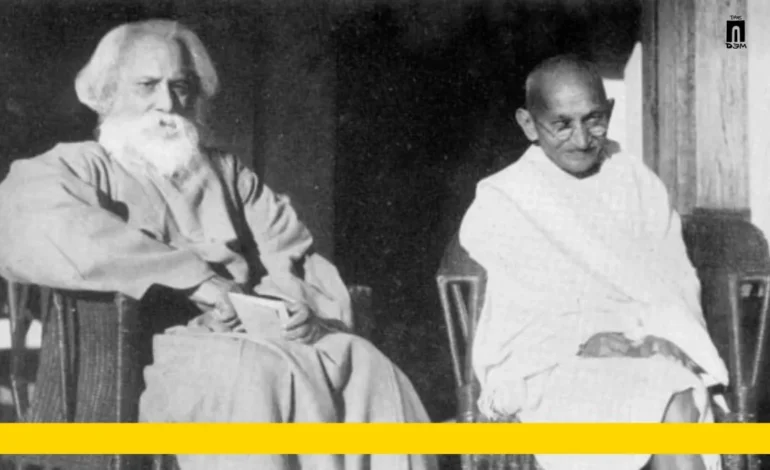
When the French philosopher Romain Rolland looked across the global landscape of the early twentieth century, he observed a magnificent, unprecedented spectacle unfolding on the Indian subcontinent. He described it as the simultaneous gathering of “two great rivers”, towering, majestic currents of human thought flowing from vastly different geographical and spiritual sources. Yet, rushing forward to nourish the very same civilisational soil. One river was Mohandas Karamchand Gandhi, the other was Rabindranath Tagore.
Theirs was a relationship that defied the ordinary grammar of political alliances or personal friendships. It stands as one of the most remarkable intellectual and moral engagements in human history, a thirty-year “noble debate” that fundamentally expanded the moral vocabulary of freedom.

They did not always walk in lockstep, in fact, they disagreed on almost everything from the economy of the spinning wheel to the very meaning of a nation. Yet, their relationship was defined by a rare, luminous intellectual companionship where dissent itself became an act of profound love. They did not argue to defeat one another, but to refine one another.
In an era where differences so often degenerate into hatred, the story of Gandhi and Tagore reminds us that a nation’s soul is not built on a fragile, forced consensus, but on the capacity of its greatest minds to disagree with absolute dignity.
“Mahatma” and “Gurudev”
The very names by which history remembers these two titans are beautiful, poetic gifts they bestowed upon each other. To the world, Gandhi became the Mahatma (The Great Soul), and Tagore became Gurudev (The Divine Teacher). Yet, the historical roots of these titles reveal a far more fascinating, layered evolution than popular memory suggests.

The sacred title of “Mahatma” was not suddenly invented by Tagore in a vacuum. Long before it became a household word, Gandhi’s closest confidant and financial supporter, Dr. Pranjivan Mehta, had quietly used the term in private correspondence, most notably in a deeply perceptive letter to the moderate leader Gopal Krishna Gokhale, recognising the saintly quality of the lawyer returning from South Africa.
But it was Tagore who took this private whisper and transformed it into a thunderous national reality. Using the immense weight of his global literary authority, Tagore publicly crowned Gandhi with the title, giving the illiterate millions of India a vocabulary of reverence for the man in the loincloth.
Gandhi, in turn, bowed before the poet’s towering cultural and philosophical mastery, christening him Gurudev. This exchange of titles was a beautiful, public contract of mutual recognition: an acknowledgement that while one was the undisputed master of political action, the other was the sovereign ruler of the human mind.
Capital and Culture

Nowhere did this hidden current of solidarity manifest more beautifully than in the physical sanctuary of Santiniketan, Tagore’s legendary open-air educational experiment in Bengal. Founded on the romantic ideals of intellectual freedom, artistic expression, and global humanism, Santiniketan was a paradise of the soul but a recurring nightmare for the checkbook. The ashram-school was chronically broke, permanently burdened by debt, and dependant entirely on personal donations and the fading physical energy of its ageing founder.
By the mid-1930s, the crisis had reached a breaking point. Tagore, already in his frail seventies, felt compelled to pack his bags and travel across the country with a student performance troupe, staging plays in cities like Delhi just to collect a few scattered rupees to keep his school alive. Hearing of this, Gandhi was deeply shaken.
Though Gandhi had spent decades publicly criticising elite, literary, and urban-centred education, advocating instead for basic manual training (Nai Talim), he refused to let his ideological disagreements blind him to Santiniketan’s civilisational value. He recognised that if Tagore’s school died, a vital lung of the Indian spirit would stop breathing.
Gandhi immediately dipped his pen in ink and sent a deeply emotional letter to the poet, telling him that it broke his heart to see the great Seer of India begging for funds on the public stage. Gandhi vowed to strain “every nerve” to lift this financial anvil from the poet’s shoulders.
True to his word, Gandhi deployed his silent network of wealthy industrialists. Within a matter of months, he slipped a Rs. 60,000 bank draft, an astronomical fortune at the time, into an envelope and sent it to Bengal with a triumphant message:
“God has blessed my poor effort. And here is the money. Now you will relieve the public mind by announcing the cancellation of the rest of the programme.”
With characteristic moral delicacy, Gandhi never told Tagore where the money came from. He purposefully concealed the fact that the entire sum had been cut from the checkbook of his close supporter, the industrialist Ghanshyam Das Birla.

This single episode completely dismantles any simplistic caricature of Gandhi and Tagore as bitter ideological enemies. Here was Gandhi acting as the silent, invisible bridge between industrial capital and artistic culture, using the wealth of a billionaire to protect the independence of a poet who regularly criticised his political movements. Santiniketan was no longer just Tagore’s dream, it had become a shared moral investment for the entire nation.
Fault Lines of Two Minds
The grand public debates between Gandhi and Tagore were carried out in the pages of journals like Young India and The Modern Review. They were watched with bated breath by millions of citizens, offering a masterclass in intellectual integrity. Their arguments were not petty squabbles, they were foundational clashes between two completely different visions of human liberation.
For Gandhi, Satyagraha was the ultimate weapon of human liberation, a “soul-force” or “love-force” rooted in absolute truth and self-suffering. Gandhi believed that by fasting and absorbing suffering without retaliation, an individual could melt the heart of the most brutal oppressor.
Tagore, however, watched this with deep intellectual scepticism. While he marvelled at Gandhi’s personal purity, he terrified himself with the thought of what happens when Satyagraha is mass-produced for millions of uneducated followers. He feared that for the masses, Satyagraha would cease to be an active moral choice and would instead become a form of blind, hypnotic obedience, a mechanical ritual that substituted one form of conformity for another. Tagore argued that India’s deep disease was a “slave mentality,” and the cure was a sharp, intellectual awakening of the individual mind, not the emotional intoxication of mass rallies.

Gandhi defined Swaraj (Self-rule) as something far deeper than merely replacing a British governor with an Indian prime minister. He defined it as not by the acquisition of authority by a few, but by the acquisition of the capacity of all to resist authority when it is abused.
For Gandhi, Swaraj was an exercise in rigorous self-restraint, localised governance, and decentralised village power. Tagore, conversely, was deeply suspicious of the very machinery of the modern political state. In his seminal essay The Call of Truth, he warned that an indigenous government could be just as cold, cruel, and oppressive as a foreign one if the minds of the people remained chained to dogma and superstition. To Tagore, true Swaraj was not a political flag flying over a parliament building, it was the total liberation of the human spirit, a mind that was completely fearless, creative, and open to the cosmos.
The Charkha
Perhaps no object symbolised their deep divide more dramatically than the Charkha, the wooden spinning wheel. Gandhi elevated the Charkha into a holy sacrament. He demanded that every Indian, whether doctor, lawyer, or peasant, spend at least half an hour every single day spinning cotton. For Gandhi, the Charkha was a brilliant economic weapon against British textiles, a direct link to the suffering of the starving millions, and a beautiful lesson in physical labour.

Tagore openly revolted against this directive in his provocative 1925 essay, The Cult of the Charkha. He argued that forcing a brilliant scientist, an artist, or an intellectual to spin a wheel for thirty minutes a day was an insult to human intelligence. He called it a monotonous, mind-numbing exercise that deadened creativity, pointing out that India’s crippling poverty could only be solved through modern science, agricultural machinery, and creative engineering, not by turning the entire population into uniform, spinning automatons.
Gandhi hit back with fierce, poetic passion, writing that to a starving man, God can only appear in the form of bread, and that spinning was a beautiful form of collective prayer for a broken country.
Clash of Reason
The most explosive and revealing confrontation between the two men occurred in the early months of 1934, following a monstrous, cataclysmic earthquake that ripped through the province of Bihar, flattening cities and killing thousands.
Gandhi, travelling through South India at the time, made a public announcement that stunned the intellectual elite. He declared that the devastating earthquake was not a random geological accident, but a direct, divine punishment sent by God to avenge the ancient sin of untouchability. He argued that the earth had literally fractured because high-caste Hindus had spent centuries fracturing the dignity of their Dalit brothers and sisters.
Tagore was profoundly appalled by this statement. He immediately published a blistering, public rebuke, accusing Gandhi of spreading dangerous, unscientific irrationalism. Tagore argued that physical laws operate blindly across the universe, entirely independent of human ethics. To tell uneducated villagers that a physical earthquake was caused by moral sins, Tagore warned, was to reinforce the very forces of blind superstition and fatalism that kept India backward.

Yet, even in this moment of raw, public collision, the exquisite tone of their engagement remained intact. Gandhi did not attack Tagore’s character, nor did his followers burn the poet’s books. Gandhi published his defence in Harijan, calmly stating that while he bowed to the poet’s superior scientific knowledge, he possessed an unshakeable faith in the mysterious connection between cosmic events and human morality.
Their public letters became a legendary historical archive: an unforgettable proof that two human beings could fiercely debate the laws of physics and God without losing a single ounce of mutual love.
Conversions at the Horizon
For all their spectacular public battles, if one travels down these two great rivers to their ultimate destination, they converge on the exact same moral horizon. Beneath the surface noise of their debates lay an absolute, unbreakable unity of purpose: a shared, uncompromising devotion to human dignity.
Tagore spent his entire life warning the world against the horrific, mechanical monster of aggressive nationalism, describing it as a soul-crushing apparatus that destroys human freedom. Gandhi, though the commander-in-chief of a massive nationalist movement, arrived at the exact same conclusion. He repeatedly stated that his vision of nationalism was completely inclusive, and that he supported independence only so that a free India could voluntarily surrender its sovereignty to a democratic world federation grounded in non-violence.
This deep spiritual convergence was recognised by Tagore himself during a quiet visit to the Sabarmati Ashram. Standing before the community, the poet remarked that the true meaning of the “Mahatma” was a man who had successfully realised his own inner self within the heartbeat of all humanity, completely melting away the artificial walls of nation, caste, and identity.
The Modern Verdict

The long, brilliant dialogue between Mahatma Gandhi and Rabindranath Tagore was never resolved. When Tagore drew his last breath in 1941, followed a few years later by Gandhi’s martyrdom in 1948, they left behind two completely distinct, unmerged blueprints for the liberation of the human race. Tagore passed away still sceptical of mass politics, Gandhi died still committed to it. Tagore remained the champion of intellectual cosmopolitanism, Gandhi remained the high priest of localised ethical discipline.
Yet, the ultimate significance of their relationship lies precisely within that unresolved tension. They proved to the world that harmony does not mean uniformity. In our modern twenty-first-century landscape, a fractured world deeply polluted by tribalism, echo chambers, cancel culture, and instant polarisation, their “noble debate” shines across the decades like a burning beacon of hope.
They leave behind an immortal, luminous standard for the intellectual life of global democracy. A lesson that true respect does not mean silent acquiescence, and that critique is the highest form of solidarity. Gandhi and Tagore remind us until the end of time that we can hold completely different versions of the truth, we can fight fiercely over the pathways of freedom, and yet we can still march hand-in-hand toward the liberation of the human soul.
Courtesy: The AIDEM