
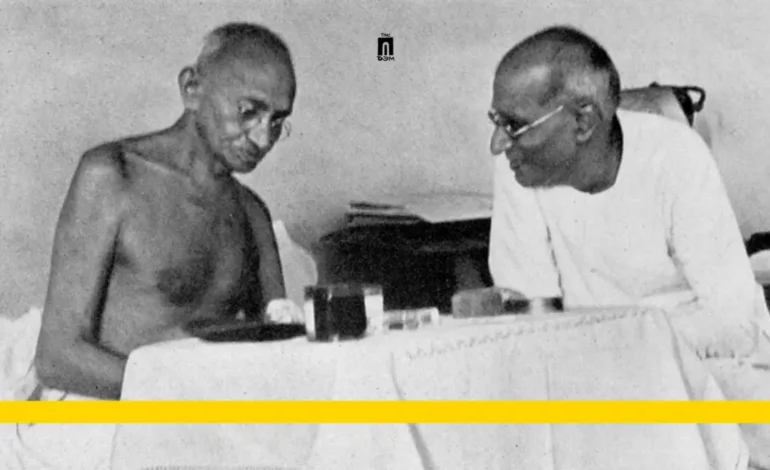
True political and moral authority is rarely forged in isolation; it is tested and tempered through rigorous intellectual honesty and fierce accountability. Beyond the iconic imagery of the independence struggle, the Gandhian movement was sustained by profound relationships built on trust, pragmatic disagreement, and a shared devotion to a higher cause.
Writer and researcher Anu Jain revisits Mahatma Gandhi’s closest political and personal bonds in this series, offering a timely reminder that transformative movements are built not merely on charismatic leadership, but on the unyielding sentinels of conscience who surround it.
For Gandhi, leadership was never a solitary endeavour. It was a collaborative, often demanding dialogue with a close circle of confidants who possessed the moral courage to hold up a mirror to him.
This exclusive five-part series explores Gandhi’s deeply complex relationships with five of his remarkable contemporaries. Together, these five bonds did more than just steer the course of the independence movement; they directly shaped the deeply personal, moral, and political choices of the Mahatma himself.
Read on the unique bond that Gandhi shared with Chakravarti Rajagopalachari here.
In mid-June 1920, a letter arrived at the Sabarmati Ashram in Ahmedabad that would make the most powerful moral leader in India stop and think.

The sender was neither a British Viceroy threatening imprisonment, nor a political rival launching a public attack. It was Chakravarti Rajagopalachari, affectionately known as Rajaji, a brilliant lawyer from Madras with a razor-sharp intellect and a quiet, unassuming demeanour. At a time when millions across the subcontinent were beginning to view Mohandas Karamchand Gandhi as an infallible saint whose every word was law, Rajaji dared to do the unthinkable. He held up a mirror to his Master’s soul and told him he was on the brink of ruin.
Gandhi was entangled in a deeply intense, emotionally charged relationship with Saraladevi Chaudhurani, a brilliant and charismatic nationalist writer. He had begun to call her his “spiritual wife” and was privately contemplating a public declaration of their unique bond. To the outer world, Gandhi seemed unstoppable, reshaping the Indian National Congress into a thunderous mass movement. But in the quiet corners of his private life, he was navigating a profound emotional labyrinth.
Question of Accountability
Rajaji refused to remain silent while other members of Gandhi’s inner circle, such as his loyal secretary Mahadev Desai, watched in nervous silence and submitted to the Mahatma’s whims. He realised that Gandhi’s unwavering moral purity, rather than political strategy, was his greatest weapon against the British Empire. To jeopardise that purity would be to capsize the ship that held the hopes of a whole country.
This is the story of an extraordinary bond, what Mahadev Desai called an “intellectual wedding.” It is the chronicle of a friendship that proved the Gandhian movement was never a cult of blind obedience, but a crucible of fierce moral accountability.

Born into a traditional Iyengar Brahmin family in the Madras Presidency, Rajaji was a man built on classical learning, strict ethical reasoning, and the analytical precision of a seasoned legal mind. When he answered Gandhi’s call to join the nationalist struggle, he left behind a highly lucrative law practise. But he did not leave behind his critical faculties. To Rajaji, loyalty did not mean the suspension of judgement. He loved Gandhi, but he loved the moral clarity of the cause more.
When Gandhi wrote to his Tamil protégé hinting at a deeper, public acknowledgement of his relationship with Saraladevi, Rajaji’s response was immediate, urgent, and fiercely protective. Though Gandhi’s original letter to Rajaji has been lost to time, fragments of Rajaji’s reply from June 16, 1920, survive as a testament to ultimate moral courage.
Rajaji did not mince words. He warned Gandhi that any public step toward validating this “spiritual marriage” would bring “unutterable shame and ruin,” effectively destroying “all saintliness, all purity, all asceticism, all India’s hope.” To drive his point home, Rajaji invoked a magnificent and terrifying metaphor:
“How could you venture out… when in your boat was the faith and fate of millions of simple souls who, if the boat had capsized, would have seen neither beauty nor love nor grandeur, but unspeakable shame and death.”
Rajaji had briefly met Saraladevi, and his legal mind was entirely unimpressed by her charms. In an unusually harsh and candid assessment, he wrote to Gandhi:
“I fail to see any ‘greatness’ in the lady. She is like a hundred other women, whom a little education makes very attractive. I have seen scores of bigger-minded and better-souled women.”
Then, turning his gaze toward Gandhi’s steadfast wife, Kasturba, he drew a stinging contrast. To compare Saraladevi to Kasturba, Rajaji noted, was like “comparing a kerosene oil lamp to the morning sun.”
Rajaji did not spare Saraladevi further, criticising her “reckless indifference to consequences.” His final directive to his Master was absolute: “Pray disengage yourself at once completely. No delay is allowable when you hold such great trusts.”
This letter was a magnificent act of bravery. In 1920, Gandhi was fast becoming a deity in the Indian imagination. To challenge him on his private affections was highly dangerous. But Rajaji understood a fundamental truth about Indian society. Gandhi’s public authority rested squarely on his ascetic image. While old Hindu traditions technically permitted polygamy, the heartbeat of Indian social practise fiercely favoured monogamy. Had Gandhi publicly embraced another partner, even under the lofty banner of a “spiritual union“, he would have fractured his credibility among ordinary citizens, crippling the moral foundation of the freedom struggle.

Gandhi was visibly shaken by the raw frankness of Rajaji’s intervention. Though the emotional disentanglement was slow, agonising, and complex, the warning worked. The grand idaea of a public declaration was dropped. By December 1920, Gandhi took the definitive step to close that chapter of his life.
Writing back to Rajaji, Gandhi quietly confirmed the victory of his friend’s counsel:
“Yes, your guess is correct. The fair friend is Saraladevi. She wants to bombard me with more stuff but I have refused to give further accommodation.”
The Mahatma had been saved from his own vulnerability by his conscience keeper.
Public Triumph
While this private storm was being weathered, the year 1920 saw Gandhi achieve unprecedented heights on the public stage. The contrast between his private crisis and his public triumph was breathtaking.
Gandhi threw himself into a massive tour of the Madras Presidency, travelling alongside the flamboyant Muslim leader Shaukat Ali. They were an unlikely pair, Shaukat Ali, loud, booming, and dressed in striking, theatrical outfits. Gandhi, soft-spoken, slender, and wrapped in simple homespun cloth. Yet, Gandhi deeply admired Ali, describing him to the English missionary C.F. Andrews was “one of the most sincere of men I have met… generous, frank, brave and gentle.”

As they moved through towns like Kumbakonam, Madurai, Trichy, Calicut, Kasargod, and Mangalore, giant crowds gathered. Crucially, women poured out to join these meetings, signalling a massive shift in the social fabric of Indian politics. Standing right beside Gandhi throughout this gruelling tour was Rajaji, acting as his voice, translating his complex ethical ideas into fluent, evocative Tamil, and seamlessly connecting the Mahatma to the masses.
That same year, at the historic Nagpur session of the Indian National Congress, Gandhi completely revolutionised the party’s architecture. He dissolved the old British administrative divisions and reorganised the Congress along linguistic lines, ensuring people could participate in their own mother tongues. He established a beautifully organised hierarchy of elected committees stretching from remote rural taluks and districts all the way up to the All India Congress Committee (AICC) and the executive Congress Working Committee (CWC).
Most importantly, he opened the doors to the poor. For a tiny, nominal fee of just four annas, any adult could join. Within a single year, the Congress transformed from an elitist, English-speaking debating club into a roaring mass movement of nearly two million members. Gandhi was building a nation, even as he was correcting a personal misjudgement.
By 1921, the political landscape grew heavy with tension. The movement was fracturing under the weight of the violent Moplah rebellion and a general sluggishness in the adoption of Khadi. During this dark period, Gandhi’s appreciation for Rajaji deepened immensely. He saw in the Tamil leader a rare combination of “wisdom, integrity and ability,” noting with relief that Rajaji was one of the very few who “fully understood the meaning of our struggle.”
It was during this southern tour, in the historic city of Madurai, that Gandhi made a decision that would forever define his visual legacy. For years, since his days in Barisal, Bengal, he had contemplated shedding his traditional clothes to fully identify with the poorest of the poor. Everywhere he went, poor labourers told him they simply could not afford khadi. It was too expensive compared to cheap, imported British mill cloth.
In a moment of profound empathy, Gandhi decided to discard his shirt and cap, adopting the simple, humble loincloth for the rest of his life. It was a radical, embodied identification with India’s destitute.

When he broke the news to his inner circle, a fierce debate erupted. Maulana Azad understood the brilliant moral logic immediately. But Rajaji, ever the cautious pragmatist, was deeply unsettled. He worried that such a drastic, sudden transformation would alienate the public, making Gandhi look eccentric, erratic, or as Gandhi himself later recalled, a “lunatic.” Rajaji’s criticism was grounded in political prudence. He looked at symbolic acts through the cold lens of social intelligibility and political fallout.
Conversely, C.F. Andrews embraced the move with deep sympathy, seeing it as an authentic, beautiful act of solidarity. This friction perfectly highlighted the unique ecosystem around Gandhi. Rajaji’s practical scepticism and Andrews’ moral idealism acted as vital guardrails, shaping the conversational, evolving nature of Gandhian leadership.
Yerwada Jail
The ultimate test of this intellectual intimacy came in March 1922, when the British colonial state finally arrested Gandhi. The great Non-Cooperation experiment was paused, and Gandhi was escorted under heavy guard from Ahmedabad to Poona, passing through the iron gates of Yerwada Jail on the evening of March 21.
The prison bureaucracy attempted to strip the Mahatma of his historical magnitude, entering him into the ledger as routine text: Inmate No. 827, charged under Section 124A of the Indian Penal Code for exciting disaffection towards the government.
But walls could not contain the movement. On April 1, 1922, during his very first permitted visitor window, Rajaji arrived at the prison gates alongside Gandhi’s son, Devadas, and the social reformer A.V. Thakkar.
Rajaji carefully observed his Master’s life behind bars and penned a vivid, moving account for Young India. He described a leader living under relentless surveillance, locked away in solitary conditions, yet maintaining an iron-clad, joyful routine of prayer, reading, and spinning. These written dispatches were crucial. They kept the flame of Gandhi’s moral authority burning bright in the hearts of the public, proving that the Mahatma remained unbroken even in captivity.

Their conversations in jail were a continuation of a profound intellectual dialogue that had begun years earlier in 1919. Back then, Gandhi had shared his deep anxieties with Rajaji regarding rising Hindu-Muslim tensions and the terrifying prospect of a militarised India, warning that normalising armed forces would turn the liberated nation into nothing more than “an armed camp.”
Medical Crisis
In January 1924, this bond of trust faced a sudden physical crisis. Still a prisoner, Gandhi developed acute appendicitis. In the dead of night, during a raging thunderstorm, he underwent emergency surgery at Sassoon Hospital in Poona. Facing extreme physical vulnerability, Gandhi’s immediate instinct was to surround himself with his trusted circle, summoning V.S. Srinivasa Sastri and Dr. V.D. Phatak to his bedside before the scalpel touched his skin.
Throughout these dark intervals of imprisonment and near-fatal illness, Rajaji remained the unshakable interpretive bridge between the secluded leader and a waiting nation. Following his subsequent release, Gandhi moved to a beachfront bungalow in Juhu to recover.
Once he was out of jail, Gandhi’s daily schedule was modified. He still woke up at 4:30 a.m. and said his prayers. At six he had a light breakfast, then took a short walk within the compound of the cottage. From then until midday he attended to his correspondence in English and in Gujarati, dictating letters and articles to a shorthand typist. He rested in the afternoon, saw visitors, and then took a forty-minute walk on the seashore. On his doctor’s advice, he had not yet resumed spinning.
Juhu, the suburb where Gandhi was recovering, was easily accessible from the city by rail and road. A stream of visitors, mostly uninvited and unannounced, descended daily from Bombay. Gandhi was finally forced to issue a public appeal, asking people to come see him between five and six in the evening only.
“The capital of energy at my disposal is very small, and I want to utilise it only in service. I wish to resume editorship of Navajivan and Young India from next week. And I need absolute quiet for that work. If all my time and energy are taken up in seeing and entertaining you, it will not be possible for me to edit the weeklies in the way I desire.”
Among those keen to see Gandhi was M.A. Jinnah’s young wife, Ruttie. She sent a basket of strawberries, with a note saying she wanted to come too, but was nervous lest it interfere with his health.
“I should hate to think that what to me is a source of pleasure must inevitably prolong the struggle for recovery. But you must know, that like the rest of the world, I too am dying to see you, so when I can legitimately do so, I shall expect a line or a word of permission.”
It is not clear whether Mrs. Jinnah in fact visited Gandhi. But plenty of other admirers descended on the cottage in Juhu. Almost immediately, Juhu became what Rajaji described with characteristic irony as a “general ward” of visitors. Writing to Mahadev Desai, Rajaji sarcastically complained:
“I understand that Juhu has become another general hospital. At Poona it was a special ward. but it is now a general ward of all consumptives and melancholics, and a ward without divisions for sexes.”
Rajaji’s remark was not merely administrative irritation. It reflected his consistent, protective concern that Gandhi’s physical body was being overexposed to the relentless demands of political devotion, treating his critical convalescence as public access.

Logistical Custodianship
This tension between intimacy and overload reappeared repeatedly over the following decade. In 1927, when Gandhi fell seriously ill again while touring Nandidurg, it was Rajaji who ensured not only medical care but also continuity of comfort and routine. He went so far as to meticulously arrange for fresh goat’s milk to be sent daily from Madras via train to Bangalore, collected at Tumkur, and carried up to the hill station so it was available for Gandhi during his health recovery stay. The detail is small, but revealing: Rajaji was not only a political interpreter of Gandhi, but also a literal logistical custodian of his fragile body.
The intimacy of this care sat alongside Rajaji’s growing unease with Gandhi’s relentless pace. In private correspondence, he increasingly expressed anxiety about overwork, overexposure, and the structural exhaustion of the movement itself. Yet this concern never became withdrawal. Instead, it deepened his function as Gandhi’s stabilising interlocutor, someone who absorbed strain so that Gandhi could continue outward expansion.
By the late 1920s and early 1930s, this relationship had become completely central to the functioning of the Congress movement itself. During Gandhi’s Tamil Nadu tour in 1927, it was Rajaji who designed the entire itinerary, coordinated meetings, and shaped the organisational logistics of mass mobilisation. The spinning campaigns that followed, where donation boxes moved through crowds after each meeting, depended heavily on Rajaji’s unique ability to translate high Gandhian ethics into airtight administrative practise.
Following the Poona Pact of September 1932, Mahatma Gandhi renamed his weekly Harijan, reflecting his conviction that the abolition of untouchability was as vital to India’s future as political independence. The term soon gained widespread acceptance among the Hindu middle classes and the nationalist press, although Dr. B.R. Ambedkar firmly rejected it and never used it for the community he represented.
The Anti-Untouchability League, established after Gandhi’s fast, was also renamed the Harijan Sevak Sangh (Servants of the Harijans). The change was intended both to popularise Gandhi’s preferred term “Harijan” and to distinguish the organisation from the Anti-Untouchability League already run by social reformer V.R. Shinde.
Rajaji, however, strongly objected to the new name. He argued that calling the organisation the Harijan Sevak Sangh implicitly accepted the continued existence of “untouchables” as a separate group. Instead, he proposed the name Untouchability Abolition League, emphasising that the real objective was not merely to serve a community but to eradicate the social evil itself. As Rajaji explained, they were striving for “the abolition of a slave status,” and the word “abolition” conveyed the purpose far more clearly than “service.”

Gandhi did not consider the issue decisive, remarking, “the Sangh will not succeed or fail because of the name. It will be judged by its work.” Nevertheless, because the suggestion came from Rajaji, whom he deeply respected, Gandhi asked G.D. Birla and A.V. Thakkar to examine the proposal.
Although Thakkar acknowledged that Rajaji’s reasoning had “much logic,” the proposal was rejected on practical grounds. The organisation’s name had only recently been changed from the Anti-Untouchability League to the Harijan Sevak Sangh, the Board had approved it, the press had announced it, and official stationery had already been printed. Thakkar argued that proposing another change so soon would invite ridicule from both the Board and the public. Consequently, despite admitting that Rajaji’s suggestion was reasonable, the Board considered it inexpedient.
The episode illustrates the tension between principle and administrative convenience. While Rajaji’s proposed name more directly expressed the mission of eliminating untouchability and avoided the paternalistic overtones of “Harijan Sevak Sangh,” bureaucratic inertia and concern over public perception ensured that the existing name remained unchanged.
Social Challenge
Gandhi’s son Devadas, still unmarried and a brahmachari, was deeply loved by his mother and also by his father. Indeed, it was only with his youngest son that Gandhi shared something like a normal relationship. However, Devadas had fallen in love with Lakshmi, the daughter of C. Rajagopalachari (Rajaji). While Gandhi and Kasturba were in Ceylon, they received a letter from a family friend describing how Devadas was wishing for Lakshmi and was determined to marry her. Gandhi replied that Devadas’ condition was pitiable and Rajaji was unlikely to permit the marriage and Lakshmi would not act without her father’s consent. While she remained cheerful, Devadas, Gandhi wrote, had “gone mad” in love, suffering deeply. He added that if such devotion were directed towards God, he might have become a saint. Yet Gandhi also acknowledged that Devadas was torn between obedience and inner rebellion, even resenting his father as an obstacle. Unsure of how to resolve this, Gandhi urged that he be guided towards peace and dharma, admitting he himself might be misunderstanding him.

The situation was further complicated by social realities. Rajaji was a Tamil Brahmin, Gandhi a Gujarati Bania, making this an inter-caste and inter-regional union. Gandhi worried that orthodoxy might seize upon such a marriage to portray him as a dangerous radical, undermining his campaign against untouchability. However, he was mistaken in one respect, Lakshmi’s love was fully reciprocated. The two had first met in June 1924 in Bangalore, where Devadas reportedly declared his love. He later formally approached Rajaji for permission. Rajaji, though fond of Devadas and familiar with him since 1918, remained hesitant.
After consulting Gandhi, the two fathers placed the couple on probation, no meetings or correspondence, to test the durability of their love. If, after some years, their feelings endured, the marriage would be allowed. This arrangement, later recalled by Rajmohan Gandhi, required the couple to wait five years without contact, after which they married with parental approval.
On 16 June 1933, Devadas married Lakshmi in Poona. At the ceremony, Gandhi remarked that Devadas had “robbed Rajagopalachari of a cherished gem” and must prove worthy of it, while praising Lakshmi as true to her name. He expressed hope that the marriage would deepen his bond with Rajaji. Significantly, Gandhi prefaced his remarks by stating that nothing had been done against dharma, an implicit acknowledgement of the inter-caste nature of the union, one typically disapproved by orthodox authorities. Gandhi had by this time come to argue more explicitly that inter-caste marriages were not only permissible but socially desirable, as they could help break down caste barriers and advance the moral regeneration of Hindu society.
This marriage also concretely bound the two families. Lakshmi, Rajaji’s daughter, became Gandhi’s daughter-in-law, further deepening the personal and political relationship between the two leaders.
The Ultimate Testimony
The profound depth of this lifelong bond reached its historical crescendo in the bloody twilight of British rule. When India gained independence amid the horrors of partition in 1947, Gandhi was fasting in Calcutta and Noakhali to stem the tide of communal madness.
The newly appointed Governor of West Bengal, C. Rajagopalachari, looked at his old friend’s fragile body and tried hard to persuade Gandhi not to go on a fast. If he died, warned Rajaji, “the conflagration would be worse.”
Gandhi calmly and beautifully answered: “At least I won’t be there to witness it. I shall have done my bit. More is not given to a man to do.”
Realising the Mahatma’s unyielding resolve, Rajaji then turned around and made a passionate, public appeal to the people of Calcutta. He urged that they must, as soon as possible, restore communal peace and goodwill in the city, as “Mahatma Gandhi had hard work before him in the Punjab, for which he must be spared.”

The city listened, and the miracle of Calcutta was achieved. Reflecting on this monumental triumph, Rajaji told the city’s Rotary Club:
“Mahatma Gandhi has achieved many things in his lifetime, but I do not think he has achieved anything so great, so grand, as he has achieved in Calcutta.”
Architecture of Freedom
The extraordinary relationship between Mahatma Gandhi and C. Rajagopalachari, perfected across the turbulent decades following the early 1920s, reveals a foundational truth about the internal engine of the Indian national movement. Gandhi was a visionary, but he was also human, prone to errors of the heart and miscalculations of the mind. His greatness lay not in a lack of flaws, but in his deliberate choice to surround himself with individuals who possessed the supreme moral courage to stand up and correct him.
Rajaji was never a passive disciple basking in the reflected glory of a saint. He was an independent, brilliant intellectual force who stabilised Gandhi’s image during moments of profound personal and political vulnerability. He translated the Mahatma’s speeches for the masses, but more importantly, he translated Gandhi’s ethical responsibilities back to Gandhi himself.
In the grand design of ‘Lesser Known Gandhi,’ this chapter reminds us that true leadership does not survive on blind adulation or the silent acquiescence of yes-men. The unyielding strength of the Gandhian struggle did not rely on the exercise of absolute, uncritical authority. It thrived because of independent sentinels of conscience like Rajaji, men who stood firmly at the threshold of power and ensured that absolute moral accountability was never sacrificed on the altar of political destiny.
Make sure to check back tomorrow for next part of the series as we explore how financial support, morality, and industrial resources forged an unlikely bond between Gandhi and G. D. Birla.
Read the previous article in the series here.
Courtesy: The AIDEM