
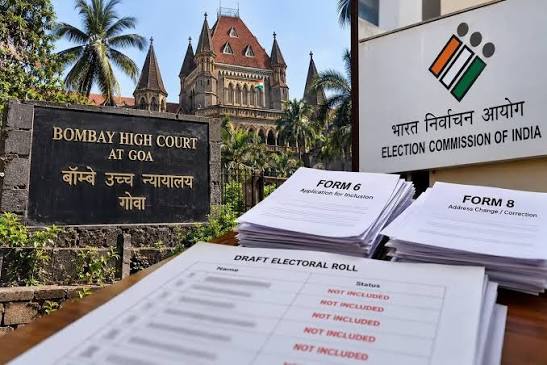
The Bombay High Court’s Goa bench on November 5 directed the Election Commission of India (ECI) to restore the names of six members of a family whose names were deleted from the final electoral roll during the Special Intensive Revision (SIR) in Goa.
A division bench of Justices Valmiki Menezes and Amit Jamsandekar allowed the petitions challenging the deletion of their names and the rejection of their Form 8 applications, which are used by existing voters to update their residential addresses.
The court directed the Booth Level Officer (BLO) of the Santacruz Assembly constituency in Goa to include the petitioners’ names within 10 days, after verifying their residence.
As reported by LiveLaw, the bench said, “We allow the petition… We have rejected the contention of the ECI that the hearing in the present plea be deferred as the issue of SIR is pending before the Supreme Court…. This is not pertaining to SIR… We therefore ordered the BLO of Santacruz Constituency (in Goa) to add the names of the petitioners within a period of 10 days from today.”
The court also refused the ECI’s request to stay the operation of its order for two weeks.
Court questions requirement to submit enumeration forms
The dispute arose after the petitioners, members of the Salgaonkar family, approached the court stating that their names had been omitted from the electoral roll despite submitting Form 8 applications seeking changes to their residential addresses.
The ECI argued that under the SIR guidelines, voters were required to submit a pre-filled enumeration form along with Form 8. Since the petitioners had not submitted the enumeration forms, they were asked to file Form 6, which is meant for fresh inclusion in the electoral roll.
The bench questioned this requirement, pointing out that the pre-filled enumeration form contained a declaration that the elector continued to reside at the address recorded in the existing electoral roll.
Questioning how voters who had shifted residence could be compelled to make such a declaration, Justice Menezes observed:
“If a voter comes to you with Form 8, saying he has changed his address you just cannot tell that person that look your name isn’t included in the draft roll now you will have to fill in Form 6 (inclusion of new voter). Your enumeration form, basically has a declaration that a person continues to live at the address as mentioned in the existing voters list. But consider, if someone has changed their residence, can you compel the person to make a false declaration by submitting that pre-filled enumeration? Why can’t that person simply give a Form 8 because anyway, his name is there in the existing list he just wants to get his address changed.. Why compel enumeration form?”
The bench had also questioned why an existing elector seeking an address correction should be required to apply as a new voter.
Court flags risk of excluding eligible voters
During the hearings, the bench questioned the ECI’s approach of rejecting Form 8 applications instead of keeping them pending for verification. It also raised concerns about the consequences of compelling relocated voters to submit declarations that no longer reflected their actual residential status.
As reported by Bar and Bench, the court flagged a “catch-22 situation” in which voters who had shifted residence faced rejection of their Form 8 applications and were instead directed to submit Form 6, potentially creating further difficulties in establishing their electoral registration.
The ECI, represented by Senior Advocate Ashutosh Kumbhakoni, argued that the draft SIR roll was prepared afresh (de novo) on the basis of newly collected enumeration forms. According to the ECI, voters whose names did not appear in the draft roll could not use Form 8 to modify an existing entry and were required to apply afresh through Form 6 during the claims and objections period.
The court, however, allowed the petitions and directed restoration of the six names. It also rejected the ECI’s request to defer the proceedings until the Supreme Court decides the broader challenges to the SIR process.
The detailed written order is awaited.
Related
Who controls access to voter records? ECINet audit raises fresh questions