
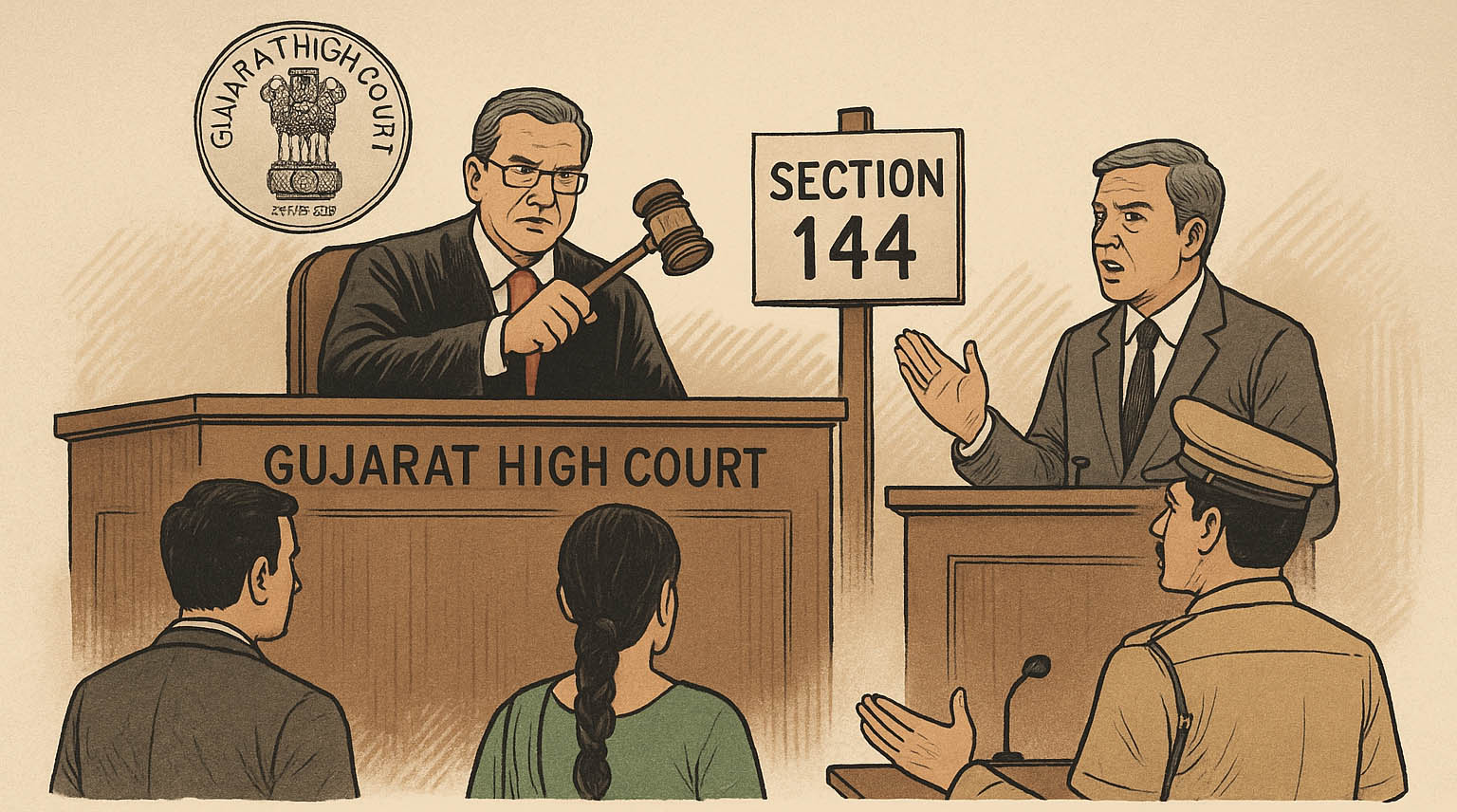
In a significant ruling that sharpens the boundaries of executive power, the Gujarat High Court has held that the Ahmedabad Police repeated and continuous imposition of Section 144 orders—now Section 163 of the Bharatiya Nagarik Suraksha Sanhita (BNSS)—amounted to unjustified, non-transparent, and constitutionally impermissible restrictions on citizens’ rights.
Justice M.R. Mengdey, delivering a detailed judgment in Navdeep Mathur & Ors. v. State of Gujarat on December 4, 2025, has not only quashed all the impugned prohibitory orders, including a 2025 notification under Section 37 of the Gujarat Police Act, but also issued binding directions to the State: future prohibitory orders must be widely publicised through social media and other accessible platforms, as publication only in the official gazette is inadequate and inaccessible to the public. He held that the State had “clearly circumvented” legal protections designed to prevent exactly this kind of prolonged, opaque restriction on public assembly.
Section 144 cannot be a “standing order”: Court questions years of continuous restrictions
The petitioners, peaceful protestors against the Citizenship Amendment Act in 2019, argued that they were prosecuted for violating Section 144 — a provision they never knew had been imposed. The reason became clear once the Court examined the records: from 2016 to 2019, Ahmedabad Police issued one Section 144 order after another, often overlapping, ensuring the city was almost perpetually under prohibitory restrictions. The Court found this argument fully substantiated.
The Court found this deeply problematic:
- No material facts were recorded in the orders
- No emergent circumstances were demonstrated
- No prior inquiry, as required by law, was carried out
- No notice was issued to affected citizens except in supposed “emergencies”
- No attempt was made to use less restrictive measures
This, the Court said, reduced a temporary emergency provision into a standing administrative tool — precisely what Supreme Court precedents warn against.
The judgment shows a clear concern: Ahmedabad Police had normalised an emergency provision, issuing one order after another—sometimes even overlapping—and effectively creating a continuous bar on public assembly for years. As the Court held:
“The material available on record indicates that the Respondent authorities continued to issue Notifications under S.144 of the Code one after the other. Learned Advocate appearing for the Petitioner is right in contending that, on occasions, the subsequent Notification was issued even when the earlier notification was holding the field.” (Para 13)
Such a practice, the Court said, circumvented Section 144(4), which caps the duration of an order at two months unless extended by the State Government. Notably, the State never once invoked its power to extend any of these notifications; instead, the police simply kept reissuing fresh ones.
“No reasons, no facts, no transparency”: Judicial scrutiny exposes procedural vacuum
Justice Mengdey emphasised the principles laid down in Anuradha Bhasin v. Union of India, Gulam Abbas v. State of UP, and Acharya Jagdishwaranand. The law requires:
- Material facts to be recorded
- Reasoned satisfaction of the need for immediate action
- Prior inquiry, unless a genuine emergency prevents it
- Temporary, tightly-tailored restrictions
But the Court found that none of the Section 144 notifications examined contained reasons, factual foundations, or evidence of emergent circumstances.
“As per the settled legal position, these powers being amenable to the judicial review and scrutiny, exercise of it, requires to appear reasonable and therefore, the authorities exercising these powers are also required to give their reasons for the same. The Notifications questioned in the present petition do not bear any reasons given by the authorities for issuing the same. When, by exercise of powers under S.144 of the Code, the fundamental rights or constitutional rights of a class of citizens are being affected, the exercise needs to be transparent. The scheme of the provision of S.144 of the Code itself makes it clear that the authority exercising these powers is required to come to a conclusion that it is necessary to exercise these powers to prevent disturbance to public peace and tranquillity.” (Para 9)
“The impugned notifications do not mention any such material facts. The safeguards and procedure prescribed in the Section are not an empty formality. Their strict adherence is mandatory as the impugned notifications propose to impose restrictions upon the citizens affecting their fundamental rights.” (Para 9)
By affecting fundamental rights without a factual basis, the State had acted in “utter disregard of the safeguards” built into the law.
Failure to use other lawful measures: State cannot label every gathering a threat
A crucial aspect of the judgment is the Court’s reminder that dissent—peaceful protest—is a constitutionally protected exercise of democratic freedom. Section 144 may be imposed only when other methods fail and only as a last resort. Before invoking it, authorities must try less intrusive methods of maintaining public order. Yet the State could not produce evidence showing any such effort.
The Court made this explicit:
“Therefore, prior to resorting to exercise of powers under S.144 of the Code, it was incumbent upon the Respondent authorities to take recourse to the other measures available to them under the law for maintenance of peace and tranquillity and it was only when those measures were found to be insufficient, the powers in question could have been exercised. There is nothing on record to indicate that the Respondent authorities had even taken recourse to the other measures and it was only upon their failure that the powers in question were exercised.” (Para 12.1)
The repeated, blanket restrictions therefore failed the test of proportionality, necessity, and reasonableness.
Court also strikes down the 2025 Ahmedabad Police Commissioner’s order under Section 37 of the Gujarat Police Act
The judgment goes beyond the Section 144 regime. Petitioners pointed out that even after the practice of constant Section 144 orders was discontinued, the State simply switched to issuing equally broad prohibitions under Section 37 of the Gujarat Police Act.
The Court closely examined the Commissioner’s November 3, 2025 notification, which cited vague allegations of violent gatherings in “certain police station areas” but did not specify which areas, when the incidents occurred, or why the entire city needed to be restricted.
The Court concluded the State had:
- Provided no nexus between the facts alleged and the sweeping prohibition imposed
- Curtained legitimate protest across Ahmedabad
- Failed to target actual offenders, instead opting for a city-wide ban that punished peaceful citizens
The same violated principles set out in George Fernandes v. State of Maharashtra, which requires a proximate, rational connection between the threat perceived and the restrictions imposed. Blanket bans fail this test.
“These observations would apply to the facts of the case on hand as well as the authorities concerned have miserably failed in demonstrating any such rationale and proximate connection or nexus between the prohibition sought to be imposed with the necessity for prevention of public order.” (Para 20)
“The aforesaid discussion would make it clear that the powers have been exercised by the respondent authorities in utter disregard of the safeguards provided for exercise of the powers in question. Therefore, the exercise of powers by the authorities appears to be arbitrary in the present case. Therefore, the notification in question including the notification of the Police Commissioner dated 3rd November 2025, are violative of the fundamental rights of the petitioners and therefore, are liable to be quashed and set aside.” (Para 21)
Adjudication despite expiry of orders
The State argued that all the notifications had “expired” and therefore no adjudication was necessary. The Court rejected this. Justice Mengdey emphasised that citizens were still facing prosecution for alleged violation of these notifications, and therefore the validity of the orders directly impacted their liberty.
“It is argued that the Notifications have lived their lives. However, there would be many including the Petitioners, who would be facing prosecution for violation of these Notifications. Therefore, even if the Notifications have lived their lives and are no more in force today, their validity is required to be considered, as, if the same is not done, the Petitioners and many others, would be facing prosecution for violation of the Notification which stands declared arbitrary. Therefore, these Notifications were required to undergo the judicial scrutiny even after their expiry.” (Para 23)
This ensures that criminal proceedings arising from unconstitutional notifications do not continue.
Publicity failure: Official gazette is not enough in the digital era
One of the most important directions in the judgment relates to transparency.
The State claimed that the orders were “widely publicised.” The Court disagreed, noting that the petitioners had demonstrated that the public had no meaningful way to know such orders were in force at all.
Justice Mengdey observed:
“In the present era, mere publication of such Notifications or orders in the official gazette would not be sufficient. Moreover, the public at large has no access to such official gazette. In the era, where several modes of mass communication, including social media platforms are available, it is incumbent upon the Respondent authorities to publish such Notifications / Orders by using such modes. While quashing and setting aside the Notifications impugned in the present petition as well as the Notification dated 3.11.2025 issued by the Commissioner of Police, Ahmedabad City being violative of fundamental rights of the citizens, the Respondent Authorities are hereby directed that, in future, while exercising such powers available under BNSS or Section 37 of the G.P.Act, due care shall be taken for adhering to the procedural aspects and the inherent safeguards required for exercising such powers and the Notifications / Orders issued under these provisions shall be given wide publicity on social media to make the public at large aware about it.” (Para 25)
The Court therefore directed:
- Mandatory publication of all Section 163 BNSS / Section 37 GP Act orders
- On social media, websites, and modern communication platforms
- In addition to regular modes
- To ensure actual public awareness and compliance
This is a major structural direction that significantly alters how prohibitory orders must be disseminated in Gujarat going forward.
A corrective moment for democratic policing
The judgment is a firm reminder that:
- Section 144 cannot be normalised
- Perpetual restrictions on peaceful assembly are unconstitutional
- The State must provide reasons, facts, inquiry, and evidence
- Blanket city-wide bans are disproportionate
- Citizens must be informed through accessible means
- Transparency and accountability are essential before curtailing democratic freedoms
The High Court’s intervention decisively pulls back an executive practice that had been allowed to operate unchecked for nearly a decade.
Conclusion: A decisive reaffirmation of democratic freedoms
By quashing the impugned notifications—both under Section 144/163 and Section 37—the High Court has sent a clear signal that public order powers cannot be used casually or mechanically to stifle dissent.
The ruling enhances procedural safeguards, demands transparency, and restores constitutional balance at a time when administrative reliance on prohibitory orders has become routine across many Indian cities.
The Gujarat High Court’s directions will now require every future invocation of Section 163 BNSS or Section 37 GP Act to satisfy:
- Reason-based scrutiny
- Evidence-based justification
- Prior exploration of lesser restrictive alternatives
- Wide public dissemination for awareness
A crucial precedent, the judgment stands as a robust defence of the right to protest and the constitutional promise that emergency powers must remain exceptional, temporary, and accountable—not a default policing mechanism.
The complete judgment may be read here:
Related:
Does imposition of Sec. 144 indicate Saffronisation of TN state machinery?
Gujarat High Court Widened Anti-Conversion Law: ‘Victims’ can be prosecuted as offenders