
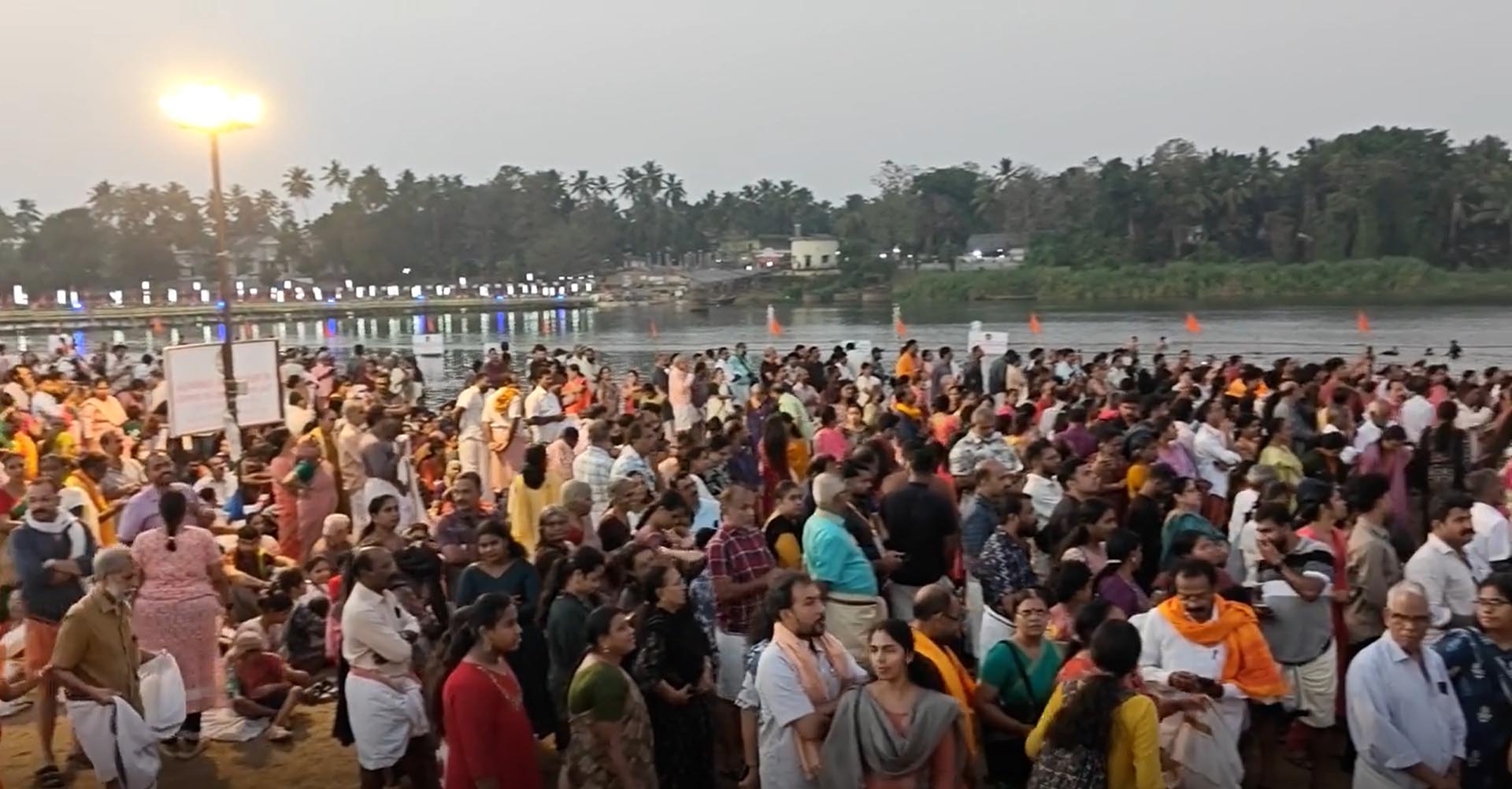
The recently concluded Maha Magha Mahotsavam on the banks of Bharatapuzha in Kerala, inaugurated by its Governor, marks a consequential moment in the reshaping of the state’s public religious landscape. Promoted as “Kerala’s Kumbh Mela,” the event was presented as a cultural revival and a spiritual congregation. Yet, when examined closely, it becomes evident that the Mahotsavam functioned less as a spontaneous expression of inherited faith and more as a carefully curated exercise in the symbolic politics of Hindutva.
Rather than emerging organically from local and lived religious practice, it sought to recast a historically plural, socially embedded river into a singular sacred geography, flattening its layered cultural, ecological and political meanings into a uniform religious spectacle.
The analogy with the Kumbh Mela is particularly revealing. In North India, the Kumbh is anchored in centuries-old institutional frameworks involving akharas, monastic orders, ritual calendars and cosmological cycles that have evolved through long-standing social consent. Bharatapuzha, by contrast, has never functioned as a Pan-Hindu pilgrimage centre. It has no historical association with mass ritual bathing, no priestly networks that regulate sacred time, and no inherited mythological mandate that binds the river to cyclical purification rites. The invocation of “Magha” rituals, the language of sin, cleansing and rebirth, and the visual grammar of saffron spectacle are recent insertions, introduced through publicity materials, digital campaigns and political speeches rather than through inherited community practice. What is being staged is not continuity but construction.
The presence of constitutional authority at the inauguration was therefore not incidental. It conferred institutional legitimacy on an invented ritual format, transforming a curated spectacle into an authorised public act, much as Prime Minister Narendra Modi’s inauguration of the newly constructed Ram Mandir in Ayodhya did. In Kerala, where religious expression has historically coexisted with strong secular institutions, such gestures alter the delicate balance between faith and governance. State endorsement converts cultural experimentation into an assertion of civilisational authenticity. The river becomes not merely a site of gathering but a stage on which new claims to cultural ownership are rehearsed and normalised.
Attempts to anchor the Mahotsavam in history frequently invoke Mamankam, the medieval assembly held periodically near the Bharatapuzha. Yet this historical analogy collapses under scrutiny. Mamankam bore little resemblance to the religious spectacle being staged today. It was neither a Hindu religious congregation nor a ritualised conflict between faiths. It was a political assembly centred on sovereignty, territorial control and the public contestation of kingship. Held once every twelve years, Mamankam was the site where the Zamorin of Calicut asserted his authority even as it was violently challenged by the Valluvanad rulers through the Chaver warriors. These warriors, drawn from specific lineages, attempted ritualised assassinations of the Zamorin, transforming the assembly into a theatre of political resistance. The purpose was not spiritual sacrifice but the destabilisation of power.
Equally central to Mamankam was its plural social composition. Muslim traders, soldiers and administrators were integral to the Zamorin’s political and economic base. Calicut’s emergence as a maritime hub depended on sustained alliances with Arab merchants, and these relationships were embedded in the very structure of power that Mamankam symbolised. To retrospectively frame Mamankam as a Hindu cultural ritual is to erase these realities and impose a communal lens that did not exist in the historical moment. Mamankam was not organised around ritual bathing, mantra recitation or priestly hierarchies. Its rituals were inseparable from warfare, trade negotiations, artistic performances and displays of military prowess.
Thus, translating Mamankam into the idiom of the Kumbh Mela strips away its political and plural character, replacing it with a homogenised religious narrative that is easier to mobilise but historically indefensible.
What distinguishes the Maha Magha Mahotsavam from earlier cultural events in Kerala is the scale and sophistication of its digital mobilisation. Social media platforms have been used not merely to publicise the festival but to frame it as a corrective to an alleged cultural suppression of Hindus in the state. This rhetoric borrows heavily from the national Hindutva lexicon, where visibility is equated with revival and dissent is recast as hostility to faith. Online narratives repeatedly position Malappuram district as a site of cultural imbalance, invoking its Muslim-majority demography to suggest that Hindu traditions require assertive reclamation. This portrayal is not new. Malappuram has long been marked in political discourse as an exception within Kerala, often detached from its historical contributions to trade, education and anti-colonial resistance. By situating a major “Hindu” event at the district’s symbolic edge, the festival implicitly marks territory.
On the ground, this rhetoric has tangible consequences. Local accounts point to heightened communal sensitivity, with Muslim residents expressing discomfort at the language used in promotional material and commentary. Pluralism is not attacked directly; it is simply bypassed. The idea of a “Hindu awakening” advanced here does not celebrate Kerala’s syncretic traditions but seeks to replace them with a uniform cultural script. In doing so, it narrows the definition of belonging and reimagines public space as an arena of assertion rather than coexistence.
Beyond ideology, the Mahotsavam raises pressing questions about environmental stewardship and public safety. Bharatapuzha is among Kerala’s most endangered rivers, its flow depleted by dams, sand mining and encroachment. Large-scale gatherings on its banks inevitably place additional stress on an already fragile ecosystem. The controversy surrounding the proposed temporary bridge illustrates the tension between spectacle and regulation. The stop memo was issued on procedural and safety grounds, including the absence of clearances and concerns over construction in a sensitive river zone. Yet sections of social media discourse reframed this administrative action as a cultural or communal slight, despite no such intent or basis in official orders. This episode highlights a deeper challenge for Kerala: how routine governance decisions are increasingly vulnerable to politicisation when wrapped in the language of faith.
Further, stampedes at religious events have demonstrated how inadequate crowd management, infrastructural shortcuts and political pressure to maximise attendance can result in tragedy. Kerala’s administrative machinery has limited experience managing events of this scale, particularly in ecologically sensitive zones. There is also the question of precedent.
Once a river is reimagined as a ritual bathing site, pressure mounts to repeat and expand such events. Environmental damage then becomes cumulative, justified in the name of a tradition that did not previously exist.
Organisers describe the Maha Magha Mahotsavam not as a culmination but as a beginning, frequently invoking 2028 as the moment when the initiative will reach its full symbolic and participatory scale. This long-term vision underscores the political nature of the project. Cultural transformation is not achieved through singular events but through repetition and institutional backing that generate familiarity; familiarity hardens into memory, and memory eventually masquerades as antiquity. This is how invented traditions become heritage.
Kerala’s historical strength has been its resistance to such flattening. Its public culture has accommodated religious expression without allowing any single narrative to monopolise history or space. The remaking of Bharatapuzha challenges this equilibrium by privileging one interpretation of the past while marginalising others. What is at stake is not merely the character of a festival but the future grammar of Kerala’s public life. Whether history is engaged as a complex inheritance or reduced to a tool of mobilisation depends on how society responds now.
Supporters present the Mahotsavam as spiritual renewal and a gateway to religious tourism, promising economic visibility and regional development. These claims cannot be dismissed outright. Kerala has long benefited from cultural tourism, and pilgrimage economies can generate livelihoods. Yet spiritual tourism is never purely economic. It reorganises space, privileges certain narratives and fixes meaning in ways that are difficult to reverse. When rituals are newly assembled rather than inherited, tourism risks converting memory into spectacle and communities into bystanders to a story told about them rather than with them.
What is unfolding along the Bharatapuzha is not a disagreement over faith but a struggle over authority: who defines culture, how memory is institutionalised, and which identities are permitted to feel native in shared spaces.
The Maha Magha Mahotsavam marks a shift from lived tradition to curated symbolism, where culture becomes less an expression of social life and more a claim to power. In this transformation, history is not engaged as complexity but recruited as an instrument.
The costs are cumulative. Socially, curated spirituality narrows belonging and renders dissent suspect. Environmentally, rivers turned into ritual stages are subjected to pressures that sanctity cannot mitigate. Historically, selective storytelling flattens the past, replacing layered inheritance with simplified images designed for mobilisation. What is lost is not only accuracy but the ethical discipline of living with contradiction.
Kerala’s pluralism was never ornamental. It was forged through negotiation, overlap and unresolved differences. The remaking of Bharatapuzha tests whether that inheritance will endure or yield to a politics that prefers clarity over truth. Culture can evolve, and tourism can coexist with tradition, but only when history remains a conversation rather than a commodity, and public space remains a site of coexistence rather than conquest.
(The author is an Indian author, political analyst and columnist. His debut book, The Essential (2023), was launched by Dr. Shashi Tharoor and features a foreword by former External Affairs Minister Salman Khurshid. His research and commentary have appeared in IJPA, Global Policy Journal, South Asian Voices, ORF, The Unpopulist, SAGE, among others, and leading dailies.He posts on ‘X’ at @ens_socialis)
Related:
Kerala MP protests RSS’ attempt to “infuse Christmas” with sectarian song
From God’s Own Country to a Hindutva Target: Kerala’s Model of Harmony Faces Persistent Threats