
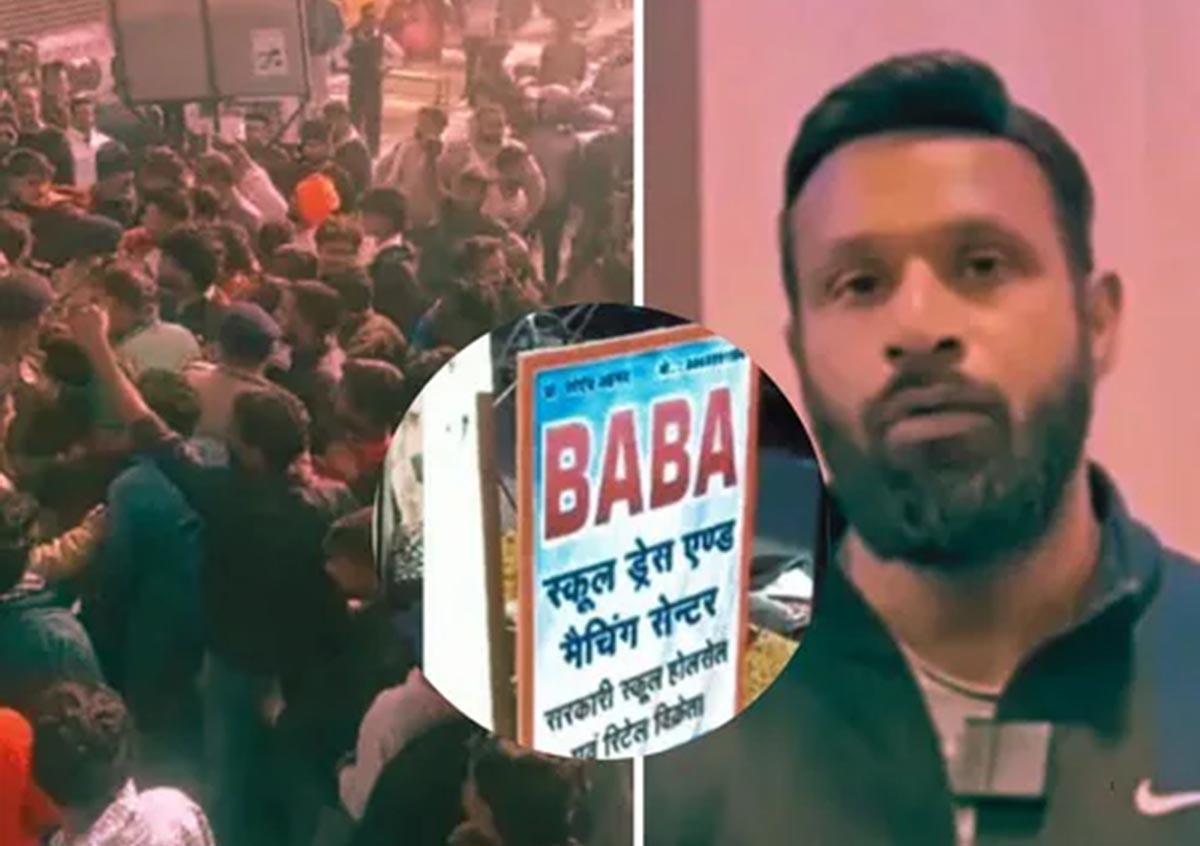
What began as a brief, spontaneous intervention by a local gym owner on Republic Day in Uttarakhand’s Kotdwar has since unravelled into a complex law-and-order and civil liberties crisis, exposing deep fault lines in the state’s response to communal intimidation.
On January 26, 2026, Deepak Kumar stepped in when a group of men, allegedly affiliated with the Bajrang Dal and the Vishva Hindu Parishad, confronted 70-year-old Muslim shopkeeper Vakeel Ahmed over the use of the word “Baba” in the name of his decades-old shop. Within days, the episode spiralled far beyond the narrow dispute at its origin — triggering multiple FIRs, large-scale mobilisation by right-wing groups, a blockade of a national highway, and the registration of criminal cases not only against alleged intimidators and protestors, but also against those who intervened to defend the elderly shopkeeper.
Extensively reported by national media, the Kotdwar incident has now emerged as a test case for how the state polices communal vigilantism, protects freedom of expression and conscience, and balances claims of law and order against the constitutional obligation to safeguard equality before the law. As investigations continue and police deployment remains heightened, the episode raises an unsettling question: when ordinary citizens resist religious intimidation, does the legal system shield them — or subject them to prosecution.
The spark: January 26 and the dispute over “Baba”
According to The Indian Express, 46-year-old Deepak Kumar, who runs a gym in Kotdwar, was present at a friend’s shop on January 26 when he overheard a group of men confronting 70-year-old Vakeel Ahmed (also reported as Ahmed Wakil), a Muslim shopkeeper whose store — Baba School Dress — has existed on Patel Marg for nearly 30 years.
The men, allegedly identifying themselves as members of the Bajrang Dal and the Vishva Hindu Parishad (VHP), reportedly objected to Ahmed’s use of the word “Baba” in his shop’s name. They allegedly demanded that the name be changed, claiming the term was exclusive to Hindu religious figures.
When Kumar intervened and asked why an elderly man was being threatened, he was reportedly told not to interfere.
The viral moment: “My name is Mohammad Deepak”
A video of the confrontation — later widely circulated across social media platforms — shows Kumar directly questioning the mob’s logic. He is heard asking why other shops are allowed to use the word “Baba” but Ahmed’s shop is not, and whether a three-decade-old establishment should now be forced to change its identity.
When members of the group ask Kumar his name, he responds: “My name is Mohammad Deepak.”
Speaking later to The Indian Express, Kumar clarified that the statement was deliberate and symbolic. “I intended to convey that I was an Indian and that everyone is equal before the law,” he said.
The phrase quickly went viral, earning praise across social media — but also, according to Kumar, triggering threats against him and his family.
“My Name is Mohammed Deepak”- How this Hindu man stood between a Bajrang Dal-linked mob and ‘Baba’ an elderly Muslim Shopkeeper in Kotdwar, Uttarakhand. The Mob was demanding the shopkeeper change his shop name. Full report @themojostory pic.twitter.com/uXLTh4TJEF
— barkha dutt (@BDUTT) January 31, 2026
The shopkeeper’s complaint and the first FIR
Following the January 26 incident, Vakeel Ahmed filed a police complaint, stating that three to four men claiming to be Bajrang Dal members had entered his shop, threatened him, and warned of “serious consequences” if he did not change the shop’s name.
Based on this complaint, police registered an FIR at Kotdwar police station under multiple provisions of the Bharatiya Nyaya Sanhita (BNS), including:
- Section 115(2) – voluntarily causing hurt
- Section 333 – house-trespass after preparation for hurt, assault or wrongful restraint
- Section 351(2) – criminal intimidation
- Section 352 – intentional insult with intent to provoke breach of public peace
The FIR names two individuals and includes unnamed persons, as per The Hindu.
Mobilisation and backlash: Protests against Deepak Kumar
While the initial confrontation ended on January 26, the situation escalated sharply days later.
On January 31, intelligence inputs indicated that people were assembling to confront Kumar at his gym and near Ahmed’s shop. According to a complaint later filed by Sub-Inspector Vinod Kumar, around 30–40 people, arriving in 12–15 vehicles, gathered in Kotdwar.
Many were reportedly from Dehradun and Haridwar and identified themselves as members of the Bajrang Dal, according to Hindustan Times.
Highway blockade, sloganeering, and police confrontation
As per the FIR registered on the sub-inspector’s complaint, the group:
- Raised slogans near Kumar’s gym
- Obstructed police personnel deployed at a barrier
- Removed police barricades
- Parked vehicles across the road, creating a traffic jam
- Blocked the National Highway for nearly an hour, affecting civilian traffic and ambulances
- Marched toward Kotdwar market and Baba School Dress, raising religious slogans and using abusive language
Deepak stood up against the Bajrang Dal activists in Uttarakhand who were harassing a muslim shopkeeper-
His house is now being attacked by Bajrang Dal members.
This is total GundaGardi.
Police must protect him.pic.twitter.com/tRZyaEy7Qz
— Arpit Sharma (@iArpitSpeaks) January 31, 2026
After being dispersed once, the group regrouped near Malviya Udyan, in front of the Municipal Council on the National Highway, where they again sat on the road and blocked traffic. The FIR records that the actions created “fear and panic” among passers-by and were aimed at disturbing communal harmony. Based on these events, according to IE, police registered an FIR against unknown persons under sections relating to:
- Unlawful assembly
- Obstruction of public servants
- Breach of peace
- Promoting enmity between groups
A parallel FIR — this time against the interveners
In a development that drew widespread criticism, Uttarakhand Police also registered an FIR against Deepak Kumar and Vijay Rawat, another local resident who had supported Ahmed on January 26.
According to The Hindu, this FIR was filed following complaints by Gaurav Kashyap, reportedly a VHP member, and Kamal Pal, identified as a Bajrang Dal member.
The complainants alleged that Kumar and Rawat:
- Assaulted them
- Snatched money, watches, and mobile phones
- Hurled caste-based slurs
- Acted as part of a violent mob
The police booked Kumar and Rawat on charges including criminal intimidation, voluntarily causing hurt, rioting, and breach of peace.
Superintendent of Police Sarvesh Panwar told The Hindu that the complainants claimed to have been conducting a “door-to-door outreach initiative” at the time of the incident.
Deepak Kumar’s response: “Why am I booked, not the harassers?”
Kumar has denied the allegations and questioned the police’s approach. Speaking to the media, he said that his life and his family’s safety were under threat and asked why action had been taken against him while those accused of harassing a 70-year-old shopkeeper remained at large.
In a subsequent Instagram video, Kumar said: “I am not Hindu, not Muslim, not Sikh, not Christian. First and foremost, I am a human being… No one should be targeted for their religion.”
He added that while hatred spreads easily, standing up for love and humanity requires courage.
Deepak Kumar, the man who confronted right wing groups harassing a Muslim shopkeeper, is getting death threats. The local administration in Kotdwar town of Uttarakhand is hands in glove with the mob, says Deepak https://t.co/bch32S1JBP pic.twitter.com/6xYbL7yKHh
— Piyush Rai (@Benarasiyaa) February 1, 2026
Police position: “Law and order first”
Addressing the controversy, SSP Sarvesh Panwar stated that all FIRs were registered to prevent escalation and maintain law and order. He confirmed that police personnel were present during the protests and had directly witnessed the blockade and sloganeering.
Police said:
- Video footage is being examined to identify participants
- Statements of all involved parties are being recorded
- Additional forces have been deployed in Kotdwar following intelligence inputs about possible fresh mobilisation
A senior officer quoted by The Hindu said investigations would proceed strictly on legal grounds and that “no one found guilty will be spared.”
Political and civil society reaction
The FIR against Kumar and Rawat triggered sharp criticism from civil rights activists, lawyers, and social media users, many of whom argued that the state appeared to be penalising those who intervened against intimidation rather than those who initiated it.
Congress leader and Leader of the Opposition Rahul Gandhi publicly backed Kumar, calling him a “living symbol of love in the marketplace of hate.” In a post on X, Gandhi accused the Sangh Parivar of deliberately fostering division and alleged that the Uttarakhand government was siding with “anti-social forces.”
“We need more Deepaks — those who do not bow, who do not fear, and who stand firmly with the Constitution,” Gandhi wrote.
उत्तराखंड के दीपक भारत के हीरो हैं।
दीपक संविधान और इंसानियत के लिए लड़ रहे हैं – उस संविधान के लिए जिसे BJP और संघ परिवार रोज़ रौंदने की साज़िश कर रहे हैं।
वे नफ़रत के बाज़ार में मोहब्बत की दुकान का जीवित प्रतीक हैं और यही बात सत्ता को सबसे ज़्यादा चुभती है।
संघ परिवार… pic.twitter.com/c1D4VHV5XO
— Rahul Gandhi (@RahulGandhi) February 1, 2026
Senior Congress leader Suryakant Dhasmana said that the Kotdwar incident, along with other recent communal and targeted attacks in Uttarakhand, had seriously damaged the state’s social fabric.
An unresolved moment
As of now, three separate FIRs remain under investigation:
- The shopkeeper’s complaint against alleged Bajrang Dal members
- The police FIR against unidentified protestors for highway blockade and disorder
- The FIR against Deepak Kumar and Vijay Rawat based on right-wing complaints
Police deployment remains heightened in Kotdwar, and authorities have appealed for calm while warning against the spread of unverified information online. What began as a neighbourhood dispute over a shop name has now become a test case for how the state responds when ordinary citizens intervene against communal intimidation — and whether standing up for constitutional equality comes at a legal cost.
Related:
From Purola to Nainital: APCR report details pattern of communal violence in Uttarakhand
Uttarakhand High Court slams police and authority for failure in maintain law and order
‘Eid Gift’: Uttarakhand CM Dhami Renames17 Places With Muslim-Sounding Names
7-year-old Muslim boy allegedly assaulted by teachers in Uttarakhand’s govt school, FIR registered